
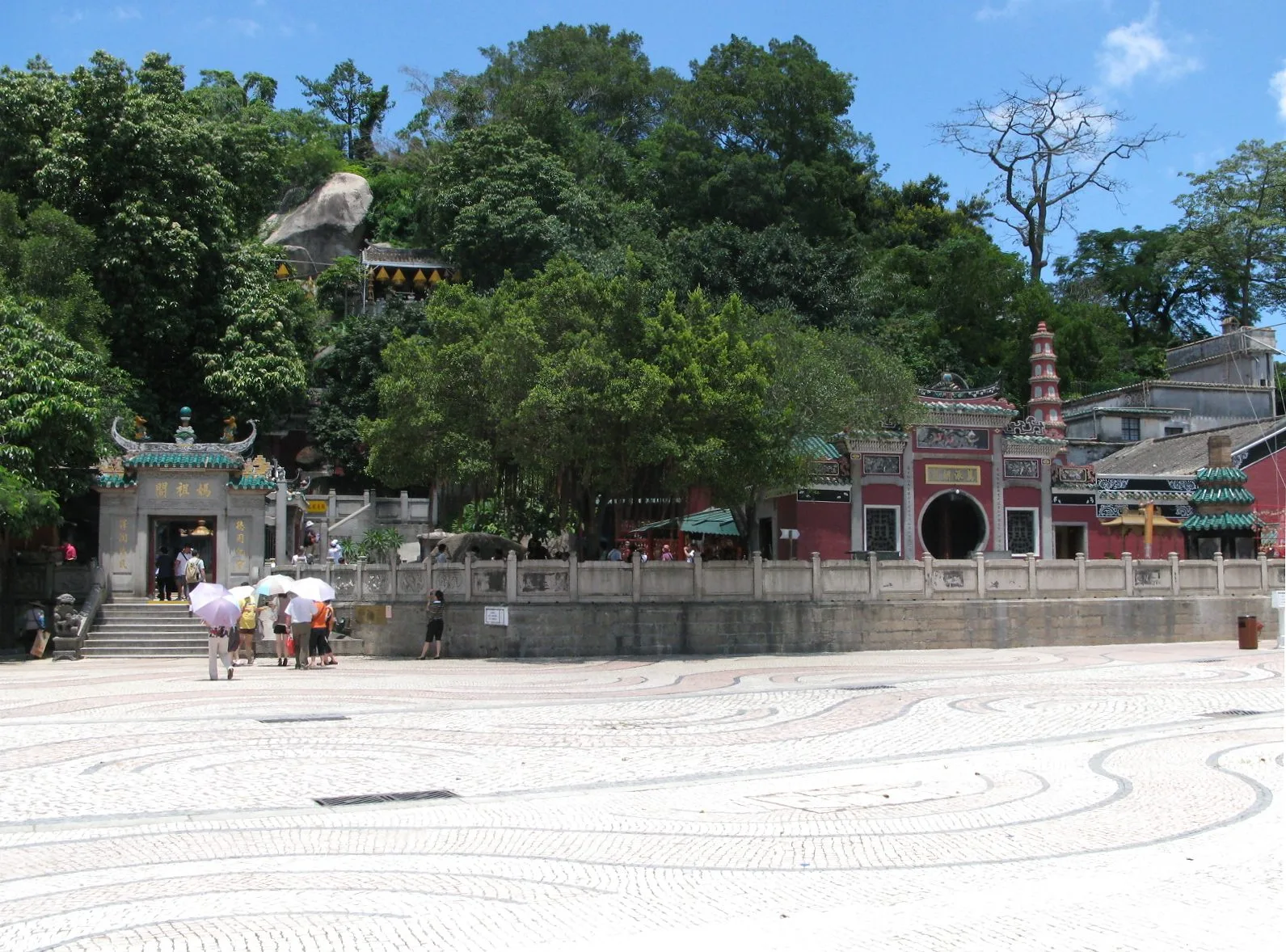
A-Ma Temple
妈阁庙 · Māgé Miào
Quick answer
No passport, no ticket. Foreigners are welcome to enter, walk around, and observe the prayer ceremonies. Photography is allowed (no flash at the altars). For a respectful visit: remove hats, lower your voice, do not point at the deities, and do not step on the thresholds of the prayer halls.
Why visit
- 1 Stand in Macau's oldest temple — built in 1488, over 30 years before the Portuguese arrived in 1557
- 2 Trace the origin of the name 'Macau' — Portuguese sailors asked the name of the peninsula and the locals said 'Māgé' (the temple's name), which the Portuguese heard as 'Macau'
- 3 Climb to the cliffside pavilion built into the rock — the best view of the Inner Harbour and the Guia Lighthouse on the hill opposite
- 4 Light a joss stick at the altar of Tian Hou / 媽祖 (Mazu), the sea goddess worshipped by every fisherman and sailor in southern China
Essential tips for foreigners
- Visit at sunrise (7:00-8:00) for the most atmospheric experience — the morning mist over the Inner Harbour, the giant incense coils just being lit, the soft light on the stone carvings. Almost no tourists, mostly elderly locals doing their morning prayers.
- The temple is built on a slope, with the entrance at the bottom and the highest pavilion up a series of stone steps carved into the rock. Visit from the bottom (entrance) and work your way up — the prayer halls are in order from oldest to newest.
- Don't photograph the altars directly without asking — flash photography is forbidden in the prayer halls, and pointing a camera at the deity statues is considered disrespectful. The exterior of the temple, the hanging incense coils, and the cliffside pavilion are all fine to photograph.
- Bring small change for the donation boxes — a MOP$10-20 note at each prayer hall is the local custom. Larger donations (MOP$100+) are welcome at the main altar if you have a specific prayer request.
- After your visit, walk 5 min up the hill to Penha Church (主教山小堂) — a 17th-century Catholic church on a hilltop with the best view of the Inner Harbour, the A-Ma Temple waterfront, and the Guia Lighthouse. Free, open 9:00-17:00.
Suggested route
- 07:00 15 min Arrive at the temple at sunrise. Enter through the main gate (entrance hall) and light incense at the main altar. Take 5 min to observe the morning prayer ceremony
- 07:15 20 min Walk up the stone steps carved into the rock, passing through the four prayer halls in order. Each hall has a different deity and different centuries of carving
- 07:35 10 min Reach the cliffside pavilion (the highest point of the temple) — panoramic view of the Inner Harbour, Guia Lighthouse on the opposite hill, the Macau peninsula
- 07:45 15 min Descend the steps to the waterfront plaza. Sit on a stone bench and watch the fishing boats and the morning light on the harbour. Vendors sell incense and offerings if you want to buy
- 08:00 1 hour Walk 5 min up the hill to Penha Church (主教山小堂) — a 17th-century Catholic church with the best view of the temple and the harbour
- 09:00 10 min + walking Walk back down to the temple, then along the waterfront Rua de São Tiago da Barra to the Barra district. 10-min walk. Optional: take bus 1, 2, or 5 back to Senado Square
A-Ma Temple (妈阁庙, Māgé Miào, lit. “the A-Ma temple”) is the oldest temple in Macau, built in 1488 — over 60 years before the Portuguese arrived in 1557. The temple is dedicated to Mazu (媽祖, the sea goddess worshipped by every fisherman and sailor in southern China) and is built into a cliff on the western waterfront of the Macau peninsula, overlooking the Inner Harbour.
The temple is also the source of the name “Macau” itself. When Portuguese sailors landed at the peninsula in 1557, they asked the locals the name of the place. The locals pointed to the temple and said “Māgé” — the Cantonese name of the temple and its sea goddess. The Portuguese heard this as “Macau” (or “Macao”) and the name stuck. The temple thus predates the Portuguese arrival by 69 years.
The temple is a UNESCO World Heritage site (inscribed 2005 as part of the Historic Centre of Macau). It is one of the most authentic places in Macau — used continuously by the same community for over 500 years, free to enter, no tickets, and the morning prayer ceremonies are still attended by elderly locals.
The four prayer halls
The temple is built on a slope, with the entrance at the bottom (the Hall of the Mountain / 弘仁殿) and the highest pavilion at the top. The four prayer halls are in order from oldest to newest:
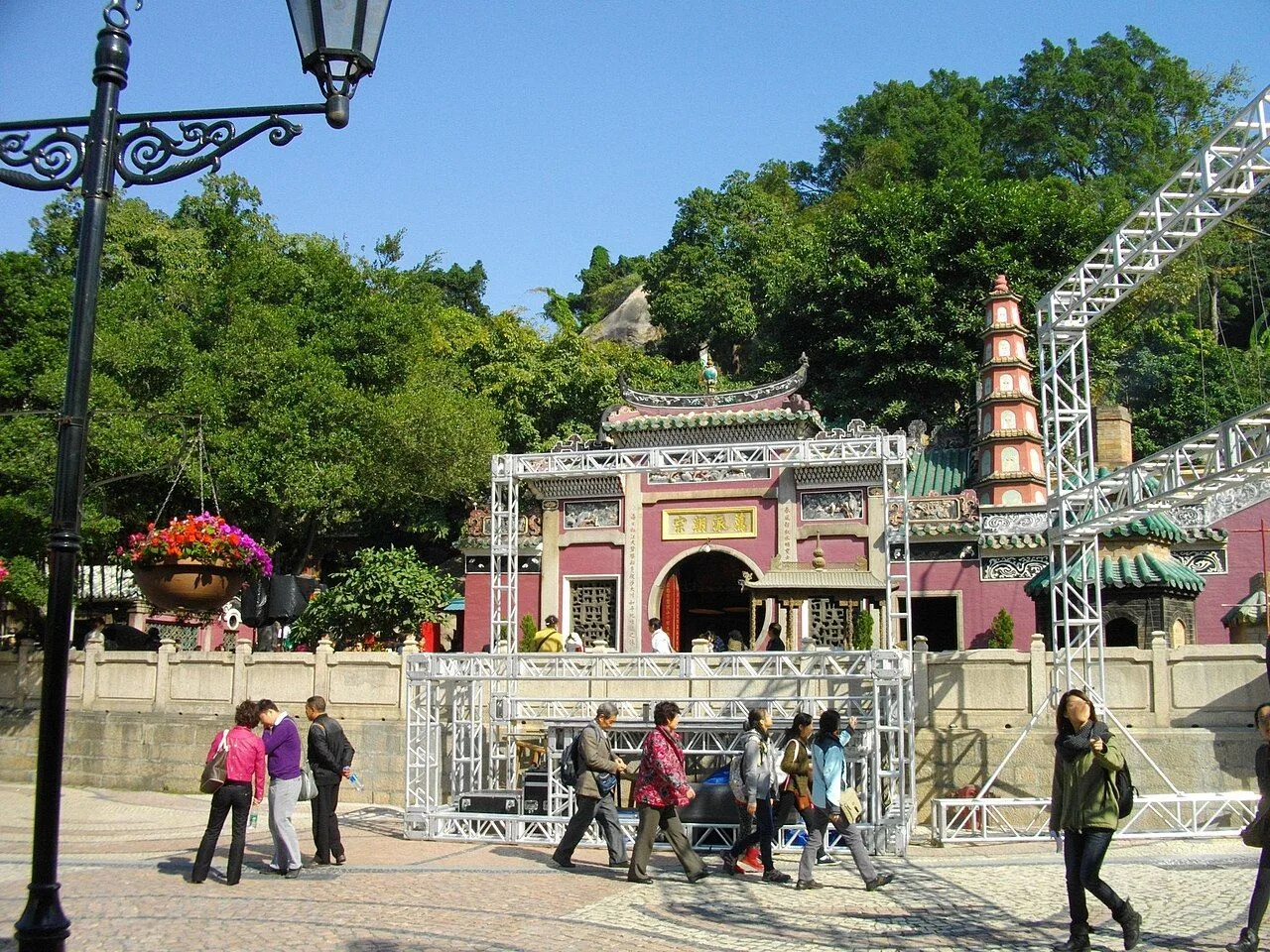
Photo: Wikimedia Commons / CC BY-SA. Source
_01.JPG)
The Hall of the Mountain (弘仁殿) is the entrance hall, built in 1488. The carved stone guardian figures on either side of the door date from the Ming dynasty. The main altar is dedicated to Mazu (the sea goddess) and Guan Yu (the God of War, also venerated by the business community).
The Hall of the Holy Sail (正觉禅林) is the second hall, built in the 16th century. The name refers to the legend that Mazu appeared to a sailor in a vision, calming a storm at sea. The hall is dedicated to Mazu and to the God of the South Sea.
The Hall of the Goddess (天后殿) is the main hall, built in the 17th century during the Qing dynasty. The giant hanging incense coils burn continuously, filling the hall with smoke that diffuses the light into a warm glow. The main altar holds the Mazu statue and offerings from fishermen and sailors.
The Pavilion of the Buddha (观音殿) is the highest point, built in the 18th century. It is built into the cliff face and offers the best view of the Inner Harbour and the Guia Lighthouse on the opposite hill.
The morning prayer
The most atmospheric time to visit is 7:00-9:00 in the morning, when the temple is filled with elderly local residents doing their morning prayers. The giant incense coils are just being lit, the morning mist is over the harbour, and the soft side-light catches the carved stone figures. Almost no tourists — this is a real, working temple, not a museum.
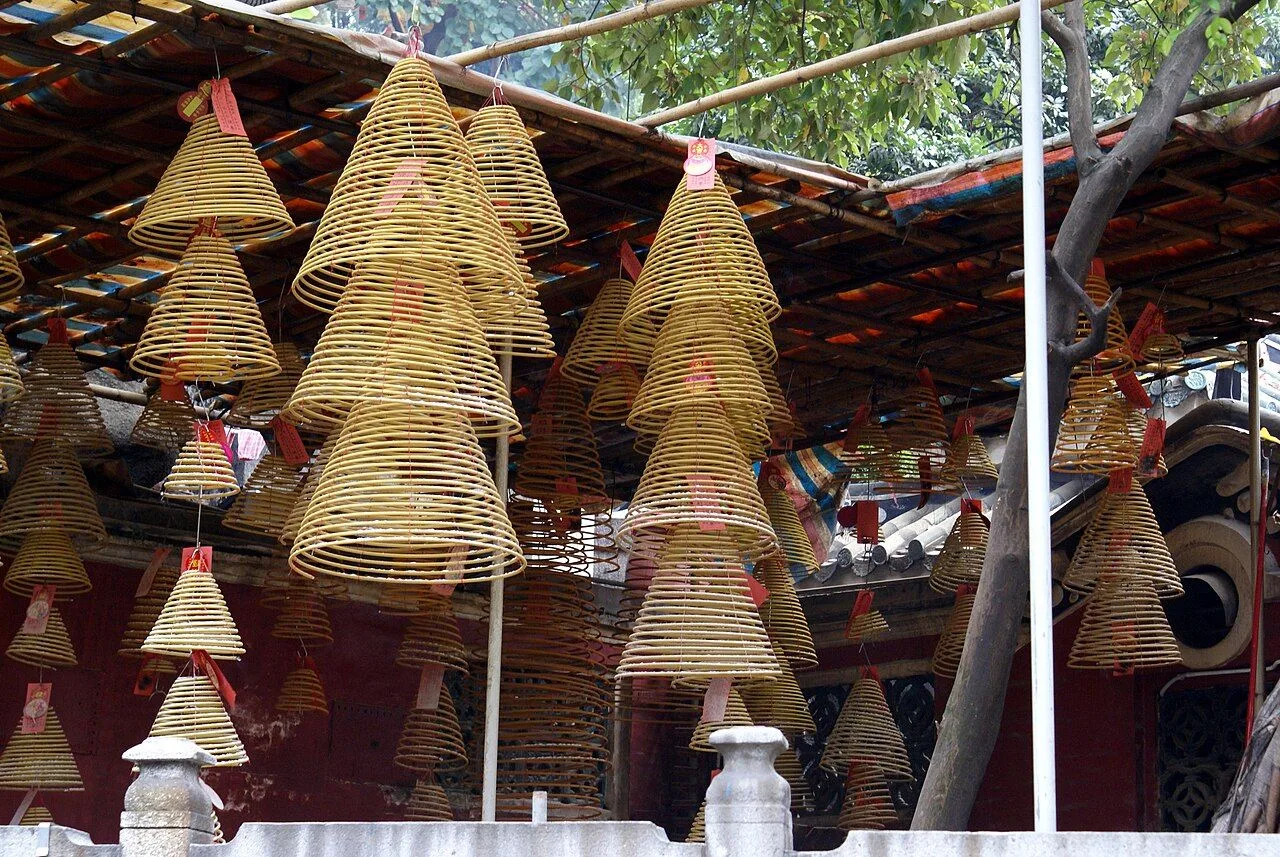
Photo: Wikimedia Commons / CC BY-SA. Source

Bring a small donation (MOP$10-20) if you want to leave an offering at the altars. Incense and joss paper are available from vendors on Rua de São Tiago da Barra outside the temple (MOP$20-50 for a bundle).
How to pair the visit
A-Ma Temple pairs naturally with the rest of the Historic Centre UNESCO walk: Senado Square (10-min taxi), Ruins of St. Paul’s (15-min walk), Penha Church (5-min walk uphill, free, great view). The classic 1-day Historic Centre walk: A-Ma Temple → Penha Church → Ruins of St. Paul’s → Mount Fortress → Senado Square → Holy House of Mercy → Lou Kau Mansion. Allow 4-6 hours at a relaxed pace, with breaks for coffee and Macanese snacks.
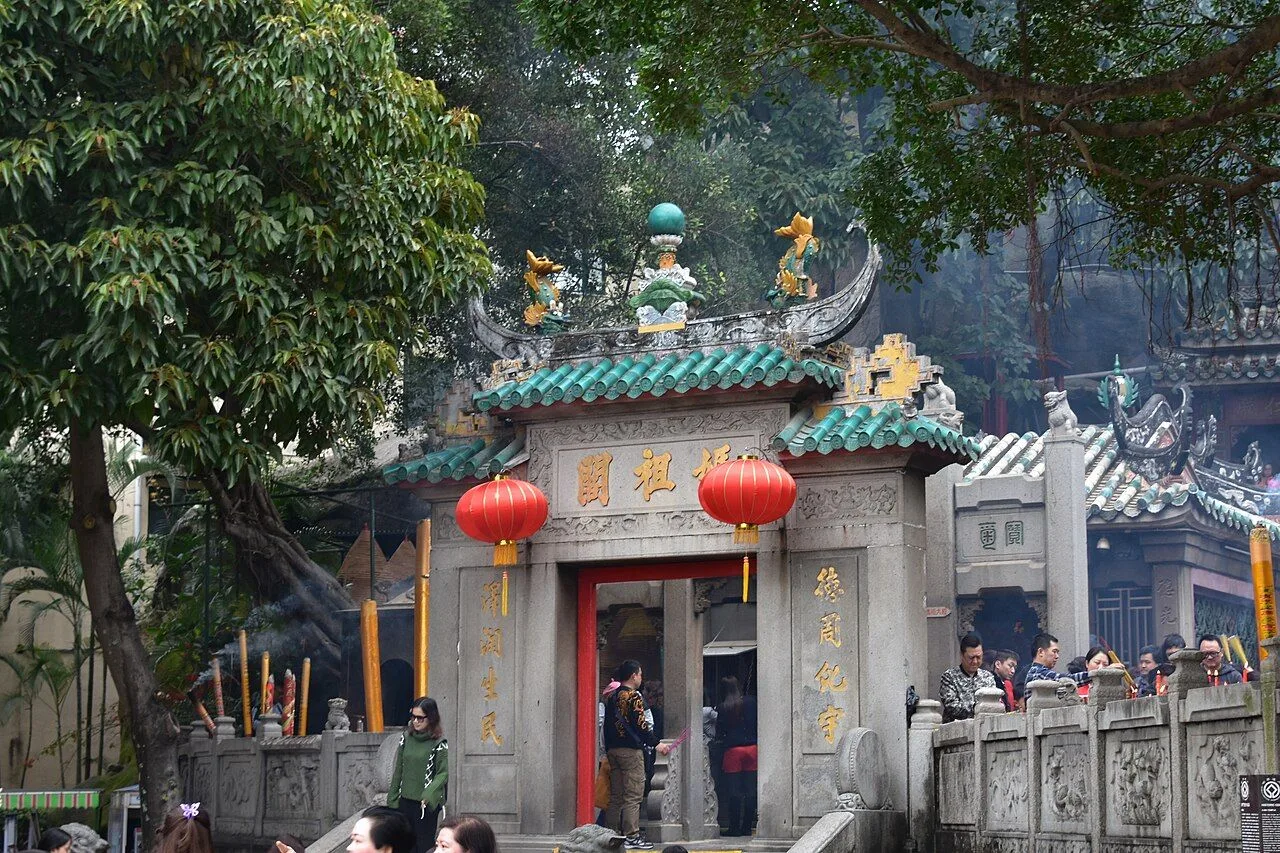
Photo: Wikimedia Commons / CC BY-SA. Source
,_built_1488_(3)_-_32858244395.webp)
Best photo spots
-
The entrance gate, looking up at the carved stone figures and hanging incense coils · Morning 7:00-9:00 (warm side-light, mist over the harbour, no crowds)
The most-photographed view of the temple. The stone gateway with carved Taoist guardian figures, the red Chinese lanterns, and the giant hanging incense coils framed against the sky. Use a 24-50mm lens.
-
The main prayer hall, looking up at the ceiling of incense coils · Mid-morning 9:00-11:00 (better light, the coils are fully lit)
Inside the main hall, the giant hanging incense coils create a cathedral-like ceiling. The smoke from the burning incense diffuses the light into a warm glow. Use a 24mm wide-angle; a fast lens (f/1.8-2.8) is helpful in the low light.
-
The cliffside pavilion, looking out over the Inner Harbour and Guia Lighthouse · Anytime, but golden hour 18:00-19:00 is best for the harbour light
The most peaceful spot in the temple. The view over the Inner Harbour with the Guia Lighthouse on the opposite hill is one of the most-photographed views in Macau. Use a 50-85mm lens for a tighter composition.
-
The waterfront plaza in front of the temple, looking up at the entrance gate · Sunrise (around 6:30-7:30, year-round)
A wider view that includes the harbour, the temple facade, and the Guia Lighthouse on the hill. Best at sunrise when the light is soft and the mist is over the water.
Where to eat nearby
-
Restaurante Litoral (九如坊葡国菜) — Rua do Almirante Sérgio
Macanese (African chicken / galinha à africana, pork chop bun, tamarind prawns) · MOP$200-400/person · 5-min walk from the temple, on the way to the Barra district
-
Tai Lei Loi Kei (大利来记) — Rua de São Roque
Macanese (pork chop bun, pork congee, milk tea) · MOP$50-100/person · 10-min walk from the temple, in the Praia do Manduco area
-
O Manel (老地方) — Rua de São Tiago da Barra
Portuguese (clams, cod, grilled sardines, Portuguese wine) · MOP$150-300/person · On the same street as the temple entrance, 2-min walk
-
Chong Kee (莊記) — Rua dos Mercadores
Macanese street food (African chicken takeaway, pork chop bun) · MOP$30-60/person · 5-min walk from the temple, near the Praia do Manduco
Frequently asked questions
How much does it cost to visit A-Ma Temple?
Free. No ticket, no reservation, no entry fee for any nationality. The temple has been continuously in use since 1488. Donation boxes at the altars accept small notes (MOP$10-20) if you want to leave an offering.
Is A-Ma Temple the origin of the name Macau?
Yes. According to the legend, when Portuguese sailors landed at the peninsula in 1557, they asked the locals the name of the place. The locals pointed to A-Ma Temple and said 'Māgé' (the temple's name in Cantonese). The Portuguese heard this as 'Macau' (or 'Macao'). The temple predates the Portuguese arrival by 69 years — built in 1488, well before European contact.
What is the difference between A-Ma Temple and the A-Ma Festival?
The temple is the physical building — a 1488 Taoist temple on the Inner Harbour waterfront in Macau. The A-Ma Festival (天后诞) is the annual celebration of the sea goddess Mazu (Tian Hou), held on the 23rd day of the 3rd lunar month (usually March or April). During the festival, the temple hosts Cantonese opera performances, dragon dances, and incense offerings; thousands of pilgrims visit from mainland China, Taiwan, and Southeast Asia. The temple itself is also worth visiting outside the festival.
Is A-Ma Temple wheelchair accessible?
Partially. The entrance hall (Hall of the Mountain / 弘仁殿) is flat and accessible. The other three prayer halls are up stone steps carved into the rock, with no elevator or ramp. For an accessible visit, the entrance hall and the waterfront plaza in front of the temple are flat and offer good views of the temple facade.
What is the religion of A-Ma Temple?
Taoist with strong folk-religion influences. The main deity is Mazu (媽祖), the sea goddess worshipped by fishermen, sailors, and anyone who travels by water in southern China. The temple also venerates Guanyin (觀音, the Goddess of Mercy), the City God (城隍), and the Jade Emperor (玉皇大帝). The four prayer halls are dedicated to different deities and built in different centuries.