
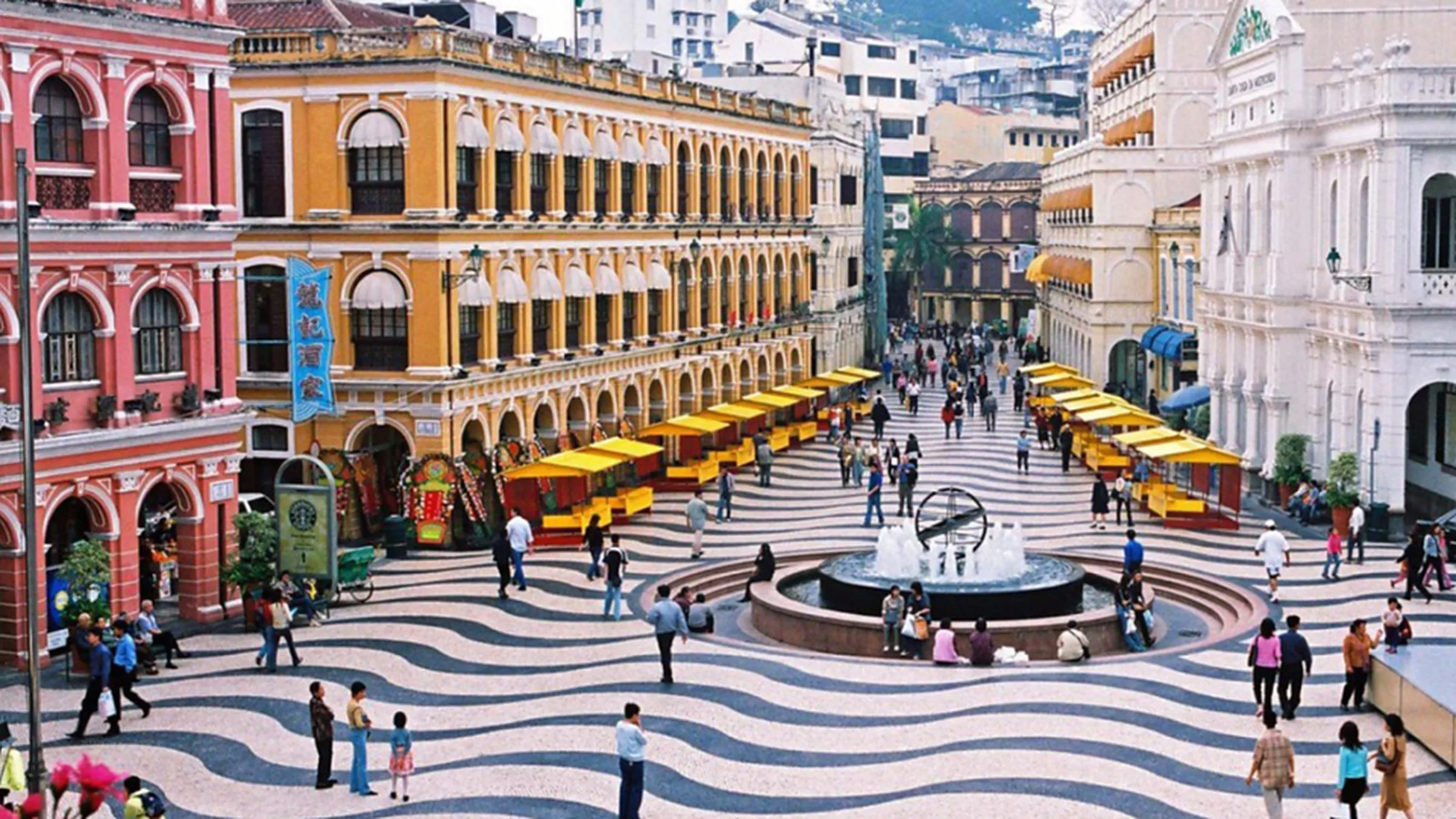
Senado Square
议事亭前地 · Yìshìtíng Qián Dì
Quick answer
No passport, no ticket. Foreigners are welcome to enter, walk around, and take photos. All signage in the Historic Centre is in English, Portuguese, and Chinese. Photography is allowed; the buildings are best photographed in the morning or at golden hour.
Why visit
- 1 Walk on the iconic wavy black-and-white cobblestone pavement (Calçada portuguesa) — a Portuguese paving tradition that uses small cut stones in geometric patterns
- 2 Stand at the heart of the UNESCO Historic Centre (inscribed 2005), the only UNESCO site in China that includes European colonial buildings alongside Chinese temples
- 3 Photograph the pastel colonial buildings (yellow, pink, green, ochre) — the most-photographed streetscape in Macau
- 4 Walk the UNESCO Historic Centre walk (2-3 hours, free) — Senado Square → Holy House of Mercy → Cathedral of São Paulo → St. Dominic's Church → Lou Kau Mansion → Sir Robert Ho Tung Library → Ruins of St. Paul's
Essential tips for foreigners
- Visit in the morning (9:00-11:00) — the soft light catches the pastel buildings beautifully, the tour buses haven't arrived, and the local elderly are doing their morning walks. Afternoon is crowded and harsh-light.
- Walk the UNESCO Historic Centre walk from Senado Square — the square is the heart of the 2-3 hour walk. The walk is free, all buildings are free or MOP$10 (Lou Kau Mansion, free Sundays), and you cover 20+ UNESCO-listed buildings on foot.
- Try a Macanese snack while you're there — Choi Heong Yuen Bakery (鉅記餅家) for almond cookies and pork jerky; Pastelaria Koi Kei for egg tarts and mango pudding; Cheung Heung Yuen for beef jerky. All within 5 min of the square.
- Don't confuse Senado Square with Praça do Centro — Senado Square is the wavy-cobblestone pedestrian square with the Holy House of Mercy. Praça do Centro is a different plaza near the Post Office.
- Free MGTO guided tour every Saturday at 10:00 — the Macao Government Tourism Office runs a free 2-hour English-language tour of the Historic Centre starting from Senado Square. Book via the MGTO website 1 week ahead.
Suggested route
- 09:00 30 min Start at Senado Square. Walk on the wavy cobblestone pavement. Photograph the pastel colonial buildings (yellow, pink, green, ochre) with the soft morning light
- 09:30 1 hour Visit the Holy House of Mercy (1569). Free museum, 16th-19th century religious art, the original building plans, the UNESCO inscription plaque
- 10:30 1 hour Walk along the Avenida de Almeida Ribeiro to the Cathedral of São Paulo (different from the Ruins). The original 17th-century Catholic cathedral is still in use; free entry
- 11:30 1 hour Walk to St. Dominic's Church (玫瑰聖母堂 / Igreja de São Domingos). A 17th-century Catholic church with a beautiful Baroque interior and an attached Museum of Sacred Art
- 12:30 1.5 hours Lunch at a Portuguese restaurant in the Historic Centre: try Restaurante O Santos (公雞葡國餐廳) for pork chop sandwich, duck rice, bacalhau, sardines. Budget MOP$200-400 per person
- 14:00 1 hour Walk to the Lou Kau Mansion (卢家大屋). A 19th-century Cantonese-Portuguese mansion with intricate stone and wood carvings. MOP$10 (free Sundays)
- 15:00 1 hour Walk through the narrow streets of the Historic Centre (Calçada do Gaio, Rua dos Mercadores) — 30 min of UNESCO-listed architecture. Detour into the Sir Robert Ho Tung Library, a 19th-century colonial mansion turned library
- 16:00 2 hours Walk up Calçada de São Paulo (大三巴街) to the Ruins of St. Paul's. 5-min walk with souvenir shops. Visit the facade, the Crypt beneath the steps, and Mount Fortress
- 18:00 30 min Golden hour at the Ruins of St. Paul's steps. The 17th-century bronze figures catch the warm light. Most tour groups have left
- 18:30 1.5 hours Walk back to Senado Square for dinner. Try a Macanese restaurant: African chicken (galinha à africana) at Restaurante Litoral, or Portuguese at Restaurante O Santos. Budget MOP$200-400 per person
- 20:00 30 min Walk back to the Ruins of St. Paul's for night photography. The facade is dramatically lit after 21:00
Senado Square (Largo do Senado / 议事亭前地) is the heart of the UNESCO Historic Centre of Macau. The 14th-century pedestrian plaza is paved with the iconic wavy black-and-white Calçada portuguesa (Portuguese cobblestone), surrounded by pastel colonial buildings in yellow, pink, green, and ochre. The square has been the centre of Macau’s civic life since the 16th century, when the Portuguese used it as the seat of the municipal council (the “Senado” or “Senate”).
The square is free to enter 24/7 and is the starting point for the 2-3 hour UNESCO Historic Centre walk — the most popular walking tour in Macau. The walk covers 20+ UNESCO-listed buildings: Senado Square → Holy House of Mercy → Cathedral of São Paulo → St. Dominic’s Church → Lou Kau Mansion → Sir Robert Ho Tung Library → Ruins of St. Paul’s → Mount Fortress. All buildings on the walk are free or MOP$10 (Lou Kau Mansion, free on Sundays).
The square was pedestrianized in the 1990s as part of the UNESCO inscription preparation. The wavy black-and-white cobblestone pavement was restored in 1997 to the original 19th-century design, using hand-cut basalt (black) and limestone (white) set in sand. The same design is found throughout the former Portuguese empire (Lisbon, Rio de Janeiro, São Paulo, Goa), but the Senado Square version is one of the largest and most-photographed.
The UNESCO Historic Centre
The Historic Centre of Macau was inscribed as a UNESCO World Heritage site in 2005. It was the first UNESCO site in China to include European colonial buildings alongside Chinese temples — a unique architectural and cultural hybrid that emerged from 442 years of Portuguese colonial rule (1557-1999).
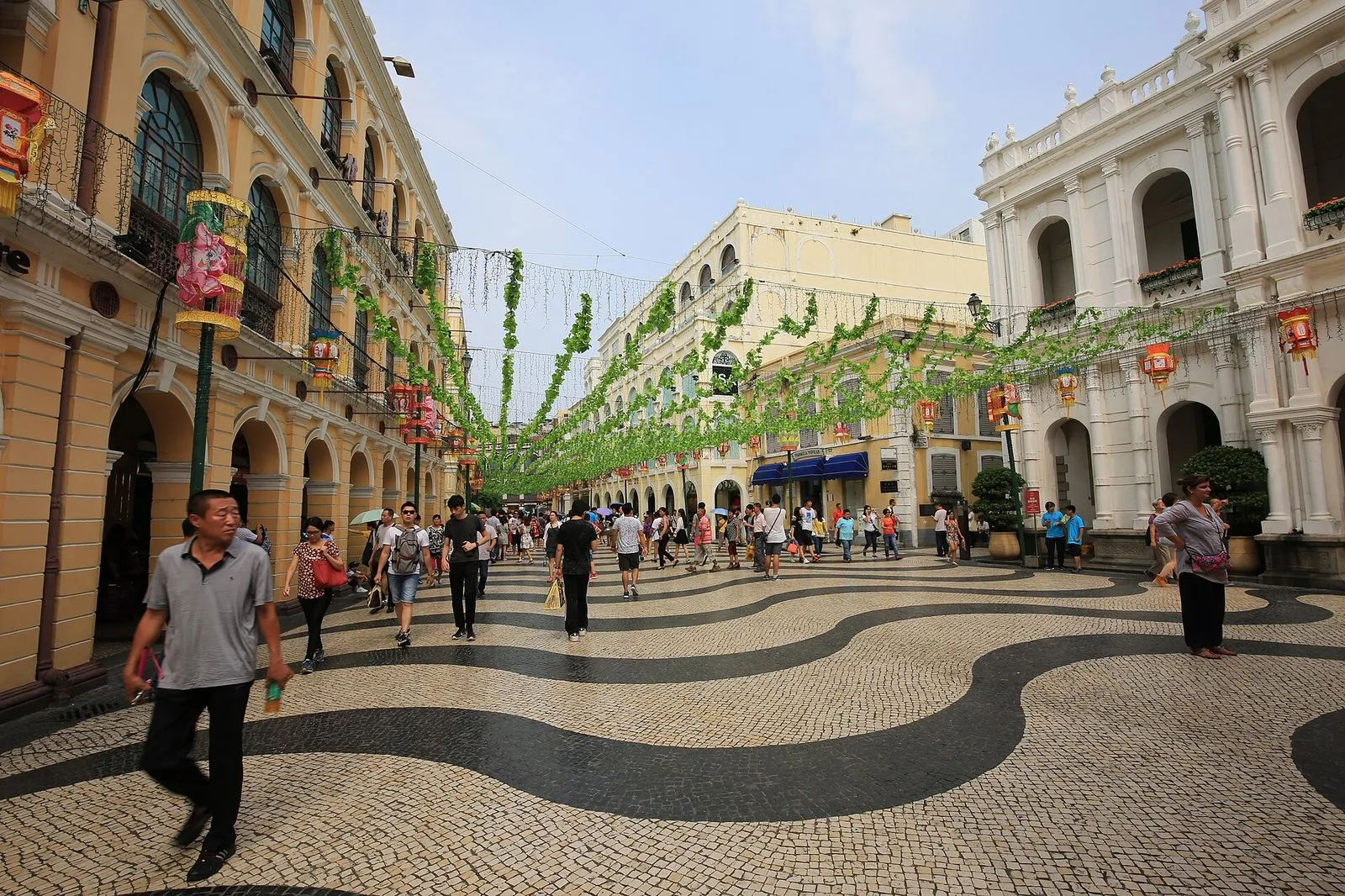
Photo: Wikimedia Commons / CC BY-SA. Source

The 25+ monuments covered by the UNESCO inscription include: the Ruins of St. Paul’s (the 17th-century stone facade of a 1580 Jesuit cathedral), A-Ma Temple (the 1488 Taoist temple that gave Macau its name), the Holy House of Mercy (the oldest Western charity in Asia, 1569), the Cathedral of São Paulo, St. Dominic’s Church, the Dom Pedro V Theatre (the first Western-style theatre in China, 1860), the Mandarin’s House (a 19th-century Chinese scholar’s mansion), the Protestant Cemetery, and Mount Fortress.
The walk from Senado Square to the Ruins of St. Paul’s (5 min up Calçada de São Paulo) is the heart of the historic centre. Most visitors take 2-3 hours for the full walk; allow 4-6 hours if you include A-Ma Temple and Penha Church.
The Holy House of Mercy
The Holy House of Mercy (Santa Casa da Misericórdia, 仁慈堂) is a 1569 Portuguese colonial building on the west side of Senado Square. It is the oldest Western charity institution in Asia, founded by the first Bishop of Macau to provide medical care, social services, and burial to the poor regardless of nationality or religion.
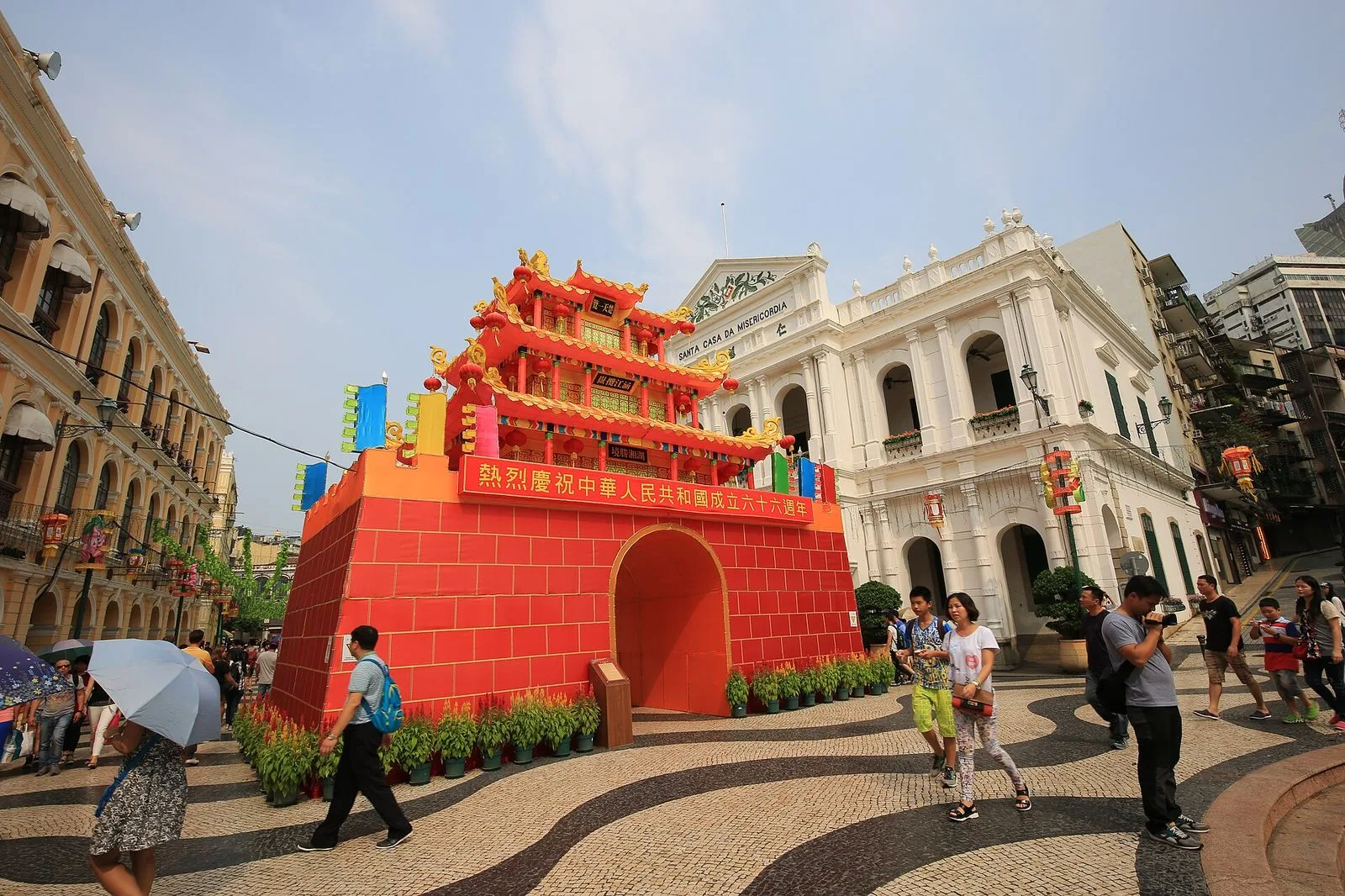
Photo: Wikimedia Commons / CC BY-SA. Source

The building has been continuously in use since 1569. Today it houses a free museum with 16th-19th century religious art (paintings, sculptures, silverware), the original building plans, and the UNESCO inscription plaque. The neoclassical facade (with a central pediment and Doric columns) was added in the 19th century. The Holy House of Mercy is one of the most-photographed colonial facades in Macau.
Best time to visit
The most atmospheric time to visit is 9:00-11:00 in the morning. The soft side-light catches the pastel buildings beautifully, the tour buses haven’t arrived, and the local elderly are doing their morning walks (the square is a popular meeting place for the local Macanese community). Afternoon is crowded with tour groups; the harsh light flattens the pastel colours.
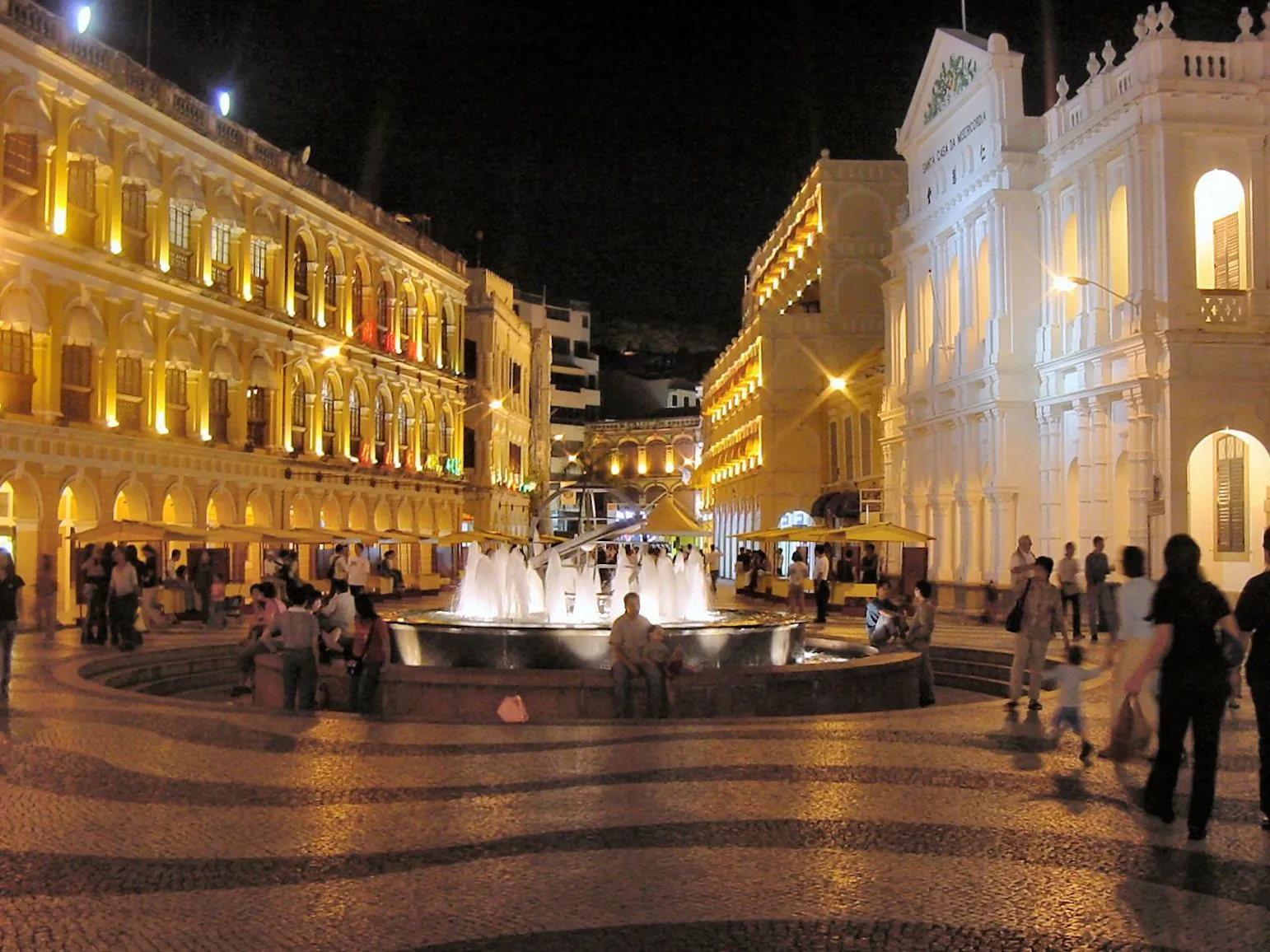
Photo: Wikimedia Commons / CC BY-SA. Source

For night photography, the square is well-lit by the surrounding buildings. The wavy cobblestone pavement reflects the warm light, and most of the tour groups have left by 21:00. The night atmosphere is very different from the day — quieter, more atmospheric, and the pastel buildings take on a warmer tone.
How to pair the visit
Senado Square is the starting point for the classic 2-day Macau itinerary. Day 1: Historic Centre (Senado Square + Holy House of Mercy + Lou Kau Mansion + Ruins of St. Paul’s + Mount Fortress + A-Ma Temple + Penha Church — all free, 4-6 hours on foot). Day 2: Cotai Strip (The Venetian Macao + The Parisian Macao + City of Dreams + Taipa Village — free to walk, 3-4 hours). The contrast is the whole point: 450 years of Portuguese colonial history + 21st-century Las Vegas-scale casinos, in 33 km².
If you only have 1 day from Hong Kong, the highlights are doable in 12 hours. Take the early ferry (8:00-9:00), spend the morning in the Historic Centre (8:00-12:00), lunch in Taipa Village (12:00-13:00), afternoon in the Cotai Strip (13:00-18:00), and return ferry (19:00-22:00).
Best photo spots
-
The wavy cobblestone pavement, looking up at the Holy House of Mercy facade · Morning 9:00-11:00 (soft light on the pastel buildings, no crowds)
The most-photographed spot in the Historic Centre. Frame the wavy black-and-white cobblestone in the foreground, the Holy House of Mercy's neoclassical facade in the background. Use a 24-35mm lens; a polarising filter enhances the contrast between the black basalt and white limestone.
-
The north end of the square, looking south at the pastel buildings · Morning or late afternoon (the soft light catches the pastel colours best)
A wider view that includes the wavy cobblestone and the full sweep of pastel buildings on both sides. Use a 24mm wide-angle.
-
Calçada de São Paulo, looking up at the souvenir shops and the cobblestone street · Afternoon 14:00-16:00 (the bright red and yellow shop signs frame the cobblestone street)
The classic approach to the Ruins of St. Paul's. The bright red and yellow souvenir shops framing the cobblestone street make a vivid contrast with the grey stone and pastel buildings. Use a 35mm lens.
-
The Holy House of Mercy facade, looking up at the neoclassical details · Morning 9:00-11:00
The neoclassical facade of the Holy House of Mercy is one of the most-photographed colonial facades in Macau. The carved stone details, the central pediment, and the surrounding pastel buildings make a perfect composition. Use a 50mm lens for a tighter composition.
Where to eat nearby
-
Restaurante O Santos (公雞葡國餐廳) — Rua de São Paulo
Portuguese (pork chop sandwich, duck rice, bacalhau, sardines) · MOP$150-300/person · 5-min walk from Senado Square, on the way up to the Ruins of St. Paul's
-
Choi Heong Yuen Bakery (鉅記餅家) — multiple branches in Senado area
Macanese bakery (almond cookies, peanut candy, pork jerky, egg rolls) · MOP$30-100/person · 5-min walk from the square, branches on Avenida de Almeida Ribeiro
-
Pastelaria Koi Kei (鉅記餅家) — Senado Square branch
Macanese bakery (almond cookies, jerky, egg tarts, mango pudding) · MOP$30-80/person · On the square, in the north-west corner
-
Restaurante Litoral (九如坊葡國菜) — Rua do Almirante Sérgio
Macanese (African chicken / galinha à africana, pork chop bun, tamarind prawns) · MOP$200-400/person · 10-min walk from Senado Square, on the way to A-Ma Temple
Frequently asked questions
How much does it cost to visit Senado Square?
Free. The outdoor square is free 24/7, no ticket, no reservation. The Holy House of Mercy (next to the square) is free, the Holy House of Mercy Museum is free, the surrounding streets are free. The only paid building on the UNESCO walk is the Lou Kau Mansion (MOP$10, free on Sundays). Most visitors spend 0 MOP on the walk.
Why is the cobblestone pavement wavy?
The wavy black-and-white cobblestone pattern is Calçada portuguesa (Portuguese pavement), a 19th-century paving tradition that uses small hand-cut stones arranged in geometric patterns. The wavy pattern is the most common; the Senado Square version is one of the largest and most-photographed Calçada portuguesa pavements in the world. The stones are hand-cut basalt (black) and limestone (white), set in sand, and designed to last 100+ years. The current pavement was restored in the 1990s for the UNESCO inscription.
Is Senado Square pedestrian-only?
Yes, the square itself is pedestrian-only. The surrounding streets (Avenida de Almeida Ribeiro, Rua de São Paulo, Calçada do Gaio) are also pedestrianized during the day (some allow emergency vehicles and delivery). The most convenient access is by bus or taxi; parking is limited to the surrounding streets.
What's the best route from Senado Square to the Ruins of St. Paul's?
5-min walk up Calçada de São Paulo (大三巴街) — the cobblestone street lined with souvenir shops. The walk is the heart of the UNESCO Historic Centre. Allow 10 min if you stop to look at the souvenir shops (almond cookies, jerky, egg tarts, Macanese snacks). The walk is uphill but gentle.
What's the difference between Senado Square and the Holy House of Mercy?
Senado Square is the public pedestrian plaza (the wavy cobblestone). The Holy House of Mercy (Santa Casa da Misericórdia, 仁慈堂) is a 1569 Portuguese colonial building on the west side of the square, the oldest Western charity institution in Asia. It now houses a free museum with 16th-19th century religious art, the original building plans, and the UNESCO inscription plaque. Together they form the heart of the Historic Centre.
Can I see Senado Square as a day trip from Hong Kong?
Yes. The classic 1-day Macau itinerary: ferry from HK Macau Ferry Terminal to Macau Outer Harbour Ferry Terminal (1 hour, HK$200-300), free shuttle to Senado Square (or taxi MOP$70-100), 4-6 hours in the Historic Centre (Senado Square, Holy House of Mercy, Cathedral of São Paulo, St. Dominic's Church, Lou Kau Mansion, Ruins of St. Paul's, Mount Fortress, A-Ma Temple, Penha Church), return ferry to Hong Kong. The walking is moderate (5-10 km total) and the cost is HK$200-300 plus MOP$100-300 for food and entry fees.