
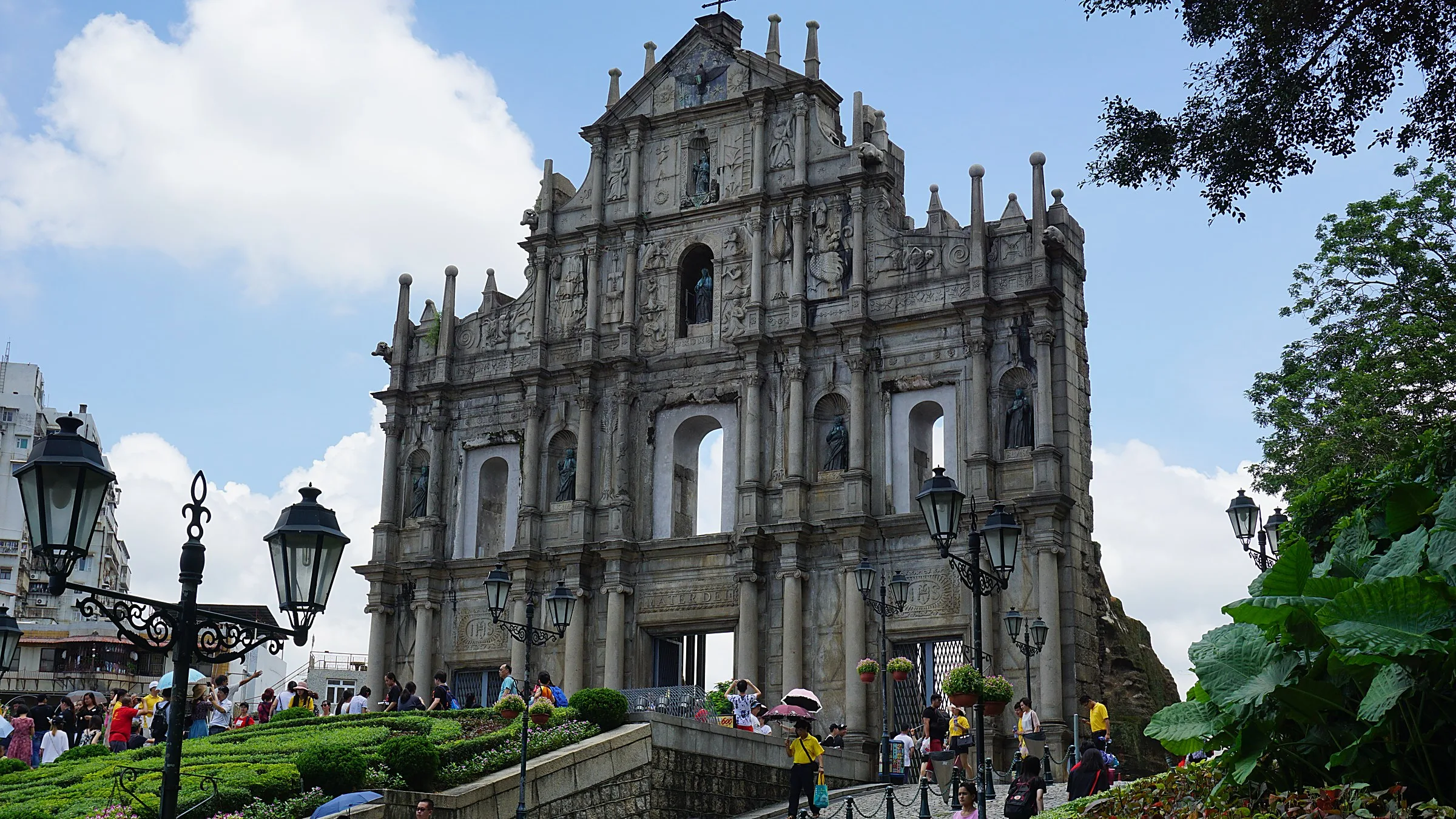
Ruins of St. Paul's
大三巴牌坊 · Dàsānbā Páifāng
Quick answer
No passport required, no ticket, no reservation. The ruins are an open public space. The on-site Crypt and Museum of Sacred Art are also free. The site is one of the most foreigner-friendly in Macau — all signage is in English, Portuguese, and Chinese.
Why visit
- 1 Stand in front of the only surviving facade of a 16th-century Jesuit cathedral — the original 1580 church and its 1640 rebuilt version both burned (the second time during a typhoon in 1835), leaving only the carved stone and bronze front wall
- 2 Examine 5 tiers of biblical carvings, including Jesuit saints carved by Japanese Christian exiles in 1620-1640, each panel more intricate than the last
- 3 Free 24/7 — the most accessible major UNESCO site in Macau; visit at golden hour (18:00-19:00) when the bronze figures catch the warm light
- 4 Walk to the underground Crypt (地下天主圣堂) — the excavated burial chamber of 16th-17th century Japanese and Vietnamese Christian martyrs, free to enter
Essential tips for foreigners
- Visit at golden hour (about 18:00-19:00, year-round). The 17th-century bronze figures on the facade catch the warm side-light and the steps are less crowded. After 21:00 the facade is dramatically lit and tour groups are gone.
- Don't skip the Crypt / 地下天主圣堂 — the small underground chamber beneath the steps holds the remains of Japanese and Vietnamese Catholic martyrs from the 16th-17th century and a reproduction of a Vatican crypt. Free, climate-controlled, very moving. Hours 9:00-18:00.
- The 68 stone steps in front are a meeting point — locals say 'meet you at the steps' (大三巴) the way New Yorkers say 'meet at the Met steps'. The steps are the main orientation landmark in the Historic Centre.
- Skip the unlicensed tour guides at the steps — they offer 'history tours' for MOP$100-200, often citing incorrect facts (the cathedral was not destroyed by the Japanese, etc.). For accurate history, take the free MGTO guided tour (Saturday 10:00, English, 2 hours) starting here.
- Free Wi-Fi from MGTO is available at the steps — the network is 'MGTO-Free-WiFi' with no password. Useful for map and translation.
Suggested route
- 09:00 30 min Start at Senado Square (議事亭前地) — 14th-century Portuguese-paved plaza. Walk the wavy black-and-white cobblestones, see the pastel colonial buildings and the Holy House of Mercy (free)
- 09:30 5 min Walk up Calçada de São Paulo (大三巴街) to the Ruins of St. Paul's — 5 min walk with souvenir shops on both sides
- 09:35 30 min Photograph the facade from the bottom of the 68 steps. Read the bronze panels — 5 tiers of biblical scenes, Jesuit saints, and Japanese Christian carvings
- 10:05 45 min Descend the steps to the underground Crypt (地下天主圣堂) and Museum of Sacred Art (聖母珍寶閣). The Crypt holds Japanese and Vietnamese martyrs' remains; the Museum has 17th-century Catholic art
- 10:50 1.5 hours Walk across the small plaza to Mount Fortress (大炮台 / Fortaleza do Monte). MOP$15 entry (free on Sundays). 17th-century cannons, panoramic views of the peninsula, the Macau Museum inside
- 12:30 15 min + 1.5 hours at temple Walk down from Mount Fortress to A-Ma Temple (妈阁庙) via the Barra district. 15 min walk through the oldest streets of Macau. Or take a taxi (MOP$50-70)
- 14:00 1.5 hours Lunch in the Praia do Manduco / Barra waterfront area: try the Macanese African chicken at Restaurante Litoral (MOP$200/person) or the pork chop bun at Tai Lei Loi Kei (MOP$50)
- 15:30 1.5 hours Walk back to Senado Square along Calçada do Gaio (the UNESCO cobblestone walk) — 30 min. Detour into the Sir Robert Ho Tung Library, the Lou Kau Mansion (MOP$10, free Sundays), and the Holy House of Mercy (free)
- 17:00 1 hour Return to Senado Square for sunset. Most souvenir shops close at 18:00-19:00. For sunset photos, walk back up to the Ruins of St. Paul's steps for the golden-hour light
- 18:00 1.5 hours Dinner in the historic centre: try a Portuguese restaurant (Restaurante Fernando on Coloane is famous, or stay in the centre at O Castiço / Restaurante O Santos). Or Macanese at Restaurante Litoral. Budget MOP$200-400 per person
- 19:30 30 min Walk back to the Ruins of St. Paul's to photograph the lit facade — much less crowded after 21:00. The facade is lit until 23:00
The Ruins of St. Paul’s (大三巴牌坊, Dàsānbā Páifāng, lit. “the big three slabs facade”) are the remains of the facade of the Cathedral of São Paulo, the largest Jesuit church in Asia in the 16th-17th centuries. The original church was built in 1580 by the Society of Jesus as part of the College of São Paulo (the first Western university in East Asia, predating Harvard). A fire destroyed it in 1595; the rebuilt version was completed in 1640, larger and more elaborate. That version was destroyed by a typhoon-caused fire in 1835 — and only the carved stone and bronze facade survived.
The five tiers of biblical carvings on the facade are some of the most detailed Christian stone carving in Asia. They depict (from bottom to top): a Jesuit monogram, a bronze frieze of the Virgin Mary and angels, the Society of Jesus emblem, the inscription of the Mother of God (MATER DEI), the Japanese Christian martyrs (a unique inclusion reflecting the Japanese Christian diaspora of the 1620s), and at the top a dove representing the Holy Spirit. The bronze figures were cast in Japan by Japanese Christian exiles — the same community that produced the famous 17th-century “hidden Christian” art in Nagasaki.
The Crypt beneath the steps was rediscovered in the 1990s during stabilisation work on the facade. It holds the remains of Japanese and Vietnamese Catholic martyrs from the 16th-17th century, including some of the same Japanese Christian community who fled to Macau. The Crypt and the adjacent Museum of Sacred Art are free and open 9:00-18:00.
Why the facade survived
The 1835 typhoon fire destroyed the wooden roof and interior of the church, but the stone and bronze facade — built into the bedrock behind it — survived. The rest of the church’s stones fell into the foundations, which had been designed to support a 3-metre-thick stone wall. When the walls collapsed, the facade tilted forward 30cm but did not fall. Engineers added a steel support structure in 1990-1995 to stabilise the tilt.
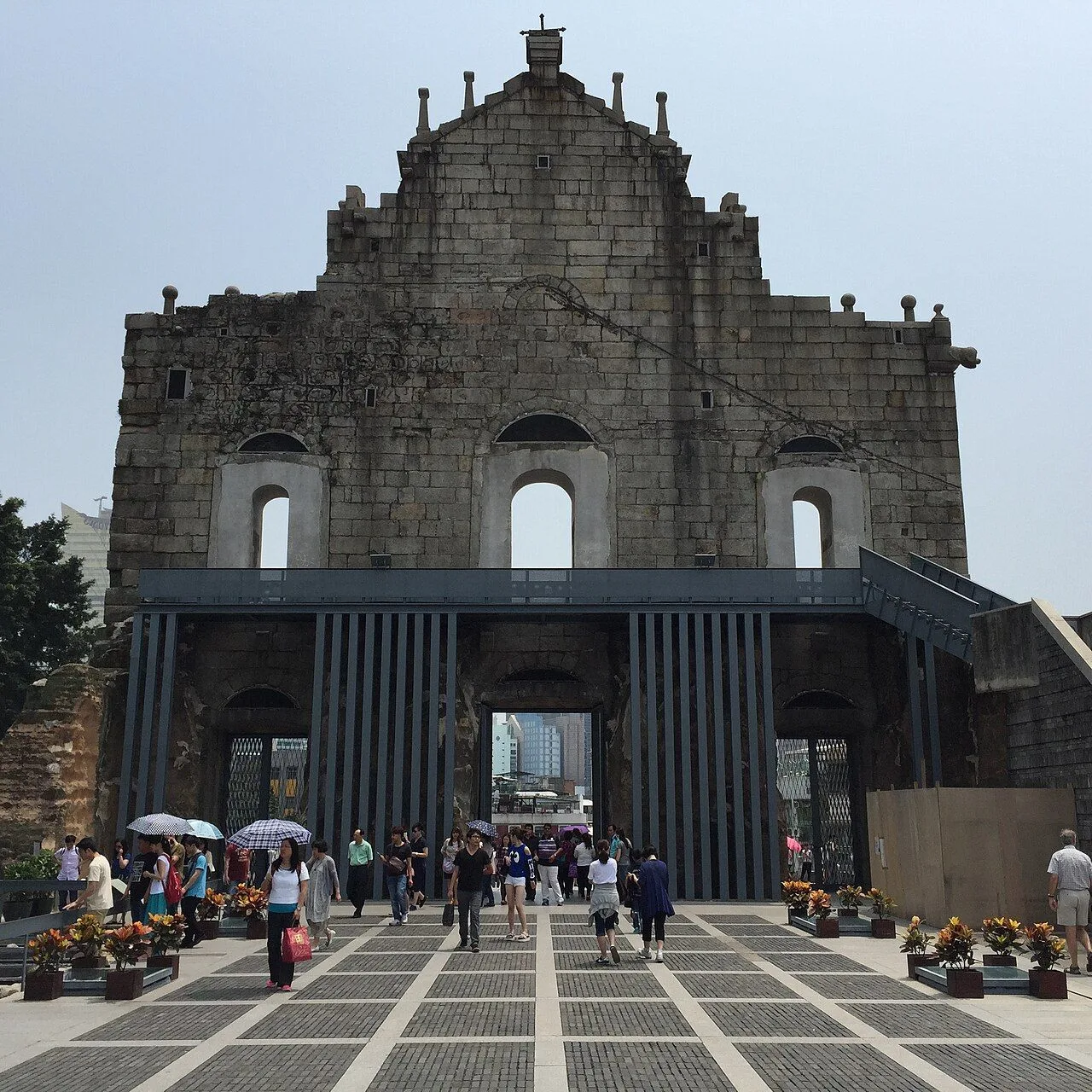
Photo: Wikimedia Commons / CC BY-SA. Source
,_Macau_(%E5%A4%A7%E4%B8%89%E5%B7%B4).jpg)
The facade is Macau’s most-photographed spot for a reason: it is unique. No other building in Asia has the same scale of carved Christian iconography, the same craftsmanship (Japanese-cast bronze, Portuguese-composed stone), or the same dramatic setting (68 stone steps, pastel Portuguese buildings, dramatic hilltop).
The UNESCO context
The Historic Centre of Macau was inscribed as a UNESCO World Heritage site in 2005. It was the first UNESCO site in China to include European colonial buildings alongside Chinese temples. The 25+ monuments covered by the inscription include the Ruins of St. Paul’s, Senado Square, A-Ma Temple, the Holy House of Mercy, the Dom Pedro V Theatre, the Mandarin’s House, and the Protestant Cemetery.
The walk from Senado Square to the Ruins of St. Paul’s (5 min up the cobblestone Calçada de São Paulo) is the heart of the historic centre. Most visitors take 1-2 hours for the ruins + Crypt + Mount Fortress; 3-4 hours for the full walk including Senado Square, the Holy House of Mercy, and the Lou Kau Mansion.
Best photo window
The 17th-century bronze figures on the facade catch the warm golden-hour light at 18:00-19:00 year-round. By 21:00 the crowds have thinned and the facade is artificially lit. The combination of warm light, blue evening sky, and detailed bronze carvings is what makes the ruins one of the most-photographed spots in Asia.
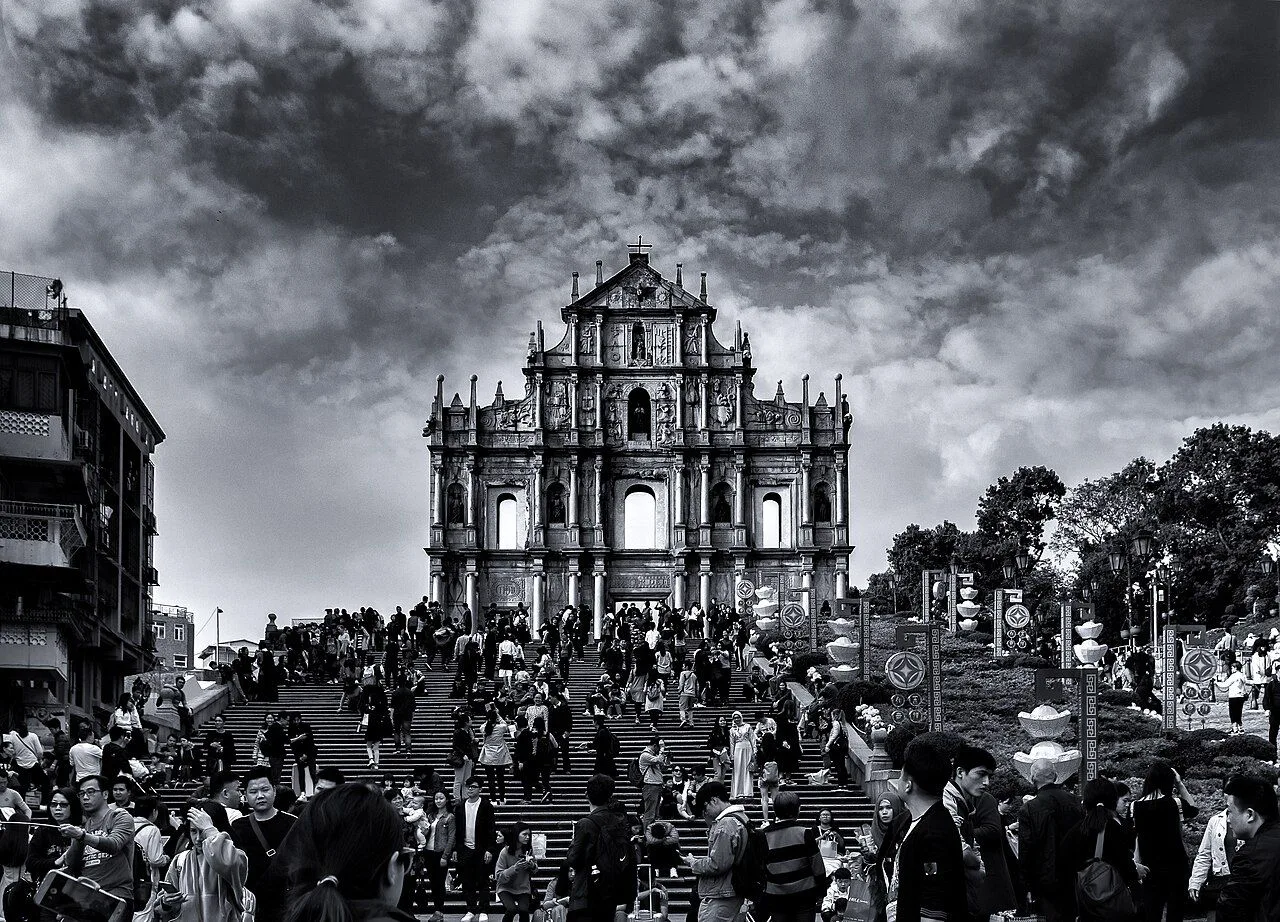
Photo: Wikimedia Commons / CC BY-SA. Source

For a different angle, the Mount Fortress rampart (just across the small plaza) provides the only elevated view of the facade. The fortress is MOP$15 (free Sundays) and the view is worth it.
How to pair the visit
The Ruins of St. Paul’s pair naturally with the rest of the Historic Centre UNESCO walk (Senado Square, A-Ma Temple, Mount Fortress — 1 day on foot). They also pair well with the Cotai Strip (The Venetian Macao, The Parisian Macao — a contrast in scale and modernity, 1 day). The classic 2-day Macau itinerary: 1 day Historic Centre, 1 day Cotai. If you only have 1 day from Hong Kong, the highlights are doable in 12 hours.
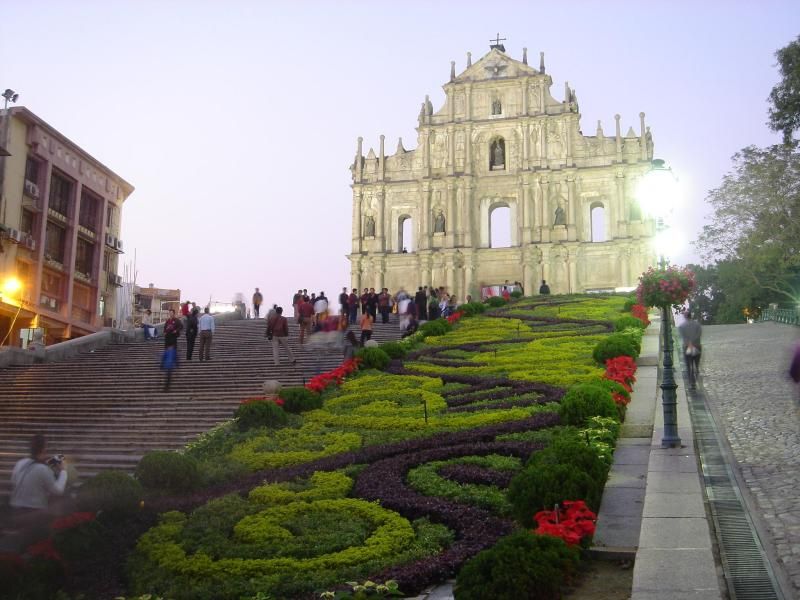
Photo: Wikimedia Commons / CC BY-SA. Source
.jpg)
Best photo spots
-
Bottom of the 68 steps, looking up at the facade · Golden hour 18:00-19:00 (warm side-light on the bronze panels) or after 21:00 (artificial light, no crowds)
The classic Macau photo. Frame the 5 tiers of carved stone and bronze against a blue or sunset sky. Use a wide-angle lens (24mm or wider) to capture the full facade; a 50mm works for tighter detail shots of the bronze panels.
-
Mount Fortress rampart, looking down at the facade · Anytime the fortress is open (9:00-18:00)
The only elevated view of the facade. You can see how the facade's triangular pediment relates to the surrounding plaza and the 68 steps. Great for a different angle that most visitors don't see.
-
Side street (Calçada de São Paulo) looking up at the facade with the souvenir shops in the foreground · Afternoon, 14:00-16:00
A more contextual shot showing the steps and the souvenir-shop-lined approach. The bright red and yellow shops framing the carved stone make a vivid contrast.
-
Inside the Crypt / 地下天主圣堂, looking up at the small dome · Anytime, hours 9:00-18:00
The small underground chamber has a beautiful vaulted ceiling and stained glass — much quieter than the facade above. Photography allowed (no flash).
Where to eat nearby
-
Choi Heong Yuen Bakery (鉅記餅家) — Rua de São Paulo do Canídromo
Macanese bakery (almond cookies, peanut candy, pork jerky, egg rolls) · MOP$30-100/person · On the way up to the ruins, dozens of branches in the area
-
Restaurante O Santos (公雞葡國餐廳) — Rua de São Paulo
Portuguese (pork chop sandwich, duck rice, bacalhau, sardines) · MOP$150-300/person · 3 min walk from the steps, on the same street as the approach
-
Pastelaria Koi Kei (鉅記餅家 / Koi Kei Bakery) — multiple branches in Senado area
Macanese bakery (almond cookies, jerky, egg tarts, mango pudding) · MOP$30-80/person · Senado Square, 5-min walk from the steps
-
Lord Stow's Bakery (安德魯餅店) — original Coloane branch
Portuguese egg tarts (pastéis de nata), bread, coffee · MOP$15-50/person · Original branch is in Coloane Village (30-min bus); Senado Square has a branch (less authentic, more touristy)
Frequently asked questions
How much does it cost to visit the Ruins of St. Paul's?
Free. The outdoor facade is free 24/7 — no ticket, no reservation, no fee for any nationality. The underground Crypt and Museum of Sacred Art (next to the facade) are also free (9:00-18:00 only). The only paid nearby attraction is Mount Fortress (MOP$15, free Sundays).
What is the Ruins of St. Paul's exactly?
The remains of the facade of St. Paul's Church (originally the Cathedral of São Paulo / 大三巴). The original church was built by the Jesuits in 1580, rebuilt in 1602-1640 after a 1595 fire, and burned again during a typhoon in 1835. Only the carved stone and bronze facade survived — the rest of the church fell into the foundations. The Crypt beneath the steps holds the remains of Japanese and Vietnamese Christian martyrs.
When is the best time to photograph the Ruins of St. Paul's?
Two windows. Golden hour (about 18:00-19:00, year-round) gives warm side-light on the bronze figures — best for detail. After 21:00 the facade is artificially lit and tour groups have left — best for clean composition. Mornings (8:00-10:00) have softer light but heavy tour-bus traffic from 9:30.
Is the Ruins of St. Paul's wheelchair accessible?
Partially. The plaza in front of the facade is wheelchair-accessible (smooth pavement, ramps). However, the 68 stone steps in front of the facade are not — the facade is best viewed from the bottom of the steps or from the plaza in front. The Crypt (underground) has stairs down. For a flat, accessible view of the facade, take the elevator at Mount Fortress and view from above.
Why is it called 大三巴 (Da Sanba)?
大三巴 is a Cantonese transliteration of 'São Paulo' (Saint Paul). 大 (da, 'big') 三巴 (sanba, 'São Paulo'). The phrase is the local Chinese name; the official name is 'Ruins of St. Paul's'. You'll see both names on Macau maps and signs.
What's the difference between the Ruins of St. Paul's and St. Dominic's Church?
Different churches. The Ruins of St. Paul's is the facade of the former Cathedral of São Paulo (the largest Jesuit church in Asia, 1580-1835). St. Dominic's Church (玫瑰聖母堂 / Igreja de São Domingos), about 200m northeast, is still an active Catholic church with a beautiful Baroque interior and an attached museum of sacred art. Both are on the same UNESCO walk.