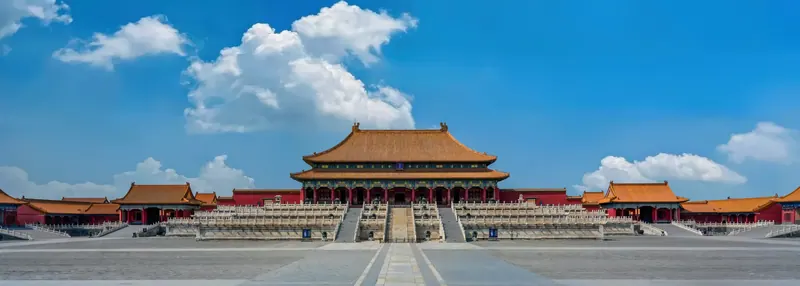
Jiayuguan Fort
嘉峪关关城 · Jiāyùguān Guānchéng
Quick answer
Real-name ticketing: passport number at booking, same passport at the gate. Foreign visitors pay the same ¥110. English signage at the fort is better than at most Gansu sites — the main gate, the barbican and the tower all carry English panels — but the side halls and the Great Wall museum's deeper displays are Chinese-only. The site is exposed: no shade in the fort's outer courtyards, and wind that makes hats a liability.
Why visit
- 1 Stand on the wall at the point where the Ming empire decided the world ended — Jiayuguan was built in 1372 as the western gate of China, and beyond it was administered wilderness
- 2 Get the Overhanging Great Wall, 8 km north-east, where the wall climbs a 45-degree slope and genuinely looks like it is hanging off the mountain — most ticket-holders never go, because they do not know it is included
- 3 Reach the First Beacon Tower on its cliff above the Taolai River gorge, the literal westernmost point of the Ming Great Wall — a glass platform now juts over the canyon where the wall simply stops
- 4 See the fort at dusk, when the Gobi goes orange and the gatehouse throws a shadow long enough to fill the outer courtyard
Essential tips for foreigners
- The ticket covers three sites, and they close at different times. The fort shuts at 18:30; the Overhanging Great Wall and the First Beacon Tower stay open until 20:00. Do the fort first, then the outlying sites — the other order leaves you locked out of the fort.
- Do not buy the satellite sites separately. They are ¥21 each on their own. Your ¥110 fort ticket already includes both, and the ticket window will not always volunteer this.
- Take the inter-site bus or a taxi for the day. The three sites are 8-15 km apart with no useful public transport between them. The景区 direct bus is ¥20 return; a taxi for the loop with waiting is ¥250-350. Walking between them is not a plan.
- Bring water and no hat you care about. The fort's outer courtyards have almost no shade, summer temperatures pass 35°C, and the wind across the Gobi takes hats off heads with some regularity.
- Book the evening light show separately if you want it. 天下嘉峪关 runs 19:30-24:00 with last entry 23:00 and costs ¥128 — it is not included in the ¥110 day ticket, and on holidays it sells out before the day.
- If you are doing the Silk Road by rail, Jiayuguan is a stop, not a base. High-speed trains link it to Dunhuang (about 4 hours) and Lanzhou (about 3 hours). Most travellers do the fort in a morning and move on the same evening.
Suggested route
- 08:30 45 min Leave Jiayuguan city centre by bus 4 or 6, or drive 20 minutes to the fort. Buy the ¥110 ticket at the visitor centre — confirm at the window that it covers all three sites
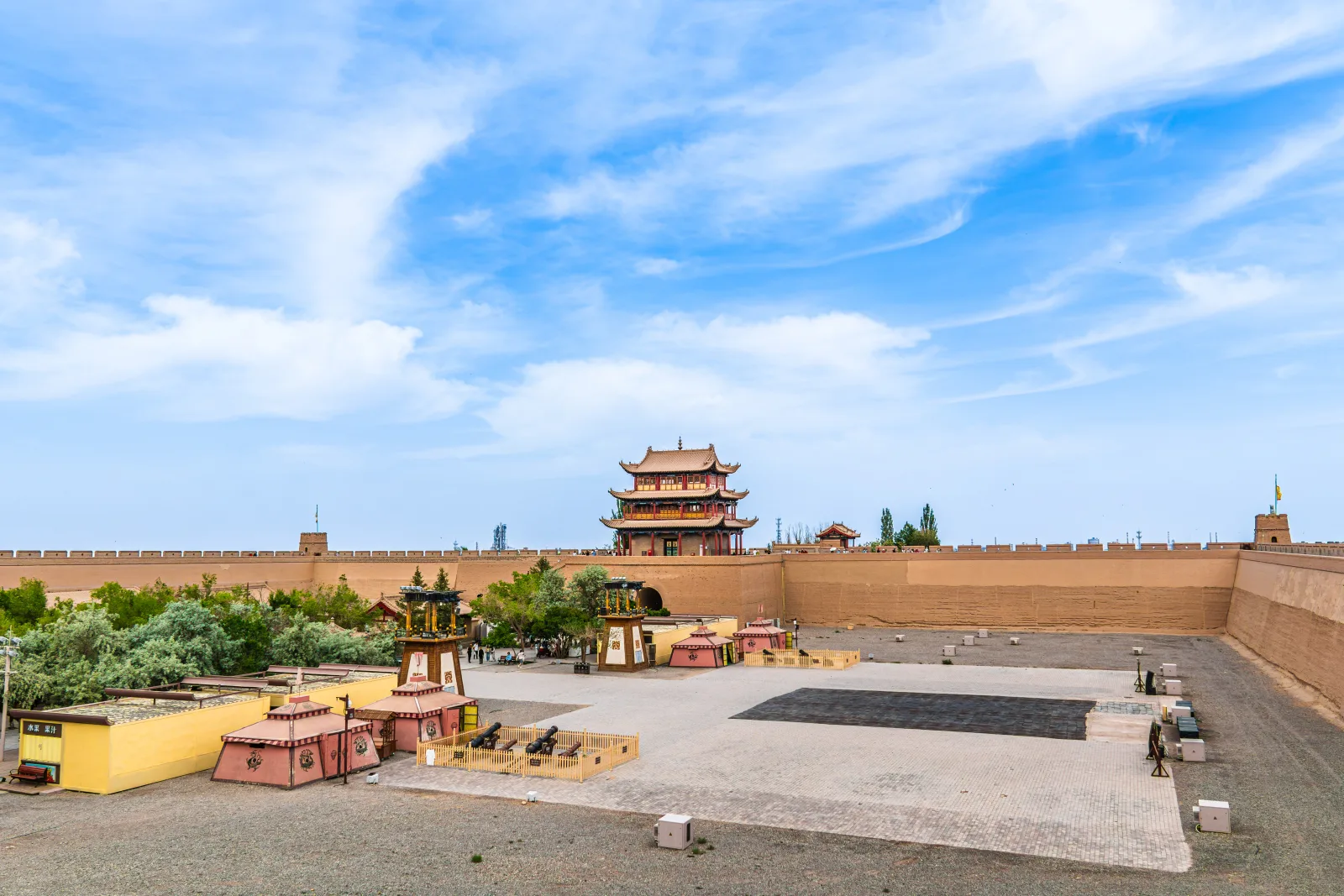
- 09:15 1 hour 30 min Enter through the east barbican and walk the fort's sequence: 东闸门 gate, the barbican courtyard, 文昌阁, 朝宗门, then the 演武场 parade ground. This is the designed approach and it builds
- 10:45 45 min Climb the 嘉峪关楼 gatehouse and walk the wall circuit. From the top you see the corridor, the Qilian range to the south and Black Mountain to the north — the whole reason the fort is here
- 11:30 40 min The Great Wall Museum inside the complex, included in the ticket. Thirty minutes of context makes the two outlying sites legible
- 12:30 1 hour 15 min Lunch in Jiayuguan city — the local speciality is lamb, and the city's night market street does it properly. Allow an hour including the drive back
- 13:45 1 hour Drive or take the inter-site bus to the First Beacon Tower, 7 km south. The glass platform over the Taolai River canyon and the point where the wall physically ends
- 15:15 1 hour 15 min On to the Overhanging Great Wall, 8 km north-east of the fort. Climb it — 45 degrees, 400 m of restored wall on the ridge, and the best panorama of the three sites
- 16:45 1 hour 30 min Return to the fort for the last hour of light on the outer walls, or head back to the city. If you are staying, the evening show starts at 19:30 and needs its own ¥128 ticket
Jiayuguan (嘉峪关) is the western gate of the Ming Great Wall, and it exists because of a piece of geography: at this point the Hexi Corridor narrows to about 15 km between the Qilian mountains to the south and Black Mountain to the north. Every cart, every envoy and every army moving between China and the Tarim Basin passed through that gap. In 1372, the fifth year of the Hongwu emperor’s reign, the Ming built a fort across it.
What survives is the most complete military pass in China — rammed earth and brick, three concentric walled enclosures, a gatehouse you can climb, and a barbican designed so that attackers entering the gate found themselves in a killing courtyard rather than inside the walls. It is a 5A site and the anchor of every Gansu Silk Road itinerary.
The practical thing to understand before you go is that the ticket is not one site. It is three, spread over 15 km, closing at two different times.
Is Jiayuguan worth visiting?
Worth it — but as half a day inside the fort, not as a stop you drive through. The ¥110 ticket covers the most complete military pass in China: rammed earth and brick, three concentric walled enclosures, a gatehouse you can climb, and a barbican designed so that attackers entering the gate found themselves in a killing courtyard rather than inside the walls. Allow 3-4 hours for the fort alone, and 6-7 hours if you add the two satellite sites.
What makes it unusual is the emptiness. The fort stands on the only flat ground wide enough to march an army through, in a gap where the Hexi Corridor narrows to about 15 km between the Qilian mountains to the south and Black Mountain to the north, and from the top of the gatehouse the whole logic of the site becomes visible: the corridor running east-west, the Qilian range along the southern horizon and Black Mountain closing the north. That is the point of the site, and it is also why a quick stop feels like a quick look. The Great Wall Museum inside the complex is included in the ticket and takes 30-40 minutes; do it before the outlying sites rather than after, because the two satellite sites make far more sense with the context.
Is Jiayuguan the end of the Great Wall?
Yes — it is the western end of the Ming wall, and it is where the wall stops in the most literal way possible. Jiayuguan was built in 1372, the fifth year of the Hongwu emperor’s reign, across the narrowest point of the Hexi Corridor — the only practical route between central China and the Tarim Basin — as the empire’s customs post, its frontier garrison and its statement about where China ended, all at once.
The westernmost point of the wall is not the fort itself but the First Beacon Tower (长城第一墩), 7 km south, which sits on a cliff above the Taolai River gorge with a glass platform projecting over the canyon. The wall does not fade out there; it stops, at a drop. Its partner 8 km north-east is the Overhanging Great Wall (悬壁长城), 400 metres of restored wall climbing a 45-degree slope of Black Mountain so steeply that from below it appears to hang rather than stand. Both are on the ¥110 ticket, and most day-trippers see neither.
What is the best time of year to visit Jiayuguan?
May, June, September and October are the sane months, and the reason is heat and cold rather than crowds. July and August regularly exceed 35°C with almost no shade inside the fort’s outer courtyards, which turns a 3-hour visit into an endurance test, and December to February is bitterly cold, with winter nights well below -15°C. Spring can bring sandstorms that shut the outdoor sections of the two satellite sites with little notice.
What makes the choice worth thinking about is that the satellite sites stay open later than the fort and the light changes fast. The fort shuts at 18:30 while the Overhanging Great Wall and the First Beacon Tower stay open until 20:00, so in September and October you can do the fort in the afternoon and still walk out to the ridge sites with the low sun on the Qilian range. In midsummer the order matters for a different reason: get the fort done early, while the outer courtyards are bearable, and keep the long climb to the Overhanging Great Wall for the cooler part of the afternoon.
How much does it cost to visit Jiayuguan Fort?
¥110 full price in peak season and ¥55 concession, and that one ticket covers all three sites — the fort, the Overhanging Great Wall 8 km north-east and the First Beacon Tower 7 km south, each valid for one entry. Buying the two outlying sites separately at ¥21 each is money thrown away, and the ticket window will not always volunteer that they are already on your ticket. Concessions are worth asking about at the window: children aged 6 and under, or 1.2m and under, are free, as are visitors aged 70 and over, and ages 7-18, full-time students up to bachelor level and visitors aged 60-69 pay half.
The extras are where a full day actually costs you. The internal shuttle is ¥20 return or ¥10 one way for the 5.7 km loop inside the scenic area, the direct bus between the three sites is ¥20 return, and the evening light show 天下嘉峪关 — 19:30 to 24:00, with last entry at 23:00 — is a separate ¥128 ticket. A taxi for the full three-site loop with waiting runs ¥250-350 for the day, and on a budget the direct bus is the answer, because the three sites are 8-15 km apart with no useful public transport between them. Residents of Jiayuguan and Jiuquan enter free on ID, but that is a local policy that does not apply to foreign visitors.
One ticket, three sites, two closing times
| Site | Distance from fort | Opening hours | Last entry | Standalone price |
|---|---|---|---|---|
| The fort (关城) | — | 08:00-18:30 | 18:30 | ¥110 (includes the others) |
| First Beacon Tower (长城第一墩) | 7 km south | 08:00-20:00 | 20:00 | ¥21 |
| Overhanging Great Wall (悬壁长城) | 8 km north-east | 08:00-20:00 | 20:00 | ¥21 |
| Evening show 天下嘉峪关 | At the fort | 19:30-24:00 | 23:00 | ¥128 (separate) |
Two consequences. First, buying the two outlying sites separately is money thrown away — they are already on your ¥110 ticket, and the window does not always say so. Second, the fort closes two hours before the others, so the fort has to be first. Visitors who drive out to the beacon tower first and come back for the fort at 18:00 find themselves outside a locked gate with two hours of daylight left and nothing to spend it on.
What the ticket does not include
| Extra | Price | Needed? |
|---|---|---|
| Internal shuttle | ¥20 return / ¥10 one way | For the 5.7 km loop inside the scenic area |
| Inter-site direct bus | ¥20 return | Fort → Beacon Tower → Overhanging Wall → fort |
| Evening light show | ¥128 | Only if you are staying the night |
| Taxi for the three-site loop | ¥250-350/day | The most flexible option |
The three sites are 8-15 km apart with no useful public transport between them. The direct bus is the cheap answer and runs on a timetable; a taxi for the day is the flexible one. Walking is not a plan — the distances are across open Gobi.
The fort itself
The sequence is designed and worth following: east gate, barbican, 文昌阁, 朝宗门, the 演武场 parade ground, then up onto the wall and along to the 嘉峪关楼 gatehouse. The barbican is the clever part — the outer gate and the inner gate are offset so that anyone who broke through the first found themselves in a walled courtyard with defenders above on three sides.
From the top of the gatehouse the whole logic of the site becomes visible: the corridor running east-west, the Qilian range along the southern horizon, Black Mountain closing the north. The fort is not on a hill or a river crossing. It is on the only flat ground wide enough to march an army through, and it blocks it.
The Great Wall Museum inside the complex is included and takes 30-40 minutes. Do it before the outlying sites rather than after — the two satellite sites make far more sense with the context.
The two sites most people skip
The First Beacon Tower (长城第一墩), 7 km south, is the literal westernmost point of the Ming wall. It sits on a cliff above the Taolai River gorge, and a glass platform now projects over the canyon. The wall does not fade out here; it stops, at a drop. That is the whole point of the site, and it takes about an hour.
The Overhanging Great Wall (悬壁长城), 8 km north-east, climbs a 45-degree slope of Black Mountain so steeply that from below the wall appears to hang rather than stand. Four hundred metres of restored wall on the ridge, with the Qilian range one way and open desert the other. It is the best walk of the three and the emptiest.
Both are on your ticket. Most day-trippers see neither.
Getting there
Buses 4 and 6 run from Jiayuguan city centre to the fort in about 20 minutes. From the high-speed station (Jiayuguan South), bus 10 then bus 6, or a ¥30-40 taxi. Parking at the fort is ¥10 per visit and free overnight.
If you are doing the Silk Road by rail, Jiayuguan is a stop rather than a base: about 4 hours from Dunhuang, 3 from Lanzhou. The workable pattern is a morning arrival, the three sites across 6-7 hours, and an evening train out — or one night if you want the light show.
Our 7-day classic China route does not come this far west, but the Dunhuang Magao Caves page covers the other end of this stretch of the corridor, and the 12306 guide is worth reading before you book the Gansu trains, because passport verification on the high-speed line is the step that catches foreign travellers.
Weather, which is a real constraint
Jiayuguan is in the Gobi. July and August regularly pass 35°C with almost no shade inside the fort, and the outer courtyards are where you will spend most of your time. December to February is well below freezing but visually the strongest version of the site — snow on rammed earth with the Qilian range behind it.
May, June, September and October are the sane months. Spring can bring sandstorms that shut the outdoor sections of the two satellite sites with little notice, which is worth knowing if you are planning a long rail journey around this stop.
Also nearby
- Dunhuang Magao Caves (莫高窟) — the other anchor of the Hexi Corridor, about 4 hours west by high-speed rail.
- Terracotta Army (兵马俑) — the eastern end of the same story: an emperor building for eternity, 1,400 km away.
- Xi’an City Wall (西安城墙) — the Ming wall’s other surviving masterpiece, and a useful comparison for how a wall is experienced rather than defended.
Best photo spots
-
Outside the east gate, looking back at the gatehouse across the desert · Late afternoon, 17:00-18:30, when the sun is low and the wall goes orange
The establishing shot. Get well back — 100 m or more — so the gatehouse has desert around it rather than filling the frame. The emptiness is the subject. A 35-50mm lens; anything longer loses the isolation.
-
The top of the 嘉峪关楼 gatehouse, looking south · Morning, before the haze builds over the corridor
The Qilian mountains run the length of the southern horizon with the corridor between you and them. Wide angle for the range, and wait for a train or a road to put scale in the middle distance.
-
The First Beacon Tower, looking down into the Taolai River gorge · Mid-afternoon, when the canyon walls are lit on one side
The wall ends at a cliff and the ground simply drops. The glass platform lets you shoot straight down. This is the frame that explains why the Great Wall stops exactly here — there was nothing left to defend.
-
The Overhanging Great Wall, from below the ridge, looking up the slope · Late afternoon, side light
A 45-degree wall climbing a bare hillside reads as an engineering decision rather than a monument. Shoot up the slope with the wall as a diagonal; the steeper the angle in the frame, the better it works.
Where to eat nearby
-
Jiayuguan night market street (嘉峪关夜市)
Gansu lamb — skewers, hand-pulled noodles, 搓鱼面, and roasted lamb leg · ¥40-100 per person · City centre, 20 min from the fort
-
Datang Food Street (大唐美食街)
Hexi Corridor cooking, noodles, lamb, and cold dishes · ¥30-80 per person · City centre
-
Fort visitor centre cafés
Basic snacks and drinks only · ¥15-40 per person · At the fort entrance
Frequently asked questions
How much does it cost to visit Jiayuguan Fort?
¥110 full price in peak season, ¥55 concession — and that one ticket covers three sites: the fort, the Overhanging Great Wall (悬壁长城) and the First Beacon Tower (长城第一墩). Many visitors buy the two outlying sites separately at ¥21 each without realising they are already included. The internal shuttle (¥20 return) and the evening light show (¥128) cost extra.
What are the opening hours of Jiayuguan Fort?
The fort is open 08:00-18:30, with ticket sales ending at 18:00 and entry ending at 18:30. The Overhanging Great Wall and the First Beacon Tower keep longer hours — 08:00-20:00, sales ending 19:30, entry ending 20:00. The evening show 天下嘉峪关 runs 19:30-24:00 with last entry at 23:00. Open daily, all year, in all weather.
What is included in the Jiayuguan ticket?
One ¥110 ticket covers the fort complex (including the Great Wall Museum), the Overhanging Great Wall 8 km north-east, and the First Beacon Tower 7 km south — each valid for one entry. It does not include the shuttle inside the scenic area (¥20 return, ¥10 one way), the direct bus between the three sites (¥20 return), or the evening light show (¥128 separate).
Is the Overhanging Great Wall worth visiting?
Yes, and it is the most under-visited part of the ticket. It is 8 km from the fort, built on a 45-degree slope of Black Mountain so that it appears to hang off the ridge, and the climb gives you the Qilian mountains across the corridor in one direction and bare Gobi in the other. Allow 60-90 minutes. Most day-trippers skip it because they do not know it is on their ticket.
How do I get to Jiayuguan Fort?
By bus, routes 4 and 6 from the city centre take about 20 minutes. From Jiayuguan South high-speed railway station, take bus 10 and change to bus 6, or a taxi for ¥30-40 and 20 minutes. From the airport, a shuttle runs to the city where you change to the bus, or take a taxi. Driving is the easiest option — the car park is ¥10 per visit and free overnight.
Why was Jiayuguan built?
As the western gate of Ming China. It was built in 1372, the fifth year of the Hongwu emperor's reign, at the narrowest point of the Hexi Corridor — a 15 km gap between the Qilian mountains to the south and Black Mountain to the north, on the only practical route between central China and the Tarim Basin. It was the empire's customs post, its frontier garrison and its statement about where China ended, all at once.
Can I visit Jiayuguan as a day trip?
Yes, and most people do. High-speed rail puts it about 4 hours from Dunhuang and 3 from Lanzhou. The pattern that works: arrive on a morning train, do the fort and the two outlying sites in 6-7 hours, and leave on an evening train — or stay one night and add the evening light show. There is a small city museum and a Great Wall museum worth an hour if you are staying.
What is the best time of year to visit Jiayuguan?
May, June, September and October. July and August regularly exceed 35°C with almost no shade in the fort's outer courtyards, which turns a 3-hour visit into an endurance test. December to February is very cold but visually the strongest — snow on the rammed-earth walls with the Qilian range behind is the photograph the site deserves. Spring occasionally brings sandstorms that shut the outdoor sections.