
Jinli Ancient Street, Chengdu
锦里 · Jǐnlǐ
Quick answer
Walking onto Jinli is the easy part - no ticket, no booking, no passport, no queue. What the street's own management office publishes as visitor rules is worth reading before you go, because it is unusually specific and several items are the kind of thing a first-time visitor would otherwise discover by getting it wrong. Pets are not permitted in the street, guide dogs excepted. Entry is refused to anyone bare-chested. Commercial filming and live-streaming are not allowed without the street management's permission. Performance and solicitation are prohibited in the street and in front of it. And the one that will actually save you money: the rules explicitly tell visitors to confirm prices before consuming anything, particularly for goods and services priced by weight - by the gram or the liang. On a street of snack stalls where portions are weighed, that sentence is a warning from the operator, not a legal boilerplate. The management office's line is 028-85563355.
Why visit
- 1 Free, with no ticket, no gate and no passport - it is a public street you walk onto
- 2 About 550 m long, which means it is a walk rather than a destination, and one to two hours is the honest budget
- 3 It is officially one of the Wuhou Shrine Museum's own three zones, the Jinli Folk Customs Zone, sharing the complex's address
- 4 It opened as a pedestrian zone in October 2004, with a second phase in January 2009 - this is a twenty-first-century rebuilt street, not a preserved one
- 5 The street's own visitor rules bar pets, refuse bare-chested entry, restrict commercial filming, and tell visitors to confirm prices before buying anything weighed by weight
- 6 The lanterns are why people come, and the street is at its best in the evening - which is also when the food stalls are open and the crowds are heaviest
- 7 CNN Travel ranked it first in its 2019 list of the world's most beautiful streets, which tells you about the branding more than the street
Essential tips for foreigners
- Go after dark. The lanterns are the reason the street photographs well, and they are lit in the evening. Early evening gets you the lights and slightly thinner crowds; full dark gets you the crowds.
- Ask the price before you eat, especially by weight. The street's own published visitor rules tell visitors to confirm prices before consuming, particularly for goods and services priced by the gram or the liang. This is a street of weighed snack portions and it is the single most useful thing on this page.
- It is a rebuilt commercial street, not an ancient town. Opened 2004, renovated from a Qing-style template, themed on the Three Kingdoms. Come for the atmosphere and the food, not for surviving original fabric - you will not find any.
- Do not buy the ticket from a third party for the shrine next door. The museum states it has never authorised third-party ticket agents and will not resolve problems with tickets bought elsewhere. Jinli itself needs no ticket; the ¥50 museum does.
- Mind the rules. No pets except guide dogs, no bare-chested entry, no commercial filming or live-streaming without permission. These are enforced by the management office, which also staffs a visitor centre.
- Combine it with Wuhou Shrine in one trip. They share a frontage. Shrine in the morning, Jinli in the evening: three and a half to four hours for both.
Suggested route
- 18:00 30 min Arrive at the street as the light goes. Eat before peak darkness rather than in it - most stalls are at their busiest from about 19:00
- 18:30 15 min Walk in from the Wuhouci Street end under the lantern gateway, where the overhead lanterns frame the whole street
- 18:45 45 min Work along the lane slowly rather than rushing to the end. The snack stalls are on both sides and the value is in comparing
- 19:30 45 min Stop and eat. This is the actual use of the street; ask the price before ordering anything weighed by weight
- 20:15 20 min Full dark. Return along the lane for the lanterns at their brightest, which is the hour the street exists for
- 20:35 20 min Walk out toward Wuhouci Street, or carry on to Kuanzhai Alleys if you want a second evening street
What Jinli actually is
The single most useful thing to understand about Jinli before you go is that it is not an old town. It is a purpose-built commercial street, and knowing that changes what you will enjoy about it.
Here is the shape of it. Jinli is about 550 metres long, running off Wuhouci Street in Wuhou District. It is officially one of the three zones of the Chengdu Wuhou Shrine Museum complex - the Jinli Folk Customs Zone, alongside the Three Kingdoms Cultural Relics Preservation Zone and the Three Kingdoms Culture Experience Zone - and it shares the museum’s address. It opened as a pedestrian zone in October 2004, with a second phase following in January 2009.
That 2004 date is the important one. The site itself has a genuinely long history: English Wikipedia traces it to the pre-Qin period, and other records place a market street here during the Shu Han kingdom and later through the Ming and Qing, when it was one of Sichuan’s busiest trading streets. But what stands there now is a reconstruction in Qing-dynasty style, themed on the Three Kingdoms, filled with snack stalls, teahouses, bars, inns and souvenir shops.
Two things follow, and they pull in opposite directions.
The first is that it works. It is a genuinely atmospheric street - the timber facades, the carved latticework, the lanterns overhead - and it is well run, with a visitor centre and a management office that publishes rules and answers a phone. It is also free. For an evening in Chengdu that is good value.
The second is that there is no surviving original fabric anywhere in it. If you are coming for the sense of an old Chinese trading street preserved through time, this is not it, and no amount of lantern photography will change that. What you are looking at is a very competent evocation.
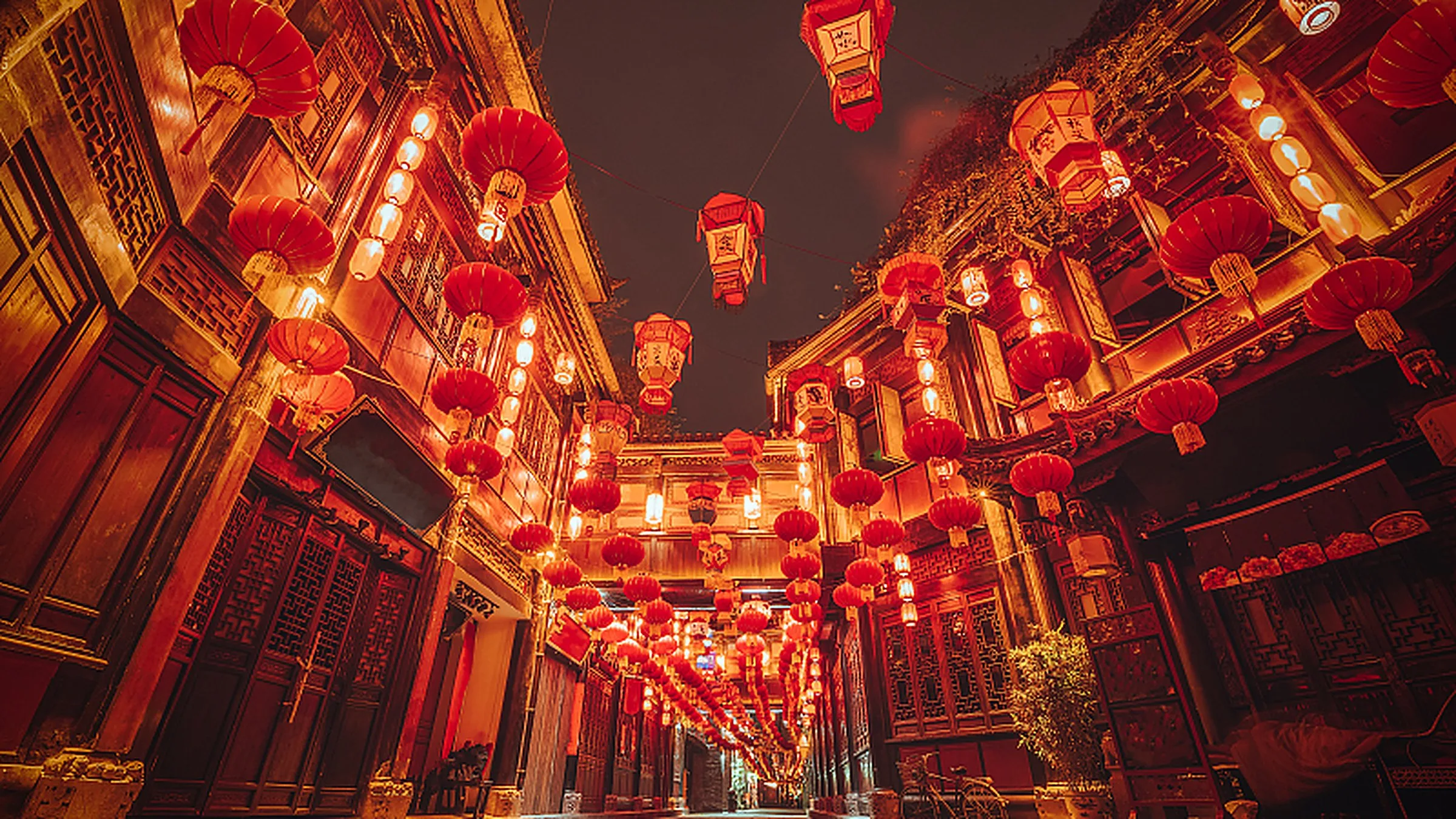
The lantern strings that hang the whole street overhead are the reason most people photograph it, and they are the reason it is worth doing at night. The image that works is a low-angle perspective looking along the lane, so the lanterns recede in a line into the dark.
Photo: repository asset, Pexels / free to use. Opened and inspected before the caption was written.
The visitor rules are worth reading, and one of them saves you money
The street’s management office publishes a set of visitor rules, and they are more specific than you would expect from a tourist street. A few are routine; two are not.
Pets are not permitted, with the exception of certified guide dogs. Entry is refused to anyone bare-chested. Commercial filming, photography for commercial purposes and live-streaming require the management’s permission - this is aimed at the people filming for content, and it is enforced rather than aspirational. Performance, solicitation, busking and handing out leaflets are prohibited in the street and in the area in front of it.
And then there is the one that will actually affect your wallet: visitors are told to confirm prices before consuming anything, with particular attention to goods and services priced by the gram (克) or the liang (两).
That sentence is doing a lot of work. This is a street of snack stalls where a portion of a dozen different things is sold by weight, and where a visitor who does not ask is weighing a decision to order without knowing what it costs. It is the operator warning you, in writing, because they know the tourist maths. Ask the price before you order. It costs nothing and it is the difference between a good evening and a bad one.
The office also publishes a visitor centre, and answers on 028-85563355.
Hours we could not verify, and what to do about it
We are not going to publish a number we cannot source, so here is the honest position.
Jinli has no gate, which means it has no published opening or closing time. There is no barrier to open and no ticketing system to publish one. What actually varies is the individual merchants, and each sets its own hours.
The closest thing to an official figure we could retrieve comes from the Wuhou Shrine Museum’s own notice for its 2026 Spring Festival temple fair, which put that event’s hours at 09:00-22:00 daily, running across the shrine zones and Jinli together. That is a single event’s schedule, not a standing one.
Third-party travel listings we found give 09:00-22:00, 08:00-22:00, and 24 hours, and they contradict each other directly. Rather than pick one, we are telling you the shape of the answer: the street is worth going to in the evening, when the lanterns are lit and the food stalls are trading, and you should not plan a pre-dawn visit expecting anything open.
There is also no closure calendar, but there is a works calendar. The management office announced maintenance and partial closures across parts of the street from December 2025 to January 2026, and a cultural-format and landscape upgrade programme announced in November 2025 with some shopfronts behind hoarding. If you are on a short weekday visit, check the official street notices first.
Free, but keep the two tickets apart
Jinli is free. The confusion worth heading off is between Jinli and the two other things at this address.
The Wuhou Shrine museum is ¥50 per person, needs a passport for its real-name booking, and runs 09:00-19:00 with no admission after 18:00. That is covered properly on the Wuhou Shrine page.
The Spring Festival temple fair is separately ticketed. For its 2026 edition the museum charged ¥40 full and ¥20 half for a fair ticket covering the Wuhou Shrine zones and Jinli together, running 13 February to 3 March 2026.
What we could not establish is whether the ¥50 museum ticket also admits you to Jinli. The museum’s own visitor pages describe what that ticket covers in terms of its own relic and experience zones, and do not extend it to the folk zone. So we are not going to claim you are covered. Plan to pay for the museum, walk onto Jinli for nothing, and ask at the gate if you would rather find out otherwise.
One more warning that carries over from the shrine, because it is the same operator: the museum states it has never authorised any third-party ticket agent and will not handle after-sales problems on tickets bought through another platform. That applies to the fair tickets too. Use the museum’s own channels.
When to go, and what to expect
After dark, and ideally from about 18:00. The lanterns are lit, the street is at its best, and the stalls are open. Going earlier means a lit street with no crowds; going much later means the peak. Half past six to seven is the compromise.
Budget one to two hours. It is 550 metres. It is not a half-day site. The honest use of the time is eating, not looking, and if you are not eating you will be done in forty minutes.
Expect a crowd. English Wikipedia records 18 million visits in the year to 2018, and that figure is for the street. At full dark in peak season it is busy in the way that narrow lanes with a bottleneck at each end are busy, which is fine but is not the quiet atmospheric walk the photographs suggest. Go early evening if you want the quiet.
Do the shrine first. They share a frontage, and doing Wuhou Shrine in the morning and Jinli in the evening turns two outings into one afternoon and evening with no wasted travel. Three and a half to four hours for both.
There is one thing worth calibrating for. CNN Travel ranked Jinli first in its 2019 list of the world’s most beautiful streets. That tells you something real about how good the branding and the lighting are, and rather less about the street as a historical place - which is the distinction this page keeps coming back to. It is a very well-made street, built to be walked at night, next to one of the best small museums in China.
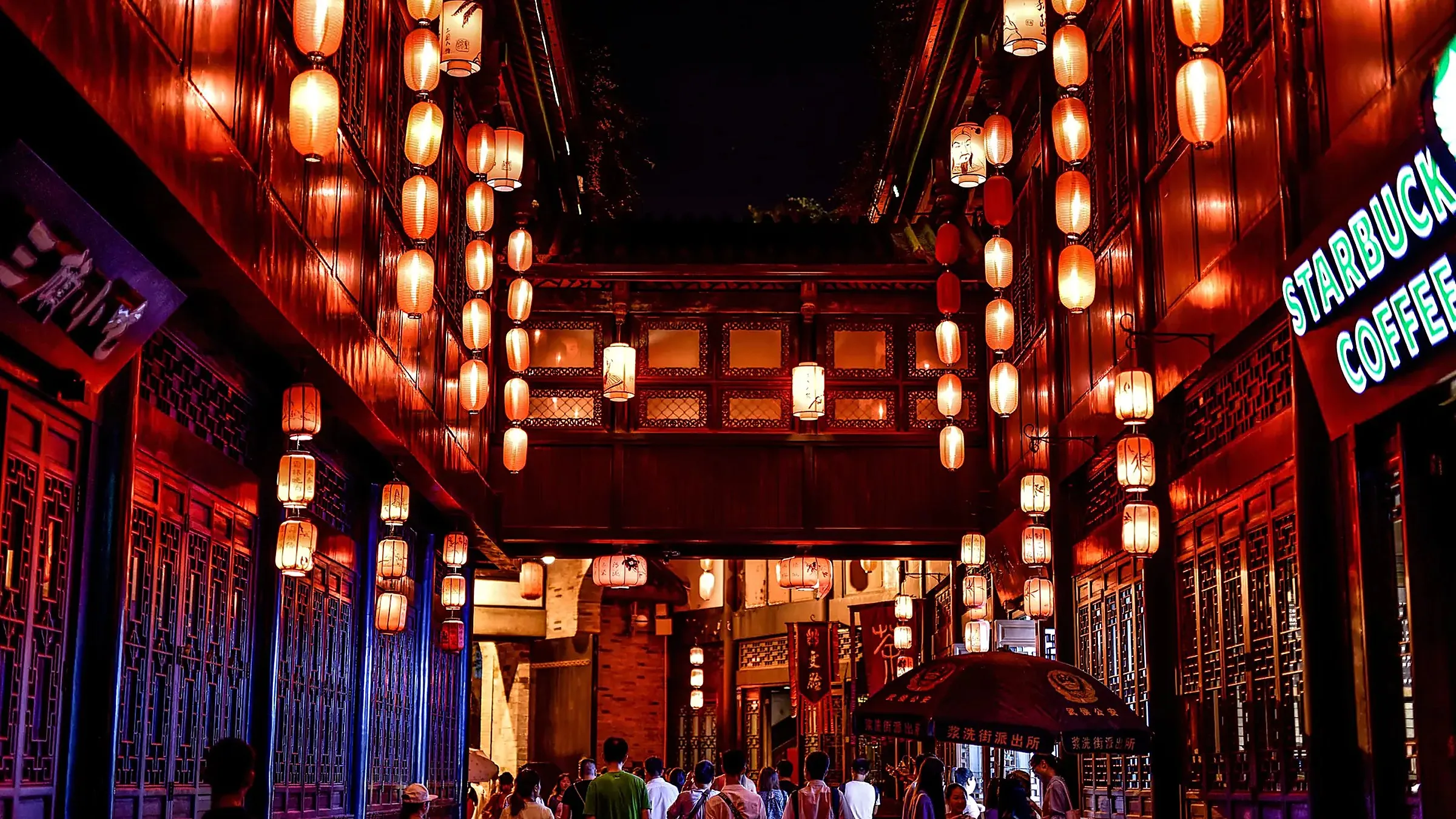
Photo: repository asset, Pexels / free to use. The chain-store signage on the right has deliberately not been cropped out of the caption, because a tourist street with international branding in frame is an accurate photograph of Jinli and a dishonest one without it.
Facts on this page were taken from the street’s own official website and from the Wuhou Shrine Museum’s published visitor pages, checked on 16 October 2026. Opening hours in particular could not be verified from any official source and are flagged as unknown above rather than guessed. Merchant hours and works schedules change without notice - check the official street notices before a short visit, and call 028-85563355 if you need anything settled.
Best photo spots
-
The lantern-strung lane, shot looking along it · After full dark, roughly 19:30-21:00
The defining image, and it is a perspective shot rather than a detail shot: stand low and look ALONG the lane so the rows of lanterns recede in a line overhead. A low camera angle is what makes it work. Straight-on shots of a lantern cluster lose the depth entirely.
-
The lantern-hung gateway at the entrance · Dusk, when the lanterns are lit but the sky still has colour
Cylindrical paper lanterns with painted designs hanging in rows either side of a covered gateway. Dusk is the moment worth being there for, because at full dark the lanterns blow out and you lose the painted detail, while too early there is nothing to photograph.
-
The lane with the shopfront signage left in · Evening, same as the rest of the street
If you photograph this street, expect chain and international branding in frame alongside the traditional frontage. That is not a flaw in your shot - it is an accurate record of a commercial street that has been purpose-built for visitors, and cropping it out produces a picture of somewhere that does not exist.
Where to eat nearby
-
Li Changqing San Da Pao, Jinli branch (李长清三大炮·锦里店) — No. 10 Jiupin Street
Sichuan street sweet. San Da Pao (三大炮) is a glutinous-rice dumpling thrown onto a brass plate in three beats, bounced into a bamboo tray of roasted soybean powder and finished with brown sugar and sesame. Baidu Baike files it as a snack house (餐馆) rather than a restaurant, with outdoor seating, afternoon tea and the loud three-bang performance as the reason people stop. · ¥9/person. Baidu Baike's structured card gives 人均价格 (average spend per person) as 9 and opening hours 8:00-21:00 — which is why it is a stop for the evening walk rather than a sit-down meal. · On this street. The address Baidu Baike records is No. 10 Jiupin Street (锦里九品街10号), and its own description of the business calls it a snack restaurant on Jinli Ancient Street. You walk to it along the lane rather than to it.
-
Tao Ji Dan Heng Gao and Bing Fen, Wuhou Temple main branch (陶记蛋烘糕·冰粉·武侯祠总店)
Chengdu street bakery. Dan heng gao (蛋烘糕) is a small griddle-baked egg cake with a crisp shell, sold sweet or savoury; the same stall does bing fen, a cold iced jelly dessert. · ¥9-10/person. 360 Map gives 人均 9元 for this branch; Qunar gives 人均 10元 for the same address. · No. 180 Wuhouci Street (武侯祠大街180号), across the road from the Jinli end of the lane. Jinli's own address is No. 231 Wuhouci Street Annex 1, so this is the same street, a short walk out of the lane and across. A Ctrip visitor records the same route in reverse — out of the shrine, through Jinli, across the road — which is the obvious way to do both.
Frequently asked questions
Is Jinli Ancient Street free to enter?
Yes, and there is no gate to pass through - you simply walk on. It is a public street, not a ticketed attraction. What trips people up is confusion with the two things near it: the Wuhou Shrine museum complex next door is ¥50 per person and does require a passport, and the Spring Festival temple fair is separately ticketed (¥40 full, ¥20 half for the museum's 2026 edition). We could not find a published statement saying the ¥50 museum ticket also covers Jinli, so plan to pay for the museum and treat Jinli as free.
What time does Jinli open and close?
We are not going to give you a number we cannot stand behind. Jinli has no gate, so it has no published opening hours - what varies is when the individual merchants are open. The best official figure we could find is from the museum's 2026 temple fair notice, which put that event's hours at 09:00-22:00 daily. Third-party listings give 09:00-22:00, 08:00-22:00 or 24 hours and contradict each other. What is certain is that the street is worth visiting in the evening, when the lanterns are lit and the stalls are trading.
Is Jinli an authentic old town or a rebuilt tourist street?
Rebuilt, and openly so. It opened as a pedestrian zone in October 2004 with a second phase in January 2009, built in Qing-dynasty style and themed on the Three Kingdoms. Its own origin story reaches back to the pre-Qin period and the site has been a market street since the Shu Han kingdom, so the location is genuinely old - but what stands there now is a twenty-first-century reconstruction of a Qing-style commercial street, with snack stalls, bars, inns and souvenir shops operating in it. It is a good, atmospheric, well-run tourist street. It is not an untouched old town, and it is worth going with that expectation.
What are the rules for visitors at Jinli?
The street's management office publishes them, and several are the kind you would rather know in advance. Pets are not permitted, guide dogs excepted. Entry is refused to anyone bare-chested. Commercial filming and live-streaming need the management's permission. Performance, solicitation and handing out leaflets are prohibited. Most practically: you are told to confirm prices before you buy, particularly for goods and services priced by the gram or the liang. The office runs a visitor centre and answers on 028-85563355.
Can I visit Jinli and Wuhou Shrine together?
Yes, and it is the obvious way to do both - they share the same street frontage at No. 231 Wuhouci Street and Jinli is officially one of the museum's three zones. Allow three and a half to four hours for the pair: the shrine in the morning, Jinli in the evening. Buy the ¥50 museum ticket through the museum's own website or WeChat account, or pay cash at the gate, and leave Jinli itself to the evening.
How long should I spend at Jinli, and is it worth it?
One to two hours, and that is not a criticism of it. The street is about 550 metres long, so it is a walk rather than a site. The honest framing is that you are spending your time eating rather than looking, and that the best return is at the end of the day when the lanterns come on. If you want an ancient town with original fabric, this is not it; if you want a well-run, atmospheric, food-heavy lantern street next to a serious museum, it is very good value at no cost.
Sources
- 成都锦里 — the official Jinli Culture & Tourism Street website, operated by the Chengdu Wuhou Shrine Museum's Jinli management office (锦里文化旅游街区官网). Source of the published address No. 231 Wuhouci Street Annex 1; the 2026 Spring Festival temple fair notice giving daily 09:00-22:00 for the event, the 21:30 daily free opening of the street to the public, ¥40 full and ¥20 half fair fares, the 18:00 daily close of the museum exhibition halls, and the museum's repeated warning that it authorises no third-party ticket sales; the Jinli visitor rules notice of 17 November 2025 (no pets except guide dogs, bare-chested entry refused, no unauthorised commercial filming or live-streaming, no solicitation, and confirm prices before consuming, especially for goods priced by the gram or liang); the maintenance closure notice for December 2025 to January 2026; and the upgrade works notice of 17 November 2025. Also gives the Jinli office line 028-85563355. · cdjinli.com
- Jinli — English Wikipedia (a street in Chengdu traced to the pre-Qin period, about 550 m long, part of the Temple of Marquis with Qing-dynasty style buildings and a Three Kingdoms theme, bars/inns/snack stores/souvenir shops, renovated in 2004, named a National Top Ten City Commercial Pedestrian Street in 2005 and a National Demonstration Base of the Cultural Industry in 2006, 18 million visitors in 2018, and the Spring Festival 'Big Temple Fair') · Wikipedia
- Jinli (Q6202606) — Wikidata (a Qing-dynasty style old commercial street in Chengdu, coordinate 30.6484759 / 104.04738, official site https://www.cdjinli.com, listed under the city of China rather than another city) · Wikidata
- 成都武侯祠 — Chinese Wikipedia (establishes that Jinli is one of the museum's three zones, the 锦里民俗区, inside the same 150,000 sqm complex as the shrine and tomb, and that the complex's Zhuge Liang shrine was founded by Cheng-Han's Li Xiong in the early 4th century) · Wikipedia
- Chengdu Wuhou Shrine Museum, Guide to Wuhou Shrine (official English site — the Jinli pedestrian zone began operation in October 2004, a second phase opened in January 2009, Jinli is the museum's 'Jinli Folk Customs Zone' alongside the relics and experience zones, and the museum's average annual visitor figure of about ten million) · en.wuhouci.net.cn
- Chengdu Wuhou Shrine Museum, Ticketing Information (official English site — the ¥50 museum ticket, its passport-based real-name booking rules, and the museum's statement that it has never authorised third-party ticket agents; cited here because Jinli sits inside the same complex and the two tickets are easy to confuse) · en.wuhouci.net.cn

