Wuhou Shrine (Temple of Marquis Wu), Chengdu
成都武侯祠 · Chéngdū Wǔhóu Cí
Quick answer
A passport is what gets you in, and it is needed at more than one step. The museum sells tickets by online real-name booking, and a passport is the identity document for that booking - for foreign visitors and foreign minors alike. Online payment is WeChat or Alipay only. If you cannot pay that way, buy cash at the on-site integrated service window next to the self-service ticket hall, presenting your passport. Minors aged 6 to 14 must come with an adult guardian. The most useful thing we can tell you is a warning the museum publishes itself: it has NEVER authorised any third party or individual to act as its ticket agent, and it will not handle any after-sales problem caused by buying through another online platform. So the museum's own website and its own WeChat public account are the only safe places to book; a cheaper listing on a third-party marketplace is not a deal, it is a ticket the museum has said it will not stand behind. On interpretation we are deliberately silent: the museum runs an English-language website and publishes its visitor rules in English, but we could not verify from any published source what signage, guides or audio interpretation are physically available at the site, so treat that as unconfirmed and bring a translation app.
Why visit
- 1 The only shrine complex in China that enshrines a ruler and his minister together, which is why the whole place is called after the minister rather than the king
- 2 Three things share one ticket: the Wuhou Shrine for Zhuge Liang, the Han Zhaolie Temple for Liu Bei, and Huiling, Liu Bei's actual tomb
- 3 Zhuge Liang's own shrine was founded later than the tomb it now shares a site with - by Li Xiong of Cheng-Han, in the early fourth century, roughly eighty years after the Three Kingdoms period ended
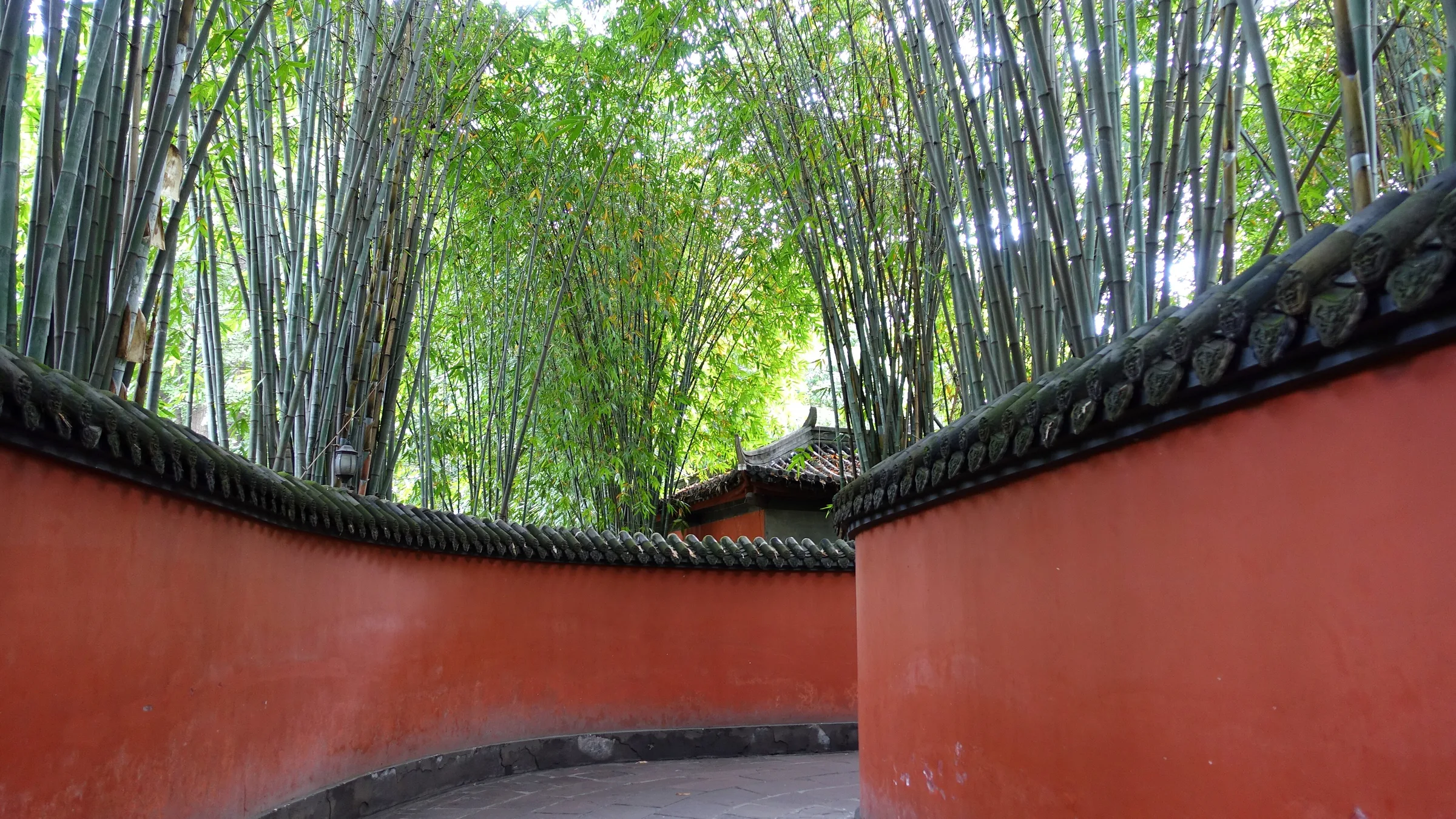
- 4 The red-walled corridor with bamboo rising behind it is the image everyone comes for, and it is a twenty-minute walk, not a hall
- 5 Twenty-eight stone civil and military officials line the east and west corridors, most famous of them the Qing-dynasty couplet by Zhao Fan on winning hearts and judging the situation
- 6 A Tang-dynasty stele behind the main gate is called the Three-Perfection Stele because its text, its calligraphy and its carving are each credited to a different master
- 7 The museum publishes a blunt warning: it has never authorised any third party to sell its tickets, and it will not resolve problems with tickets bought anywhere else
Essential tips for foreigners
- Book through the museum, or buy cash at the gate - and nothing in between. The museum states that it has never authorised a third-party ticket agent and will not handle after-sales on tickets bought elsewhere. Its own website and its own WeChat account are the only safe channels.
- Carry your passport. It is the booking identity document, it is what buys the half-price and free child categories, and it is what you show if you are buying cash at the service window.
- Last entry is 18:00, not 19:00. The published hours end at 19:00 but admission stops an hour earlier, and the on-site service window and ticketing hotline both shut at 18:00 as well - so a late arrival cannot even fall back on buying a ticket.
- Online payment is WeChat or Alipay only. If you have neither, skip the booking entirely and pay cash at the integrated service window beside the self-service ticket hall.
- Budget three hours, not one. Three zones, a lot of courtyard, and the walk out to Huiling is the part that quietly adds thirty minutes.
- Go for the corridor, not the halls. The red wall and the bamboo are the reason to come; the Zhuge Liang hall is a quick stop inside a much larger site.
Suggested route
- 09:00 15 min Arrive at the South Gate on Wuhouci Street as the site opens, or earlier if you booked online and want to be through the barrier before the coach groups
- 09:15 30 min Han Zhaolie Temple first - it stands in front, dedicated to Liu Bei, and reading it before the shrine sets up the joint worship that makes the site unusual
- 09:45 40 min Cross the courtyards into the Wuhou Shrine itself and the hall dedicated to Zhuge Liang, at the back of a high-front, low-back layout
- 10:25 30 min Work out to the east and west civil and martial corridors and the 28 stone officials in them, stopping at the Zhao Fan couplet
- 10:55 15 min Go behind the main gate to the Tang stele known as the Three-Perfection Stele
- 11:10 35 min Take the long walk to the red-walled corridor and the bamboo behind it - this is the photograph, and it deserves unhurried time
- 11:45 40 min Walk out to Huiling, Liu Bei's tomb, in the northern part of the site
- 12:25 35 min Back out through the west zone, the former Nanjiao Park, or exit and take a short taxi to Jinli for the evening
The only shrine in China that worships a ruler and his minister together
Most Chinese shrines memorialise one person. This one has two, and that is the reason it exists in this shape.
The Wuhou Shrine was built to commemorate Zhuge Liang, the chancellor who ran the Shu Han state out of Chengdu. What makes it unusual is that the ruler he served is enshrined in the same complex, in a temple called the Han Zhaolie Temple - after Liu Bei’s posthumous title, Emperor Zhaolie - and that Liu Bei’s actual tomb, Huiling, is on the site as well. So the ¥50 buys you a shrine, a temple and a mausoleum, and the Chinese name 成都武侯祠 covers all three without distinguishing them. The museum is explicit that this is the only such combined shrine in China, and it bills itself as the most influential Three Kingdoms relic museum in the world, under the nickname 三国圣地 - the mecca of the Three Kingdoms.
There is a detail in the history that catches people out, and it is the one worth knowing before you walk in. The tomb and the Liu Bei temple are the oldest part of the site, going back to the early 220s. Zhuge Liang’s own shrine is later. Chinese Wikipedia records it as founded by Li Xiong of Cheng-Han - a state that existed after the Han, in the early fourth century - originally standing in a different part of Chengdu, and moved next to Huiling and the Han Zhaolie Temple around the year 500, during the Northern and Southern dynasties. That arrangement then held for centuries.
The layout you walk today was settled by accident of the Ming. In 1390 the Ming prince Zhu Chun came to pay homage and had the tomb, the temple and the shrine combined, on the stated grounds that lord and minister ought to be honoured as one. The shrine was destroyed in the fighting at the end of the Ming and rebuilt under the Kangxi Emperor - the museum’s English guide dates that rebuild to 1671. What stands now is largely that reconstruction. In 1984 the site became the Chengdu Wuhou Shrine Museum, and in 2008 it was rated among the first museums in China to hold the National Grade I designation.
So the through-line is: a tomb from the early Three Kingdoms, a shrine built about eighty years after the period ended, and a single unified visitor site assembled in 1390 and rebuilt in the 1670s. It is a layered site, not a preserved one, and it is much better for it.
What the ¥50 buys, and the ticket trap nobody warns you about
The price is ¥50 per person, published by the museum. Half price at ¥25 for minors aged 6 to 18, and free for children under 6 or not taller than 1.3 m. Those categories explicitly include foreign children, on a passport. The guardian accompanying a free or half-price child pays full price in every case, so a family of two adults and two children under 18 pays 100, not 50.
One pricing note, because it is a real trap for anyone timing a visit: the museum runs a Spring Festival temple fair, 大庙会, across the relics zone, the west zone and Jinli street together, and for its 2026 edition it charged ¥40 full and ¥20 half for a fair ticket. That is a different product from museum admission. Do not budget for it unless you are going during the fair.
The more important thing is the sentence the museum publishes at the top of its own ticketing page: it has never authorised any third-party organisation or individual to act as its ticket agent, and it will not accept any after-sales problem caused by buying through another online platform. That is unusually blunt, and it is worth taking literally. If a listing on a third-party marketplace is cheaper than ¥50, that is not a saving - it is a ticket the museum has said in advance it will not stand behind if the booking fails on the day. Use the museum’s own website, or its own WeChat public account, or buy cash at the gate.
We also could not establish from any published source whether the single ticket also admits you to Jinli street next door. Both are run by the same museum and sit on the same complex, but the museum’s published materials describe what the ticket covers in terms of its own relic and experience zones, and do not extend that to Jinli. Plan on paying for the museum and treating Jinli as the free public street it is, until someone at the gate tells you otherwise.
Getting in with a passport
This is the part that is genuinely different for a foreign visitor, and it is more structured than most Chinese attractions.
Tickets are sold by online real-name booking, which means every ticket is tied to a named identity document - for you, your passport. Tickets go on sale 14 days ahead. Each valid document can be used for one booking per day, and each account can book for up to 20 people per day. You scan the QR code from your order, or from the email confirmation, at the barrier of the main South Gate.
There are two constraints worth planning around. First, online payment is WeChat or Alipay only. If you have neither set up, do not fight it: the museum says explicitly that anyone who cannot pay that way may present their passport at the on-site service window next to the self-service ticket hall and buy with cash. Second, booking is not required. That is why this page lists it as walk-in: the gate route is a first-class option, not a fallback.
Refunds are handled, with a deadline attached. Unused online tickets can be refunded through the original channel before 22:00 on the day of visit, after which the system refunds automatically; paper tickets bought on site have to be refunded at the service window before 18:00 that day. Once used, a ticket is not refundable.
What we are deliberately not telling you is what you will find inside. The museum has an English website and publishes its visitor rules in English, which tells you something but not much. We could not verify from any published source what on-site signage, whether guides are available, or whether there is audio interpretation, so we are not going to guess. Bring a translation app, and treat that as the honest answer rather than a criticism of the museum.
Hours, and the hour that is not an hour
The published hours are 09:00-19:00, every day, with no closure calendar.
Underneath that is the line that catches out latecomers: visitors are not admitted after 18:00. The site is open for ten hours and admits for nine. That is not a rounding detail, because the on-site integrated service window also runs 09:00-18:00, and so does the customer service line. An arrival at 18:30 does not find a quiet last hour and a ticket desk still open - it finds a closed operation. If you want to be safe, be inside before 17:00.
There are no published closure days, which is what you would expect of a site that publishes the same hours for every day of the year. If you are travelling over a Chinese public holiday, that is the one circumstance where we would confirm rather than assume, on 028-85535951, the ticketing number the museum publishes.
How long to allow, and how to walk it
Two to three hours is the honest figure, and most people get it wrong in the same direction - they budget an hour and spend it badly, because each hall is small and quick and the site is large.
The complex covers 150,000 square metres and has three zones. The Three Kingdoms Cultural Relics Preservation Zone is the historical core: the Han Zhaolie Temple at the front, the Wuhou Shrine behind it, Huiling at the far end, and the Sanyi Temple, relocated into the site wholesale in the late 1990s. The Three Kingdoms Culture Experience Zone occupies the west and is built out of the former Nanjiao Park. Jinli is the folk zone on the edge.
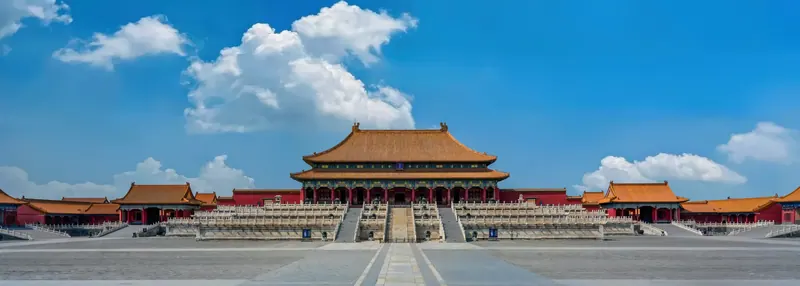
The layout is traditional and worth knowing before you go, because it means you walk forward through the king to reach the minister. The two form front and rear courtyards with a high-front, low-back profile - the Han Zhaolie Temple in front, the Wuhou Shrine (its main hall the Zhongwu Hall, for Zhuge Liang) behind, and Guan Yu and Zhang Fei statues in the halls between them. So the sequence is Liu Bei, then the space between, then Zhuge Liang.
Running east and west off the axis are the civil and martial corridors, with 28 stone officials in them. The one everyone stops for is a Qing-dynasty couplet by Zhao Fan, and it is worth reading twice, because it is about how to rule rather than about the Three Kingdoms: if you can win hearts, the traitorous dissolve of themselves; know the situation, and leniency and severity alike are errors; do not fight for its own sake. It closes by telling whoever governs Shu later to think deeply. That is a memorial to Zhuge Liang written as advice to future governors.
Behind the main gate are six Tang-period stone steles from the prime minister Pei Du’s time, written by the calligrapher Liu Gongquan and carved by the mason Lu Jian - celebrated as the Three-Perfection Stele because text, calligraphy and carving each have a separate acknowledged master.
And then there is the walk out to Huiling. It is the single biggest reason to budget three hours instead of one.
The red wall and the bamboo
Almost everyone comes here for a picture, and almost everyone is thinking of the wrong thing.
The image people want is not a hall. It is the red-walled corridor: a long curving wall in red plaster, capped with grey glazed roof tiles, with dense bamboo rising behind it and throwing shadows across the surface. The museum’s own English guide carries a photograph of it under the name Red Walled Alley. It is a twenty-minute walk into the site, and it is the reason to allow the time in the first place.
Photographically it is a mid-day subject rather than a golden-hour one. The shot is the bamboo shadow crossing the red plaster, which needs sun coming from the side and from behind the wall. Golden-hour light flattens it; heavy overcast flattens it worse, because the red goes grey. What does work is a bright day where the shadow edges are still sharp, and a slightly long lens so the curve of the wall carries the frame.
Photo: Wikimedia Commons / CC0, Daderot. Worth being precise about what this shows: the corridor wall and the bamboo behind it, not a hall and not the entrance. We opened the file before writing the caption, because a Commons filename is not an alt text.
The corridor is also the honest summary of the site. Huiling was built in the 220s, the shrine for Zhuge Liang came later, and what stands today was largely rebuilt under the Kangxi Emperor in the 1670s after the fighting at the end of the Ming. It is a place that has been destroyed, rebuilt, merged and re-merged more than once. The red wall is what that looks like after four centuries of being maintained.
On the dates, where the sources disagree
Because this page is written from sources rather than from memory, here is where the sources actually differ - so you can see what we chose and why.
The founding date. The museum’s own English guide dates the complex’s origin to the first year of the Zhangwu era under Liu Bei, giving 221. Chinese Wikipedia gives 223, which is the year Liu Bei died and the year it assigns to the building of Huiling and the Han Zhaolie Temple. We have published the museum’s framing, because it is the site speaking about itself, and flagged the alternative here rather than silently picking one.
The Kangxi reconstruction. The museum’s English guide gives the 10th year of Kangxi, 1671. Chinese Wikipedia gives 1672, the 11th year. Same building, adjacent years, same discrepancy in kind as the founding date. We publish the museum’s figure.
Hours. Some travel listings give 08:00-20:00 for summer, and one gives 09:00-18:00. We publish the museum’s own 09:00-19:00 with no admission after 18:00, and disregard the rest.
None of these change what to do on the day. They are the reason we quote the museum rather than a roundup.
Getting there, and pairing it with Jinli
The museum’s own transport page gives one metro instruction: Line 3 to Gaoshengqiao Station, Exit A, about ten minutes on foot. Buses 1, 57, 82, 334 and 335 run directly to the site. There is also a Line 10 station in Chengdu named Wuhou Shrine (武侯祠站) that several listings point at instead; we confirmed the station exists but could not verify a walking time from it to the gate, which is why we publish the museum’s Line 3 instruction instead of the more convenient-looking alternative.
If you are coming from the airport or the main station, the museum also runs scenic-area shuttles from Chengdu Shuangliu International Airport, the East long-distance bus terminal, Kuanzhai Alleys, Du Fu Thatched Cottage, the Jinsha Site, IFS, Chunxi Road, Taikoo Li, Dujiangyan and Sanxingdui. That list is worth reading as a planning tool: it tells you the shrine is treated as one of the city’s anchor sights, not a suburb.
Driving buys you nothing. The underground car park at the same address has 865 spaces, is open 24 hours, and charges ¥5 for the first two hours then ¥1 an hour - and then you walk the complex exactly like everyone else.
Pair it with Jinli, which is attached to the same complex and best after dark. Doing both takes three and a half to four hours; the shrine in the morning, Jinli in the evening. Du Fu Thatched Cottage and the Wuhou Shrine are also close enough to share a half-day if the weather is bad, and the Jinsha Site is the obvious third pairing for anyone doing the Three Kingdoms circuit properly.
Prices, hours and booking rules on this page were taken from the museum’s own published English visitor pages, checked on 16 October 2026. Gate arrangements, fares and event schedules can change without notice - confirm on the day, and call 028-85535951 if you need anything settled before you travel.
Best photo spots
-
The red-walled corridor · Late morning to early afternoon, when the light is high enough to throw the bamboo shadows onto the red plaster
The reason most people come. A long curving wall in red, capped with grey tiles, with dense bamboo behind it. The shot people want is the one where the shadows of the bamboo fall across the red surface - which needs sun from the side and behind the wall, so it is a mid-day subject rather than a golden-hour one. Overcast light flattens the red completely; avoid it.
-
The east and west civil and martial corridors · Morning, when the light down the corridor axis is still low and even
Twenty-eight stone figures of officials in civil and martial dress, set into the covered corridors on both sides of the central axis. They are best read as a sequence along the wall rather than as individual portraits, and the corridor roof keeps the light flat and soft, which suits the stone carving.
-
The Three-Perfection Stele behind the main gate · Whenever the light rakes across the stele face at an angle
The Tang-period stele behind the Wuhou Shrine gate, celebrated because the text, the calligraphy and the carving were each done by a different acknowledged master. It is a flat vertical surface, so raking light is what separates the incised characters from the stone instead of flattening both into grey.
-
Huiling, Liu Bei's tomb mound · Late afternoon on the way out, when the site is emptying
The burial mound of the first ruler of Shu Han, at the far end of the complex from the entrance. Most people walk out to it without a plan; going at the end of the visit means you have the walk in cooler air and a nearly empty site, which is the opposite of how most itineraries arrive at it.
Where to eat nearby
-
Li Changqing San Da Pao, Jinli branch (李长清三大炮·锦里店) — No. 10 Jiupin Street
Sichuan street sweet. San Da Pao (三大炮) is a glutinous-rice dumpling thrown onto a brass plate in three beats, bounced into a bamboo tray of roasted soybean powder and finished with brown sugar and sesame. Baidu Baike files it as a snack house (餐馆) rather than a restaurant, and records outdoor seating, afternoon tea and the three-bang performance as the reason to go. · ¥9/person. Baidu Baike's structured card for this listing gives 人均价格 (average spend per person) as 9, and the same card gives opening hours 8:00-21:00. · On the Jinli lane itself, at No. 10 Jiupin Street (锦里九品街10号) — Baidu Baike's own description of the business is a snack restaurant on Jinli Ancient Street, Wuhou District. Jinli shares this complex's frontage at No. 231 Wuhouci Street, so this is on the same block, a few minutes at most on foot from the South Gate.
-
Tao Ji Dan Heng Gao and Bing Fen, Wuhou Temple main branch (陶记蛋烘糕·冰粉·武侯祠总店)
Chengdu street bakery. Dan heng gao (蛋烘糕) is a small griddle-baked egg cake with a crisp shell, sold sweet or savoury; the same stall does bing fen, a cold iced jelly dessert. · ¥9-10/person. 360 Map gives 人均 9元 for this branch on its live page; Qunar's listing gives 人均 10元 for the same address. Two sources, one street number, a one-yuan spread. · No. 180 Wuhouci Street (武侯祠大街180号) — the same street as the shrine, whose main South Gate the museum gives as No. 231 Wuhouci Street. A few hundred metres along the frontage, on the opposite side of the road from the Jinli entrance.
Frequently asked questions
What is Wuhou Shrine, and why is a tomb part of it?
It is a shrine complex dedicated to Zhuge Liang, the chancellor of Shu Han, and it is unusual in China because the founder's ruler is enshrined beside him. Three separate things share one ticket: the Wuhou Shrine itself for Zhuge Liang, the Han Zhaolie Temple for Liu Bei, and Huiling, which is Liu Bei's tomb. In 1390 the Ming prince Zhu Chun had the three combined on the argument that ruler and minister ought to be honoured as one, and because Zhuge Liang overshadows Liu Bei in popular memory the whole complex took his name. Liu Bei's actual grave being inside a working shrine is the part that surprises people, and it is why the site is closer to a mausoleum campus than a single temple.
How much does Wuhou Shrine cost, and can I buy the ticket on arrival?
¥50 per person, published by the museum. Yes, you can buy at the gate with cash at the integrated service window next to the self-service ticket hall, showing your passport, so booking ahead is not required. What the museum does insist on is where you book if you book: online tickets go through its own website or its own WeChat public account, 14 days ahead, real-name on a passport, paid by WeChat or Alipay. It states that it has never authorised any third-party ticket agent and will not deal with after-sales problems on tickets bought through any other online platform.
What time does Wuhou Shrine open, and can I get in late?
The museum publishes 09:00-19:00 every day. The catch is the one line underneath: visitors are not admitted after 18:00. So the gate stops taking people an hour before the stated closing time, and the on-site service window and the ticketing hotline both finish at 18:00 too - arriving at 18:30 means arriving to a shut operation, not to a quiet last hour. There are no published closure days.
Is Wuhou Shrine suitable for children, and are there discounts?
Yes. Minors aged 6 to 18 pay half price at ¥25, and the museum explicitly includes foreign minors on a passport. Children under 6, or not taller than 1.3 m, are free, with the ticket exchanged at the service window. Minors aged 6 to 14 have to be accompanied by an adult. In all of those cases the accompanying guardian pays full price, which is worth knowing if you are budgeting for a family of four.
Is Wuhou Shrine a temple, a museum, or both?
It started as a shrine and now functions as a museum - the Chengdu Wuhou Shrine Museum was established in 1984 and rated a National Grade I museum in 2008, the first batch of museums to hold that grade. It sits inside a 150,000 square metre site with a preserved relics zone, a culture experience zone built out of the former Nanjiao Park, and the Jinli folk-crafts street on the edge. The relic zones are genuinely active devotional space in origin, but the visitor experience is a museum: courtyards, steles, statuary and explanatory work rather than liturgy.
How long should I allow, and what is the must-see?
Two to three hours across three zones. The single thing worth walking to is the red-walled corridor with bamboo rising behind it, which is the image the site is known for and which the museum's own English guide captions as the Red Walled Alley. After that, the Zhuge Liang hall at the back and the walk out to Huiling are the other two anchors. Under-budgeting at one hour is the common mistake, because each hall is quick and the walking between them is what fills the time.
Can I combine Wuhou Shrine with Jinli?
Yes, and they are effectively attached - Jinli is the museum's own folk-crafts zone on the edge of the same complex. The practical question is tickets rather than walking: we could not find a published statement saying the ¥50 museum ticket also admits you to Jinli street, so plan to pay for the museum and treat Jinli as its own free street. Doing both in one visit takes about three and a half to four hours, and the natural order is the shrine in the morning and Jinli after dark.
Sources
- Chengdu Wuhou Shrine Museum, Ticketing Information (official English site — full and half price, passport rules, 14-day advance real-name booking, WeChat/Alipay-only online payment, cash at the on-site service window, the museum's statement that it has never authorised third-party ticket agents, and the published hours 09:00-19:00 with no admission after 18:00) · en.wuhouci.net.cn
- Chengdu Wuhou Shrine Museum, Transportation (official English site — Line 3 to Gaoshengqiao Exit A and ten minutes on foot, buses 1/57/82/334/335, scenic-area shuttles, and the 865-space Southern Suburb underground car park with its ¥5-then-¥1-per-hour tariff) · en.wuhouci.net.cn
- Chengdu Wuhou Shrine Museum, Guide to Wuhou Shrine (official English site — the complex's history from the Zhangwu era through the c. 500 AD relocation from Shaocheng, Zhu Chun's 1390 unification of tomb, temple and shrine, the Kangxi reconstruction, the 1961 and 2008 state designations, Jinli opening October 2004, the 150,000 sqm footprint and its three zones) · en.wuhouci.net.cn
- 成都武侯祠 — Chinese Wikipedia (the Chengdu complex specifically: composed of 武侯祠, 汉昭烈庙 and 惠陵, China\'s only ruler-and-minister joint shrine, founded by Cheng-Han\'s Li Xiong, relocated c. 500 AD, the 1672 Kangxi reconstruction, the 28 civil and martial stone statues, the Zhao Fan couplet and the Tang 'Three-Perfection Stele', 1961 key cultural relic protection unit, 1984 museum, 2006 national AAAA rating) · Wikipedia
- 成都武侯祠 (Q1069942) — Wikidata, the item for Chengdu's Wuhou Shrine, carrying its own coordinate statement of 30.64830556 / 104.04702778 · Wikidata
- 武侯祠 (Q11123827) — Wikidata, cited because the repository's attraction-coords.ts records this QID against the Chengdu shrine; it is in fact a disambiguation page listing the Mian County, Nanyang and Chengdu sites, not the shrine itself · Wikidata
- Corridor — Wuhou Shrine — Chengdu, China — DSC05489.jpg, Wikimedia Commons (CC0 public domain dedication, Daderot, own work, 25 September 2015 — the source of the image used on this page) · Wikimedia Commons
- Wuhou Shrine ticket office (node 5402706721), OpenStreetMap — at 30.6470833 / 104.0471215 on 武侯祠大街 in Wuhou District, corroborating that the published coordinate falls on the shrine's own frontage · openstreetmap.org
- Wuhou Shrine station (Q111225504) — Wikidata, confirming the Chengdu Metro Line 10 station named 武侯祠站 exists; no walking time from it to the gate was verified, so the museum's Line 3 instruction is the one published · Wikidata