
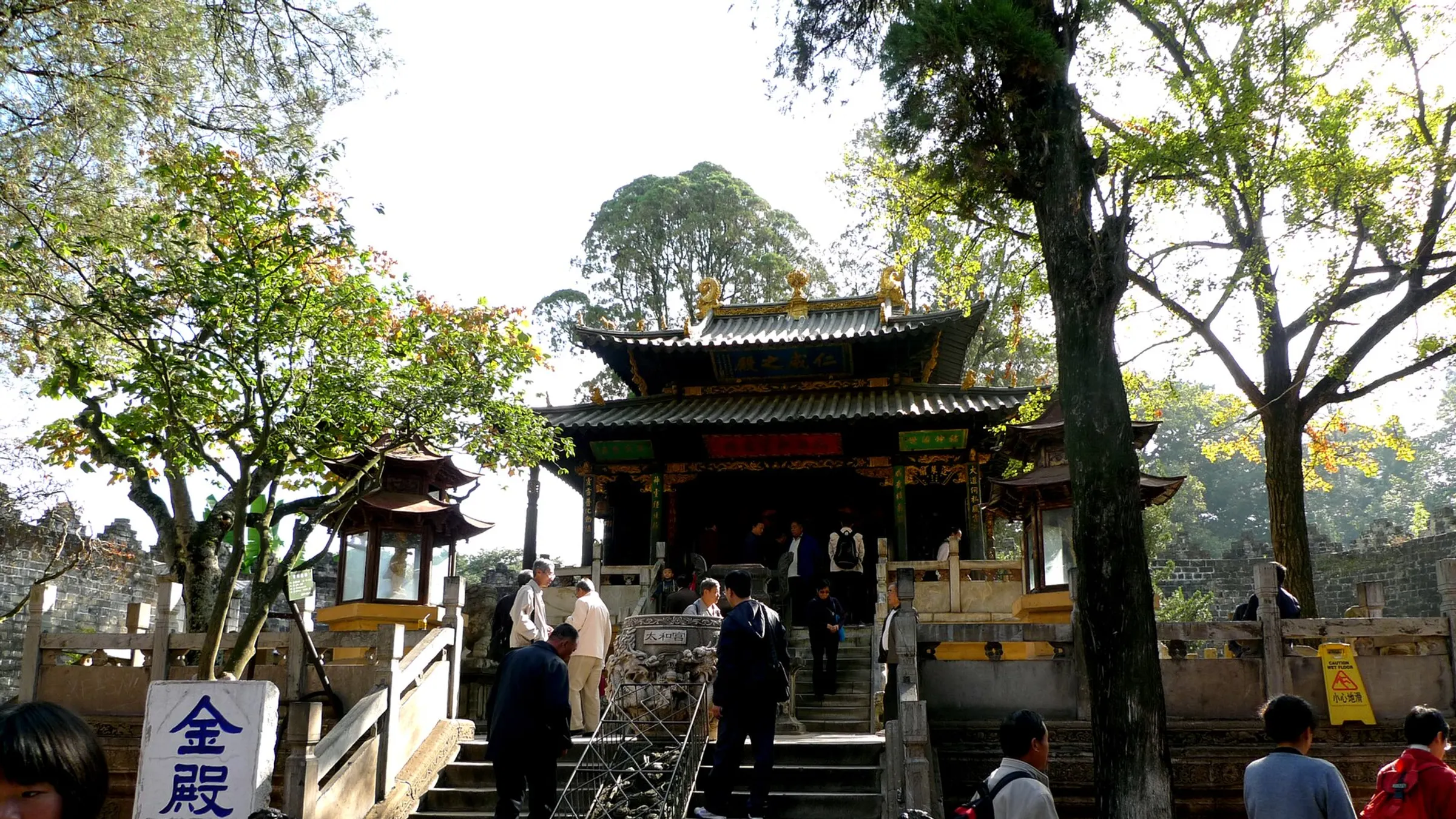
Golden Temple (Taihe Palace), Kunming
金殿 · Jīndiàn
Quick answer
Walk-in. Buy the ¥25 ticket at the gate - no advance booking system is listed. Children are charged by height, so have a rough idea of your child's height before you queue. English-language interpretation is not listed in the published visitor information, so a translation app or a Chinese-speaking companion is worth having for the Taoist terminology; the site itself is walkable and self-explanatory. Reaching it is straightforward: buses 10, 57, 71, 146, 147, 159, Z146 and Z150 all run to Jindian Chechang (金殿车场).
Why visit
- 1 The cypresses growing in and around the temple wood are traditionally said to be older than the building itself - the trees were here before the bronze hall
- 2 A Ming-dynasty Taoist hall in the Taihe Palace (Hall of Supreme Harmony) form, rebuilt in 1890 using about 250 tonnes of solid bronze
- 3 Everything except the staircases and balustrades is copper: walls, columns, rafters, roof tiles, altars and statues. The polished metal is why it is called the Golden Temple
- 4 The bronze was originally ordered to be shipped east and minted as coinage. The delivery was cancelled by an armed conflict, and the metal became a temple instead
- 5 You climb a wooded mountainside through three decorated Heavenly Gates before you reach the hall - the walk up is half the experience
- 6 Behind the temple stands a three-storey bell tower, built in 1984 around a Ming-period copper bell roughly 3.5 m tall and 14 tonnes
- 7 A 600-year-old camellia beside the temple flowers every February, and the park has formal camellia and orchid gardens
Essential tips for foreigners
- Go early. The gate opens at 7:30 and the climb is shaded; by mid-morning the stairway is busy and, in summer, hot and hazy.
- Budget the climb properly. The hall sits on the summit of Mingfeng Hill. Two hours includes the stairs up and down, the gates and the hall - not more.
- Wear shoes with grip. The approach is stepped stone throughout. Flat sandals are a bad idea here in any weather.
- The hall is not the whole site. The Heavenly Gates, the Lingxing Gate forecourt and the bell tower behind the hall each get their own few minutes and are easy to walk past.
- Nothing here is loud. This is an active Taoist shrine, not a staged attraction. Keep your voice down inside the hall and be careful where you point a camera.
- Bring water and a layer. Kunming's mild reputation holds all year, but the hilltop is windier and cooler than the city below, especially at opening time.
Suggested route
- 07:30 20 min Arrive at the gate as it opens, before the day-trippers and before the hill warms up
- 07:50 30 min Start the climb through the first Heavenly Gates, shaded by cypress and pine
- 08:20 20 min Pause at the Lingxing Gate forecourt and its miniature city wall, and look at the heavy engraved sword
- 08:40 30 min Enter the bronze Taihe Palace hall - small, so allow 30 minutes rather than an hour
- 09:10 20 min Walk behind the temple to the three-storey bell tower and its Ming copper bell
- 09:30 30 min Descend through the park, taking the camellia and orchid gardens on the way down
- 10:00 30 min Didi back to central Kunming, or continue to the Western Hills for a second half-day
The cypresses are older than the building
Almost everyone who comes here for the bronze remembers the trees instead.
The cypresses growing in and around the temple wood are traditionally said to predate the structure they surround. That is worth sitting with, because the hall they enclose has been rebuilt and re-founded more than once. What stands at the summit today is the product of an 1890 rebuild carried out under the Guangxu Emperor using roughly 250 tonnes of solid bronze, and even that building is a seventeenth-century copy of an earlier one. The trees have simply gone on being trees through every version of the hall, and the hillside is thick with them: pine, evergreen and hardy cypress, which is why the place was being called the Fairyland of Mingfeng as long ago as the Qing dynasty.
That inversion is the thing to hold onto when planning the visit. The Golden Temple is usually presented as an object, a metal building with a gold-like shine, and the marketing photographs tend to reward that reading. In practice you experience it as a walk up a wooded mountain, and the metal arrives at the end of the walk looking considerably smaller than you had pictured. Plan for the climb and the wood, and treat the hall as the payoff rather than the whole event.
Photo: Wikimedia Commons / CC BY 3.0 (Gisling). Worth being precise about what this shows: the approach and the entrance stairway, not the bronze hall. The hall is beyond the Heavenly Gates.
What the ¥25 actually buys
One ticket covers the whole hillside, not just the building. It gets you into the park, up the mountain, through all three of the Heavenly Gates, into the forecourt at the Lingxing Gate, and into the bronze hall itself — and it also covers the landscaped sections on the way, which have been added over the years as a Parrot Garden, a Camellia Garden and an Orchid Garden.
That matters when you are deciding whether the site is worth two hours on a short Kunming itinerary. There is no second gate to pay, and nothing at the top is ticketed separately. The exception is the walk back down: if you want to see the gardens on the return leg, they are on your homeward route rather than a detour.
It is also worth knowing what the money is not buying, because the site is easy to oversell. You are paying to look at a small hall, an unusual cast-bronze exterior, a bell tower, and a very good hillside. Kunming has heavier-weight attractions within an hour of the city — the Stone Forest, for one — where the same ticket money buys something closer to spectacle. The Golden Temple’s case is that it is different in kind rather than bigger: a working Taoist shrine on a mountain you walk up, close enough to the centre of the city to do before lunch.
Getting up there from central Kunming
It sits in the wooded hills north of the city, about 11 km from downtown, and there is no metro station. The honest options are a taxi or Didi straight to the gate, or a bus.
For the bus, lines 10, 57, 71, 146, 147, 159, Z146 and Z150 all run to Jindian Chechang (金殿车场), which is the terminus for the site. From there it is a short uphill walk to the entrance. Buses are cheap and they put you at the foot of the hill, but they stop for the rest of Kunming’s traffic, so budget generously — this is the slowest and most crowded part of the day if you are doing it by bus.
A Didi is the sensible default for most itineraries. The destination is well known locally as 金殿, and 铜殿 — the ‘Copper Hall’, also written Tongwa Temple — is an alternative name you will hear, so it is worth having the characters ready to show the driver rather than relying on the English name alone. Driving yourself is possible but buys you nothing: the approach is a mountain climb, parking is at the bottom, and you will be walking the same distance anyway.
Note also what you are actually buying with the return journey. Coming down out of the northern hills in the late afternoon, with the light going long across the valley, is one of the better free things in Kunming.
How long to allow, and how to spend it
Two hours at a relaxed pace is the right number, and the shape of that time matters more than the total. Almost all of it goes on the mountain: the climb up the winding stone steps, the gates, the forecourt, and the walk back down. The hall itself is small and compact, and visitors routinely spend more time photographing the approach than standing inside the building.
A workable two hours looks roughly like this. Arrive as the gate opens at 7:30 and start the climb while the stairway is empty and the air is still cool. Give the first Heavenly Gates a few minutes each rather than walking through them as a corridor — they are heavily decorated with painted archivolts and carved beams and rafters, and that decoration is the reason the climb feels like an approach to somewhere rather than a walk to a building. At the Lingxing Gate, stop at the miniature city wall on its platform, where there is a heavy double-edged sword with the Big Dipper engraved on it, more than 20 kilograms of it, which local tradition identifies as the magic sword of Zhen Wu, the deity said to guard this hill.
Then the hall, then the bell tower behind it, which is a later structure built in 1984 to house a large Ming-period copper bell roughly 3.5 metres tall and around 14 tonnes. It is the single biggest object on the site and the one most likely to be missed, because it is behind the building everyone came to see. Then descend, taking the gardens on the way down rather than on the way up, when you are not trying to make the gate before closing.
If you only have forty-five minutes, the gates and the hall are the core, and you can skip the bell tower. If you have half a day, this is the natural first half of it.
What the bronze hall is actually doing inside
The structure is a Taoist hall in the Taihe Palace (太和宫, Hall of Supreme Harmony) form, modelled on the Wudang Shan temple complex in Hubei, and it is the largest copper temple in China. The name ‘Golden Temple’ is a description of the finish rather than the material: the metal is bronze, cast into wall panels, columns, rafters and roof tiles, but it was polished until it burned like gold, and that sheen is what stuck.
The distinction becomes obvious once you are standing there. The staircases and the balustrades are ordinary stone and marble; essentially everything above that line is copper, including the altars and the figures. Standing at the bottom of the steps looking up, the boundary is easy to read, and it explains the slightly uncanny quality of the building — the roof throws a metallic sound in rain, and the whole structure moves like something lighter than half a million kilos of architecture.
Its history is a good deal stranger than the building suggests. The bronze was first cast in 1602, in the Wanli reign, by a devout Taoist governor of Yunnan building a temple to a deity named Zishi. The metal had originally been ordered to be shipped east and minted as coinage; the delivery was cancelled by an armed conflict, and Yunnan and Guizhou’s authorities decided to spend it on a temple instead, copying Wudang Shan. In 1637 the whole building was moved to Jizu Mountain in western Yunnan. In 1671 Wu Sangui, then governor of Yunnan, had an exact duplicate built here. It stood for close to two centuries until the Muslim rebellion of 1857 damaged it, after which the Guangxu Emperor ordered a complete repair, completed in 1890.
It is an active shrine, not a museum, and it is treated as one. Voices stay low, people bow or burn incense, and cameras get pointed at the roof rather than at people at prayer.
Pairing it with the Western Hills
The Western Hills and Dragon Gate are a different massif to the west of the city, and they are a separate ticketed site rather than a joined extension of the Golden Temple. What makes them worth pairing is geography and pacing rather than theme: one is a short wooded climb to a small metal hall in the north, the other is a longer, more strenuous ridge walk ending at a stone gate cut into a cliff face above Dianchi Lake.
Run them in sequence and the day divides itself. Golden Temple first, because the gate opens early and the climb is best done cool and quiet; the Western Hills after lunch, when you want the heat and the longer exposure. A Didi between the two takes the edge off the transition. Doing both comfortably fills a day with a gap in the middle, which is about right — the temptation to rush is what turns a good day into a tiring one.
If you only have time for one, pick on your priorities rather than on size. The Golden Temple gives you the trees, the quiet and the strange metal building; the Western Hills give you the ridge, the cliff-cut Dragon Gate and the lake views.
Cameras, silence and the camellia season
Two things to set before you climb.
The first is time of day. Early morning is not only the emptiest; it is also the best light. Low sun comes in sideways under the cypress canopy on the stairway, which gives you the long, raking shots that make the approach photograph well. By late morning the wood is evenly lit and flat, and by midday the copper roof has lost the sheen that gives the building its name.
The second is the camellia. Beside the temple there is a 600-year-old camellia tree that opens hundreds of flowers every February, and the surrounding park has a formal Camellia Garden and an Orchid Garden besides. If you can choose your date, February is the one to choose — Kunming is mild enough that this is a winter flowering, and it is the single seasonal reason to time a visit rather than simply fitting one in. It is also why this page leads on the cypresses: the trees are what you will remember, and in late winter they are accompanied by a flowering that is genuinely rare.
Prices and hours on this page were checked against the published listings cited in the sources below in October 2026. Gate arrangements can change without notice — confirm on the day, and if you need accessible entry arranged, ask the site directly rather than relying on published information.
Best photo spots
-
The cypress-lined stairway below the temple · Early morning, 7:30-9:00
The approach is the strongest image available and the one most visitors shoot. Long cypresses close over the stone steps, and in early February the light comes in low and sideways under the canopy. Soft, humid conditions suit this shot better than hard midday sun.
-
The bronze hall, from the forecourt · Late morning, around 10:00-11:00
The hall is small and best framed from the Lingxing Gate forecourt, where you get the full roofline and the gilded sheen of the copper tiles. Side light brings out the cast panels on the walls; flat overhead sun kills the contrast.
-
The 600-year-old camellia near the temple · Every February, in the morning
Hundreds of flowers on a single ancient tree, signposting the approach of spring. It is the one seasonal subject at the site worth timing a visit around, and it photographs well against the dark cypress behind it.
Frequently asked questions
What is the Golden Temple in Kunming, and is it a Buddhist temple?
It is a Taoist temple, not a Buddhist one, despite the Buddha figures among its altars - which is common in Chinese religious architecture, where older devotional figures are often incorporated into later temples. The complex is the Taihe Palace (太和宫, Hall of Supreme Harmony) and is dedicated to Zhen Wu, the Daoist deity described as a guardian of the northern realm. Kunming's Yuantong Temple is the better-known Buddhist site in the city if you want Buddhism specifically.
How much does the Golden Temple cost, and do I need to book in advance?
Entry is ¥25 and you buy it at the gate on arrival - no advance booking system is listed. Children between 1.2 m and 1.4 m pay half, and children under 1.2 m enter free, so height is what determines the ticket rather than age.
What time does the Golden Temple open?
Published gate hours are 7:30 to 18:00. A separate last-entry time is not published, so if you want to be certain of getting in, aim to arrive at least 90 minutes before closing. Kunming's daylight shifts a lot across the year, and a late winter afternoon can be over well before the gate does.
How long should I allow for the Golden Temple?
Two hours at a relaxed pace is the right figure. That covers the uphill climb through the Heavenly Gates, the forecourt at the Lingxing Gate, the bronze hall itself and the bell tower behind it. It is not a large site once you are at the top - the time goes on the stairs, not in the hall.
Can I combine the Golden Temple with the Western Hills?
Yes, and it makes a good half-day, though they are separate ticketed sites in separate hillsides rather than one joined attraction. The Golden Temple sits in the hills north of the city; the Western Hills and Dragon Gate are a different massif to the west. Most visitors do one in the morning and the other after lunch, with a Didi between them.
Is the Golden Temple suitable for children or for a short visit?
It is a comfortable visit with children - the climb is shaded, the bell is worth seeing up close, and the hall is small. For a very short visit, the hall plus the gates is about 45 minutes. Note the site is stepped throughout, so a stroller is more of a problem than a wheelchair, and it is worth confirming current access arrangements directly.
Why is it called the Golden Temple if it is made of bronze?
Because of the finish. The structure is copper rather than gold - roughly 250 tonnes of solid bronze in the 1890 rebuild - but it was polished until it gleamed like gold, and that burnished surface is what earned the name. You can see the difference between the cast bronze panels on the walls and the more ordinary stone and marble of the steps and railings.