
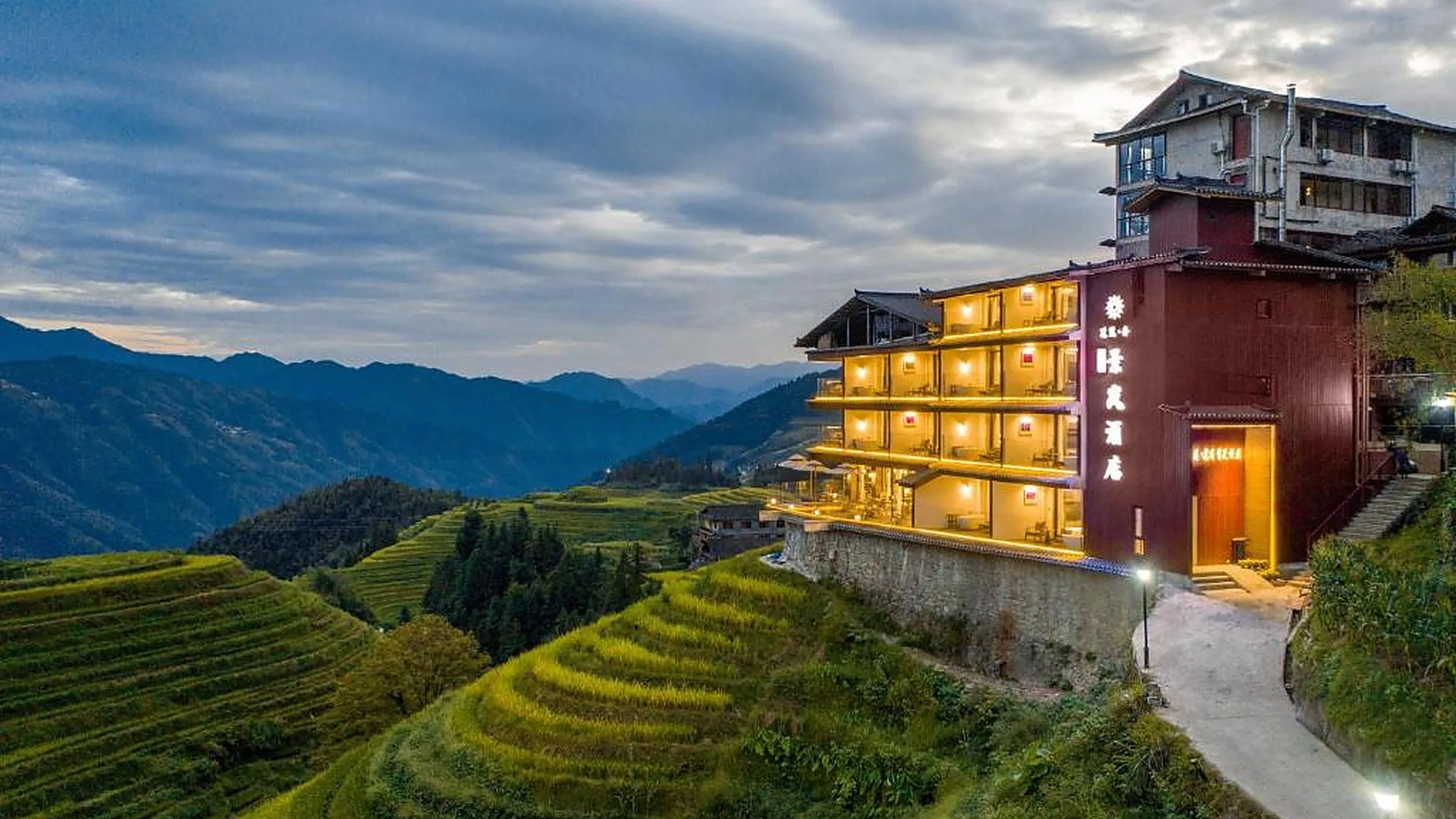
Longji Rice Terraces
龙脊梯田 · Lóngjǐ Tītián
Quick answer
Foreign passport required at entry. Tickets sold at the gate in cash, Alipay, or WeChat Pay. No advance booking required. The terraces are in Longsheng County, a Zhuang and Yao ethnic minority area — most signage is bilingual (Chinese + English).
Why visit
- 1 700-year-old terraced rice paddies — built by Zhuang and Yao minorities in the 13th century, still farmed today
- 2 The terraces span 4 main villages over a 66 km² area — the most extensive terraced landscape in China south of Yunnan
- 3 Four distinct seasonal looks: water-mirror (April-May), green planting (June-July), golden harvest (September-October), and snow (December-February, rare)
- 4 Ping'an village (平安) — the most visited, 3-4 hours, easier trails, classic viewpoint at Seven Stars with Moon (七星伴月)
- 5 Dazhai village (大寨) — the larger and more remote, 4-6 hours, more authentic, viewpoint at Thousand-Layer Ladder (千层天梯)
- 6 Zhuang and Yao cultural immersion — long-hair Yao women, red-embroidered Zhuang clothing, bamboo rice (竹筒饭) and sticky rice in bamboo tubes
Essential tips for foreigners
- Visit in April-May for the water-mirror — the terraces are filled with water for planting, and the surface reflects the sky like a mirror. The most-photographed scene in all of Guangxi.
- Take a Didi round-trip, not a tour bus — the shuttle bus schedule is rigid (08:00 outbound, 16:00 return) and doesn't allow you to catch the late-afternoon golden light. A Didi waiting driver gives you full flexibility.
- Combine Ping'an + Dazhai if you have a full day — the two villages are 15 km apart and show different scales of the terraces. A local driver can drop you at Ping'an, wait 2 hours, then drive you to Dazhai for another 2 hours.
- Bring a waterproof jacket in April-May — the rain starts suddenly, and you'll be on mountain trails with no shelter. The mist in the rain is the most photogenic of all.
- Wear hiking shoes with grip — the stone steps are wet and slippery year-round, especially in the morning when the dew hasn't dried. The trail to Seven Stars with Moon viewpoint is the steepest section.
- Don't buy 'ethnic minority souvenirs' at the gate — they're overpriced and often mass-produced. Buy from the village women directly (¥30-80) — they hand-make the embroidery and the prices are fair.
Suggested route
- 06:00 2.5 hours Early Didi from Guilin to Longji Rice Terraces (2-3 hours, ¥250-350 one-way, or ¥600-800 round-trip with waiting). The early start beats the Guilin day-trip tour buses.
- 08:30 30 min Arrive at the gate, buy ticket (¥95), enter Ping'an village. Optional cable car up (¥50-60) to skip the steep initial climb.
- 09:00 1.5 hours Walk the Ping'an trail — the 1.5 km loop to Seven Stars with Moon viewpoint (七星伴月) and Nine Dragons (九龙). Allow 1.5 hours at a comfortable pace.
- 10:30 1 hour Lunch at a Ping'an village restaurant — try bamboo rice (竹筒饭), sticky rice, smoked pork, free-range chicken. ¥50-80/person.
- 11:30 1 hour Drive to Dazhai village (15 km, 30 min). Switch to a local guide at Dazhai (optional, ¥150-250) for cultural context on the Yao minority.
- 12:30 1.5 hours Walk the Dazhai trail to Thousand-Layer Ladder viewpoint (千层天梯) — the most dramatic single viewpoint in Longji. Allow 1.5 hours.
- 14:00 1.5 hours Explore the Yao village — visit a long-hair Yao woman, see the embroidery, walk the rice paddies. Allow 1-2 hours.
- 15:30 2.5 hours Return drive to Guilin (2-3 hours). If you've arranged a waiting Didi, the driver is at the gate.
- 18:00 30 min Back in Guilin. Optional evening walk along the Two Rivers Four Lakes (两江四湖) area.
The most-photographed terraces in China
The Longji (Dragon’s Backbone, 龙脊) Rice Terraces are a 700-year-old terraced rice paddy system built by the Zhuang and Yao ethnic minorities in Longsheng County, 100 km north of Guilin. The terraces span 66 km² across four main villages — Ping’an, Dazhai, Longji, and Jinkeng — at elevations from 300 m to 1,100 m. The total length of the terraced ridges, if laid end to end, would circle the Earth.
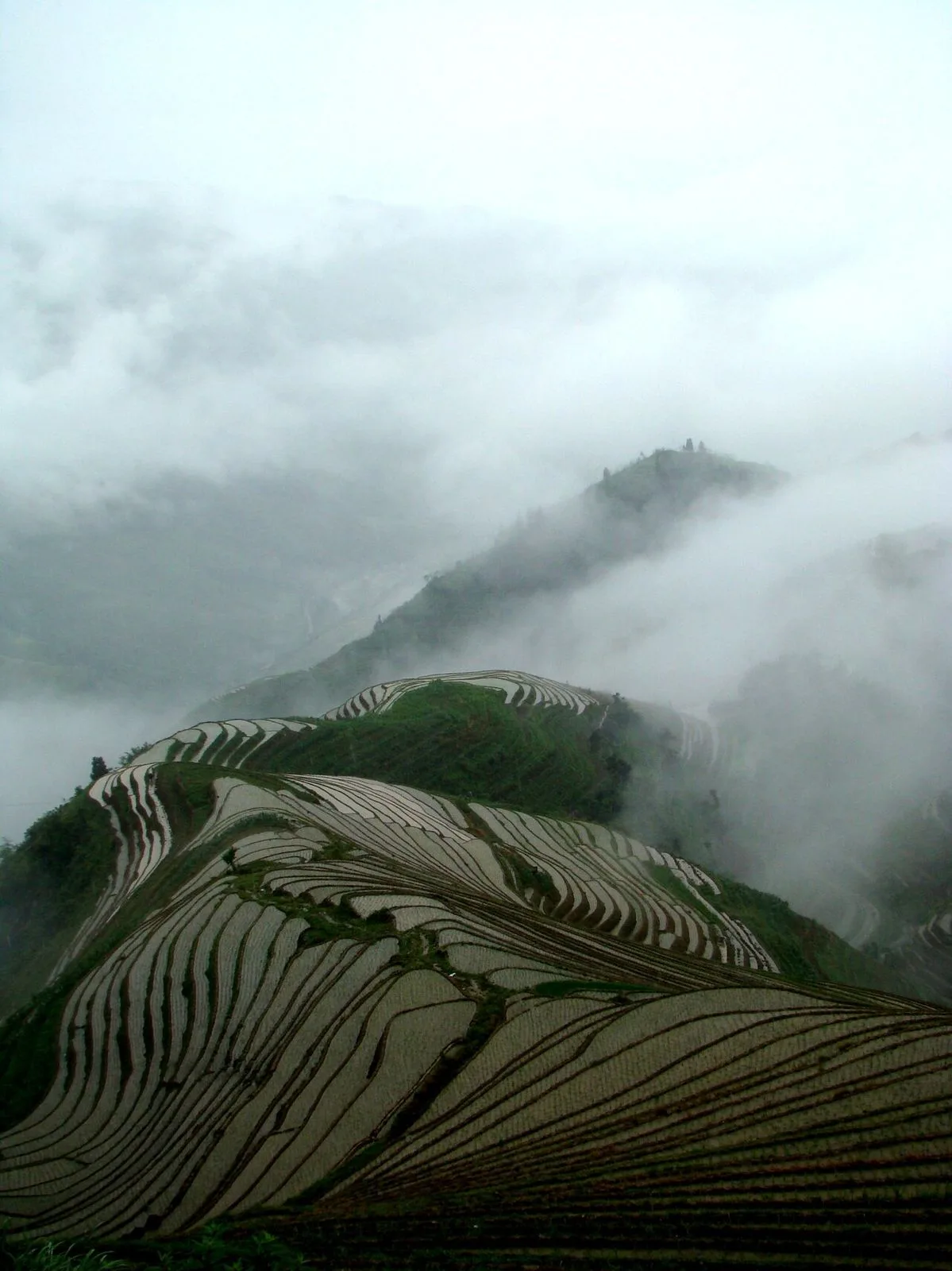
Photo: Wikimedia Commons / CC BY-SA. Source

The name “Dragon’s Backbone” comes from the shape: the ridge of the mountain resembles a dragon’s spine, with the rice paddies forming the scales. The system was designed over centuries by Zhuang farmers to maximize water retention on steep mountain slopes, and the paddies are still actively farmed today by Yao and Zhuang families using traditional methods.
For foreign visitors, Longji is the most accessible major terrace landscape in China — closer to a major international airport (Guilin) than the more famous Yuanyang terraces in Yunnan (6 hours from Kunming). The terraces are reachable as a 1-day trip from Guilin city, with a Didi round-trip or a self-drive.
What to actually see
The terraces change dramatically with the season:
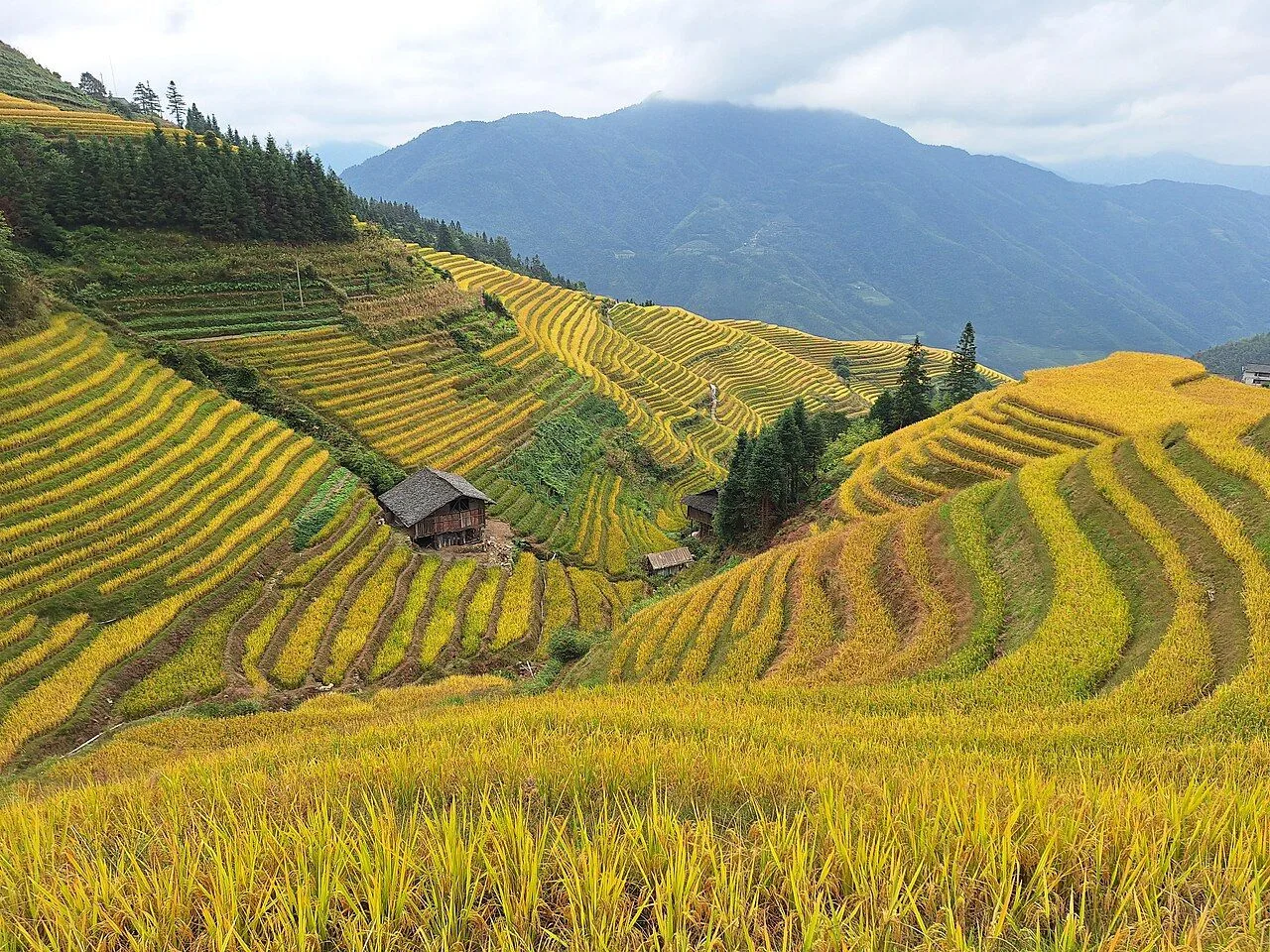
Photo: Wikimedia Commons / CC BY-SA. Source

- April-May (water-mirror season) — the paddies are filled with water for planting, and the surface reflects the sky like a mirror. The most-photographed scene in all of Guangxi. Mornings have low mist rising from the paddies; afternoons are clear and bright.
- Late June-July (green planting season) — the rice is planted, the paddies are lush green, the surrounding forest is full. Occasional rainbows. Fewer domestic tourists than April.
- September-October (golden harvest season) — the rice ripens to gold, the harvest begins, the air smells of fresh rice. The second-most-photographed season. Cooler weather.
- December-February (winter) — the terraces are dormant, the paddies are brown, occasional snow (rare in southern China). The fewest tourists. Stark and beautiful.
Two villages are the main entry points:
Ping’an (平安) — the closer (1 hour from the gate) and more visited. Easier trails, the classic Seven Stars with Moon viewpoint, more restaurants and shops. Most day-trippers and most tour buses stop here. 3-4 hours is enough.
Dazhai (大寨) — the further (1.5 hours from the gate) and more authentic. Bigger terraces, the Thousand-Layer Ladder viewpoint, less crowded, fewer Western tourists. Yao minority culture is more present. 4-6 hours to do properly.
Most foreign visitors do both villages in one day, with a Didi driver who waits at the gate.
A brief history
The Longji terraces were first built in the Southern Song dynasty (13th century) by the Zhuang minority, who migrated from the lowlands to the mountains to escape war and political instability. Over the following 700 years, Zhuang and Yao families extended the terraces, each generation adding new paddies and improving the irrigation system.
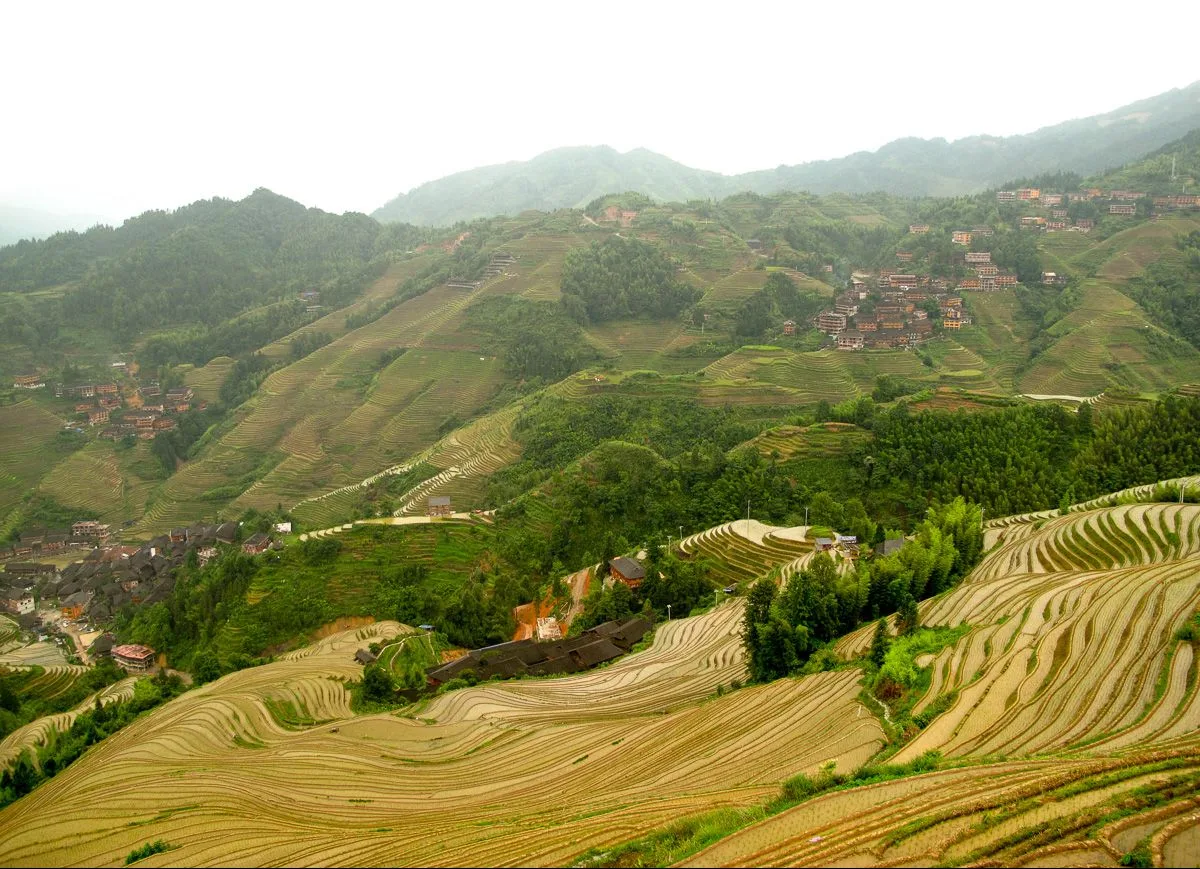
Photo: Wikimedia Commons / CC BY-SA. Source

The terraces are still actively farmed. Each family owns a few paddies and passes them down through the generations. The water-management system is communal — a village head (寨老) coordinates the water release schedule for the entire village, ensuring each paddy gets its share.
In the 1990s, the local government recognized the terraces as a tourism resource and began developing infrastructure (roads, viewpoints, restaurants). In 2018, Longji was designated a UNESCO Global Agricultural Heritage site — one of the first in China.
Getting to Longji Rice Terraces
Longji is 100 km north of Guilin, in Longsheng County. The transfer is the main challenge — there is no direct public transport that matches the rhythm of a day trip.
Didi round-trip (recommended): ¥600-800 total for a 1-day trip with the driver waiting 4-6 hours. Most flexible option. Negotiate the round-trip price before departing (the meter will be more expensive).
Self-drive: 2 hours via G65 Baotou-Maoming Expressway north to Longsheng exit, then 30 km of mountain road. Roads are paved but winding. Parking at Ping’an ¥20/day, Dazhai ¥15/day.
Tourist shuttle from Guilin Railway Station: ¥50 one-way, 2.5 hours, departs 08:00, returns 16:00. Rigid schedule but cheapest.
Private car with driver: ¥800-1,200 for a 1-day trip. Bookable through your hotel or via WeChat mini-programs.
Practicalities for foreign visitors
- Payment: Gate accepts Alipay (with international Visa/Mastercard) and WeChat Pay. Village restaurants also accept cash and Alipay. Bring small cash (¥200-500) for tips, souvenirs, and small purchases.
- Dress code: No dress code but wear hiking shoes (the stone steps are wet and slippery). Bring a waterproof jacket in April-May. Warm layers in October-November.
- Photography: Allowed throughout. The classic viewpoint at Seven Stars with Moon is the most-photographed; arrive at sunrise for the best light and fewest people.
- Language: Main viewpoints and the gate are bilingual (Chinese + English). The trails have Chinese-only signage. Local Zhuang and Yao people speak basic Mandarin.
- Restrooms: Available at the gate, the main viewpoints, and at most village restaurants (¥2-5). Bring your own tissue paper.
- WiFi: No WiFi at the terraces. Use mobile data (China eSIM recommended).
What to do nearby
- Li River Cruise (漓江) — 65 km south, the classic Guilin-to-Yangshuo cruise. Combine with Longji for a 2-day Guilin itinerary.
- Reed Flute Cave (芦笛岩) — 5 km from Guilin city, a 240-meter illuminated limestone cave. Half-day visit.
- Elephant Trunk Hill (象鼻山) — the symbol of Guilin city, a 55-meter hill shaped like an elephant drinking from the Li River. Easy 1-2 hour visit.
- West Street, Yangshuo (阳朔西街) — 65 km south, the foreigner-friendly pedestrian street with 800+ shops. Combine with Longji for a 2-day trip.
Best photo spots
-
Seven Stars with Moon viewpoint (七星伴月), Ping'an village · 06:00-08:00 (sunrise) and 16:00-18:00 (golden hour, sunset)
The most-photographed viewpoint in all of Guangxi. Seven small rounded terraces clustered around a larger moon-shaped paddy. Best at sunrise with morning mist. The classic 'Lonely Planet' Longji shot.
-
Thousand-Layer Ladder viewpoint (千层天梯), Dazhai village · 10:00-14:00 (midday side-light)
A massive 800-meter-long terrace wall with 500+ visible levels cascading down the mountain. More dramatic than Ping'an but harder to access (1.5 km uphill walk from the village).
-
Ping'an village rooftops (looking down on the terraces) · 06:30-09:00 (morning side-light)
The 200-year-old wooden Zhuang houses provide foreground interest for the terraces. Climb to the highest wooden building in the village and shoot down. Best in April-May (water reflection) and October (golden harvest).
-
Yao long-hair women in traditional dress (大寨, Dazhai) · Any time (most women are happy to pose for ¥20-30 tip)
Red-embroidered clothing, long black hair wrapped around a wooden comb, silver jewelry. The most authentic cultural portrait in Longji. Ask before photographing — most women are willing.
Where to eat nearby
-
Village bamboo rice (竹筒饭) at Ping'an or Dazhai
Glutinous rice cooked inside a fresh bamboo tube, often with smoked pork or mushrooms. The signature dish of the Longji terraces — the bamboo imparts a subtle smoky flavor to the rice. · ¥15-30/tube · Multiple village restaurants in Ping'an and Dazhai
-
Yao smoked pork (瑶族熏肉) at Dazhai
Pork belly smoked over a low fire for 2-3 days, served sliced. Rich, fatty, deeply smoky. The signature dish of the Yao minority. · ¥40-60/portion · Dazhai village restaurants
-
Free-range chicken soup (土鸡汤) at Ping'an
Whole chicken slow-cooked with ginger and mountain herbs. Clear broth, tender meat, very nourishing. Served family-style in the village. · ¥80-120/chicken (serves 3-4) · Ping'an village restaurants
-
Sticky rice in bamboo (糯米饭) at Dazhai
Black or white glutinous rice steamed in a small bamboo basket, served with chili dip or smoked meat. The Yao staple food, eaten at every meal. · ¥10-20/basket · Dazhai village restaurants
Frequently asked questions
How long does it take to visit Longji Rice Terraces?
Full day (8-10 hours including transfer). The round-trip from Guilin is 4-5 hours (2-3 hours each way), so most visitors do an early 6:00 AM departure and 8:00 PM return. Ping'an village alone is 3-4 hours, Dazhai alone is 4-5 hours. Most foreign visitors combine both villages with a Didi driver who waits.
How much does Longji Rice Terraces cost?
Gate entry: ¥95. Cable car to viewing platforms: ¥50-60 each way (optional). Local guide: ¥150-250/day. Shuttle between Ping'an and Dazhai villages: ¥20-50. Round-trip Didi from Guilin: ¥600-800. Total day cost: ¥350-500 per person including meals at a village restaurant.
Is Longji kid-friendly?
Partially. The main viewpoints are accessible, but the full trail network has steep stone steps. Children under 6 should be carried or in a hiking carrier (not stroller — too rough). Older children (8+) can manage the Ping'an trail. The village atmosphere (water buffalo, bamboo forests, Yao women weaving) appeals to children.
What is the best time to visit Longji Rice Terraces?
Four distinct seasons: **April-May (water-mirror)** — the most-photographed, the terraces are filled with water and reflect the sky. **Late June-July (green)** — rice planting, lush green, occasional rainbows. **September-October (harvest)** — golden paddies, fewer tourists than April, warmer weather. **December-February (winter)** — rare snow, terraces are dormant, fewer tourists but the views are stark. Avoid Chinese National holidays (Oct 1-7, May 1-3).
How does Longji compare to Yuanyang Rice Terraces (Yunnan)?
Yuanyang (Hani minority terraces) is the most famous in China, but it's a 6-hour drive from Kunming and a multi-day trip. Longji is closer to a major international airport (Guilin) and is reachable as a day trip. Yuanyang is more dramatic (deeper, steeper), Longji is more accessible (better infrastructure, more visitor services). For most foreign visitors with limited time, Longji is the right choice.
Can I stay overnight in the villages?
Yes, and we recommend it for the sunrise. Ping'an and Dazhai both have family-run guesthouses (¥150-300/night for a clean double room, often with home-cooked Yao or Zhuang meals). The sunrise from Seven Stars with Moon viewpoint is the most-photographed moment in all of Guangxi. Most English-speaking hostels are in Ping'an; Dazhai is more remote and quieter.
Is Longji accessible without Chinese language skills?
Yes, with a phone and translation app. Most signs at the gate and main viewpoints are bilingual. The local Zhuang and Yao people speak basic Mandarin (their own language at home). Download Pleco and Google Translate (with the offline Chinese pack). Your Didi driver will help with translations on the spot.
What is the difference between Ping'an and Dazhai villages?
Ping'an (平安) is the closer (1 hour from gate) and more visited — easier trails, classic Seven Stars with Moon viewpoint, more restaurants and shops. Dazhai (大寨) is further (1.5 hours from gate) and more authentic — bigger terraces, less crowded, longer Thousand-Layer Ladder viewpoint, fewer Western tourists. Both are spectacular. Combine both if you have a full day; pick Ping'an if you have only 3-4 hours.