
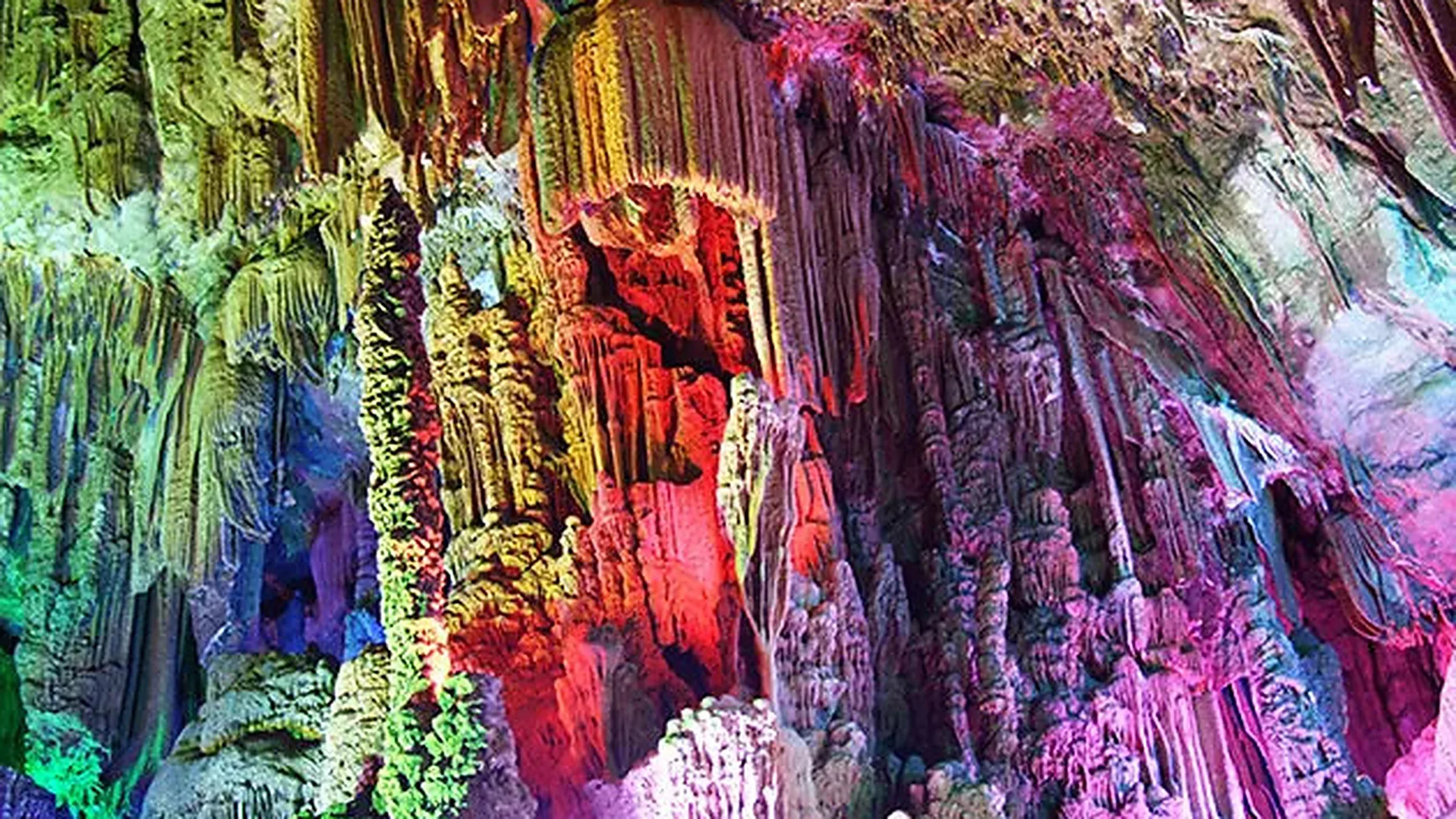
Reed Flute Cave
芦笛岩 · Lúdí Yán
Quick answer
Foreign passport required at entry. Tickets sold at the gate in cash, Alipay, or WeChat Pay. No advance booking required. The cave is well-organized for self-guided visits with English signage throughout.
Why visit
- 1 240-meter illuminated limestone cave — one of the most-visited caves in China, open to the public since 1962
- 2 Discovered in 1959 and developed into a tourist attraction in 1962 — the cave has been welcoming visitors for 60+ years
- 3 Stalactite formations lit with red, blue, green, and purple LED lights — the color comes from the lights, not the rocks themselves
- 4 The cave's name comes from the reeds growing outside — ancient people made flutes from the reeds, hence 芦笛 (reed flute)
- 5 Year-round 16-20°C climate — a relief from Guilin's hot, humid summers or cold winters
- 6 1-2 hours total visit — the most efficient major attraction in Guilin, perfect for a half-day
Essential tips for foreigners
- Buy the ¥20 audio guide — available in English, French, German, Japanese, Korean, and Mandarin. The guide explains each major formation in 30-40 minutes and turns a 'just rocks' experience into a 270-million-year geological story.
- Visit in summer (June-August) for the temperature escape — the cave is 16-20°C year-round, a 15°C drop from Guilin's summer heat. Or visit on a rainy day when the outdoor karst landscape is fogged in.
- Take Bus 3 or 213 from Guilin Railway Station — the cheapest way to reach the cave (¥2, 30 min). Didi is ¥20-30 and faster but the bus lets you see the city along the way.
- Allow 1-2 hours, not 3-4 — the cave is 240 meters long with a single one-way walking path. Most visitors spend 45-90 minutes inside. Don't over-budget time.
- The colors are LED lights, not natural rock color — the stalactites are naturally white/gray/yellow limestone. The red, blue, green, purple colors come from LED lighting designed to highlight the formations. This is widely known but worth mentioning for first-time visitors who might be confused.
- Combine with Elephant Trunk Hill (象鼻山) — both are in northwestern Guilin, only 5 km apart. Morning at Reed Flute, lunch, then Elephant Trunk Hill for a perfect half-day itinerary.
Suggested route
- 09:00 30 min Take Bus 3 or 213 from Guilin Railway Station (¥2, 30 min), or Didi (¥20-30, 15 min). Arrive at the cave gate.
- 09:30 15 min Buy ticket (¥90), pick up audio guide (¥20), enter the cave. The guide explains the first formation.
- 09:45 1.5 hours Walk the 240-meter cave path. The audio guide covers 27 major formations. Allow 60-75 minutes.
- 11:15 30 min Exit the cave. Optional: visit the cymbidium greenhouse (¥30, 30 min) for a different micro-climate experience.
- 11:45 30 min Return to downtown Guilin by Didi (¥20-30, 15 min) or Bus 3/213 (¥2, 30 min). Optional lunch at a downtown Guilin restaurant.
- 13:00 1.5 hours If you have the afternoon free, walk to Elephant Trunk Hill (象鼻山) — 5 km from Reed Flute, 15 min by Didi. Combine for a half-day itinerary.
A 270-million-year-old cathedral
The Reed Flute Cave (芦笛岩, Lúdí Yán) is a 240-meter illuminated limestone cave 5 km northwest of Guilin city center. The cave was formed over 270 million years as mineral-rich water dripped through the limestone, slowly depositing calcium carbonate into stalactites (hanging from the ceiling), stalagmites (rising from the floor), and columns (where the two have joined).
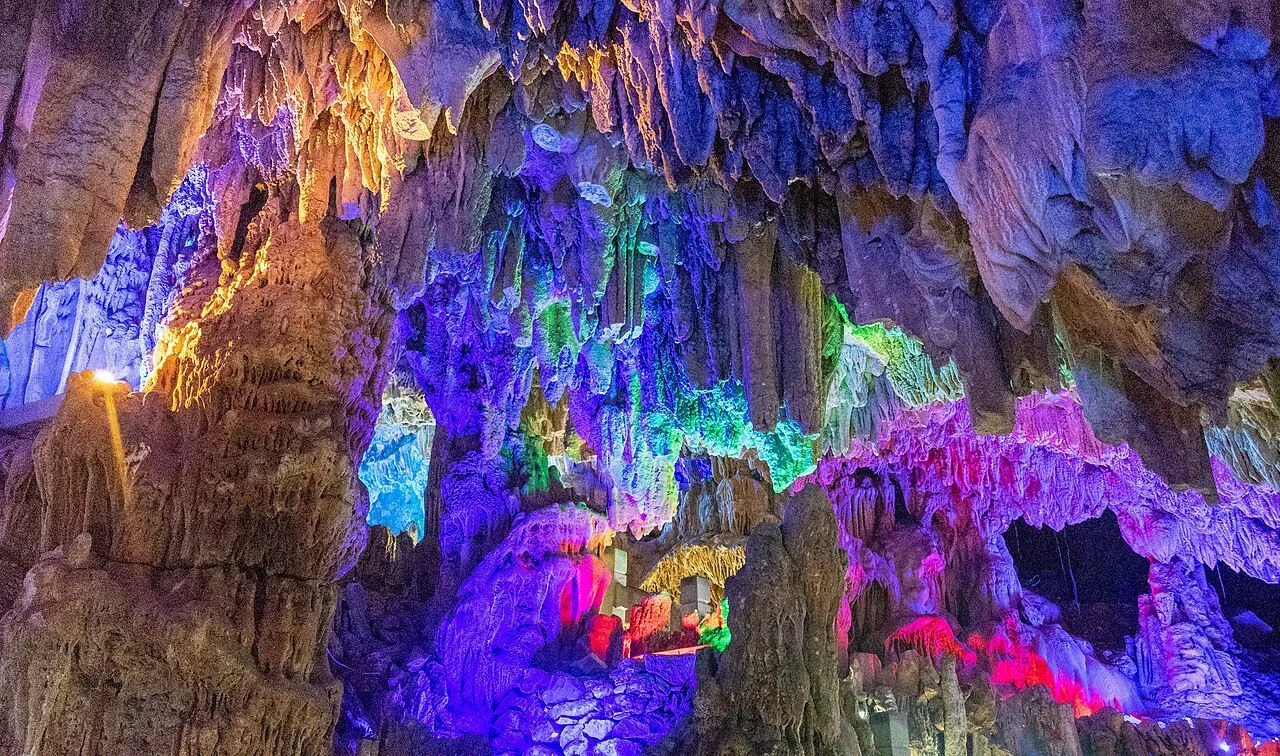
Photo: Wikimedia Commons / CC BY-SA. Source
.jpg)
The cave was ‘discovered’ in 1959 by a local farmer who was hunting in the mountains. News of the beautiful underground formations reached the Guilin government, and the cave was developed into a tourist attraction in 1962 — the first major show cave in southern China. In 1972, President Nixon visited Guilin and was taken through the cave, which put Reed Flute on the international tourism map.
The cave’s name comes from the reeds (芦) that grow outside the cave entrance. In ancient times, local people made flutes (笛) from these reeds, hence 芦笛 (reed flute) and 芦笛岩 (reed flute rock). The reeds still grow outside the cave today.
What to actually see
The 240-meter walking path takes you through 27 major formations, each with a fanciful Chinese name and an LED light highlighting it. The audio guide (¥20, available in 6 languages) explains the geology and naming of each formation. Highlights include:
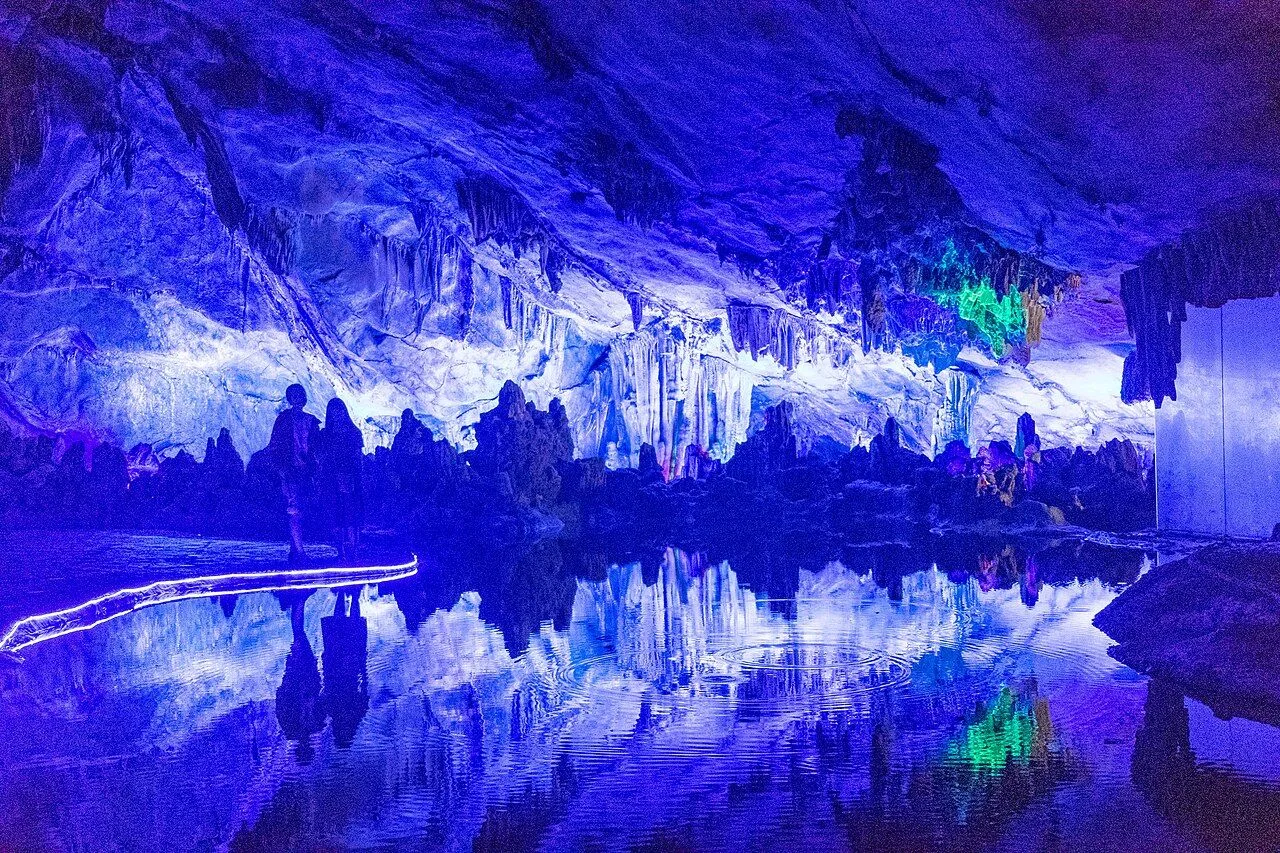
Photo: Wikimedia Commons / CC BY-SA. Source
.jpg)
Crystal Palace (水晶宫) — the largest chamber, 100m long x 18m high. The colored LED lights (red, blue, green, purple) reflect in the still underground pool, creating a mirror effect. The most-photographed spot in the cave.
Single Pillar (独柱擎天) — a 9-meter-tall single stalagmite column, dramatically lit. The audio guide explains how it formed over 270 million years as a single drop of mineral-rich water at a time.
Pine and Cypress in the Forest (林海雪原) — a chamber with multiple stalactites resembling pine trees. The lights cycle slowly from blue to green to purple, simulating dawn to dusk.
Crystal Curtain (帘外幕) — a thin, translucent stalactite formation that looks like a draped silk curtain. The audio guide explains how it formed through 100,000+ years of slow mineral deposition.
The pace is self-guided but typically takes 45-90 minutes. The path is flat and paved, fully wheelchair accessible. The cave is climate-controlled at 16-20°C year-round — bring a light layer even in summer.
A brief history
The cave was formed 270 million years ago in the Permian period, when the Guilin area was a shallow tropical sea. As the sea receded, limestone was deposited. Over the following millions of years, rainwater absorbed carbon dioxide from the air, becoming weakly acidic, and slowly dissolved the limestone, creating underground caves. As the water dripped through the caves, it left behind calcium carbonate deposits, which accumulated into the stalactites and stalagmites we see today.
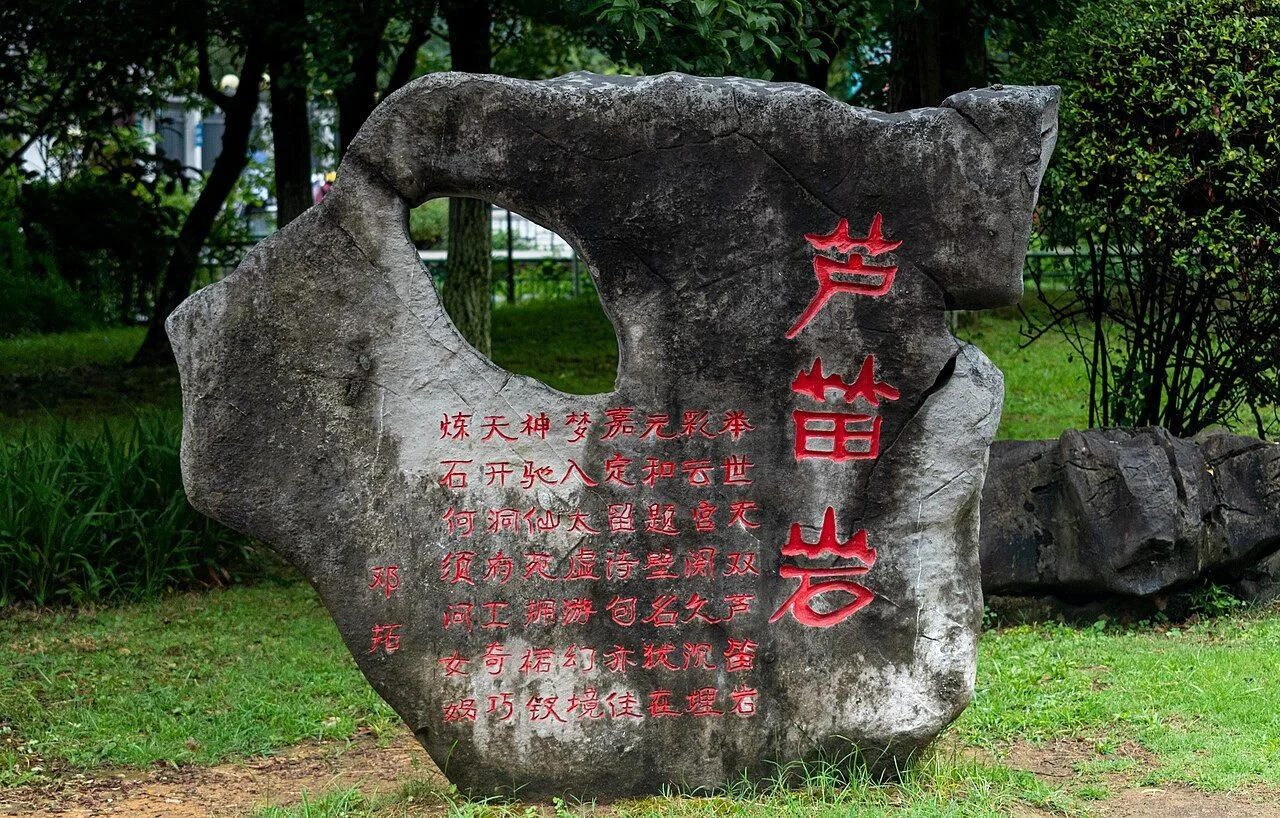
Photo: Wikimedia Commons / CC BY-SA. Source
.jpg)
The cave was ‘discovered’ by a local farmer in 1959. The Guangxi government recognized its tourism potential and developed it as a show cave, opening to the public in 1962. The first LED lighting system was installed in 1980 and has been progressively upgraded — the current colorful lighting was installed in 2010.
In 1972, US President Richard Nixon visited Guilin as part of his historic visit to China, and was taken through the cave. Photos of Nixon in Reed Flute Cave were widely published, putting Guilin on the international tourism map and making Reed Flute one of the most famous caves in China.
Getting to Reed Flute Cave
The cave is 5 km northwest of downtown Guilin, easily accessible:
Bus 3 or 213 from Guilin Railway Station: ¥2, 30 minutes. The cheapest option. The bus also passes the Li River and several downtown landmarks — a good introduction to the city.
Didi: ¥20-30, 15 minutes. The fastest option. Show the driver 芦笛岩 (Lúdí Yán).
Self-drive: 20 minutes from downtown. Free parking at the cave entrance.
Bicycle: 30-40 minutes from downtown via the riverside path. A scenic ride but not for the unfit.
Practicalities for foreign visitors
- Payment: Gate accepts Alipay (with international Visa/Mastercard) and WeChat Pay. Cash also accepted. Audio guide deposit: ¥100 (refundable).
- Temperature: The cave is 16-20°C year-round. Bring a light layer even in summer; the cool cave is a relief from Guilin’s 35°C heat.
- Photography: Allowed throughout (no flash, no tripod restrictions). Long exposure (1-2 seconds) works best for the reflection shots.
- Accessibility: Fully wheelchair accessible. Paved path, well-lit, benches every 50-100 meters.
- Audio guide: Available in English, French, German, Japanese, Korean, and Mandarin. ¥20. Highly recommended.
- Restrooms: Available at the gate. Bring your own tissue paper.
What to do nearby
- Li River Cruise (漓江) — 65 km south, the classic Guilin-to-Yangshuo cruise. Combine with Reed Flute for a 1-day Guilin itinerary.
- Elephant Trunk Hill (象鼻山) — 5 km from Reed Flute, the symbol of Guilin city, a 55-meter hill shaped like an elephant drinking from the Li River. Easy 1-2 hour visit.
- Longji Rice Terraces (龙脊梯田) — 100 km north, the 700-year-old terraced rice paddies. Combine with Reed Flute for a 2-day trip.
- West Street, Yangshuo (阳朔西街) — 65 km south, the foreigner-friendly pedestrian street. Combine with Reed Flute and the Li River cruise for a 2-day itinerary.
Best photo spots
-
Crystal Palace (水晶宫) — the largest chamber inside the cave · Any time (the lighting is constant)
The largest single chamber in the cave, 100m long x 18m high. The colored LED lights reflect in the still underground pool, creating a mirror effect. Best shot: long exposure (1-2 seconds) to capture the reflection. Tripod recommended.
-
Single Pillar (独柱擎天) — a stalagmite column · Any time
A 9-meter-tall single stalagmite column, dramatically lit. The most-photographed single formation in the cave. The audio guide explains how it formed over 270 million years.
-
The cave entrance (looking back at the natural light) · Any time
From inside the cave, looking back at the entrance — the natural green foliage frames the artificially-lit interior. A good 'before/after' composition showing the transition from Guilin's surface to the underground.
-
The cymbidium greenhouse (芦笛景区兰花圃) · Spring (March-May) for orchid blooms
Outside the cave, a small greenhouse with 200+ orchid varieties. Different micro-climate. Optional ¥30 entry. Best in spring when the orchids are in bloom.
Where to eat nearby
-
Guilin rice noodles (桂林米粉) at downtown Guilin
The signature Guilin dish — rice noodles in a clear broth with pickled beans, peanuts, chili, and your choice of meat (beef, pork, intestine). Cheap and ubiquitous. ¥10-25/bowl. · ¥10-25/bowl · Multiple locations in downtown Guilin (5 km from cave)
-
Beer fish (啤酒鱼) at Yangshuo (65 km south)
Carp from the Li River cooked with beer, tomatoes, peppers, and ginger. The signature Yangshuo dish. Sweet, sour, and savory. · ¥80-150/fish · Yangshuo West Street area (65 km from cave, 1 hour by Didi)
-
Lipu taro braised pork (荔浦芋扣肉) at downtown Guilin
Pork belly braised with Lipu taro (a local specialty). Rich, fatty, savory. The signature dish of Guilin banquets. · ¥40-80/portion · Downtown Guilin restaurants
-
Snail rice noodles (螺蛳粉) at downtown Guilin
Guilin's famous strong-smelling snail broth rice noodles. Acquired taste — the fermented bamboo shoots give a distinctive 'rotten' smell. Locals love it; foreigners either love it or hate it. · ¥15-30/bowl · Multiple downtown locations, especially Zhengyang Pedestrian Street (正阳步行街)
Frequently asked questions
How long does it take to visit Reed Flute Cave?
1-2 hours total. The cave itself is a 240-meter one-way walk, typically taking 45-90 minutes at a comfortable pace. The gate, audio guide pickup, and the cymbidium greenhouse (optional) add 30-60 minutes. Most visitors are done in 1.5 hours.
How much does Reed Flute Cave cost?
Gate entry: ¥90. Audio guide: ¥20 (highly recommended). Cymbidium greenhouse: ¥30 (optional). Total: ¥110-140 per person. Bus from downtown: ¥2. Didi from downtown: ¥20-30. Round trip + cave visit: ¥150-200 per person.
Is Reed Flute Cave kid-friendly?
Yes — very. The path is flat and paved, fully wheelchair accessible. The colorful lights and fantasy names of formations (Crystal Palace, Single Pillar, etc.) appeal to children. The temperature is comfortable year-round. Strollers work. Audio guide has a children's version in some languages.
What is the best time to visit Reed Flute Cave?
Year-round. The cave is climate-controlled. Summer (June-August) is most popular for the temperature relief. Winter (December-February) is least crowded. Spring and autumn are balanced. The cave is open 08:00-17:00 daily. Arrive at 08:00 opening or 16:00 (last hour) for the fewest crowds.
Are the formations natural or painted?
The formations are natural — stalactites, stalagmites, and columns that have grown over 270 million years as mineral-rich water dripped through the limestone. The COLORS are from LED lighting installed in the 1990s-2010s. The natural color of the limestone is white, gray, and pale yellow. The lights highlight the formations and create the dramatic visual experience.
How does Reed Flute Cave compare to other caves in China?
Reed Flute is one of three famous illuminated show caves in China (along with Stalagmite Cave in Beijing and Zhijin Cave in Guizhou). Reed Flute has the most colorful and varied lighting, the easiest access (5 km from downtown Guilin), and the best audio guide. For geology enthusiasts, Zhijin Cave in Guizhou is more dramatic, but it's 2 hours from Guiyang and harder to reach.
Can I take photos inside the cave?
Yes, photography is allowed throughout. The colored lights are dramatic but require either a steady hand (no flash) or a small tripod for sharp shots. The best photo spot is the reflection in the underground pool at the Crystal Palace (水晶宫) formation — try a long exposure (1-2 seconds) to capture both the formation and its reflection.
Is the cave accessible to people with mobility issues?
Yes — the path is flat, paved, and well-lit. Wheelchairs, walkers, and strollers all work. The cave is fully wheelchair accessible. Benches are available every 50-100 meters for those who need to rest.