Sea of Clouds at Huangshan
云海 · Yúnhǎi
Quick answer
There is no separate ticket and no separate checkpoint for the clouds. Everything that applies on the mountain applies here: carry your passport, because the mountain entrance ticket category and any cable car are validated against it. The one thing worth saying plainly is that this is the single most weather-dependent thing you will plan a whole trip around, and no amount of advance booking changes it.
Why visit
- 1 A weather event rather than an attraction: cloud pooling in the valleys below the summit overnight, named for looking like an ocean from above
- 2 Best odds come from the run of days after rain or snow, when the valleys fill it; the summit is in cloud on more than 200 days a year and the view is simply absent on those days
- 3 Seen from the high ridges above 1,800 m, principally from Bright Summit, with the summit areas historically called the North Sea and South Sea for the cloud they look out over
- 4 Costs nothing extra and has no gate - but it is inseparable from being on the mountain, which is not free
- 5 Burns off after sunrise, so the window is first light to mid-morning rather than all day
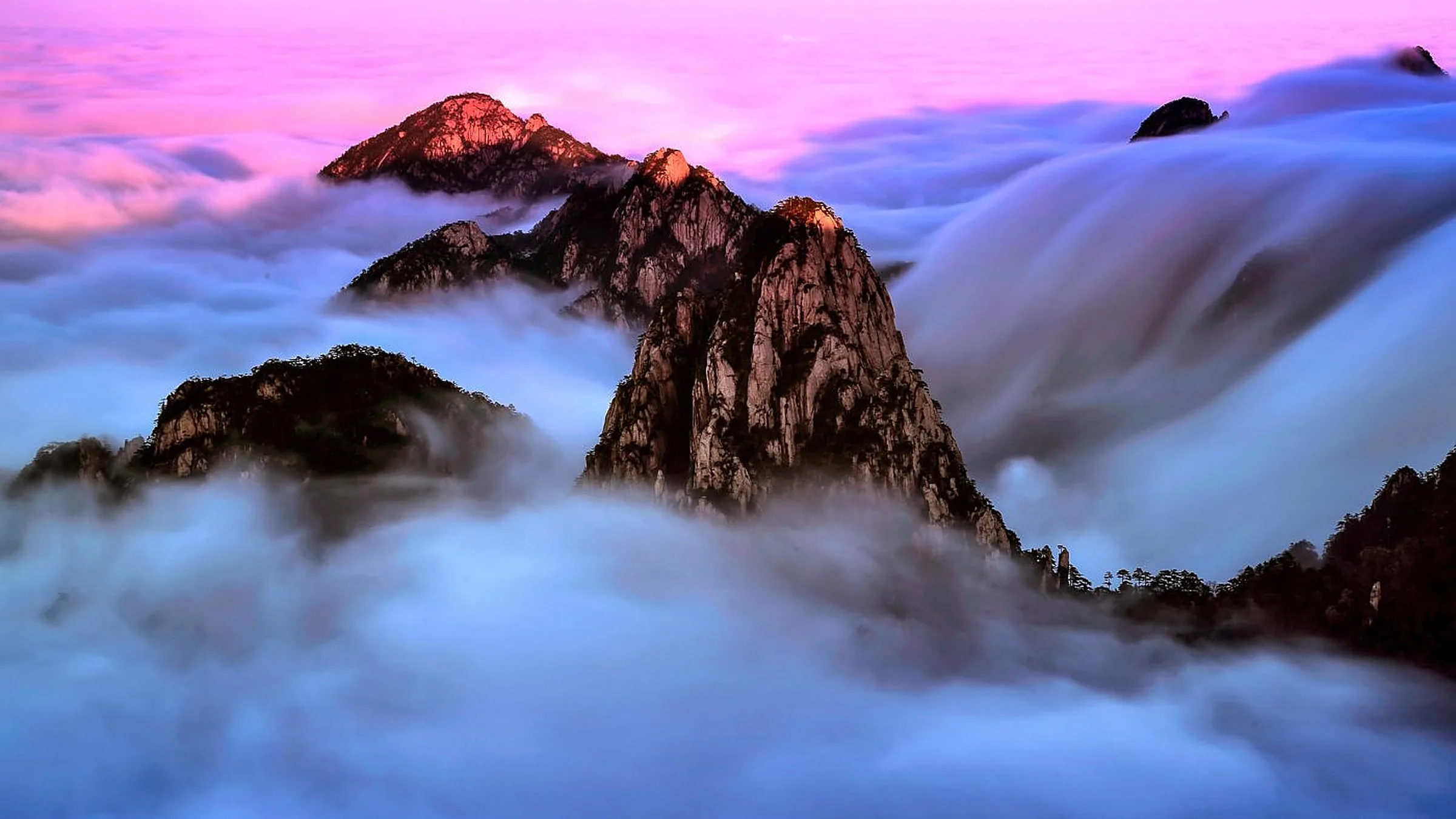
- 6 The same weather that hides the peaks lights them: the classic cloud-sea image is warm light on granite with white cloud below
Essential tips for foreigners
- Go up the night before. The cloud forms after dark in the valleys, so you cannot drive up to it in the morning. Staying on the summit is the only way to be standing above it at first light.
- Check the forecast for rain, not just for cloud. Wet weather the previous night is what fills the valleys. A dry clear week is the bad case, not the good one.
- Accept the 200-day problem. The summit is in cloud on a large share of days of the year. A trip built around the sea of clouds needs slack days, because you are gambling on weather.
- Treat it as a bonus, not the plan. Build the trip on the mountain's permanent features - the granite, the pines, the carved steps - and let the cloud sea be the thing that happens to you.
- Do not count on the mountain being free to reach. No ticket buys the clouds; the mountain entrance and any cable car are separate, and published figures for them disagree.
Suggested route
- Day before, 15:00 15 min Read the forecast for the valley, not just the summit, and decide whether the previous night is a wet one
- Day before, late afternoon 1 hour Ride up and check the state of the cloud in the valleys below before you commit to the night
- 17:00 2 hours Settle in on the summit; the cloud arrives in the valleys after dark, so there is nothing to wait for yet
- 05:30 30 min Get out before first light and find a position with an unobstructed line down into the valleys
- 06:00 1 hour Watch the cloud sea form and take the light on the granite as the sun comes up
- 07:30 1 hour Cloud is burning off by now - this is your window and it is closing
- 09:00 1-2 hours Descend, or drop to a lower valley viewpoint where the cloud often persists after it has left the peaks
This is weather wearing a destination’s clothes
The single most useful thing to understand about the Huangshan sea of clouds is that it is not a place. There is no gate, no ticket, no boundary and no address. Cloud collects in the valleys overnight after rain, the temperature inversion holds it there, and at first light the people standing on a summit ridge at nearly 1,900 metres look down at the top of an ocean that formed while they were asleep.
That reframing removes most of the confusion people arrive with. It is free, in the sense that nothing extra is sold for it. It is also completely out of your control, in a way that no other attraction on this mountain is.
Photo: Wikimedia Commons / CC BY-SA. Source: stored in this repository as the Huangshan cloud-sea reference image.
Why it is called a sea
The name is not decorative. The summit areas of Huangshan have historically been named for the cloud they look out over rather than for their own geology, with areas called the North Sea and South Sea for the water they face. When you stand at Bright Summit on a good morning you are looking down at a flat white surface with ridges coming out of it, and the resemblance is close enough to be the reason the name stuck and the reason it survives in guidebooks.
It also explains why the historical descriptions of this mountain emphasise the view so heavily. Huangshan has been painted, photographed and written about for a thousand years, and the cloud sea is very often the subject, because it is the condition that makes the granite worth looking at.
The 200-day problem
Here is the number that should govern how you build a trip around this. The summit of Huangshan is in cloud for something over two hundred days a year, and on those days the scenery is simply hidden - not degraded, hidden. If you arrive on one of those mornings there is no sea of clouds, and there is also no peaks.
The corollary is that the sea of clouds and the peaks are not independent things. People treat the cloud sea as a bonus on top of a good mountain day, when in practice they are the same condition. A morning with a spectacular cloud sea very often has the peaks in and around it, briefly, at odd angles. A morning with clear air and crisp peaks all day is a morning that probably missed.
What actually produces it
The mechanism is simple enough to plan around, which is the useful part.
Cloud forms in the valleys rather than at the summit because the valley air cools overnight and the temperature inversion traps the moisture below you. Rain and snow do the cooling. So the signal to watch is not today’s forecast but the previous day’s, and more precisely whether it rained in the valley.
That is why a clear sunny week can be a bad week for this. People arrive on a run of beautiful clear days and find crisp, empty, cloudless peaks and no ocean. Conversely the days after a wet spell are the ones worth rearranging a schedule for.
Where to stand, and where not to
You have to be above the cloud layer, which in practice means on the summit ridge. Bright Summit is the classic position and the one with the observatory, and the neighbouring high platforms along the ridge all work for the same reason: they are high enough that the cloud is below your feet rather than around your head.
The instinct to stand at the entrance or in the valley is wrong, and worth unlearning before you go. From below, on a morning when the summit is clear, you may well look across the top of a cloud sea toward the peaks - which is a fine photograph, and frequently a better one, but it is the opposite vantage from the famous image.
The window is short and it is early
Cloud arriving in the valleys after dark and burning off after sunrise means the usable window is roughly first light to mid-morning. The famous photographs are made in the first hour. By late morning you are looking at ordinary mountains.
If you want the evening version, the same conditions recur at sunset in the opposite direction, with fewer people on the ridge and often cleaner colour, because the air has been in sunlight all day. If you can only manage one dawn on the mountain, spend it here.
What to do when it does not come
Since it will not always come, it is worth being clear about what the mountain is like without it, because the answer is that it is still a very good mountain.
Huangshan is granite. The permanent features are the pinnacles and the cliffs, the Huangshan pines growing straight out of bare rock with nothing but mist and rainwater to feed them, and an extraordinary number of stone steps carved into the cliff faces across the summit area, some of which are said to be around fifteen hundred years old and some of which are still being cut into the rock today. None of that is weather-dependent, and none of it is the same thing as the cloud sea.
The useful framing is to build the trip on those, and treat the cloud as what happens to you if the nights have been wet. People who do this have a good trip either way. People who build a two-day schedule around a forecast and then get a clear, flat, disappointing morning tend to be the ones who remember Huangshan as a disappointment.
One thing to be clear about on cost
There is no ticket for the sea of clouds and there is nothing to buy for it. But the mountain you have to be standing on is not free to enter, and a cable car, if you use one, is a further separate purchase.
We are not quoting you a mountain entrance figure here, and that is deliberate. The published numbers we could find for the Huangshan Scenic Area entrance disagree with one another substantially, which means at least some of them are out of date, and a guide that quotes a confident wrong price sends you to the ticket window with the wrong expectation. Buy it at the gate on the day.
Best photo spots
-
Bright Summit (光明顶) looking east at first light · 20 minutes before sunrise to shortly after
The standard framing: warm light arriving on the granite ridges with the white cloud sea filling everything below them. Get there early enough to have a position before the light, because the good foreground goes fast at dawn.
-
Any high platform on the summit ridge with a west-facing line · Sunset, for the reverse view
The same conditions in the evening light, looking the other way. Less crowded than the dawn crowd, and the colour is often cleaner at sunset because the air has been sitting in sunlight all day.
-
Lower valley viewpoints below the summit · Mid-morning, after the summit cloud has gone
When the sea of clouds is happening you are generally too high to see much of it. From down in the valleys the reverse is true - you look across the top of a cloud sea toward clear peaks. Often the better shot of the same morning.
Frequently asked questions
Is there a ticket for the Huangshan sea of clouds?
No, and that is the honest answer. The cloud is a weather phenomenon in the valleys below the summit, not a site with a gate. What you do have to pay for is getting onto the mountain - the scenic area entrance and any cable car are separate tickets bought at the gate.
What time of day is the sea of clouds best?
From first light until roughly mid-morning. The valleys fill with cloud overnight and the rising sun burns it off, so an afternoon visit usually finds an ordinary clear view of peaks instead.
How do I guarantee seeing the sea of clouds?
You cannot, and anyone who tells you otherwise is selling something. The condition is weather - cloud pooling overnight after rain or snow. Build a trip with spare days, stay on the summit the night before, and accept that you may not get it.
Where exactly do I stand?
Bright Summit is the classic spot, with the neighbouring high platforms along the summit ridge also working. What matters is being above the cloud layer, which is why the low entrances and the valley viewpoints are the wrong places to be standing.
Is the sea of clouds the same as the hot springs or the pines?
They are separate things that share the name of the same mountain. The clouds form above the valleys, the pines grow out of granite at the summit, and the hot springs are at the foot. You can see pines and cloud in the same frame; the springs are a completely different trip.
What if I get to the summit and there is no cloud?
Then you are in weather, not on a wasted trip. The permanent reasons to be on Huangshan - the granite pinnacles, the pines on the cliffs, the sea of stone steps carved into the rock - are not weather-dependent. See it from a lower viewpoint the same day if you want a cloud sea without the summit, because it often fills the valleys while the peaks are clear.
Sources
- Huangshan — English Wikipedia (the Sea of Clouds seen from the summits and why it is called that, the North Sea and South Sea named vistas, over 200 days a year with the summit in cloud, cloud collecting in the valleys overnight after rain or snow, the pines growing out of the rock, Buddha's Light) · Wikipedia
- Huangshan — Wikivoyage (the summit being in cloud for over 200 days a year and the scenery hidden when it is, valleys collecting cloud overnight after rain or snow to form the cloud sea, the summit plateau and hotel locations used for sunrise) · Wikivoyage
- Bright Summit on OpenStreetMap (peak node 793824924 at 30.1346774 / 118.1640111, Huangshan District, Huangshan City, Anhui) · openstreetmap.org