Shuhe Old Town
束河古镇 · Shùhé Gǔzhèn
Quick answer
No passport check and no separate foreigner ticket for walking the streets of Shuhe. Carry your passport anyway if you are combining this with Dayan Old Town or any ticketed site in Lijiang, because those do check ID and your passport is what establishes your identity for any discounted category.
Why visit
- 1 A component of the UNESCO World Heritage property Old Town of Lijiang, inscribed in 1997 — the official component register lists it as 811-004 Shuhe Town, alongside Dayan and Baisha
- 2 Free to walk. There is no entrance ticket, and the ¥50 Lijiang Old Town maintenance fee is a separate charge for the Old Town core area, not for this settlement
- 3 One of the earliest Naxi settlements in Lijiang and the best-preserved trading town on the Tea Horse Road, where leatherworkers and craftspeople concentrated from the Ming dynasty onward
- 4 The Three Wells (三眼井) and the Nine Tripod Dragon Pool (九鼎龙潭), with Jade Dragon Snow Mountain reflected in the water on a still morning
- 5 Half the size and a fraction of the crowds of Dayan Old Town, and the old lanes still function as a residential quarter rather than only a tourist strip
Essential tips for foreigners
- Go early or late. The lanes are shared with residents and shopkeepers, and from roughly 10:00 to 17:00 tour groups arrive. Before 09:30 the stone is empty and the light is low.
- The ¥50 maintenance fee is not a Shuhe ticket. It is levied for entry to the core area of the Lijiang Old Town scenic area. Shuhe is a separate settlement roughly 4 km north. If you arrived on a packaged tour of Dayan Old Town, the fee was likely already collected and folded into what you paid.
- Everything is on foot. The old town is walkable end to end in about an hour; budget half a day if you also walk to San Sheng Palace and the Dragon Pool.
- Expect uneven paving. Stone slabs and steps, and the main lanes are flat but the side alleys are not. Wheelchairs and full-size strollers will struggle.
- English signage is thin here. Unlike Dayan, Shuhe has little English interpretation. A guide or a translation app is worth more in Shuhe than almost anywhere else in Lijiang.
- Ask before photographing inside a courtyard. Many of the old timber houses are still family homes, and some are guesthouses. A nod and a question goes a long way.
Suggested route
- 07:30 20 min Arrive by taxi as the town wakes rather than at 10:00. Park at the edge of the old town and walk in
- 08:00 45 min Walk the main lane to Qinglong Bridge over the Qinglong River, then cross to the Three Wells before the tour groups arrive
- 09:00 1 hour Continue north through the residential lanes past San Sheng Palace to the Nine Tripod Dragon Pool, where Jade Dragon Snow Mountain reflects on a still morning
- 10:15 1 hour Breakfast at a courtyard cafe, or Naxi flatbread and butter tea if you want the local version
- 11:30 1.5 hours Wander the side alleys west toward the hills, which is where the old wooden houses are least commercialised
- 13:00 1.5 hours Lunch in the old town, or head back toward Dayan if you want the evening there
- 17:00 1.5 hours Return for the golden hour, when the tiled roofs warm up and the day-trippers have gone
A free town inside a ticketed World Heritage site
Shuhe is the part of Lijiang that most visitors never properly see, and the reason is a piece of geography: it is not inside the famous walled town. Dayan Old Town — the place with the canals, the waterwheels and the crowds — sits about 4 km to the south. Shuhe is a separate settlement to the north, reached along the road that runs up the east side of Zhongjihai, and it is both smaller and calmer than its famous neighbour.
What makes it more than a quieter copy is its status. When the Old Town of Lijiang was inscribed on the UNESCO World Heritage List in 1997, the property was not the walled town alone. The official register lists four components: Dayan Old Town, Heilongtan Pool, Baisha Village and Shuhe Town. Shuhe is component number 811-004. So when you read that Shuhe is “part of the Lijiang Old Town”, that is true in the formal heritage sense, and it is worth holding on to, because it shapes what you are actually charged for when you get here.
Photo: Wikimedia Commons / CC BY-SA 4.0 (Yumeto). Source
One caveat that belongs early, because it is the thing visitors get wrong: Shuhe was inscribed only about two years after a devastating earthquake struck the area, and the reconstruction of the old structures was carried out with UNESCO guidance and to UNESCO standards. The timber frame, the tile roofs and the street plan are authentic heritage. Some of what you are looking at was put back together in the late 1990s. That is not a criticism of the site — it is why it survived at all — but it is the honest context for a place whose buildings are routinely described as centuries old.
What the ticket situation actually is
There is no ticket to buy. You walk into Shuhe and you are there. The figure on this page is ¥0 for that reason.
The confusion comes from a different charge that shares the name. The Lijiang Old Town maintenance fee (维护费, still widely called 古维费) is levied on visitors entering the Old Town. It has moved several times: levied from 2001, formalised at ¥80 per person in the 2007 Lijiang rules, cut to ¥50 in 2017, and under the Lijiang municipal measures published in July 2025 it stayed at ¥50 while being explicitly scoped to the core area of the Lijiang Old Town scenic area, given a 365-day validity, and extended with eight categories of exempt visitors. For organised groups, the travel agency collects it and it is normally already inside the price you paid.
So the honest summary is this. If you booked a packaged tour of Dayan Old Town, you have most likely already paid the maintenance fee without noticing. If you arrived independently and drove or took a taxi straight to Shuhe, you have not walked through the Old Town core area, and the fee is scoped to a different place. We were not able to confirm the current collection point at Shuhe’s own entrance, and we would rather tell you that than invent a confident answer. Ask at the gate when you arrive.
What we can tell you with confidence is the thing that matters commercially: nothing you pay in Shuhe buys you a guide, a performance, a boat or a meal. There is no bundled activity here, which is the opposite of Lashi Lake, where the wetland visit and the horse riding are sold together.
Why this town exists at all
Shuhe is one of the earliest places the Naxi people settled in the Lijiang basin, and its name records that: in Naxi it is Shaowu, meaning the village below the high peak, the village having taken its name from the hill behind it.
But the town as you see it was built on trade. From the Ming dynasty onward, craftspeople — leatherworkers above all, along with other handicrafts — concentrated here, and Shuhe grew into a major stop on the Tea Horse Road and a centre of Naxi cultural exchange along it. It is usually described as a living specimen of the Naxi transition from an agrarian society to a commercial one, which is a fairly grand way of saying that this is a town that got rich from being on a road.
The physical evidence survives. There are Ming-dynasty murals, the Ming building Dajue Palace, and the Qing building San Sheng Palace. San Sheng Palace is the one most people end up at, because it sits beside the water at the north end of the old town and is named for the three figures it honours across its halls — Guanyin in the west hall, the Dragon King in the north, and Sun Bin in the south as the patron of cobblers, which tells you what this quarter of the town made its living from.
Xu Xiake, the Ming traveller whose journals are the closest thing to a contemporary account of these towns, passed through and wrote of a large settlement by the water. He could not have known what it would become.
Water is the whole point
Shuhe is organised around a spring-fed stream, and the water features are not decoration. They are where the town met.
The Three Wells (三眼井) sit on a paved square near the centre: three rectangular stone pools cut into the paving, filled from the same spring. They were the practical and social heart of the settlement — somewhere to draw water, somewhere to stop, somewhere to stand and talk. The interpretation board there is one of the few in Shuhe with English on it.
The Nine Tripod Dragon Pool (九鼎龙潭) is the larger feature at the north end, and it is the reason photographers come. On a still, windless morning the surface holds a clean reflection of Jade Dragon Snow Mountain, which rises to the west and is present in the frame whether or not it is cloud-free. It is one of the traditional Eight Views of Shuhe.
The traditional list of Eight Views is worth knowing because it tells you what this town considered worth looking at: the misty willows at Qinglong Bridge, the fireflies of the old night market, the broken stele that rings when struck, the red leaves on the western hills in autumn, the fish that are unafraid of people, the moon seen from the upper gallery of San Sheng Palace, Jade Dragon reflected in the pool, and the poor scholars who read by lamplight in the cave at Stone Lotus Hill. Several of them are ordinary things that only exist because people lived here for a long time.
What it is like to walk it
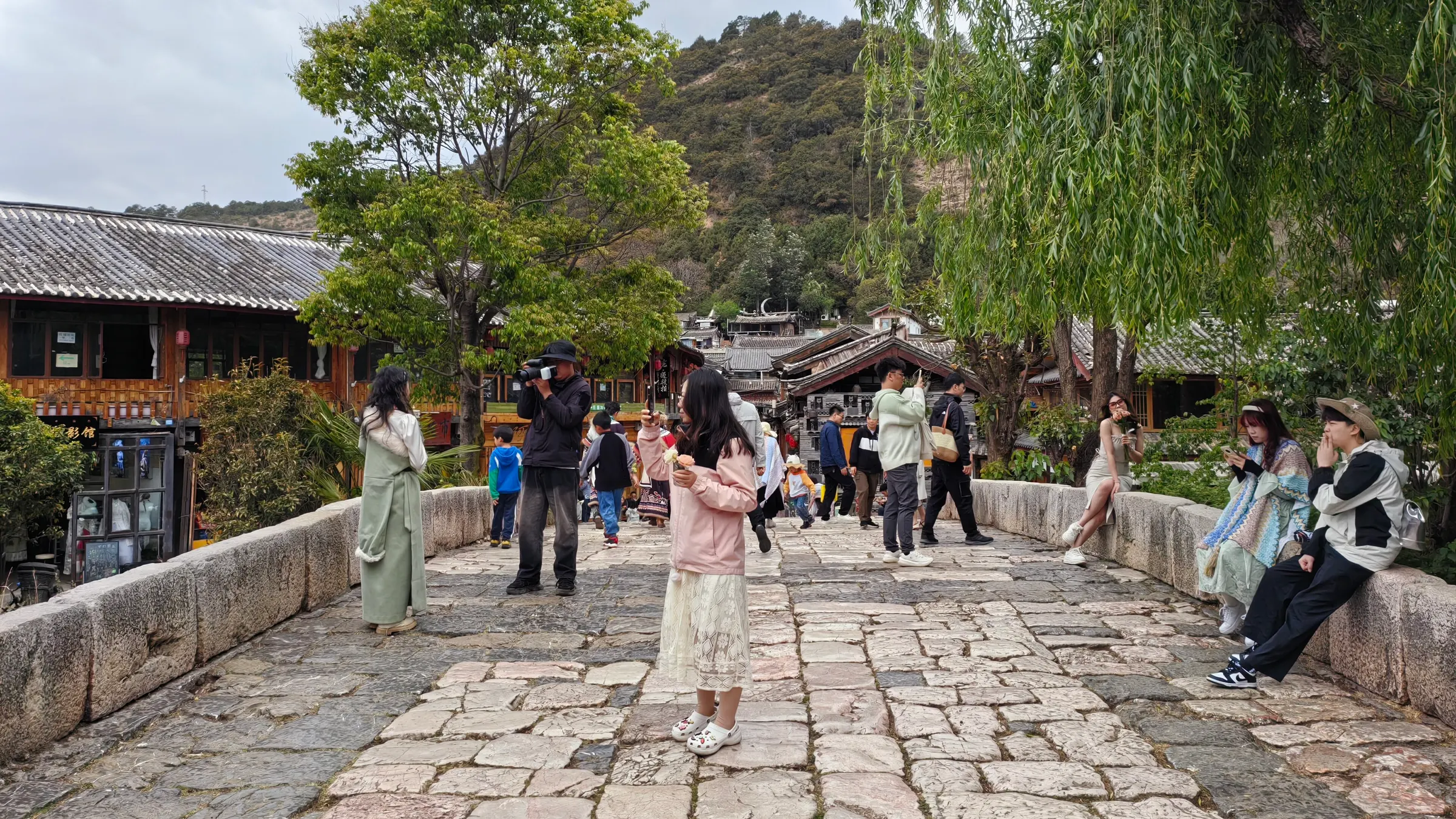
The lanes are stone, laid unevenly, and the main run is flat enough but the side alleys have steps. Buildings are timber frame with grey tile roofs, built tight along the water. Because this is still a residential quarter rather than purely a visitor strip, you will see washing, bicycles, small shops doing a day’s trade, and schoolchildren — alongside the guesthouses, which are numerous but do not yet displace the residents the way they largely have in Dayan.
The flip side of that is the thing that most affects your experience. Between roughly 10:00 and 17:00 the day-trippers from Lijiang arrive in coach groups, and the lanes fill. Before 09:30 and after 17:00 the town belongs to the people who live in it. This is the single most useful piece of advice on this page, and it costs nothing to follow.
English interpretation is thin. Unlike the main Old Town, Shuhe does not have consistent English signage. If you want to understand what you are looking at rather than just walking through it, a guide is worth arranging, and it is one of the places in Lijiang where that is most true.
Getting there
There is no metro in Lijiang and no useful rail leg — Shuhe is reached by road from the town.
From Dayan Old Town it is roughly 4 km north, about 10 to 15 minutes by taxi or Didi depending on traffic, and the same trip in the other direction at the end of the day. If you are staying inside the Old Town, a taxi is easier than walking and cheap. You cannot drive into the lanes themselves; park at the edge and walk the last few minutes.
Shuhe pairs naturally with Baisha to the north, which is the other small traditional settlement on the same road and the third area of the World Heritage property. Most visitors see only one of the two. If you have the time, seeing both in a day is a better use of it than seeing either alone.
Final tip
Go at half past seven in the morning, not at ten. The same streets, the same bridges, the same water, a third of the people — and you will actually be standing in a town rather than in a queue. The afternoon gives you the light; the morning gives you the place.
Best photo spots
-
Qinglong Bridge (青龙桥) · Early morning, 07:30–09:00, or late afternoon
The bridge at the centre of town, crossing the Qinglong River, with timber houses on both banks. One of the traditional Eight Views of Shuhe. It is also the first thing to fill up with people, so the hour matters more than the spot.
-
Three Wells (三眼井) · Mid-morning, when the paving is dry and the light is still low
Three rectangular stone pools on a paved square, the historic social centre of the settlement and the easiest place to picture how the town actually functioned.
-
Nine Tripod Dragon Pool (九鼎龙潭) · Dawn, on a still, windless morning
The larger pool at the north end of the old town, near San Sheng Palace. On a calm morning it reflects Jade Dragon Snow Mountain, which is the reflection people come to Shuhe for.
-
The western hills above the old town · October–November
The lacquer trees on the hills west of Shuhe turn vivid red in autumn, one of the Eight Views, and the higher ground also gives the best overview back over the tiled roofs.
Frequently asked questions
Is there an entrance fee for Shuhe Old Town?
No separate ticket to walk into the town, so entry is free. What causes confusion is a separate charge: the Lijiang Old Town maintenance fee, 维护费, currently ¥50 per person. Under the Lijiang rules published in July 2025 that fee applies to the core area of the Lijiang Old Town scenic area, and Shuhe sits about 4 km north of that core area as its own World Heritage component. Travel agencies collect the fee on behalf of group tourists and it is usually built into the tour price. We have not confirmed the current collection point at Shuhe's own entrance, so treat that as something to check on the ground rather than a settled fact.
How long should I spend at Shuhe Old Town?
Half a day is the realistic figure. The old town lanes themselves take about an hour to walk end to end, and you want to slow down. Add time for San Sheng Palace and the Dragon Pool at the north end, and for sitting down. If you have only one day in Lijiang, spend it on Dayan Old Town, Black Dragon Pool and Mu Mansion, and treat Shuhe as the thing to cut.
Is Shuhe part of the UNESCO World Heritage site?
Yes. The World Heritage property inscribed in 1997 is not just the walled town most people picture. The official register lists four components: Dayan Old Town, Heilongtan Pool, Baisha Village and Shuhe Town. Shuhe is component 811-004. The inscription happened about two years after a devastating earthquake, and much of what you see in all three areas was rebuilt under UNESCO guidance, which is worth knowing when you are looking at 'ancient' timber frame.
Is Shuhe quieter than Lijiang Old Town?
Substantially, and that is the main reason to come. Shuhe is roughly a fifth of the size of the Dayan town, and unlike Dayan it still functions as a residential quarter, with families living in the old houses and guesthouses occupying a minority of them. That does not make it empty — it makes it a different place, and a quieter one outside peak hours.
Can I get into Shuhe with a foreign passport?
There is no gate and no ID check for the streets of Shuhe, so nothing is required to walk in. Carry your passport regardless if you are also visiting ticketed sites in Lijiang, such as Mu Mansion or the Dayan Old Town maintenance-fee checkpoint, because those do check identity and your passport is what establishes your visitor category.
What is Shuhe actually known for historically?
The Tea Horse Road. From the Ming dynasty onward, leatherworkers and other craftspeople concentrated here, and Shuhe grew into a major town and a centre of Naxi cultural exchange along that route. It holds Ming-dynasty murals, the Ming building Dajue Palace and the Qing building San Sheng Palace. The Naxi name for the place is Shaowu, meaning the village below the high peak, and it is usually described as a living example of the Naxi transition from an agrarian to a commercial society.
What are the Three Wells and why do they matter?
The Three Wells (三眼井) are a set of three rectangular stone pools on a paved square at the heart of the old town, supplied by the spring water that runs through Shuhe. They are the social centre of the settlement — the place people stopped — and they appear on the interpretation board in both Chinese and English. Nine Tripod Dragon Pool (九鼎龙潭), at the north end near San Sheng Palace, is the larger water feature, and on a still morning it reflects Jade Dragon Snow Mountain.
Is Shuhe worth it if I only have one day in Lijiang?
Probably not. With a single day, Dayan Old Town, Black Dragon Pool at sunrise and Mu Mansion are the higher-value targets, and Jade Dragon Snow Mountain takes a full day of its own. Shuhe pays off if you have two or three nights in Lijiang, and it pairs naturally with the Baisha area to the north on the same road.
Sources
- 束河古镇 — Chinese Wikipedia (earliest Naxi settlement in Lijiang, Tea Horse Road trading centre, Ming murals and the Dajue Palace, Qing San Sheng Palace, component of the World Heritage Lijiang Old Town, rated 4A, Naxi name Shaowu, the Eight Views of Shuhe, Xu Xiake's account) · Wikipedia
- Old Town of Lijiang — UNESCO World Heritage Centre, site 811 (inscription record; official component list including 811-004 Shuhe Town at 26.925 / 100.2027777780) · UNESCO World Heritage Centre
- 丽江古城 — Chinese Wikipedia (maintenance fee history: levied from 2001, ¥80 rules from 2007, cut to ¥50 in 2017, and the July 2025 Lijiang rules keeping ¥50 and scoping it to the core area of the Old Town scenic area with a 365-day validity and eight exempt categories; World Heritage property comprises the Dayan group, the Baisha residential group and the Shuhe residential group) · Wikipedia
- Old Town of Lijiang — English Wikipedia (Greater Lijiang including Dayan, Baisha and Shuhe registered on the World Heritage List in 1997 after the 1996 earthquake; Nakhi Dongjing music performed for a donation in Shuhe and Baisha rather than for a fee as in Dayan) · Wikipedia
- Shuhe — Wikidata Q65965238 (described as part of a World Heritage site in China; coordinate 26.925 / 100.2028) · Wikidata