Yellow Crane Tower (黄鹤楼), Wuhan
黄鹤楼 · Huánghèlóu
Quick answer
There is no separate foreigner rate and no passport or visa condition in the material published by the Wuhan culture and tourism bureau's official channels. One set of prices applies to every visitor, and the concessions are written by category rather than by nationality: the day ticket is 70 yuan, with a 35 yuan concession for children, the elderly, students and retired servicemen. The night programme 夜上黄鹤楼 is a separate product with its own prices (adult 150 yuan, concession 110 yuan, student 90 yuan, child 75 yuan). The official material for the tower does not say whether advance booking is required, so check the notice before you travel; the scenic area enquiry line is 027-88875096.
Why visit
- 1 First built in AD 223 during the Three Kingdoms period, more than 1,700 years ago — and the building standing today is the 1981–1985 reconstruction, opened to the public on 11 June 1985
- 2 51.4 metres, five storeys, a square plan with four equal sides, 72 columns and 60 upturned corners each hung with a golden bell, in reinforced concrete imitation of timber
- 3 A 5A-rated historical-and-cultural scenic area on Snake Hill in Wuchang, with a 17.2-hectare park around the tower
- 4 The day ticket is 70 yuan and the concession day ticket is 35 yuan for children, the elderly, students and retired servicemen
- 5 The 夜上黄鹤楼 night programme is a separate product at 150 yuan, with a 19:30–22:30 session, the 《晚风吹笛》 live show and a light-and-shadow show on the main tower
Essential tips for foreigners
- Know which ticket you are buying. The 70 yuan day ticket and the 150 yuan 夜上黄鹤楼 night ticket are two different products with two different sessions — the night price is not an upgrade of the day ticket, and no combined day-and-night ticket is published.
- Read the two dates together. The tower was first built in AD 223; the structure you walk up was completed in 1985. Both are official, and treating the 1985 building as 1,700 years old is the single easiest mistake to make here.
- The interior is organised floor by floor. The stone-carved full text of 《黄鹤楼记》 is on the second floor, a mural on the third, calligraphy on the fourth, and ten large painted panels on the fifth — climb it rather than stopping at the first balcony.
- Two free historic sites are walkable from the tower. Qingchuan Pavilion and Guqin Terrace are inside the same scenic area and both close on Mondays, so plan the day around that if you want to see them.
- Read the gold plaques on the top floor. The four sides carry 南雄高拱, 楚天极目 and 北斗平临 as well as the tower's own name — a detail that costs nothing and no other visitor in the queue will point out.
Yellow Crane Tower (黄鹤楼) stands on Sheshan — Snake Hill — in Wuchang District, Wuhan, Hubei, at the upper western end of the hill. The Wuchang District government lists it in its scenic-area register as a 5A-rated attraction (rated in 2007) of the historical-and-cultural type, at No. 1 Xishan Slope, and the park around the tower covers 17.2 hectares.
The first tower on this spot was built in AD 223. The Wuhan local gazetteer records that 黄鹤楼 was first built in the second year of Huangwu of the Wu kingdom of the Three Kingdoms period — 公元 223 年 — more than 1,700 years ago. The tower people photograph today is not that building. The present structure was rebuilt between 1981 and 1985 and opened to the public on 11 June 1985. Both dates are official, and knowing them is the difference between visiting a ruin and visiting a reconstruction of something very old.
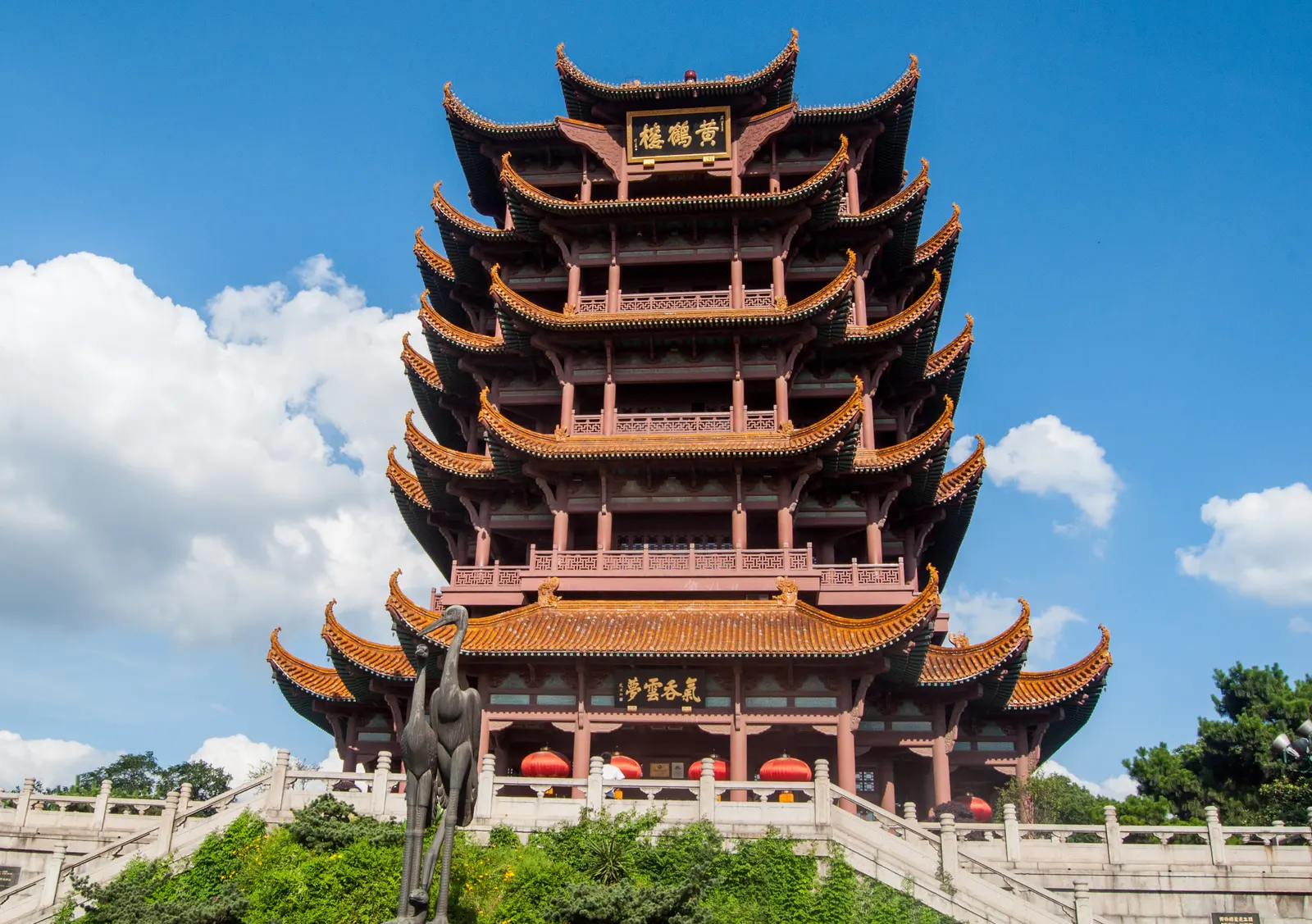
What you actually climb is worth the ticket. Five storeys, 51.4 metres, a square plan with all four sides the same length, 72 columns and 60 upturned corners each carrying a golden bell — a reinforced-concrete imitation-wood structure in the shape of a Qing-era tower. Inside there is the stone-carved full text of 《黄鹤楼记》, a mural on the third floor, calligraphy on the fourth, and ten large painted panels on the fifth. Outside, a poem-stele corridor more than 200 metres long runs through the park with nearly 200 inscribed steles. And the day ticket is 70 yuan, with a 35 yuan concession for children, the elderly, students and retired servicemen.
| Yellow Crane Tower at a glance | |
|---|---|
| Scenic area rating | 5A, rated in 2007 (Wuchang District government scenic-area list) |
| Type | Historical and cultural |
| Address | No. 1 Xishan Slope, Sheshan (蛇山), Wuchang District, Wuhan, Hubei |
| First built | AD 223, Three Kingdoms period (吴 黄武二年) |
| Present structure | Completed 1985, opened to the public on 11 June 1985 |
| Height and form | 51.4 m, 5 storeys, 72 columns, 60 upturned corners |
| Park area | 17.2 hectares |
| Day ticket | ¥70 (concession ¥35) |
| Enquiry | 027-88875096 |
What is the Yellow Crane Tower?
Yellow Crane Tower is a tower — one building at the top of a hill, with a park around it — and officially a 5A-rated historic-and-cultural scenic area. Five storeys and 51.4 metres to the top, with a riding pavilion (骑楼) under which the top floor is open on all four sides.
The interior is organised floor by floor. The second floor carries the stone inscription of the full text of 《黄鹤楼记》, written in the Tang dynasty by Yan Boli (阎伯理) and calligraphed by Wang Xiaju (王遐举). The third floor holds a mural titled 人文荟萃. The fourth floor is given over to calligraphy and paintings. The fifth floor carries a group of ten large panels titled 江天浩瀚, covering more than 90 square metres. The Huanghelou Art Museum, in 白云阁 (White Cloud Pavilion) in the grounds, stages art exhibitions as a standing arrangement rather than a special event.
In the evening the same building changes character: the 《晚风吹笛》 live show is now a daily regular performance, and a light-and-shadow show on the main tower is the finale of the night programme.
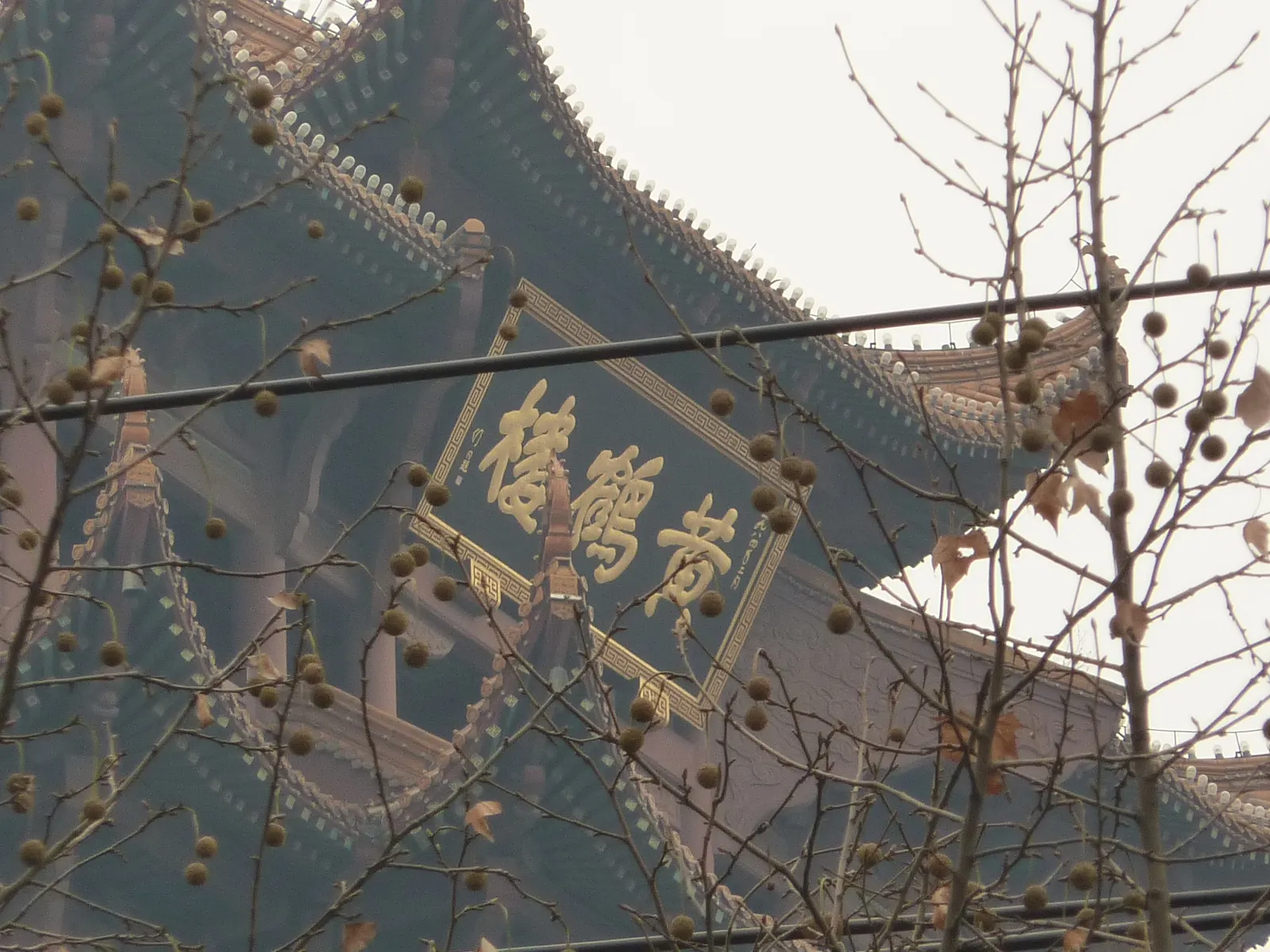
The name plaque on the tower, framed by winter branches. Photo: Wikimedia Commons / CC BY-SA 3.0 — User:Vmenkov. Source
When was the Yellow Crane Tower built?
Two dates, and the official record gives both.
The first is AD 223. The Wuhan local gazetteer records that the tower was first built in the second year of Huangwu of the Wu kingdom of the Three Kingdoms period (三国吴黄武二年,公元 223 年), more than 1,700 years ago.
The second is 1985, and the reconstruction has its own paper trail. The city government set up a preparatory office in August 1980. Ground was broken in October 1981. The main structure was completed in 1985. That June the Yellow Crane Tower Park management office was established, and on 11 June the site opened to the public.
Three older objects are kept on the site. A Yuan-dynasty Shèngxiàng pagoda (胜像宝塔) stands 9.36 metres tall. The copper roof finial of the Tongzhi-period tower, cast in 1868, is 3.4 metres high and weighs about two tonnes. And there is a cast-bronze yellow crane, made by the artist Liu Zhengde (刘政德).
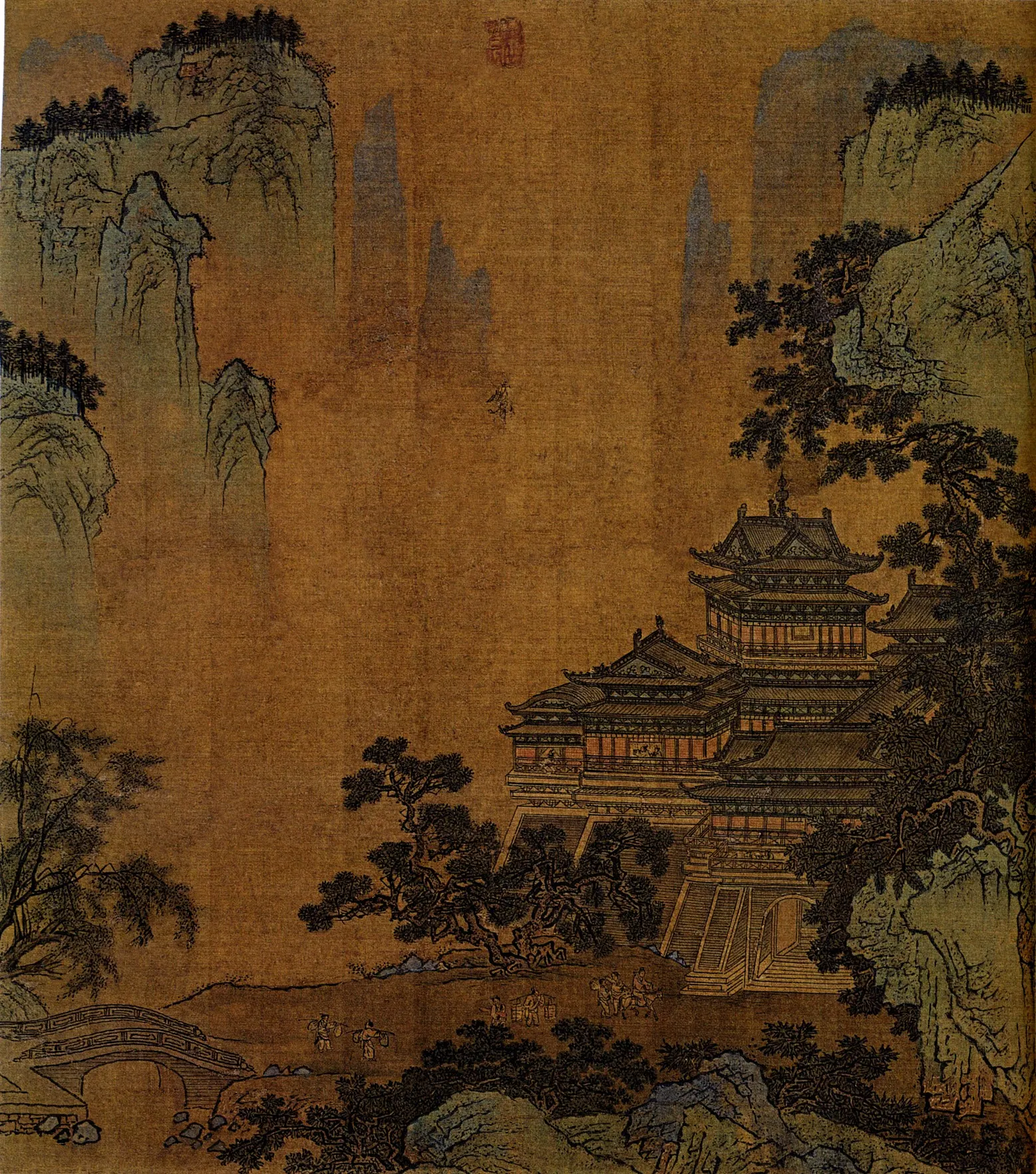
An old painting of the tower — the landmark long before today’s building. Photo: Wikimedia Commons / Public domain — Unknown author. Source
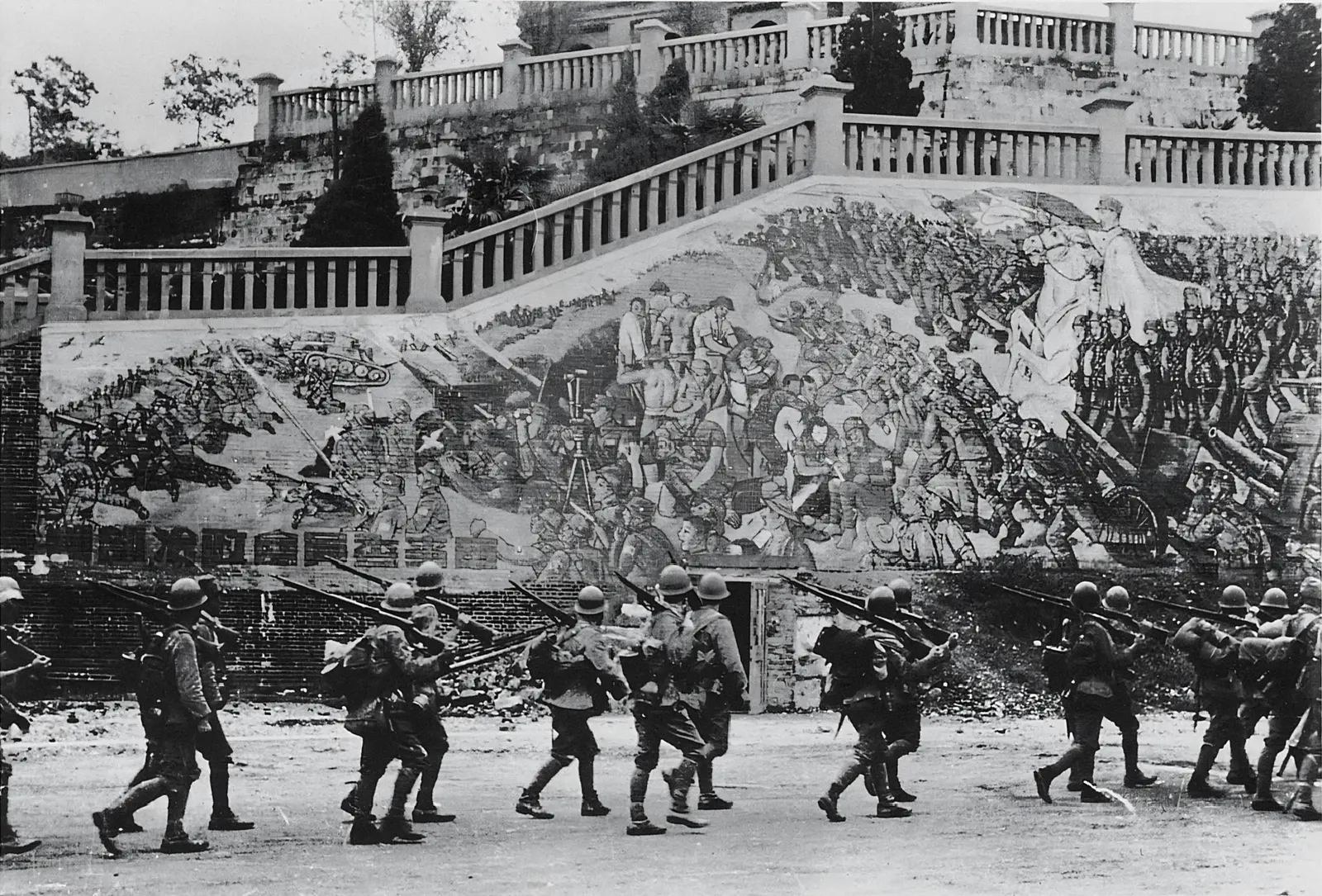
A mural near the entrance recalling the fighting around Wuhan in 1938. Photo: Wikimedia Commons / Public domain — Koyanagi Tsugi’ichi. Source
What dynasty was the Yellow Crane Tower built in?
The original tower was a Three Kingdoms building: Wu, the second year of Huangwu, AD 223 (三国吴黄武二年). So the oldest layer of Yellow Crane Tower is Three Kingdoms, and the name has stood on this line of this hill in Wuchang ever since.
The modern design deliberately reaches back further still. The Wuhan local gazetteer records that the present tower was modelled on the tower of the Tongzhi period (清同治) and reworked by taking the best of the Song, Yuan, Ming and Qing versions — which is why it reads as a Qing-era tower at a glance without being a copy of one. The building you walk up is the 1981–85 reconstruction; no Qing-era tower survives on the hill, only its copper finial and the Tang-dynasty essay that the second floor carries.
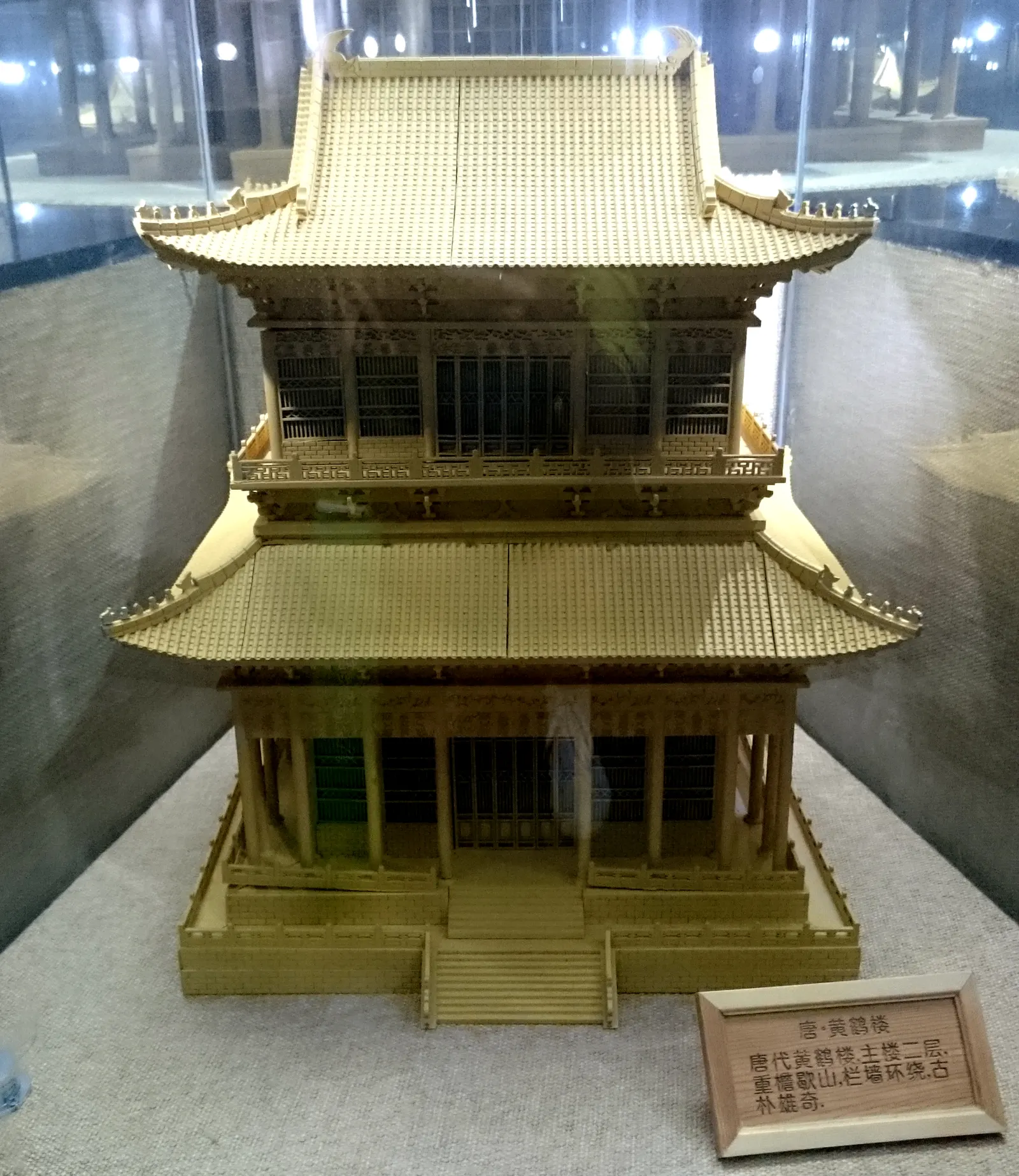
A museum model of how the tower looked in the Tang dynasty, in timber. Photo: Wikimedia Commons / CC BY-SA 4.0 — Wuchernchau. Source
How tall is the Yellow Crane Tower?
51.4 metres, five storeys. That is the official figure from the Wuhan local gazetteer, which describes the structure as square in plan, four equal sides (四望如一), built as reinforced concrete in imitation of timber, carried on 72 columns, with 60 upturned corners, each hung with a golden bell.
The height is the reason to go up. From the top floor you look out over the old tiled rooftops of Wuchang and the modern skyline beyond, and across the river at the dense apartment blocks of Hankou. On a clear afternoon that is Wuhan’s whole geography in one view: the river, the two halves of the city, and the hill you came up.
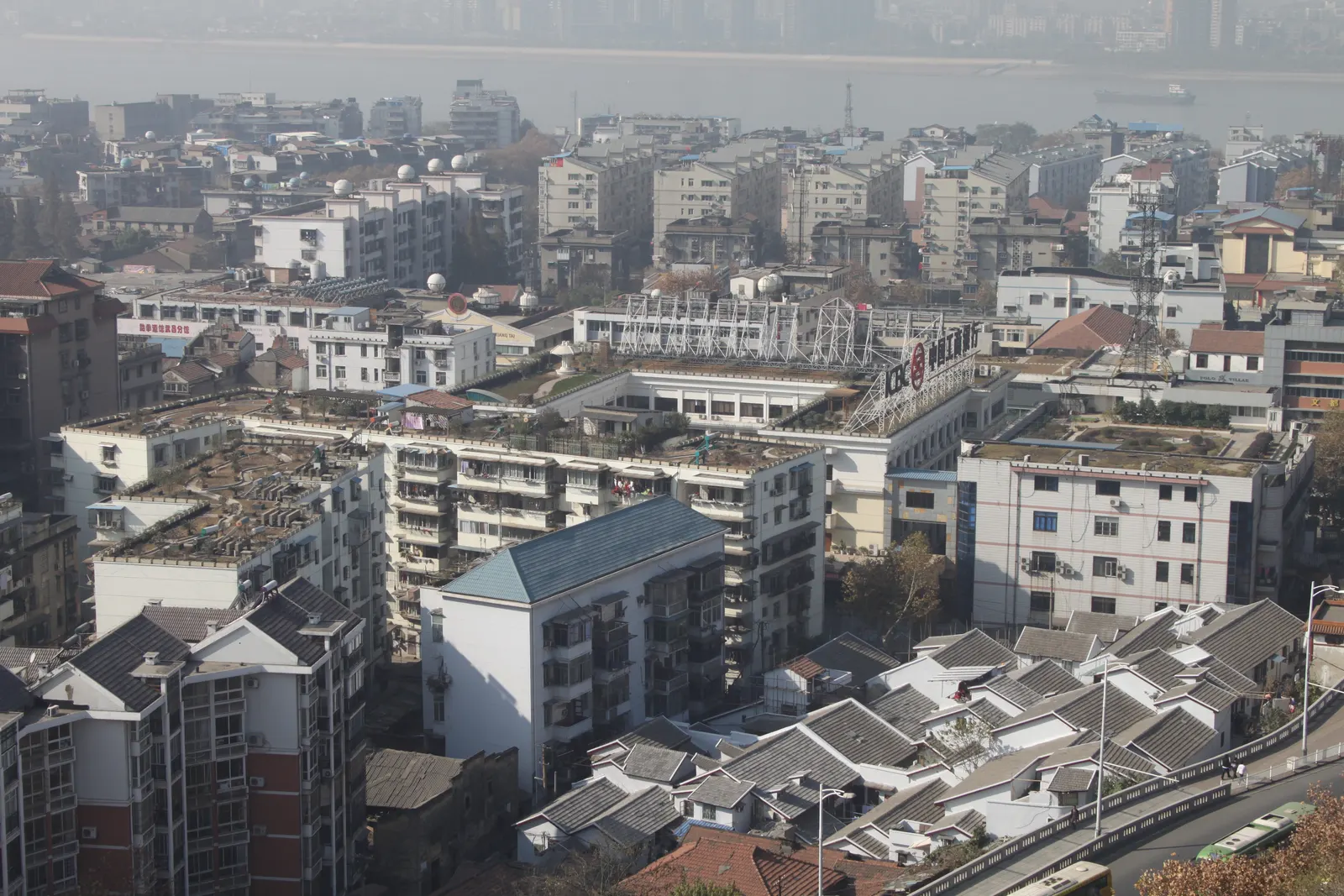
What you actually see from the top: the old rooftops of Wuchang and the modern skyline beyond. Photo: Wikimedia Commons / CC0 — Gary Todd from Xinzheng, China. Source
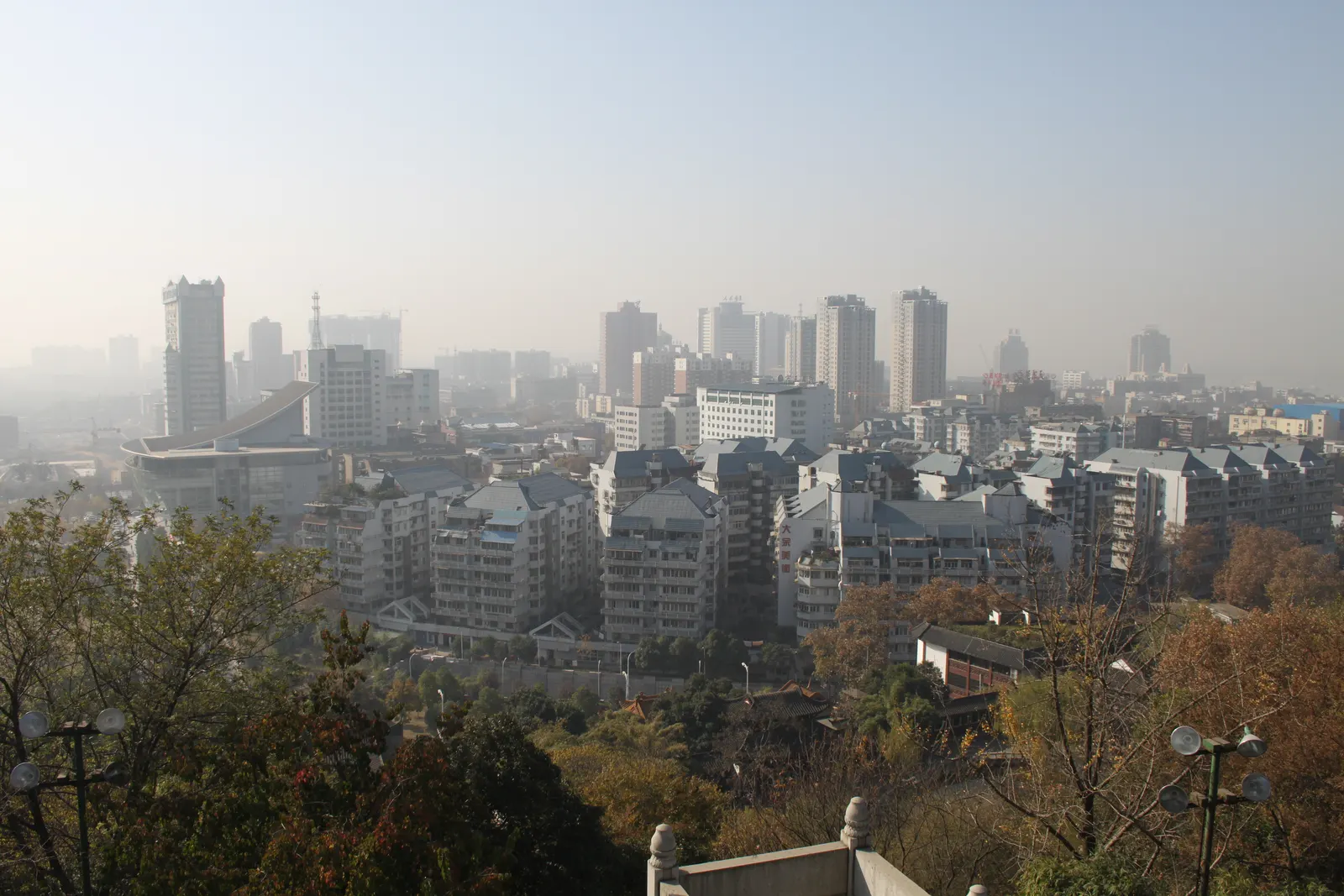
Hankou’s dense modern blocks, seen from the tower across the river. Photo: Wikimedia Commons / CC0 — Gary Todd from Xinzheng, China. Source
Who designed the Yellow Crane Tower?
The names are recorded, and they are the same names you will see on the 1980s project paperwork. The design was proposed by the Hubei Provincial Industrial Design Institute (湖北省工业建筑设计院). Architect Xiang Xinran (向欣然) was responsible for the overall design. Engineer Zheng Jinming (郑锦明) was responsible for the structural design. The municipal construction company no. 2 (市建二公司) carried out the construction.
The shape follows the model described above — a Qing-era tower reworked with the best of the Song, Yuan, Ming and Qing versions — and the details are the point. The top floor sits under a riding pavilion on all four sides, each face hung with a gold-lettered plaque: 黄鹤楼 on the front, 南雄高拱 on the south, 楚天极目 on the east, 北斗平临 on the north.
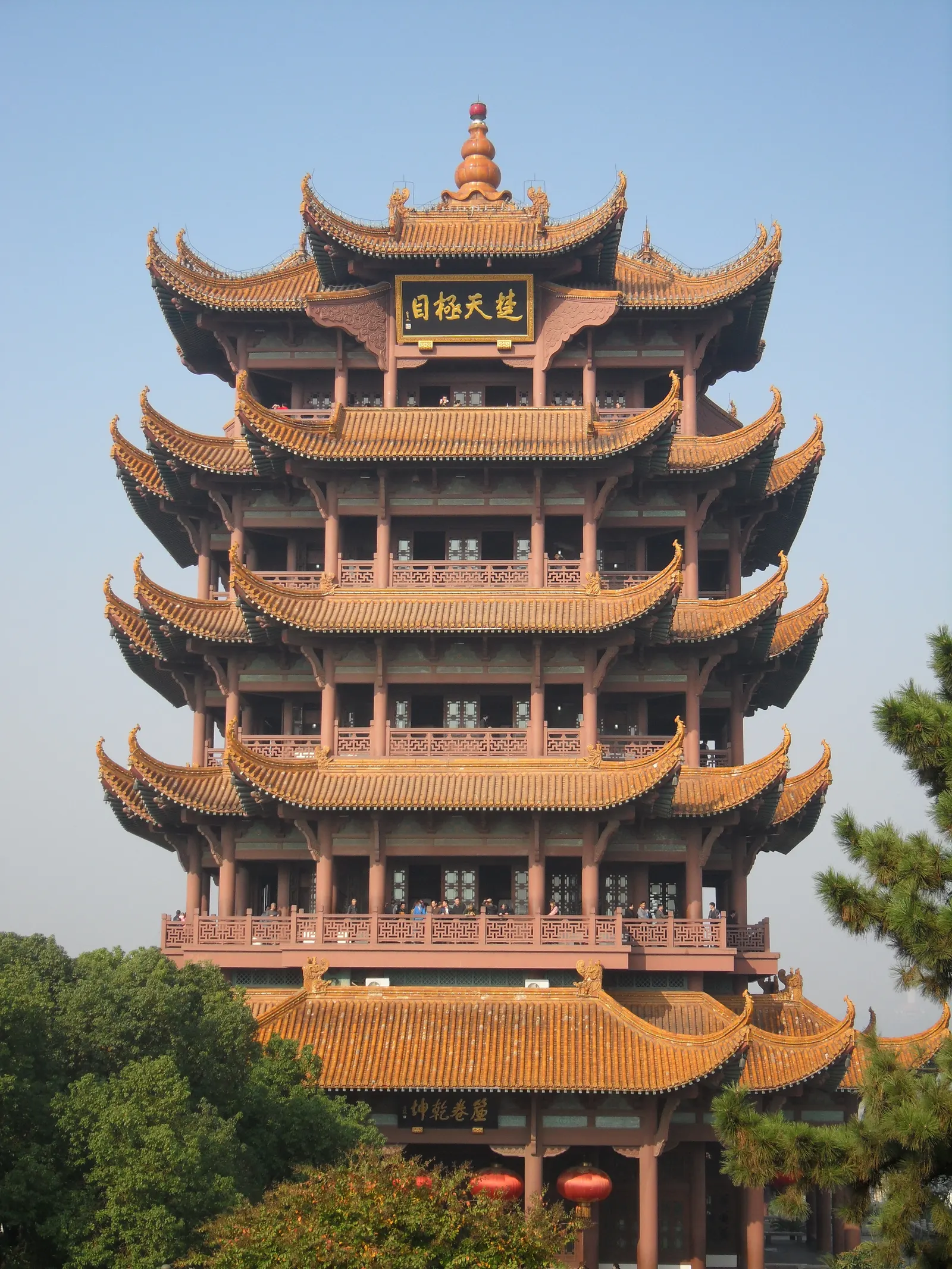
The layered upturned eaves that give the tower its silhouette. Photo: Wikimedia Commons / CC BY-SA 3.0 — MonsieurRoi. Source
Where is the Yellow Crane Tower located?
On Snake Hill (蛇山) in Wuchang District, Wuhan, Hubei, at the upper western end of the hill. The address the district government publishes is No. 1 Xishan Slope, Sheshan (武昌蛇山西山坡 1 号), and the park around it covers 17.2 hectares.
The hill sits on the Wuchang side of the Yangtze, so the river is below you and the opposite bank is Hankou. From the top floor the view runs over the riverfront, and across the water you can see the Hankou bank and the Yangtze River Bridge.
Getting there is straightforward. The nearest metro station is 黄鹤楼站, known on the station signage as Simenkou; the signs inside the station point to the tower, so the last stretch is signposted rather than a matter of guesswork. The district government publishes an enquiry line for the scenic area, 027-88875096.
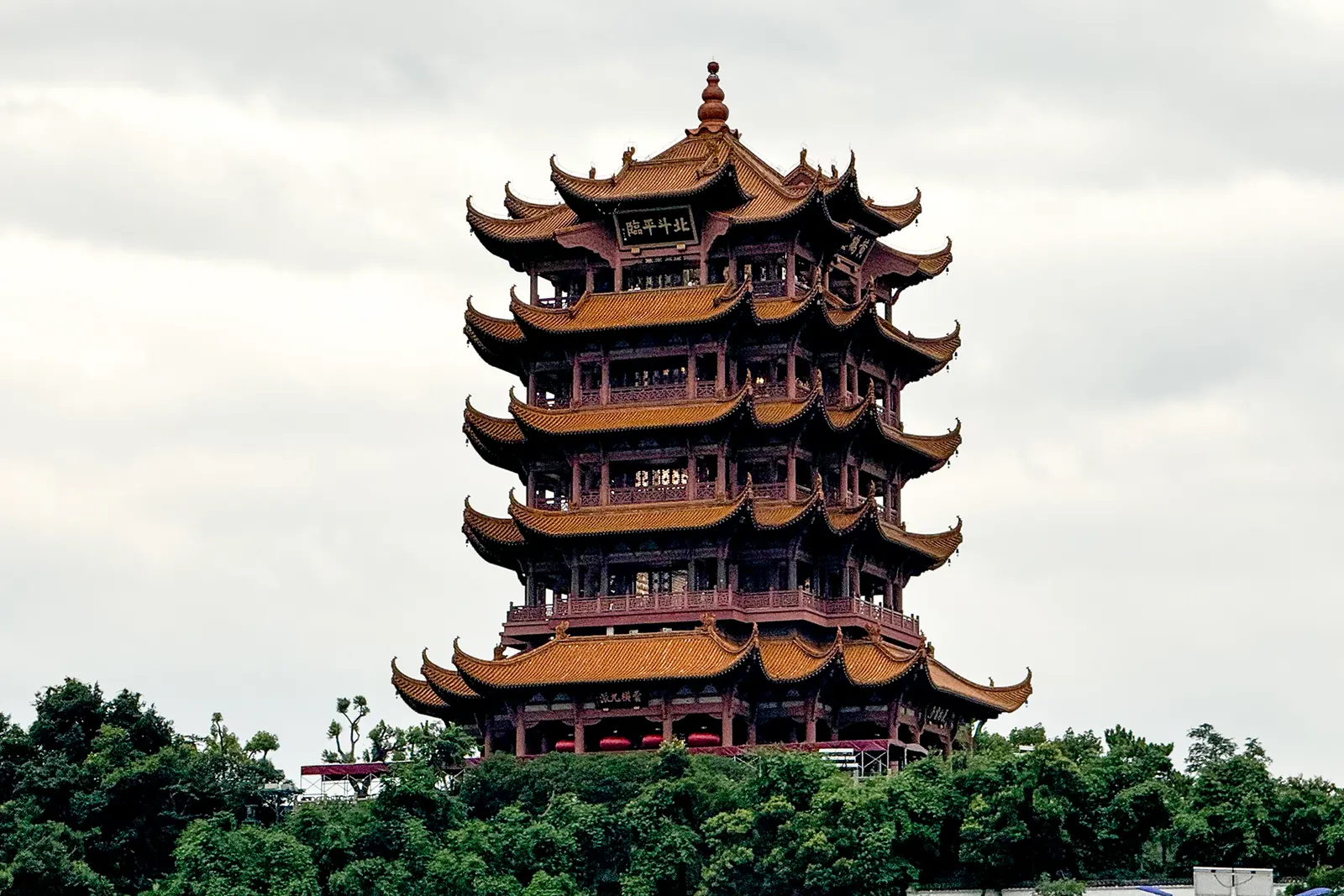
The tower seen from inside the park, over the white walls of the complex. Photo: Wikimedia Commons / CC BY-SA 4.0 — Windmemories. Source
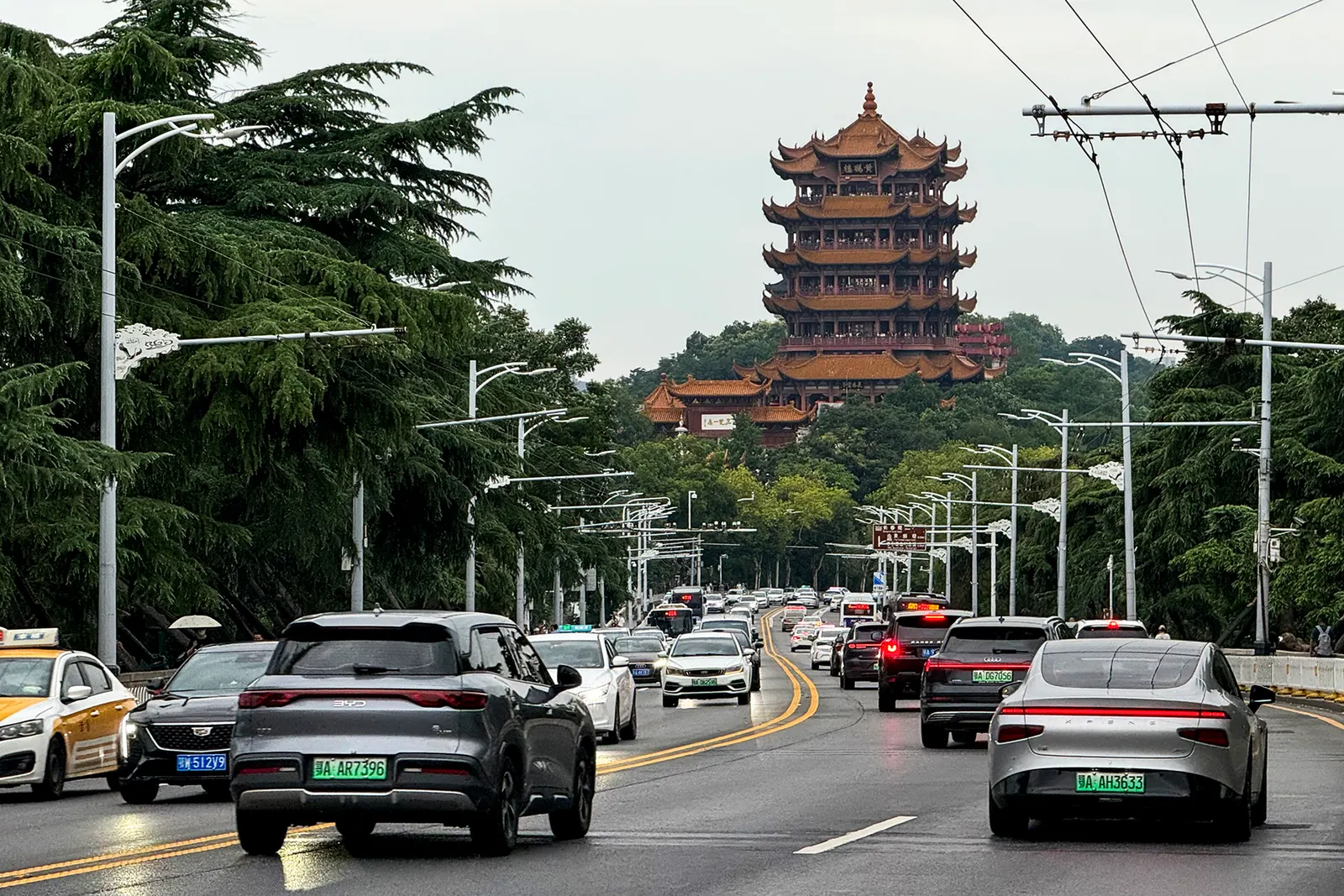
The tower in the middle of everyday Wuhan traffic. Photo: Wikimedia Commons / CC BY-SA 4.0 — Windmemories. Source
Tickets, opening hours and the night programme
The day ticket and the night programme are two different products with two different tickets. That distinction matters, because the night ticket is not a supplement to the day ticket, and the day ticket does not get you in after dark.
| Day ticket | Price |
|---|---|
| Full price | ¥70 |
| Concession — children, the elderly, students, retired servicemen | ¥35 |
| 夜上黄鹤楼 night programme | Price |
|---|---|
| Adult | ¥150 |
| Concession | ¥110 |
| Student | ¥90 |
| Child | ¥75 |
| Session and hours | Published window |
|---|---|
| Day visit, 1 April – 31 October | 8:00–18:00 |
| Day visit, 1 November – 31 March | 8:00–17:00 |
| Night programme | 19:30–22:30, last entry 21:30 |
| What runs in the night session | The 《晚风吹笛》 live show, now a daily regular performance, and the light-and-shadow show on the main tower |
Getting there and getting around
The metro station described above is the simplest arrival: follow the signs for the tower out of the station and up the hill. The scenic area itself is compact — the tower, the poem-stele corridor and the park are all walkable inside it — so the useful plan is to arrive in the morning and stay through the middle of the day rather than treat the place as a quick stop.
Two more historic sites sit in the same scenic area, walkable from the tower: Qingchuan Pavilion (晴川阁) and Guqin Terrace (古琴台). Both are free, and both close on Mondays, so if you want them, plan the day around that.
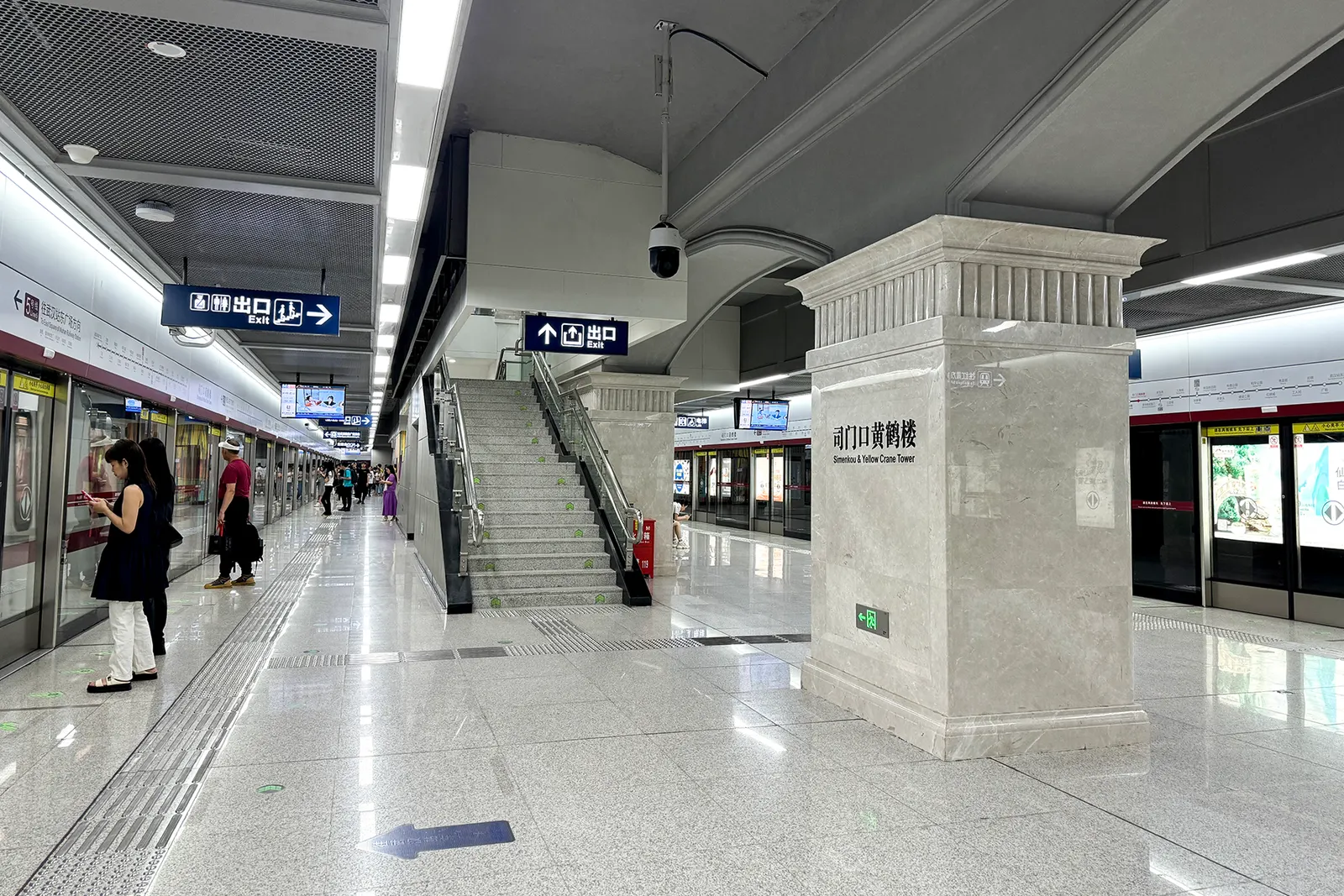
Simenkou metro station — the easiest way to arrive, with signs for the tower. Photo: Wikimedia Commons / CC BY-SA 4.0 — Windmemories. Source
| Neighbouring site | Hours | Days |
|---|---|---|
| Qingchuan Pavilion (晴川阁) | Day 09:00–17:00, night 18:30–21:30 | Closed Mondays; free, with a free reservation |
| Guqin Terrace (古琴台) | 09:00–17:00, last entry 16:30 | Closed Mondays; free; open Tuesday to Sunday |
Notes for foreign visitors
There is no separate foreigner rate and no passport or visa condition in the material published by the Wuhan culture and tourism bureau’s official channels. One set of prices applies to every visitor, and the concessions are written by category rather than by nationality — children, the elderly, students and retired servicemen pay 35 yuan for the day ticket. The night programme has its own list (150 / 110 / 90 / 75 yuan).
The official material for the tower does not say whether advance booking is required, so check the notice for the day you travel before you set out; the scenic area enquiry line is 027-88875096. The neighbouring Qingchuan Pavilion does require a free reservation.
Where this fits
Yellow Crane Tower is the anchor of a first day in Wuhan, and it is where a Wuhan travel guide earns its place: a plan that starts on the hill in the morning and ends on the riverfront in the evening fits the tower into the middle of the day rather than squeezing it in. The Wuhan city page sets out how the rest of the city fits around it.
Also nearby
- 3 Days in Wuhan travel guide (2026) — the itinerary that starts at the tower and ends on the riverfront.
- Wuhan city page — the rest of the city in one place, so you can put the tower into a full day rather than a stop.
- The same historic half-day: the tower and the two smaller historic sites inside the same scenic area are a comfortable pairing, since they are all within walking distance of each other.
Best photo spots
-
The top floor, looking over Wuchang
The old tiled rooftops of Wuchang with the modern skyline beyond, and the Yangtze below — the payoff for the climb.
-
The top floor plaques
The gold-character plaques under the riding pavilion on each of the four sides: 黄鹤楼, 南雄高拱, 楚天极目, 北斗平临.
-
The poem-stele corridor
More than 200 metres of stone steles carrying nearly 200 inscribed poems, running through the park below the tower.
Frequently asked questions
What is the Yellow Crane Tower?
A five-storey, 51.4-metre historic tower on Snake Hill in Wuchang District, Wuhan, rated a 5A historical-and-cultural scenic area. It was first built in AD 223 during the Three Kingdoms period; the present structure is the reconstruction completed in 1985 and opened to the public on 11 June 1985. The day ticket is 70 yuan, and the surrounding Yellow Crane Tower Park covers 17.2 hectares.
When was the Yellow Crane Tower built?
Twice, and the official record gives both dates. The tower was first built in the second year of Huangwu of the Wu kingdom of the Three Kingdoms period — AD 223 — more than 1,700 years ago. The reconstruction now standing was broken ground in October 1981, completed in 1985, and opened to the public on 11 June 1985.
What dynasty was the Yellow Crane Tower built in?
The original tower dates to the Wu kingdom of the Three Kingdoms period (三国吴黄武二年, AD 223). The present design was modelled on the tower of the Tongzhi period of the Qing dynasty, reworked by taking the best of the Song, Yuan, Ming and Qing versions. The building on the hill today is the 1981–1985 reconstruction, not a Qing-era survivor.
How tall is the Yellow Crane Tower?
51.4 metres, over five storeys, according to the Wuhan local gazetteer. The same source describes it as square in plan with all four sides the same length, built in reinforced concrete imitation of timber, carried on 72 columns, with 60 upturned corners each hung with a golden bell. The view over Wuchang's rooftops and the Yangtze is the reason to climb.
Who designed the Yellow Crane Tower?
The design was proposed by the Hubei Provincial Industrial Design Institute (湖北省工业建筑设计院). Architect Xiang Xinran (向欣然) was responsible for the overall design and engineer Zheng Jinming (郑锦明) for the structural design, with the municipal construction company no. 2 (市建二公司) carrying out the construction. The form was modelled on the Tongzhi-period tower and reworked from earlier Song, Yuan, Ming and Qing versions.
Where is the Yellow Crane Tower located?
On Snake Hill (蛇山) in Wuchang District, Wuhan, Hubei — the upper western end of the hill, with the Yellow Crane Tower Park around it covering 17.2 hectares. The address published by the Wuchang District government is No. 1 Xishan Slope, Sheshan. The nearest metro station is 黄鹤楼站, known on the station signage as Simenkou, where signs point to the tower.
Sources
- 武汉市武昌区人民政府门户网 — 旅游景区一览表:黄鹤楼(5A 景区级别、历史文化类型、地址、开放时间、咨询电话) · Government of the PRC
- 武汉市文化和旅游局官方公众号稿 — 黄鹤楼门票与「夜上黄鹤楼」夜游(日场/夜游票价、夜游时段、实景秀《晚风吹笛》、主楼光影秀) · toutiao.com
- 湖北文旅官方微博 — 黄鹤楼夜游与周边景点(晴川阁、古琴台的开放时间与闭馆日) · weibo.com
- 武汉地方志数字方志馆《武汉市志-城市建设志(下)》园林绿化【黄鹤楼公园】(始建年代、1981-1985 重建时间线、设计者、建筑形制、匾额、楼层内容、诗碑廊) · Government of the PRC
- 武汉地方志数字方志馆《黄鹤楼志》第三章「巍峨今楼」(今楼形制与园内实物) · Government of the PRC
- Wikidata Q462372 黄鹤楼 — 现存建筑建成年份(1985)与坐标(Wuhan, Hubei) · Wikidata