
China Border Agent Checklist 2026: What Gets You Through
Four legal ways into mainland China in 2026 — 30-day visa-free, 240-hour transit, L visa and the new permit — plus the 5 most common failure modes.
Policy checked October 2026 against National Immigration Administration and State Council sources.
The single most common reason foreigners get sent to secondary inspection at Chinese immigration isn’t a denied visa. It’s a missing document — usually the printed hotel address, the health declaration QR, or a misunderstanding about whether their itinerary qualifies as “transit.” This guide covers the four legal entry paths into mainland China in 2026, the universal documents every foreigner needs, and the 5 specific failure modes that put you in secondary inspection for 30-90 minutes (or get you denied entry entirely).
The good news: 90% of entries are routine. The officer scans your passport, checks the health QR, glances at the hotel booking, stamps you in, and you’re through in 3-5 minutes. The bad news: if you’re in the 10% who have a documentation gap, the experience is dramatically worse — secondary inspection, a senior officer reviewing every document, a discretionary decision to admit or deny. This guide is built to make sure you’re in the 90%.
The 4 Legal Entry Paths Into Mainland China (2026)
China runs four parallel entry systems. Pick the one that matches your nationality and itinerary.
| Path | Nationalities | Max stay | Application | Onward ticket to 3rd country? | Hotel required? | Best for |
|---|---|---|---|---|---|---|
| 30-day visa-free (unilateral) | 50 countries (UK, AU, NZ, EU, JP, KR, BR, AR, CA, CL, PE, UY — NOT US) | 30 days per entry | No application needed | Not required (return OK) | Recommended but not required | Tourism, family, business ≤30 days |
| 240-hour transit visa-free | 57 countries (incl. US, RU, most EU, JP, KR, ID, VN, KG, MX, CA, AU, BR) | 10 days (240h, starts 00:00 next day) | No application needed | Required to a 3rd country | Registered — the hotel files it at check-in; a host or rental files it at the police station or online | Stopover, multi-city, layovers |
| L tourist visa | Any nationality | 30-90 days per entry | Apply at Chinese consulate in home country | Not required | Recommended | Long stays, multiple entries |
| Hainan 30-day island exemption | 61 countries (incl. US, UK) | 30 days in Hainan only | No application | Not required (return OK) | Recommended | Hainan-only trips (Sanya, Haikou) |
The 50-country 30-day list excludes the United States, India (for non-diplomatic passports), most African and South Asian countries. If you’re American or from a country not on the 30-day list, your two options are 240-hour transit (if you have a third-country route) or L visa.
The 240-hour policy is the most popular “loophole” for US citizens: route the return through Hong Kong, Tokyo, Seoul, or Taipei, and a 10-day mainland trip is visa-free.
Universal Documents Required at Immigration (Every Path)
Regardless of which path you use, every foreign traveler must present:
- Passport with 6+ months validity from entry date. The 240-hour policy officially requires 3 months, but airlines enforce 6 months at check-in. Renew before flying if borderline.
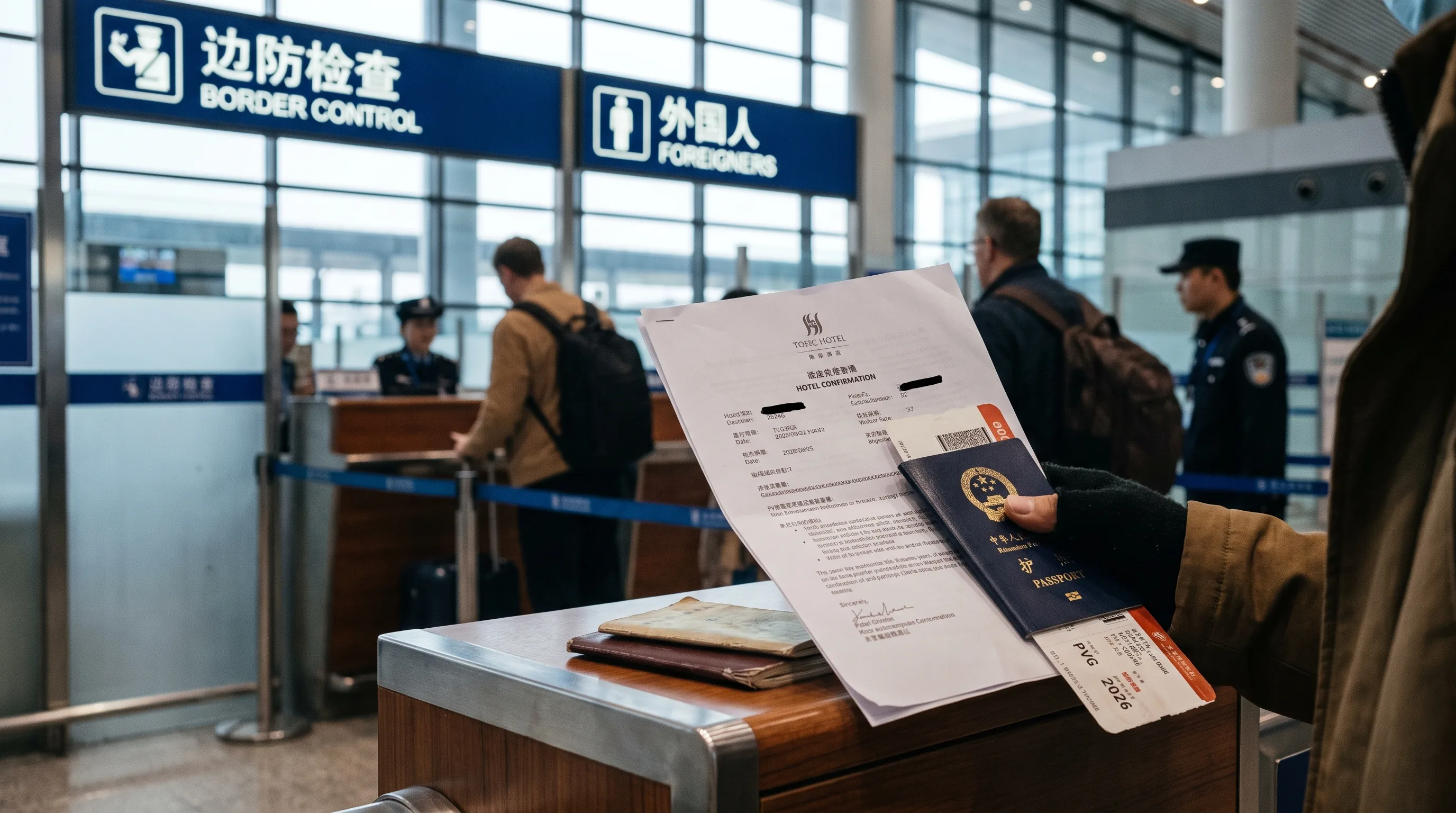
- Printed hotel booking covering at least the first 3 nights. Use Trip.com or Booking.com, filter for “accepts foreign guests” (接待外宾). Print the confirmation with the hotel name in both Chinese and English, the full address in Chinese characters, your name, and the dates. Officers read the Chinese address faster than the English one.
- Onward or return ticket. For 240h: onward to a third country (confirmed, with seat assignment, not on hold). For 30-day: return ticket recommended but not required.
- 24-hour health declaration QR code. Submitted online via the NIA portal within 24 hours before landing. Free, 2-3 minutes, no app required. Screenshot the QR and save to your phone. This is required for all entries regardless of visa status.
- Sufficient funds proof (rarely asked, but have it ready). A credit card screenshot or recent bank statement showing $2,000-3,000 USD available. Officers rarely ask, but if you’re sent to secondary inspection, this is the first thing they request.
Documents that help (strongly recommended, not legally required): printed travel insurance, simple one-page itinerary (which cities, which dates), invitation letter if visiting family or business contact, accommodation address for every night (not just the first 3).
Policy-Specific Additions
For 240-hour transit only:
- A third-country route — your ticket must show a destination different from your country of departure. US→Beijing→Tokyo, US→Shanghai→Hong Kong, UK→Chengdu→Bangkok all qualify. US→Beijing→US does NOT.
- Entry through one of 65 designated ports — all major international airports (PEK, PKX, PVG, SHA, CAN, SZX, CTU, CKG, XIY, KMG, HGH, NKG, TSN, TAO) plus selected rail crossings and seaports. Not every port qualifies. A full list is on the NIA website (link in sources).
- Stay within the 24-permitted-province area — you can move between the 24 permitted provinces, but Tibet, parts of Xinjiang (Kashgar, Urumqi outside designated zones), and some western Sichuan areas are restricted. Jiuzhaigou, Zhangjiajie, and western Sichuan scenic areas are also outside the 240h permitted regions of their provinces. Plan your itinerary accordingly.
For 30-day visa-free only:
- Return or onward ticket (recommended). Without one, you may face secondary inspection.
- Proof of accommodation for the full stay if possible.
For L tourist visa only:
- The visa sticker in your passport (verify every field at the consulate before leaving).
- The documents you submitted with the application (invitation letter, hotel booking, itinerary) — officers may cross-check.
The 5 Common Failure Modes (and How to Avoid Them)
These five mistakes account for ~60% of secondary inspection referrals and entry denials.
1. Round-trip ticket (US→CN→US) doesn’t qualify as transit
This is the #1 reason US citizens get denied the 240-hour policy. If your itinerary is US→Beijing→US, you do NOT have a third-country transit. The fix: book the return leg via Hong Kong, Tokyo, Seoul, or Taipei. Hong Kong counts as a “third region” for this purpose. The route US→Shanghai→Hong Kong→US qualifies. If you cannot route through a third country, use the 30-day policy (if eligible) or apply for an L visa.
2. The 240-hour clock starts at 00:00 the day AFTER entry (not at the moment of stamping)
The most misunderstood detail of the 240-hour policy. The clock starts at midnight the day after your entry, not when you clear immigration. If you land at 11:50 PM and clear immigration at 12:30 AM, your 240-hour period starts at 00:00 the next day — you must leave before 23:59 on day 10. If you land at 1:00 AM, your effective time in China is closer to 10 days plus 23 hours. Overstaying by even 1 hour triggers a fine, visa revocation, and a potential 5-year entry ban.
3. Entering through a port not on the 65-designated list
There are 65 designated ports for 240-hour transit. If you land at a smaller regional airport that doesn’t participate, you cannot use the 240-hour policy. The 65 ports include: all major international airports in tier-1 and tier-2 cities, plus selected cross-border rail ports (Hong Kong West Kowloon, Shenzhen-HK border), and a few cruise seaports (Shanghai, Tianjin). If you’re transiting through a non-designated city, the policy doesn’t apply.
4. Missing a printed hotel address in Chinese
A printed Trip.com or Booking.com confirmation with the hotel name in Chinese and English, the full address in Chinese characters, your name, and the dates. Officers read the Chinese address faster than the English one. A confirmation from a major platform (Trip.com, Booking.com) is exactly the kind of proof immigration officers are used to seeing. Do not just show a screenshot on your phone — print it. Officers may refuse to look at your phone in secondary inspection for hygiene reasons.
5. Accommodation never registered within 24 hours
Every foreigner must register their accommodation within 24 hours of arrival, on any entry basis — 240-hour transit, 30-day visa-free, Hainan, L-visa, it makes no difference. Registration is a separate obligation from the visa itself.
- Hotel or hostel: the property files it at check-in when it scans your passport. Hotels need 涉外接待资质 to host foreigners.
- Staying with friends, a short-term rental, or Airbnb: this is perfectly legal. The foreigner or their host files a 临时住宿登记 at the local police station (所出所) within 24 hours.
- Since 20 March 2026 the NIA has piloted online accommodation registration in Hebei, Liaoning, Zhejiang, Hubei, Guangxi, Chongqing and Sichuan, via the 移民局12367 app, its WeChat and Alipay mini-programs, or the NIA government services portal. Online filing has the same legal effect as filing in person, and the NIA has said it will roll out nationwide — check whether your province is live.
There is no rule requiring 240-hour permit holders to stay in hotels, and no rule banning private homes or Airbnb on any entry basis.
The 24-Hour Health Declaration QR Code (Required for Everyone)
The NIA health declaration is now mandatory for all foreign entries. The process:
- Go to the NIA foreign traveler declaration portal (link in sources). The official site is the only valid one — there are scam sites that charge for this free form.
- Fill in within 24 hours before landing: name (exactly as passport), nationality, passport number, flight number, departure port, arrival port, accommodation address in Chinese, contact phone, health status, 14-day travel history.
- Submit. You’ll get a QR code.
- Screenshot the QR to your phone. Also print a copy as backup.
- At immigration, scan the QR at the kiosk or show it to the officer.
The form is in Chinese and English. It takes 2-3 minutes. This is the #1 reason foreigners are sent to secondary inspection — they forget the QR or submit it more than 24 hours before landing. Submit between 24 hours and 1 hour before landing.
What Happens in Secondary Inspection (and How to Get Through It)
Secondary inspection is a separate room where a senior officer reviews your documents in detail. Common reasons:
- Documents look inconsistent (return ticket but no hotel; hotel but no return ticket)
- You’re at the wrong port for your visa-free policy
- Passport has stamps from countries of concern
- You overstayed on a previous China visit
- You cannot explain your itinerary in basic English
- The 240-hour clock is too tight (officer suspects overstay)
Secondary inspection takes 30-90 minutes. The officer decides: admit, deny entry, or grant a shortened stay. To get through:
- Have all printed documents ready
- Stay calm — secondary inspection is routine for 5-10% of foreigners
- Speak in simple English about your itinerary: “Tourism, 8 days, Beijing, Shanghai, Hong Kong”
- Have a contact phone the officer can call (your hotel, a tour operator, an emergency contact)
- Do not argue. The officer has discretion. If denied, the only option is to take the next flight home.
Practical Tips for a Smooth Entry
- Arrive with paper documents. Phones die. Officers prefer paper. A printed hotel booking and flight confirmation in your passport costs you 10 seconds at a printer and saves you 45 minutes in secondary inspection.
- Have a one-page itinerary. Cities, dates, hotel names. Bullet points, not a polished document. Officers appreciate the clarity.
- Use the NIA health declaration within 24 hours of landing. Not 24 hours before check-in. Not 24 hours before security. Within 24 hours of when you expect to land.
- Book the hotel through Trip.com or Booking.com with the “accepts foreign guests” filter. Budget Chinese platforms (Xiaozhu, Tujia) often don’t have foreign-passport-licensed properties.
- Arrive at the airport 3 hours early for international flights. The health QR check + immigration + baggage + customs adds 30-60 minutes over domestic flights.
- For US citizens: route via Hong Kong, Tokyo, Seoul, or Taipei to qualify for 240-hour transit. This is the only visa-free way for US passport holders.
- Save the 12367 hotline (+86-10-12367 from abroad, 12367 within China) — the National Immigration Administration 24/7 hotline in 8 languages. If you have a last-minute question or a documentation issue, call before you fly.
Where This Guide Fits in Your China Trip
- First-time visitor (UK, AU, EU, JP, KR, BR): use 30-day visa-free, no application, just show passport + hotel + return ticket. The 30-day list is your friend.
- First-time visitor (US, IN, MX, RU, ID, most African and South Asian nationalities): route via Hong Kong for 240-hour transit, OR apply for an L visa at a Chinese consulate in your home country. The L visa fee is set per nationality (US citizens USD 185), takes 4-7 working days, and avoids the third-country routing requirement.
- Repeat visitor: same rules apply, but your previous Chinese entry/exit stamps help establish credibility. If you overstayed on a previous visit, you may be flagged in the immigration system and sent to secondary inspection every time.
- Long stay (>30 days): L tourist visa (30-90 days per entry, multiple entry possible). Apply at the Chinese consulate in your home country. For >90 days, you need M (business), F (exchange), X (student), or Z (work) visa.
The 2026 entry landscape is more accessible than ever — 17.8 million foreigners entered China visa-free in the first half of 2026, a 30.6% YoY increase. The documentation requirements are strict but clear, and the 4-path system means there’s almost always a legal way to visit. The 5 failure modes above are the only real risks for a prepared traveler.
Step by step
-
Choose your entry path (1 minute decision)
Three questions: (1) Is your nationality on the 50-country 30-day visa-free list? If yes, use it — no application, just show passport. (2) Is your nationality on the 57-country 240-hour transit list AND do you have a real third-country route? If yes, use 240h. (3) If neither applies (or you want >30 days), apply for an L tourist visa at a Chinese consulate in your home country. US citizens: 30-day list does NOT include the US, so use 240h transit (with third-country routing) or L visa. UK, Canada, Australia, EU, Japan, Korea, Brazil citizens: use 30-day visa-free (no application needed).
-
Verify your passport has 6+ months validity (do this first)
Check the expiration date. If your passport has less than 6 months validity from your planned entry date, renew it BEFORE booking your flight. Airlines enforce 6 months at check-in (this is industry-wide, not just China). The 240-hour policy officially requires 3 months, but airlines won't board you. There is no grace period. Passports damaged at the biometric chip or with water damage may also be rejected — replace before flying.
-
Book your hotel for at least the first 3 nights (with foreign passport filter)
Use Trip.com (Chinese, but has English filter) or Booking.com. Filter by 'accepts foreign guests' (accepts foreign guests / 接待外宾 / 允许接待外国人). The hotel must be licensed to host foreigners — most 3-star+ hotels in major cities are, but some budget hotels and 民宿 (B&Bs) are not. Print the booking confirmation showing the hotel name in Chinese and English, your name, the dates, and the address in Chinese characters. Officers read the Chinese address faster than the English one. The hotel will register your stay with police at check-in (this is separate from immigration — see our hotel registration article).
-
Book your onward or return ticket (must be confirmed, not on hold)
For 240-hour transit: a confirmed onward ticket to a third country within 240 hours. A reservation on hold (e.g., not paid, no seat assignment) is rejected. A printed copy or e-ticket screenshot with seat assignment, flight number, and your full name is required. For 30-day visa-free: a return ticket is recommended but not required (one-way works). The risk of one-way: secondary inspection for 30-60 minutes. For L tourist visa: same as 30-day, return ticket recommended.
-
Submit the health declaration online within 24 hours before landing
Go to the NIA foreign traveler health declaration portal (link in sources). Fill in: name (exactly as passport), nationality, passport number, flight number, departure port, arrival port, accommodation address (in Chinese, paste from your hotel booking), contact phone (your eSIM or hotel number works), health status (no symptoms), 14-day travel history. Submit. You'll get a QR code — screenshot it and save to your camera roll. The QR code is scanned at the immigration kiosk or shown to the officer. This is free, takes 2-3 minutes, and is required for ALL entries regardless of visa status.
-
Pack paper documents in your carry-on (not checked luggage)
If your phone dies, you lose your documents. Carry on: (1) passport, (2) printed hotel booking, (3) printed onward/return flight, (4) screenshot of health declaration QR (on your phone is fine, but have a printed backup), (5) printed travel insurance confirmation (optional but helpful), (6) printed bank statement or credit card screenshot showing $3,000+ available (rarely asked but helps in secondary inspection), (7) paper invitation letter if visiting a business contact or family (translated to Chinese if possible). A single sheet of folded paper in your passport saves you 45 minutes in secondary inspection.
-
At immigration: present documents, scan health QR, get stamped
Follow signs to the visa-free / 240-hour transit / foreign passport line (it's usually separate from the main Chinese passport line). The officer will ask: (1) purpose of visit, (2) length of stay, (3) where you're staying. Have answers ready in simple English: 'tourism, 8 days, Beijing Marriott Hotel'. Present passport, hotel booking, onward ticket, health QR. The officer stamps your passport with the entry date and stay duration. Keep the entry stamp visible — you may need to show it at hotel check-in and at the airport when leaving.
-
After entry: register at the hotel within 24 hours (automatic at most hotels)
Hotels handle police registration automatically at check-in (just hand your passport). Airbnb, short-term rentals and private residences are legal, but they require manual PSB registration within 24 hours — and since 20 March 2026 seven provinces (Hebei, Liaoning, Zhejiang, Hubei, Guangxi, Chongqing, Sichuan) accept it online through the 移民局12367 app with the same legal effect. See our china-hotel-registration-foreigners article for the full process. The hotel does NOT report your stay to immigration, only to local police. Your immigration stay is governed by the entry stamp in your passport, not by the hotel.
-
If you change policy mid-trip (e.g., 240h → L visa extension) — apply at local PSB before day 9
Cannot be done at the airport. If you entered under 240-hour transit and want to stay longer, you must visit the local Public Security Bureau Exit-Entry Administration office (公安局出入境管理处) before your 240-hour clock expires. Apply for a stay permit (停留证件) with proof of emergency (medical, family, business) and pay a fee. Same process for 30-day visa-free if you want to extend beyond 30 days. The application is in Chinese, requires a Chinese host or invitation, and takes 7-15 working days. There is no 'visa run to Hong Kong' loophole for extending mainland stay — re-entering resets the clock but cannot exceed 30 days per entry under the 30-day policy.
-
At departure: have hotel registration receipt + entry stamp ready (3 minutes)
Hotel registration is at check-in (automatic). The receipt is a small paper card in your passport. Keep it. At airport departure, immigration may ask to see the entry stamp (in your passport) and the hotel receipt. For 240h transit, they will check that you have not exceeded 240 hours. For 30-day visa-free, they check you have not exceeded 30 days. Overstay triggers a fine (¥500/day for 30-day visa-free, up to ¥10,000) and a potential 5-year entry ban. Departure is usually faster than arrival — exit immigration is automated for most passports.
FAQ
-
Can I use the 240-hour transit policy if I'm flying back to my home country?
No. The 240-hour policy is a transit policy — it requires a third country or region. A US→Beijing→US round-trip does NOT qualify. You need a route like US→Beijing→Tokyo, US→Shanghai→Hong Kong, or US→Guangzhou→Seoul. The fix: book the return leg through a third country. Hong Kong, Macau, and Taiwan count as third regions for this purpose, so a US→Shanghai→Hong Kong→US itinerary works. If you cannot route through a third country, apply for the L tourist visa or use the 30-day visa-free if your nationality is on the list (50 countries — 25 of the 27 EU member states plus the UK, AU/NZ, JP/KR, BR/AR/CL/PE/UY/CA, Gulf states and others; Czechia and Lithuania are transit-only, and the US is not on it). -
What if my passport has less than 6 months validity but more than 3 months?
For the 240-hour transit policy, the official requirement is 3 months validity from the date of entry. But airlines enforce their own rules at check-in — most will refuse boarding if your passport has less than 6 months. The practical advice: renew your passport before booking if it's below 6 months. Border officers have discretion and may ask for proof of onward travel (within 240 hours) and hotel booking if your passport is borderline. The 30-day visa-free policy requires 6 months validity (official) and airlines enforce 6 months at check-in. There is no grace period. -
Can I enter China on a one-way ticket?
Under the 30-day visa-free policy: yes, but a return ticket is strongly recommended. Officers may ask, and lacking one can lead to a secondary inspection (30-60 minute delay). Under the 240-hour transit policy: NO. You must have a confirmed onward ticket to a third country. An open reservation without a seat assignment is rejected. An e-ticket screenshot is acceptable at most ports, but a printout is recommended for secondary inspection safety. The 30-day L tourist visa is the same as 30-day visa-free: one-way works but a return ticket avoids friction. -
How many days do I actually get on a 240-hour transit?
Up to 10 days, but the 240-hour clock starts at 00:00 the day AFTER entry (not at the moment of entry). So if you land at 11:50 PM and clear immigration at 12:30 AM, your 240-hour period starts at 00:00 the next day. You must leave China before 23:59 on day 10 after entry. Practical effect: if you land late at night, you effectively get an extra slice of free time. If you land at 1:00 AM, your real time in China is closer to 10 days plus 23 hours. The clock is checked at departure — overstaying by even 1 hour triggers a fine, visa revocation, and a 5-year entry ban. -
Do I need a visa if I'm just transiting for 4 hours at Beijing airport?
If you stay inside the airport international transit area and don't clear immigration, no visa is needed for most nationalities (24-hour direct transit). If you want to leave the airport to tour Beijing (even for 4 hours), you need either: (a) the 240-hour transit visa-free policy (if your nationality is on the 57-country list and you have an onward ticket to a third country), or (b) a visa. A 4-hour layover tour of Beijing via DiDi is technically possible under 240h, but it's a tight window — most travelers use this only for overnight layovers. -
What if I want to stay in China longer than 30 days?
Apply for the L tourist visa at a Chinese consulate or visa center in your home country before traveling. Processing time is 4-7 working days; the fee is set per nationality on a reciprocal basis (US citizens USD 185, UK GBP 151, Canada CAD 150, most EU EUR 75, most other nationalities roughly USD 30-60), and the visa is typically valid for 30-90 days per entry (multiple entry possible for 6-12 months validity). For stays longer than 90 days, you need an M (business), F (exchange), X (student), or Z (work) visa, each with specific requirements. Note: 30-day visa-free and 240-hour transit cannot be extended or combined. Once you've used 30 days, you must leave and re-enter to get another 30 days. -
Is Hong Kong / Macau / Taiwan a 'third country' for 240-hour transit purposes?
Yes. Hong Kong SAR, Macau SAR, and Taiwan are all considered separate 'third regions' for the 240-hour transit policy. A US→Shanghai→Hong Kong route qualifies, even if you fly back to the US from Hong Kong. This is the most-used loophole for US citizens and other nationalities not on the 30-day list, because routing the return via Hong Kong turns a round-trip into a transit trip. -
What happens in secondary inspection?
Secondary inspection is a separate room where a senior officer reviews your documents in detail. Common reasons you're sent there: (1) your documents look inconsistent (return ticket but no hotel; hotel but no return ticket), (2) you're at the wrong port for your visa-free policy, (3) your passport has stamps from countries of concern (varies by officer), (4) you overstayed on a previous China visit, (5) you cannot explain your itinerary in basic English. Secondary inspection takes 30-90 minutes. The officer decides: admit, deny entry, or grant a shortened stay. Have all your printed documents ready and stay calm — secondary inspection is routine for 5-10% of foreigners and is not a 'problem' by itself.
Related guides
- Visa & Entry
China 240-Hour Visa-Free Transit: Complete 2026 Guide
57 countries get 240 hours (10 days) visa-free transit; Vietnam and Kyrgyzstan joined on 20 August 2026. Transit only: a confirmed onward ticket to a third country is required.
9min read
- Visa & Entry
China Hotel Registration for Foreigners: The 24-Hour Rule
Chinese law requires foreigners to register within 24 hours. Hotels do it automatically; Airbnb and friends do not. Missing it risks a ¥2,000-10,000 fine.
8min read
- Visa & Entry
China Visa for US Citizens 2026: Do You Need One?
US citizens cannot use the 30-day visa-free policy. Your options are the 240-hour transit exemption or an L-visa: costs, timing and photo rules.
7min read
- Visa & Entry
China Travel FAQ 2026: 50 Questions Every First-Timer Asks
The 50 questions first-timers ask about China, answered: visa-free entry, Alipay, blocked apps, trains, hotels, food and safety.
14min read
- Visa & Entry
China Visa-Free Countries 2026 (50+ List)
50 countries get 30-day visa-free entry to China in 2026, plus 29 more [list as of 2026-01-28] with mutual visa exemption. Full lists, expiry dates and how to check.
8min read
- Visa & Entry
China Visa for UK Citizens 2026: 30 Days, No Visa Needed
UK passport holders get 30 days visa-free under the policy that added the UK on 17 Feb 2026: what it covers, what it does not, and how to extend.
6min read