
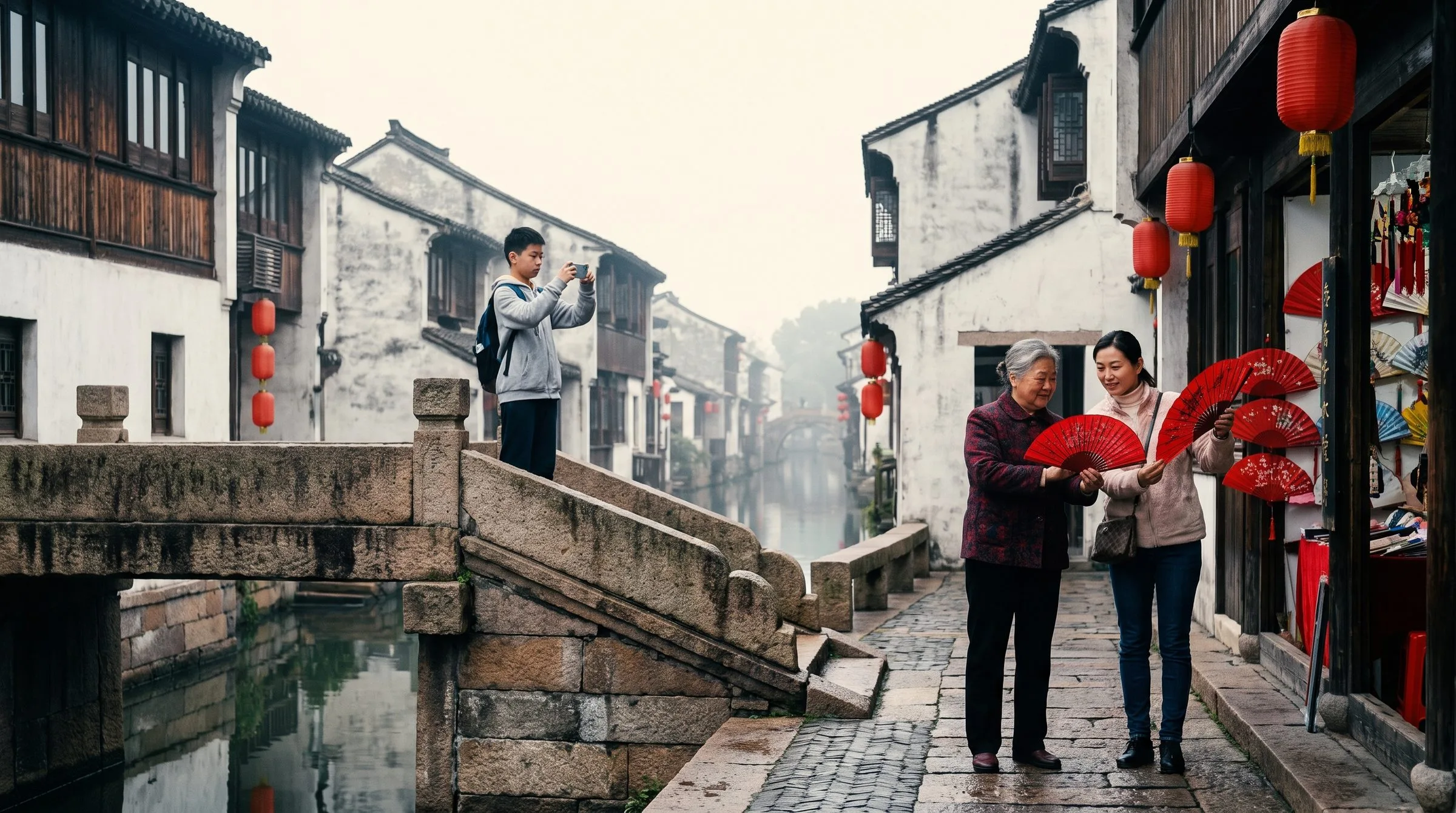
China Multigenerational Family Trip 2026: 3-Generation Itinerary (Grandparents, Parents, Kids)
A 12-day China trip for three generations — grandparents 60-80, parents 35-55, kids 5-15. Covers pacing for seniors, accessible attractions (Mutianyu cable car, Li River flat-bottomed boat, West Lake flat walking), hotels with family suites and elevators, medical insurance and evacuation coverage, the visa options that work, and the must-sees for grandparents (Great Wall cable car, panda base, Yu Garden) vs. parents vs. kids. Built around slow travel, 2-3 nights per city, and zero long-distance days.
Why a 3-generation China trip works
For the deep-dive on senior pacing, accessibility, and which attractions in China are wheelchair-friendly, see our senior travel pacing guide.
Traveling with grandparents, parents, and kids in the same group is hard in any country. China is one of the better countries to do it in, for reasons that are not obvious. (For the kids-only version of this same routing without the senior-pacing rules, see our China family vacation with kids guide.):
- The infrastructure is built for it. HSR stations all have elevators, the major sites are wheelchair-accessible, hotels in all major cities have accessible rooms with grab bars and walk-in showers, and the food is structured enough that older travelers with restricted diets can find something to eat.
- The cultural payoff is large for grandparents. For an 70-year-old who has read about the Great Wall all their life, actually seeing it is a once-in-a-lifetime moment. Same for the Terracotta Warriors, the Bund, the panda. China is one of the few destinations where the grandparents’ expectations are bigger than the parents’ and the kids’.
- The kids and parents benefit from the slow pace. The temptation on a family trip is to pack each day. With grandparents, the day is slower by default — and that pace, the 2-hour afternoon rest, the early dinner, the “do one thing per day” rule, is actually a better trip for everyone. The kids will remember the boat on the Li River more than they will remember the third temple.
The single most important rule: max 2-3 nights per city, max 1 main activity per day, and a 2-hour afternoon rest built into every day for the grandparents. If the grandparents do not rest, the second half of the trip will fall apart.
This guide assumes 6 travelers: 2 grandparents 60-80 (in good health, able to walk 1-2 km per day, can manage 1-2 flights of stairs slowly), 2 parents 35-55 (the planners and carriers of the trip), and 2 kids 5-15. If anyone has severe mobility issues (wheelchair, walker), see the accessibility section at the end.
12-day 3-generation route
| Days | City | Headline activity | Why it works for all 3 generations |
|---|---|---|---|
| 1-3 | Beijing | Mutianyu Great Wall cable car + Forbidden City slow tour | Grandparents: no climbing. Kids: toboggan. Parents: photo op. |
| 4-6 | Hangzhou | West Lake flat walk + Lingyin Temple + tea farm | Grandparents: flat, easy. Kids: boat ride. Parents: most beautiful city in China. |
| 7-9 | Guilin | Li River flat-bottomed boat + Reed Flute Cave | Grandparents: sit-on-boat luxury. Kids: the karst landscape. Parents: photo op. |
| 10-12 | Shanghai | Disney for kids + Yu Garden for grandparents + Bund for everyone | The kids get their day, the grandparents get theirs, the parents get the night view. |
Total: 11 nights, 12 days. Internal transport: 1 HSR Beijing-Hangzhou (5 hours), 2 flights (Hangzhou-Guilin 1.5h, Guilin-Shanghai 1.5h).
Day-by-day breakdown
Days 1-3: Beijing (3 nights)
Day 1 (arrival + rest). Land at Beijing Capital or Daxing, DiDi to the hotel (USD 20-30 for a 6-person minivan). Spend the afternoon in the hotel. Light dinner in the hotel restaurant. Early to bed — the jet lag is hardest on the first day for everyone but especially the seniors.
Day 2 (Mutianyu Great Wall). This is the headline Beijing day. Mutianyu is the right wall for a 3-gen trip because:
- Cable car up (the senior leg) — no climbing, sit the whole way, 8 minutes.
- 2 km of well-restored wall to walk, with handrails and a flat section that strollers and walkers can manage. Grandparents can do 500 m to 1 km, then sit on a bench and watch the parents and kids.
- Toboggan down (the kid highlight) — kids 5+ can ride alone, with a brake handle. The grandparents take the chairlift down (sit-down, 8 minutes).
- Lunch at the wall base — trout, dumplings, corn on the cob, all USD 5-10 per person.
Book a private car for the day (USD 120, hotel arranges). Leave 08:00, return 17:00.
Day 3 (Forbidden City slow tour + Jingshan Park). The Forbidden City is the right second-day activity because it is mostly flat walking with benches every 200 m. The trick for seniors is to do it in 90 minutes, not 3 hours. Enter from the south, walk the central axis to the emperor’s throne, exit to Jingshan Park on the north, climb the 5-minute hill (or take the elevator) for the classic view. Lunch in the Jingshan area, afternoon rest at the hotel, evening Peking duck dinner at a sit-down restaurant in Qianmen (the duck is sliced at the table, no effort required).
Days 4-6: Hangzhou (3 nights)
Hangzhou is the right second stop because it is the slowest, easiest, and most beautiful city on the route. West Lake is a flat 13 km loop; you can do half of it on the flat side, take a boat, and call it a day.
Day 4 (HSR Beijing-Hangzhou + hotel rest). First-class HSR from Beijing South to Hangzhou East (5 hours, USD 120-150 first class per person). Lunch in the dining car. Arrive Hangzhou by 16:00, DiDi to the hotel, light dinner, rest. The first-class seat upgrade is worth it for a 5-hour ride with seniors.
Day 5 (West Lake + boat + tea farm). The classic Hangzhou day. Morning: walk the flat western side of West Lake (3 km, all flat, all bench-lined), stop at the Su Causeway and the Three Pools Mirroring the Moon island. Mid-morning: take a rowboat or electric boat across the lake to the island (USD 15-30 per boat). Lunch in a lakeside restaurant. Afternoon rest at the hotel. Late afternoon: visit a Longjing tea farm on the hillside west of the lake (USD 5 entry, sit under the tea bushes, the family can buy green tea to bring home). The tea farm is a 30-minute slow walk with benches every 100 m, perfect for seniors.
Day 6 (Lingyin Temple + Hefang Street). Lingyin Temple is a 1,700-year-old Buddhist temple in a forested valley west of the lake. The main hall is reached by 5 minutes of flat walking from the gate; the surrounding hills have harder walking for those who want it. The temple itself is shaded, cool, and benches-lined. Lunch in the temple vegetarian restaurant (USD 8-10 per person). Afternoon rest. Evening: Hefang Street (an old street with shops, tea houses, and snacks) for a slow stroll and a light dinner. Pack light for the flight to Guilin the next morning.
Days 7-9: Guilin (3 nights)
Guilin is the right third stop because the Li River cruise is the single best senior activity in China. You sit on a flat-bottomed boat for 4 hours and watch the karst landscape slide past. No walking, no stairs, no effort.
Day 7 (fly to Guilin + rest). Morning flight from Hangzhou to Guilin (1.5 hours, USD 80-120 per person). DiDi to the hotel, light lunch, afternoon rest.
Day 8 (Li River flat-bottomed boat). The headline grandparents day. The 4-hour boat from Guilin to Yangshuo on a flat-bottomed boat (USD 50-80 per person, includes lunch) is comfortable, scenic, and zero-effort. The boat has indoor and outdoor seating, a small bathroom, a lunch counter serving rice and vegetables, and a microphone that the captain uses to point out the famous scenes (the picture on the back of the 20 RMB note is here). Land in Yangshuo, electric car tour of the small town (1 hour, USD 5 per person), lunch in Yangshuo, drive back to Guilin (1.5 hours). Early dinner at the hotel.
Day 9 (Reed Flute Cave + Seven Star Park). Reed Flute Cave is a 180-million-year-old limestone cave with a 240-meter lit walking path inside (all flat, all handrail-lined, all lit). Allow 1.5 hours. The temperature inside the cave is 18°C year-round — bring a light layer. Afternoon: Seven Star Park (a city park with a small zoo, a tea house, and a kids’ playground) for a slow family afternoon. Dinner at a local Guilin rice-noodle restaurant (mifen, USD 2-3 per bowl, the local specialty).
Days 10-12: Shanghai (3 nights)
Shanghai is the right last stop because it is the easiest departure. Three nights gives you one Disney day, one city day, and one rest day.
Day 10 (Disney day for kids, hotel day for grandparents). This is the key split: the parents + kids go to Shanghai Disney Resort (1-day ticket, USD 80 adult / USD 60 child, leave the hotel at 08:00, return by 21:00). The grandparents stay at the hotel, swim, nap, and have a quiet day. Dinner together at a family restaurant in the French Concession (the kids are tired but happy, the grandparents are rested). If the grandparents want a partial Disney day, they can do a 4-hour afternoon visit — Shanghai Disney is the most accessible Disney park in the world (electric wheelchair rental, USD 25, accessible attractions, accessible restaurants).
Day 11 (Yu Garden + Bund + Huangpu River cruise). This is the headline Shanghai grandparents day. Yu Garden is a 400-year-old Ming-dynasty garden in the old city (USD 8 entry, 1 hour, mostly flat with benches). The Bund is a 1.5 km flat walk along the riverfront with the colonial-era buildings on one side and the Pudong skyline on the other. Take the Huangpu River cruise (USD 5-15 per person, 1 hour, indoor seating with bathroom) for the night view of the skyline. Dinner at M on the Bund or Lost Heaven (kid-friendly menu, Western food backup, accessible seating).
Day 12 (departure). Maglev from Pudong to the airport (USD 8, 8 minutes at 430 km/h — the grandparents will love this) or DiDi (USD 20, 45 min, more comfortable for seniors who don’t want the speed). Check in 3 hours before international flight.
The senior-friendly hotel list (4 cities)
The single biggest determinant of a 3-gen trip’s success is the hotel. Each city needs: (1) one suite that sleeps 4-6, (2) elevator access to all floors, (3) accessible bathroom in at least one room, (4) on-site restaurant, (5) within walking distance of at least one main site.
All prices are mid-range, 6 people in 2 rooms or 1 family suite, June-September 2026, USD/night.
| City | Hotel | Configuration | USD/night |
|---|---|---|---|
| Beijing | Sofitel Beijing Central | 1 2-bedroom suite (sleeps 4) + 1 standard room (sleeps 2) | 200-280 |
| Beijing | Grand Hyatt Beijing | Same configuration, more luxury | 300-400 |
| Hangzhou | West Lake State Guest House | 2 lakeview rooms (each sleeps 3) | 180-260 |
| Hangzhou | Sofitel Hangzhou Westlake | 1 family suite + 1 standard | 200-300 |
| Guilin | Lijiang Waterfall Hotel | 1 family suite (sleeps 4) + 1 standard | 100-150 |
| Guilin | Shangri-La Guilin | Same configuration, more luxury | 180-260 |
| Shanghai | Grand Kempinski Shanghai | 1 2-bedroom suite + 1 standard | 250-350 |
| Shanghai | Pudong Shangri-La | Same configuration, river view | 350-500 |
Booking tip: Always email the hotel in advance to confirm: (1) the room configuration matches your family size, (2) there is at least one accessible bathroom with grab bars, (3) the on-site restaurant has an English menu, (4) the hotel can store medications in the fridge if needed.
Slow travel rules (the 7 rules for a 3-gen trip)
- Max 2-3 nights per city. Every transition is energy; the longer you stay, the less you have to do each day.
- Max 1 main activity per day. Two main activities in a day is a hard rule for trips with seniors. Morning activity, lunch, afternoon rest, light evening activity.
- Built-in 2-hour afternoon rest. Every day. The hotel is not a wasted day; the hotel is the recovery that lets the trip work.
- First-class HSR for the 5-hour Beijing-Hangzhou leg. The legroom matters for seniors on a 5-hour ride.
- No overnight trains or red-eye flights. The jet lag and the physical cost of an overnight sleeper are too high for a 3-gen group.
- Eat dinner at 18:30, in the hotel, and order off the picture menu. No long walks to a far-away restaurant. No decision fatigue. No “what does everyone want?” debates.
- Have a “Plan B” rest day in the middle. If anyone is sick or exhausted on Day 6, do not push. Spend the day at the hotel. The trip can survive one rest day; it cannot survive one collapsed senior.
Medical insurance (the non-negotiable)
For a 3-gen trip, medical insurance is not optional. Chinese private hospitals are world-class (Beijing United Family, Shanghai Parkway Health) but they cost USD 5,000-15,000 for a single ER visit without insurance. Medical evacuation to a Western-standard hospital in Hong Kong or Singapore is USD 50,000-100,000.
Required coverage:
- $100,000+ per person for medical expenses
- $250,000+ for emergency medical evacuation
- Coverage for pre-existing conditions (the seniors)
- Coverage for all 6 family members
- Direct billing with the major private hospitals in Beijing, Hangzhou, and Shanghai
Recommended insurers for senior-friendly plans:
- World Nomads — family plans, covers most countries, evacuation included
- GeoBlue — US-based, excellent for seniors, covers pre-existing conditions on the higher-tier plans
- IMG Global — good for multi-generation families, customizable
Document checklist for the seniors:
- Doctor’s letter listing all conditions and current medications (in English and Chinese)
- 2x prescription meds in original packaging (one in carry-on, one in checked bag)
- Blood-pressure cuff and glucose monitor if applicable
- Compression socks for the flight
- Photocopy of all insurance documents
- Emergency contact card in Chinese characters (the hotel front desk will help write this)
What to pack for the grandparents
- 2x prescription meds in original packaging (split between two bags)
- Doctor’s letter listing all conditions and current medications (in English and Chinese)
- Compression socks for the flight
- Small pillow for the HSR and the plane
- Familiar snacks (energy bars, dried fruit, electrolyte packets)
- Sunscreen, hat, light jacket (Beijing and Hangzhou nights drop to 10-15°C even in summer)
- Reusable water bottle
- A small notebook and pen (for jotting down questions for the tour guide)
- Photocopy of all passports
- A small first-aid kit (plasters, anti-diarrheal, paracetamol)
- The hotel address in Chinese characters, written on a card in their pocket
Visa, payment, and the practical prep
Visa: 12 days is 2 days too long for the 240-hour transit. Apply for the L-visa 30 days out. $140 USD per passport for US/Canada/Australia. 4 working days processing, valid for 30 days. UK and Schengen passport holders get 30 days visa-free in 2026.
Payment: WeChat Pay and Alipay both link to Visa/Mastercard/Apple Pay in 2026. Setup before you fly — you will need a friend with a Chinese WeChat to scan and verify your account. Bring USD 300-500 in cash as backup.
Phone: A China unicom or China mobile eSIM (USD 5-10 for a 14-day plan with 5-10GB) or an international eSIM from Airalo or Holafly. DiDi and Maps.me work with any data connection. Google Maps requires VPN; Apple Maps works without VPN in China. Install and sign up for a paid VPN (ExpressVPN, NordVPN, or Astrill) before you fly.
Apps to install before takeoff: DiDi, WeChat, Alipay, Pleco (offline Chinese dictionary), Maps.me, Trip.com, and a paid VPN.
When to go (best months for a 3-gen trip)
- Best: April-May and late September-October. Temperatures 18-25°C, no school holidays, low crowds, reasonable prices. The best windows.
- Good: Early June and early September. Hot but no school holiday, lower hotel prices.
- Avoid: July-August (school holiday, 35°C+ in Beijing, peak Disney crowds, hotel prices 30-50% higher), Golden Week (October 1-7), and Spring Festival (late January / mid-February).
Senior travel bonus: April-May and September-October are also the shoulder seasons for Chinese domestic travel, so the HSR, the hotels, and the major sites are all 20-30% less crowded than peak season.
Accessibility for severe mobility issues
This route assumes grandparents who can walk 1-2 km per day and manage 1-2 flights of stairs slowly. If any traveler is in a wheelchair, has a walker, or has severe mobility issues:
- Mutianyu Great Wall is wheelchair-accessible to the lower platform; the upper wall has stairs only. The chairlift down is wheelchair-friendly.
- West Lake in Hangzhou is fully wheelchair-accessible on the flat eastern and western sides.
- Li River cruise is wheelchair-accessible; the boats have ramps and an accessible bathroom.
- Shanghai Disney is the most accessible Disney park in the world — electric wheelchair rental (USD 25), accessible attractions, accessible restaurants.
- The Forbidden City is partially wheelchair-accessible; the central axis is flat, but the side halls have raised thresholds.
- The Terracotta Warriors (not on this route, but the most common swap) is NOT wheelchair-friendly — uneven ground, no elevators between pits.
Hotel accessibility checklist:
- Roll-in shower (not just grab bars)
- Shower chair available on request
- Lowered light switches and peephole
- Elevator access to all floors
- Accessible bathroom in at least one of your rooms
One last thing
A 3-generation China trip is one of the highest-leverage family trips you can take. The grandparents will see the Great Wall. The parents will see the grandparents see the Great Wall. The kids will see the grandparents see the Great Wall and decide they want to come back when they are older. The trip ages well — you will be talking about the Li River boat in 20 years.
Plan the visa, book the family suite, pack the medications, and go. The wall is not going to climb itself, the pandas will not eat bamboo all day, and the grandparents are not getting any younger.
Plan and book
For a one-stop 3-generation booking, the cleanest path is:
- Hotel platform: Trip.com (foreign credit cards accepted, free cancellation on most family suites) or Booking.com (larger accessibility-tagged inventory).
- Internal transport: Trip.com for HSR (book first-class for the 5-hour Beijing-Hangzhou leg) and flights.
- Insurance: World Nomads or GeoBlue — verify pre-existing condition coverage for the seniors before booking.
- Li River boat: Book through the hotel or on Trip.com. The flat-bottomed boats (4-hour Guilin-Yangshuo) sell out 7 days out in peak season.
- Disney tickets: Official site (shanghaidisneyresort.com) — book 30-60 days out for peak season.
Step by step
-
60 days out: L-visa for the whole family + book medical insurance
Book a 30-minute appointment at the Chinese consulate for 6 passports. $140/person for US/Canada/Australia, $0 for UK/Schengen, 4 working days. On the same day, buy travel medical insurance covering emergency evacuation ($100,000+ per person) — World Nomads, GeoBlue, or IMG. Verify that the policy covers pre-existing conditions for the grandparents; most do not by default, so you may need to pay extra.
-
45 days out: Book 4 hotels with family suites + elevators
The single biggest determinant of a 3-gen trip's success is the hotel. Each city needs: (1) one suite that sleeps 4-6, (2) elevator access to all floors, (3) accessible bathroom in at least one room, (4) on-site restaurant for slow breakfasts, (5) within walking distance of at least one main site. Top picks: Beijing — Sofitel Beijing Central (USD 200-280/night for a 2-bedroom suite); Hangzhou — West Lake State Guest House or Sofitel Hangzhou Westlake; Guilin — Lijiang Waterfall Hotel or Shangri-La Guilin; Shanghai — Grand Kempinski Shanghai or Pudong Shangri-La.
-
30 days out: Book the Great Wall Mutianyu private car + Li River boat
Mutianyu Great Wall is the headline senior day. The wall has a cable car up and a chairlift down — no climbing. Book a private car for the day (USD 120, hotel arranges), leave 08:00, return 17:00. The Li River flat-bottomed boat from Guilin to Yangshuo (4 hours, USD 50-80 per person) is the headline grandparents day — comfortable seats, indoor cabin, bathroom, lunch on board, no physical effort.
-
14 days out: Buy HSR + 1 short flight; print all tickets
The Beijing-Hangzhou HSR (5 hours) is the longest single day. Book first-class seats for the grandparents (USD 120-150 vs second class USD 60-80 — the extra legroom matters on a 5-hour ride). The Hangzhou-Guilin leg is a 1.5-hour flight (USD 80-120 per person). The Guilin-Shanghai leg is a 1.5-hour flight (USD 70-100) — better than the 8-hour HSR for seniors.
-
Pack the senior kit: medications, copies, comfort items
For each senior: 2x prescription meds in original packaging (one in carry-on, one in checked bag), doctor's letter listing all conditions and meds, blood-pressure cuff if applicable, compression socks for the flight, familiar snacks, a small pillow, a book. A printed card with the hotel address in Chinese characters for every city. Photocopies of all passports. A small first-aid kit (plasters, anti-diarrheal, paracetamol, electrolytes).
FAQ
-
Can grandparents travel to China?
Yes — China is a strong multigenerational destination. The infrastructure is built for it: HSR stations all have elevators, the major sites (Mutianyu Great Wall, Hangzhou West Lake, Shanghai Bund, Yu Garden) are wheelchair-accessible, mid-range hotels in all 4 cities have elevators and accessible rooms, and the food is structured enough that older travelers with restricted diets can find something to eat. The keys for an over-60 traveler: (1) medical insurance that covers pre-existing conditions and emergency evacuation (US$100,000+ coverage), (2) max 2-3 nights per city, (3) max 1 main activity per day, (4) built-in 2-hour afternoon rest, and (5) one main medical contact at each hotel. Avoid the Terracotta Warriors pit if anyone has severe mobility issues — it is uneven ground with no elevator between pits. -
What is the best China itinerary for 3 generations?
The right itinerary puts the slowest pace first and lets the kids and parents add to it. The recommended 12-day route: Beijing (3 nights, slow) → Hangzhou (3 nights, slow) → Guilin (3 nights, slow) → Shanghai (3 nights, moderate). Total internal transport: 1 HSR Beijing-Hangzhou (5 hours, can be overnight sleeper), 1 short flight Hangzhou-Guilin (1.5 hours), 1 HSR Guilin-Shanghai (8 hours, or 1.5-hour flight). This route avoids long-distance days back-to-back, has flat or cable-car-accessible major sites, and the hotels are all 4-star with elevators, family suites, and on-site restaurants — no long walks from the lobby. -
How much does a 3-generation China trip cost?
For 6 people (2 grandparents 60+, 2 parents 35-55, 2 kids 5-15), a mid-range 12-day trip costs USD 6,000-10,000 excluding international flights and visas. The biggest line items: hotels with family suites (USD 200-400/night, can sleep 4-6 in one suite), internal flights and HSR (USD 800-1,200 for the family), attraction tickets (USD 200-300 total), and food (USD 30-50 per person per day for sit-down meals). The seniors' tickets are usually 50% off, kids under 1.2 m are often free. A budget version (3-star hotels, mix of street food and restaurants) is USD 4,000-6,000. A luxury version (5-star hotels, private driver throughout) is USD 15,000-25,000. -
What visa do grandparents need for China?
If the trip is 12 days, the 240-hour (10-day) visa-free transit is 2 days too short. The cleanest options: (1) L-visa tourist visa, $140 USD per passport for US/Canada/Australia seniors (the visa fee is the same as for adults; there is no senior discount), 4 working days, single entry 30 days, valid for the whole family. (2) 240-hour transit, valid only if entering from a third country (Hong Kong → Beijing → Hong Kong) — works for a 9-day or shorter version of the route. For most 3-generation families, the L-visa is the right call. UK and Schengen passport holders get 30 days visa-free in 2026, no visa needed.
Related guides
- Itineraries
China Honeymoon 2026: 8 Best Destinations, Real Costs & 10-Day Itineraries
China honeymoon 2026: 8 best destinations, real costs by tier ($1,800-$8,000), 240h visa-free for 57 countries, and 10-day sample itineraries from Beijing to Lijiang and Sanya.
9min read
- Itineraries
China Family Vacation with Kids 2026: 12-Day Itinerary for Ages 4-12
A practical 12-day China family vacation for kids aged 4-12 covering four cities (Beijing, Xi'an, Shanghai, Chengdu). Best kid-friendly hotels with family rooms, age-by-age itinerary, what to pack, kid-friendly food, safety for children in crowded places, ticket booking for foreigners, and the visa options that work for families. Built around Mutianyu Great Wall (toboggan ride), Terracotta Warriors, Shanghai Disney Resort, and the Chengdu panda base.
- Itineraries
China Honeymoon Itinerary: 10 Romantic Days (2026)
10-day China honeymoon itinerary from Beijing to Shanghai via Xi'an and Guilin/Yangshuo. Best honeymoon places in China, romantic hotels, visa-free entry for newlyweds, real cost tiers for 2026.
13min read
- Itineraries
2 Weeks in China: The Classic Beijing-Xi'an-Chengdu-Shanghai Route (2026)
A complete 14-day China itinerary for first-time visitors: 3 days Beijing, 2 days Xi'an, 2 days Chengdu, 4 days Shanghai, with day-by-day timing, costs, transit between cities (high-speed rail vs flight), hotel recommendations, and which days to skip if you have less time. Budget: ¥15,000-22,000 per person excluding international flights.
12min read
- Itineraries
7 Days in China: Beijing → Xi'an → Shanghai
The most-searched 7-day China first-timer itinerary: Beijing Great Wall, Xi'an Terracotta Warriors, Shanghai Bund. High-speed train routes, hotels, costs, and visa-free entry tips.
9min read
- Itineraries
China Solo Travel Guide 2026: 2-Week Backpacker Route for First-Time Visitors
A practical 2-week China solo travel guide for first-time backpackers and independent travelers. Covers a five-city route (Beijing, Pingyao, Xi'an, Chengdu, Shanghai), hostel and boutique-hotel picks, the China 240-hour visa-free transit, DiDi, HSR, sleeper trains, group tour options for harder-to-reach places, daily budgets, and a no-safety-theatre safety section.