
Qinghai Lake Guide: Cycling China's Largest Saltwater Lake
Qinghai Lake in Qinghai is China's largest saltwater lake (4,400 sq km, 3,196m) with rapeseed flowers, Chaka Salt Lake. Covers transport, tickets, 3-4 day plan.
Qinghai Lake (青海湖, Qinghai Hu) is the largest inland lake in China and the largest saltwater lake in the country, with 4,400 sq km of surface area. The lake sits at 3,196m elevation on the Qinghai-Tibet Plateau, in a basin surrounded by mountains that rise to 4,000-5,000m. The water is saline (0.3% salinity) but supports the lake’s famous naked carp (湟鱼), a species endemic to the lake that has been harvested for centuries by the local Tibetan and Mongolian populations.
The lake is part of the larger Qinghai-Tibet Plateau ecosystem and is a critical breeding ground for migratory birds. The annual population of bar-headed geese, great crested grebes, and brown-headed gulls exceeds 100,000 during the April-June breeding season at Bird Island (鸟岛) on the northwest shore. The lake was designated a UNESCO Man and the Biosphere reserve in 1997, and is a tentative UNESCO World Heritage site for its natural significance.
The 360 km road loop around the lake is one of China’s most popular cycling routes, and the south shore has the most dramatic combination of deep blue water, golden rapeseed fields, and snow-capped mountains in the background. The peak season is July-August when the rapeseed flowers bloom; the lake is accessible year-round but most hotels and yurts close November-April.
How to plan your 3-4 day trip
Day 1 - Xining to Qinghai Lake
Pick up the rental car at Xining Caojiabu Airport. Drive 150 km west on the G109 highway, 2.5 hours. Stop at Sun Mountain pass (3,410m) for the panoramic view. Continue to Heishan village on the south shore. Check into a yurt camp or lake-view hotel. Watch sunset over the lake (7:30-8:00 PM in July).
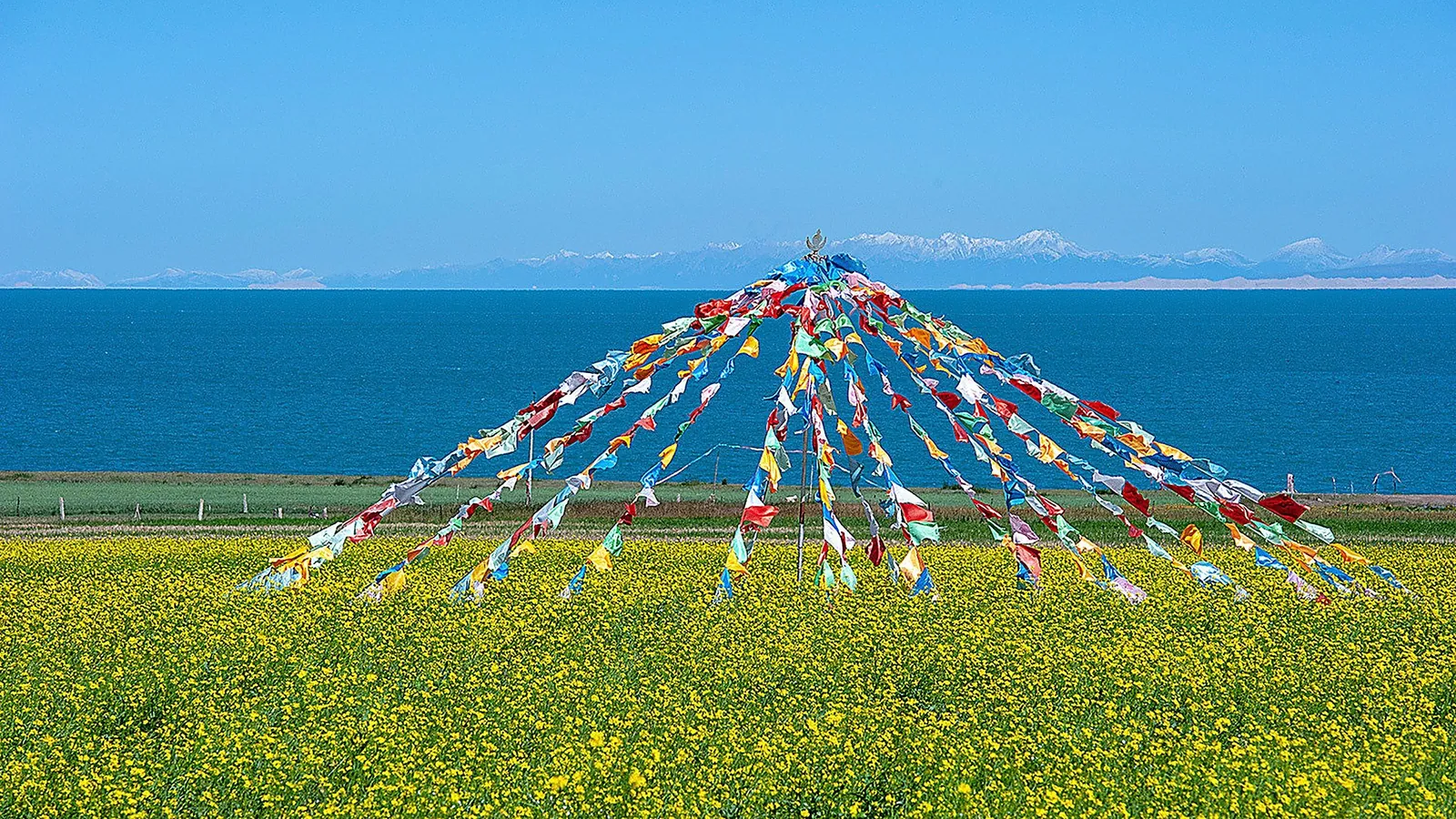
Photo: Wikimedia Commons / CC BY-SA. Source

Day 2 - Cycling day
Rent a bike at the yurt camp. Ride east along the south-shore road to the rapeseed flower fields (10-20 km depending on camp location), then back. The round trip is 30-50 km, 3-5 hours. Most cyclists take a support van for the longer 80-100 km ride to Jiangxigou. Afternoon: rest at the yurt, walk the lake shore. Evening: Tibetan dinner at the yurt.
Day 3 - Chaka Salt Lake
Drive 80 km west on the G109 to Chaka Salt Lake. Spend 2-3 hours walking on the salt flat and taking mirror photos. Lunch at Chaka town (small noodle shops, ¥30-50). Drive back to the south shore for the night, or drive back to Xining if time is short (3 hours).
Day 4 - Sand Island and return to Xining
Drive to Sand Island (沙岛) on the north shore, 70 km north, entry ¥30. Allow 2 hours. Drive back to Xining on the G109, 3 hours. Drop off the rental car. Fly out from Xining Caojiabu Airport.
Tickets, booking, and payment
Major sites and their 2026 entry fees:
- Qinghai Lake scenic area - ¥100 (peak May 1 to October 31), free off-season. Single entry, valid for 3 days.
- Chaka Salt Lake - ¥60 entry, ¥20 small train to the lake center. 7:30 AM to 7:00 PM.
- Sand Island - ¥30 entry, ¥20 shuttle. 8:00 AM to 6:00 PM.
- Bird Island - ¥60 entry, ¥40 shuttle. 8:00 AM to 6:00 PM, closed November-March.
- Kumbum Monastery - ¥80 entry. 8:00 AM to 5:30 PM.
- Riyue Mountain (Sun Moon Mountain) - ¥40 entry. 8:00 AM to 6:00 PM.
How to book:
- At the gate - passport required, cash or Alipay/WeChat. No foreigner surcharge.
- Trip.com - English, accepts Visa/Mastercard, 5% service fee. The most comprehensive booking platform for cycling tour packages including bike, support van, and hotels.
- Alipay mini-program - search 青海湖, pick the date. E-ticket loads into Alipay wallet.
Free entry: Children under 1.2m, seniors over 65 (with passport). Most sites give 50% student discount with Chinese ID.
What is NOT included:
- Bike rental (¥80-150 per day, paid at the yurt camp or in Jiangxigou)
- Support van for cyclists (¥400-600 per day, paid to local operators)
- Cycling gear (helmet, gloves, knee pads) - bring your own or rent for ¥30-50
- Chaka Salt Lake small train (¥20) - optional, the lake is walkable
Getting there and around
By air: Xining Caojiabu Airport (XNN). Direct flights from Beijing (2h 30m, 5-6 daily), Shanghai (3h, 4 daily), Xi’an (1h 30m, 4 daily), Chengdu (2h, 3 daily), Guangzhou (3h 30m, 2 daily). Round trip from Beijing is ¥1,500-2,800. The airport is 30 km east of downtown; airport bus ¥20, taxi ¥80-100.
By train: Xining Station is on the Qinghai-Tibet Railway, the highest railway in the world. Direct trains from Beijing (24 hours, sleeper ¥600-900), Shanghai (32 hours, sleeper ¥800-1,200), Xi’an (10 hours, sleeper ¥400-600). The slow but scenic route. Most travelers fly.
By car (self-drive): From Xining, the G109 highway runs west to Lhasa via the south shore of Qinghai Lake. The road is paved and well-maintained. A sedan works for the south shore and Chaka; a 4WD is needed only for the unpaved north-shore road to Sand Island in wet weather.
Inside the lake region: Most travelers self-drive or hire a driver. Car rental in Xining is ¥300-500/day for a sedan, ¥600-800/day for a 4WD. The driver-hire option in Xining is ¥500-700 per day including fuel; most hotels can arrange this. Cycling is the alternative for fit travelers, with bike rental at the yurt camps.
When to go and what to expect
Mid-July to early August (rapeseed peak). Peak season. The rapeseed fields bloom for 3-4 weeks. Yellow flowers against blue water, with snow-capped mountains behind. Crowds are highest. Book hotels 2-3 weeks ahead. Temperatures: 8C to 22C, with cool nights.
Late June to mid-July (early bloom). Shoulders into peak. Some rapeseed fields are blooming, some are still green. Fewer crowds. Temperatures: 6C to 20C. Excellent for cyclists who want less traffic.
Late August to mid-October (post-bloom). Rapeseed is harvested; the lake returns to blue-only. Fewer crowds. Temperatures: 0C to 18C. Best for travelers who want quiet and clear weather.
November to March (winter). Cold (-20C nights, -5C days). The lake can freeze at the edges. Most yurts and hotels close. Bird Island closes. Some hotels in Xining offer winter package tours to the frozen lake.
April to June (spring/birds). Migratory birds arrive at Bird Island. Temperatures: -5C to 15C. Best for birdwatchers and photographers. Most yurts and the full lake road are open from May.
What to bring
- Sunscreen and lip balm with SPF - UV index at 3,200m reaches 9-11 in summer. The sun is intense; sunburn on the lips is common.
- Layered clothing - Summer days are 20C, nights are 5C. A fleece and a windbreaker are essential. The lake wind is strong in the afternoon.
- Cycling gear (if cycling) - helmet, gloves, padded shorts, sunglasses. Most bike shops have basic helmets but not the rest. Bring your own if you have a serious cycling habit.
- Cash (¥500-800) - Small yurt camps and bike shops prefer cash. Xining and Chaka accept Alipay. Foreign cards are not accepted outside Xining.
- Power bank - The lake has no reliable outlets at viewpoints. A 20,000 mAh pack is enough for 2 phone charges.
- Offline maps - Amap or Apple Maps. Cell signal is good in towns, weak on the open lake shore.
- Water bottle and snacks - Few shops on the lake road. Stock up in Xining or Heishan each morning.
- Diamox (acetazolamide) 125mg - Available at Xining pharmacies. Start 24 hours before going above 3,000m if you have any history of altitude sickness. For other travel health scenarios (hospitals, insurance, English-speaking clinics), see our sick in China as a foreigner guide.
- Headlamp - The yurt camps have poor outdoor lighting; a headlamp is useful for evening bathroom trips.
The 5 photo spots that matter
- Sun Mountain pass (3,410m). The classic wide-angle view. Park at the pass viewpoint, walk 100m to the eastern edge, and the lake unfolds below you. Best at 7:00 AM in July when the morning light hits the south shore. Bring a wide-angle lens.
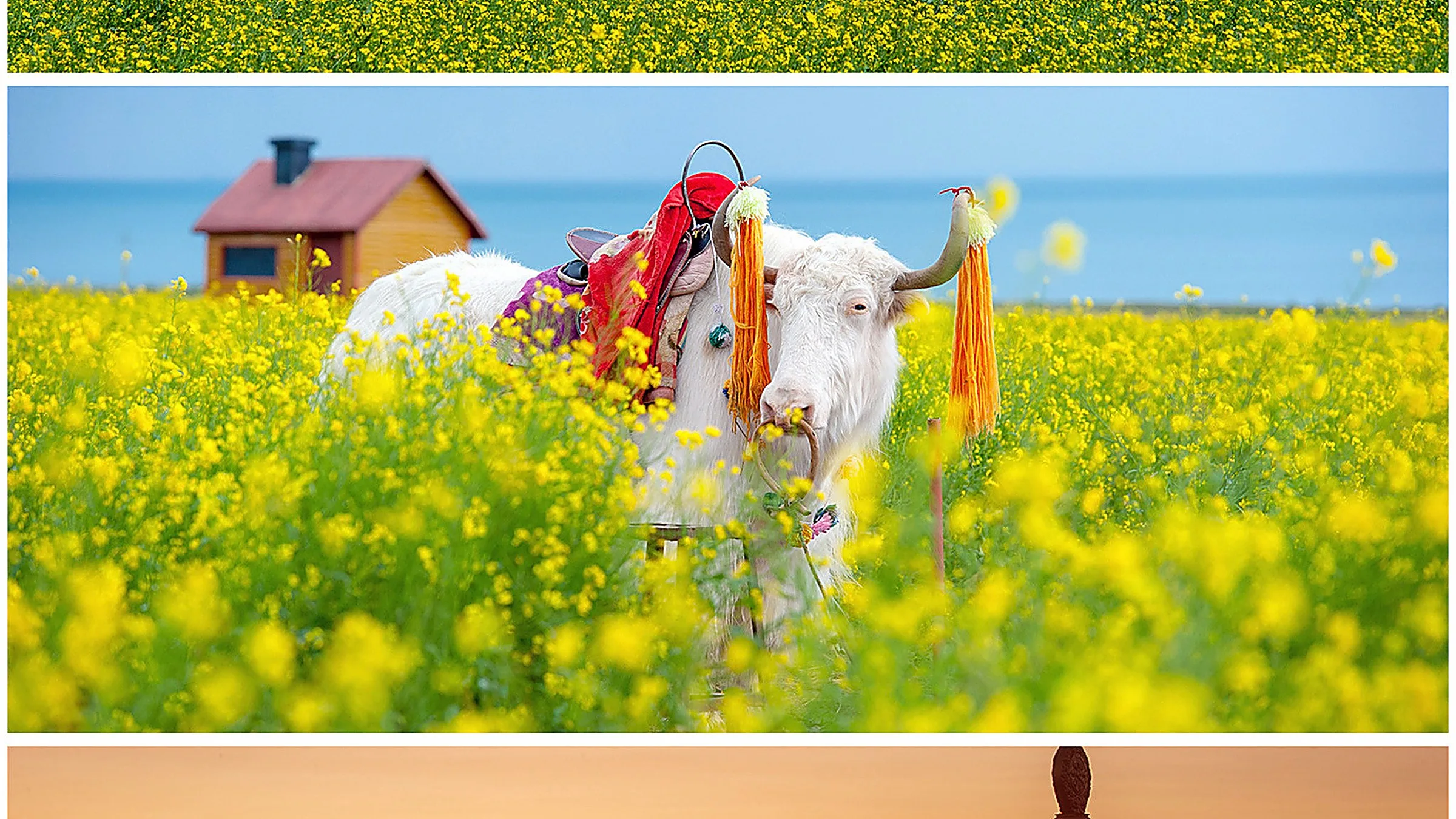
- Heishan rapeseed fields. The yellow flowers with the blue lake behind. The fields are private plots; the owners charge ¥10-20 per person to walk through, with a small fee collected at the entrance. Best at 9:00 AM in mid-July.
Photo: Wikimedia Commons / CC BY-SA. Source 3. Jiangxigou cycling road. The flat south-shore road with the lake on one side and rapeseed on the other. Best for action shots of cyclists. Most photogenic 5-7 PM with golden light. 4. Chaka Salt Lake mirror. Walk 500m out onto the salt flat. The mirror reflection works best on a calm day with thin cloud cover. Wear bright colors (red dress, white shirt) for the most photogenic contrast. Best 9-11 AM. 5. Sand Island (沙岛) dunes. The narrow strip of dunes extending into the lake. Best at sunset (7:30-8:00 PM) when the dune shadows create patterns. Bring a telephoto for the dune textures.

Common mistakes to avoid
- Driving from Xining to the lake in one go. The 150 km drive is only 2.5 hours but you climb from 2,275m to 3,196m. The combination of speed and altitude is the most common cause of altitude sickness. Spend 1 night in Xining first. For the bigger picture on altitude (and what to do if symptoms get serious), see our sick in China as a foreigner guide, or read about the 4,000m+ version at Daocheng Yading in Sichuan.
- Cycling the full loop in 2 days. Most tour operators offer 2-day “express” loop tours. At 3,200m, 180 km per day is dangerous. The 4-day loop is the safe minimum. Most cyclists who get hurt on this route underestimate the altitude.
- Going to Chaka Salt Lake on the same day as the cycling day. Chaka is 80 km west of the south shore. The combined 250 km day is exhausting. Plan Chaka as a separate day.
- Arriving at Chaka at noon. The salt lake mirror is best in the morning (9-11 AM) when the wind is calmest. Afternoon wind kicks up ripples and ruins the reflection.
- Wearing sandals. The lake shore has sharp rocks and the cycling roads have loose gravel. Closed shoes with ankle support are essential.
- Skipping the layered clothing. The temperature swing from morning (5C) to afternoon (22C) is 17C. A single jacket will either be too warm or too cold.
- Trusting Google Maps. Google services are blocked in China. Use Amap (高德地图) for navigation. Save key Chinese names: 青海湖, 茶卡盐湖, 黑马河, 江西沟, 倒淌河, 日月山, 沙岛, 鸟岛.
Where to stay
- Xining (gateway city) - downtown. Budget: Hanting, Home Inn, 7 Days (¥150-250/night). Mid-range: Sofitel Xining, Qinghai Hotel (¥450-800/night). All have Western toilets and reliable hot water.
- Heishan village (south shore) - the most popular base. Yurt camps with shared bathrooms (¥150-300/night), or lake-view hotels (¥400-800/night). Most yurts include Tibetan dinner and breakfast.
- Jiangxigou (south shore, 30 km east of Heishan) - quieter, more cycling-friendly. Jiangxigou Hotel (¥350-500/night), Yading Hotel (¥400-600/night). Bike rental at the village center.
- Chaka town - small town 1 km from Chaka Salt Lake. Basic hotels: Chaka Salt Lake Hotel (¥200-350/night). Most visitors stay on the lake side and visit Chaka as a day trip.
Local food and culture
Qinghai cuisine is a mix of Tibetan, Hui Muslim, and northwestern Chinese influences. Most Xining restaurants serve halal-friendly beef noodles, lamb skewers, and the local yogurt - the city is one of the easier places in China for Muslim travelers (see our China Muslim travel and halal guide for what to look for on menus). Must-try dishes:
- Yak hotpot (牦牛火锅) - the regional staple, ¥80-150 per person at any yurt camp. Served with potato, mushroom, and Tibetan bread.
- Butter tea (酥油茶) - salty, hot, served in every Tibetan yurt. The traditional breakfast drink.
- Tsampa (青稞面) - roasted barley flour mixed with butter tea. The traditional Tibetan staple.
- Qinghai naked carp (湟鱼) - the lake’s endemic fish, served fried or braised. Available May-August only (fishing ban March-June). ¥80-120 per dish.
- Hand-pulled noodles (拉面) - the Hui Muslim specialty, ¥20-30 per bowl. Available in any Xining restaurant.
- Sweet fermented barley drink (甜醅) - a Qinghai specialty, ¥10 per cup. Cool, sweet, slightly alcoholic.
Tibetan culture: prayer flags (经幡) on every lakeside hilltop, the annual horse racing festival in August, kora (circumambulation) walks around the lake by Buddhist pilgrims (full circuit 7-10 days, shorter 1-day loops near monasteries), and the working Tibetan Buddhist monasteries in the area (Kumbum is the most famous). The local Tibetan and Mongolian populations are the main hosts at the yurt camps and most speak Tibetan, Mongolian, and Mandarin.
Book your Qinghai Lake trip
Xining hotel (gateway to Qinghai Lake)
Trip.com's Xining hotel listing with foreigner-friendly options. Most travelers stay 1-2 nights in Xining before the 2.5-hour drive to Qinghai Lake. Foreign cards accepted, free cancellation.
Hotels from $40/night
Affiliate disclosure: We earn a small commission at no extra cost to you. See full disclosure.
Plan your trip - verified tools
These free tools are built on real, monthly-verified data and help you skip the trial-and-error phase of China trip planning:
- China 240-Hour Visa-Free Transit Checker - 57 countries, 24 provinces, 65 ports. See if if you qualify for 10-day visa-free transit, which cities you can visit, and the 5-step process.
- China 6-City 5-Day Budget Calculator - Real 2026 prices for 5 days in Beijing, Shanghai, Guangzhou, Chengdu, Xi’an, or Hangzhou. Budget / mid-range / comfort tiers, broken down line by line.
Verified August 2026 by TravelHubChina Editorial. We re-check prices and policy details monthly so the data doesn’t drift.
Step by step
-
Fly to Xining Caojiabu Airport (XNN)
Xining is the gateway city. Direct flights from Beijing (2h 30m, 5-6 daily), Shanghai (3h, 4 daily), Xi'an (1h 30m, 4 daily), Chengdu (2h, 3 daily), and Guangzhou (3h 30m, 2 daily). Round trip from Beijing is ¥1,500-2,800. The airport is 30 km east of downtown Xining; airport bus ¥20, taxi ¥80-100. The Qinghai-Tibet Railway also stops at Xining Station but takes 24+ hours from Beijing.
-
Spend 1 night in Xining (2,275m) to acclimatize
Xining is at 2,275m and is the lowest elevation between the lowlands and the lake. Spend 1 night here to drop your body into high-altitude mode before driving higher. Visit the Kumbum Monastery (¥80) 25 km south of the city, one of the six great monasteries of the Yellow Hat sect of Tibetan Buddhism. Stay in downtown Xining (budget: Hanting, Home Inn, ¥180-280; mid-range: Sofitel Xining, ¥500-900).
-
Drive Xining to Qinghai Lake (150 km, 2.5 hours)
From Xining, drive west on the G109 highway, 2.5 hours to the south shore of the lake. The road climbs from 2,275m to 3,196m at the lake level. Stop at Sun Mountain pass (3,410m) for the classic wide-angle view of the lake. Entry fee is ¥100 (peak May-Oct), free off-season. Most hotels and yurts are at the south shore, between Heishan and Jiangxigou villages.
-
Stay 2 nights in a south shore yurt or hotel
Options range from basic Tibetan yurts (¥150-300/night, shared bathroom) to mid-range lake-view hotels (¥400-800/night, private Western toilet). The yurts at Heishan village have the most direct lake access. The hotels at Jiangxigou are quieter. Book 2 weeks ahead in July-August. Almost all offer Tibetan dinner (yak hotpot, butter tea) and breakfast for ¥80-150 per person.
-
Cycle 50-80 km along the south shore
Rent a road bike or mountain bike at the yurt camp (¥80-120 per day) or at Jiangxigou bike shop (¥100-150 with helmet and gloves). The south-shore road is flat to gently rolling. Most cyclists ride east from Heishan to the rapeseed flower fields, then back. A support van is recommended for first-timers at altitude; most yurt camps offer this for ¥400 per day. The full 360 km loop takes 4 days for fit cyclists.
-
Drive to Chaka Salt Lake and back (160 km round trip, 5 hours)
From the south shore, drive 80 km west on the G109 to Chaka Salt Lake. Entry ¥60, plus ¥20 for the small train to the lake center. The salt lake is 105 sq km with a 2-3 cm layer of water on white salt, creating a perfect mirror reflection of the sky. Walk 500m out onto the lake for the photo. Allow 2-3 hours. Drive back to the south shore for the night.
-
Visit Sand Island and return to Xining
On day 3 or 4, visit Sand Island (沙岛) on the north shore, a narrow strip of dunes extending into the lake. Entry ¥30, includes a small lake-view shuttle. Then drive back to Xining on the G109 (2.5 hours). If time allows, stop at the Riyue Mountain (日月山, 3,520m) pass 80 km west of Xining for the final panoramic view.
-
Download offline maps and translation before arrival
Google Maps does not work in China. Use Amap (Gaode) or Apple Maps for navigation. Download Pleco dictionary for offline Chinese-English. The lake region has limited English; even the yurt camps have mostly Chinese-only staff. Save key Chinese names: 青海湖 (Qinghai Lake), 茶卡盐湖 (Chaka Salt Lake), 黑马河 (Heishan), 江西沟 (Jiangxigou), 倒淌河 (Dao Tang He), 日月山 (Riyue Mountain), 沙岛 (Sand Island).
FAQ
-
How many days do you need at Qinghai Lake?
3 days is the minimum. Day 1: drive from Xining to the lake, visit Sun Mountain pass, stay at a lake-side yurt camp. Day 2: full cycling day, 50-80 km around the south shore. Day 3: drive to Chaka Salt Lake, return to Xining. 4 days adds a buffer day for weather and a half day at Bird Island (April-June). Less than 3 days means skipping either the cycling day or the Chaka side trip. -
Can I cycle the full 360 km loop around Qinghai Lake?
Yes, but allow 4 full days. Most cyclists ride clockwise from the south shore (the prevailing wind is from the west). 360 km over 4 days averages 90 km per day, which is challenging at 3,200-3,400m elevation. The road is fully paved but the shoulder is narrow and trucks are frequent. A support vehicle is recommended. Bike rental is ¥80-120 per day in Heishan or Jiangxigou. -
Is altitude sickness a concern at Qinghai Lake?
Less than Daocheng Yading but still real. The lake sits at 3,196m and Sun Mountain pass at 3,410m. Acute Mountain Sickness hits 15-25% of visitors arriving directly from below 2,000m. Prevention: spend 1 night in Xining (2,275m) before driving up, drink 3L water per day, avoid alcohol, bring Diamox 125mg if you have any history of altitude sickness. Most visitors feel mild headache on day 1 that resolves by day 2. -
When is the best time to see the rapeseed flowers?
Mid-July to early August is peak. The rapeseed (canola) is planted as a crop on the south shore of the lake, blooming for 3-4 weeks. The yellow fields against the deep blue water are the iconic Qinghai Lake image. Outside this window, the fields are either green (June) or harvested (September). Late August is too late; the fields are cut by then. Plan your trip around the bloom window. -
What is the difference between Qinghai Lake and Chaka Salt Lake?
Qinghai Lake is China's largest saltwater lake (4,400 sq km) with deep blue water and grassy shores. Chaka Salt Lake is a small salt lake 2.5 hours west of Qinghai Lake, famous for the thin layer of water over white salt that creates a perfect mirror reflection. They are 80 km apart and usually combined in a 2-day trip. Chaka is the more photographed for the mirror effect; Qinghai Lake is the more scenic for the wide-angle landscape. -
Do I need a permit or guide to visit Qinghai Lake?
No permit is required for foreign tourists. No guide is required for the main sites. A guide is recommended only for multi-day cycling (to provide a support vehicle) and for the Chaka side trip (to navigate the salt lake walking paths). Self-drive is the most popular option; car rental in Xining is ¥300-500/day for a sedan. Most lake-side yurts and hotels can arrange transport from Xining for ¥300-500 per car (4 passengers). -
How do foreigners book Qinghai Lake transport and tickets?
Fly to Xining (XNN) from Beijing, Shanghai, or Xi'an, all direct 2-3 hour flights. Rent a car at Xining Caojiabu Airport (Sedan ¥300-500/day, 4WD ¥600-800/day, passport + international driving permit required). Book hotels and tickets via Trip.com (English, accepts Visa/Mastercard), or via the Qinghai Lake Smart Tour mini-program in Alipay. Foreigners pay the same ¥100 peak entry as Chinese citizens; no foreigner surcharge.
Related guides
- Scenic & Nature
Guilin & Li River Scenic Guide: Cruises, Karst, Yangshuo, Longji (2026)
Guilin and the Li River in Guangxi is a karst landscape of limestone peaks, bamboo-lined rivers, and ancient villages. This guide covers the Li River cruise vs Yangshuo cycling decision, the Longji Rice Terraces, Reed Flute Cave, and how to plan 3-5 days.
12min read
- Scenic & Nature
Big Wild Goose Pagoda Guide: Xi'an's 1,300-Year Tang Pagoda
Big Wild Goose Pagoda (Dayan Ta) in Xi'an: 64m Tang-dynasty brick pagoda from 652 AD, UNESCO since 2014 as part of the Silk Roads network. Tickets (¥50), climb times, and the free North Square musical fountain (9 PM nightly).
8min read
- Scenic & Nature
China's Top 3 Scenic Wonders Compared: Zhangjiajie vs Huangshan vs Jiuzhaigou (2026)
Zhangjiajie (sandstone pillars), Huangshan (sea of clouds + granite peaks), Jiuzhaigou (turquoise lakes + waterfalls). Decision guide covering which fits your time, budget, fitness level, photography goals, and travel style. Prices, distances from Shanghai/Beijing, best seasons compared.
12min read
- Scenic & Nature
Daocheng Yading Scenic Guide: Three Sacred Mountains & Alpine Lakes
Daocheng Yading in Sichuan is a 4,000-6,032m reserve with three sacred peaks and Milk Lake. Covers ¥146-266 tickets, Chengdu flights, hiking, altitude prep.
12min read
- Scenic & Nature
Ejina Populus Forest Guide: 21 Days of Golden China
Ejina Populus Forest in Inner Mongolia has 39,000 hectares of Populus euphratica, gold October 1-21. Covers tickets, transport, Erdaoqiao Bridge, 4-day plan.
12min read
- Scenic & Nature
Forbidden City Guide: Beijing Imperial Palace, Tickets & Plan
The Forbidden City in Beijing: 72 hectares, 980 buildings, 1.4 million artifacts, Ming and Qing dynasties, UNESCO since 1987. Tickets (¥60), WeChat booking.
12min read