
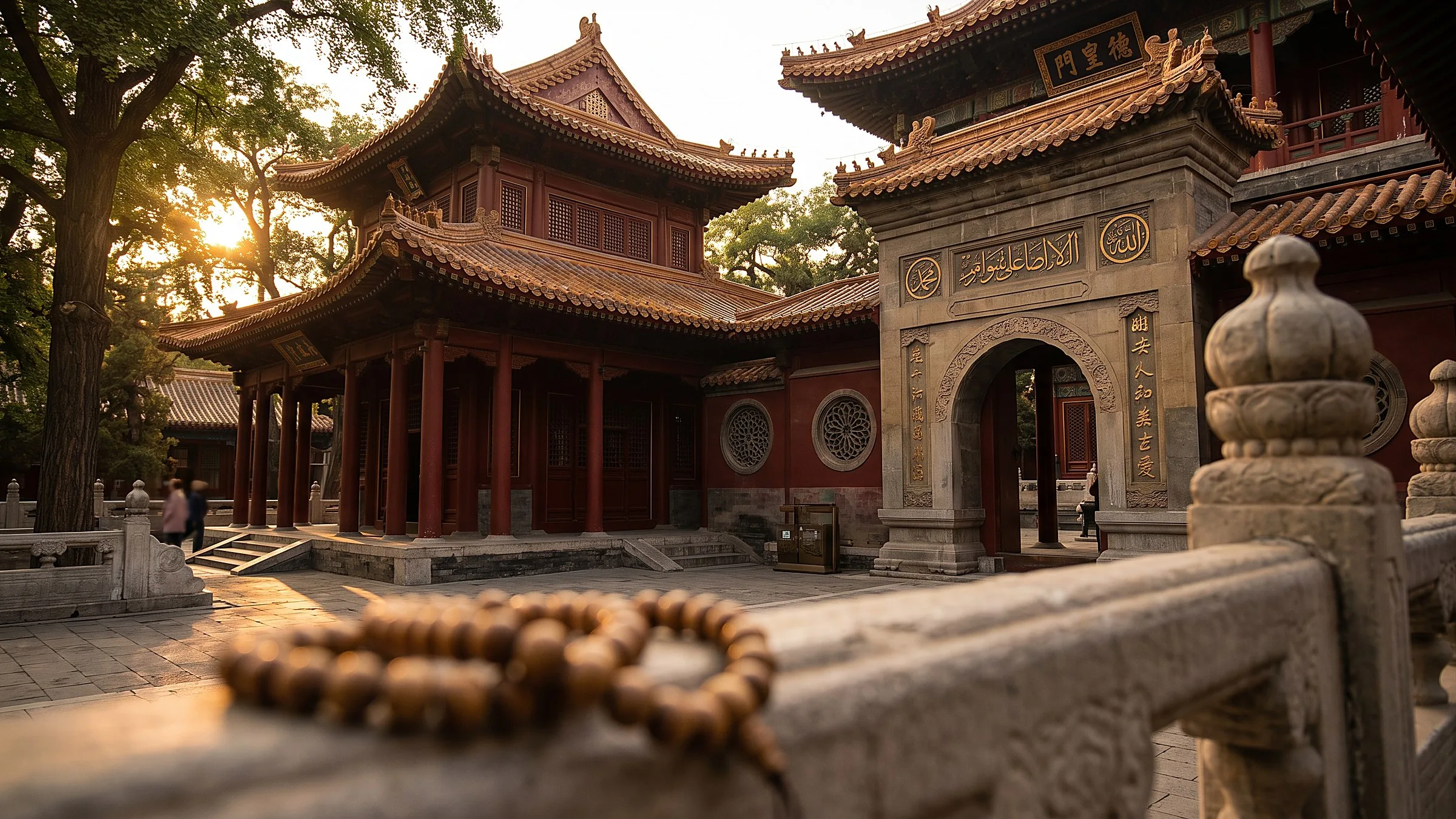
China Muslim Travel Guide (2026)
Muslim travel guide to China: 10 historic mosques, verified halal restaurants in 6 cities, prayer times, Qibla direction, and visa-free entry for 50+ Muslim-majority countries.
China is home to one of the oldest continuous Muslim communities in the world — the 4,000+ year Silk Road heritage, the Yuan and Ming dynasty Hui Muslim migration, and the modern 10 recognized Muslim ethnic groups (Hui, Uyghur, Kazakh, Kyrgyz, Uzbek, Tajik, Tatar, Salar, Bonan, Dongxiang) make China a viable destination for Muslim travelers from Southeast Asia, the Middle East, North Africa, and the global diaspora. But the practical infrastructure is uneven: halal restaurants cluster in a few neighborhoods in a few cities, mosque access for Friday prayer is straightforward in Beijing and Xi’an but inconsistent in Shanghai, and most online “halal China” guides are either outdated (pre-COVID, pre-2024 visa-free expansion) or written for Chinese Muslim domestic travel — not foreign visitors.
This guide covers the practical side of Muslim travel in China: the 10 most significant historic mosques you can actually visit, where to find verified halal food in 6 major cities, how to handle the 5 daily prayers and Qibla direction, what Ramadan looks like in China (and whether to travel during it), the 5 visa-free pathways for Muslim-majority countries, and a 12-day sample itinerary that strings the major sites together without backtracking. It is written for a Muslim traveler who has never been to China, not for a Sinologist.
A short note on tone: this article is descriptive, not preachy. We list the sites because they are historically significant and practically useful for Muslim travelers, not because the site is recommending any particular interpretation. Visitors of all backgrounds are welcome at every mosque listed as “tourist visits OK”; at the mosques marked “active prayer only,” please respect the prayer schedule and observe before entering.
Quick orientation: 4 things Muslim travelers need to know first
Before the city-by-city section, four practical facts that shape every Muslim trip to China:
1. Pork and alcohol are everywhere in the default Chinese food culture. Most restaurants, even mid-range ones, cook with pork lard (猪油) and serve dishes with pork. Order carefully, ask in English (“no pork, no lard, no alcohol?”), and look for the green crescent (🌙) or the Chinese characters 清真 (qīngzhēn, “halal”) on the sign. In areas with Hui Muslim communities (Beijing Niujie, Xi’an Muslim Quarter, Quanzhou, Linxia, Yinchuan), the entire restaurant strip is halal. Outside these areas, the ratio drops to 1 in 20 or worse.
2. The 5 daily prayers are practical in major cities, complicated in tourist sites. Beijing, Xi’an, Shanghai, Guangzhou, Kunming, and Yinchuan all have functioning mosques with English-speaking imams or caretakers. Friday (Jumu’ah) prayer is held at the major mosques (Beijing Niujie, Xi’an Great Mosque, Shanghai Huxi, Guangzhou Huaisheng) and is straightforward to attend. Outside these cities — at tourist sites like the Great Wall, the Terracotta Warriors, or Zhangjiajie — there is rarely a prayer space. Bring a pocket prayer mat and plan to combine prayers (Jam’ al-Taqdim) when touring outside Muslim-friendly areas.
3. Qibla direction varies by location in China. China is east of Mecca, so Qibla is generally west-northwest in eastern China (Beijing, Shanghai: 277°–285° WNW), west in central China (Xi’an, Chengdu: 280°–285° W), and west-southwest in western China (Xinjiang, Tibet: 285°–295° WSW). Use the IslamicFinder app or any Qibla compass app — both work offline once installed.
4. Ramadan is observed but most restaurants stay open. Mainland China is officially secular on the national level, but the Islamic Association of China and individual mosques observe Ramadan. In Muslim-majority areas (Xinjiang, Ningxia, Linxia in Gansu), restaurants may close during daylight hours in Ramadan. In Beijing, Shanghai, and Guangzhou, most halal restaurants stay open but may close their dining room and only offer takeaway. The Iftar time in Beijing varies — check the local mosque’s noticeboard the day before.
Beijing
1. Niujie Mosque (牛街清真寺) — the heart of Beijing’s Muslim community
- Address: 18 Niujie, Xuanwu District (宣武区牛街18号)
- Built: 996 AD (Northern Song dynasty, one of the oldest mosques in North China)
- Style: Traditional Chinese courtyard + Arabic calligraphic decoration, the prayer hall roofed in traditional Chinese glazed tiles
- Capacity: 1,000+ worshippers
- Friday Jumu’ah: 12:30 PM (winter) / 1:00 PM (summer), Arabic + Chinese sermon
- Daily prayer times: Posted at the entrance, follow Beijing local time
- Visitor policy: Tourists welcome 8:00 AM–5:00 PM, free entry, modest dress required (covered shoulders, knee-length shorts/trousers, no shorts above the knee for men either)
- How to reach: Metro Line 7 to Caishikou Station, Exit B, 8-min walk
- The honest note: Niujie is not just a mosque — it is the 2-km Muslim Quarter surrounding it, with the highest concentration of verified halal restaurants in Beijing. The mosque itself is a working Hui community center (the Hui are the Chinese-speaking Muslim ethnic group, ~10 million people). For Friday prayer, the mosque is full by 12:15 PM — arrive 30 min early. The minaret (Bangke Lou, 邦克楼) is the distinctive 14m tower at the entrance.
2. Niujie Halal Food Street (牛街清真美食街)
- Location: The 2-km stretch of Niujie Street between Caishikou and Taoranting Park
- What to eat: Niujie Baodu (牛街爆肚, ¥40, lamb tripe hot pot), Hongshaorou (红烧肉, halal-style braised pork substitute made with beef, ¥30, this is a Hui specialty, not real pork), Shuijianbao (水煎包, pan-fried lamb dumplings, ¥12/6 pieces), and the famous Wangfujing Aiweiwo halal branch for lamb skewers
- What to drink: Ayran-style yogurt (酸奶, ¥5) at any Niujie shop, the Hui Muslim version is tangier than the standard Inner Mongolian yogurt
- Restaurants that English menus have: Najia Xiang (那家小馆, ¥120 per person, Beijing Hui cuisine in a restored courtyard, English menu available) and Hongbinlou (鸿宾楼, ¥180 per person, the most famous halal restaurant in Beijing, 70-year history, English menu)
- What to skip: The lamb skewer (羊肉串) vendors near the south end — the meat is often not certified halal; stick to the sit-down restaurants with the green crescent sign
Xi’an
3. The Great Mosque of Xi’an (西安大清真寺) — the oldest surviving mosque in China
- Address: 30 Huajue Lane, Lianhu District (莲湖区化觉巷30号), inside the Muslim Quarter northwest of the Drum Tower
- Built: 742 AD (Tang dynasty, on the site of an earlier 627 AD mosque)
- Style: Traditional Chinese pagoda-style architecture with Arabic calligraphy — the prayer hall has 24 Chinese-style wooden pillars, the minaret is a hexagonal 9-story pagoda, no traditional Islamic dome
- Capacity: 1,000+ worshippers
- Friday Jumu’ah: 1:00 PM, Arabic + Chinese sermon, the largest Friday congregation in Northwest China
- Visitor policy: Tourists welcome 8:00 AM–7:00 PM (winter closes 6 PM), ¥25 entry, modest dress, no photos during prayer
- How to reach: Inside the City Wall, 5-min walk west of the Drum Tower, the entrance is at the end of a narrow market lane
- The honest note: This is the single most historically significant mosque in mainland China. The Tang dynasty founding date is older than the Huaisheng Mosque in Guangzhou (627 AD) by only ~115 years, but the Great Mosque of Xi’an is the better-preserved building. The prayer hall layout follows traditional Chinese temple architecture — wood, tile, painted beams — not the Middle Eastern dome-and-minaret convention. For Muslim travelers, this is the essential first stop. The Muslim Quarter outside the mosque is the largest active Muslim commercial district in China, with the same food profile as Beijing’s Niujie but larger and more central.
4. Xi’an Muslim Quarter (回民街 / Huimin Jie)
- Location: The 1.5-km network of lanes west of the Drum Tower, centered on Beiyuanmen and Duanlumen
- What to eat: Yangrou Paomo (羊肉泡馍, ¥35, lamb stew with torn flatbread — the Xi’an signature dish, this is Muslim Hui cuisine), Biang Biang Mian (biangbiang noodles, ¥20, hand-pulled wide noodles with chili oil and lamb), Liangpi (凉皮, ¥8, cold rice noodles), and Rou Jia Mo (肉夹馍, ¥8, “Chinese hamburger” with braised lamb, the Muslim version is the original)
- Restaurants that English menus have: Tong Sheng Xiang (同盛祥, ¥80 per person, lamb paomo specialty, English menu, 1930s founding) and Lao Sun Jia (老孙家, ¥120 per person, the most famous paomo restaurant in Xi’an, English menu, 1898 founding)
- What to skip: The persimmon cakes (柿子饼) vendors on the main drag — they are mostly for tourists, not authentic. Walk 2 streets deeper into the Quarter for the real stalls
Shanghai
5. Huxi Mosque (小桃园清真寺) — the main Shanghai Friday prayer venue
- Address: 52 Xiaotaoyuan, Huangpu District (黄浦区小桃园52号)
- Built: 1925 (Republic of era, rebuilt 2005)
- Style: Modern Islamic with a single minaret, brick + concrete
- Capacity: 500 worshippers
- Friday Jumu’ah: 12:45 PM, English-speaking imam available, foreign passport holders welcome
- Daily prayer times: Posted at the entrance
- Visitor policy: Tourists welcome 9:00 AM–5:00 PM, free entry, modest dress, no photos during prayer
- How to reach: Metro Line 10 to Yuyuan Station, Exit 1, 10-min walk
- The honest note: Huxi is the mosque foreign Muslim travelers will use most in Shanghai — the imam speaks English, the community is small but well-organized, and the location is central. For Friday prayer, arrive 20 min early. The mosque has a small library with English Islamic books and a dedicated women’s prayer space on the second floor.
6. Songjiang Mosque (松江清真寺) — the oldest mosque in the Yangtze Delta
- Address: 21 Xilin Lane, Songjiang District (松江区西林巷21号), 40 km southwest of central Shanghai
- Built: 1341 (Yuan dynasty, on the site of a 1295 mosque)
- Style: Traditional Chinese courtyard + Arabic calligraphy, the Ming-era minaret (邦克楼) is the only surviving Yuan-dynasty mosque minaret in China
- Visitor policy: Tourists welcome 8:00 AM–4:30 PM, free entry
- How to reach: Metro Line 9 to Songjiang University Town Station, 15-min walk
- The honest note: Worth a half-day side trip from Shanghai for the historical significance, not for daily prayer (services are small, mostly local Hui). The Ming dynasty wooden minaret and the Yuan dynasty stone gateway are the architectural highlights.
7. Shanghai Halal Food — the 4 verified options
- Hai Di Lao Muslim Branch (海底捞清真店, ¥150 per person, hot pot, English menu, the only verified halal hot pot chain branch in Shanghai) — multiple locations
- Xian Xia Xiang (鲜虾香, ¥80 per person, Hui cuisine, English menu) — Changning District
- Yang’s Dumpling Muslim Branch (小杨生煎清真店, ¥30 per person, pan-fried dumplings with lamb) — Jing’an Temple area
- Crescent Moon Restaurant (新月楼, ¥120 per person, Uyghur cuisine, English menu, Sunday buffet with live Uyghur music) — Hongqiao area
Guangzhou
8. Huaisheng Mosque (怀圣寺) and the Lighthouse Pagoda (光塔) — the oldest surviving mosque in China
- Address: 56 Guangta Road, Yuexiu District (越秀区光塔路56号)
- Built: 627 AD (Tang dynasty, predates the Xi’an Great Mosque by 115 years)
- Style: Arabic-influenced with a 36m brick minaret (the Lighthouse Pagoda / Guangta, 光塔) — the oldest extant Islamic minaret in the world, predating any in North Africa
- Friday Jumu’ah: 1:00 PM, Arabic + Chinese + Cantonese
- Visitor policy: Tourists welcome 9:00 AM–5:00 PM, ¥5 entry, modest dress
- How to reach: Metro Line 1 or 2 to Gongyuanqian Station, Exit D, 8-min walk
- The honest note: This is the single most historically significant mosque in the world for the Muslim traveler. The Lighthouse Pagoda was used by Tang and Song dynasty Muslim merchants to navigate the Pearl River, and the current minaret structure dates to the 14th century (Yuan dynasty) with the foundation from the 7th century. The mosque is in the older Yuexiu district near the Pearl River — combine with a visit to the Six Banyan Temple (Liu Rong Si, 六榕寺) and the Chen Clan Ancestral Hall for a full day of Cantonese heritage.
9. Guangzhou Halal Food — the 2 verified options
- Ma Xiang Xing (马祥兴, ¥80 per person, Hui + Cantonese halal, English menu) — Liwan District, near the Pearl River
- Bostan Uyghur Restaurant (波斯坦, ¥100 per person, authentic Uyghur cuisine, English menu, lamb skewers and hand-pulled noodles) — Tianhe District
Kunming (bonus)
10. Yongning Mosque (永宁清真寺) — the southwest hub
- Address: 16 Yongning Road, Wuhua District (五华区永宁路16号)
- Built: 9th century (Tang dynasty, on the Southern Silk Road)
- Style: Traditional Chinese + Arabic calligraphy, rebuilt multiple times, current structure Ming/Qing
- Friday Jumu’ah: 1:00 PM, well-attended
- Visitor policy: Tourists welcome 8:00 AM–5:00 PM, free entry
- How to reach: Metro Line 3 to Dongfeng Square Station, 10-min walk
- Why on the list: Kunming is the gateway to Yunnan, the most ethnically diverse province in China (25 of 56 ethnic groups, including 6 Muslim minorities). For travelers planning a Yunnan side trip (Dali, Lijiang, Shangri-La), the Kunming mosque is the main Friday prayer venue. The Yunnan Muslim cuisine (滇菜清真) is distinct from Hui cuisine — try the Qiguo Xiang (气锅鸡, steam-pot chicken, ¥60, halal version) and Xishuangbanna-style grilled fish (烤鱼, ¥50).
Quanzhou (bonus)
11. Qingjing Mosque (清净寺) — the only Arab-style mosque in China
- Address: 110 Tumen Street, Licheng District (鲤城区涂门街110号)
- Built: 1009 AD (Song dynasty, on the Maritime Silk Road)
- Style: Pure Arab-style stone mosque, the only surviving Arab-style mosque in mainland China, originally built by Syrian and Persian Muslim merchants
- Visitor policy: Tourists welcome 8:00 AM–5:30 PM, ¥3 entry
- How to reach: Inside the old town, 10-min walk from the Kaiyuan Temple
- The honest note: The Arab-style stone archway (望月楼) is the most photographed Islamic architecture in China. The mosque was severely damaged in the 1457 earthquake and partially rebuilt, but the original Song dynasty carved stone gate survives. For Muslim travelers interested in the Maritime Silk Road heritage (rather than the inland Silk Road version), this is the single most important site in China. Combine with the adjacent Kaiyuan Temple (开元寺, Buddhist) for a visual contrast of two world religions arriving in China at the same historical moment.
Yinchuan (bonus, for the dedicated traveler)
12. Yinchuan is the Muslim capital of modern China — 30% of the population is Hui
- Hedong Mosque (河东清真寺) — the largest in Ningxia
- Nanguan Mosque (南关清真寺) — rebuilt in 2011 in traditional Arab style, 9,000 sqm
- Visit if: you want the most immersive Muslim China experience outside Xinjiang. Yinchuan has the highest density of halal restaurants in China, and the Hui cultural traditions (linguistic, culinary, dress) are most visible. Skip if: you are short on time and the rest of the itinerary is Beijing/Xi’an/Shanghai.
Sample 12-day itinerary (traveler from Indonesia, Malaysia, or Turkey)
| Day | City | Sites |
|---|---|---|
| 1 | Arrive Beijing (PEK) | Check into Dongcheng hotel, rest, Niujie dinner |
| 2 | Beijing | Niujie Mosque Friday Jumu’ah, Niujie Street food tour afternoon |
| 3 | Beijing | Forbidden City (non-halal, no food inside), Niujie dinner |
| 4 | Beijing → Xi’an | HSR 4h 30m, Great Mosque afternoon, Muslim Quarter dinner |
| 5 | Xi’an | Terracotta Warriors (halal lunch on-site is limited, pack snacks), Tang Dynasty show |
| 6 | Xi’an | City Wall bike, Great Mosque second visit for Fajr prayer, bazaar shopping |
| 7 | Xi’an → Shanghai | HSR 6h 30m, Huxi Mosque for Asr if time |
| 8 | Shanghai | The Bund, Yu Garden, Hai Di Lao halal hot pot dinner |
| 9 | Shanghai | Songjiang Mosque half-day, French Concession walk |
| 10 | Shanghai → Guangzhou | HSR 6h 30m, Huaisheng Mosque late afternoon |
| 11 | Guangzhou | Huaisheng Mosque for Fajr, Six Banyan Temple, Chen Clan Hall, Bostan Uyghur dinner |
| 12 | Guangzhou → home | DiDi to CAN airport |
For travelers with extra time, add Quanzhou (2 nights) between Day 9 and Day 10 for the Maritime Silk Road heritage, or Yinchuan (2 nights) as a separate Ningxia detour.
How to handle the 5 daily prayers
App recommendations (all free, all work offline in China):
- IslamicFinder (iOS + Android) — the gold standard, accurate Qibla + prayer times, no VPN needed
- Muslim Pro (iOS + Android) — alarm-based Athan, slightly heavier on data, requires occasional sync
- Qibla Compass (iOS + Android) — simple offline Qibla direction
Friday Jumu’ah strategy:
- Beijing: Niujie Mosque, arrive 12:00, Jumu’ah at 12:30 (summer) / 1:00 (winter)
- Xi’an: Great Mosque, arrive 12:30, Jumu’ah at 1:00 PM year-round
- Shanghai: Huxi Mosque, arrive 12:30, Jumu’ah at 12:45 PM
- Guangzhou: Huaisheng Mosque, arrive 12:30, Jumu’ah at 1:00 PM
Combining prayers (Jam’ al-Taqdim) when touring outside Muslim areas:
- Combine Dhuhr + Asr if you are on a Great Wall day trip and returning late
- Combine Maghrib + Isha if you are at an evening show (Tang Dynasty, Acrobatics)
- Do not combine Fajr with anything — Fajr must be prayed at its own time
Wudu in Chinese tourist sites:
- Most public restrooms in tourist sites do not have wudu facilities. Bring a portable wudu cup (¥15 on Taobao, or any travel-size plastic cup) for washing in a public restroom sink. Alternatively, do tayammum (dry ablution with clean dust/earth) when water is not available.
Ramadan in China — should you travel during it?
Short answer: Yes, with planning.
- 2026 Ramadan dates (expected): ~February 18 to March 19, 2026 (subject to moon sighting). 2027 Ramadan: ~February 7 to March 8, 2027.
- In Muslim-majority areas (Xinjiang, Ningxia, Linxia, Yinchuan): restaurants may close during daylight hours, particularly in Xinjiang. Plan to eat pre-dawn (Suhur) and at Iftar (sunset).
- In Beijing, Shanghai, Guangzhou, Xi’an: most halal restaurants stay open, but may close their dining room and only offer takeaway. The mosques are busier than usual at Iftar — the Great Mosque of Xi’an hosts a community Iftar with hundreds of Hui Muslims on the weekends; foreign visitors are welcome.
- Travel tip: Avoid Xinjiang during Ramadan for non-Muslim sightseeing (security presence is heightened). Beijing, Shanghai, Guangzhou, Xi’an, and Kunming are all normal during Ramadan.
Visa-free entry for Muslim-majority countries (2026)
30-day mutual visa exemption (the largest group, applies to passport holders from):
- Malaysia (30 days)
- UAE (30 days, from 2024)
- Indonesia (30 days, from 2025)
- Mauritius (30 days)
- Maldives (30 days)
30-day unilateral visa-free (China allows these, but their home countries do not return the exemption):
- Saudi Arabia, Bahrain, Kuwait, Oman, Qatar, Iran, Iraq, Jordan, Lebanon, Tunisia, Morocco, Algeria (most are 30 days; check the National Immigration Administration list for the current cohort)
240-hour visa-free transit (if you have a confirmed onward ticket to a third country within 10 days):
- Available to all 57 countries in the transit program, including Turkey, Egypt, Pakistan, Bangladesh, and most Muslim-majority nations not in the exemption list above
Visa-required: Pakistan, Bangladesh, and several others still need a tourist L-visa ($130 USD / ¥840, 4 working days). Apply at the nearest Chinese consulate.
For the full 2026 list, see the China Visa-Free Countries 2026 guide or the 240-hour visa-free transit checker.
Booking essentials
- Alipay/WeChat setup: see the Alipay guide — useful for halal restaurant payments, taxi fare, museum tickets
- eSIM data: see the eSIM guide — the sites are spread out, you will need maps, translation, and prayer time apps
- HSR bookings: book Beijing → Xi’an and Xi’an → Shanghai on Trip.com 5+ days ahead, the halal meal option is available on most long-distance HSR (order at seat)
- Halal meal on flights: book all domestic flights with the “halal meal” option (宗教餐 / zōngjiào cān) 24h+ ahead — both Air China and China Southern offer it on international and most domestic routes
- Travel insurance: confirm it covers the regions you are visiting (Yunnan, Xinjiang, and Tibet have some policy exclusions)
Book this trip
A solo traveler or family of 4 can book all 12 days of this route on these three platforms. Click through to compare prices for your dates and check the halal meal option at each booking step.
HSR + halal meal + 4-city hotels
Book all 3 long-distance HSR legs (Beijing → Xi'an, Xi'an → Shanghai, Shanghai → Guangzhou), the halal meal option on each train, and 11 nights at Marriott / Hilton / IHG with verified halal-friendly restaurants in walking distance. English interface, foreign cards accepted, the halal meal option is bookable at the seat selection step.
HSR from $78 · Hotels from $90/night
Plan your trip — verified tools
These free tools are built on real, monthly-verified data and help you skip the trial-and-error phase of China trip planning:
- China 240-Hour Visa-Free Transit Checker — 57 countries, 24 provinces, 65 ports. See if you qualify for 10-day visa-free transit, which cities you can visit, and the 5-step process.
- China 6-City 5-Day Budget Calculator — Real 2026 prices for 5 days in Beijing, Shanghai, Guangzhou, Chengdu, Xi’an, or Hangzhou. Budget / mid-range / comfort tiers, broken down line by line.
Verified August 2026 by TravelHubChina Editorial. We re-check prices and policy details monthly so the data doesn’t drift.
Step by step
-
Plan your Friday around a major mosque
Beijing Niujie (Jumu'ah 12:30-1:00 PM), Xi'an Great Mosque (1:00 PM), Shanghai Huxi (12:45 PM, English-speaking imam), and Guangzhou Huaisheng (1:00 PM) all welcome foreign Muslim travelers. Arrive 20-30 minutes early and bring your passport. Modest dress is required (covered shoulders, knee-length shorts or trousers) at all mosques.
-
Find verified halal food in Muslim quarters
Stick to Beijing Niujie Street, Xi'an Muslim Quarter (Huimin Jie), Shanghai's Huxi area, and Guangzhou's older Yuexiu district. Look for the green crescent or the Chinese characters 清真 (qingzhen) on the sign. Ask 'no pork, no lard, no alcohol?' in English. Outside these neighborhoods, the ratio drops to 1 in 20 or worse.
-
Download offline prayer apps before you arrive
IslamicFinder and Muslim Pro both work offline in China without VPN. Set Qibla to 277-285 degrees (WNW in eastern China) and adjust prayer times to Beijing local time. Bring a pocket prayer mat and a portable wudu cup (¥15 on Taobao) for ablutions in public restrooms at non-Muslim tourist sites like the Great Wall or Terracotta Warriors.
-
Use visa-free or 240-hour transit entry
Citizens of 50+ Muslim-majority countries (Indonesia, Malaysia, UAE, Saudi Arabia, Qatar, Turkey, Iran, Egypt, etc.) get 7-30 days visa-free or 240-hour visa-free transit. Apply at the transit desk on arrival with a confirmed onward ticket to a third country. Check the China MFA website for your specific country before booking flights.
-
Combine prayers on heavy travel days
At tourist sites outside Muslim areas (Great Wall, Terracotta Warriors, Zhangjiajie), combine Dhuhr with Asr or Maghrib with Isha (Jam' al-Taqdim). Do not combine Fajr with anything. Pack a small Quran, a compass for Qibla backup, and a printed prayer schedule in case the local mosque noticeboard is in Chinese only.
FAQ
-
Is it easy to find halal food in China as a foreign traveler?
Yes, but only in specific neighborhoods. Beijing's Niujie, Xi'an's Muslim Quarter, Shanghai's Huxi area, Guangzhou's older Yuexiu district, and Yinchuan (Ningxia) have a high density of verified halal restaurants. Outside these areas, the ratio drops to 1 in 20 or worse. Look for the green crescent or the Chinese characters 清真 (qingzhen) on the sign, and ask 'no pork, no lard, no alcohol?' in English at any restaurant where you are unsure. -
Can foreign Muslims attend Friday prayer at Chinese mosques?
Yes, the major mosques welcome foreign visitors. Beijing Niujie, Xi'an Great Mosque, Shanghai Huxi, Guangzhou Huaisheng, and Kunming Yongning all hold Friday Jumu'ah with capacity for 500-1,000+ worshippers. Arrive 20-30 minutes early. The Shanghai Huxi imam speaks English, and most major mosques have a designated women's prayer space. Modest dress is required at all mosques, and you should not photograph during prayer. -
Do I need a visa to travel to China as a Muslim?
Most likely no. As of 2026, citizens of 50+ Muslim-majority and Muslim-friendly countries (Indonesia, Malaysia, UAE, Saudi Arabia, Qatar, Kazakhstan, Iran, Turkey, Egypt, etc.) can enter China visa-free for 7-30 days or use the 240-hour (10-day) visa-free transit. Check the China MFA website for your specific country. If a visa is required, an L (tourist) visa costs USD 140-180 and takes 4-7 business days to process. -
What is the Qibla direction in China?
Qibla in China is generally west to west-northwest, since China is east of Mecca. Eastern China (Beijing, Shanghai) is 277-285 degrees WNW. Central China (Xi'an, Chengdu) is 280-285 degrees W. Western China (Xinjiang, Tibet) is 285-295 degrees WSW. The IslamicFinder and Muslim Pro apps work offline in China and show the correct Qibla for your exact location once installed. -
Is it safe to travel to China during Ramadan?
Yes, but expectations differ by region. In Muslim-majority areas (Xinjiang, Ningxia, Linxia in Gansu), restaurants may close during daylight hours in Ramadan. In Beijing, Shanghai, and Guangzhou, most halal restaurants stay open but may offer only takeaway during the day. Friday Jumu'ah is well-attended everywhere. The Iftar time in Beijing varies by season, so check the local mosque's noticeboard the day before you break your fast.
Related guides
- Culture & Practical
Christian Heritage in China: 12 Churches & Jesuit Sites
The 12 most significant Christian heritage sites in China: Beijing's oldest Catholic church, Shanghai's St. Ignatius Cathedral, the Jesuit Beitang, and more. With addresses, mass times, and how to visit.
12min read
- Itineraries
3 Days in Beijing: Forbidden City + Great Wall
The best 3-day Beijing itinerary for first-time visitors: Forbidden City, Mutianyu Great Wall, Temple of Heaven, Summer Palace, and hutong food tour. With prices, transit times, and ticket tips.
10min read
- Itineraries
Beijing 2-Day Layover: Max China, Min Time
A tested 2-day Beijing itinerary for a long layover: Forbidden City highlights, Mutianyu Great Wall, Peking duck, and a Hutong night walk. With PVG/PEK airport transfer times and 240h visa-free rules.
9min read
- Culture & Practical
11 Cultural Mistakes Foreigners Make in China (And How to Avoid Them)
The 2026 etiquette guide for foreigners in China: 11 cultural mistakes that cause offense, awkwardness, or worse — and exactly what to do instead. Covers tipping (don't), chopsticks (don't stick them in rice), gift-giving (red envelope etiquette), loud phone calls, queueing, gift color symbolism, and the 茶 ceremony scam. Plus regional and generational differences.
9min read
- Culture & Practical
China's Minority Villages: Miao, Dong, Hakka, Yi, Tibetan (2026 Off-the-Beaten Guide)
The 2026 off-the-beaten-path guide to China's 5 most photogenic minority cultures: Miao silver + embroidery in Guizhou (Kaili, Xijiang, Langde), Dong drum-tower villages in Guizhou/Hunan (Zhaoxing), Hakka tulou earthen roundhouses in Fujian (Nanjing, Yongding), Yi/Yue festivals in Yunnan (Yuanyang), and Tibetan villages in Sichuan (Danba, Litang). With how to get there, where to stay, what to eat, and the cultural respect notes (don't photograph without asking, dress modestly at village ceremonies).
- Itineraries
First Time in Beijing 2026: The Practical Guide (3-Day Playbook)
The Beijing chapter of our first time in China guide — visa-free entry, paying with Alipay, getting to the Wall, where to actually stay, and the scams that catch Western travelers. Updated August 2026.
12min read