
Xi'an Muslim Quarter (Hui Min Jie)
西安回民街 · Xī'ān Huímín Jiē
Quick answer
Passport not required for the Muslim Quarter (it's a public neighborhood). The Great Mosque of Xi'an requires a passport for entry. The food stalls accept cash, Alipay, and WeChat Pay — set up Alipay before the visit for the smoothest experience. Most stall owners do not speak English, but the food is visual (you point at what you want).
Why visit
- 1 Eat the iconic Xian street food: rou jia mo (肉夹馍), biangbiang noodles (油泼面), yangrou paomo (羊肉泡馍), kebabs, persimmon cakes
- 2 Visit the Great Mosque of Xi'an (大清真寺) — 1,300 years old, the oldest and largest mosque in China, blending Islamic and Chinese architecture
- 3 Walk the central Beiyuanmen night market with red lanterns and steaming food stalls — the most atmospheric food street in central China
- 4 Try the 30+ flavors of the famous Xian sticky rice cake (镜糕) at the corner stalls
Essential tips for foreigners
- Set up Alipay before the visit — most stall owners do not accept foreign credit cards. Alipay with your international Visa/Mastercard works at every food stall. Bring ¥100-200 in cash as backup for the smaller stalls.
- Come hungry — the food walk is the experience. Plan 2-3 hours and at least 4-6 small dishes. The most foreigner-friendly walk is Beiyuanmen (北院门) → Dapiyuan (大皮院) → Xiyangshi (西羊市).
- The food is mostly Halal (Muslim) and Hui-style — lamb, beef, bread, hand-pulled noodles. Bring a card or ask for the menu in English (some stalls have it). Vegetarians: ask for 素 (vegetarian) or look for the tofu and bread stalls.
- Visit the Great Mosque of Xi'an (大清真寺, ¥25) in the heart of the quarter — bring your passport. The mosque is the oldest in China (1,300 years old) and blends Islamic and Chinese architectural styles.
- Combine with a 1-hour walk on the South Gate of the City Wall (10 min walk east) for the night views. The quarter is busiest 18:00-22:00.
Suggested route
- 18:00 10 min Take Metro Line 2 to Zhonglou Station (钟楼站) Exit C, walk 10 min west to the Drum Tower (鼓楼)
- 18:15 5 min Walk through the Drum Tower archway into the Muslim Quarter. Start at the Beiyuanmen (北院门) night market entrance — the most atmospheric entry point
- 18:30 45 min Walk the central Beiyuanmen street — first rou jia mo (Chinese hamburger) at the corner stall, then biangbiang noodles at the second stall, then kebabs and persimmon cake as you walk
- 19:15 1 hour Cut into the Dapiyuan (大皮院) side street for yangrou paomo (lamb and crumbled flatbread) — sit-down at a restaurant, allow 30-45 min for the broth to settle
- 20:15 45 min Visit the Great Mosque of Xi'an (大清真寺) — 5 min walk from Dapiyuan, ¥25 entry, passport required. 30 min self-guided tour of the prayer hall and the Chinese-Islamic architecture
- 21:00 45 min Walk through the back streets to Xiyangshi (西羊市) for dessert — jinggao (sticky rice cake) and the local yogurt stalls. Take photos of the night market from the elevated Drum Tower viewpoint if you have time
- 21:45 15 min Walk back to the Drum Tower and take Metro Line 2 or Didi back to the hotel
The Xi’an Muslim Quarter (回民街, Huímín Jiē) is a 1-square-kilometer network of historic streets just west of the Drum Tower in central Xi’an, home to the Hui Muslim community that has lived here since the Tang dynasty 1,300 years ago. The quarter has 80+ food stalls and small restaurants serving the iconic Xian street food — rou jia mo, biangbiang noodles, yangrou paomo, kebabs, and more.
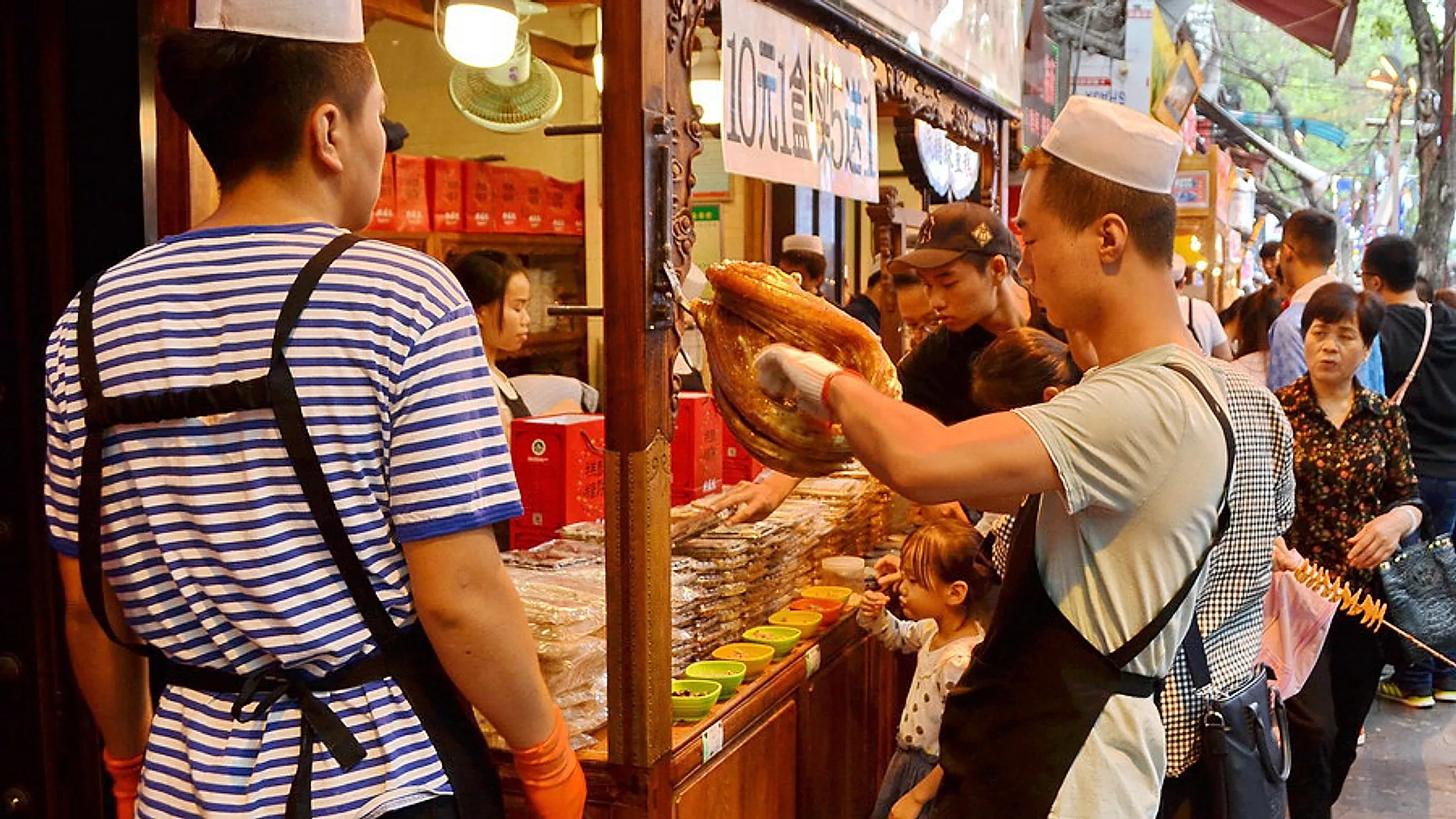
For travelers, the Muslim Quarter is the food highlight of any Xi’an trip. The food is different from what you find in Beijing or Shanghai (Xian’s cuisine is Silk Road-influenced: lamb, beef, bread, hand-pulled noodles) and the atmosphere is unique — the central Beiyuanmen street is closed to vehicles at night and becomes a lantern-lit food bazaar. The quarter is also home to the Great Mosque of Xi’an (大清真寺), the oldest and largest mosque in China.
History
The Hui Muslim community has lived in Xi’an since the Tang dynasty (7th-8th centuries), when Arab and Persian merchants came to Chang’an (the Tang capital) along the Silk Road. The community grew through the Song, Yuan, Ming, and Qing dynasties, with the quarter becoming a distinct neighborhood in the 14th century. The Great Mosque was founded in 742 AD, making it one of the oldest mosques in the world.
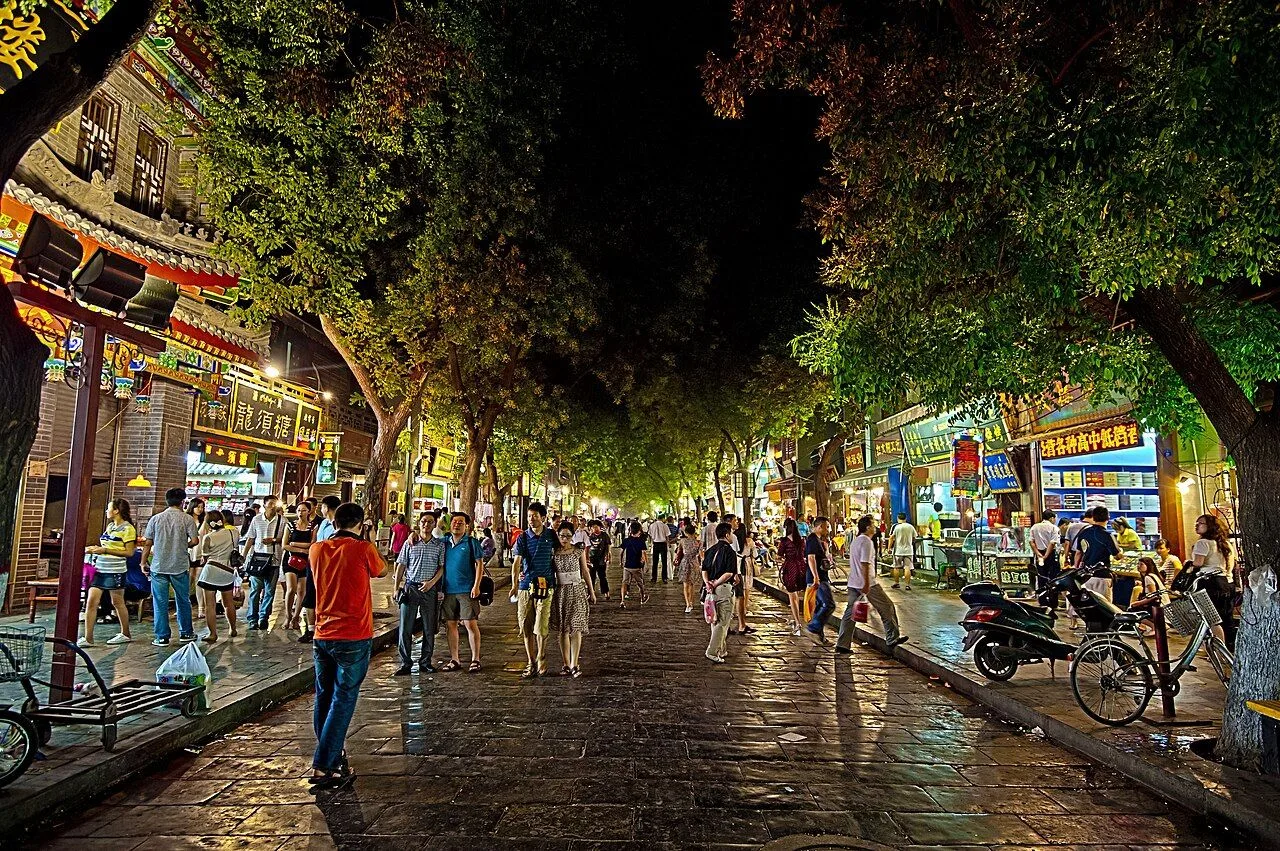
Photo: Wikimedia Commons / CC BY-SA. Source

The Hui are ethnically Chinese (Hui is one of China’s 56 recognized ethnic groups) but religiously Muslim. They have integrated Islamic and Chinese culture over 1,300 years — the Great Mosque is the iconic example, with traditional Chinese wooden-beam construction in the prayer hall but Islamic calligraphy and the minaret. The food reflects this fusion: lamb (introduced via Silk Road trade), beef, hand-pulled noodles, and bread (from the Central Asian tradition), combined with Chinese cooking techniques and the chili oil that is the signature of Xian cuisine.
The quarter was severely damaged in 1911 during the Chinese Revolution and again during the Cultural Revolution. The 1980s-2000s restoration returned the central Beiyuanmen Market to its historic layout and the Great Mosque to its Qing-dynasty form. The quarter is now one of the most-visited night markets in central China.
What to eat
The four iconic Xian street foods are:
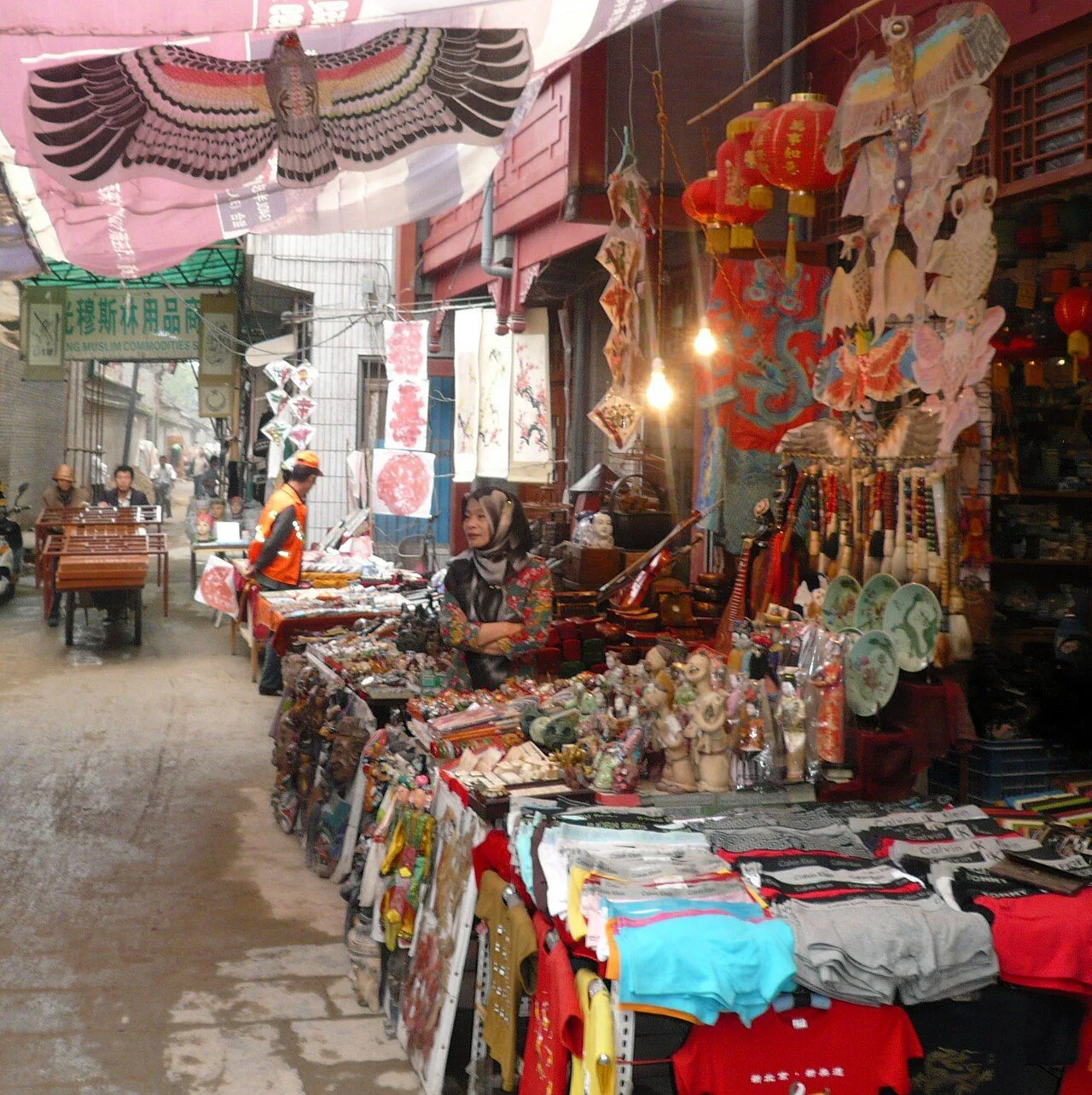
Photo: Wikimedia Commons / CC BY-SA. Source

Rou jia mo (肉夹馍, “Chinese hamburger”) — slow-braised pork or beef in a crispy flatbread. The most iconic Xian street food, ¥10-15 per piece. The braised meat is finely chopped and stuffed into a small crispy sesame flatbread. Every stall has its own version — the best is the freshly-baked flatbread with hand-chopped meat. ¥10-15.
Biangbiang noodles (油泼面) — hand-pulled wide noodles topped with chili oil, soy sauce, and scallions. The name is famously un-typewritable (the character 𰻞 has 56 strokes). The noodles are hand-pulled to about 2-inch width, served hot with a generous spoonful of smoking-hot chili oil poured over the top. ¥15-25.
Yangrou paomo (羊肉泡馍, “lamb crumbled flatbread in broth”) — the most iconic Hui dish. The diner is given a round flatbread and crumbles it by hand into a bowl, which is then taken to the kitchen and cooked with lamb broth, lamb meat, glass noodles, and wood ear mushrooms. The broth is rich and savory. Allow 30-45 minutes for the meal — the traditional pace is slow. ¥30-50.
Kebabs (烤串) — the Silk Road lamb kebab, the most common Xian street snack. Cumin-and-chili lamb skewers, ¥3-8 per skewer. Best with a cold beer.
Other regional specialties: liangpi (cold mung-bean noodles), jinggao (sticky rice cake with bean paste, ¥5-10), persimmon cakes (the Xian persimmon is famous), beef and lamb stews, and Hui-style flatbreads.
Most stalls let you point at what you want — English menus are rare but the food is visual. Set up Alipay before the visit for the smoothest experience (most stalls do not accept foreign credit cards).
The Great Mosque of Xi’an
The Great Mosque of Xi’an (大清真寺, Dà Qīngzhēnsì) is the oldest and largest mosque in China, founded in 742 AD during the Tang dynasty. The current layout is Ming-Qing dynasty, with the prayer hall, the Minaret (the only original Tang-dynasty element), and the central archway as the highlights.
Photo: Wikimedia Commons / CC BY-SA. Source
.jpg)
The mosque is the iconic example of Chinese-Islamic cultural fusion: the prayer hall is built in traditional Chinese wooden-beam construction, with Islamic calligraphy and Arabic-style arches. The layout is unusual for a mosque: the buildings are arranged along a central axis (like a Chinese temple) rather than around a central courtyard (like a typical mosque).
Entry is ¥25 for foreigners, same price as Chinese visitors. Bring your passport. The mosque is closed Fridays 12:00-14:00 for the noon prayer. The 30-min self-guided tour is enough to see the prayer hall, the Minaret, and the central archway. Photography is allowed (no flash).
The mosque is a 5-min walk from the central Beiyuanmen Market. Combined with the food walk, the mosque + the central quarter is a 2-3 hour experience.
When to visit
The food stalls are open 10:00-22:00 daily. The Great Mosque is open 8:00-19:30 in summer (April-October) and 8:00-18:00 in winter (November-March).
The most atmospheric time is evening 18:00-22:00, when the central Beiyuanmen Market is closed to vehicles and the food stalls are at full operation. The crowd is local families, students, and tourists; the central awning is lit with red lanterns; the food stall steam and kebab smoke rise into the cool air.
Year-round. April-May and September-October are the most comfortable for outdoor eating (15-25°C). Winter evenings (December-February) are cold (0-5°C) but the steaming food stalls are atmospheric — many travelers rate winter as the best time for the night atmosphere. Summer (June-August) is hot (30-35°C) but the awning and the food stall misters make it bearable.
How to pair the visit
The Muslim Quarter is a 10-min walk east of the South Gate of the Xi’an City Wall. A natural evening pairing is: South Gate of the City Wall at sunset (1.5 hours) → walk west to the Muslim Quarter (10 min) → food walk + Great Mosque (2-3 hours) → Didi or Metro Line 2 back to the hotel.
The Drum Tower (鼓楼, ¥35) is at the east entrance of the quarter. The Bell Tower (钟楼, ¥50) is 200m east. Combined, the historic center walk is: Bell Tower (30 min) → Drum Tower (30 min) → Muslim Quarter (2-3 hours) → South Gate of the City Wall (1.5 hours) — a full day of central Xi’an, easily walkable.
For a guided food tour (¥200-300, 2-3 hours, English-speaking guide who knows the best stalls), book via Trip.com or get a recommendation from your hotel concierge.
Best photo spots
-
Beiyuanmen (北院门) central street, looking north · Evening, 18:30-20:00
The classic Muslim Quarter shot: red lanterns overhead, steaming food stalls on both sides, the Great Mosque minaret in the distance. The crowd is dense and the atmosphere is unmistakable.
-
Great Mosque prayer hall interior · Daytime, any time
The prayer hall blends Islamic and Chinese architecture: traditional wooden-beam construction with Islamic calligraphy. Photography is allowed (no flash). The Minaret (the only original Tang-dynasty element) is the most-photographed spot.
-
Dapiyuan (大皮院) side street, with the central awning · Evening, 19:00-21:00
The most photogenic side street: hand-pulled noodle making, kebab smoke, lanterns reflecting on the awning. Quieter than Beiyuanmen but more authentic.
-
Drum Tower (鼓楼) viewpoint, looking west over the quarter · Late afternoon, golden hour, before entering the quarter
From the Drum Tower (¥35 entry), the quarter spreads west — the rooftops of the Great Mosque, the central awning, and the lanterns at night. Less crowded than the South Gate of the City Wall.
Where to eat nearby
-
Famous Lao Sun's (老孙家饭庄) — yangrou paomo
Xian paomo (lamb + crumbled flatbread in broth) · ¥30-50/person · Inside the quarter, Dapiyuan Street — the most famous paomo restaurant in Xi'an
-
Tong Sheng Xiang (同盛祥) — rou jia mo and biangbiang
Xian street food classics · ¥20-50/person · Inside the quarter, Beiyuanmen central street — the most foreigner-friendly stall with English menu pictures
-
Ming De Lou (明德楼) — halal banquet
Hui-style halal banquet · ¥80-150/person · Next to the Great Mosque — sit-down Hui banquet for a more formal meal
Frequently asked questions
Is the Xi'an Muslim Quarter free to visit?
Yes — entry to the neighborhood is free. The food stalls and restaurants are pay-as-you-eat, typically ¥15-60 per dish. The Great Mosque of Xi'an inside the quarter charges ¥25 for foreigners (same price as Chinese visitors; passport required at the gate). Most travelers spend ¥80-150 on a full food walk including the mosque.
What food should I try at the Muslim Quarter?
The four iconic Xian street foods are: rou jia mo (肉夹馍, Chinese hamburger — slow-braised pork in crispy flatbread, ¥10-15); biangbiang noodles (油泼面, hand-pulled wide noodles with chili oil, ¥15-25); yangrou paomo (羊肉泡馍, lamb and crumbled flatbread in a savory broth, ¥30-50); and kebabs (¥3-8 each). Other regional specialties: liangpi (cold noodles), jinggao (sticky rice cake), persimmon cakes. Most stalls let you point at what you want — English menus are rare.
Is the Great Mosque of Xi'an worth visiting?
Yes for anyone with even passing interest in Islamic art, Chinese-Islamic cultural fusion, or the Silk Road. The mosque is 1,300 years old, the oldest and largest in China, and uniquely blends Islamic and Chinese architectural styles: the prayer hall has traditional Chinese wooden-beam construction but is oriented toward Mecca. The ¥25 entry includes a 30-min self-guided tour. Bring your passport. Closed Fridays 12:00-14:00 for the noon prayer.
Is the Muslim Quarter safe at night?
Yes — the quarter is well-lit, well-policed, and one of the safest night markets in central China. The busiest time is 18:00-22:00, when the central street is closed to vehicles and the food stalls are at full operation. The crowd is local families, students, and tourists — no pickpocketing issues reported. The food stalls are hygienic; if a stall looks dirty, move on to the next one.
How do I get to the Muslim Quarter by public transport?
Metro Line 2 to Zhonglou Station (钟楼站) Exit C — 10 min walk west to the Drum Tower, then walk west through the archway into the Muslim Quarter. Metro Line 1 to Wulukou Station (五路口站) — 15 min walk south. Bus routes are plentiful but slower (40-60 min from most central Xi'an hotels). Didi or taxi from any central hotel: 10-20 min, ¥15-30.
Can I find vegetarian food at the Muslim Quarter?
Yes — the quarter is known for lamb and beef, but there are several vegetarian-friendly stalls: liangpi (cold mung-bean noodles), jinggao (sticky rice cake with bean paste), persimmon cakes, and several tofu and bread stalls. Ask for 素 (sù, vegetarian) or point at the menu picture. The Great Mosque has a vegetarian-friendly halal restaurant next to it. Note: the quarter is a Muslim (Hui) neighborhood, so all meat served is halal — no pork — but plenty of vegetarian options.
What is the best time of year to visit the Muslim Quarter?
Year-round. The central Beiyuanmen street has a permanent awning, so the quarter is partly covered. The most atmospheric time is autumn (September-November) and spring (April-May), when the temperature is comfortable for outdoor eating (15-25°C). Winter evenings (December-February) are cold (0-5°C) but the steaming food stalls and red lanterns are atmospheric — many travelers rate winter as the best time for the night atmosphere. Summer (June-August) is hot (30-35°C) but the awning and the food stall misters make it bearable.