

Lijiang Old Town
丽江古城 · Lìjiāng Gǔchéng
Quick answer
Foreign passport required at entry if the fee is being collected (some entry points accept ID only). Most entry points now have foreign-friendly QR payment via Alipay or WeChat.
Why visit
- 1 UNESCO-listed 5-sq-km pedestrian zone built by the Naxi minority along canals and stone bridges
- 2 Over 350 stone bridges in the Old Town — the highest density in China
- 3 Black Dragon Pool (黑龙潭) at sunrise — the classic Jade Dragon Snow Mountain reflection
- 4 Lion Hill (狮子山) — climb 30 min to Wangu Tower for the panoramic view of the rooftops
- 5 Naxi Ancient Music — performed nightly at the Old Town stage (¥140-180)
- 6 Stay in a Naxi courtyard hotel — most are restored 200-year-old wooden buildings
Essential tips for foreigners
- The ¥80 fee is called 古维费 (Old Town Maintenance Fee). It's collected at entry checkpoints 07:00-19:00. After 19:00 and early morning, entry is free.
- Stay overnight inside the Old Town — at least 2 nights. The daytime tour buses leave by 18:00, and the real Lijiang is the night and early morning when the lanes are quiet.
- Climb Lion Hill (狮子山) at sunrise for the rooftop view, then walk to Black Dragon Pool for the Jade Dragon Snow Mountain reflection.
- Bring a light jacket — Lijiang is at 2,400 m elevation, and nights drop to 5-10°C even in summer.
- Beware of the 'free tea ceremony' scam — vendors invite you in for tea, then charge ¥200-500 for the cup. Politely decline.
- No cars in the Old Town — luggage is hauled by handcart. Hotels will send porters if you ask ahead.
Suggested route
- 07:00 1 hour Wake up before the tour buses arrive; walk the empty stone lanes for photos
- 08:00 1.5 hours Climb Lion Hill (狮子山) — 30 min to the top via stone steps, ¥60 entry to Wangu Tower
- 09:30 1.5 hours Walk north to Black Dragon Pool (黑龙潭) — ¥0 entry, the iconic Jade Dragon reflection
- 11:00 1 hour Return to the Old Town for breakfast — try 丽江粑粑 (Lijiang flatbread) and 酥油茶 (butter tea)
- 12:00 2 hours Walk the main lanes — explore the side alleys; the best are just off 四方街 (Square Street)
- 14:00 1.5 hours Visit the Naxi Heritage Museum (东巴文化博物馆) — free, with English signage
- 15:30 1.5 hours Rest at the hotel; the afternoon is quiet in the Old Town
- 17:00 1.5 hours Return to the lanes for the golden hour; the lanterns come on at dusk
- 19:00 1.5 hours Dinner — try 纳西烤肉 (Naxi grilled meat) at 阿安酸奶 (Ah An Yogurt) for dessert
- 20:30 1 hour Catch the Naxi Ancient Music performance (¥140-180) at the Old Town stage
The 800-year-old town built by the Naxi minority
Lijiang Old Town is one of four ancient towns in China designated UNESCO World Heritage (along with Pingyao, Langzhong, and Shexian). What makes Lijiang unique is its Naxi minority culture — the Naxi are one of China’s smallest ethnic groups, and Lijiang is the only town in China where their 800-year-old wooden architecture, stone canals, and 354 bridges are still intact. Marco Polo called Lijiang “the finest and most splendid city in the world” when he passed through in the 13th century, and the town has retained that atmosphere — at least before 8am and after 19:00, when the day-trippers leave.
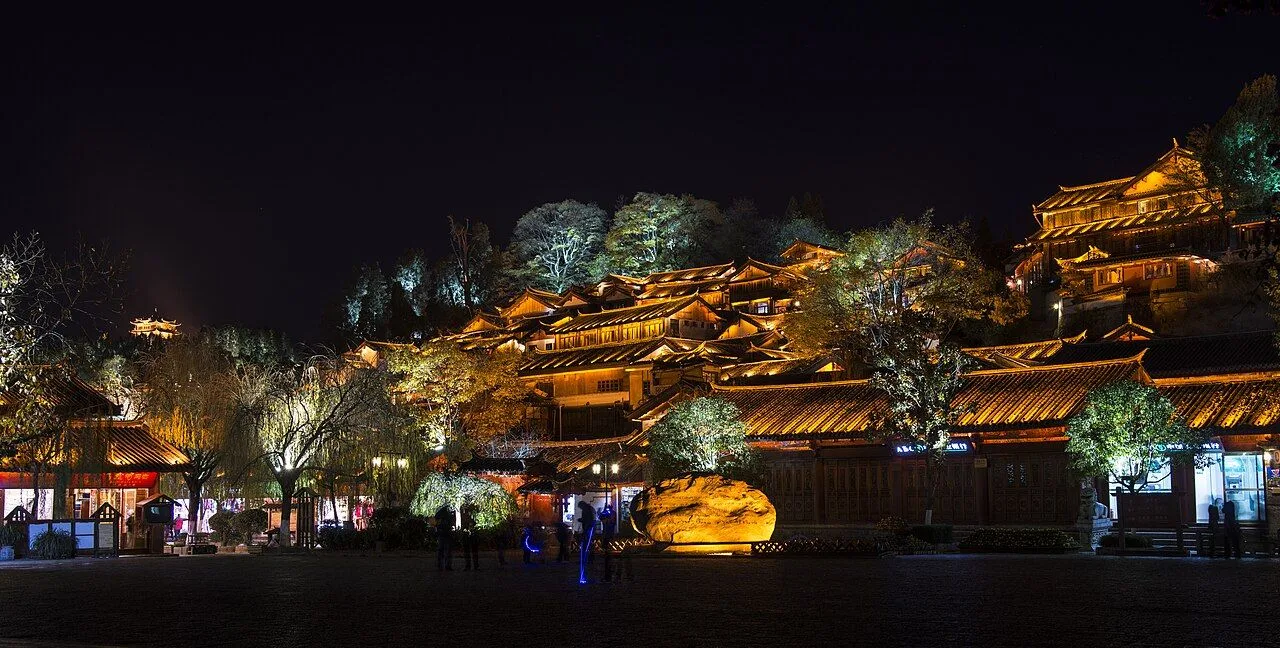
Photo: Wikimedia Commons / CC BY-SA. Source

The Old Town is fully pedestrianized. Cars are not allowed inside; luggage is hauled on handcarts; deliveries arrive by handcart. The result is a town that feels almost European in pace: stone lanes, cobblestone underfoot, and the sound of water from the canals that thread through every street. The 354 stone bridges are the highest density in China — most date to the Ming and Qing dynasties, and several have legends attached (the most famous being the Couple’s Bridge 双龙桥 where Naxi couples would meet).
What the foreigner experience looks like in 2026
The Old Town is well-set-up for foreign travelers. The ¥80 entrance fee (called 古维费 “Old Town Maintenance Fee”) is collected at 16 entry checkpoints 07:00-19:00; after 19:00 the Old Town is free to enter. Alipay works everywhere, English signage is consistent in the main lanes, and most of the small inns have English-speaking staff. The town is small enough to walk across in 2 hours, but most travelers stay 2-3 days to catch the night atmosphere and the early-morning golden hour on Jade Dragon Snow Mountain.
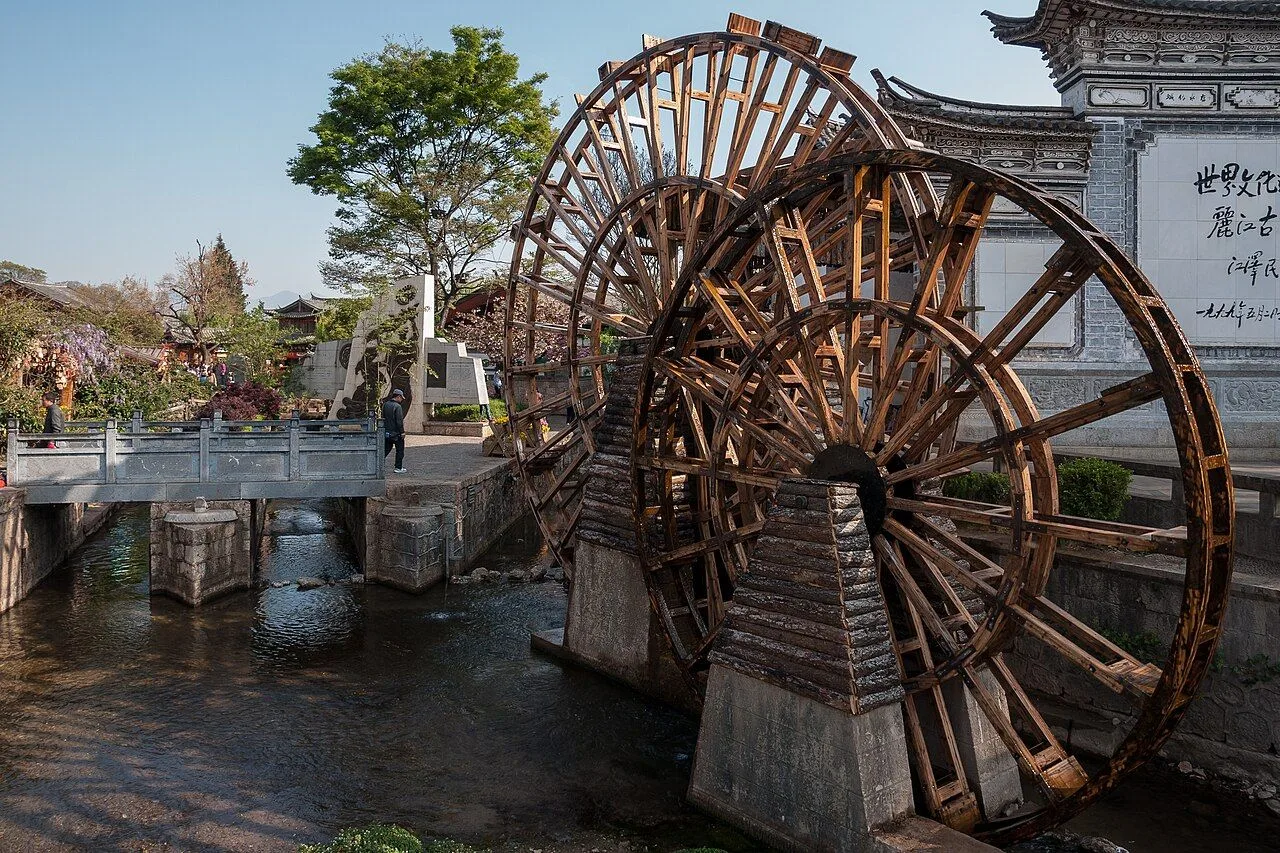
Photo: Wikimedia Commons / CC BY-SA. Source

The main thing to know: the Old Town is overrun with day-trippers between 10:00 and 17:00, when the tour buses arrive. If you stay in a hotel inside the Old Town, you can experience the lanes empty by walking out at 6am or 9pm. This is the difference between a frustrating day and an unforgettable one.
Naxi culture: what makes Lijiang different
The Naxi minority has one of the most distinctive cultures in China. Their 1,000-year-old pictographic writing system (东巴文 Dongba) is still used by Taoist priests for religious ceremonies — it’s the only pictographic script in the world still in active use. The Naxi Ancient Music (纳西古乐), performed nightly at the Old Town stage, is a fusion of Taoist ritual music, Confucian ceremony, and the Naxi tradition — played on instruments from the 14th century. The Naxi Heritage Museum (东巴文化博物馆) is free and has good English signage; allow 90 minutes.
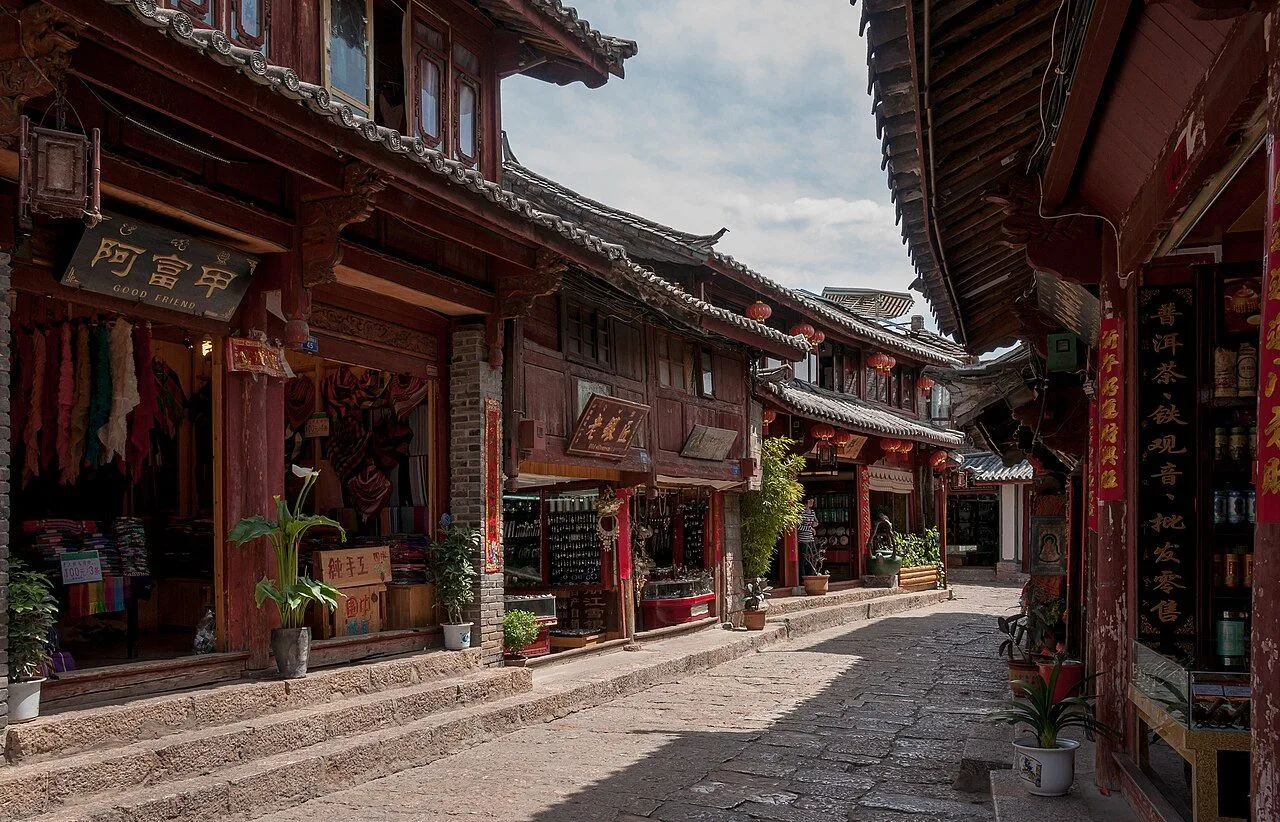
Photo: Wikimedia Commons / CC BY-SA. Source

The Naxi matrilineal tradition is also worth knowing. Until 1956, Naxi women did not marry; they had visiting relationships with men from other clans, and the children stayed with the mother. The Naxi term “阿注” (azhu, “friend”) for these relationships is now a tourist slogan, but the original meaning is matrilineal, not casual. The Naxi women still wear distinctive blue aprons and embroidered caps; the embroidery tradition is the most famous in Yunnan.
Where to stay: choose a Naxi courtyard hotel
Most Old Town hotels are restored 200-year-old Naxi courtyard houses (四合院 siheyuan) — wooden buildings with a central courtyard, a small stream running through the property, and roof tiles that creak in the wind. The best mid-range options are 客栈 kèzhàn (inns) in the eastern lanes — quieter than the western side, walking distance to Black Dragon Pool. The luxury options (InterContinental, Banyan Tree) are modern, not restored, and located just outside the Old Town.
Final tip
Wake up before 7am. The lanes are empty, the tour buses haven’t arrived, and the light on the stone bridges is golden. Spend 1-2 hours walking the eastern lanes (五一街 Wuyi Jie area) — these are the quietest, with the best small cafes and the fewest crowds. Then head to Black Dragon Pool (黑龙潭) for the Jade Dragon Snow Mountain reflection.
Best photo spots
-
Black Dragon Pool (黑龙潭) · Sunrise, 07:00-08:00
The classic Jade Dragon Snow Mountain reflection, with the ancient pavilion in the foreground. Get there 30 min before sunrise; the light is best 15 min after.
-
Lion Hill (狮子山) Wangu Tower · Morning, 08:30-09:30
The panoramic view of the Old Town's grey-tiled rooftops with Jade Dragon on the horizon. ¥60 entry to the tower.
-
Old Town canal bridges · Golden hour, 17:00-18:00
Stone bridges over the canals, with lanterns reflecting in the water. The most-photographed scene in Lijiang.
-
Square Street (四方街) · Late afternoon, 16:00-17:00
The 800-year-old central square where the original market was. Less crowded before the dinner rush.
-
Wenchang Palace (文昌宫) viewpoint · Anytime
Free viewpoint in the southeast of the Old Town. Less crowded than Lion Hill but similar views.
Where to eat nearby
-
阿安酸奶 (Ah An Yogurt)
Yogurt with fresh fruit and Naxi honey · ¥15-25/bowl · Old Town center, off Square Street
-
纳西烤肉 (Naxi grilled meat) at 88 Snack Street
Yunnan BBQ, mushroom hotpot · ¥60-100/person · Outside the Old Town south gate, 5 min walk
-
Restaurants on 五一街 (May 1st Street)
Mix of Chinese, Western, and Naxi; many vegetarian options · ¥50-120/person · East side of the Old Town
-
Lijiang Baba (丽江粑粑)
Local flatbread with savory or sweet fillings · ¥5-15/piece · Street food throughout the Old Town
Frequently asked questions
How much does Lijiang Old Town cost in 2026?
¥80 entrance fee (called 古维费 'Old Town Maintenance Fee'). It's collected 07:00-19:00; after 19:00 the Old Town is free to enter. Seniors over 60 and children under 1.2 m are free with ID.
Do I need a visa for Lijiang?
Most travelers fly into Kunming (KMG), the Yunnan capital, and take a 3-hour high-speed train to Lijiang. 57 nationalities get 240-hour visa-free transit at Kunming; otherwise, apply for an L-visa at a Chinese consulate before flying.
How long should I spend in Lijiang Old Town?
Minimum 2 nights. The first day for the lanes and Lion Hill, the second for Black Dragon Pool at sunrise and a Jade Dragon Mountain day trip. Three nights lets you add Tiger Leaping Gorge.
Is the ¥80 fee avoidable?
Yes — after 19:00, the entry checkpoints close and the Old Town is free to enter. Most visitors pay the fee because they want to walk in during the day. If you're staying inside the Old Town, the fee is included in many hotel bookings.
What is the best time of year to visit Lijiang?
Year-round, but spring (March-May) for rhododendrons on Jade Dragon Mountain, autumn (October-November) for clear skies and fall colors. Avoid the Chinese New Year period (last week of January to mid-February) when the Old Town is overrun with domestic tourists.
Is Lijiang Old Town wheelchair accessible?
Partially — the main lanes are flat stone, but many side lanes have steps and uneven cobblestones. Some hotels have step-free access; book ahead and confirm. The Lion Hill climb is not wheelchair-accessible.
Can I use Alipay in Lijiang Old Town?
Yes — Alipay works everywhere in the Old Town, including the entry checkpoints, restaurants, and craft shops. Link a Visa/Mastercard before you arrive; even the small family-run inns accept it.
What's the difference between Lijiang Old Town and Lijiang City?
Lijiang City (大研镇 Dayan) is the modern city surrounding the Old Town. The Old Town is the UNESCO pedestrian zone. Most travelers stay in the Old Town itself; the new city has the train station, modern hotels, and shopping malls.