
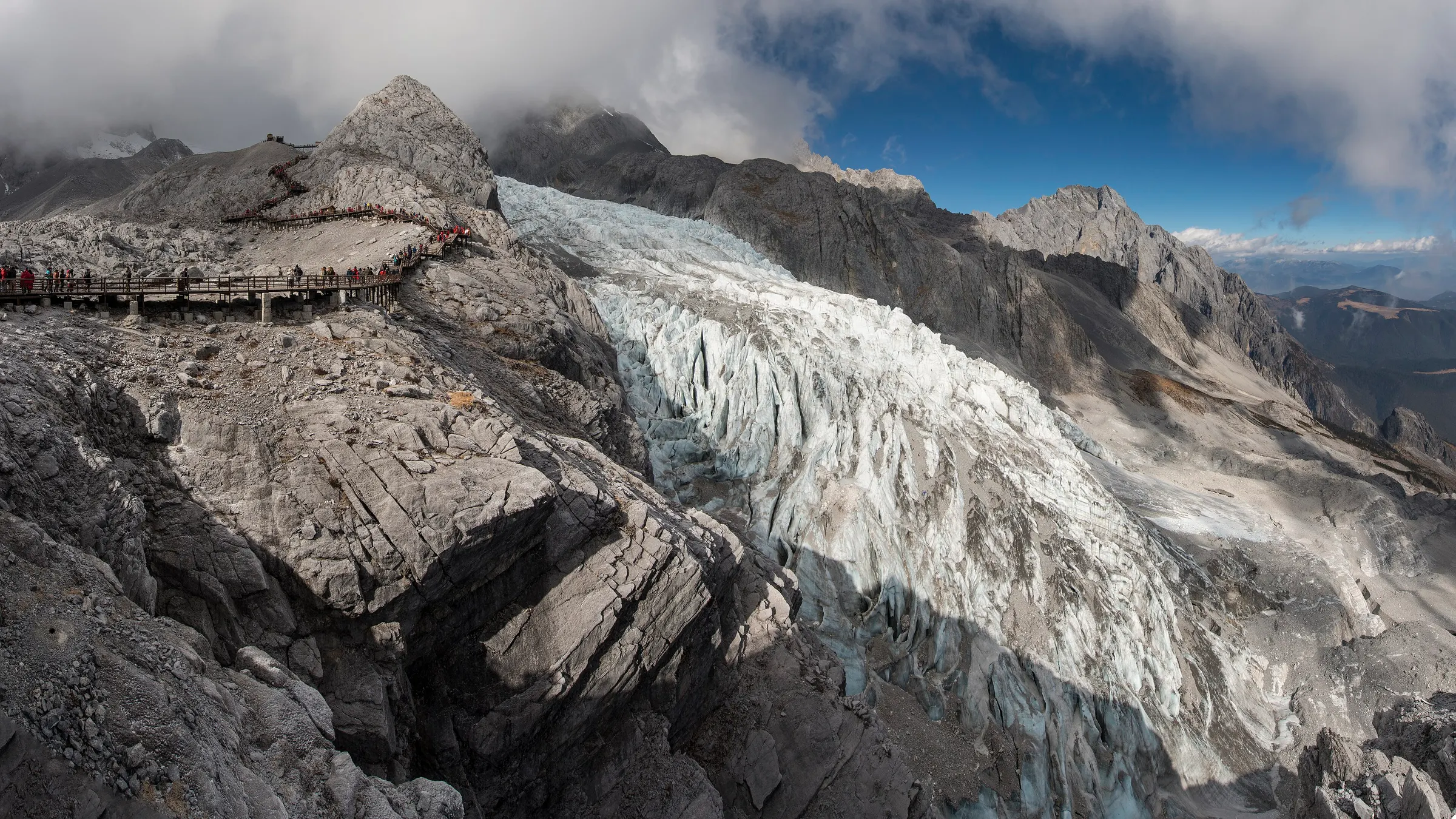
Jade Dragon Snow Mountain
玉龙雪山 · Yùlóng Xuěshān
Quick answer
Carry your passport. The scenic area runs on a ticket gate and shuttle-bus system on a plateau about 25 km outside Lijiang, and the passport is the document that establishes your identity and any age or student category you claim when you buy the ticket. Nothing needs to be booked in advance; you pay at the gate.
Why visit
- 1 5,596 m Shanzidou (扇子陡), the highest point in Yunnan and the most southerly permanent-snow summit on the Eurasian mainland
- 2 A cable car climbs to an observation platform at 4,506 m, with a second, higher platform at 4,680 m — one of the highest in the world
- 3 19 glaciers covering 11.61 km2; Baishui No.1 (白水一号) is the glacier developed for visitors
- 4 The massif is sacred to the Naxi as one of the three manifestations of the deity Sanduo, and the whole Lijiang basin takes its water from it
- 5 Blue Moon Valley (蓝月谷) is the first stop on the park shuttle bus and the reason most day visitors come at all
- 6 UNESCO-inscribed as the Yulong Snow Mountain Scenic Area in 1988; national 5A rating since 2007-05-08
Essential tips for foreigners
- The ¥130 entrance ticket buys you nothing but entry. The cable car and the ¥20 shuttle bus loop are separate tickets, and the shuttle is not optional — the nearest walking trail starts about 6 km from the gate.
- Buy the ¥20 shuttle loop before you walk anywhere. It runs a circuit past Blue Moon Valley, the Baishui River dams, Spruce Meadow and Yak Meadow, and you can get on and off as many times as you like.
- The cable car can be closed for wind at short notice, and it does not run in high wind even on a clear day elsewhere in Lijiang. Treat the upper mountain as a bonus, not the plan.
- Altitude, not cold, is what will spoil your day. The platform is at 4,506 m and Lijiang itself is at 2,400 m; most of the unpleasantness comes from the 2,000 m of ascent, not from the temperature.
- Expect to see very little between June and September. Roughly 80% of the region's rain falls in those four months and the summit is usually in cloud. Come October to December.
- There is no public bus to the gate. The shared minibuses that fan out from the square in front of the Mao statue in the Old Town are the standard way there, and they leave when they are full.
Suggested route
- 08:00 45 min Leave Lijiang Old Town on a shared minibus or a hired car for the Ganhaizi plateau; the drive takes about 45 minutes
- 09:00 20 min Pay the ¥130 entrance at the ticket gate, then buy the ¥20 shuttle-bus loop before you set off on foot
- 09:30 1.5 hours Ride the shuttle to Blue Moon Valley and get off — the first stop, and the artificial waterfalls over white limestone are worth the walk
- 11:00 45 min Back on the shuttle past the Baishui River dams, where the meltwater is held in a series of small turquoise reservoirs
- 12:00 2 hours Take the cable car up to the observation platform at 4,506 m and walk the boardwalk to the glacier edge, if the cable car is running
- 14:00 1 hour Ride back down and eat at one of the canteens near the visitor centre before spending any more time on the shuttle
- 15:00 1.5 hours Optional second leg of the shuttle to Spruce Meadow (云杉坪, 3,240 m) or Yak Meadow, both of which are quieter than the lower stops
- 17:00 45 min Head back to Lijiang while there is still light; the road is unlit in places
A 5,596-metre limestone wall above a UNESCO town
Jade Dragon Snow Mountain (玉龙雪山, Yùlóng Xuěshān) is a northwest-to-southeast mountain range 35 km long and 13 km wide, standing about 15 km from the centre of Lijiang. Its highest point, Shanzidou (扇子陡), reaches 5,596 m — the highest peak in Yunnan and, by a wide margin, the most southerly permanent-snow summit on the Eurasian mainland. The massif is snow-covered year-round and is built almost entirely of carbonate rock in a sequence more than 3,000 m thick.
For most visitors it is a backdrop seen from a restaurant terrace. For the Naxi people it is something else: a sacred mountain and one of the three manifestations of the deity Sanduo. The whole Lijiang basin draws its water from the snowfield, which is why the massif sits at the centre of local identity rather than at the edge of it.
Photo: Wikimedia Commons / CC BY-SA 4.0 (chensiyuan). Source
The mountain was inscribed as the Yulong Snow Mountain Scenic Area in the second batch of Chinese national scenic areas in 1988, and the scenic area was upgraded to China’s top 5A rating on 8 May 2007.
What “full day” actually means
The day has three distinct altitude bands, and almost all visitor disappointment comes from misjudging which one they are in.
The gate and the plateau, around 2,900 m. You arrive at Ganhaizi, pay the entrance fee, and buy the shuttle bus. This is where you spend the first hour and it is genuinely pleasant — an alpine meadow with the massif standing straight ahead of you.
The lower park, 2,900 m to about 3,500 m. Blue Moon Valley, the Baishui River dams, Spruce Meadow and Yak Meadow, all served by the shuttle loop. Reliable, well-developed, and the part of the day that works in any weather.
The cable car and Glacier Park, 4,506 m and above. A steep step up, weather-dependent, and the reason people book the day at all.
Plan around the first two and treat the third as the bonus. That framing is the difference between a good day and a wasted one.
Tickets: the price is layered, and that is the whole trick
This is the single most common booking mistake made here, so it is worth being precise about what the ¥130 covers.
The ¥130 entrance ticket buys entry to the scenic area and nothing else. It explicitly does not include any cable car or any transport. On top of it you will normally buy two more things: the ¥20 shuttle-bus loop inside the park, and a cable-car ticket sold separately at the visitor centre.
The shuttle bus is not optional in practice. The closest walking trail begins about 6 km from the ticket gate, and the loop is what connects the visitor centre to Blue Moon Valley, the Baishui River dams and the chair-lift stations. It runs as a circuit, you can get on and off freely, and you can ride it back to the gate at the end.
We do not publish a cable-car price on this page. The last publicly published figure we could verify is several years old and almost certainly wrong, and a wrong number here costs you money at the ticket window. Buy that ticket at the visitor centre on the day, after you have seen whether the cable car is running.
The cable car is the point — and it can be shut
The cable car climbs to an observation platform at 4,506 m, with a second and higher platform at 4,680 m, described as one of the highest in the world. From there the developed glacier comes down a limestone ridge to within walking distance of a boardwalk.
The mountain holds nineteen glaciers totalling 11.61 square kilometres. Baishui No.1 (白水一号) is the one that has been developed for visitors, and its meltwater is what feeds the Baishui River you pass lower down.
And here is the catch: the cable car is closed when the wind is too strong. Not seasonally — weather-dependently, at short notice, on days that are otherwise perfectly clear in Lijiang. Anyone building a fixed plan around going up to 4,500 m is building it on the wrong assumption.
Criticism of the cable car is also worth knowing about, if you are deciding whether to buy it: some have argued that the construction accelerates the melting of the snow and reduces the mountain’s water retention. That is a live local argument, not a settled fact.
The lower park, which most people skip
If the cable car is closed, the day is not lost.
Blue Moon Valley (蓝月谷) is the first stop on the shuttle bus and, for a lot of visitors, the reason they came. The valley floor is white limestone and marble, and on clear days the water reads as vivid blue, which is where the name comes from. A wooden walking trail runs parallel to the bus road and is a better way to do it than the electric buggy that will be offered to you.
The Baishui River dams are the next stop. The river’s bed is built from white limestone and carbonatite fragments, which makes the whole channel white-grey, and the meltwater is held in a series of small reservoirs.
Spruce Meadow (云杉坪) sits at 3,240 m in a clearing of about half a square kilometre of spruce forest. Its Naxi name translates as the place where love died. Yak Meadow is the furthest of the three from Lijiang and the least visited.
Ganhaizi (干海子) is the arrival plateau itself — four kilometres long, 1.5 km wide, at about 2,900 m, used as a summer grazing camp by Naxi, Tibetan and Hui herding families.
Altitude is the real risk, not cold
Lijiang sits at about 2,400 m, which is enough for some people to feel something on arrival. The cable-car platform is at 4,506 m. That is roughly 2,000 m of ascent compressed into about ten minutes, and it is the reason for carrying canned oxygen at the top station — many visitors do, and there are stalls selling it.
Go slowly when you get off. Drink water. If a headache becomes more than a headache, the correct response is to come back down, not to walk further. The cold is manageable — the summit is far colder than Lijiang but it is dry, sunlit and still. The altitude is what actually stops people.
When to go
October to December is the window. Lijiang’s climate is strongly monsoonal: roughly 80% of the annual rainfall falls between June and September, and those months also carry the cloud that hides the summit. The post-monsoon months from October give the clearest air and the best odds of an unobstructed view. March to May is also dry, with no better summit odds.
Chinese New Year, from the last week of January to mid-February, is the worst fortnight of the year. The domestic tour groups are at their heaviest and the shuttle queues are longest.
The mountain is open year-round in the sense that the lower park does not close, but the upper sections are weather-dependent and the access roads around Ganhaizi see snow in winter.
Getting there
The gate is about 25 km from Lijiang Old Town and roughly 45 minutes by road.
The standard, and cheapest, way is the shared minibus from the square in front of the Mao Zedong statue in the Old Town, around ¥20 each way. These wait until they are full before leaving, so it is a waiting game, and it is the reason the first hour of the morning is often spent drinking tea on a kerb.
A hired car or taxi is faster and lets you leave on your own schedule, which matters if you are trying to beat the cloud or beat the crowds. There is no direct public bus to the gate.
Drive back before dark. The road out of the plateau is unlit in places.
What almost nobody tells you
The most famous view of Jade Dragon Snow Mountain in Lijiang is not taken here. It is taken from Black Dragon Pool (黑龙潭), the spring-fed pool on the northern edge of the Old Town, where the massif sits above the white marble bridge with its reflection in the water — a view English-language sources have long called one of the finest in China.
If you have one morning in Lijiang rather than a full day, spend it there. You get the mountain for a fraction of the cost and none of the altitude.
Best photo spots
-
Glacier Park (冰川公园) · Mid-morning, before the cloud builds
The reason people come. The Yulong Glacier comes down a grey limestone ridge to within walking distance of the boardwalk at around 4,500 m, with the Jade Dragon peaks and cloud behind it. Get there before the coach groups.
-
Blue Moon Valley (蓝月谷) · Any time, but clearest water at midday under strong sun
The lower park's signature view. White limestone bedrock under turquoise water, which reads as vivid blue only in clear weather — hence the name. The wooden walking trail runs parallel to the bus road and is the better way to do it.
-
Ganhaizi (干海子) meadow · Late afternoon
The alpine pasture on the plateau below the mountain at about 2,900 m, used as a summer grazing camp by Naxi, Tibetan and Hui herders. The classic arrival view of the massif on the drive in.
-
Spruce Meadow (云杉坪) · Midday
A 0.5 sq km clearing of spruce forest at 3,240 m, reached by a short chair lift. Quieter and higher than the main stops, and the Naxi place-name translates as the place where love died.
Frequently asked questions
How much does Jade Dragon Snow Mountain cost?
The park entrance is ¥130. That figure covers the Yulong Snow Mountain Scenic Area only. On top of it you will normally buy the ¥20 shuttle-bus loop and, if you want to reach the glacier, a cable-car ticket sold separately at the visitor centre. We do not publish a cable-car price because the last publicly published figure we could verify is several years old and almost certainly wrong. A realistic full-day budget should assume the entrance plus the shuttle plus the cable car.
How long do you need at Jade Dragon Snow Mountain?
A full day. The drive from the Old Town is about 45 minutes, the shuttle circuit alone takes two to three hours if you get on and off at every stop, and the cable-car ride and the walk up to the glacier are a couple more hours at 4,500 m. Half a day means you see Blue Moon Valley and little else.
Do you need a passport to visit Jade Dragon Snow Mountain?
Carry one. The site is a national 5A-class scenic area run on a ticket gate and shuttle system, and the passport is what establishes your identity and any age or student category when you buy the ticket. Nothing is pre-booked; you pay at the gate.
Is the cable car always running?
No, and this is the single biggest variable in the day. The cable car is closed when the wind is too strong, and the suspension is weather-dependent rather than tied to a published timetable. There is plenty to see without going up: Blue Moon Valley, the Baishui River dams, Spruce Meadow and Yak Meadow are all reached by the shuttle bus.
Will I get altitude sickness?
It is possible. Lijiang sits at about 2,400 m and the cable-car platform is at 4,506 m, so you gain roughly 2,000 m in about ten minutes. Many people feel short of breath or get a headache; a smaller number feel genuinely ill. Go slowly on arrival, drink water, and if symptoms worsen, come back down rather than pushing on.
When is the best time to see the snow peak?
October to December. Lijiang's rain is concentrated in June to September — roughly 80% of the annual total — and the summit is in cloud through that window. The post-monsoon months from October bring the clearest air. March to May is also dry, but the odds of a cloudless summit are no better.
Is Jade Dragon Snow Mountain worth a full day?
It depends what you came for. The upper mountain is a genuine high-altitude glacier landscape and the geology is unusual, but it is weather-dependent and crowded. The lower park — Blue Moon Valley, the Baishui River dams, Spruce Meadow — is reliable, cheap and good even when the summit is invisible. Build the day around the lower park and treat the cable car as the bonus.
Can you see Jade Dragon Snow Mountain from Lijiang itself?
Yes, from many parts of the city, and Black Dragon Pool (黑龙潭) on the northern edge of the Old Town is the classic spot for the reflection. If you only have a short window in Lijiang, that view gets you the mountain without the full-day commitment.
Sources
- Jade Dragon Snow Mountain — Wikipedia (5,596 m Shanzidou peak, UNESCO-inscribed Yulong Snow Mountain Scenic Area approved 1988, cable car to 4,506 m with a higher 4,680 m platform, altitude risk, 1938 Byles expedition and the 1987 summit) · Wikipedia
- Yulong Xueshan — Chinese Wikipedia (5,596 m elevation, 35 km NW-SE by 13 km E-W, limestone sequence over 3,000 m thick, 19 glaciers totalling 11.61 km2, Ganhaizi / Baishui River / Blue Moon Valley / Spruce Meadow / Yak Meadow, vegetation zones, national 5A rating approved 2007-05-08) · Wikipedia
- Lijiang — Wikivoyage (¥130 park entrance ticket explicitly excluding cable cars and transport, separate ¥20 shuttle-bus loop, Blue Moon Valley as the first shuttle stop, cable car subject to wind cancellations, shared minibus transport from the Old Town) · Wikivoyage
- Lijiang — Wikipedia (climate: roughly 80% of annual rainfall falls June-September, driest and sunniest October-December, city elevation around 2,400 m) · Wikipedia
- Jade Dragon Snow Mountain — Wikidata Q1465660 (elevation 5,596 m, prominence 3,202 m, coordinates 27.098333 / 100.175, OpenStreetMap node 298460509) · Wikidata
- File:1 yulong xueshan 2012.jpg — Wikimedia Commons (CC BY-SA 4.0, chensiyuan), the source file for the hero image of the Yulong Glacier at Glacier Park · Wikimedia Commons


