
Black Dragon Pool
黑龙潭 · Hēilóngtán
Quick answer
Carry your passport. This is a national 4A scenic area and a national key cultural relics protection unit, so the site is documented and ticketed rather than an open public garden. Nothing needs to be pre-booked.
Why visit
- 1 The classic Jade Dragon Snow Mountain reflection, taken from a garden roughly 1 km north of the Old Town — the image most visitors come for
- 2 A spring-fed karst pool at 2,419 m whose water is the Old Town's main supply, running north into the canals in three branches
- 3 The 1601 Five-Phoenix Tower (五凤楼), moved here in 1979 from a temple 30 km to the west
- 4 The Forest of Stele (碑林), more than 50 inscribed stones running from the Tang dynasty to the Republic of China
- 5 A national key cultural relics protection unit since 2006 and a national 4A scenic area since 2009
- 6 It is a working local park as much as a monument — Naxi residents use it every evening
Essential tips for foreigners
- Go at sunrise, and go to the water's edge. The reflection needs still water and a clear morning; by mid-morning the wind picks up and by mid-afternoon the coach groups have arrived.
- Check the pool before you plan the shot. This pool has genuinely dried out before — most recently from January 2012 to April 2014 — so a photo built around the reflection has no guarantee.
- Walk in from the waterwheels (大水车) rather than taking a taxi. Follow the canal upstream for about ten minutes and you arrive at the south entrance having walked the most scenic stretch of the Old Town. The main gate is on Minzhu Road.
- The ¥50 figure on this page is dated. It was published in February 2019 and the entry arrangements have changed more than once since. A large northern area beyond the Dongba Museum has long been free. Confirm at the gate.
- Combine it with the Old Town. The Dongba Culture Museum sits immediately to the north of the park and Elephant Hill rises behind it, so two hours here plus two in the Old Town is a natural half-day.
- Come back in the evening. This is a working local park, not a monument — you will find Naxi residents dancing, playing mahjong and Chinese chess, and students from the college further north.
Suggested route
- 06:30 20 min Leave the Old Town before it wakes and walk north from the waterwheels, following the canal upstream for about ten minutes
- 07:00 45 min Enter at the south gate as the park opens, and go straight to the water's edge on the far side before the wind picks up
- 08:00 45 min Cross the white marble Suocui Bridge and photograph the reflection with the massif behind it
- 09:00 1 hour Walk the lake past the Five-Phoenix Tower and the Forest of Stele while the light is still low on the tiled roofs
- 10:15 30 min Cross to the Dragon God Temple, built 1737 and named by the Qianlong Emperor, on the east side of the park
- 11:00 1.5 hours Walk on to the Dongba Culture Museum immediately north of the park, or climb Elephant Hill if you have the legs for it
A spring that feeds the whole Old Town
Black Dragon Pool (黑龙潭, Hēilóngtán), also called Jade Spring Park, sits at the foot of Elephant Hill about a kilometre north of the Lijiang Old Town pedestrian zone. It is often described as a pond. It is better understood as a 625,300-square-metre garden built around a karst spring at 2,419 m — and as the reason the Old Town has water in its canals at all.
The pool is fed by the spring water of the Jiuzi Hai fissure-karst zone above it, at 2,800 to 3,588 m, through a protected water conservation area of roughly 20 square kilometres. Three channels leave the pool under Suocui Bridge and run north into the Old Town, dividing into eastern, central and western branches. The eastern branch dates from the Qing dynasty, the western from the Yuan; the middle one is natural. The pool is the Old Town’s main water source, which is why its level is treated as a public issue rather than a scenic one.
What is actually inside the park
Nine structures are formally listed as cultural relics, and the park was named a national key cultural relics protection unit in the sixth batch, announced on 25 May 2006 under the register number 6-0749-3-452. It became a national 4A tourist attraction in 2009.
Wenmingfang (文明坊) is the gate — it is the park’s street entrance, and it is what you walk through.
Deyue Lou (得月楼), the Moon-Embracing Pavilion, was originally built in the late Ming dynasty. The structure standing today is a 1963 reproduction, put up after a fire destroyed the original in 1950.
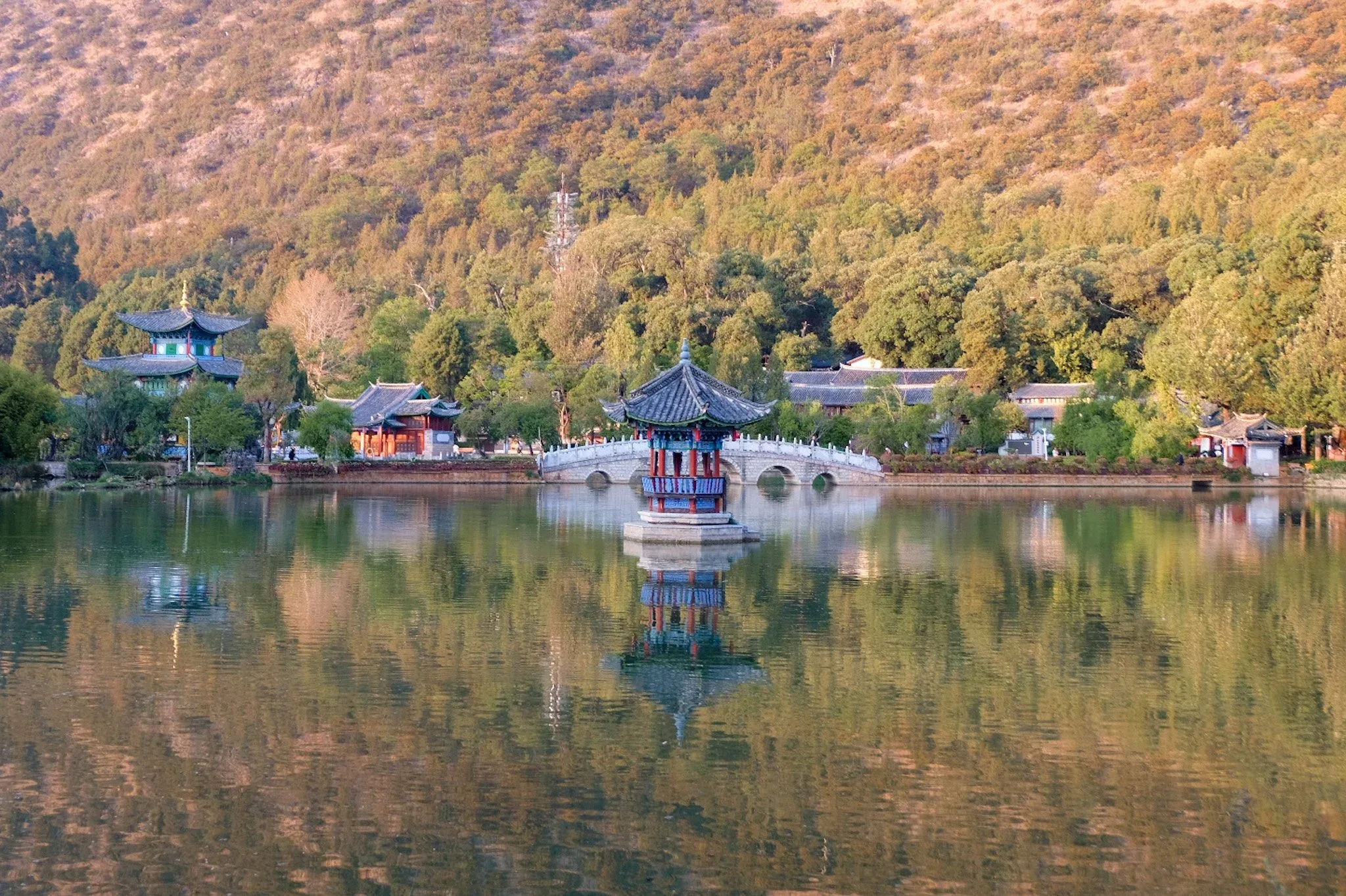
Wufeng Tower (五凤楼), the five-phoenix tower, is the famous one. It was built in 1601 and moved to the park in 1979 from Fuguo Temple, 30 km to the west. It stands on its own island in the water, which is why it photographs so well.
Longshen Temple (龙神祠), the Dragon God Temple, was built by local Naxi people in 1737 on the east side of the park. The Qianlong Emperor gave it its name in the same year.
The Forest of Stele (碑林) is described as the treasure house of Naxi culture: more than fifty inscribed stones spanning the Tang dynasty through to the Republic of China.
There are also Guangbi Tower, Yiwen Pavilion, the Jietuo Linmen gate tower and a theatre stage. Five of the listed buildings — the gate tower, Wufeng Tower, Guangbi Tower, Yiwen Pavilion and Wenmingfang — were all relocated here from elsewhere.
The Dongba Culture Research Institute and the Dongba Culture Museum are also in the park; the museum is immediately to the north and is free.
The view, and the thing that ruins it
The reason people come is Jade Dragon Snow Mountain.
Seen from the gardens here, the massif is noted as one of the finest views in China, and the classic composition puts the white marble bridge in the foreground with the snow peak rising directly behind it and the whole thing doubled in still water. It is the photograph that sells Lijiang.
The problem is that the pool has been empty before, and not long ago. Its water is governed by a karst aquifer rather than by rainfall, so it is not simply a wet-season thing. It dried up from 1 November 2007 to 9 June 2008 — nine months, the longest on record — and then went completely dry again on 21 January 2012 and stayed that way until 10 April 2014. Earlier cycles are documented at roughly twenty-year and roughly five-year intervals.
The response was to declare the surrounding area a water conservation area in 2010, which is when the Old Town’s water security was formally addressed rather than assumed.
The practical consequence for you: this is a spring-fed pool, and a photo built around the reflection has no guarantee. Check before you build the morning around it.
What it costs, and what that number rests on
We publish ¥50 here, and we want to be explicit that it is not a fresh figure.
¥50 is the last gate price we could verify from a source we fetched, recorded by Wikivoyage in February 2019 and noted as free for visitors over 60. We have not found a newer authoritative price, and we are not going to invent one.
Two things make it harder to rely on:
- The park’s entry arrangements have changed more than once, and the current status is not something we could confirm from a fetched source.
- A large area of the park beyond the Dongba Museum has long been free to walk into. The northern part of the park is reachable without passing a gate, so “free” and “ticketed” are both partly true depending on how far north you go.
So: treat ¥50 as the best documented figure we have, not as today’s price. Ask at the gate.
Getting there
The scenic way is on foot. From the waterwheels at the southern edge of the Old Town, follow the canal upstream for about ten minutes and you arrive at the south entrance — which means you walk the most photogenic stretch of the Old Town on the way, with the canal on one side.
The main street entrance is on Minzhu Road, and the park’s telephone number is published locally as +86-888-5188041 if you want to check the day’s arrangements before setting out.
Elephant Hill rises directly behind the pool. If you have the legs and the time, the climb is short and gives the wider view back across the water to the Old Town rooflines.
When to come
Sunrise, without exception. The point of the place is a reflection, and a reflection needs still water and low light. The guides single out the bridge as the spot. Be there half an hour before dawn and accept that you may wait an hour for the light.
Seasonally, October to March gives the clearest air and the best odds of both the peak being visible and the pool being full. Lijiang’s rain is concentrated in June to September, and while the pool is spring-fed rather than river-fed, poor visibility in the wet months does nothing for the photograph.
Spring also has its own argument. Autumn turns the wooded slope behind the pool gold and green, which is when the park is at its most photogenic beyond the mountain itself.
Come back in the evening
This is the part that surprises people who expect a monument.
Black Dragon Pool is a working local park. In the evenings Naxi residents come to dance, to play mahjong and Chinese chess on the shore, and to use the water. There is a local college further north whose students help visitors find their way and run a small café. On hot summer afternoons people swim in a reservoir beyond the park.
An hour at sunrise for the photograph, and a second visit at dusk for the park itself, is better than one long visit in the middle of the day.
Best photo spots
-
The white marble bridge over the pool · Sunrise, 06:30-08:00
The view the park exists for: the white marble bridge in the foreground with Jade Dragon Snow Mountain directly behind it and its reflection in the water. Be there half an hour before sunrise; by ten the light is flat and the wind has started.
-
The Five-Phoenix Tower (五凤楼) · Early morning or late afternoon
The 1601 timber structure moved here from a temple 30 km west in 1979, standing on its own island across the water. Reads best in low side-light, when the layered rooflines separate.
-
The tiled-roof shore walk · Late afternoon, golden hour
The far shore of the pool, where the Qing buildings sit against the wooded slope of Elephant Hill. Autumn turns the hillside gold and green, which is when the park is at its most photogenic.
-
The Forest of Stele (碑林) · Midday
More than 50 inscribed stones from the Tang dynasty through to the Republic of China, described as the treasure house of Naxi culture. Diffuse light suits close-ups of the inscriptions; it is not a landscape shot.
Frequently asked questions
How much does Black Dragon Pool cost?
The last verifiable gate price is ¥50, recorded in February 2019 and free for visitors over 60. We are flagging that as dated rather than current: this park's entry arrangements have changed more than once, and a large northern area beyond the Dongba Museum has long been accessible for free. Confirm the price at the gate on the day.
Is Black Dragon Pool free?
Partly, and it depends where you enter. The southern, ticketed section around the pool and the main buildings has carried a gate fee. The area further north, beyond the Dongba Museum, has long been free to walk into. Check at the gate rather than assuming either way.
What are the opening hours?
07:00 to 19:00, daily. Both the English and Chinese Wikivoyage guides give the same window, along with the same address on Minzhu Road and the same telephone number.
Can I get into Black Dragon Pool with a foreign passport?
Yes. It is a national 4A scenic area and a documented national key cultural relics protection unit, so entry is ticketed and formal rather than casual. Bring your passport as identification. Nothing is pre-booked.
How long should I spend at Black Dragon Pool?
One to two hours. Most people walk the lake, cross the white marble bridge, look at the Forest of Stele and the Five-Phoenix Tower, and leave. If you want the reflection properly you will want to be there and settled before dawn.
Is the pool always full of water?
No, and this is the park's single biggest variable. It is spring-fed from a karst aquifer, and it has dried out repeatedly — from November 2007 to June 2008, and again completely from January 2012 until April 2014. The local government declared the surrounding area a water conservation area in 2010 precisely to protect the supply.
Why is it called Black Dragon Pool?
The legend. Ten dragons are said to have caused harm to people here, and the Taoist immortal Lü Dongbin captured nine of them, walling the tenth under the old pagoda in town. He kept the last one's tail as his staff, and the pool is named for what it holds.
What is the best time of day to visit?
Sunrise. The point of the place is the reflection of Jade Dragon Snow Mountain, which needs still water and low light. The English and Chinese Wikivoyage guides both single out the bridge over the pool as the spot, with the massif behind it. Be there half an hour before dawn.
Sources
- Black Dragon Pool — Wikipedia (Jade Spring Park at the foot of Elephant Hill, built 1737, Deyue Lou and the 1601 Wufeng Tower moved from Fuguo Temple in 1979, Forest of Stele, Dongba Culture Museum, sixth batch of national key cultural relics protection units, 4A rating 2009, the pool has been dry in the past and was declared a water conservation area in 2010) · Wikipedia
- Lijiang Heilongtan — Chinese Wikipedia (625,300 sq m site at 2,419 m, fed by the Jiuzi Hai karst fissure zone at 2,800-3,588 m through a 20 sq km water conservation area, three branches feeding the Old Town canals dating to the Yuan and Qing periods, nine listed buildings, the dry periods of 2007-2008 and 2012-2014, the ten-dragon legend) · Wikipedia
- Lijiang — Wikivoyage (Black Dragon Pool opening 07:00-19:00, address 1 Minzhu Road, phone +86 888 5188041, the Y50 gate ticket recorded in February 2019 free for over-60s, the free northern section beyond the Dongba Museum, Elephant Hill climb, the Dongba Museum immediately north of the park) · Wikivoyage
- Black Dragon Pool — Wikidata Q4920688 (coordinates 26.88760833 / 100.233275, national key cultural relic 6-0749-3-452 inscribed 2006-05-25, area 215,000 sq m, part of the Old Buildings of Heilongtan heritage listing) · Wikidata
- Jade Dragon Snow Mountain — Wikipedia (the view of the massif from the Black Dragon Pool gardens is noted as one of China's finest, and the pool's water level has historically affected it) · Wikipedia

