
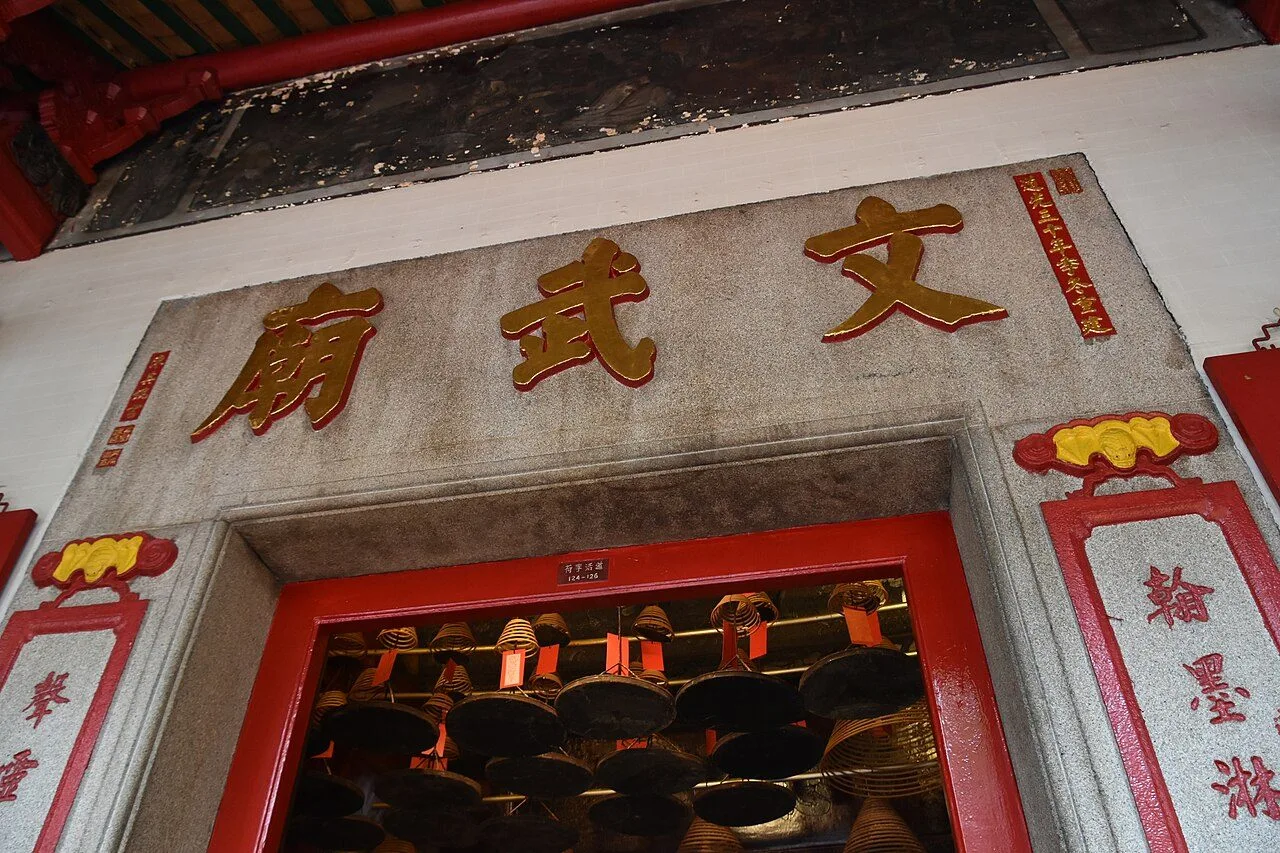
Man Mo Temple
文武廟 · Wénwǔ Miào
Quick answer
No passport required and no ticket — just walk in. The temple is a working place of worship and is open to all visitors regardless of religion. Fortune telling (求籤) is available at the front counter for HK$20-50; the fortune sticks are translated into English, French, and Japanese on printed slips. Photography is allowed (no flash, no tripod) inside the main hall. Visitors are asked to remove hats, lower voices, and not touch the incense coils.
Why visit
- 1 See the oldest temple in Hong Kong — built 1847, declared a monument in 2010, free entry, 8:00-18:00 daily
- 2 Watch the hanging spiral incense coils — the most-photographed feature, lit fresh throughout the day, the smoke has spiritual meaning in Taoist tradition
- 3 Stand before the joint altars to Man (文, god of literature) and Mo (武, god of war) — the only major Taoist temple in HK dedicated to these two civil and military gods
- 4 Walk 3 minutes to the Central-Mid-Levels escalator (the world's longest outdoor covered escalator, 800m, free) and 5 minutes to Tai Kwun (former Central Police Station, now a heritage arts centre)
- 5 Try fortune telling (求籤) at the front counter for HK$20-50 — the fortune sticks are translated into English, French, and Japanese on printed slips
Essential tips for foreigners
- Visit weekday morning (8:00-10:00) — fewer crowds, the freshest incense smoke, and the best light for photography. Weekend mornings can be busy with worshippers and tour groups.
- The temple is NOT wheelchair accessible — the entrance has 4 stone steps and the doorways are narrow. Visitors with mobility issues can view the temple courtyard and the incense coils through the open doorway from the street.
- No flash, no tripod, no touching the incense coils — the temple is a working place of worship and visitors are asked to be respectful. Hats off inside, voices low, and the central aisle is for worshippers only.
- The incense smoke is a feature, not a bug — the smoke is part of the spiritual experience and is replaced throughout the day. The smoke softens the light inside the temple and creates the most photogenic atmosphere in any Hong Kong attraction.
- Pair with the Central-Mid-Levels escalator (3 min walk) and Tai Kwun (5 min walk) for a half-day on the western side of Hong Kong Island. The escalator is the world's longest outdoor covered escalator, 800m, free, and runs downhill 10:20-00:00.
Suggested route
- 09:00 15 min Take the MTR to Sheung Wan Station Exit A2, walk 8 min uphill on Hollywood Road. Or take a taxi from Central to Man Mo Temple (HK$40-60, 10-15 min)
- 09:20 5 min Arrive at Man Mo Temple (124-126 Hollywood Road). Free entry, no ticket. Remove hats before entering the main hall
- 09:25 5 min Step inside and pause — the incense smoke takes a few seconds to adjust to. The main hall has two altars: Man (文, god of literature) on the left, Mo (武, god of war) on the right
- 09:30 15 min Photograph the hanging spiral incense coils. The light is best in the morning when the sun is low and the smoke is thickest. No flash, no tripod, no touching the coils
- 09:45 15 min Walk through the courtyard to the side halls — the altars to the City God (城隍) and the Earth God (土地). The side halls are quieter and less photographed
- 10:00 15 min Optional: fortune telling (求籤) at the front counter. HK$20-50, the fortune sticks are translated into English, French, and Japanese. The process: shake the bamboo cylinder until a stick falls out, then the counter staff looks up the corresponding slip in the printed book
- 10:15 30 min Walk 3 min east to the Central-Mid-Levels escalator. Take the escalator uphill one or two stops to the Hollywood Road / Ladder Street area — the antique shops and small galleries are along this stretch
- 10:45 1.5 hours Walk back downhill to Tai Kwun (5 min walk from the temple). The former Central Police Station compound is now a heritage arts centre with galleries, shops, and restaurants. Free entry to the courtyards, ticketed exhibitions in the galleries
- 12:15 1 hour Lunch at one of the restaurants in Tai Kwun or on Hollywood Road. The area has a mix of Cantonese, Italian, French, and modern Western options (HK$150-400/person). Or walk 10 min downhill to the IFC Mall for more choices
- 13:15 30 min Continue to Central via the Central-Mid-Levels escalator (downhill) or on foot. From Central, take the Star Ferry to Tsim Sha Tsui (HK$4-6, 10 min) or the MTR to your next destination
Man Mo Temple (文武廟, Wénwǔ Miào) is the oldest temple in Hong Kong, built in 1847 during the Qing dynasty. It is dedicated to Man (文), the god of literature and civil wisdom, and Mo (武), the god of war and martial arts — the civil and military gods of the Taoist pantheon, jointly venerated by students preparing for imperial examinations and by soldiers going to war. The temple is famous for its hanging spiral incense coils (線香) that burn slowly from the ceiling, filling the main hall with fragrant smoke.
The temple sits on Hollywood Road in Sheung Wan, the heart of colonial-era Hong Kong on the western side of Hong Kong Island. It was built by wealthy Chinese merchants at the start of the British colonial period, funded by the donations of the area’s Chinese community. In 2010, the temple was declared a Declared Monument of Hong Kong, recognizing its historical and architectural significance. The temple is free to enter, open 8:00-18:00 daily, and is a working place of worship — visitors are asked to be respectful, lower voices, remove hats, and not block the central aisle.
For most travelers, Man Mo Temple is a half-hour stop on a half-day walk through the western side of Hong Kong Island — combined with the Central-Mid-Levels escalator, Tai Kwun, and the Hollywood Road antique strip, it forms one of the most atmospheric walks in the city. The temple is small and atmospheric rather than extensive; the value is in the incense smoke, the colonial-era architecture, and the Taoist culture on display.
History
Man Mo Temple was built in 1847, two years after Hong Kong became a British crown colony, and is the oldest temple in Hong Kong still operating on its original site. The temple was built by the Chinese merchant community of Sheung Wan, led by the area’s leading traders and landowners, as a place of worship for the growing Chinese population of the new colony. The temple was funded by donations and was used for community gatherings, dispute resolution, and worship.
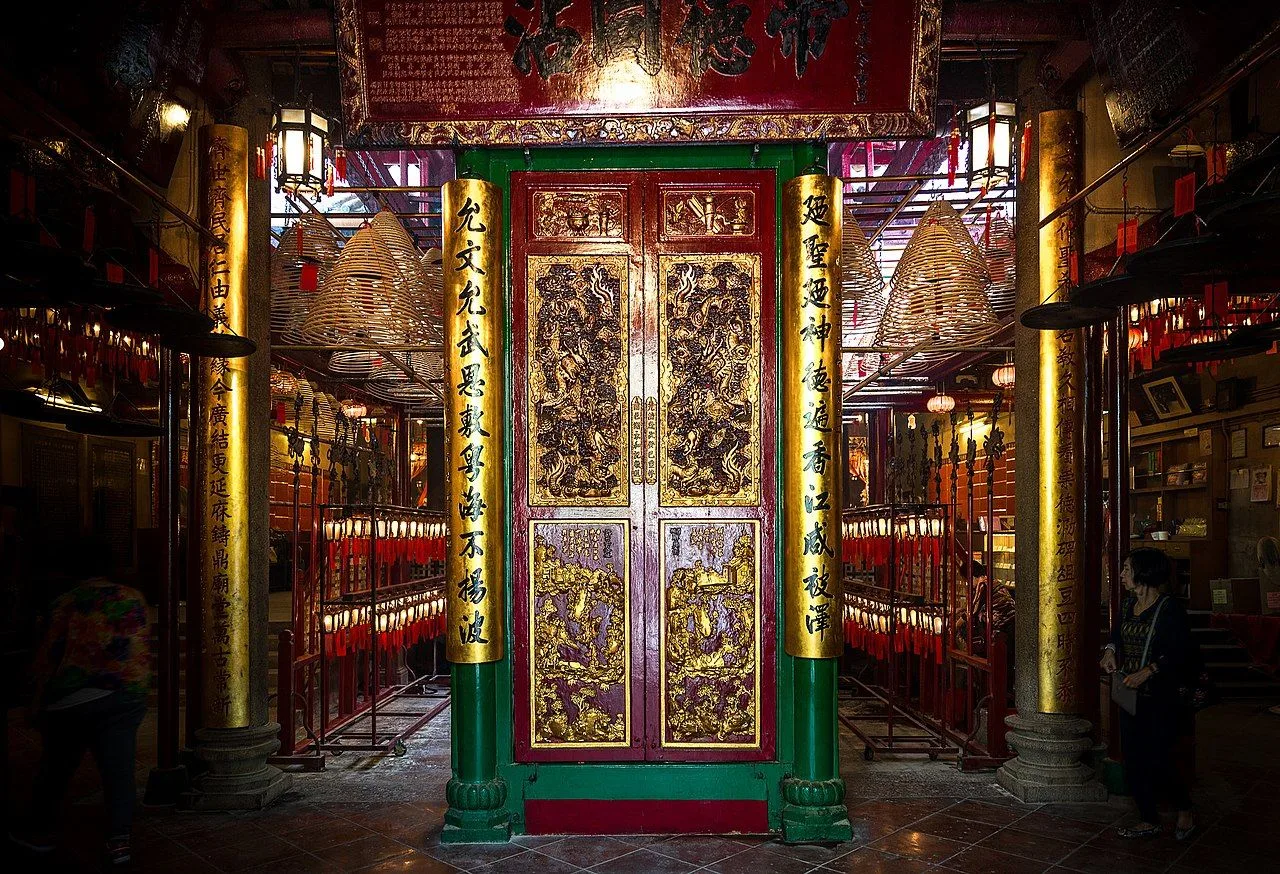
Photo: Wikimedia Commons / CC BY-SA. Source
.jpeg)
The temple’s joint dedication to Man (文) and Mo (武) reflects the dual nature of Chinese imperial society: Man (the god of literature) was venerated by scholars preparing for the imperial civil service examinations, and Mo (the god of war) was venerated by soldiers and military officials. The joint veneration at Man Mo Temple made the temple important to both the scholarly and military classes of colonial Hong Kong.
The temple survived the Japanese occupation (1941-1945) and the cultural upheavals of the 20th century, and was declared a Declared Monument of Hong Kong in 2010. The original 1847 structure is largely intact, with the brick facade, the wooden beam ceilings, and the central altars all original. The temple is still supported by donations and is maintained by the Chinese Temples Committee, a government body that oversees Hong Kong’s major Taoist and Buddhist temples.
What to see
The temple is a small, atmospheric space — about 30 meters long and 15 meters wide for the main hall, with two side courtyards. The main hall has two central altars: Man (文, god of literature) on the left, wearing a green robe and holding a writing brush, and Mo (武, god of war) on the right, wearing a red robe and holding a sword. The two altars are flanked by smaller altars to the City God (城隍) and the Earth God (土地).
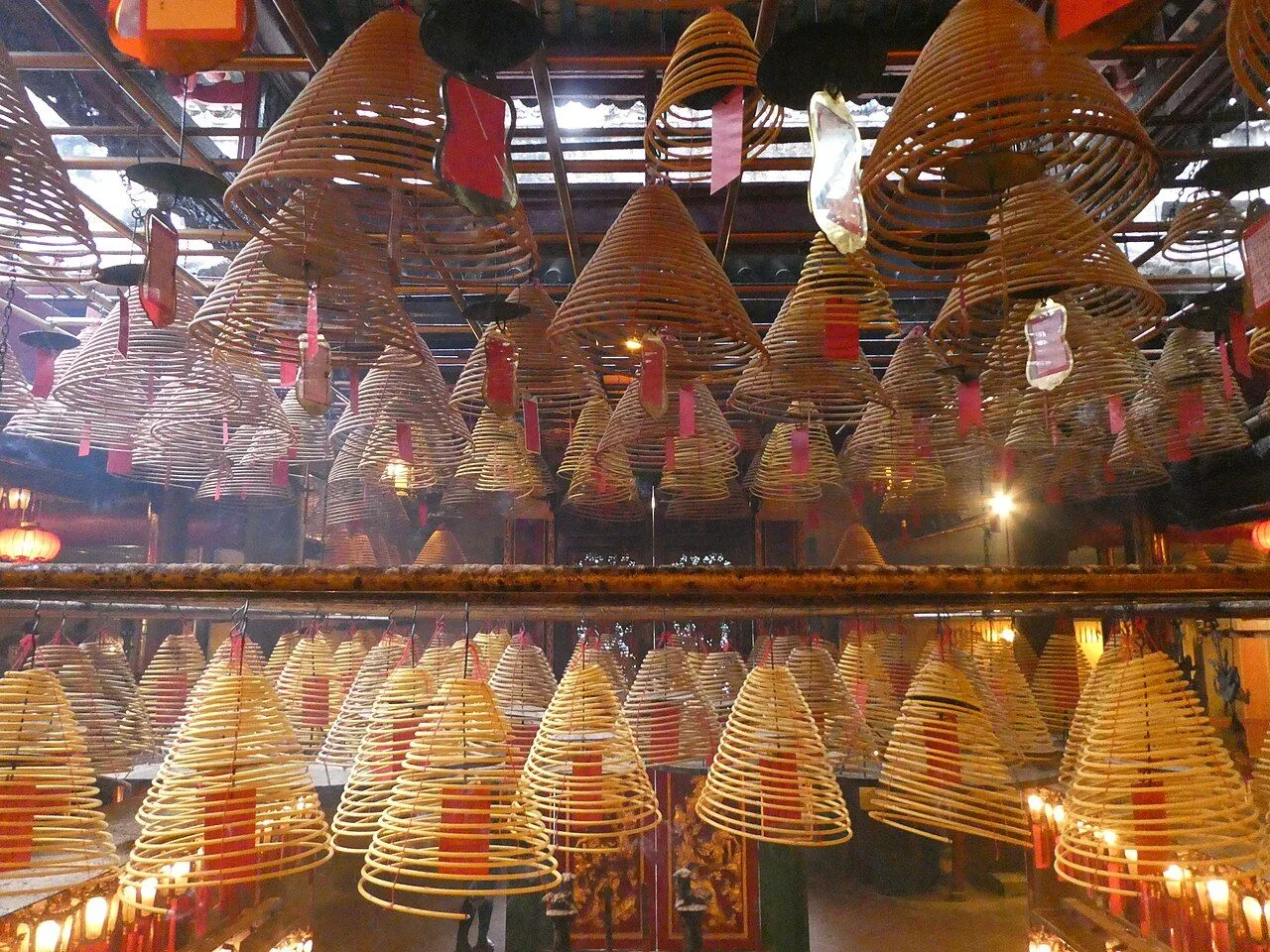
Photo: Wikimedia Commons / CC BY-SA. Source
.jpg)
The most-photographed feature is the hanging spiral incense coils (線香). Each coil is 1-2 meters in diameter and burns slowly from the outside in over 1-2 weeks. The coils are lit and replaced by the temple staff throughout the day, and the smoke is a key part of the Taoist worship experience — the smoke is believed to carry prayers to the gods and to purify the air. The smoke creates a soft, atmospheric light inside the temple and is the most-photographed scene in any Hong Kong attraction.
The side halls house additional altars and small wooden plaques with worshippers’ prayers. The walls are lined with wooden plaques and lanterns from the 19th century, and the wooden beam ceilings are darkened with incense soot from 170+ years of worship. The temple courtyard has a pair of banyan trees and stone offering tables. The entire complex is a working place of worship, with regular Taoist ceremonies and worshippers burning incense and offering prayers throughout the day.
When to visit
Weekday morning, 8:00-10:00, is the best time. The temple is least crowded, the incense coils are freshly lit, and the morning light through the courtyard doorway creates the most photogenic atmosphere. The weekend mornings are busier with worshippers and tour groups. Avoid the days around Lunar New Year and the Taoist Hungry Ghost Festival (the 7th lunar month, usually August-September) when the temple is packed with worshippers and the incense smoke is overwhelming for non-worshippers.
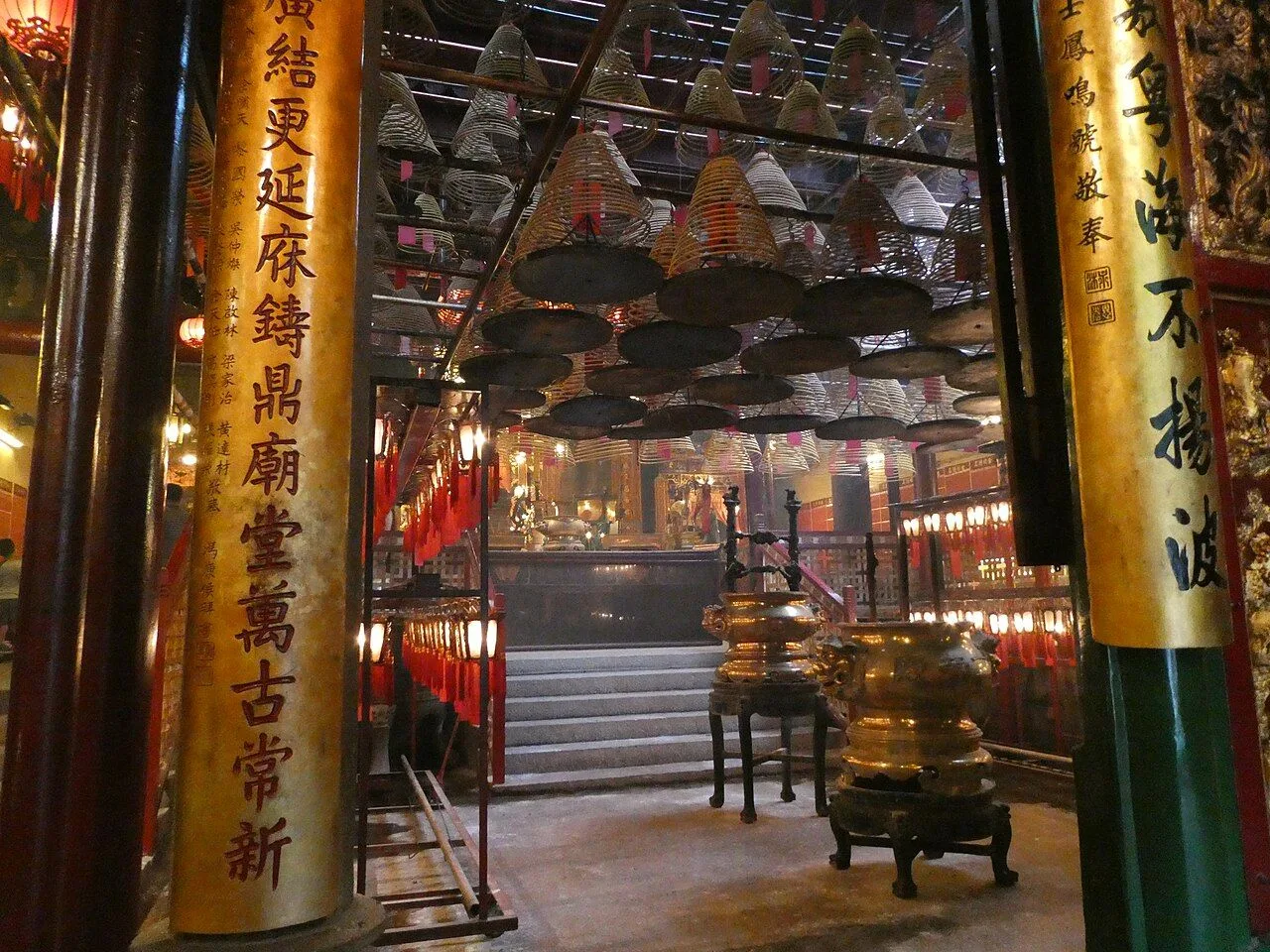
Photo: Wikimedia Commons / CC BY-SA. Source
.jpg)
The temple is open 8:00-18:00 daily and is generally quieter in the late afternoon (16:00-17:30) as the morning worshippers leave and the late afternoon light is at its warmest. The freshest incense is in the morning; by late afternoon the coils have been burning for hours and the smoke is more diffuse. The temple is closed only on the day of Lunar New Year, the day after, and the birthday of the God of Literature — these dates move each year per the Chinese calendar.
How to get there
Take the MTR Island Line to Sheung Wan Station Exit A2 and walk 8 minutes uphill on Hollywood Road. The walk is steep at the end — turn right at the Ladder Street junction and the temple is 50 meters on the right. Alternatively, take the Central-Mid-Levels escalator from Central to Hollywood Road and walk 2 minutes east. The escalator is the world’s longest outdoor covered escalator (800m, free) and runs downhill 10:20-00:00 — most visitors take a taxi or the MTR up in the morning and ride the escalator down.
Taxis from Central cost HK$40-60 and take 10-15 minutes. From Tsim Sha Tsui, the taxi is HK$100-140 via the Cross-Harbour Tunnel, 20-30 minutes. The driver will recognize 文武廟 or Man Mo Temple. The Hong Kong-Macau Ferry Terminal is 10 minutes walk south, useful if you are arriving from Macau.
How to pair the visit
The three best pairings within a 5-minute walk. The Central-Mid-Levels escalator (3 minutes east) is the world’s longest outdoor covered escalator, 800m, free, and runs from Central up to the Mid-Levels residential neighbourhood. The escalator is downhill 10:20-00:00 and uphill 06:00-10:20 — most visitors take a taxi or the MTR up in the morning and ride the escalator down. Tai Kwun (5 minutes walk downhill) is the former Central Police Station compound, restored as a heritage arts centre with galleries, shops, and restaurants in the restored 19th-century buildings. Hollywood Road itself is lined with antique shops, traditional Chinese medicine shops, and small galleries.
The half-day on the western side of Hong Kong Island — Man Mo Temple, the Central-Mid-Levels escalator, Tai Kwun, and the Hollywood Road antiques strip — is one of the most atmospheric walks in Hong Kong and is a strong alternative to the more commercial Tsim Sha Tsui waterfront. The walk is about 3 km, takes 3-4 hours including stops, and is flat once you reach the temple from the Central-Mid-Levels escalator. Most visitors combine the walk with lunch in Tai Kwun or at the IFC Mall (10 minutes downhill) and then continue to the Star Ferry pier for the harbour crossing to Tsim Sha Tsui.
Best photo spots
-
Main hall, central aisle facing the altars · Morning, 8:30-10:30, when the sun is low and the incense smoke is thickest
The classic Man Mo Temple shot: the hanging spiral incense coils with the altars of Man (god of literature) and Mo (god of war) visible through the smoke. The morning sun through the courtyard doorway creates the most photogenic light. No flash, no tripod; the temple is too dark for fast handheld shots at f/4 or higher.
-
Courtyard, looking back at the temple facade · Late morning, 10:30-12:00
The 1847 brick facade of Man Mo Temple, with the stone steps at the entrance and the banyan trees flanking the courtyard. The light is more even in late morning than early morning, and the courtyard is quieter as the morning worshippers leave.
-
Side hall altars · Any time
The smaller side halls house the City God (城隍) and Earth God (土地) altars, often overlooked by tourists. The side halls are quieter and more photogenic for portrait shots of the altars. The walls have small wooden plaques with worshippers' prayers, and the wooden beams are darkened with incense soot from 170+ years of worship.
-
Ladder Street, just south of the temple · Afternoon, 14:00-16:00
The 19th-century granite Ladder Street is one of the most-photographed streets in Hong Kong — a pedestrian-only staircase climbing up from Hollywood Road to Pottinger Street. The street was built in the 1840s to connect the harbour to the upper levels of the city. Best photographed from the bottom looking up, with the temple visible in the background.
Where to eat nearby
-
Tai Kwun restaurants (Orphans, The Chinese Library, Madame Fu)
Cantonese, modern Western, Chinese tea · HKD 200-500/person · 5 min walk downhill from the temple, inside the Tai Kwun heritage compound
-
Lung King Heen (Four Seasons Hotel, 3 Michelin stars)
Cantonese fine dining (3 Michelin stars, longest-running 3-star Cantonese restaurant in the world) · HKD 800-1,500/person · 10 min walk downhill, IFC Mall, Central
-
Yat Lok (一樂燒鵝)
Cantonese roast goose (Michelin-starred, since 1956) · HKD 100-200/person · 10 min walk downhill, Central, on Stanley Street
-
Sheung Wan dai pai dong on Wing Lok Street
Cantonese street food (wonton noodles, congee, dai pai dong classics) · HKD 50-100/person · 5 min walk downhill, the dai pai dong cluster on Wing Lok Street
Frequently asked questions
How much does Man Mo Temple cost to visit?
Free entry for all visitors, no ticket required. The temple is a working place of worship and is supported by donations — HK$10-100 is a typical donation. Fortune telling (求籤) at the front counter is HK$20-50, paid in cash; the fortune sticks are translated into English, French, and Japanese on printed slips. There is no charge for incense, lighting, or sitting in the temple courtyard. The adjacent Tai Kwun arts centre (5 min walk) is a separate visit with free entry to the courtyards and ticketed exhibitions in the galleries.
What are the hanging spirals inside Man Mo Temple?
The hanging spirals are large incense coils (線香) suspended from the ceiling above the central altars. Each coil can be 1-2 meters in diameter and burns slowly from the outside in over 1-2 weeks. The coils are lit and replaced by the temple staff throughout the day; the incense smoke is a key part of the Taoist worship experience, believed to carry prayers to the gods and to purify the air. The coils are not sold to visitors — they are the temple's own offerings. The smoke creates the most photogenic atmosphere in any Hong Kong attraction, and the warm afternoon light through the incense smoke is the most-photographed scene in the temple.
How do I get to Man Mo Temple from Central?
Three options from Central (Hong Kong Island MTR station). MTR (fastest): take the Island Line to Sheung Wan Station Exit A2, walk 8 min uphill on Hollywood Road — the walk is steep at the end. Total: 12-15 min, HK$8 Octopus. Central-Mid-Levels escalator (most scenic): walk 5 min from Central to the escalator entrance on Garden Road, take the escalator uphill (runs 10:20-00:00 downhill only; take a taxi or MTR uphill in the morning) to Hollywood Road, walk 2 min east. The escalator is 800m, free, and the world's longest outdoor covered escalator. Taxi: HK$40-60, 10-15 min. The driver will recognize 文武廟 or Man Mo Temple.
Is Man Mo Temple wheelchair accessible?
No. The temple entrance has 4 stone steps, the doorways are narrow (about 80cm wide), and the central hall has a raised threshold. Visitors with mobility issues can view the temple courtyard and the incense coils through the open doorway from the street — the courtyard is visible from the entrance steps and the incense smoke is visible from the door. Wheelchairs and strollers cannot enter the main hall. The adjacent Tai Kwun (former Central Police Station, now a heritage arts centre) is fully wheelchair-accessible and is a 5 min walk downhill — a good alternative for visitors with mobility issues.
What's the best time to visit Man Mo Temple?
Weekday morning, 8:00-10:00, is the best time. The temple is least crowded, the incense coils are freshly lit, and the morning light through the courtyard creates the most photogenic atmosphere. The weekend mornings are busier with worshippers and tour groups. Avoid the days around Lunar New Year and the Taoist Hungry Ghost Festival (the 7th lunar month, usually August-September) when the temple is packed with worshippers and the incense smoke is overwhelming for non-worshippers. The temple is open 8:00-18:00 daily and is generally quieter in the late afternoon (16:00-17:30) as the morning worshippers leave and the late afternoon light is at its warmest.
What's near Man Mo Temple that I can pair with the visit?
Three excellent pairings within a 5-minute walk. The Central-Mid-Levels escalator (3 min walk east) is the world's longest outdoor covered escalator, 800m, free, and runs from Central up to the Mid-Levels residential neighbourhood. The escalator is downhill 10:20-00:00 and uphill 06:00-10:20 — most visitors take a taxi or the MTR up in the morning and ride the escalator down. Tai Kwun (5 min walk downhill) is the former Central Police Station compound, restored as a heritage arts centre with galleries, shops, and restaurants in the restored 19th-century buildings. Hollywood Road itself is lined with antique shops, traditional Chinese medicine shops, and small galleries. The half-day on the western side of Hong Kong Island — Man Mo Temple, Central-Mid-Levels escalator, Tai Kwun, and the Hollywood Road antiques strip — is one of the most atmospheric walks in Hong Kong.