Oriental Pearl Tower
东方明珠广播电视塔 · Dōngfāng Míngzhū Guǎngbō Diànshì Tǎ
Quick answer
Tickets are real-name (实名制): you buy against a passport number and scan the same document at the gate. Foreign passports are accepted and pay the same ¥199 as Chinese visitors — the booking system simply has a separate ticket type for non-mainland documents, so pick the non-mainland option rather than the default 身份证 one or the gate scanner will reject you. At security, foreign passports normally go through the staffed lane next to the e-gates; bring the physical passport, not a photo. There is a full bag X-ray, liquids may be tasted, and large suitcases must be checked at the luggage counter before you go up.
Why visit
- 1 Stand on the 259m fully transparent glass walkway — glass floor, 259 metres of air beneath it, and the Huangpu's barges sliding past underneath your feet. This is the single reason the tower still beats the taller observation decks in the city
- 2 Get the 263m main deck at 16:30-17:00 and you see the city three times in one ticket: daylight, the sunset over the Bund, and the 19:00 switch-on of the Pudong skyline
- 3 The 0m Shanghai History Museum is included in the ¥199 ticket and is the most-skipped part of the building — a reconstructed late-Qing and Republican-era street with trams and shopfronts, and the best 30 minutes in the tower on a wet day
- 4 Understand the ticket before you buy it: ¥100 more gets you exactly one extra room, the 351m space module, and nothing else
Essential tips for foreigners
- Pick the non-mainland ticket type at checkout. Tickets are real-name and tied to a passport number. If you buy the default ticket type in the booking system, the gate scanner will not read your passport. The non-mainland SKU costs the same ¥199 — it is a document-type flag, not a surcharge.
- Enter at 16:30, not at noon. One ticket, three cities: the deck in daylight, the Bund at sunset from the west side, and the skyline lighting up around 19:00. Arriving at midday means paying the same ¥199 for the least interesting two hours of the day.
- Skip the ¥299 three-sphere ticket on a first visit. The extra ¥100 buys only the 351m space module: a small cabin with curved glass that distorts photographs, reached by a second timed queue that can run 40 minutes on holidays. Put the ¥100 toward the rotating restaurant instead.
- Check the air before you buy. The tower sells a view, and Shanghai's summer haze can reduce it to a white wall. The ticket is not weather-refundable. October to December and March to May are the reliable months; a clear winter morning is the sharpest of the year.
- Do the climb top-down and do not skip the bottom. Lift to 263m first, walk down one level to the 259m glass walkway, then take the lift down to 78m for the ring-screen show, and finish at 0m in the history museum on your way out. Most visitors leave after the glass walkway and never see the museum they already paid for.
- Luggage goes in a locker, not up the tower. Security X-rays every bag, may ask you to taste liquids, and turns away large suitcases at the gate. There is a left-luggage counter at the base — use it before joining the queue, not after.
Suggested route
- 16:20 20 min Arrive at the base via Metro Line 2 to Lujiazui, Exit 2. Drop any large bag at the left-luggage counter, clear security (passport in hand, staffed lane), and scan in at the gate
- 16:40 30 min Take the high-speed lift straight to the 263m main sightseeing deck. Walk the full circuit once in daylight — west for the Bund and the Huangpu bend, north for the Suzhou Creek confluence. This is your daylight pass
- 17:10 25 min Walk down one level to the 259m fully transparent glass walkway. Stand on the glass once, then use the solid perimeter strip for the photographs. The light is turning gold by now and the river traffic is backlit
- 17:40 40 min Hold the west side of the 263m deck through sunset. In late spring and summer the sun drops behind the Bund's roofline; in winter it is already low when you arrive, so compress the earlier steps
- 18:20 15 min Lift down to 78m for the ring-screen multimedia show, then continue to 0m. Queue for the lift early — this is the one bottleneck of the whole visit
- 18:40 35 min Walk the 0m Shanghai City History Development Museum. Reconstructed Qing and Republican street, trams, shophouses. Included in your ticket and almost empty at this hour because everyone else has left
- 19:20 20 min Exit to the plaza and step back for the tower itself. The facade light show runs on the hour after dark — the skyline and the tower are both lit by now, and the plaza is free
- 19:45 2 hours Walk the Lujiazui riverside promenade toward the Bund-facing bank, or take the ¥2 ferry from Dongchang Road to Jinling East Road for the cheapest night view in Shanghai. Dinner on the Bund side, or back at Super Brand Mall if you are staying in Pudong
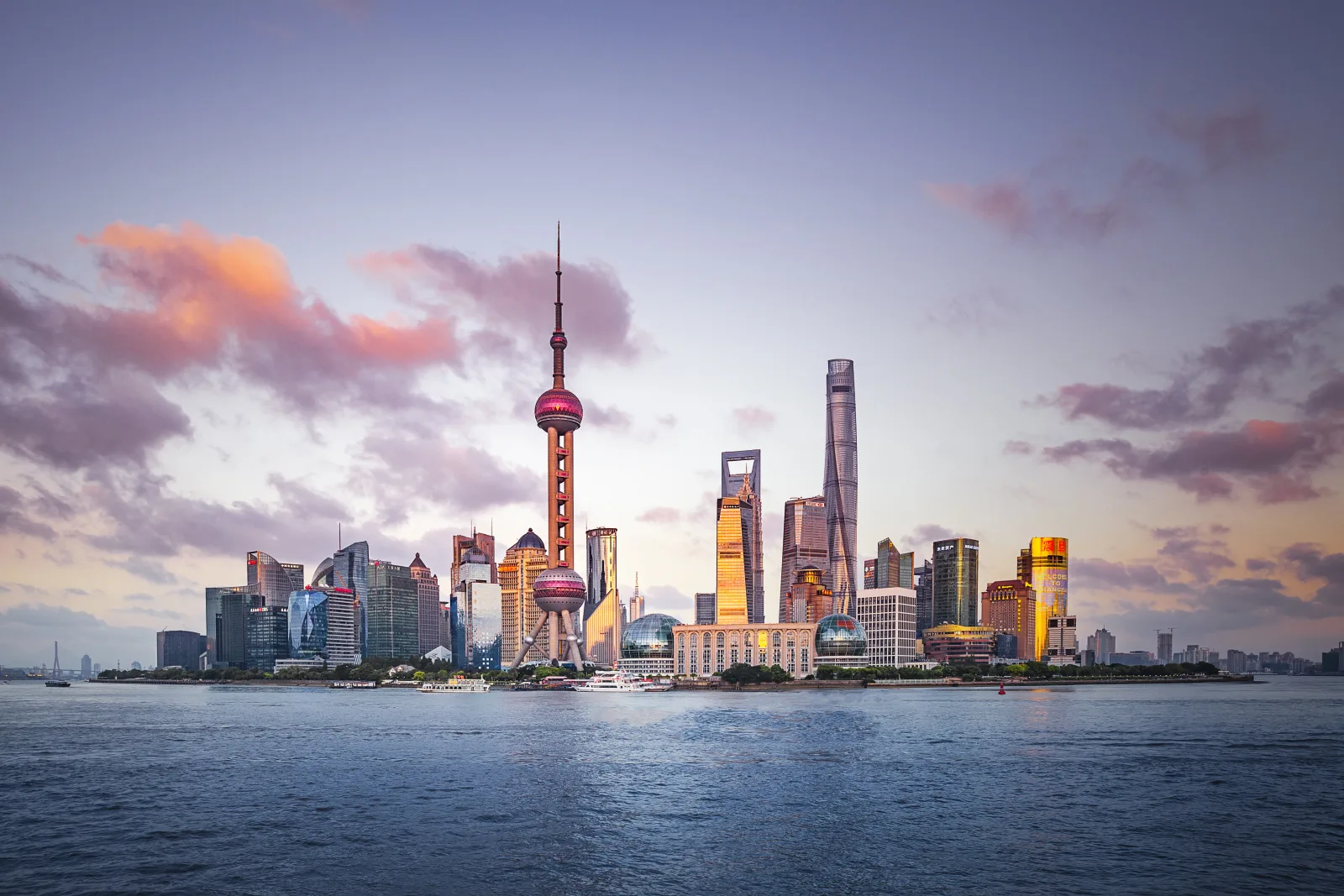
The Oriental Pearl Tower (东方明珠广播电视塔) is the 468m broadcast tower on the tip of Lujiazui, opened on 18 November 1994 and still the building most people picture when they picture Shanghai. Eleven spheres are threaded along three columns — the design is usually explained in Chinese as 大珠小珠落玉盘, “large pearls and small pearls falling into a jade plate” — with the two largest forming the observation levels that visitors pay for.
It is not the tallest thing in the city any more. Shanghai Tower next door clears it by 164m, and the Shanghai World Financial Center’s 100th-floor walkway is higher than anything the Pearl sells. That is exactly why the ticket decision here is different from the other two: you are not buying altitude, you are buying the glass floor at 259m and a building that looks like nothing else on earth.
The tower is a national 5A scenic area, and the plaza and the 0m lobby are open to the public without a ticket — during peak flow the plaza itself switches to ticket-only entry, so do not plan a free visit around a public holiday.
Which is better, Oriental Pearl Tower or Shanghai Tower?
For a first visit, the Oriental Pearl Tower — and the reason is the ticket, not the altitude. The Pearl is 468m tall and sells three paid levels: the 263m main sightseeing deck, the 259m fully transparent glass walkway and the 351m space module, and the last of those is three-sphere-only. Shanghai Tower clears the tower by 164m and the Shanghai World Financial Center’s 100th-floor walkway sits higher than anything the Pearl sells, so if your priority is the highest possible number on a ticket, the Pearl is the wrong building.
What the ¥199 two-sphere ticket actually contains is the argument for it: the 263m deck, the 259m glass walkway, the 78m “Shanghai Geng Shang Hai” ring-screen show and the 0m Shanghai History Museum. Altitude is the smallest part of that list. You also get a building that looks like nothing else on earth — eleven spheres threaded along three columns — and the glass floor is the one experience Shanghai’s newer supertalls do not sell at all.
Is the Oriental Pearl Tower worth visiting?
Yes, if you give it two to two and a half hours and time it for late afternoon. The standard ticket is ¥199 and covers four separate experiences, from the 263m deck down to the 0m museum, so it is not one attraction with a view attached — it is the closest thing Shanghai has to a vertical museum. The recommended duration for the two-sphere ticket done properly is 2-2.5 hours; add the 351m space module and it is 3-3.5 hours.
The one thing that can make it not worth it is the weather, and the tower will not refund you. Shanghai’s summer haze turns the 263m deck into white nothing, which is why October to December and March to May are the reliable months and a clear winter morning is the sharpest view of the year. The free alternative is real too: the plaza at the base and the 0m lobby are open without a ticket, so the tower itself can be photographed from underneath at no cost, and the nightly facade light show is free to watch from anywhere outside.
Why is the Oriental Pearl Tower famous?
Three reasons, and only one of them is height. It is a 468m broadcast tower on the tip of Lujiazui that has been in the Shanghai skyline since it opened on 18 November 1994, and it carries a national 5A scenic area rating that puts its plaza and lobby in the same category as a national park. Its design language is why it is instantly recognisable: eleven spheres threaded along three columns, which Chinese description renders as 大珠小珠落玉盘.
The third reason is the one that has actually kept the tower famous as the city grew around it. Shanghai Tower and the Shanghai World Financial Center both overtake it, and both sell you altitude; the Pearl sells a 259m fully transparent glass floor with the Huangpu’s barge traffic directly underneath, plus a facade light show that runs on the hour after dark and photographs better than the tower itself. The skyline changed, the tower’s silhouette did not, and that is why it is still the first image of Shanghai for most people.
How much is it to go up the Oriental Pearl Tower?
The climb itself is ¥199 for an adult on the two-sphere ticket, and that is the only compulsory spend. The three-sphere ticket is ¥299, so the 351m space module costs an extra ¥100 and buys you exactly one more room — a small cabin with curved glass that distorts photographs, reached by a second timed-slot queue that can run 40 minutes on public holidays. Children 1.0-1.3m pay ¥99 and children 14 and under pay ¥60, and under 1.0m is free.
Everything above ¥199 is optional, and the options are worth ranking. The cheapest useful upgrade is the 351m space module at ¥299; above that sit the 267m revolving restaurant buffet at about ¥378 bundled with the two-sphere ticket and the 18m Coca-Cola buffet at about ¥298. The VR coaster and the Huangpu River cruises that leave from the tower’s own pier are excluded from every one of those tickets.
And the floor of the price list is zero: the plaza and the 0m lobby are free to enter outside peak flow, the nightly facade light show is free to watch from anywhere outside, and the ¥2 ferry from the Bund puts you under the tower with the whole Pudong skyline in front of you the entire way.
Does the Oriental Pearl Tower have a restaurant at the top?
Yes — the revolving restaurant (空中旋转餐厅) sits at 267m in the upper half of the second sphere, seats about 360 across 1,500 sq m, and completes one full revolution every two hours. It is the highest eating room in the building, above the 263m main deck, so the view comes with the meal. It is not in the ¥199 ticket: it is a separate buffet ticket, or bundled with the two-sphere ticket at about ¥378.
There is a second, cheaper buffet at 18m (the Coca-Cola restaurant, about ¥298 bundled), and a sit-down Shanghainese restaurant, 老上海8号餐厅, at the tower base at ¥150-300 per person. Three restaurants are inside the tower complex in total. If you only want the tower without the meal, the same 267m view is available on the observation decks — the difference is that you pay ¥199 for the deck and ¥378 for the deck plus a revolving buffet.
Two ticket tiers, and the ¥100 question
Almost every visitor’s real decision is whether to pay ¥299 instead of ¥199. The answer is in what the difference buys.
| Ticket | Price | What it actually includes |
|---|---|---|
| Two-sphere adult (mainland ID) | ¥199 | 263m main deck, 259m glass walkway, 78m ring-screen show, 0m history museum |
| Two-sphere adult (non-mainland ID) | ¥199 | Identical — the difference is a document type, not a price |
| Two-sphere child, 1.0-1.3m | ¥99 | Same access, child rate |
| Two-sphere child, 14 and under | ¥60 | Same access, youth rate |
| Three-sphere adult | ¥299 | Everything above, plus the 351m space module |
| Three-sphere child, 1.0-1.3m | ¥149 | Same, child rate |
| Two-sphere + 267m revolving restaurant buffet | ~¥378 | Two-sphere access plus the buffet |
| Two-sphere + 18m Coca-Cola buffet | ~¥298 | Two-sphere access plus the cheaper buffet |
| Under 1.0m | Free | No ticket needed |
Read that table again and the ¥100 is doing very little work. The three-sphere ticket adds the 351m space module and nothing else — no extra deck, no extra show, no restaurant. The space module is a small cabin at the top of the shaft, its windows are curved and distort photographs, and it is reached by a second timed-slot queue that on public holidays can run 40 minutes. Meanwhile the two things the tower is actually famous for, the 263m deck and the 259m glass walkway, are both in the ¥199 ticket.
First visit: buy the two-sphere. If you have already been, or you specifically want the highest reachable point, the space module is a legitimate reason to pay the extra hundred.
What is on each floor
| Level | What it is | Included in |
|---|---|---|
| 0m | Shanghai City History Development Museum (上海城市历史发展陈列馆) and the free-to-enter lobby | Two-sphere and above |
| 18m | Coca-Cola Restaurant (可口可乐欢乐餐厅), casual buffet | Paid separately, or bundled |
| 78m | ”Shanghai Geng Shang Hai” ring-screen multimedia show | Two-sphere and above |
| 259m | Fully transparent suspended glass walkway (全透明悬空观光廊) | Two-sphere and above |
| 263m | Main sightseeing deck (主观光层) | Two-sphere and above |
| 267m | Revolving restaurant (空中旋转餐厅) | Buffet ticket |
| 351m | Space module (太空舱) | Three-sphere ticket only |
The sequence matters more than the list. Lift to 263m first, walk down one level to 259m, then descend to 78m and finish at 0m on your way out. Visitors who do it in the other order queue twice for the same lifts.
Getting in with a foreign passport
This is where most foreign visitors lose ten minutes at the gate, so it is worth stating plainly. Tickets are real-name (实名制): you buy against a passport number, and you scan that same document at the entrance. The booking system carries a separate ticket type for non-mainland documents at the identical price — choose that one. If you buy the default option the scanner at the gate will not read a foreign passport, and the fix happens at a staffed window while your timed slot drains away.
At security, foreign passports normally go through the staffed lane beside the e-gates rather than the automatic ones. Everyone’s bag goes through X-ray, liquids may be tasted, and large suitcases are refused at the gate — there is a left-luggage counter at the base, and you should use it before joining the queue rather than after. Bring the physical passport; a photograph of it is not enough.
Buying online a day ahead through the official 「东方明珠」 WeChat account or mini program is the reliable pattern in peak season, because same-day online sales can close before the evening and the walk-up window is the longest queue in the building.
The hour that decides whether the ticket was worth it
A ¥199 ticket buys the same deck at 12:00 and at 17:00, and they are not the same product. Enter at 16:30-17:00 and one ticket covers three versions of the city: the deck in daylight, the sun dropping behind the Bund’s roofline from the west side, and the Pudong skyline switching on at about 19:00. Enter at midday and you have paid the same money for flat light and the longest elevator queue of the day.
The other variable is air, and the tower cannot sell you that. Summer in Shanghai is hazy, and on a bad day the 263m deck looks into white nothing — the ticket is not weather-refundable. October to December and March to May are the reliable months; a clear winter morning is the sharpest visibility of the year, though it costs you the sunset. Weekday afternoons are markedly quieter than weekends, when security alone can take an hour.
The museum at 0m that most people skip
The Shanghai City History Development Museum sits at the bottom of the building, is included in the ¥199 ticket, and is the part of the visit that most people never reach — they ride down from the glass walkway and walk straight out. It reconstructs late-Qing and Republican-era Shanghai street by street: trams, shophouses, old brand signage, wax figures in period dress.
Give it 30-40 minutes on the way out. On a wet day, when the deck view has gone, it is the reason the tower is still worth the ticket.
Getting there, and the ¥2 alternative
Metro Line 2 or Line 14 to Lujiazui (陆家嘴) is the easy answer — from Line 2, Exit 2 opens onto the pedestrian bridge with the tower straight ahead, about five minutes on foot. It is one of the few major sights in Shanghai that needs no taxi and no navigation.
The better answer, if you are starting from the Bund side, is the ferry. Jinling East Road pier (金陵东路渡口) crosses to Dongchang Road (东昌路渡口) for ¥2, and you walk ten minutes to the tower with the entire Pudong skyline in front of you for the whole crossing. It takes longer than the metro and is the only way to arrive here that is worth remembering.
Do not drive. Lujiazui’s blocks around the tower are the worst congestion in the city at weekends, and the tower’s own car park is small and expensive. Super Brand Mall or the Shanghai IFC mall, then walk.
How to pair it
The tower is a natural half-day anchor for a Pudong-then-Puxi day: tower from 16:30, then the riverside promenade, then the ¥2 ferry across to the Bund for dinner and the lit-up skyline. Our 5-day Shanghai itinerary puts it on day two for exactly that reason, and the Shanghai guide for foreigners covers the transport card and payment setup you will want before you arrive. If this is your first metro trip in China, read the metro guide first — Lujiazui is an easy station, but the exit numbering is not obvious.
Worth knowing before you go: the tower sells a bundled ticket with the Huangpu cruises that depart from its own pier, and those cruises are a different experience from the ferry — 50 minutes of commentary and skyline rather than two minutes of crossing. Neither is included in the ¥199 tower ticket.
Also nearby
- The Bund (外滩) — the far bank, and the view you have just been photographing from above. ¥2 by ferry, 10 minutes.
- Yu Garden (豫园) — Ming-dynasty garden and the bazaar around it, 20 minutes by metro on Line 14.
- Nanjing Road Pedestrian Street (南京东路) — the shopping spine between the Bund and People’s Square.
Best photo spots
-
The 259m fully transparent glass walkway, looking straight down · 17:00-18:00, when the barges below are backlit and the glass picks up the sky
The shot everyone comes for, and it works because the Huangpu below is busy rather than empty. Put the camera flat against the glass to kill reflections, or wear light colours — dark clothing mirrors badly in the glass floor. Wide angle, and be ready to wait: the best segment of the walkway is a bottleneck.
-
The west side of the 263m main deck, facing the Bund · Sunset, roughly 17:00-18:30 depending on season
The Huangpu bends directly below you with the Bund's 1920s roofline on the far bank — the one view that explains Shanghai's geography in a single frame. Shoot at 35-50mm; a wider lens makes the river look like a canal.
-
Street level in Lujiazui, looking up from the base plaza · Blue hour, 18:30-19:30, when the spheres light up against a still-blue sky
Free, and often the better photograph. The tower's 468m is impossible to convey from the deck itself; from underneath, with the surrounding Pudong towers as scale, it finally reads. The plaza is free to enter outside peak flow.
-
The north bank of the Huangpu, opposite Lujiazui · After dark, once the facade light show starts on the hour
The skyline shot with the tower in it rather than the shot from the tower. A 10-minute taxi or the ¥2 ferry plus a walk. Tripod territory; the promenade is open and lit.
Where to eat nearby
-
空中旋转餐厅 (Revolving Restaurant) — 267m
Buffet: Chinese, Japanese, Southeast Asian and Western · About ¥378 bundled with the two-sphere ticket · Inside the tower, 267m, upper half of the second sphere
-
可口可乐欢乐餐厅 (Coca-Cola Restaurant) — 18m
Casual buffet, family-oriented · About ¥298 bundled with the two-sphere ticket · Inside the tower, 18m
-
老上海8号餐厅 (Old Shanghai No. 8) — tower base
Shanghainese, sit-down · ¥150-300 per person · Inside the tower complex, ground level
-
Super Brand Mall (正大广场) food floors
Full mall range — Shanghainese, hotpot, dim sum, international chains · ¥60-200 per person · 8-minute walk from the tower
Frequently asked questions
How much does it cost to visit the Oriental Pearl Tower?
¥199 per adult for the two-sphere ticket (二球观光), which is the one to buy. It covers the 263m main sightseeing deck, the 259m fully transparent glass walkway, the 78m ring-screen multimedia show and the 0m Shanghai History Museum. The three-sphere ticket (三球联票) is ¥299 and adds only the 351m space module. Children between 1.0m and 1.3m pay ¥99 (two-sphere) or ¥149 (three-sphere); children 14 and under pay ¥60; under 1.0m is free. Foreign passports pay the same ¥199 as Chinese visitors.
What are the opening hours of the Oriental Pearl Tower?
09:00-21:00 daily, all year, with last entry at 21:00. The observation decks themselves close earlier than the tower base — the last call for the 263m and 259m levels is around 20:30 — so the final hour of the published schedule is not usable for the climb. There is no weekly closing day, but outdoor areas and the glass walkway are suspended during typhoons and heavy fog.
Is the glass walkway included in the ticket?
Yes. The 259m fully transparent glass walkway is part of the ¥199 two-sphere ticket, not an add-on. It sits one level below the 263m main deck, so you walk down to it rather than queuing separately. The floor is genuinely transparent — the Huangpu and its barge traffic are directly beneath you — and there is a solid perimeter strip if you would rather not stand on the glass.
Two-sphere or three-sphere ticket — which should I buy?
The two-sphere ticket, unless you have already been. The ¥100 difference buys the 351m space module and nothing else: a small cabin, curved glass that distorts photos, and a second timed-slot queue that can take 40 minutes at peak. The 263m deck and the 259m glass walkway — the two things worth the trip — are in the cheaper ticket. Repeat visitors and anyone who wants the highest possible point can take the three-sphere.
Can foreigners visit the Oriental Pearl Tower with a passport?
Yes, and the price is identical to the Chinese rate. What matters is the ticket type: the system has a separate non-mainland document option, so choose that rather than the default ID-card option, and carry the physical passport you booked against. At security, foreign passports usually go through the staffed lane beside the e-gates. Book online a day ahead in peak season — same-day online sales can close before the evening.
What is the best time of day to go up the Oriental Pearl Tower?
Enter at 16:30-17:00. In one ticket you get the deck in daylight, the sunset over the Bund from the west side, and the Pudong skyline switching on at about 19:00. Midday is the worst value: the same ¥199, flat light, and the longest elevator queues. Weekday afternoons are markedly quieter than weekends, when security alone can take an hour.
How do I get to the Oriental Pearl Tower by metro?
Take Metro Line 2 or Line 14 to Lujiazui station (陆家嘴). From Line 2, Exit 2 leads onto the pedestrian bridge with the tower straight ahead, about five minutes on foot. The alternative that most visitors miss is the ferry: from the Bund, the Jinling East Road pier (金陵东路渡口) crosses to Dongchang Road (东昌路渡口) for ¥2, and you walk ten minutes to the tower with the whole Pudong skyline in front of you the entire way.
Is the Shanghai History Museum inside the tower worth it?
It is the best-value part of the building and most visitors never reach it. The 0m Shanghai City History Development Museum (上海城市历史发展陈列馆) is included in the ¥199 two-sphere ticket and reconstructs late-Qing and Republican Shanghai street by street — trams, shophouses, old brand signage, wax figures. Allow 30-40 minutes on your way out, and treat it as the reason the tower is worth visiting on a rainy day when the deck view is gone.
Does the Oriental Pearl Tower have a restaurant at the top?
Yes — the rotating restaurant (空中旋转餐厅) sits at 267m in the upper half of the second sphere, seats about 360 across 1,500 sq m, and completes one full revolution every two hours. It is a separate buffet ticket, or bundled with the two-sphere ticket at about ¥378. There is a second, cheaper buffet at 18m (the Coca-Cola restaurant, about ¥298 bundled). Neither is included in the plain ¥199 ticket.
Sources
- Oriental Pearl Tower — Official Site (明珠简介 / 设计理念 / ticket listings) · orientalpearltower.com
- Ctrip — Oriental Pearl Tower sight listing (ticket SKUs incl. non-mainland ID type) · m.ctrip.com
- Tongcheng Travel — Oriental Pearl Tower listing (live opening status and last-entry time) · m.ly.com
- Wikipedia — Oriental Pearl Tower · Wikipedia