
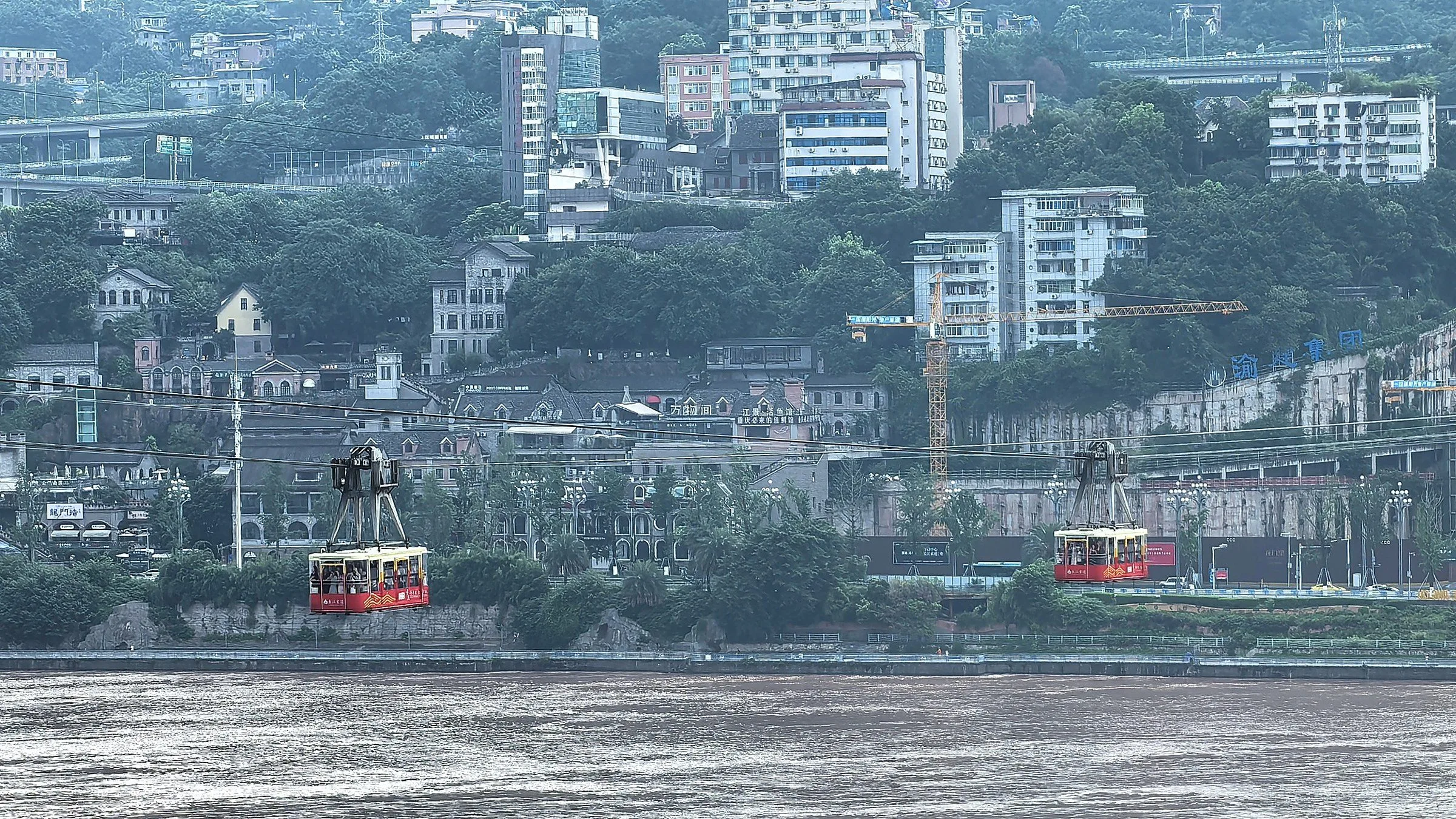
Yangtze River Cable Car (长江索道)
长江索道 · Chángjiāng Suǒdào
Quick answer
No entry restrictions. Foreigners buy tickets the same way as locals — show your passport at the counter if asked (rare). The ride is a public transit experience, not a guided tour.
Why visit
- 1 The only way to cross the Yangtze by air — a 1,166 m cable car ride that has been running since 1987, predating most of Chongqing's modern skyscrapers
- 2 Best aerial view of Chongqing's vertical city — from the cabin you can see the Yangtze and Jialing rivers, Hongya Cave, and the bridge-stacked skyline all at once
- 3 Round-trip is only ¥30 per person — cheaper than a Didi, faster than the metro, and far more memorable
- 4 5-minute ride each way — short enough to fit between lunch and a Hongya Cave evening visit
- 5 Operating since 1987 (originally for commuters) — a piece of living Chongqing history, not a tourist trap
- 6 Two terminals in two different districts — combine with a walk through Nan'an's old streets (south) or Jiefangbei shopping (north)
Essential tips for foreigners
- Go at 09:00 opening or after 19:00 — queues from 10:00-18:00 regularly exceed 1 hour, especially on weekends. First and last 2 hours of operation are the most peaceful.
- Take the north → south → north route (one-way) for the best value: ¥20 one-way to the south, then walk the old Nan'an streets and take a Didi or metro back. Round-trip ¥30 wastes time queuing again.
- Sit on the right side going north → south — the view of Hongya Cave and the Jialing River is on the right. Going south → north, sit on the left for the same view.
- Bring cash or set up Alipay/WeChat Pay before you arrive — the ticket counter does not reliably accept foreign credit cards. ¥20-30 in cash is a safe backup.
- Avoid Chinese national holidays (May 1-3, Oct 1-7, Chinese New Year week) — queues can hit 3 hours, and the cabins get so packed you cannot see out. The cable car still runs but the experience suffers.
- Combine with Hongya Cave at dusk — the north terminal is 5 min walk to Hongya Cave. Take the cable car at 18:00, ride to the south, then return by metro and walk to Hongya Cave for the 19:00 light show.
Suggested route
- 16:30 15 min Arrive at Jiefangbei (解放碑) metro station, walk 10 min north to the Yangtze Cable Car north terminal
- 16:45 20 min Buy a one-way ticket (¥20) and queue for the cable car
- 17:05 5 min Board the cable car — sit on the RIGHT side for the Hongya Cave and Jialing River view
- 17:10 1 hour Arrive at the south terminal (Nan'an district), walk 15 min to the old Nan'an streets for sunset views
- 18:15 15 min Take the metro (Line 6) from Shangxinjie back to Xiaoshizi, 10 min
- 18:30 — Walk 5 min to Hongya Cave, arrive by 19:00 for the light show
The 5-minute cable car ride that crosses the Yangtze 40 meters above the water
The Yangtze River Cable Car (长江索道 Chángjiāng Suǒdào) is a 1,166-meter aerial tramway that has crossed the Yangtze River in central Chongqing since 1987. The 5-minute ride lifts you 40 meters above the river, with the north terminal in the dense Yuzhong district and the south terminal in the older Nan’an district. From the cabin windows, you can see the Yangtze and Jialing rivers converging below, the 11-story stilted houses of Hongya Cave to the north, and the stacked bridges and skyscrapers of Chongqing’s vertical city in every direction.
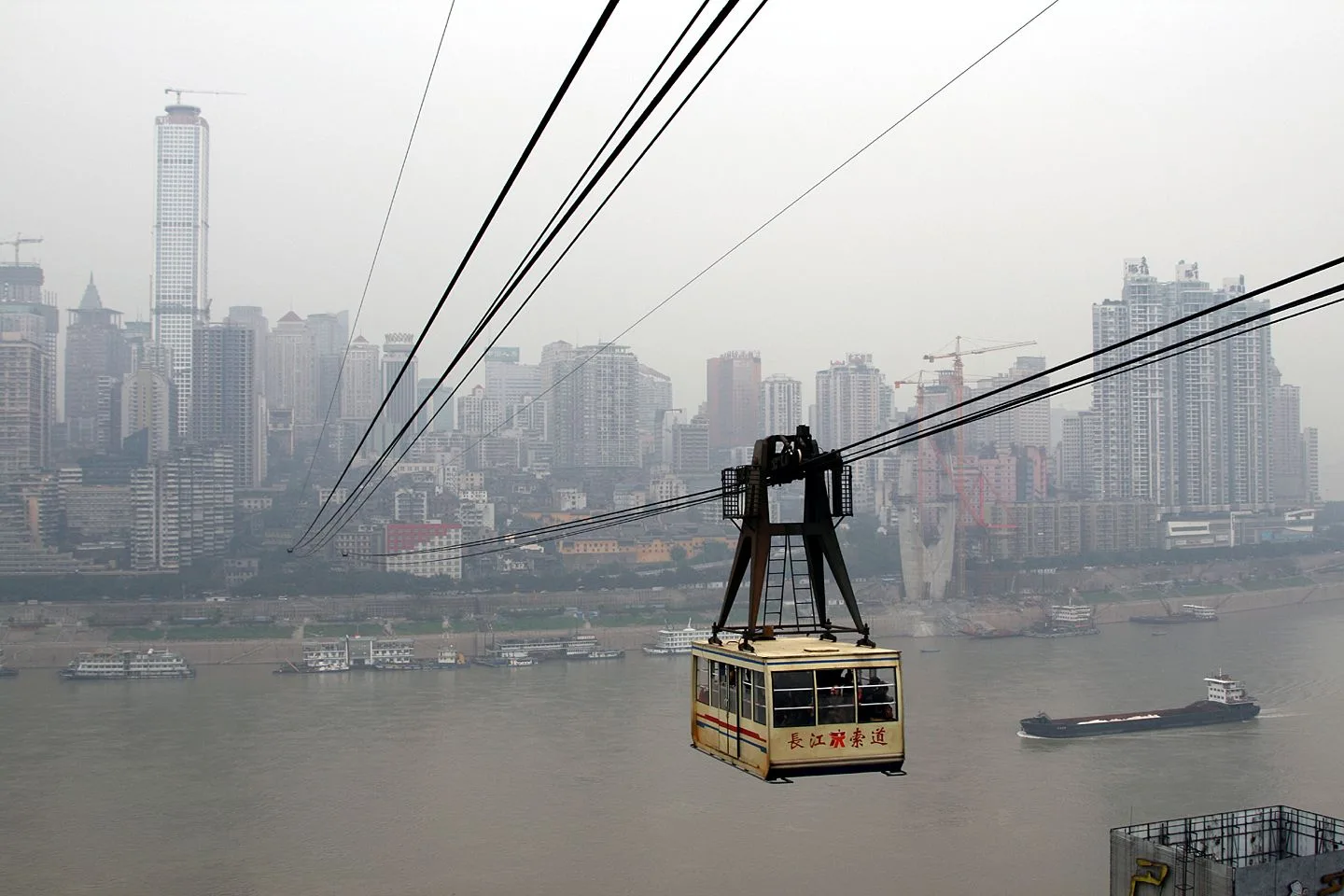
Photo: Wikimedia Commons / CC BY-SA. Source

It is the single best value experience in Chongqing: ¥20 one-way or ¥30 round-trip. The ride is short, the queues can be long, but the view is the kind you cannot get from any bridge, boat, or building in the city.
What the foreigner experience looks like in 2026
The Yangtze Cable Car is one of the most foreigner-friendly experiences in Chongqing. Tickets are sold at the same counter to locals and foreigners; no passport check, no guided tour, no special booking. You walk up, buy a ticket, queue, and board.
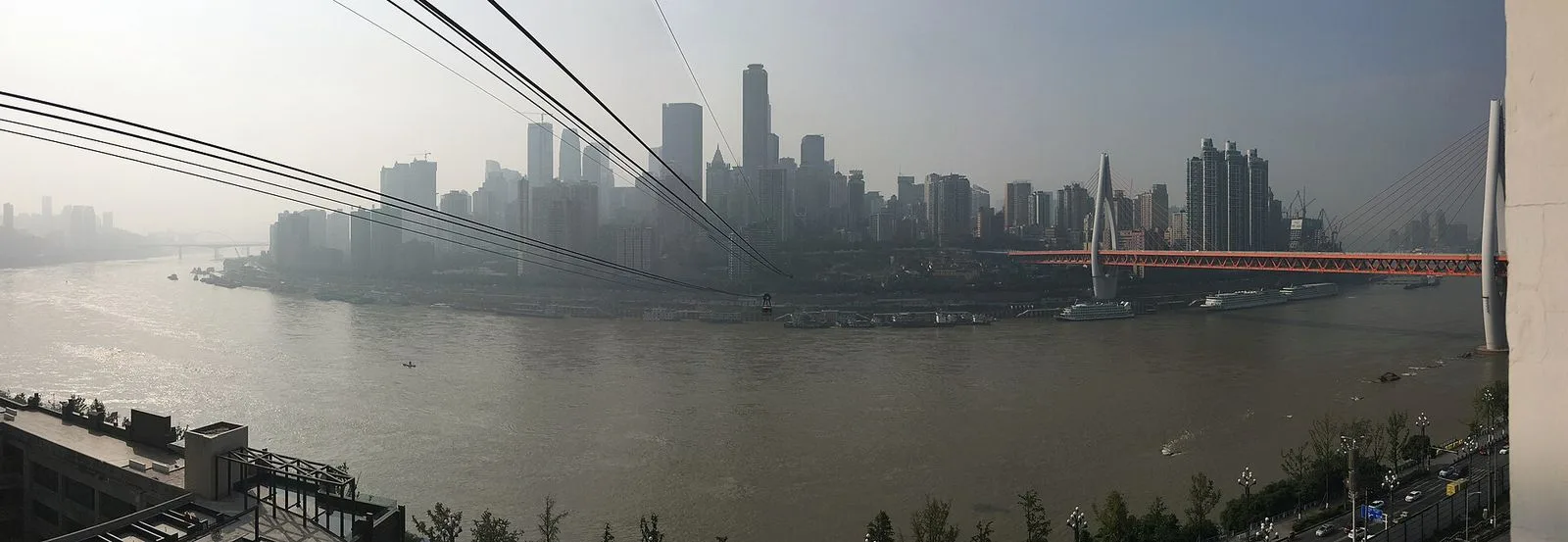
Photo: Wikimedia Commons / CC BY-SA. Source

The main thing to know is timing. The cable car runs 07:30-21:30, but the queues from 10:00-17:00 can be 1-2 hours on weekends and 3+ hours during Chinese national holidays (May 1-3, Oct 1-7, Chinese New Year week). Two strategies work:
- Go at 09:00 opening (smallest queue of the day, soft morning light)
- Go at 19:00 (queues thin out, and the city lights are turning on — you see the Hongya Cave light show begin from the cabin)
Most foreign visitors combine the cable car with a Hongya Cave evening visit. The north terminal is 5 min walk to Hongya Cave, so the natural flow is: cable car at 17:00-18:00 → metro back from the south terminal → walk to Hongya Cave by 19:00 → light show from Qiansimen Bridge.
The 1987 commuter line, not a tourist trap
The Yangtze Cable Car was built in 1987, when Chongqing had only one bridge across the Yangtze (the Qiansimen Bridge, also built that year) and the population was growing faster than the road infrastructure. The cable car was a commuter line for workers crossing between Yuzhong and Nan’an — a 5-minute ride that avoided a 30-minute bus trip through the narrow streets and across the bridges.
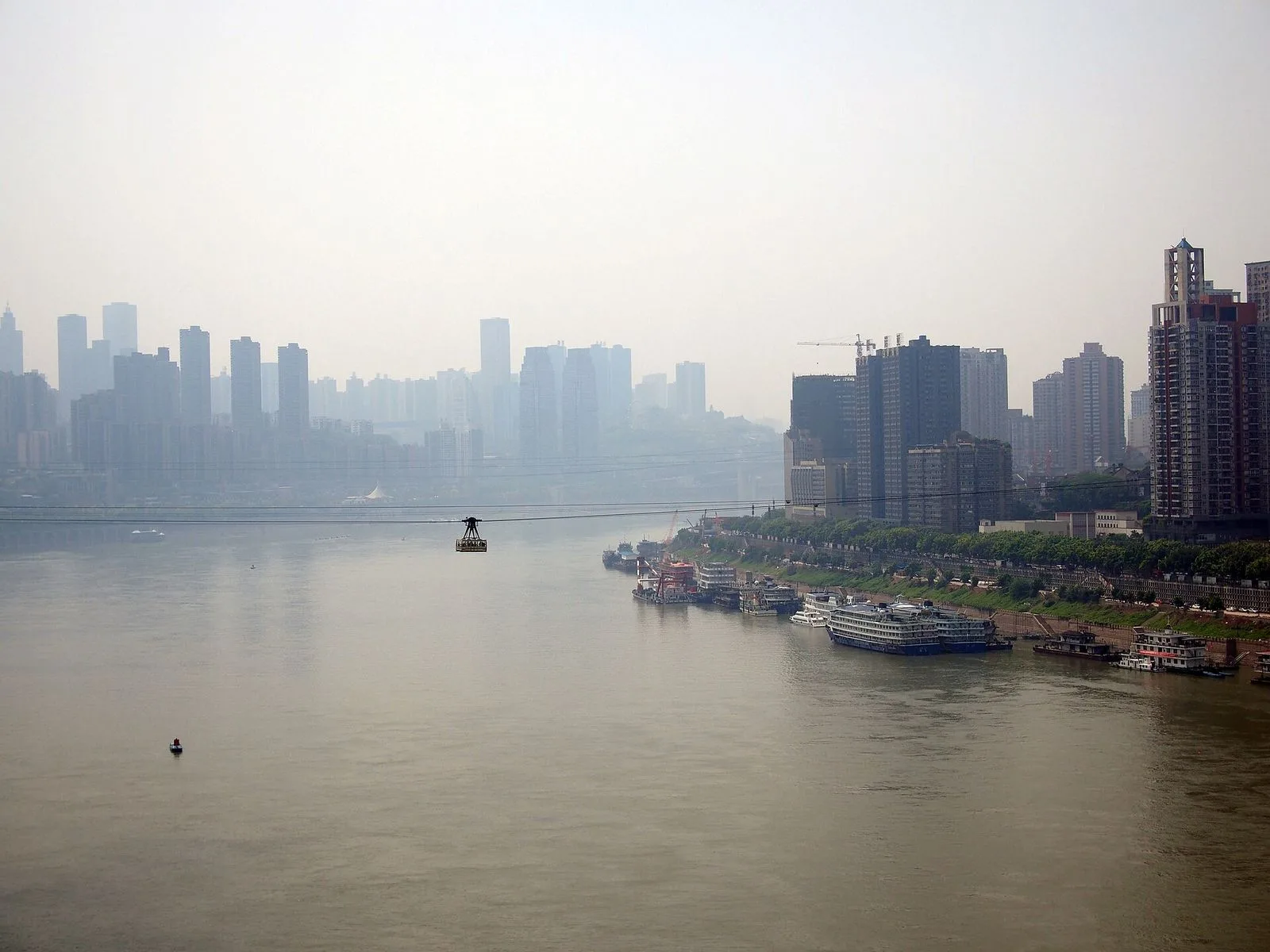
Photo: Wikimedia Commons / CC BY-SA. Source

The original cabins were small (8 people each, no doors), and the line carried 10,000+ commuters per day. As more bridges opened in the 2000s (Huangjueping, Caiyuanba, Yuzhou, Dafosi), commuter use dropped, and the cable car shifted to a tourism and sightseeing role. In 2018, the system was upgraded with larger, enclosed cabins (15-20 people, air-conditioned) and self-service ticket kiosks. The 2020s saw the line promoted heavily as a cultural icon — it appears on Chongqing metro cards, postage stamps, and the city’s official tourism branding.
Today, the cable car carries about 5,000-8,000 passengers per day — split roughly 60% tourists and 40% locals who still use it to skip traffic.
The two terminals: Yuzhong vs Nan’an
The two terminals are in completely different parts of Chongqing. Picking which one to start at changes the whole experience.
North terminal (Yuzhong district, 新华路): The busier, more central terminal. It is 5 min walk from Hongya Cave, 5 min walk from Xiaoshizi metro station, and a 10-min walk from Jiefangbei shopping. If you only have time for one direction, start here.
South terminal (Nan’an district, 双柏路): The quieter, more local terminal. It is in the older Nan’an district, with the Nan’an Old Street (南滨路) and the Nanshan Buddhist Temple (南山) a 20-min Didi away. Most tourists ride one-way (north → south) and take a Didi or metro back, instead of queuing again for the return cable car ride.
The route between the two terminals crosses the Yangtze at a 40-meter altitude, with the Jialing River confluence visible 1 km to the west. The cabin moves at about 6 meters per second — slow enough to see the river, fast enough to feel the height.
What to see from the cabin
The 5-minute ride is short, but there is a lot to see if you know where to look:
- Right side, going north → south: The view of Hongya Cave and the Qiansimen Bridge, with the Jialing River curving away. This is the iconic shot — most travel photos are taken from this angle.
- Left side, going north → south: The Nan’an mountainside with old apartment buildings stacked 20+ stories up the cliff. The vertical-city feel is most extreme here.
- Right side, going south → north: The Yuzhong skyline at sunset, with the skyscrapers of Jiefangbei and the Raffles Chongqing tower. The light at 18:00 in autumn is golden.
- Left side, going south → north: The Chaotianmen dock area (朝天门码头) where the Yangtze and Jialing rivers meet, with the massive Chaotianmen Bridge arching overhead.
Final tip
Buy a one-way ticket (¥20), not a round-trip (¥30). Ride north → south, then take the metro (Line 6, 10 min) or a Didi (¥15-20, 15 min) back. The return cable car ride gives you the same view from the opposite side — but you have already seen it, and the 1-hour queue for the return is not worth the ¥10 savings. Use the time saved for a slow walk through Nan’an’s old streets, or to get to Hongya Cave by 19:00 for the light show.
Best photo spots
-
Inside the cable car cabin (right side, going north→south) · Late afternoon, 17:00-19:00
The most photogenic angle: looking down at the Yangtze, with Hongya Cave and the Qiansimen Bridge in the frame. The cabin is enclosed so you shoot through the window — wipe any fingerprints first.
-
Inside the cable car cabin (left side, going south→north) · Late afternoon, 17:00-19:00
Same view as the right-side going north→south, but reversed. If you round-trip, take the return ride in the opposite direction to see both angles.
-
From the south terminal viewing platform · Daytime, 10:00-16:00
Looking back across the river at the north terminal, with the cable car suspended in mid-air. The classic 'iconic' Yangtze Cable Car shot.
-
From Qiansimen Bridge (千厮门大桥) pedestrian path · Anytime, but lit best at night 19:00-21:00
From the bridge, you can see the cable car crossing the river in the distance. Less photogenic up close but adds scale — a small yellow cabin in front of the vast skyline.
-
From the river (Yangtze cruise boats) · Anytime, dusk is best
The 2-hour Yangtze evening cruises pass directly under the cable car. From the boat, the cabin is overhead and the city skyline is the backdrop. Book the cruise separately — most depart from Chaotianmen dock (朝天门码头).
Where to eat nearby
-
好又来酸辣粉 (Hao You Lai Sour-Spicy Noodles)
Sour-spicy sweet potato noodles (酸辣粉) — a Chongqing street classic · ¥15-25/bowl · 8 min walk from north terminal, Jiefangbei area
-
珮姐老火锅 (Pei Jie Hotpot)
Famous Chongqing hotpot chain, mala (numbing-spicy) copper pot with 9-grid divider · ¥120-180/person · Inside Hongya Cave, 4th floor — 5 min walk from the north terminal
-
胖哥小面 (Pang Ge Xiao Mian)
Chongqing small noodles (重庆小面) — the local breakfast staple · ¥15-30/bowl · Ground floor of Hongya Cave, 5 min walk from the north terminal
-
南山泉水鸡 (Nanshan Spring Chicken)
Free-range chicken cooked in spring water with Sichuan peppercorns — a Nan'an district specialty · ¥150-250/person · 20 min Didi from the south terminal, on the slopes of Nanshan Mountain
Frequently asked questions
How much does the Yangtze Cable Car cost?
¥20 one-way, ¥30 round-trip per person. Children under 1.2m ride free; 1.2-1.4m pay half price (¥10). Pay at the terminal counter or self-service kiosk — Alipay and WeChat Pay accepted, foreign credit cards often rejected.
What are the Yangtze Cable Car hours?
Daily 07:30-21:30. The last cable car leaves at 21:00. The line closes earlier on extreme-weather days (heavy fog, lightning, high winds) — call +86-23-6381-7777 to confirm if the weather is borderline.
Is the Yangtze Cable Car worth it?
Yes — it is the single best value experience in Chongqing (¥30 for 10+ minutes of one-of-a-kind views). It is also the only way to cross the Yangtze by air; all other crossings are bridges (driving) or ferries. Most foreign visitors rate it as a top-3 Chongqing experience alongside Hongya Cave and a hotpot dinner.
How long is the Yangtze Cable Car ride?
5 minutes each way, including the loading and unloading. The 1,166-meter cable takes about 4 minutes to traverse at a steady speed. The total experience — queue + ride + queue — is 30-45 minutes outside peak hours, 1.5-2 hours during peak (10:00-17:00 weekends and holidays).
Where is the Yangtze Cable Car?
Two terminals: the north terminal is at 4 Xinhua Road (新华路), Yuzhong District — 5 min walk from Xiaoshizi metro station (Lines 1 and 6) and 5 min walk from Hongya Cave. The south terminal is at 51 Shuangbei Road (双柏路), Nan'an District — 10 min walk from Shangxinjie metro station (Line 6).
Do I need a visa to ride the Yangtze Cable Car?
No special visa — the same visa you used to enter China covers the ride. The cable car is a public transit experience, not a tour. Just show your passport at the ticket counter if asked (rare).
Can I use Alipay to buy Yangtze Cable Car tickets?
Yes — the ticket kiosk and counter both accept Alipay. Link a Visa/Mastercard to Alipay before you arrive. WeChat Pay works the same way. Foreign credit cards are sometimes rejected at the counter, so mobile wallet or cash (¥20-30) is the safe choice.
Is the Yangtze Cable Car safe?
Yes — it has been running since 1987 with a perfect safety record. Each cabin holds 15-20 people. The system has multiple redundant cables, wind sensors that halt operations in storms, and the cabins are checked daily. The only safety concern is the standard 'don't lean out the window' — the cabin is fully enclosed.
What is the best time to ride the Yangtze Cable Car?
Late afternoon, 17:00-19:00. The 5-minute ride transitions from golden-hour light to the city lights turning on, and you can see the Hongya Cave light show begin from the cabin. Second-best: 09:00 opening for the smallest queues and cleanest morning light.
What is the difference between the Yangtze Cable Car and the Yangtze River Bridge?
The cable car is a 5-minute aerial ride across the Yangtze (1,166 m). The Yangtze River Bridge is a 7-km road+rail bridge you drive across (or walk on the pedestrian path). The cable car is the experience; the bridge is transport. Foreigners typically do the cable car as a 30-45 min activity, not the bridge.