
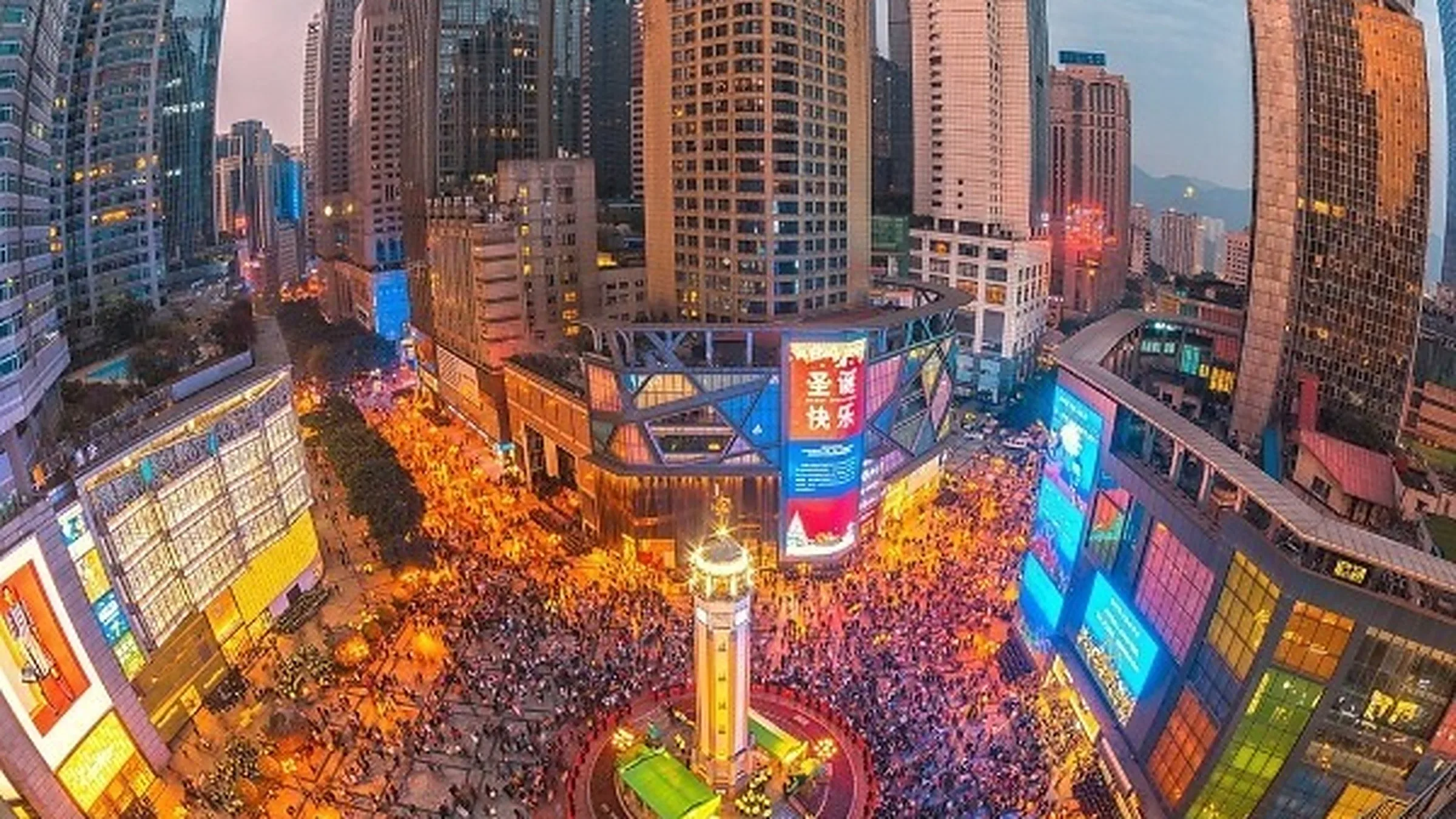
Jiefangbei Pedestrian Street (解放碑)
解放碑 · Jiěfàngbēi
Quick answer
No entry restrictions. The pedestrian streets, malls, and the monument are all open to foreigners with no ID check. Alipay and WeChat Pay are accepted everywhere; cash as backup.
Why visit
- 1 The Liberation Monument (解放碑) — a 27.5m stone obelisk from 1947 marking China's victory in the War of Resistance against Japan, now surrounded by Chongqing's most modern skyscrapers
- 2 The CBD of central Chongqing — the densest concentration of luxury malls, restaurants, and night-life in western China
- 3 200+ restaurants within a 10-min walk — Chongqing hotpot, Sichuan cuisine, hotpot chains, and international food (Japanese, Korean, Italian, French)
- 4 Covered shopping arcades (Mitsukoshi, IFS, Raffles City) — a perfect rainy-day or hot-summer escape
- 5 Free to enter, open 24/7 — the streets, the monument, the atmosphere are all public
- 6 The Yangtze River Cable Car north terminal is 10 min walk west — easy to combine in one outing
Essential tips for foreigners
- Go at dusk (18:00-20:00) — the monument lights up at sunset, the surrounding skyscrapers turn on their light shows, and the night-market food stalls open. The single best time to experience the area.
- The monument is small (27.5m) and easy to miss — it is in the middle of a roundabout, surrounded by skyscrapers and shopping malls. Most first-time visitors walk right past it. Look for the white obelisk with red Chinese characters on all four sides.
- Eat hotpot here, not in the tourist zone around the monument — the 3 famous chains (珮姐, 晓宇, 刘一手) are clustered 5-10 min walk from the monument, off the main pedestrian street. Lines are shorter and the food is the same.
- Use the metro — Jiefangbei is in the heart of central Yuzhong, with 3 metro stations within 5 min walk. Driving is slow (one-way streets, narrow alleys) and parking is expensive (¥15/hour).
- Bring a jacket in winter — the skyscrapers create a wind-tunnel effect. Evenings are 5°C+ colder than the surrounding areas.
- Combine with Hongya Cave (10 min walk south) and the Yangtze Cable Car (10 min walk west) — all three are walkable from each other. A natural 4-hour evening loop: cable car 17:00 → walk to Jiefangbei 18:00 → hotpot 19:00 → Hongya Cave 21:00.
Suggested route
- 18:00 10 min Arrive at Linjiangmen metro station (Line 2), Exit A, walk 3 min to the Liberation Monument roundabout
- 18:10 30 min Walk the 4 sides of the monument (each side has different Chinese characters), then continue north to Bayi Food Street (八一好吃街)
- 18:40 1.5 hours Dinner at 珮姐老火锅 (Pei Jie Hotpot) — 5 min walk east of the monument. Arrive by 19:00 to avoid the dinner rush
- 20:10 30 min Walk west to IFS mall rooftop for the night view of the surrounding skyscrapers
- 20:40 10 min Walk south 10 min to Hongya Cave for the 21:00 light show from Qiansimen Bridge
- 21:00 — Watch the light show from the bridge, then take metro Line 6 from Xiaoshizi back to your hotel
The 1947 monument that became the heart of Chongqing’s CBD
Jiefangbei (解放碑 Jiěfàngbēi, literally “Liberation Monument”) is a 27.5-meter stone obelisk erected in 1947 to commemorate the victory of the Chinese people in the War of Resistance against Japan. The monument stands at the center of a roundabout in Yuzhong district, the most central point in Chongqing. Around it, the city has built its densest concentration of skyscrapers, luxury malls, restaurants, and night life.
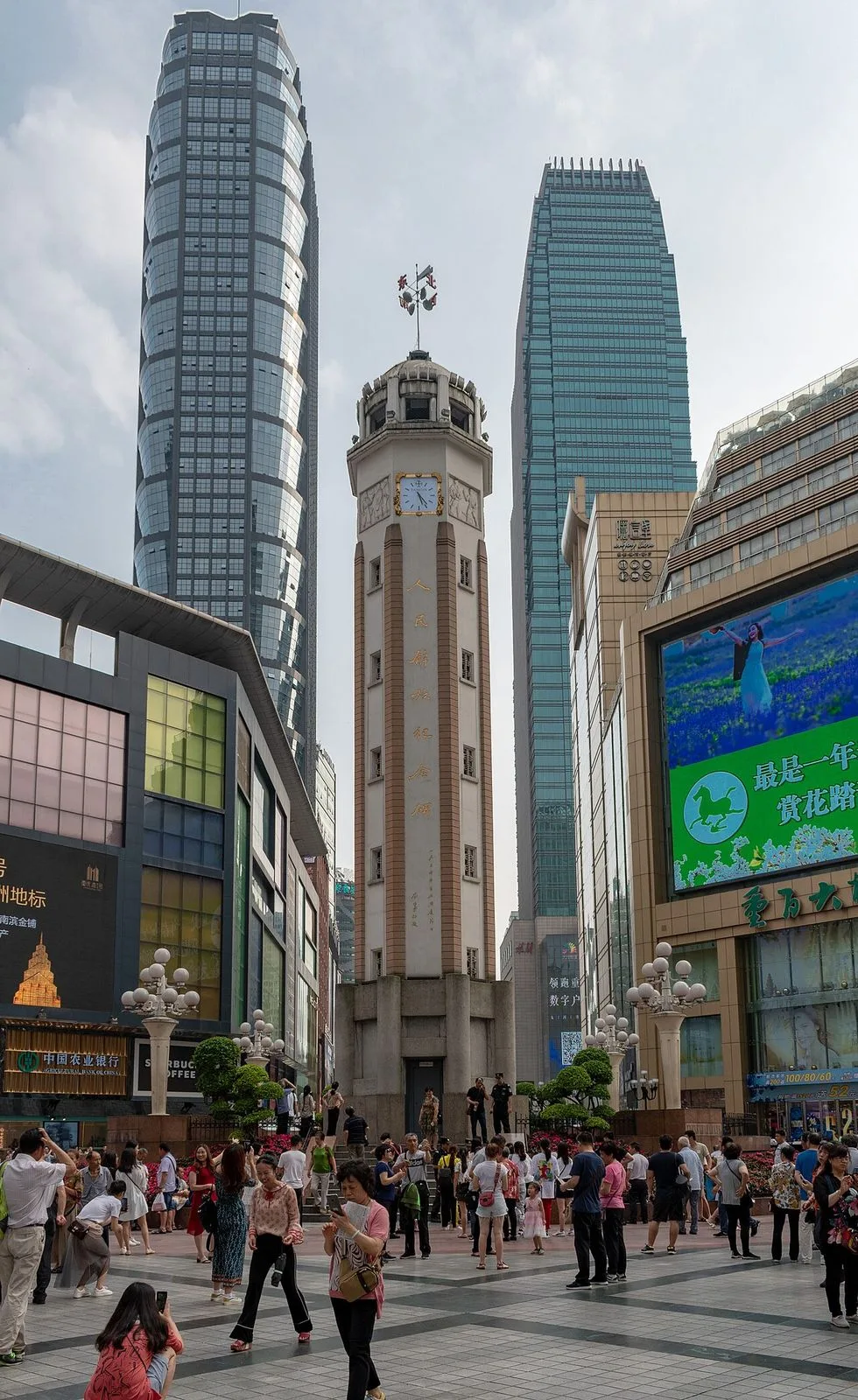
Photo: Wikimedia Commons / CC BY-SA. Source
.jpg)
In 2026, Jiefangbei is the Times Square of central China. The original 1947 monument is now almost lost among the surrounding skyscrapers — but it remains the symbolic heart of Chongqing. The pedestrian streets, shopping arcades, and 200+ restaurants within a 10-min walk are what most visitors actually come for.
What the foreigner experience looks like in 2026
Jiefangbei is one of the most foreigner-friendly areas in Chongqing. The pedestrian streets, malls, and monument are all open access — no tickets, no ID check, no guided tour required. Every shop and restaurant accepts Alipay or WeChat Pay; cash (¥100-200) is a useful backup. English signage is widespread in the major malls and chain restaurants, less so in the small street-food stalls.
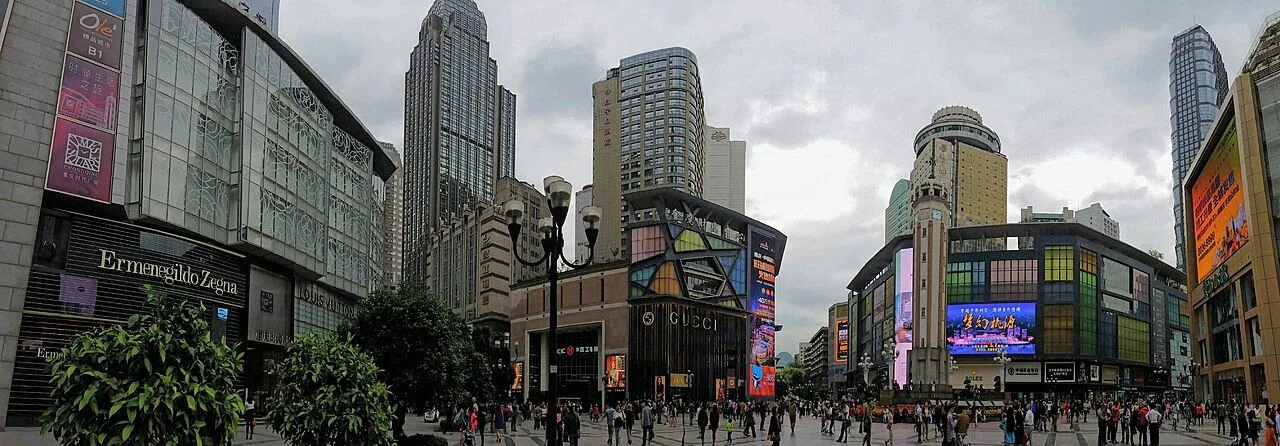
Photo: Wikimedia Commons / CC BY-SA. Source

The main thing to know is that Jiefangbei is more of a place to experience than a single attraction. The monument itself is small (27.5m, smaller than a 10-story building) and easy to miss in the middle of a roundabout. What makes the area worth visiting is the surrounding 2 km² of:
- 5 covered shopping malls (IFS, Raffles City, Metropolitan Tower, Times Square, Wangfujing)
- 3 pedestrian food streets (Bayi, Shaanxi Road, Minzu Road)
- 200+ restaurants, with 30+ dedicated Chongqing hotpot places
- The Yangtze Cable Car north terminal (10 min walk west)
- Hongya Cave (10 min walk south)
The 1947 monument: from war memorial to CBD
The Liberation Monument was commissioned in 1940 by the Nationalist government (then based in wartime Chongqing) and completed in 1947, after the war ended. The original inscription reads “抗战胜利纪功碑” (Victory of the War of Resistance Monument) — commemorating China’s 8-year war with Japan. After the 1949 Communist victory, the inscription was changed to “人民解放纪念碑” (People’s Liberation Monument), giving the area its current name.
Photo: Wikimedia Commons / CC BY-SA. Source
.jpg)
In the 1980s and 1990s, Yuzhong district was still a dense low-rise neighborhood of mixed shops, restaurants, and small residences. The monument stood in a busy commercial area, but not a particularly distinctive one. The transformation came in the 2000s, when Chongqing’s economy boomed (helped by the 1997 direct-control municipality status and the 2010s automotive and electronics manufacturing growth) and the surrounding neighborhood was demolished and rebuilt as skyscrapers.
By 2020, the monument was a 27.5m stone obelisk completely surrounded by 200m+ skyscrapers. It is now legally protected as a cultural relic, but it is also dwarfed by the buildings that grew up around it. The contrast — a 1947 stone monument in the middle of a 21st-century CBD — is the visual identity of Jiefangbei.
The 5 malls, 3 food streets, 1 monument
The Jiefangbei area is best understood as a 1 km² grid of 5 malls + 3 food streets + 1 monument, all connected by covered walkways. The full walking tour is 2-3 hours.
The 5 malls:
- IFS (国金中心) — luxury international brands, the rooftop sculpture garden (free viewing deck, panoramic Jiefangbei view)
- Raffles City (来福士) — the iconic Moshe Safdie-designed building with the horizontal sky-bridge (¥88 rooftop observation deck, 250m high)
- Metropolitan Tower (美美时代百货) — mid-range, Korean and Japanese brands
- Times Square (大都会) — high-end, European luxury
- Wangfujing (王府井) — Chinese department store chain, more accessible pricing
The 3 food streets:
- Bayi Food Street (八一好吃街) — the most famous, with neon-lit entrance and 50+ stalls. Best for the night-market vibe.
- Shaanxi Road (陕西路) — older, more local, fewer tourists. Better for the authentic experience.
- Minzu Road (民族路) — a mix of street food and sit-down restaurants, lined with hotpot chains.
The monument:
- The obelisk itself, surrounded by 4 streets (Minquan, Zourong, Minzu, and Yingbin). The Chinese characters on each side change every 30 years — the current set is from 2010.
Where to eat: hotpot, hotpot, hotpot
Jiefangbei is the single best place in Chongqing to try mala hotpot. The area has 30+ dedicated hotpot restaurants, ranging from ¥80/person neighborhood places to ¥200/person luxury chains. The 3 most famous:
- 珮姐老火锅 (Pei Jie Hotpot) — the most famous, the most photographed, the longest lines (2 hours on weekends). Worth it once.
- 晓宇火锅 (Xiao Yu Hotpot) — the locals’ choice, no-frills, no English menu, no decorations. The food is better than Pei Jie and the price is half.
- 刘一手 (Liu Yi Shou Hotpot) — the chain choice, standardized menu, English-friendly, consistent quality. Good for first-timers who want to know what they’re getting.
For non-hotpot options, the food streets have everything: Chongqing small noodles (¥15-30), sour-spicy sweet potato noodles (酸辣粉, ¥15-25), grilled skewers (¥5-15 each), and bubble tea. There are also 20+ international restaurants within a 5-min walk: Japanese (Ichiban, Sushi O), Korean (Gangnam BBQ), Italian (Pizza Marzano), French (Le Café).
Final tip
Eat at 晓宇, not 珮姐. The 2-hour line at 珮姐 is not worth the same food at half the price next door. For first-timers, 珮姐 is the cultural experience; for second-timers, 晓宇 is the better meal. Both are within 10 min walk of the monument.
Best photo spots
-
Liberation Monument roundabout (4 corners) · Dusk, 18:00-20:00
The classic Jiefangbei shot: the white obelisk in the center, with the surrounding skyscrapers lit up. The 4 sides of the roundabout give slightly different angles. The best corner is the northeast (closest to Bayi Food Street).
-
IFS mall rooftop (rooftop sculpture viewing deck) · Anytime, but lit best at night 19:00-22:00
Free rooftop access at IFS mall gives you a panoramic view of the Jiefangbei area and beyond. Less crowded than the Raffles City viewing deck, and free.
-
Qiansimen Bridge (千厮门大桥) pedestrian path · Night, 20:00-22:00
From the bridge, you can see the Liberation Monument in the distance, with the Jiefangbei skyscrapers as the backdrop. Combine with the Hongya Cave light show for the iconic Chongqing evening shot.
-
Bayi Food Street (八一好吃街) entrance · Anytime, evening 19:00+ is most atmospheric
The neon-lit entrance to the night-market food street, with the Chinese characters 八一好吃街 glowing red. Best for street-photography vibes.
-
From the Yangtze Cable Car cabin (north → south direction, left side) · Late afternoon, 17:00-19:00
From the cable car, looking back at Jiefangbei from above — the monument is a small white dot in the middle of the skyscraper forest. The opposite of the usual ground-level shot.
Where to eat nearby
-
珮姐老火锅 (Pei Jie Hotpot)
Famous Chongqing mala hotpot, copper 9-grid pot, ¥120-180/person · ¥120-180/person · 5 min walk east of the Liberation Monument, Minquan Road
-
晓宇火锅 (Xiao Yu Hotpot)
Authentic neighborhood Chongqing hotpot, no-frills, popular with locals · ¥80-130/person · 8 min walk north of the monument, near Linjiangmen metro
-
刘一手 (Liu Yi Shou Hotpot)
Chongqing hotpot chain, more standardized menu, good for first-timers · ¥100-150/person · 5 min walk south of the monument, near Xiaoshizi metro
-
Bayi Food Street (八一好吃街) night market
Street food stalls — sour-spicy noodles, grilled skewers, Chongqing small noodles, sweet rice cakes · ¥10-50/stall · 2 min walk north of the Liberation Monument
Frequently asked questions
How much does Jiefangbei cost?
Free to enter and walk. The monument, pedestrian streets, and surrounding plazas have no admission. Budget ¥80-200 per person for a hotpot dinner, ¥100-500 for shopping, ¥30-80 for street food and bubble tea. The area is one of the more expensive parts of Chongqing for dining.
What is Jiefangbei famous for?
Three things: the 1947 Liberation Monument (the original obelisk commemorating China's WWII victory), Chongqing's most expensive shopping district (luxury malls like IFS and Raffles City), and the densest cluster of Chongqing hotpot restaurants in the city. It is the Times Square of central China.
What is the best time to visit Jiefangbei?
Dusk to night, 18:00-22:00. The monument is lit, the skyscrapers turn on their nightly light shows, the night-market food stalls open, and the hotpot restaurants are full but not yet packed. Daytime (10:00-17:00) is also good for shopping but less atmospheric.
Is Jiefangbei safe for tourists?
Yes — extremely safe. Jiefangbei is the most heavily patrolled area of Chongqing, with police stations within 200m of the monument. Petty theft is rare. The main safety concern is the standard Chongqing one: do not lean over the edges of the surrounding viewing platforms (the city is built on cliffs).
How do I get to Jiefangbei from Hongya Cave?
10 min walk north from Hongya Cave. Exit Hongya Cave from the top floor (street level), turn left (west) onto Cangbai Road, walk 800m north to the monument. Or take metro Line 6 from Xiaoshizi (1 stop) to Jiefangbei station.
Can I use Alipay at Jiefangbei?
Yes — every restaurant, shop, and mall accepts Alipay and WeChat Pay. Even the street-food stalls and bubble-tea vendors take mobile payments. Link a Visa/Mastercard to Alipay before you arrive. Cash (¥100-200) is a useful backup.
Are there English signs at Jiefangbei?
Yes — most of the major malls, chain restaurants, and metro exits have English signage. Street food stalls and small shops may have Chinese-only menus, but pointing at pictures works. The Liberation Monument itself has Chinese characters only — no English plaque.
What should I buy at Jiefangbei?
Sichuan peppercorns, Chongqing hotpot base (the mala chili paste in vacuum-sealed bags, available at every supermarket), and local tea. Avoid the luxury-brand malls if you want value — the prices are mainland-China retail (no discount over other major cities). The night-market stalls sell cheap souvenirs (¥20-100) but most are made in Yiwu, not Chongqing.
Is Jiefangbei the same as Chaotianmen?
No — they are different areas. Jiefangbei is the central CBD, 2 km north of the Yangtze-Jialing confluence. Chaotianmen (朝天门) is the dock area at the confluence itself, with the iconic Chaotianmen Bridge and the Yangtze river cruises. Both are worth visiting; they are 15 min by Didi from each other.
What is the difference between Jiefangbei and Nanping?
Jiefangbei is the modern, central, luxury shopping area. Nanping (南坪) is the older, southern commercial district, with more local shops, cheaper food, and fewer tourists. Foreigners typically prefer Jiefangbei for the first-time visit; Nanping is a second-visit option for travelers who want to see the more local side of Chongqing.