
Ciqikou Ancient Town (磁器口)
磁器口 · Cìqìkǒu
Quick answer
No entry restrictions. The ancient streets, temples, and teahouses are open to all. No ID check at any point. Alipay and WeChat Pay accepted in most shops; cash as backup.
Why visit
- 1 1,000 years of porcelain-port history — Ciqikou was the upstream trading post where boatmen from the Yangtze River sold porcelain, tea, and spices from the 10th century onward
- 2 12 ancient streets, all pedestrian-only — narrow stone lanes with Ming-Qing architecture, red lanterns, and Sichuan-style shopfronts
- 3 Baolun Temple (宝轮寺) — a 1,000-year-old Buddhist temple still in active use, ¥20 entry, with a rare 14-meter wooden Buddha statue from the Song dynasty
- 4 The street food capital of Chongqing — chen-liang noodles (陈凉粉), ma-la tang, and Chen mahua (a local twisted-dough snack) are all invented here
- 5 Free to enter — only Baolun Temple charges admission; the streets, teahouses, and craft shops are all open access
- 6 30-40 min by metro from central Chongqing — the easiest ancient town to reach from the city
Essential tips for foreigners
- Go at 09:00-11:00 (weekday morning) — the town is at its most peaceful. After 11:00, tour buses arrive and the main street gets packed. After 18:00, the lanterns turn on but the street food starts to close.
- Eat chen-liang noodles (陈凉粉) and Chen mahua (陈麻花) — these are the two snacks invented in Ciqikou. The original shops are on the main street (Ciqikou Zhengjie 磁器口正街); avoid the ones at the entrance gate, which are tourist-priced.
- Take the metro, not a Didi — Ciqikou is on Line 1, 35-40 min from central Yuzhong. Driving means 30 min stuck in Shapingba district traffic + expensive parking (¥10/hour) + walking the same distance from the car park.
- Wear comfortable shoes — the streets are 1,000 years old, the stones are uneven, and there are 200+ steps between the upper and lower town. Sandals are not recommended.
- Visit Baolun Temple (宝轮寺) — ¥20 entry, 30-45 min visit. The 14-meter wooden Buddha is the only one of its kind in Sichuan, and the temple's mountain backdrop is the best view in Ciqikou.
- Skip the souvenir stalls at the entrance — the same Yiwu-sourced trinkets (¥10-50 fans, calligraphy sets, chopsticks) are sold at every Chinese ancient town. Walk 200m into the town for the same items at half the price.
Suggested route
- 09:00 10 min Arrive at Ciqikou metro station (Line 1), Exit 1, walk 5 min to the main entrance gate
- 09:10 1.5 hours Enter through the main gate, walk down the main street (Ciqikou Zhengjie 磁器口正街), stopping at the original Chen mahua and chen-liang noodle shops
- 10:40 45 min Climb the steps to Baolun Temple (宝轮寺), ¥20 entry, visit the 14-meter wooden Buddha
- 11:25 30 min Walk down to the riverside (Jialing River), take photos of the old town from across the water
- 11:55 1 hour Sit down for lunch at a teahouse — try the longjing tea + ma-la tang set (¥80-120/person)
- 12:55 45 min Walk back up through the back streets (less crowded, more authentic), exit via the south gate
- 13:40 40 min Take metro Line 1 back to central Chongqing (Jiefangbei or Xiaoshizi)
The 1,000-year-old porcelain port that became Chongqing’s most authentic ancient town
Ciqikou Ancient Town (磁器口古镇 Cìqìkǒu Gǔzhèn) is a 1,000-year-old porcelain-trading port on the Jialing River, 30-40 minutes by metro from central Chongqing. The town grew up in the Song dynasty (10th-13th centuries) as the upstream trading post where boatmen from the Yangtze would offload ceramics, tea, and spices for distribution to the Sichuan interior. The name “Ciqikou” means “Porcelain Wharf” — a reference to the porcelain warehouses that lined the river dock.
Today, Ciqikou is a preserved ancient town with 12 pedestrian streets, Ming-Qing architecture, the 1,000-year-old Baolun Temple, and a thriving street-food scene. It is the most authentic ancient town near central Chongqing — neither a theme-park rebuild (like Hongya Cave) nor a remote village (like the Dazu Rock Carvings), but a real, lived-in town that has been continuously inhabited for a millennium.
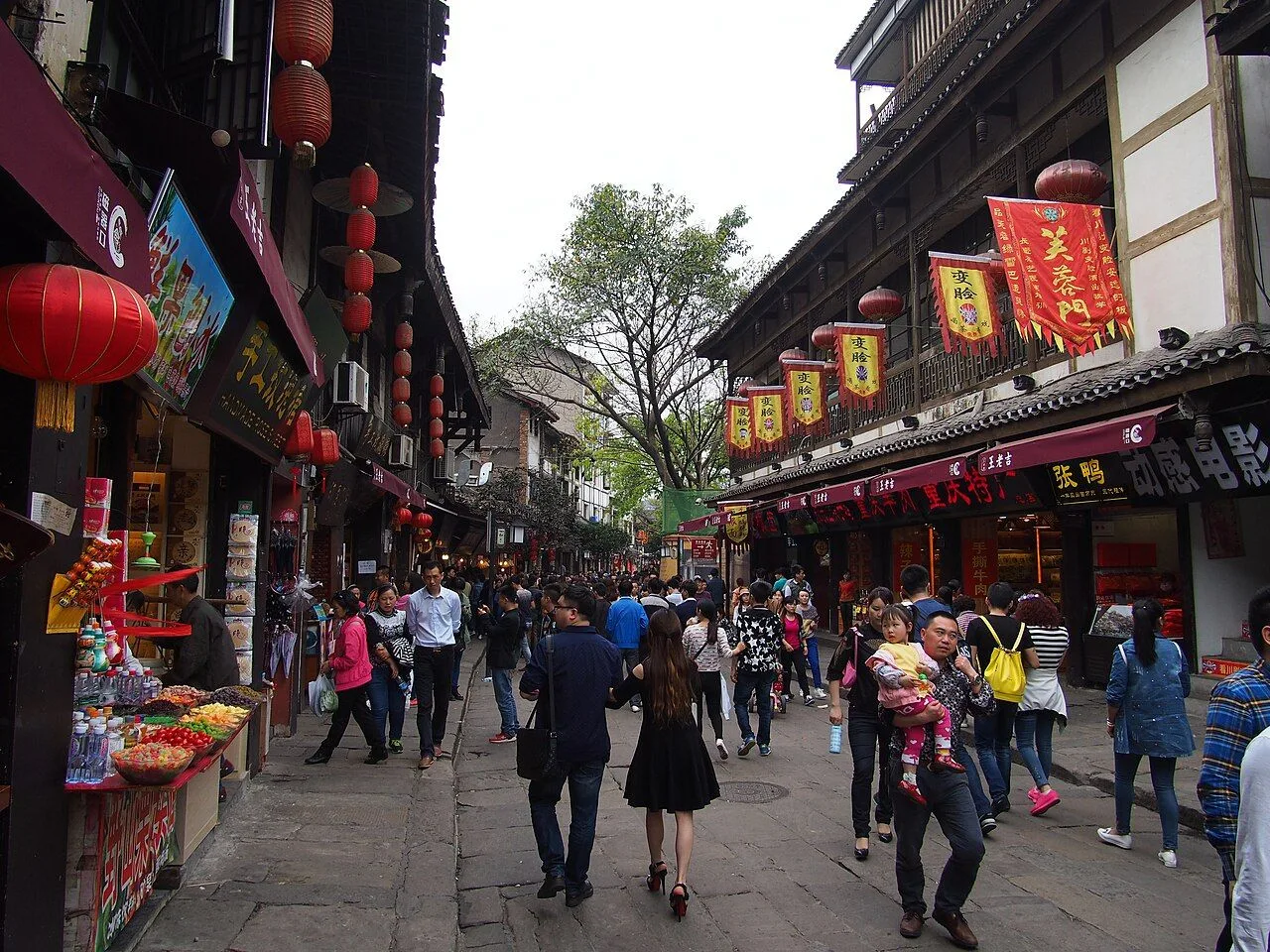
Photo: Wikimedia Commons / CC BY-SA. Source

What the foreigner experience looks like in 2026
Ciqikou is one of the easiest day-trips from central Chongqing. The town is on Metro Line 1, 35-40 minutes from Jiefangbei, and entry is free. The main street is pedestrian-only, with the 800-meter Ciqikou Zhengjie (磁器口正街) lined with craft shops, teahouses, and street-food stalls. The side streets are quieter, with old residences and local life.
The main thing to know is timing. Ciqikou gets crowded from 11:00-17:00 with tour groups, especially weekends and Chinese national holidays (May 1-3, Oct 1-7, Chinese New Year week). The peak overcrowding is May 1-3, when 100,000+ visitors a day pack the 800-meter main street and walking is impossible. Two strategies work:
- Go at 09:00-11:00 (weekday morning) — smallest crowds, soft light, fresh street food
- Go after 18:00 (weekday evening) — red lanterns turn on, most tour groups have left, but most street food is closing
For first-timers, the 3-hour morning visit (09:00-12:00) covers the main street, Baolun Temple, and a teahouse break — the canonical Ciqikou experience.
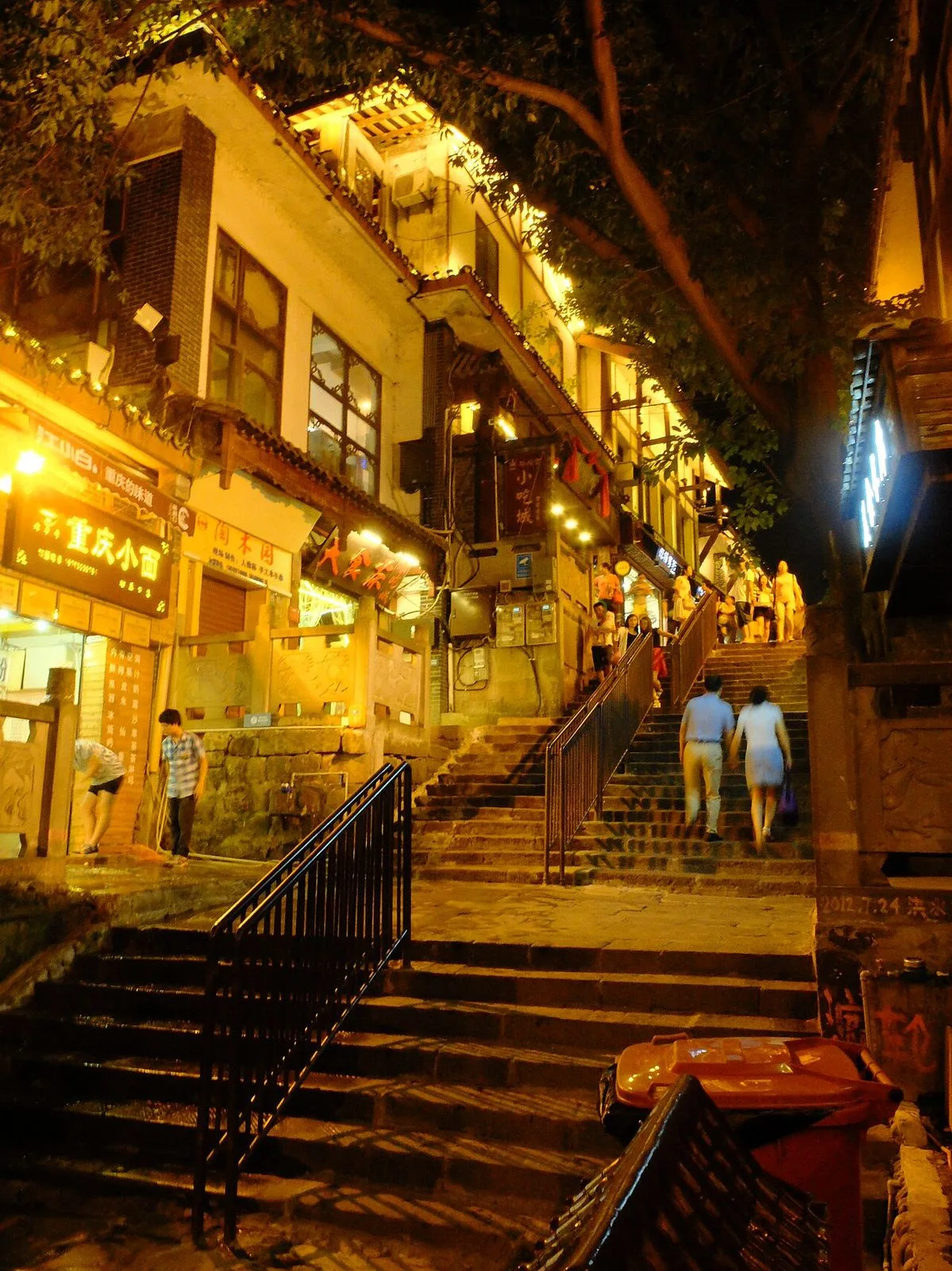
Photo: Wikimedia Commons / CC BY-SA. Source
.jpg)
The Song dynasty porcelain port
Ciqikou was established in the Song dynasty (960-1279 AD) as a critical node in the Yangtze River trade network. Boatmen from the lower Yangtze (Jiangnan region) would sail upstream to Chongqing with cargoes of porcelain, tea, silk, and salt. Ciqikou was the last navigable point for smaller boats — beyond Ciqikou, the Jialing River becomes too shallow for cargo, and goods had to be transferred to overland transport. The town grew up around the transshipment warehouses, with merchants, money-changers, and craftspeople settling to service the trade.
The town’s golden age was the Ming and Qing dynasties (14th-19th centuries). By the 18th century, Ciqikou was one of the most important commercial ports in western China, with permanent warehouses for the Jiangnan porcelain trade, the Sichuan tea trade, and the salt monopoly. The town’s main street (today’s Ciqikou Zhengjie) was paved in the 18th century; many of the shopfronts date from the 19th century.
In the 20th century, the rise of railways and the decline of river trade reduced Ciqikou to a backwater. The town survived largely because it was too small to attract the same level of demolition that hit central Chongqing in the 1990s-2000s. By the time the 2000s restoration effort began, the original Ming-Qing architecture was still largely intact.
The 12 streets and 1 temple
Ciqikou is laid out as a grid of 12 stone-paved streets on a hillside sloping down to the Jialing River. The 800-meter main street (Ciqikou Zhengjie) runs roughly east-west along the contour of the hill, with 11 side streets branching off north and south. The whole town is walkable in 2-3 hours; the back streets are quieter and more authentic than the main street.
Baolun Temple (宝轮寺) is the single must-see in Ciqikou. The temple was founded in the Song dynasty (around 1000 AD) and rebuilt in the Ming dynasty. It is still an active Buddhist temple, with resident monks and daily prayer sessions. The highlight is the Mahavira Hall (大雄宝殿), which contains a 14-meter wooden Buddha statue from the Song dynasty — the only one of its kind in Sichuan, and one of the few surviving Song-dynasty wooden sculptures in China. Entry is ¥20, the temple is open 08:00-17:30, and the visit takes 30-45 minutes.
The teahouses are the other Ciqikou experience. The riverside has 10+ old-style teahouses with bamboo chairs, wooden tables, and views of the Jialing River. The most famous is 磁器口老茶馆 (Ciqikou Old Teahouse), with longjing tea + Sichuan snacks (mahua, sunflower seeds, ginger candy) for ¥30-80 per person. The teahouse is open 09:00-23:00 and is busiest in the afternoon, when tour groups stop for a break.
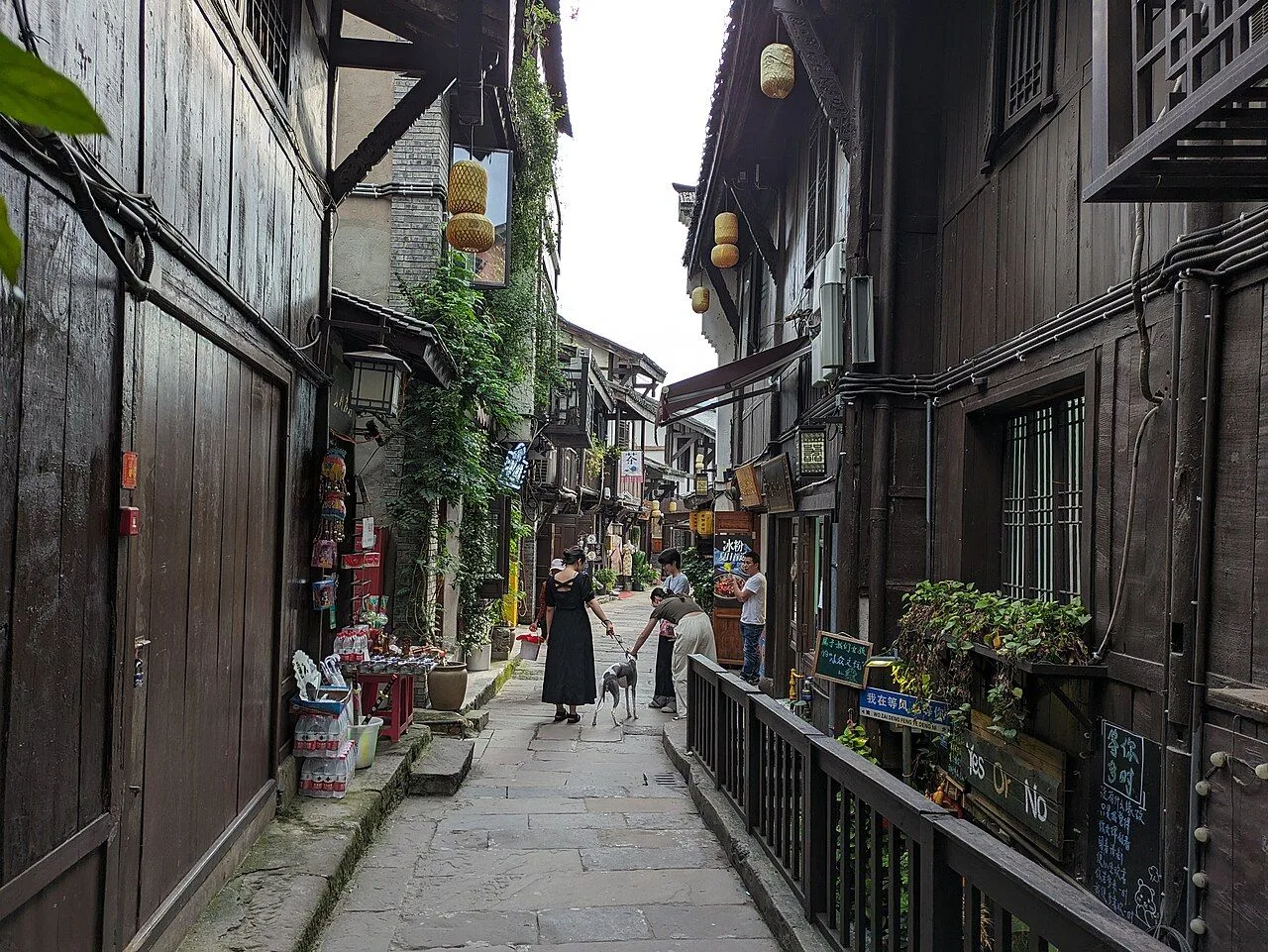
Photo: Wikimedia Commons / CC BY-SA. Source

What to eat: the snacks invented in Ciqikou
Ciqikou is the birthplace of two of Chongqing’s most famous street snacks:
Chen mahua (陈麻花) — a twisted-dough snack, fried crispy, with a slightly sweet or savory flavor. The original Chen family recipe dates to the Qing dynasty; the original Chen shop is on the main street about 200m from the entrance gate. Sold in 100g bags for ¥15-25, vacuum-sealed for travel. The shop is the busiest single location in Ciqikou, with a queue that wraps around the corner on weekends.
Chen liangfen / chen-liang noodles (陈凉粉) — cold noodles in chili oil, Sichuan pepper, vinegar, and garlic. The original Chen family recipe; spicy but addictive. The original shop is on the main street about 300m from the entrance gate. ¥15-25 per bowl.
In addition to the two Chen originals, the main street has 50+ other street-food stalls selling ma-la tang, grilled skewers, fried dough sticks, sweet rice cakes, and bubble tea. The most popular is 古镇鸡杂 (Guzhen Ji Za), a spicy stir-fried chicken offal dish that is a Ciqikou signature — ¥40-80 per portion, enough for 2 people.
Final tip
Visit Baolun Temple last, not first. The temple is uphill from the main street, and most first-time visitors climb to it immediately, then have to walk back down through the same crowded main street. Instead: enter through the main gate, walk the main street to the far (west) end, eat lunch at a teahouse on the riverside, then climb up to Baolun Temple from the south side — fewer stairs, fewer crowds, and you finish with the temple’s mountain view rather than the main street’s commercial bustle.
Best photo spots
-
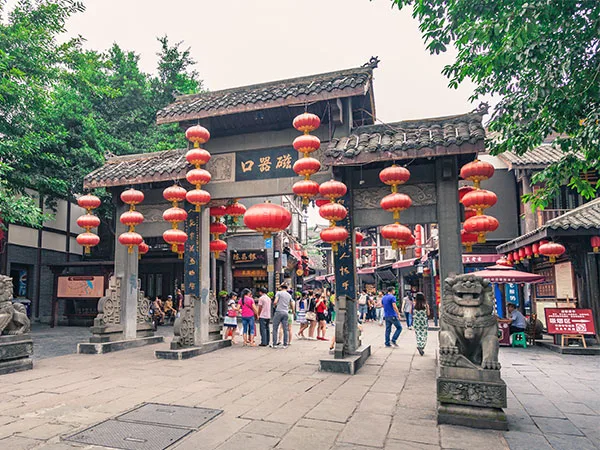
Main entrance gate (磁器口大牌坊) · Morning, 09:00-10:00 (no crowds)
The red-lantern-festooned entrance gate, with the stone arch and the surrounding old town visible behind. The classic 'I went to Ciqikou' shot. Best in the morning before the tour buses arrive.
-
Ciqikou Zhengjie (磁器口正街) main street · Morning, 09:00-11:00
The 800-meter main street with red lanterns, traditional Sichuan shopfronts, and the crowd of pedestrians. Photogenic in any season, but the lanterns are most striking at dusk.
-
Baolun Temple (宝轮寺) main hall · Anytime, 09:00-17:00
The 14-meter wooden Buddha statue in the main hall, with the mountain backdrop visible through the open door. The only Song-dynasty wooden Buddha in Sichuan.
-
Jialing River riverside (south end of the town) · Late afternoon, 16:00-18:00
From the riverside, looking back at Ciqikou on the hillside. The town's vertical layout (sloping down to the river) is most photogenic from this angle.
-
Back streets (less crowded, more authentic) · Any time, 09:00-17:00
The 12 side streets branching off the main street, with quieter teahouses, old residences, and local residents going about daily life. Less iconic, more authentic.
Where to eat nearby
-
陈麻花 (Chen Mahua) — original Ciqikou shop
Twisted-dough snack, fried crispy, slightly sweet or savory. The original Chen family recipe from the Qing dynasty, sold in 100g bags (¥15-25) · ¥15-25/bag · Main street (Ciqikou Zhengjie), about 200m from the entrance gate
-
陈凉粉 (Chen Liang Noodles) — original Ciqikou shop
Cold noodles in chili oil, Sichuan pepper, vinegar, and garlic. The original Chen family recipe; spicy but addictive · ¥15-25/bowl · Main street, 300m from the entrance gate
-
古镇鸡杂 (Guzhen Ji Za — Ancient Town Chicken Offal)
Spicy stir-fried chicken offal with pickled vegetables, peppers, and Sichuan peppercorn. A Ciqikou signature · ¥40-80/portion · Main street, 500m from the entrance gate
-
磁器口老茶馆 (Ciqikou Old Teahouse)
Longjing green tea + traditional Sichuan snacks (mahua, sunflower seeds, ginger candy). Bamboo chairs, wooden tables, river view · ¥30-80/person · Riverside, 200m from the south end of the main street
Frequently asked questions
How much does Ciqikou cost?
Free to enter the ancient town. Baolun Temple (宝轮寺) charges ¥20 per person. Street food is ¥5-30 per item; sit-down meals are ¥40-150 per person. A typical 3-hour visit costs ¥50-150 per person including food, drinks, and the temple.
What is Ciqikou famous for?
Three things: 1,000 years of porcelain-port history (it was the upstream trading post for Yangtze boatmen selling ceramics, tea, and spices), the original chen-liang noodles (陈凉粉) and Chen mahua (陈麻花) snacks invented here, and the Baolun Temple with its rare 14-meter Song-dynasty wooden Buddha. It is the most authentic ancient town near central Chongqing.
What is the best time to visit Ciqikou?
Weekday morning, 09:00-11:00. The town gets crowded from 11:00-17:00 with tour groups, especially weekends and Chinese national holidays. After 18:00, the red lanterns turn on and the atmosphere is more romantic, but most street food has closed. Avoid Chinese New Year week — the town is so packed you cannot walk.
How do I get to Ciqikou from Jiefangbei?
35-40 min by metro. From Jiefangbei station (Lines 1/6), take Line 6 one stop to Xiaoshizi, transfer to Line 1, ride 6 stops to Ciqikou station, Exit 1, 5 min walk. Or take a Didi directly (¥40-60, 30-40 min in traffic).
Is Ciqikou a real ancient town or a fake one?
Real — it has been continuously inhabited for 1,000 years. The Ming-Qing architecture (1390s-1800s) is original, not rebuilt. About 70% of the original street grid survives. The town was heavily restored in the 2000s, but the restoration was on existing 100+ year old structures, not a theme-park rebuild. The Baolun Temple and several residences are 500+ years old.
Can I use Alipay at Ciqikou?
Yes — most shops, teahouses, and restaurants accept Alipay and WeChat Pay. The street-food stalls and small craft vendors usually take mobile payments too. Cash (¥50-100) is a useful backup. Foreign credit cards are not reliably accepted outside the major chain teahouses.
Are there English signs at Ciqikou?
Limited — the main entrance has English signage, and the major temples have small English plaques. The street names, shop signs, and most menu boards are Chinese-only. The town is more of a 'wander and explore' experience than a 'read the signs' one — most foreign visitors do not need English once they see the food.
How long should I spend at Ciqikou?
2-3 hours for the main street loop (entrance gate → main street → Baolun Temple → teahouse → back). 4-5 hours for the full experience including a long teahouse break, a meal, and the back streets. Most tour groups do 90 minutes; independent travelers typically do 3-4 hours.
What is the difference between Ciqikou and Hongya Cave?
Ciqikou is a 1,000-year-old real ancient town, 30-40 min from central Chongqing, with Ming-Qing architecture and Sichuan street food. Hongya Cave is a 2006 reconstruction of a Ming dynasty stilted-house complex, in central Chongqing, free, lit with thousands of LEDs at night. Hongya Cave is the more photogenic evening experience; Ciqikou is the more authentic day-trip.
Is Ciqikou wheelchair accessible?
Mostly no — the streets are 1,000 years old and have 200+ stone steps between the upper and lower town. The main entrance and the main street (Ciqikou Zhengjie) are flat and accessible, but reaching Baolun Temple, the back streets, and most teahouses requires climbing stairs. A few restaurants in the lower town have step-free access — ask at the entrance gate for the current list.