
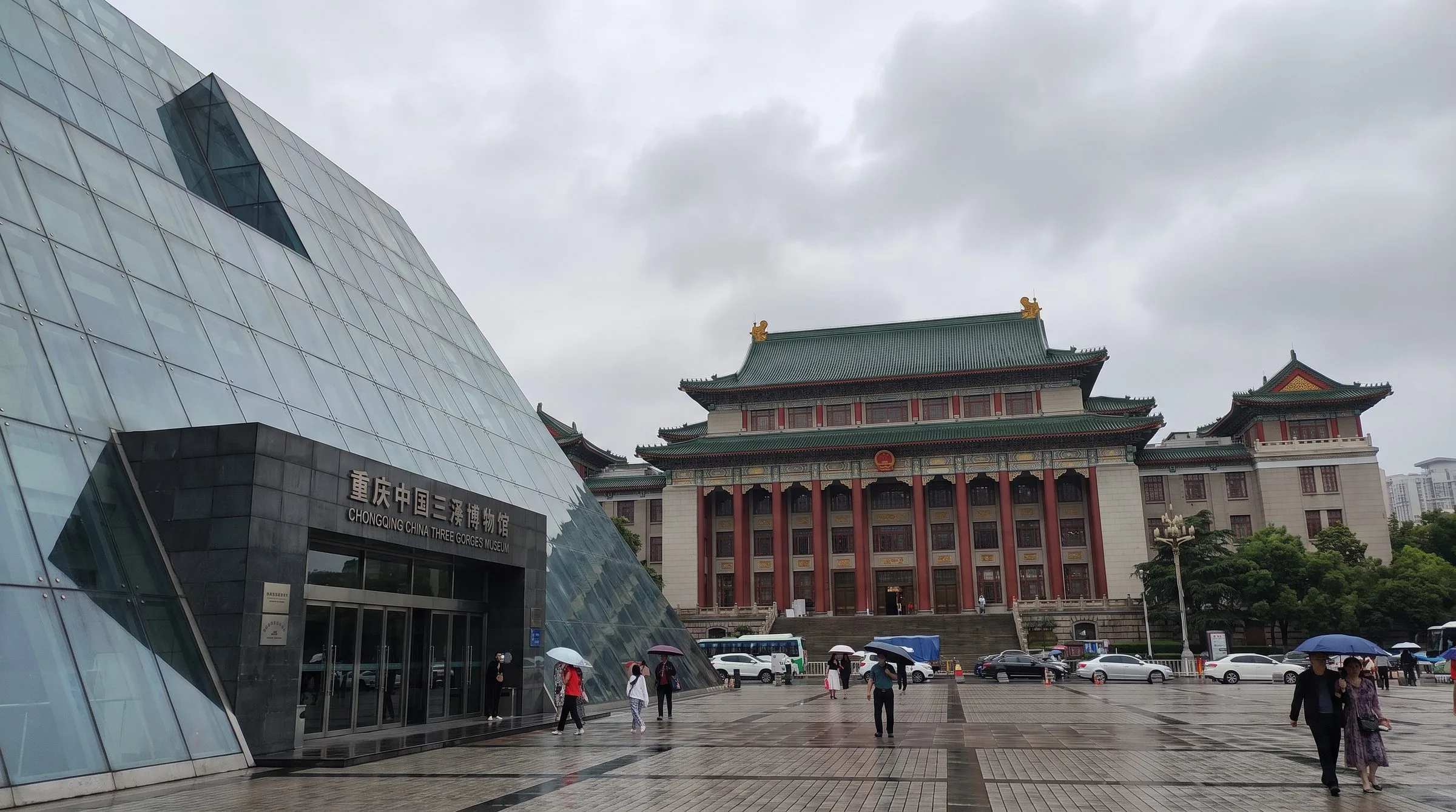
Three Gorges Museum (重庆中国三峡博物馆)
重庆中国三峡博物馆 · Chóngqìng Sānxiá Bówùguǎn
Quick answer
Free entry with passport. Foreigners can book via the museum's WeChat mini-program (use the Chinese version, not the tourist version) or reserve at the visitor center on the day. The audio guide is in English; the gallery signage is bilingual (Chinese + English). The staff at the visitor center speak basic English.
Why visit
- 1 Free entry — the only major museum in Chongqing that is free for all visitors, including foreigners
- 2 4 floors, 30+ permanent galleries, 180,000+ artifacts — the largest collection in western China, focused on the Three Gorges region and the Ba-Shu culture (the ancient civilization of the Sichuan basin)
- 3 The Three Gorges Dam gallery — a comprehensive 2-floor exhibit on the world's largest hydroelectric dam (built 1994-2012), with scale models, original construction equipment, and 50+ years of pre-dam photographs
- 4 Modern, climate-controlled, English-friendly — opened in 2005, designed by the Chinese Academy of Architectural Design. The most visitor-friendly museum in Chongqing
- 5 Next door to the People's Great Hall (人民大礼堂) — the iconic 1950s Soviet-style building, also free to enter, can be combined in a single 4-5 hour visit
- 6 Air-conditioned refuge from Chongqing's summer heat (35°C+) and winter damp — a perfect 3-4 hour escape from the weather
Essential tips for foreigners
- Reserve 1-7 days in advance via the museum's WeChat mini-program. Without a reservation, you may have to wait in a 30-60 min line at the visitor center, especially on weekends. The mini-program is in Chinese; non-Chinese speakers can reserve at the visitor center on the day with passport.
- Buy the ¥20 English audio guide at the visitor center — the gallery signage is bilingual but the audio gives much more context. The 4-hour audio tour covers all 30+ galleries with 200+ individual stops.
- Start at the top floor (4F) and work down — the museum's narrative flows from the ancient Ba-Shu culture (4F) → Three Gorges history (3F) → Three Gorges Dam construction (2F) → modern Chongqing (1F). Most tour groups start at 1F and work up, which is the wrong order.
- Allow 3-4 hours minimum — the museum is huge (4 floors, 30+ galleries, 180,000+ artifacts). Most visitors who plan for 90 min end up rushing. Allocate 4 hours for the main galleries, 5-6 hours if you want to see special exhibitions.
- Combine with the People's Great Hall next door — the 1950s Soviet-style auditorium is also free to enter, with a 30-45 min self-guided tour. The two buildings share the same Renmin Road frontage, so the natural flow is: museum 09:00-13:00 → lunch → People's Great Hall 14:00-15:00 → People's Square 15:00-16:00.
- Avoid Mondays and Chinese national holidays — the museum is closed Mondays (except holidays, when it is mobbed with school groups). Best on Tuesday-Thursday mornings, when the galleries are peaceful.
Suggested route
- 09:00 20 min Arrive at the museum. Reserve entry at the visitor center (if no advance booking) or scan the WeChat mini-program QR code at the entrance (if pre-booked). Pick up the ¥20 English audio guide
- 09:20 1 hour Start at the 4F — the Ba-Shu culture galleries. Ancient Shu bronzes, Sanxingdui-style artifacts, the mysterious Ba culture of the Yangtze River
- 10:20 1 hour Move to 3F — the Three Gorges history galleries. The Three Gorges region's 5,000-year history, from the Ba culture to the Tang dynasty
- 11:20 1.5 hours Move to 2F — the Three Gorges Dam gallery. The world's largest hydroelectric dam: scale models, original construction equipment, photographs from 1950s-2010s
- 12:50 1 hour Move to 1F — the modern Chongqing galleries. The wartime capital (1937-1945), the 1949 revolution, the 1997 municipality status, the 2010s boom
- 13:50 1 hour Lunch at the museum café (basic Chinese food, ¥40-80/person) or at a nearby restaurant in the People's Square area
- 14:50 45 min Walk across the square to the People's Great Hall (人民大礼堂). 30-45 min self-guided tour of the 1950s Soviet-style auditorium. Free entry, English signage
- 15:35 — Walk through People's Square, then take metro Line 2 from Zengjiayan back to central Chongqing (Jiefangbei or Hongya Cave), 10 min
- 15:45 — Optional: continue to Jiefangbei (1 stop) or Xiaoshizi (2 stops) for the late-afternoon / evening experience
The free municipal museum that tells the 5,000-year story of the Three Gorges region
The Three Gorges Museum (重庆中国三峡博物馆 Chóngqìng Zhōngguó Sānxiá Bówùguǎn) is Chongqing’s only municipal-level comprehensive museum, opened in 2005 to document the history and culture of the Three Gorges region and the Ba-Shu civilization of the Sichuan basin. The museum is free to enter, 4 floors, 30+ permanent galleries, and 180,000+ artifacts — the largest collection in western China.
The museum is the most visitor-friendly museum in Chongqing, with full English signage, an English audio guide, climate-controlled galleries, and a central location next to the People’s Great Hall. It is the single best place in Chongqing to understand the historical and cultural context of the Yangtze River, the Three Gorges Dam, and the Ba-Shu culture that pre-dated Chinese civilization in the Sichuan basin.
What the foreigner experience looks like in 2026
The museum is one of the most foreigner-friendly in China. The galleries are bilingual (Chinese + English), the audio guide is in English (¥20), the staff at the visitor center speak basic English, and the building is fully wheelchair accessible. The main practical challenge is the reservation system — the museum requires advance booking for all visitors.
The main thing to know is the museum’s narrative flow. The 4 floors are organized chronologically from top to bottom:
- 4F: Ancient Ba-Shu culture (2,000+ years ago to 316 BC) — Sanxingdui-style bronzes, the mysterious Ba culture of the Yangtze, the ancient Shu kingdom
- 3F: Three Gorges history (316 BC to 1911 AD) — the Three Gorges region’s 2,000+ years of history, from the Qin dynasty to the end of the Qing
- 2F: Three Gorges Dam construction (1911 AD to 2012) — the world’s largest hydroelectric dam, built 1994-2012, with scale models and original construction equipment
- 1F: Modern Chongqing (1911 to present) — the wartime capital (1937-1945), the 1949 revolution, the 1997 municipality status, the 2010s boom
Most tour groups start at 1F and work up, but the chronological flow is clearer from top to bottom. Plan 1 hour per floor, 3-4 hours for the main galleries, 5-6 hours if you want to include special exhibitions and the museum café.
The 4 floors: what to see
4F — Ba-Shu culture: The museum’s most artistic galleries, focused on the 4,000-year-old Ba-Shu civilization that pre-dated Chinese civilization in the Sichuan basin. The highlight is the bronze gallery, with 2,000+ year-old ceremonial weapons, ritual vessels, and the mysterious bronze masks that echo the famous Sanxingdui finds. The Ba culture was a sophisticated bronze-working civilization with extensive trade networks along the Yangtze. It was eventually absorbed by the Qin dynasty in 316 BC.
3F — Three Gorges history: The 2,000+ year history of the Three Gorges region, from the Ba culture to the end of the Qing dynasty. The galleries trace the development of river trade, the rise of the boatman culture, the emergence of Chongqing as a major port, and the impact of the Yangtze on the region’s economy and culture. The galleries are less visually striking than 4F, but they provide essential context for understanding the Three Gorges Dam and the modern Yangtze.
2F — Three Gorges Dam: The museum’s most popular gallery, documenting the construction of the Three Gorges Dam — the world’s largest hydroelectric dam. Built 1994-2012, the dam is 2,335m long, 185m tall, with 32 main generators producing 22,500 MW of power. The gallery includes a 5-meter detailed scale model, original construction equipment, photographs from 1950s (when the project was first proposed) to 2012 (when the last generator came online), and exhibits on the environmental and social impact (1.3 million people were relocated, 13 cities and 1,500+ villages were submerged).
1F — Modern Chongqing: The 100+ year history of modern Chongqing, from the 1911 revolution to the present. The highlight is the wartime capital gallery, documenting Chongqing’s role as China’s capital during the Japanese invasion (1937-1945). The galleries cover the 1949 Communist revolution, the 1997 designation as a direct-control municipality, and the 2010s economic boom that turned Chongqing into one of China’s largest cities. The galleries are the most emotionally resonant, especially for visitors interested in modern Chinese history.
The Three Gorges Dam gallery: the single must-see
The 2F Three Gorges Dam gallery is the most impressive single exhibit in the museum. The gallery is comprehensive, with:
- A 5-meter detailed scale model of the dam, showing the dam structure, the 5-tier ship locks, the 32 main generators, and the 660-km-long reservoir
- Original construction equipment, including a 3-meter-diameter tunnel-boring machine used to excavate the dam’s spillways
- Photographs from 1950s (when Mao Zedong first proposed the project) to 2012 (when the last generator came online)
- A documentary film (15 min, English subtitles) on the dam’s construction, with original footage from 1994-2012
- Exhibits on the 1.3 million people who were relocated, the 13 cities that were submerged, and the 1,500+ villages that disappeared
- A debate section on the environmental impact — the dam reduced the Yangtze’s sediment load by 60%, increased downstream flooding risk, and caused the extinction of the Yangtze river dolphin (the baiji, declared functionally extinct in 2007)
The gallery is balanced and honest, presenting both the benefits (clean energy, flood control, navigation improvement) and the costs (1.3 million displaced people, environmental damage, cultural heritage lost). It is one of the most thoughtful museum exhibits in China.
The People’s Great Hall next door
The museum shares a square with the People’s Great Hall (人民大礼堂), one of Chongqing’s most iconic buildings. The Great Hall was built in 1954 in the Soviet style, with green-tile roofs, red columns, and a 4,500-seat main auditorium. It hosted the first Chongqing People’s Congress and remains an important political venue.
The Great Hall is free to enter, with a 30-45 min self-guided tour. The interior is open to visitors when not in use for events; the most photogenic angle is from across the square, with the museum in the foreground and the Great Hall in the background. The natural flow is: museum 09:00-13:00 → lunch → People’s Great Hall 14:00-15:00 → People’s Square 15:00-16:00.
Final tip
Start at the top floor (4F), not the ground floor (1F). The museum’s narrative flows from ancient (top) to modern (bottom). Most tour groups start at 1F and work up, which is the wrong order. By starting at 4F and working down, you follow the chronological story from the Ba-Shu culture (4,000 years ago) to the modern Chongqing (today). The transition from the ancient bronzes on 4F to the Three Gorges Dam on 2F is the museum’s most powerful narrative moment — 4,000 years of history in 2 floors.
Best photo spots
-
Main entrance and People's Great Hall view · Anytime, 09:00-17:00
The museum's modern glass-and-stone facade, with the iconic People's Great Hall (a 1950s Soviet-style building with green-tile roofs and red columns) visible directly behind. The classic Chongqing composition — modern museum + historic political architecture in the same frame.
-
4F Ba-Shu bronze gallery · Anytime, 09:00-17:00
The 2,000-year-old Ba-Shu bronze artifacts — ceremonial weapons, ritual vessels, and mysterious bronze masks. The most photogenic gallery in the museum. Low light, bring a higher ISO setting.
-
2F Three Gorges Dam scale model · Anytime, 09:00-17:00
A 5-meter detailed scale model of the Three Gorges Dam, the world's largest hydroelectric dam. The model is illuminated, allowing you to see the dam structure, the 5-tier ship locks, and the 32 main generators. The most impressive single exhibit in the museum.
-
1F wartime capital gallery · Anytime, 09:00-17:00
The gallery documents Chongqing's role as China's wartime capital (1937-1945) during the Japanese invasion. Photographs, propaganda posters, and personal artifacts. The most emotionally resonant gallery in the museum.
-
People's Great Hall (next door) · Anytime, 09:00-17:00
The 1950s Soviet-style auditorium with green-tile roofs, red columns, and a 4,500-seat main hall. The most iconic political architecture in Chongqing. The interior is open to visitors; the exterior is the most-photographed angle from across the square.
Where to eat nearby
-
Museum café (4F)
Basic Chinese food — fried rice, noodle soup, coffee, pastries. Functional, not memorable. Good for a quick lunch between galleries · ¥40-80/person · Inside the museum, 4F
-
People's Square restaurants
Local Chongqing food — hotpot, Sichuan cuisine, Chongqing small noodles. Multiple options within 5-10 min walk · ¥60-150/person · 5-10 min walk from the museum, around the People's Square
-
Zengjiayan hotpot street
Chongqing hotpot cluster — 10+ hotpot restaurants within a 5-min walk. Less famous than Jiefangbei but cheaper and more local · ¥80-130/person · 5 min walk from Zengjiayan metro station, near the museum
-
Convenience store snacks
Bread, fruit, instant noodles, drinks. Convenient if you want to snack between galleries · ¥10-30/person · Multiple convenience stores within 5 min walk of the museum
Frequently asked questions
How much does the Three Gorges Museum cost?
Free entry to the main galleries. The English audio guide is ¥20. Special exhibitions (3-4 per year, on rotation) charge ¥20-50. The museum is one of the few free world-class museums in China. Foreigners pay the same price; passport required at the visitor center for foreigners without a Chinese phone number.
Is the Three Gorges Museum worth visiting?
Yes — it is the most visitor-friendly museum in Chongqing and the only one with comprehensive English signage. The collection is focused on the Three Gorges region and the Ba-Shu culture, with the world's largest exhibit on the Three Gorges Dam. Foreign visitors who want to understand the history and context of the Yangtze region will find it invaluable. The museum is also a great rainy-day or hot-summer refuge.
How do I get to the Three Gorges Museum from central Chongqing?
Three options. 1) Metro Line 2 to Zengjiayan (曾家岩) station, Exit B, 5 min walk. 2) Metro Line 1 or 6 to Xiaoshizi (小什字), then 15 min walk north. 3) Didi directly, 15-20 min from anywhere in central Yuzhong, ¥20-30.
What is the best time to visit the Three Gorges Museum?
Tuesday-Thursday morning, 09:00-12:00. The museum is least crowded on weekday mornings; weekends and Chinese national holidays are mobbed with school groups. The 4-floor museum takes 3-4 hours to see properly, so plan for a 09:00-13:00 visit or a 13:00-17:00 afternoon visit.
How long do I need at the Three Gorges Museum?
3-4 hours for the main galleries (4 floors, 30+ permanent galleries). 5-6 hours including the audio guide, special exhibitions, and the museum café. 2 hours for a quick highlights tour. The museum is much larger than it looks from the outside — the 4 floors span 30,000+ square meters.
Do I need a reservation?
Yes — the museum requires advance reservation for all visitors, including foreigners. Reserve 1-7 days in advance via the museum's WeChat mini-program (三峡博物馆). Non-Chinese speakers without a Chinese phone number can walk in with passport and reserve at the visitor center on the day, but expect 30-60 min wait during peak times.
Are there English signs at the Three Gorges Museum?
Yes — all 30+ permanent galleries have bilingual signage (Chinese + English). The audio guide is in English, Japanese, and Korean. The visitor center staff speak basic English. For deeper context, hire a Chongqing tour guide (¥500-800/day) in advance.
Can I use Alipay at the Three Gorges Museum?
Yes — the audio guide rental and the special exhibitions all accept Alipay and WeChat Pay. The museum café accepts mobile payments too. Foreign credit cards are not reliably accepted; mobile wallet or cash (¥50-100) is the safe choice. Entry itself is free, so no payment is needed at the door.
What is the difference between the Three Gorges Museum and the Chongqing Museum?
There is no Chongqing Museum — the Three Gorges Museum IS the Chongqing Museum (重庆中国三峡博物馆 literally translates to 'Chongqing China Three Gorges Museum'). It is the only municipal-level comprehensive museum in Chongqing. There are smaller thematic museums in the city (the Chongqing Natural History Museum, the Chongqing Art Museum), but for a single comprehensive visit, this is the one.
Is the Three Gorges Museum wheelchair accessible?
Yes — the museum is fully wheelchair accessible. Elevators between all 4 floors, ramps at all entrances, accessible restrooms on each floor, and wheelchairs available for loan at the visitor center (free with passport). The galleries are spacious and well-lit, with benches every 20-30m for resting.