
Dazu Rock Carvings (大足石刻)
大足石刻 · Dàzú Shíkè
Quick answer
No special entry restrictions. Foreigners need a passport to buy tickets (the system requires ID). No guided tour required; English audio guide available for ¥20 at the visitor center. Most signage at the sites is bilingual (Chinese + English).
Why visit
- 1 UNESCO World Heritage Site since 1999 — one of only 57 UNESCO sites in China, and the only Chongqing site on the list
- 2 70,000+ Buddhist sculptures carved into cliff faces — the largest collection of Buddhist rock art in China, spanning the Tang, Song, and Ming dynasties (7th-17th centuries)
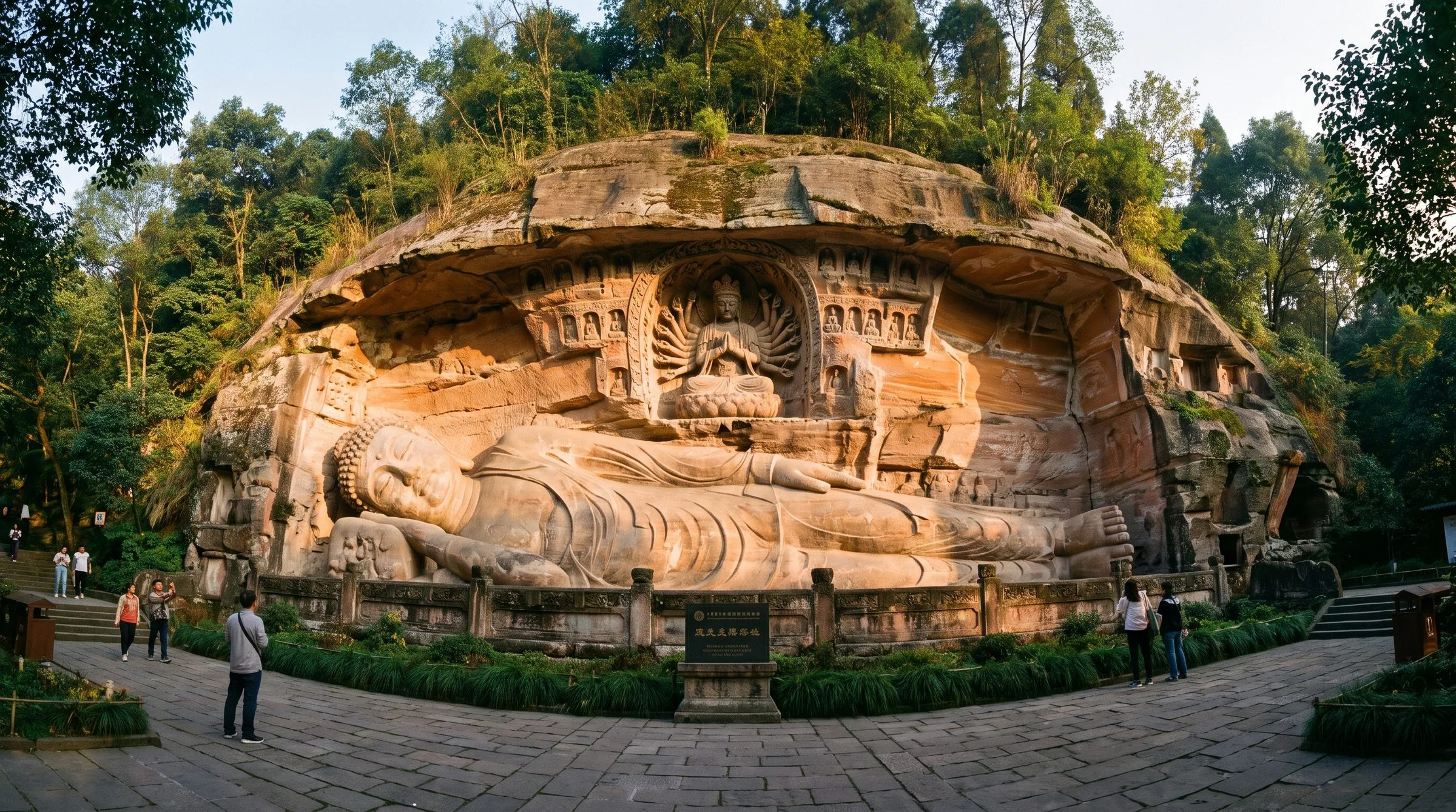
- 3 Baodingshan (宝顶山) — the most spectacular site, with a 31-meter reclining Buddha, a 1,000-arm Guanyin, and 10,000+ life-size figures arranged in a single 500-meter-long grotto
- 4 North Hill (北山) — the oldest site, with 10,000+ Tang-Song dynasty carvings in 290 grottoes, more refined and intimate than Baodingshan
- 5 Day-trip from Chongqing — 1.5-2 hours by high-speed train, full-day visit, return by evening
- 6 Multilingual audio guide (¥20) — Chinese, English, Japanese, Korean, French, German. Recommended for first-time visitors; the carvings have complex Buddhist iconography
Essential tips for foreigners
- Take the high-speed train from Chongqing North Station — 30 min, ¥30-50, every 30-60 min from 07:00. Faster and cheaper than a chartered car. From Dazu Station, Bus 205 to North Hill or Didi to Baodingshan.
- Start at North Hill, then Baodingshan — the chronological order makes the art history clearer (North Hill = older Tang-Song, Baodingshan = more recent Song). Many tour groups do the reverse, but the experience is better chronological.
- Buy the ¥20 English audio guide at the visitor center — the carvings are visually striking but the iconography is complex. The audio explains each major sculpture's Buddhist symbolism, the artists, and the historical context.
- Bring sunscreen, hat, water, and snacks — the sites are outdoor with limited shade. The walkways are 3-4 km total. Most restaurants at the sites are overpriced (¥60-100/person for mediocre food). Bring your own.
- Avoid weekends and Chinese national holidays — May 1-3, Oct 1-7, Chinese New Year week: 30,000+ visitors per day, queues 2+ hours, you cannot see the carvings. Weekday visits are peaceful.
- Hire a chartered car for the day (¥600-800) if you are 3+ people — combines train + Didi + bus into a single door-to-door experience. The driver waits at each site; you set the pace. Best for groups.
Suggested route
- 07:00 30 min Take high-speed train from Chongqing North Station to Dazu Station (30 min, ¥30-50). Buy tickets in advance via Trip.com or 12306.cn
- 07:30 40 min Arrive at Dazu Station. Take Bus 205 to North Hill visitor center (40 min, ¥5) or Didi directly (¥40, 20 min)
- 08:10 — Buy combined ticket (¥140) and English audio guide (¥20) at the North Hill visitor center. Start the visit
- 08:15 2.5 hours Walk the North Hill circuit — 10,000+ Tang-Song carvings in 290 grottoes. Audio guide covers the highlights (Peacock King, Thousand-Arm Guanyin, reclining Buddha)
- 10:45 25 min Take Didi to Baodingshan visitor center (15 km, ¥40, 25 min)
- 11:10 50 min Lunch at the Baodingshan visitor center restaurant (¥60-100/person) or eat your own packed lunch
- 12:00 3.5 hours Start the Baodingshan circuit — the Great Buddha Bend (31-meter reclining Buddha), the 1,000-Arm Guanyin, the Ten Thousand Buddha Grotto. Audio guide covers the iconography
- 15:30 25 min Take Didi back to Dazu Station (¥40, 25 min) for the return train to Chongqing
- 15:55 30 min Take high-speed train back to Chongqing North Station (30 min, ¥30-50)
- 16:30 — Arrive in central Chongqing. Optional: dinner at Jiefangbei or Hongya Cave (1.5 hours away)
The 70,000-figure Buddhist cliff carvings that earned UNESCO status in 1999
The Dazu Rock Carvings (大足石刻 Dàzú Shíkè) are a series of Buddhist, Confucian, and Taoist sculptures carved into cliff faces in Dazu District, 1.5-2 hours by high-speed train from central Chongqing. The carvings span the 7th-17th centuries, with the bulk of the work from the 9th-13th centuries (late Tang, Song, and early Ming dynasties). There are 70,000+ carved figures across 5 major sites, with the two main sites — North Hill and Baodingshan — containing the most spectacular work.
The carvings are unique in world art history for three reasons. First, the scale: 70,000+ figures in one geographic area, rivaling the cave complexes of Ajanta (India), Bamiyan (Afghanistan), and Dunhuang (Gansu). Second, the naturalistic Song-dynasty style: the carvings at Baodingshan depict realistic human figures, daily-life scenes, and complex Buddhist iconography in a way that broke from the more stylized Tang-dynasty tradition. Third, the religious syncretism: the carvings blend Buddhist, Confucian, and Taoist themes, reflecting the unique religious climate of Song-dynasty Sichuan.
In 1999, the Dazu Rock Carvings were inscribed on the UNESCO World Heritage List — the only Chongqing site on the list, and one of only 57 UNESCO sites in China.
What the foreigner experience looks like in 2026
The Dazu Rock Carvings are a full-day trip from Chongqing. The carvings are in a rural area 1.5-2 hours away, so the visit takes 8-10 hours round-trip. Most foreign visitors do it as a day trip from central Chongqing, with the following pattern:
- 07:00 — High-speed train from Chongqing North Station to Dazu Station (30 min, ¥30-50)
- 08:00 — Arrive at Dazu, take Bus 205 or Didi to North Hill (40 min)
- 09:00-12:00 — North Hill visit
- 12:00-13:00 — Lunch
- 13:00-16:30 — Baodingshan visit
- 17:00 — Return train to Chongqing
- 18:00-19:00 — Back in central Chongqing
The main thing to know is that the carvings are visually spectacular but culturally complex. The iconography draws on 1,000+ years of Buddhist, Confucian, and Taoist symbolism, and the visual experience is much richer with the ¥20 English audio guide.
The two main sites: North Hill vs Baodingshan
North Hill (北山, Beishan) is the older, more refined site. The carvings here were made between the late Tang dynasty (847 AD) and the Southern Song dynasty (1239 AD), a span of about 400 years. The 290 grottoes contain 10,000+ figures, with the most famous being the Peacock King Grotto (孔雀明王窟) and the Thousand-Arm Guanyin (千手观音). The art is delicate, refined, and classical — the typical Tang-Song style with elegant Buddhist figures, flowing robes, and subtle iconography. The visit takes 2-3 hours. North Hill is in Dazu city itself, walkable from the railway station with a 30-min walk or a 5-min Didi.
Baodingshan (宝顶山, Baoding Mountain) is the newer, more spectacular site. The carvings were made in a single 60-year burst (1179-1249 AD) under the direction of a single Buddhist monk, Zhao Zhifeng, who hired a master sculptor named Wen Shengyun. The 10,000+ figures are arranged in a single 500-meter-long grotto system, with a 31-meter reclining Buddha, a 1,000-arm Guanyin, the Life-Cycle Wheel, and the Ten Thousand Buddha Grotto as the highlights. The art is dramatic, narrative, and naturalistic — Song-dynasty realism at its peak. The visit takes 3-4 hours. Baodingshan is 15 km from Dazu city, a 25-min Didi ride.
For first-time visitors, the chronological order (North Hill first, then Baodingshan) makes the artistic evolution clearer. Tour groups often do the reverse, but the experience is richer with the older art first.
The 31-meter reclining Buddha and the Life-Cycle Wheel
The two most iconic carvings at Dazu are both at Baodingshan.
The Great Buddha Bend (大佛湾) is a 31-meter-long reclining Buddha, depicting the Buddha’s passage into nirvana. The figure is carved into a 100-meter cliff face, with the 1,000-arm Guanyin in a separate niche above. The reclining Buddha’s serene face, the 32 carved attendants surrounding him, and the 1,000-arm Guanyin (each hand holding a different Buddhist symbol) together form the single most impressive Buddhist sculpture in China outside Dunhuang.
The Life-Cycle Wheel (六道轮回图) is a 3-meter carved stone wheel depicting the Buddhist cycle of life, death, and rebirth. The wheel is divided into six segments (the six realms of Buddhist cosmology: gods, demi-gods, humans, animals, hungry ghosts, and hell beings), with a central figure representing impermanence. The carving is the most-photographed single image at Dazu, and the most reproduced in Chinese Buddhist art history textbooks.
Final tip
The audio guide is non-negotiable. The carvings are visually spectacular, but the iconography is dense: each major figure has 5-10 layers of Buddhist meaning (mudra hand positions, body posture, accompanying symbols, color coding, narrative scene). Without the audio, you see beautiful carvings. With the audio, you understand why they are a UNESCO World Heritage Site. The ¥20 is the best money you will spend at Dazu.
Best photo spots
-
Baodingshan — Great Buddha Bend (大佛湾) · Mid-morning, 10:00-12:00 (best light on the reclining Buddha)
The 31-meter reclining Buddha carved into the cliff face, with the 1,000-arm Guanyin above. The largest single carving at Baodingshan. The most iconic Dazu shot. The carved figure of the dying Buddha, 31m long, with the 1,000-arm Guanyin (each hand holding a different Buddhist symbol) in a separate niche above. Best photographed in the morning when the sun lights the cliff face from the east.
-
Baodingshan — Life-Cycle Wheel (六道轮回图) · Midday, 11:00-13:00
A 3-meter carved stone wheel depicting the Buddhist cycle of life, death, and rebirth. The most-photographed single carving at Dazu for its intricate detail and symbolic depth. Best with a telephoto lens to capture the small carved figures around the wheel.
-
North Hill — Peacock King Grotto (孔雀明王窟) · Anytime, 09:00-16:00
The largest grotto at North Hill, with a 3-meter carved peacock and the Peacock King bodhisattva. The Tang-dynasty art is more refined and intimate than Baodingshan. The grotto is dimly lit; bring a higher ISO setting or a tripod.
-
North Hill — Thousand-Arm Guanyin (千手观音) · Midday, 11:00-14:00
A Song-dynasty carved Guanyin with literally 1,000 carved hands, each holding a different Buddhist symbol. The most refined carving at North Hill. Best with a wide-angle lens to fit the whole figure.
-
Baodingshan — the Ten Thousand Buddha Grotto (万佛殿) · Anytime, 09:00-17:00
A circular grotto with 10,000+ small Buddha figures carved into the walls and ceiling. Walking inside is one of the most atmospheric experiences at Dazu. A wide-angle lens with a high ISO setting captures the immersive effect.
Where to eat nearby
-
Dazu Xianshui Fish (大足咸水鱼)
Freshwater fish from local reservoirs, prepared in 5 Sichuan styles (boiled, braised, deep-fried, with pickled vegetables, with chili). A Dazu regional specialty · ¥80-150/person · Multiple restaurants in Dazu city, 5-10 min Didi from the sites
-
Dazu Tofu Feast (大足豆腐宴)
A traditional banquet of 20+ tofu dishes — braised, fried, fermented, stuffed, in soup. A Dazu specialty dating to the Tang dynasty · ¥150-250/person · Specialty restaurants in Dazu city; book ahead for the full feast
-
Visitor center restaurant (Baodingshan)
Basic Chinese food — fried rice, noodle soup, stir-fried vegetables. Functional, not memorable · ¥40-80/person · Inside the Baodingshan visitor center, walking distance from the carvings
-
Pack your own lunch
Sandwiches, fruit, snacks from Chongqing before you leave. The on-site restaurants are overpriced and the queues are long during peak season · ¥20-50/person · Buy at any supermarket in Chongqing before the train
Frequently asked questions
How much do the Dazu Rock Carvings cost?
¥140 per person for the combined ticket (North Hill + Baodingshan + Small Buddha Bay). Single-site tickets: North Hill ¥80, Baodingshan ¥100. Add ¥20 for the English audio guide. Shuttle buses between sites are extra (¥10-20 per ride) or take a Didi. Foreigners pay the same price as Chinese; passport required.
What is special about the Dazu Rock Carvings?
Three things. First, the scale: 70,000+ Buddhist sculptures across 5 sites, the largest collection in China and one of the 4 great rock-carving sites in the world (along with Ajanta in India, Bamiyan in Afghanistan, and Dunhuang in Gansu). Second, the artistic style: the Song-dynasty carvings at Baodingshan are uniquely naturalistic, with realistic human figures, daily-life scenes, and Confucian/Taoist/Buddhist syncretism. Third, the historical span: the carvings were made over 1,000 years (7th-17th centuries), with the bulk from the 9th-13th centuries.
How do I get to Dazu from Chongqing?
Three options. 1) High-speed train from Chongqing North Station to Dazu Station, 30 min, ¥30-50, every 30-60 min. Then Bus 205 to North Hill or Didi to Baodingshan. Total: 1.5-2 hours each way. 2) Chartered car (¥600-800 round-trip), 1.5-2 hours each way, door-to-door. 3) Long-distance bus from Chongqing Chenjiaping bus station to Dazu, 2 hours, ¥50-70. The train is the fastest and most reliable.
What is the best time to visit Dazu?
March-May and September-November for the best weather (15-25°C, low humidity). Avoid Chinese national holidays (May 1-3, Oct 1-7, Chinese New Year week) — 30,000+ visitors per day, queues 2+ hours. Avoid summer (35°C+ heat, midday sun). Winter (December-February) is the least crowded but the carvings are harder to see in low light. Weekday morning (09:00-12:00) is the most peaceful.
How long do I need at Dazu?
Full day (6-8 hours) for all 3 sites. 4-5 hours for the 2 main sites (North Hill + Baodingshan). 2-3 hours for one site. Most independent visitors do the 2 main sites in a day trip from Chongqing: 07:00 train, 09:00 North Hill, 12:00 lunch, 13:00 Baodingshan, 16:00 return, 19:00 back in Chongqing. Tour groups do it in 5-6 hours with rushed visits.
Are there English signs at Dazu?
Yes — most of the major carvings have bilingual plaques (Chinese + English) explaining the iconography. The visitor centers and museums at both sites have full English signage. The audio guide (¥20) is available in English, Japanese, Korean, French, and German. Most staff at the visitor center speak basic English.
Can I use Alipay at Dazu?
Yes — the ticket counter, restaurants, and souvenir shops all accept Alipay and WeChat Pay. Link a Visa/Mastercard to Alipay before you arrive. The site is in a rural area, so foreign credit cards are not reliably accepted; cash (¥200) is a useful backup.
Is Dazu wheelchair accessible?
Mostly no — the sites are cliff faces with hundreds of stone steps. The visitor centers and main paths at both North Hill and Baodingshan are wheelchair-accessible, but reaching the actual carvings requires climbing stairs. North Hill is more accessible than Baodingshan (some grottoes are at ground level). A few carved panels at each site are visible from the main path without climbing.
What is the difference between North Hill and Baodingshan?
North Hill (北山) is the older, more refined site — 10,000+ Tang-Song dynasty carvings in 290 grottoes, focused on Buddhist figures and bodhisattvas. The art is more delicate, more classical. Baodingshan (宝顶山) is the newer, more spectacular site — 10,000+ Song dynasty carvings by a single master artist, with 31-meter reclining Buddha, 1,000-arm Guanyin, and life-size daily-life scenes. The art is more dramatic, more narrative. North Hill takes 2-3 hours, Baodingshan takes 3-4 hours.
What should I bring to Dazu?
Sun protection (hat, sunscreen, sunglasses), 1-2 liters of water, snacks (the on-site restaurants are overpriced), comfortable walking shoes (3-4 km of stone paths and stairs), light raincoat (the sites are exposed). For photography: a wide-angle lens for the 31-meter reclining Buddha, a polarizing filter to cut the glare on the stone, and a tripod is allowed (but not flash).