
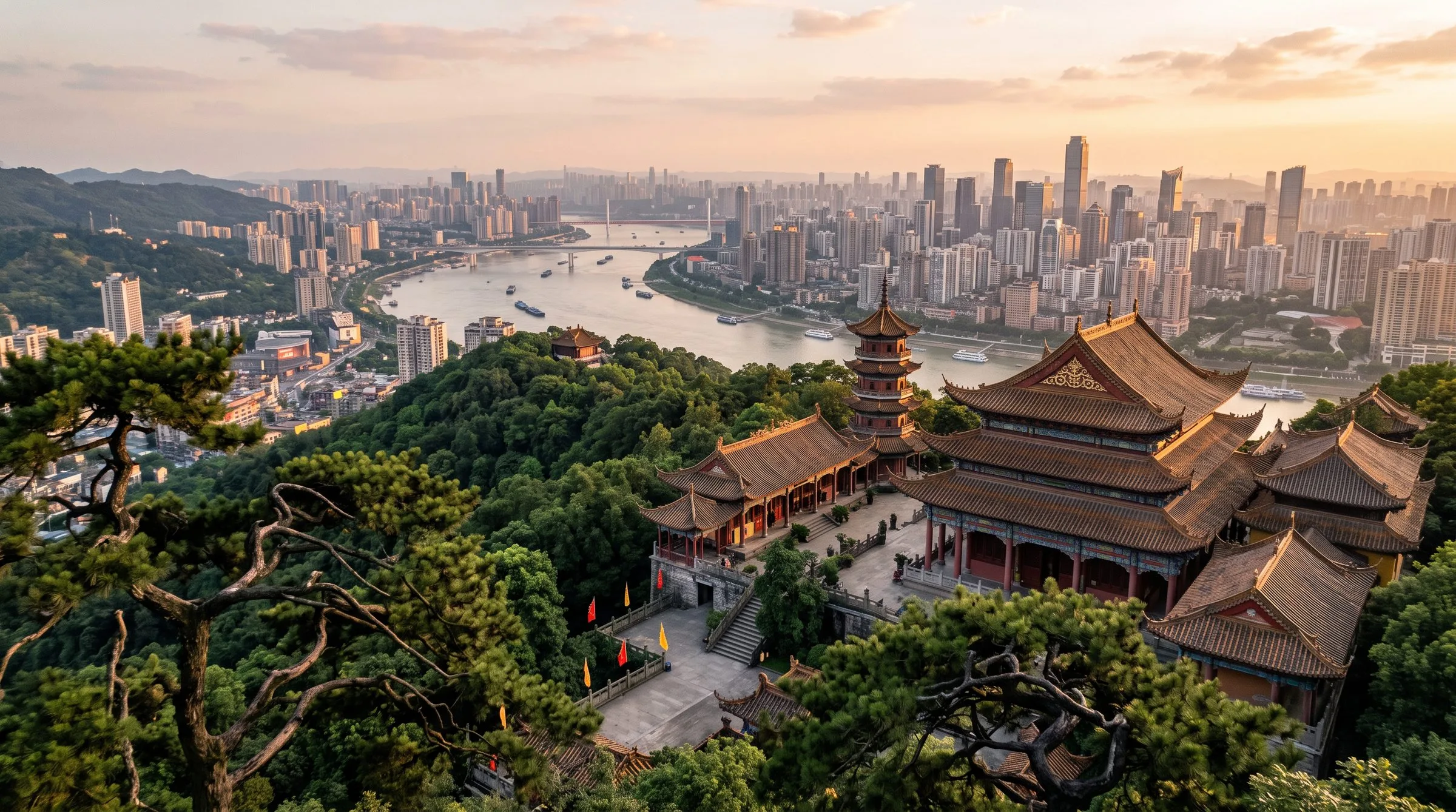
Nanshan Temple (南山)
南山 · Nánshān
Quick answer
No entry restrictions. The temple is open to all visitors, no ID check. The Nanshan Pagoda is climbable by anyone. The botanical garden is the same. Alipay and WeChat Pay accepted; cash as backup.
Why visit
- 1 1,000 years of Buddhist history — Nanshan Temple (涂山寺) was founded in the late Tang dynasty (around 800 AD), making it one of the oldest Buddhist sites in Chongqing
- 2 7-story Nanshan Pagoda (南山塔) — a modern (2004) 7-story Buddhist pagoda with a panoramic view of the Yangtze River and central Chongqing. ¥5 to climb, 360° view from the top
- 3 Best sunset view in Chongqing — the mountain is on the south bank of the Yangtze, directly facing central Chongqing. The sunset view of the skyscrapers lit up across the river is the most-photographed view in the city
- 4 Free to enter — the temple, halls, gardens, and meditation areas are all open access
- 5 Spring cherry blossoms (March-April) — the Nanshan Botanical Garden (next door) has 1,000+ cherry trees, drawing 100,000+ visitors during the 2-week peak bloom
- 6 Famous Nanshan spring chicken (南山泉水鸡) — a free-range chicken dish cooked in mountain spring water with Sichuan peppercorns. The mountain has 50+ restaurants specializing in this dish
Essential tips for foreigners
- Go at 16:00-18:00 for the sunset view — the late-afternoon light hits the Yangtze River and the central Chongqing skyscrapers on the north bank. The view from the pagoda is the single best sunset shot in the city.
- Climb the Nanshan Pagoda (¥5) — 7 stories, 168 steps, 360° view from the top. The pagoda is modern (2004) but the view is timeless: Yangtze River, central Chongqing skyline, Jialing River confluence to the west, and the mountains to the south.
- Combine with a Nanshan spring chicken dinner — the mountain has 50+ restaurants specializing in the dish. The classic place is 竹楼泉水鸡 (Bamboo Building Spring Chicken), 10 min walk from the temple. ¥150-200/person for the full dish.
- Take a Didi, not the bus — Bus 383 from Shangxinjie takes 40 min and stops at the bottom of the mountain. Didi goes door-to-door in 30-40 min, ¥40-60, and saves 30 min of walking. Especially useful at night when the bus service is sparse.
- Visit in spring (March-April) for the cherry blossoms — the adjacent Nanshan Botanical Garden has 1,000+ cherry trees, drawing 100,000+ visitors during the 2-week peak. The temple grounds themselves are peaceful year-round.
- Skip the Nanshan Botanical Garden on peak weekends — the cherry blossom weekends are mobbed (30,000+ visitors per day, 2-hour queues for entry). Go on a weekday morning or a non-peak weekend.
Suggested route
- 16:00 40 min Take a Didi from central Chongqing (Yuzhong district) to Nanshan Temple (30-40 min, ¥40-60)
- 16:40 40 min Arrive at the main entrance. Walk through the temple grounds — main hall, side halls, gardens, Buddhist sculptures. 30-40 min
- 17:20 30 min Climb the Nanshan Pagoda (¥5, 168 steps, 360° view). Reach the top in time for golden-hour light (17:30-18:00)
- 17:50 40 min Watch the sunset from the pagoda top or the temple grounds. The Yangtze and central Chongqing light up after dark (18:30+)
- 18:30 1.5 hours Walk 10 min down the mountain to 竹楼泉水鸡 (Bamboo Building Spring Chicken) for dinner. Try the spring chicken + mountain vegetables + local rice wine
- 20:00 40 min Take a Didi back to central Chongqing (¥40-60, 30-40 min)
- 20:40 — Arrive in central Chongqing. Optional: continue to Hongya Cave (10 min walk) for the light show from Qiansimen Bridge
The 1,000-year-old Buddhist temple with the best Yangtze view in Chongqing
Nanshan Temple (南山 Nánshān, literally “South Mountain”) is a 1,000-year-old Buddhist temple on the south bank of the Yangtze River, 30-40 minutes by Didi from central Chongqing. The temple is small (1 main hall, 2 side halls, and a meditation garden), but its location on a 580-meter mountain gives it a panoramic view of the Yangtze River and central Chongqing’s skyscrapers that is unmatched anywhere in the city. The adjacent Nanshan Pagoda — a modern 7-story pagoda built in 2004 — offers a 360° view from the top for ¥5.
The temple grounds are free to enter, the pagoda is ¥5, and the area is one of the most popular sunset and night-photography spots in Chongqing.
What the foreigner experience looks like in 2026
Nanshan is one of the most underrated experiences in Chongqing. Most tour groups skip it (it is not on the standard Great Wall / Forbidden City / Yangtze Cruise itinerary), so the temple is peaceful even on weekends. The experience is straightforward: take a Didi from central Chongqing, walk through the temple, climb the pagoda, watch the sunset, eat Nanshan spring chicken for dinner, take a Didi back.
The main thing to know is that the temple itself is small — first-time visitors typically spend 30-40 min in the main hall. The reason to come is the view, not the architecture. Plan to spend 1-2 hours at the pagoda and the sunset viewpoint, plus 1-1.5 hours for the spring chicken dinner.
The 1,000-year history of Nanshan
Nanshan Temple (涂山寺 Tushansi, sometimes called Nanshan Temple as the popular name) was founded in the late Tang dynasty, around 800 AD, making it one of the oldest Buddhist sites in the Chongqing area. The temple is built on the site of a legendary Xia dynasty (2070-1600 BC) ceremony — according to Chinese mythology, the great ruler Yu the Great (大禹) performed rituals here to control the Yangtze floods. The temple was built on the same site to commemorate the legend.
The temple flourished during the Song dynasty (960-1279 AD), when it was a major Buddhist learning center with 500+ resident monks. The Ming and Qing dynasties saw multiple rebuilds; the current structures are largely from the Qing dynasty (1644-1911 AD) and a 2004 restoration. The 7-story Nanshan Pagoda (南山塔) was added in 2004, replacing a Ming-dynasty pagoda that had collapsed in the 19th century.
In the 20th century, the temple suffered the same fate as most Chinese religious sites — damaged during the Cultural Revolution (1966-1976), partially restored in the 1980s, and fully revived in the 2000s. Today, it is an active Buddhist temple with 30+ resident monks and daily prayer sessions.
The Nanshan Pagoda and the Yangtze view
The 7-story Nanshan Pagoda is the most-photographed structure at Nanshan, and the single best viewpoint in Chongqing. The pagoda is 168 steps to the top, with each of the 7 floors featuring Buddhist sculptures, paintings, and calligraphy from local artists. The top floor is an open viewing platform with 360° views.
From the top, you can see:
- North: The Yangtze River and central Chongqing’s skyscrapers, with the Qiansimen Bridge and Hongya Cave clearly visible
- West: The Jialing River confluence, with the Chaotianmen dock area and the massive Chaotianmen Bridge
- South: The Nanshan mountains, with the botanical garden and the spring chicken restaurants
- East: The Yangtze River continuing east, with the bridges and the Nanbin Road waterfront
The best time to climb is 17:00-18:00, when the late-afternoon light hits the Yangtze and the central Chongqing skyscrapers. After sunset (18:30+), the city lights turn on, and the view is the most-photographed night scene in Chongqing. A tripod is recommended for the low-light photography.
The Nanshan spring chicken
The mountain is famous for a single dish: Nanshan spring chicken (南山泉水鸡). The dish is a free-range chicken from the Nanshan mountain farms, cooked in mountain spring water with Sichuan peppercorns, dried chilies, ginger, and garlic. The recipe dates to the 1980s, when a local farmer started serving it to hikers. It became famous in the 1990s, and today the mountain has 50+ restaurants specializing in the dish.
The classic place to try it is 竹楼泉水鸡 (Bamboo Building Spring Chicken), 10 min walk down the mountain from the temple. The chicken is served whole, with the cooking liquid as a dipping sauce. ¥150-200 per whole chicken, enough for 2-3 people. Pair it with mountain vegetables and local rice wine (¥30-50 per bottle) for the full experience.
The dish is spicy but not the mouth-numbing mala of Chongqing hotpot — the Sichuan peppercorns give a tingly, aromatic flavor, not the burning heat. Most foreign visitors who find Chongqing hotpot too spicy can handle Nanshan spring chicken.
Final tip
Go for sunset, stay for night photography. The sunset view (17:30-18:30) is the main draw, but the night view (19:00-21:00) is equally photogenic. The Nanshan Pagoda is open until 18:00 (closing time), but the temple grounds and the surrounding viewpoints are open until 21:00-22:00. Bring a tripod and a wide-angle lens; the blue hour (the 20-min window after sunset) is when the city lights and the sky are both visible.
Best photo spots
-
Nanshan Pagoda top (7th floor viewing platform) · Golden hour, 17:00-18:00
The 360° panoramic view from the pagoda's top. The Yangtze River and central Chongqing skyscrapers to the north, the mountains to the south, the Jialing River confluence to the west. The most iconic Chongqing sunset shot. Bring a wide-angle lens and a tripod for the best results.
-
Temple grounds, looking north · Sunset, 18:00-18:30
From the temple courtyard, looking north across the Yangtze River to the central Chongqing skyline. The skyscrapers light up at dusk, with the river reflecting the colors. A more intimate shot than the pagoda view.
-
Nanshan Botanical Garden cherry blossoms (March-April) · Morning, 08:00-10:00 (fewer crowds)
1,000+ cherry trees in bloom, drawing 100,000+ visitors during the 2-week peak. Best with a telephoto lens to compress the blossoms against the city skyline in the distance.
-
Yangtze Cable Car south terminal viewing platform · Late afternoon, 17:00-19:00
The cable car crosses the Yangtze between the north and south terminals. The south terminal viewing platform gives you the cable car + Yangtze + central Chongqing skyline in a single frame. Free access, 5 min walk from the south terminal.
-
Temple meditation garden (back of the temple) · Anytime, 09:00-17:00
A small Japanese-style garden with a pond, koi fish, and traditional Sichuan landscaping. The most peaceful spot in the temple. Best with a wide-angle lens for the full composition.
Where to eat nearby
-
竹楼泉水鸡 (Bamboo Building Spring Chicken)
Nanshan spring chicken — free-range chicken cooked in mountain spring water with Sichuan peppercorns, dried chilies, ginger, and garlic. The Nanshan signature dish · ¥150-200/person (whole chicken + sides) · 10 min walk down the mountain from the temple, 5 min from the bus stop
-
南山老火锅 (Nanshan Old Hotpot)
Chongqing mala hotpot with a view — the only hotpot restaurant on the mountain with a Yangtze River view · ¥120-180/person · 5 min walk from the temple entrance, on the main road down the mountain
-
泉水豆腐 (Spring Water Tofu)
Tofu made with Nanshan mountain spring water, served 5 ways: fried, steamed, in soup, cold with chili, with preserved vegetables. A local vegetarian specialty · ¥60-100/person · Multiple small restaurants on the main road, 5-10 min walk from the temple
-
Temple vegetarian restaurant (斋饭)
Simple Buddhist vegetarian meals — tofu, vegetables, rice, soup. No meat, no garlic, no onion. Tranquil setting, basic menu · ¥30-50/person · Inside the temple grounds, open during temple hours
Frequently asked questions
How much does Nanshan Temple cost?
Free to enter the temple. The Nanshan Pagoda is ¥5 per person to climb. The adjacent Nanshan Botanical Garden is ¥30 per person (separate venue). A typical 2-3 hour visit costs ¥5-35 per person including the pagoda and optional botanical garden.
What is Nanshan Temple famous for?
Three things. First, the Yangtze view — the mountain is directly across the river from central Chongqing, giving a panoramic view of the skyscrapers and bridges. Second, the 7-story Nanshan Pagoda — a modern 2004 pagoda with a 360° view from the top. Third, the Nanshan spring chicken — a free-range chicken dish cooked in mountain spring water that is a Chongqing regional specialty.
How do I get to Nanshan Temple from central Chongqing?
Three options. 1) Didi directly, 30-40 min, ¥40-60, door-to-door. 2) Metro Line 6 to Shangxinjie (上新街), then Bus 383 to Nanshan Temple (40 min, ¥5). 3) Didi to the Yangtze Cable Car south terminal, then walk 30 min up the mountain. The Didi is the easiest.
What is the best time to visit Nanshan Temple?
Late afternoon, 16:00-18:00. The sunset view of the Yangtze and central Chongqing is the highlight. The pagoda is best at golden hour (17:00-18:00 in autumn). Avoid weekends and Chinese national holidays — the temple gets crowded with day-trippers.
Is Nanshan Temple worth visiting?
Yes, for the view. The temple itself is small (1 main hall, 2 side halls) and not as impressive as Ciqikou or Baolun Temple. The reason to visit is the Yangtze view and the pagoda climb. First-time visitors typically spend 2-3 hours; serious photographers spend 4-5 hours (sunset, blue hour, and night city views).
Can I use Alipay at Nanshan Temple?
Yes — the temple ticket counter, the pagoda, and the surrounding restaurants all accept Alipay and WeChat Pay. Link a Visa/Mastercard to Alipay before you arrive. Cash (¥50-100) is a useful backup. Foreign credit cards are not reliably accepted at the small restaurants.
Are there English signs at Nanshan Temple?
Limited — the main hall has a small English plaque, but most of the temple signage is Chinese-only. The pagoda has no English signage, but the view is the same in any language. The temple staff speak basic English; for a deeper understanding, hire a Chongqing tour guide (¥500-800/day) in advance.
How long should I spend at Nanshan Temple?
2-3 hours for the temple + pagoda + view. 4-5 hours including a spring-chicken dinner at one of the mountain restaurants. 6-8 hours including the Nanshan Botanical Garden (especially in cherry blossom season). Most independent visitors do the 2-3 hour version; serious photographers and cherry-blossom fans do the longer versions.
What is the difference between Nanshan Temple and Ciqikou Temple?
Nanshan Temple is a small Buddhist temple on a mountain, with a Yangtze River view and a modern 7-story pagoda. Ciqikou (Baolun Temple) is a 1,000-year-old Buddhist temple in a preserved ancient town, with a 14-meter Song-dynasty wooden Buddha. Nanshan is for the view; Ciqikou is for the historic architecture. Nanshan is 30-40 min from central Chongqing; Ciqikou is 35-40 min. Both are worth visiting.
Is Nanshan Temple wheelchair accessible?
Mostly yes — the main temple grounds, halls, and gardens are flat and accessible. The pagoda is not accessible (168 steps, no elevator). The botanical garden has paved paths but the hilly terrain makes some sections difficult. The Nanshan spring chicken restaurants at the top of the mountain have step-free access.