
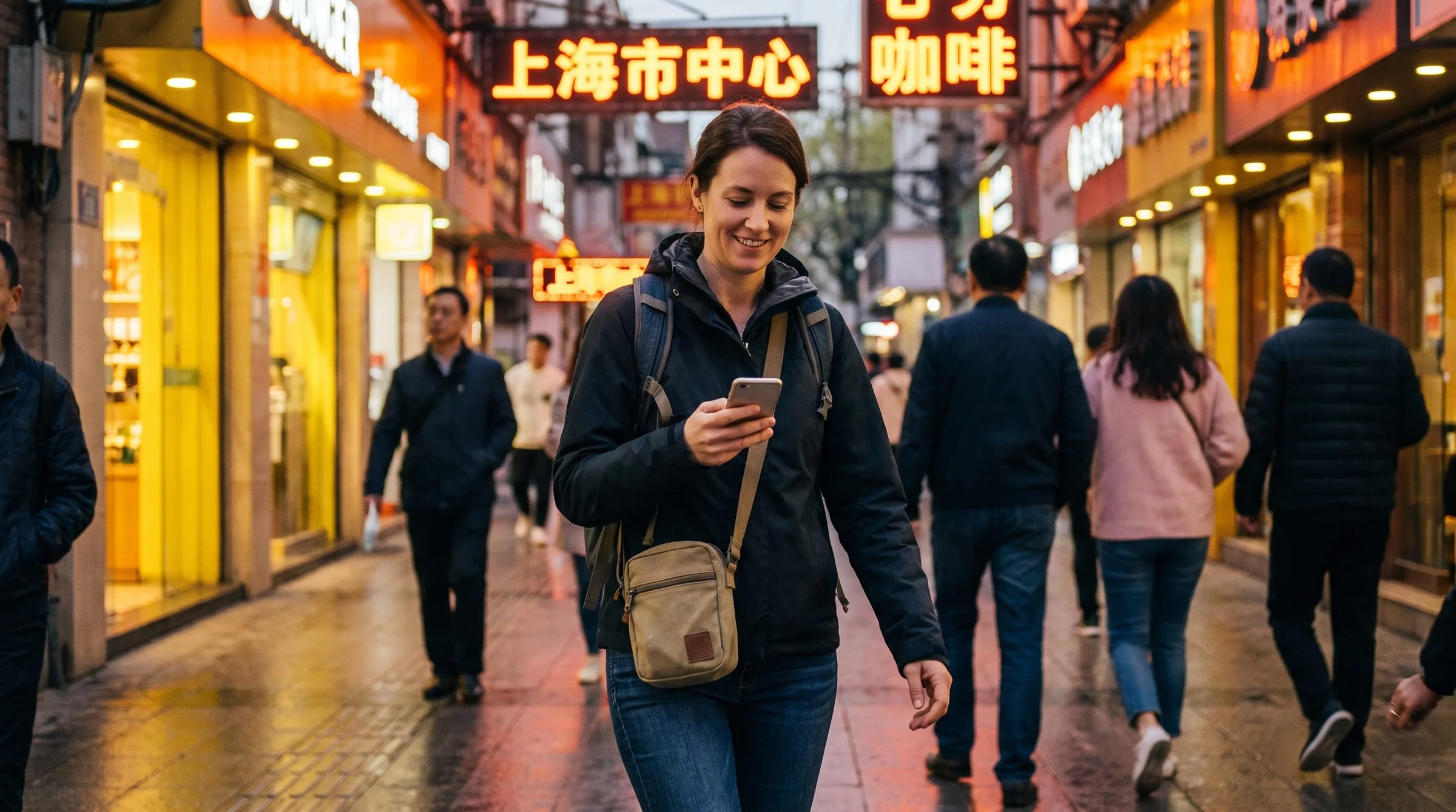
Solo Female Travel in China 2026: The Honest Safety Guide
China is statistically safe for solo female travellers, but the risk profile differs. The 4 scenarios that catch people out and the 2 to avoid.
China is statistically one of the safer large countries for solo female travelers. But the safety profile is structurally different from the West. Here’s what actually happens.
The 4 scenarios that catch solo female travelers
1. DiDi at night in tier-2 cities
Frequency: Very common (every solo female traveler uses DiDi) Risk: Low overall, but the rare incidents are serious Fix: Always share your ride. Always. The DiDi app has a 1-tap share button that sends your live location, driver name, plate number, and ETA to a chosen contact. This is the single most important daily safety habit for any solo traveler. Takes 0 extra seconds.
2. Hostel mixed dorms after 11pm
Frequency: Affects 20% of solo female hostel-stayers Risk: Verbal harassment, occasional physical boundary violation Fix: Book female-only dorms (女寝, nǚ qǐn) when available. If only mixed dorms are available, choose a top-rated hostel with strict check-in (passport required, no outside guests, 24/7 reception). Pack a small padlock for your locker. The ¥80-150/night upgrade to a private room is well worth it.
3. Tea ceremony / art student scam
Frequency: Affects 30% of solo female travelers in tourist areas Risk: ¥2,000-10,000 bill, occasional intimidation Fix: When a 20-30 year old Chinese man approaches you with “free” English conversation, “real Chinese” experience, tea house, art gallery, or bar — say 不要, 谢谢 (no thanks) and walk away. Don’t be polite; politeness is the scam’s main tool.
4. The “friendly local who wants to practice English”
Frequency: Same as tea ceremony scam, often the same people Risk: Leads to tea ceremony scam, art student scam, or fake bar Fix: Same as #3. The line 我老公在酒店等我 (my husband is at the hotel) is the most effective response in China, even if you’re not married.
The 2 scenarios where you should NOT travel solo
- Rural Guizhou / Yunnan remote trekking — ethnic minority areas, Miao and Dong villages, remote parts of Yunnan (Shangri-La, Lijiang remote). Get a group tour, a male companion, or a Chinese guide. The risk isn’t violent crime; it’s being stuck in a remote area with no English, no transport, and no way to communicate with locals. Cultural and language isolation is the real risk.
- Tibet (Lhasa, Everest base camp) — altitude sickness, limited medical care, language barrier even in the capital. The altitude alone (3,650m in Lhasa, 5,000m at EBC) can hospitalize you within hours. Add the language and medical barrier, and solo travel is genuinely risky. Group tour mandatory.
The 5 phrases every solo female traveler should learn
Save these in your phone’s notes and practice them out loud before your trip:
| Chinese | Pinyin | English | When to use |
|---|---|---|---|
| 不要 | bù yào | No thanks | Universal rejection |
| 我不需要 | wǒ bù xūyào | I don’t need it | Vendors, touts, scam approach |
| 请走开 | qǐng zǒu kāi | Go away | When someone won’t stop |
| 我要报警了 | wǒ yào bàojǐng le | I’m calling the police | When threatened or followed |
| 我老公在酒店等我 | wǒ lǎogōng zài jiǔdiàn děng wǒ | My husband is at the hotel | Anti-scam line — most effective in China |
The 3 places that are safer than you think
- Hotels in tier-1 cities — 24/7 reception, security cameras, key cards, English staff at 4-star+. The lobby is the safest place in any city.
- Chain restaurants — Starbucks, Haidilao, McDonald’s, KFC. Open late, English menu, staff will help you. The staff are trained to handle foreign customers.
- Police stations (派出所) — there is one in every Chinese city, usually within 1-2 km of any location. The police will help you, even with limited English. The 110 number connects to police nationwide.
What you should NOT bring
- No expensive jewelry — leave the diamond earrings at home. China is safe for violent crime, but a wedding ring on a foreign hand is a target for pickpockets in tourist areas.
- No revealing clothing — not for safety, but for cultural reasons. Tank tops, short shorts, and deep V-necks attract attention in tier-2 cities and rural areas. Tier-1 cities (Beijing, Shanghai) are fine. Tier-2 and below: cover shoulders and knees.
- No laptop visible in tourist areas — pickpockets target laptops in Wangfujing, Tiananmen, and metro stations. Keep it in a backpack, not a handbag.
- No “I don’t speak Chinese” assumption — Chinese scammers target foreigners who look like they don’t speak Chinese. Learning 10 basic phrases makes you look like a traveler, not a target.
What you should bring
- Padlock for hostel lockers (small combination lock)
- Doorstop alarm for private room doors
- Two different payment methods (foreign Visa + Alipay set up) — if one fails, you have backup
- Spare phone power bank — a dead phone in China is a serious safety issue
- A printed copy of your passport bio page — separate from your passport. If your passport is lost, this speeds up emergency replacement
- A list of your country’s embassy + 4-city consulates (Beijing, Shanghai, Guangzhou, Chengdu for most countries)
The 1 thing Westerners get wrong
Assuming Chinese safety advice for women is the same as Western advice. It isn’t.
In the West, the main safety risks for solo female travelers are: stranger harassment, catcalling, following, and physical assault. In China, the main risks are: targeted scams, tea ceremony/art student setups, and DiDi incidents at night. China does not have the same harassment patterns as Tokyo or Paris or NYC. Chinese people generally do not catcall or sexually harass foreign women in public — the social cost is too high. The “creepy local” trope that exists in Western media about China is largely inaccurate for the modern day.
The practical takeaway: don’t apply Western safety advice to China. Don’t walk home alone at 2am in any city. But don’t assume the specific risks are the same either. The 4 scenarios above (DiDi at night, hostel mixed dorms, tea ceremony scam, friendly local scam) are the actual risks. The fix is different for each.
Related guides
- First Time in China 2026 — Full first-trip playbook
- China Hotel Registration for Foreigners — 24-hour rule
- Lost Passport in China — Emergency procedure
- Cash or Card in China 2026 — Payment backup
Step by step
-
Pre-trip: register with your embassy + share itinerary with someone at home
US citizens: enroll in STEP (Smart Traveler Enrollment Program) at step.state.gov. UK citizens: use the FCDO travel registration. Canadian: ROCA program. Australian: smartraveller.gov.au. This costs 5 minutes and lets your embassy contact you in a major incident, helps them locate you if there's a regional crisis, and is free. Share your hotel itinerary with one trusted person at home — flight numbers, hotel names, city-by-city dates, embassy phone number.
-
Daily: share your DiDi ride with a contact (1-tap, 30 seconds)
Open DiDi, request a ride, then tap the share button (arrow icon, top right of the ride screen). DiDi sends a real-time link to a chosen contact — they can see your live location, driver name, plate number, and estimated arrival. This is the single most important daily safety habit. Cost: 0 seconds of extra time, 0 cost. Trains, subways, walking in tourist areas: no need to share. DiDi rides after 10pm, walks back to hotel at night, rides from train stations: always share. The DiDi share function uses a map link that auto-expires when the ride ends.
-
Choose accommodation: 4-star+ hotel or female-only hostel dorm
For solo female travelers, the 4-star international chain (Hanting Premium, Atour, Hilton, Marriott, IHG) is the safest option. Front desk 24/7, security cameras, key card access, well-lit, English-speaking staff. For hostels, choose female-only dorms (女寝) over mixed dorms. Top-rated hostels with strict check-in: Mifa Inn, Old School, Lost Cafe, Beijing Downtown Backpacker. Avoid party hostels near bar streets (Sanlitun Soho, Wudaokou, Xintiandi after 11pm). Private rooms in 3-star hostels are ¥80-150/night — the upgrade is worth it for first-time solo female travelers.
-
At night: DiDi or hotel-arranged car, never unmarked taxi or walking alone in non-tourist areas
After 9pm, take DiDi or have the hotel call a car. Never take an unmarked taxi, even if it looks clean. Never accept rides from strangers offering to 'take you somewhere good'. Never walk alone in non-tourist residential areas after dark — even 100m from a tourist street can be a different world in some Chinese cities. The exception: well-lit main streets in tier-1 cities (Beijing Wangfujing, Shanghai Bund, Chengdu Chunxi Road) are fine to walk after dark. If you find yourself in a sketchy area after dark, walk INTO the nearest hotel, restaurant, or shop, and order a DiDi from there.
-
The 5 phrases to learn (speak out loud, not just on phone)
(1) 不要 (bù yào) — 'no thanks' — universal rejection. (2) 我不需要 (wǒ bù xūyào) — 'I don't need it' — for vendors, touts, and scam approach. (3) 请走开 (qǐng zǒu kāi) — 'go away' — stronger, use when someone won't stop. (4) 我要报警了 (wǒ yào bàojǐng le) — 'I'm calling the police' — shows you know the system; 110 is the number. (5) 我老公在酒店等我 (wǒ lǎogōng zài jiǔdiàn děng wǒ) — 'My husband is at the hotel' — the most effective anti-scam line in China; can be said even if you're not married. Practice these out loud before your trip so they come out naturally.
-
If you feel unsafe: enter the nearest hotel, restaurant, or police station
The single most effective thing you can do if you feel unsafe: walk into a public place. Any 4-star+ hotel has English-speaking staff who will help you. Any chain restaurant (Starbucks, Haidilao, McDonald's) has staff who will help you. Police stations (派出所, pài chū suǒ) are everywhere in Chinese cities — the police will help you, even with limited English. The 110 emergency number connects to police nationwide; 120 connects to ambulance. The DiDi safety center in-app lets you report an incident and contact emergency services in one tap.
FAQ
-
Is China safe for a solo female traveler in 2026?
Yes, statistically. China has one of the lower violent-crime rates of any large country. The risks solo female travelers actually encounter in China are different from the West: targeted scams (tea ceremony, art student, fake monk) affect foreigners at higher rates than locals, but violent stranger crime is rare. The practical reality: violent stranger crime against female tourists is rarer than in the US or most of Europe. The main risks are: scam-induced high bills (¥2,000-10,000), DiDi incidents at night (always share ride), and hostel mixed-dorm harassment (request female-only dorm). Pre-trip research + standard precautions are enough for 95% of first-time solo female trips. -
Is the hostel mixed-dorm safe for a solo female traveler?
Mixed dorms (4-8 beds, mixed gender) are common in Chinese hostels and budget hotels. The legal and cultural reality: most solo female travelers report mixed dorms are fine in 4-star+ hostels (Hanting, Jinjiang, Atour) but uncomfortable in party-hostels near bars (Wudaokou in Beijing, Xintiandi in Shanghai). The best practice: book female-only dorms (女寝, nǚ qǐn) when available — most Chinese hostels offer this. If only mixed dorms are available, choose a top-rated hostel with strict check-in (passport required, no outside guests), pack a padlock for your locker, and bring a sleep sheet. Private rooms are ¥80-150/night; well worth the upgrade if budget allows. -
How do I handle being followed or approached by a 'friendly local'?
The most common scenario: a 20-30 year old Chinese man approaches you in a tourist area (Wangfujing, Tiananmen, West Lake) and starts a conversation in broken English. He compliments you, offers to show you a 'real Chinese' experience, suggests going to a tea house, art gallery, or bar. This is the tea ceremony scam or art student scam — the bill will be ¥2,000-10,000. The right response: smile, say '不要, 谢谢' (no thanks) or '我老公在酒店等我' (my husband is at the hotel — even if you're not married), and walk into the nearest shop, hotel, or restaurant. Do NOT continue the conversation, do NOT follow them anywhere. The scam relies on politeness; being rude is the right move.
Related guides
- Culture & Practical
Is It Safe to Travel to China in 2026? A Full Safety Guide
Yes, China is safe for visitors in 2026. Crime statistics, region-by-region risk, the 12 most common scams, and advice for solo women and LGBTQ+ travelers.
12min read
- Culture & Practical
Is Beijing Safe for Tourists in 2026? A District Guide
One of the world's safest capitals, but it varies by district. Which are safe at 2am, the 5 Beijing scams, and getting around safely.
- Culture & Practical
Is Guangzhou Safe for Tourists in 2026? A District Guide
Guangzhou is one of China's safest Tier-1 cities, but the profile differs from Beijing and Shanghai. Which districts are safe at 2am and the 4 local scams.
- Culture & Practical
Is Shanghai Safe for Tourists? A District Guide (2026)
One of the world's safest big cities, but very different from Beijing. Which districts are safe at 2am, the 5 foreigner scams, and maglev tips.
- Culture & Practical
Is Shenzhen Safe for Tourists in 2026? District Guide
China's safest Tier-1 city by every crime index — but watch for targeted scams: fake electronics in Huaqiangbei, touts at OCT, knockoffs in Luohu.
- Culture & Practical
Chinamaxxing 2026: 12 Everyday Chinese Experiences
The 2026 trend: hot water, park qigong, tea ceremony, tai chi, mahjong and hanfu — twelve experiences ranked by how easy they are to join.
9min read