
Huangshan (Yellow Mountain) Guide: Sunrise, Sea of Clouds, Trails (2026)
Huangshan (黄山, Yellow Mountain) in Anhui is a UNESCO World Heritage site famous for its sea of clouds, twisted pines, and granite peaks. This guide covers the 2-3 day plan, ticket prices (¥190-310), cable cars, sunrise timing, and Hongcun village.
Huangshan (黄山, Huángshān, literally “Yellow Mountain”) is in southern Anhui province, about 300 km west of Shanghai. The mountain has been a subject of Chinese landscape painting since the Tang dynasty (618-907 CE); Li Bai, the Tang poet, called it “the mountain I will never tire of.” It was inscribed as a UNESCO World Heritage Site in 1990, both for its natural granite landscape and for the cultural impact it had on Chinese art. For the best months to visit, April-May and September-November are the windows.
The mountain has 77 named peaks above 1,000m, with Lotus Peak (莲花峰) at 1,864m the highest. The four signature views are: the sea of clouds (云海), the sunrise (日出), the twisted pines (奇松), and the hot springs (温泉). The first three require being on the summit; the hot springs are at the base in the village of Hot Springs (温泉).
How to plan your 2- or 3-day trip
Option A: 2 days / 1 night (most common)
- Day 1 — Arrive Tangkou, take Yungu Cable Car to summit, walk to summit hotel, see sunset at Danxia Peak or Bright Summit. Sleep on the summit.
- Day 2 — Sunrise at Lion Peak, walk the North Sea loop, descend via Yuping Cable Car, see the Guest-Greeting Pine, return to Tangkou. Optional: Hongcun or Xidi ancient village on the way down.
Option B: 3 days / 2 nights (recommended)
Add a 2nd night on the summit. Day 2 is the West Sea Grand Canyon (the most dramatic granite valley), then return to a different hotel for a 2nd sunrise. Day 3 is the descent + Hongcun.
Option C: 4 days (with village side trip)
- Day 1: Hongcun and Xidi villages
- Day 2: Hot Springs + Yungu Cable Car up + sunset
- Day 3: Sunrise + North Sea loop
- Day 4: West Sea Grand Canyon + descend
Hike difficulty cheat sheet
The 5 main hiking routes on Huangshan. Most visitors combine 1-2 routes with cable cars; full summit-to-summit hiking is a serious undertaking (10-15 hours total, 2,000+ m elevation change).
| Trail | Distance | Time | Elevation | Difficulty |
|---|---|---|---|---|
| Yuping cable car → summit (玉屏索道上) | 0.5 km | 15 min | n/a (cable) | Easy — cable car covers the climb |
| Yuping Trail up (玉步登道, walk-up) | 7.5 km | 3-4 h | +1,000 m | Strenuous — 30,000+ stone steps, mostly shaded |
| Taiping Trail down (太平索道下) | 8 km | 3-4 h | -1,200 m | Strenuous — steep stone steps, knee-stressful |
| Beginning-to-End Peak trail (始信峰→鳌鱼峰→光明顶) | 5 km point-to-point | 2-3 h | +200 m net | Moderate — paved path, exposed at top |
| West Sea Grand Canyon loop (西海大峡谷) | 8 km loop | 3-4 h | +600 m / -600 m | Strenuous — narrow cliffside paths, optional 1-km “dream trail” plank detour |
Best for backpackers: take the Yungu (云谷) cable car up, walk the 5 km summit loop (Bright Summit + Beginning-to-End Peak + Flying Rock) in 3 hours, then take Yuping cable car down. This covers 80% of the iconic views without ever doing a serious climb. The West Sea Grand Canyon loop is the one serious hike — only attempt if you have a full day, sturdy shoes, and aren’t afraid of heights.
Drone rules (Yellow Mountain is a strict no-fly zone)
Drones are banned across the entire Huangshan UNESCO World Heritage core area under Anhui Provincial Order No. 9 (2019, updated 2023). The ban covers all four gates (Yuping, Taiping, Taiping North, Yungu), the entire summit area, the hot springs resort, and the sea-of-clouds viewing platforms. Penalties: drone confiscation, ¥5,000–20,000 fine, and Public Security Bureau filing for foreign passport holders. Huangshan is also inside military radar coverage — even a non-tourist drone flight at the trailhead parking lot has triggered military intercept responses.
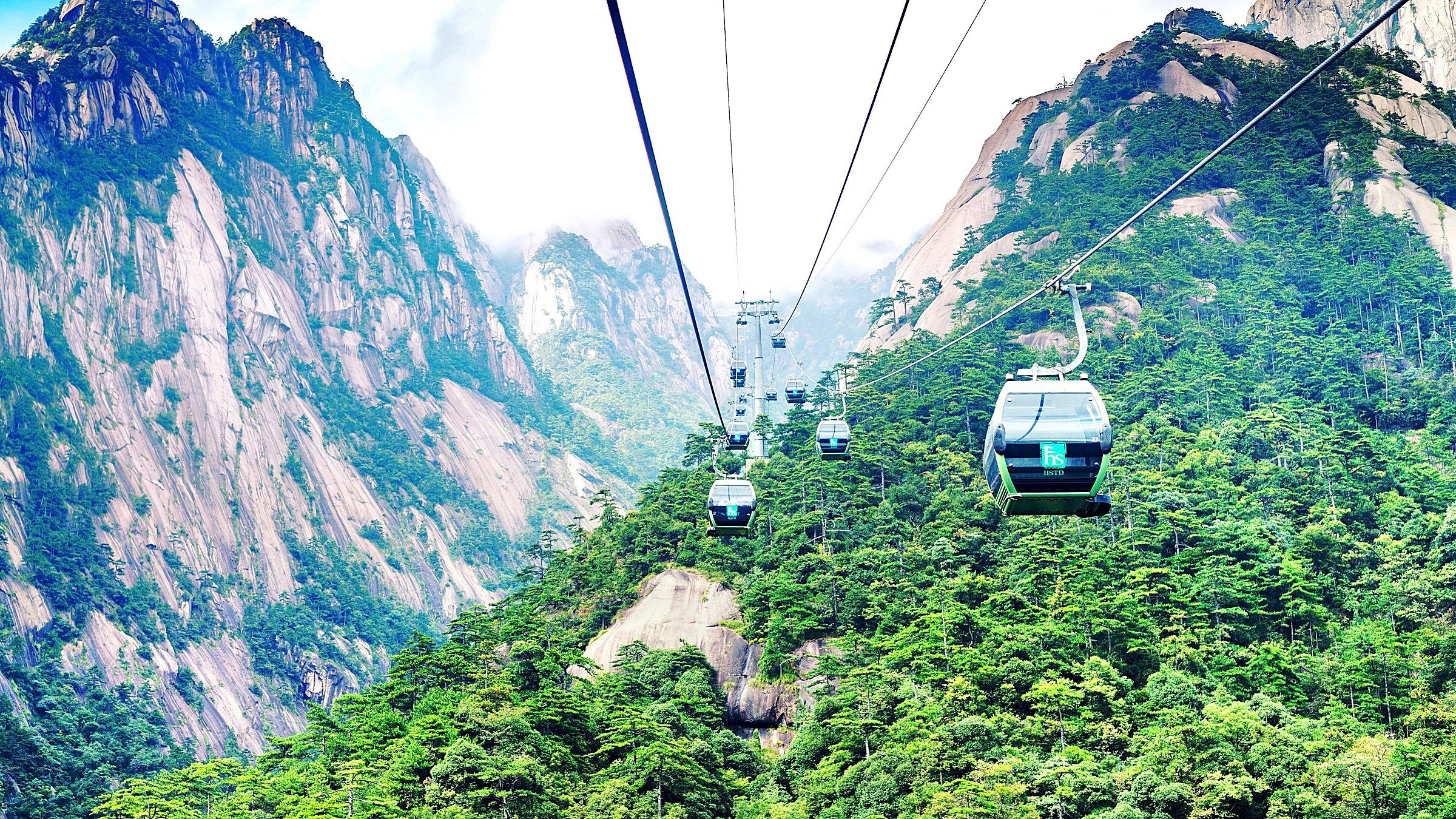
What you can do instead: Huangshan is one of the most-photographed mountains in China precisely because the sea-of-clouds, sunrise, and pine-on-cliff compositions are better from the ground than from above. The 2 most iconic shots — the Welcome Pine (迎客松) and the sea-of-clouds at Lion Peak — are both taken from permitted observation decks on the summit. For the high-angle “above the cloud” perspective, the Yuping cable car provides the same vantage the entire way up.
The signature views (and when to see them)
Sea of clouds (云海)
The sea of clouds is the most-celebrated Huangshan phenomenon. The mountains are at 1,800m, often higher than the cloud layer, and on still mornings the valleys fill with fog. Best vantage points: Lion Peak, Bright Summit, the West Sea Grand Canyon. Probability by season: 50-60% in winter, 30-40% in spring/autumn, 20-30% in summer. The Cloud-Sea Hotel posts a daily forecast on its WeChat (translation app needed).
Sunrise (日出)
The summit sunrise is the main reason people stay overnight. Best viewpoints in order: Lion Peak (most iconic, often in paintings), Danxia Peak (less crowded, 20-min walk from Lion Peak), Bright Summit (360° view but the sun rises behind a ridge). Sunrise times by month: 5:15 AM in June, 5:30 AM in July, 6:00 AM in September, 6:50 AM in late October. Be at the viewpoint 30 minutes early.
Twisted pines (奇松)
The pine trees of Huangshan grow out of granite cracks, twisted by wind into shapes that Chinese painters have copied for 1,000 years. The most famous: Guest-Greeting Pine (迎客松, Yingke Song, 1,000+ years old, on Yuping Peak, 24-hour guard), Seeing-Off Pine (送客松), and the Twin-Pine of Tianshi. There are 100+ named pines; the Guest-Greeting Pine is the only must-see.
Hot springs (温泉)
The Huangshan Hot Springs (黄山温泉) are at the base, 2 km from the south gate, ¥238/person for the spa complex. The water is 42°C year-round and rich in minerals. Best as a soak after a long day on the summit. Not a must-do but a popular add-on.
Tickets, booking, and payment
Combined ticket:
- Peak season (Mar 1 - Nov 30): ¥190
- Off-season (Dec 1 - Feb 28/29): ¥150
- Valid 2-3 days depending on date selected
Cable cars (one-way):
- Yungu (云谷): ¥90 (most popular, north side)
- Yuping (玉屏): ¥90 (south side, near Guest-Greeting Pine)
- Taiping (太平): ¥80 (west side, less crowded, longer ride)
How to book:
- In Alipay — Huangshan Smart Tour mini-program (search 黄山). E-ticket shows in your Alipay wallet. Passport number required.
- Trip.com — English, accepts foreign cards, ¥210 with service fee.
- At the south gate — passport required, queue can be 60+ min in peak season.
- Daily cap — 30,000 visitors. Pre-book in peak season to avoid being turned away.
Discounts: Children 1.2-1.4m half-price. Students with valid ID 50% off. Seniors over 65 free (passport required).
Getting there and around
By air: Huangshan Tunxi International Airport (TXN). Direct flights from Beijing, Shanghai, Guangzhou, Shenzhen, Xi’an, and 30+ Chinese cities. The airport is 60 km from the south gate; tourist shuttle bus is ¥30 (80 min), taxi ¥350.
By HSR: Huangshan North Railway Station (黄山北站) is on the Beijing-Fuzhou HSR line. Shanghai 2h 30m (¥180), Hangzhou 1h 30m (¥120), Beijing 5h (¥400), Nanjing 2h 15m (¥150). Tourist shuttle bus to Tangkou: ¥35, 80 min. For full HSR booking and seat-class tips, see our China high-speed rail guide. For comparison with other dramatic Chinese peaks (Zhangjiajie’s pillars, Emei’s Buddhist mountain, Daocheng Yading), see our China scenic wonders comparison — Huangshan is the granite-sea-of-clouds entry; Zhangjiajie is the Avatar-pillars entry, the closest visual cousin.
By bus: Long-distance buses from Hangzhou (4 hours, ¥110) and Hefei (5 hours, ¥140). Not recommended — HSR is faster.
From the city to the south gate: Tourist shuttle bus from Huangshan city (Tunxi) to Tangkou: ¥30, 60 min, every 30 min. Tangkou is the base for all climbs.
Inside the mountain: Free shuttle buses between the 3 cable car stations (Tangkou, Hot Springs, and Taiping). The summit area is connected by paved walkways and stone steps. No cars, no scooters — only foot traffic and the rare supply trolley.
What to bring
- Sturdy hiking shoes — the stone steps are uneven and slippery when wet. Sneakers are not enough.
- Layers — summit temperature is 8-12°C below the base. A fleece plus a windbreaker in summer, a down jacket in winter.
- Rain gear — a light, packable rain jacket. Disposable ponchos are sold in the park (¥10) but are flimsy.
- Water and snacks — food on the summit is 2-3x city prices. Noodles ¥50, instant coffee ¥30, bottled water ¥15-20. Bring 1-2L water and energy bars.
- Cash (¥200-300) — small vendors are cash-only. Most accept Alipay.
- Power bank — 20,000 mAh is enough for 2-3 phone charges. No outlets on the summit.
- Headlamp — required for pre-dawn sunrise walks. The summit is dark and the path is uneven.
- Sun protection — UV is strong at altitude. Sunscreen, hat, polarized sunglasses.
Summit hotels — what to book
There are 4 hotels on the summit. All include breakfast and dinner (the only realistic way to eat on the summit — restaurants are scarce and expensive). All book out 2-3 months ahead for October weekends.
- Beihai Hotel (北海宾馆) — north side, the largest, 4-star equivalent. Best for sunrise at Lion Peak (15-min walk). ¥1,200-1,600/night.
- Cloud-Sea Hotel (排云楼宾馆) — west of Lion Peak, 3-star. Best for the West Sea Grand Canyon. ¥900-1,200/night.
- Shilin Hotel (狮林大酒店) — at Lion Peak itself, 3-star. Closest to the best sunrise point. ¥800-1,100/night.
- Baiyun Hotel (白云宾馆) — south side, near the Yuping Cable Car. 3-star. Best for Guest-Greeting Pine. ¥900-1,300/night.
Dorm beds: The Baiyun Hotel annex and the Beihai Hostel have shared rooms (6-8 beds) for ¥300-500/night. The cheapest way to be on the summit for sunrise.
Common mistakes to avoid
- Climbing on rainy days. The stone steps become a slip hazard. The sea of clouds is more dramatic the day after rain, not during.
- Relying on cable cars in bad weather. They close for high winds (>50 km/h), thunderstorms, and ice. Always plan a 1-2 hour buffer.
- Skipping the Yuping Guest-Greeting Pine area. Most people take the Yungu cable car and miss it. The pine is the single most-photographed tree in China and worth a 30-min walk from the Yuping Cable Car top.
- Going on weekends or holidays. Daily cap of 30,000 is hit by mid-morning on Saturdays in October. Cable car queues can be 90+ min.
- Trying to do it as a day trip from Shanghai. Shanghai is 2h 30m by HSR, plus 80 min to Tangkou, plus 8 min cable car, plus 6 hours on the summit — the math doesn’t work. Stay overnight.
- Trusting Google Maps. Google services are blocked in China. Use Amap (高德地图) or Apple Maps. Inside the park, signs at the main viewpoints are bilingual; bus announcements are Chinese only.
Side trips from Huangshan
- Hongcun (宏村) — UNESCO Huizhou-style village, 30 km from the south gate. ¥104 ticket. Famous for the crescent pond (月沼) at the village center, framed by white-washed houses and stone bridges. Best in the early morning before tour buses arrive. Half-day trip.
- Xidi (西递) — UNESCO village 5 km further, smaller and quieter than Hongcun. ¥104 ticket (combo ticket with Hongcun is ¥180).
- Huizhou Old Town (徽州古城) — 25 km from Huangshan city. Free entry, pay per sight. Tang-dynasty street grid, the Memorial Archways (牌坊群, paifang), and the Ancient Government Office. 2-3 hours.
- Tunxi Old Street (屯溪老街) — historic street in Huangshan city, 1.5 km of Qing-dynasty architecture, free, lots of food. Easy 1-2 hour stop on the way to/from the airport.
Plan your trip — verified tools
These free tools are built on real, monthly-verified data and help you skip the trial-and-error phase of China trip planning:
- China 240-Hour Visa-Free Transit Checker — 55 countries, 24 provinces, 65 ports. See if you qualify for 10-day visa-free transit, which cities you can visit, and the 5-step process.
- China 6-City 5-Day Budget Calculator — Real 2026 prices for 5 days in Beijing, Shanghai, Guangzhou, Chengdu, Xi’an, or Hangzhou. Budget / mid-range / comfort tiers, broken down line by line.
Verified August 2026 by TravelHubChina Editorial. We re-check prices and policy details monthly so the data doesn’t drift.
Step by step
-
Fly or HSR to Huangshan City (Tunxi)
Fly into Huangshan Tunxi International Airport (TXN) — direct flights from Beijing (2h 15m), Shanghai (1h 30m), Guangzhou (2h), and 30+ other cities. Or take HSR to Huangshan North Railway Station (黄山北站) — 2h 30m from Shanghai (¥180), 5h from Beijing (¥400). The HSR station is 70 km from the south gate; airport is 60 km.
-
Transfer to the South Gate (Tangkou, 汤口镇)
From Huangshan city, take a tourist shuttle bus to Tangkou (¥30, 60 min). From HSR station, direct tourist bus to Tangkou (¥35, 80 min). Stay overnight in Tangkou the night before you climb — there are 50+ hotels from ¥150-500/night, and you can buy tickets and ride the first cable car at 6:30 AM without the 90-min bus ride from the city.
-
Buy the combined ticket (¥190 peak, ¥150 off-peak)
Buy at the south gate or in advance via the Huangshan Smart Tour mini-program inside Alipay (search 黄山). Combined ticket is valid for 2-3 days depending on the date you select. Passport required. Free for children under 1.2m and seniors over 65 (passport required).
-
Take the Yungu Cable Car to the summit (¥90)
The Yungu Cable Car (云谷索道) is the most popular route. 8 minutes, 1,156m vertical. The alternative is Yuping Cable Car (玉屏索道) from the south gate — closer to the Guest-Greeting Pine (the most-photographed tree) but longer queues. For sunrise, take Yungu up the afternoon before and stay overnight on the summit.
-
Walk the West Sea Grand Canyon and North Sea loop
From the summit, the classic 6-hour loop is: Yungu Cable Car top → Shixin Peak → North Sea → Lion Peak → Flying Rock → Bright Summit → descend via Yuping Cable Car. The West Sea Grand Canyon detour (1-2 hours) drops 400m into a valley of granite spires — do it before noon for the best light.
-
Stay one night on the summit for sunrise
Book summit hotels 2-3 months in advance for October (peak season). Options: Beihai Hotel (north, 4-star, ¥1,200-1,600), Cloud-Sea Hotel (mid, 3-star, ¥900-1,200), Shilin Hotel (west, 3-star, ¥800-1,100), Baiyun Hotel (south, ¥900-1,300). All include breakfast and dinner. The earlier you book, the lower the rate.
-
Catch the sunrise at Lion Peak or Danxia Peak
Sunrise times: 5:15 AM in June, 6:50 AM in October. Best vantage points: Lion Peak (狮子峰) for the classic 'pines + sea of clouds' shot, Danxia Peak (丹霞峰) for the second-best angle, Bright Summit (光明顶) for 360° views. Be at the viewpoint 30 minutes before sunrise. Bring a headlamp and a tripod.
-
Add Hongcun or Xidi village on the way down
Hongcun (宏村) and Xidi (西递) are UNESCO-listed Huizhou-style villages, 30-60 km from the south gate. Hongcun (¥104 ticket) is more photogenic — the crescent pond framed by white-washed houses. Xidi is smaller and quieter. Both are good for a half-day detour. Tourist bus to Hongcun is ¥25 from Tangkou.
FAQ
-
How many days do you need at Huangshan?
2 days / 1 night on the mountain is the minimum. This lets you catch both a sunrise and sunset and walk the west-sea-of-clouds loop. 3 days lets you add the North Sea pines, Lion Peak, and the lesser-visited West Sea Grand Canyon. Add a 4th day for Hongcun or Xidi ancient villages at the base. -
Do I need to book Huangshan tickets in advance?
Yes during peak season (April-May, October holidays). The combined ticket is capped at 30,000 visitors per day for safety and crowd control. Book via the Huangshan Smart Tour mini-program in Alipay 1-7 days ahead, or via Trip.com. Off-season (December-February) tickets are usually available same-day. -
How much does Huangshan cost for foreigners?
The combined ticket is ¥190 in peak season (Mar 1 - Nov 30) and ¥150 in off-season. Cable cars ¥65-90 one-way. A 2-day budget is ¥600-900 per person including ticket, 2 cable cars, 1 night at the summit, food, and a Hongcun visit. There is no foreigner surcharge — same price as Chinese citizens. -
Can you see the sea of clouds every day at Huangshan?
No — the sea of clouds requires specific weather: cool air below, warm above, light wind, recent rain. The probability is 50-60% in winter (Nov-Feb), 30-40% in spring and autumn, and 20-30% in summer. Cloud-Sea Hotel posts daily sunrise and sea-of-clouds forecasts on its official WeChat (English available via translation app). -
What is the best time of year to visit Huangshan?
April-May for azalea blooms and comfortable temperatures. September-November for autumn colors and the highest sea-of-clouds probability. December-February has snow and the smallest crowds but temperatures drop to -10°C at the summit. Avoid Chinese National Day (Oct 1-7) — daily visitors peak at the 30,000 cap. -
Is Huangshan suitable for seniors?
Yes, with planning. The cable cars (Yungu, Yuping, Taiping) eliminate 90% of the climbing. The summit area is mostly flat boardwalk and stone steps. The main issue is the altitude — Lotus Peak is 1,864m, and some visitors experience mild altitude symptoms. Avoid if you have severe heart, lung, or joint conditions. -
Can you stay overnight on the summit of Huangshan?
Yes. There are 4 summit hotels (Beihai Hotel, Cloud-Sea Hotel, Shilin Hotel, Baiyun Hotel) ranging from ¥800-1,800/night for a standard room in peak season. They book out 2-3 months ahead for October sunrise weekends. Dorm beds in shared rooms are available from ¥300-500/night at the Baiyun Hotel annex.
Related guides
-
Big Wild Goose Pagoda Guide: Xi'an's 1,300-Year Tang Pagoda
Big Wild Goose Pagoda (Dayan Ta) in Xi'an: 64m Tang-dynasty brick pagoda from 652 AD, UNESCO since 2014 as part of the Silk Roads network. Tickets (¥50), climb times, and the free North Square musical fountain (9 PM nightly).
-
Jinli Ancient Street Guide: Chengdu's Most Photogenic Old Quarter
Jinli Ancient Street in Chengdu: a reconstructed Qing-era street next to Wuhou Shrine, 350m long, free entry. Best at dusk when the red lanterns come on. Combine with Wuhou Shrine and Du Fu Thatched Cottage.
-
Kuanzhai Alley Guide: Chengdu's Wide and Narrow Alleys
Kuanzhai Alley (Wide and Narrow Alleys) in Chengdu: 3 parallel Qing-era courtyard streets, free entry, the upscale alternative to Jinli. Best for boutique teahouses, Sichuan opera, and a quieter old-China experience.