
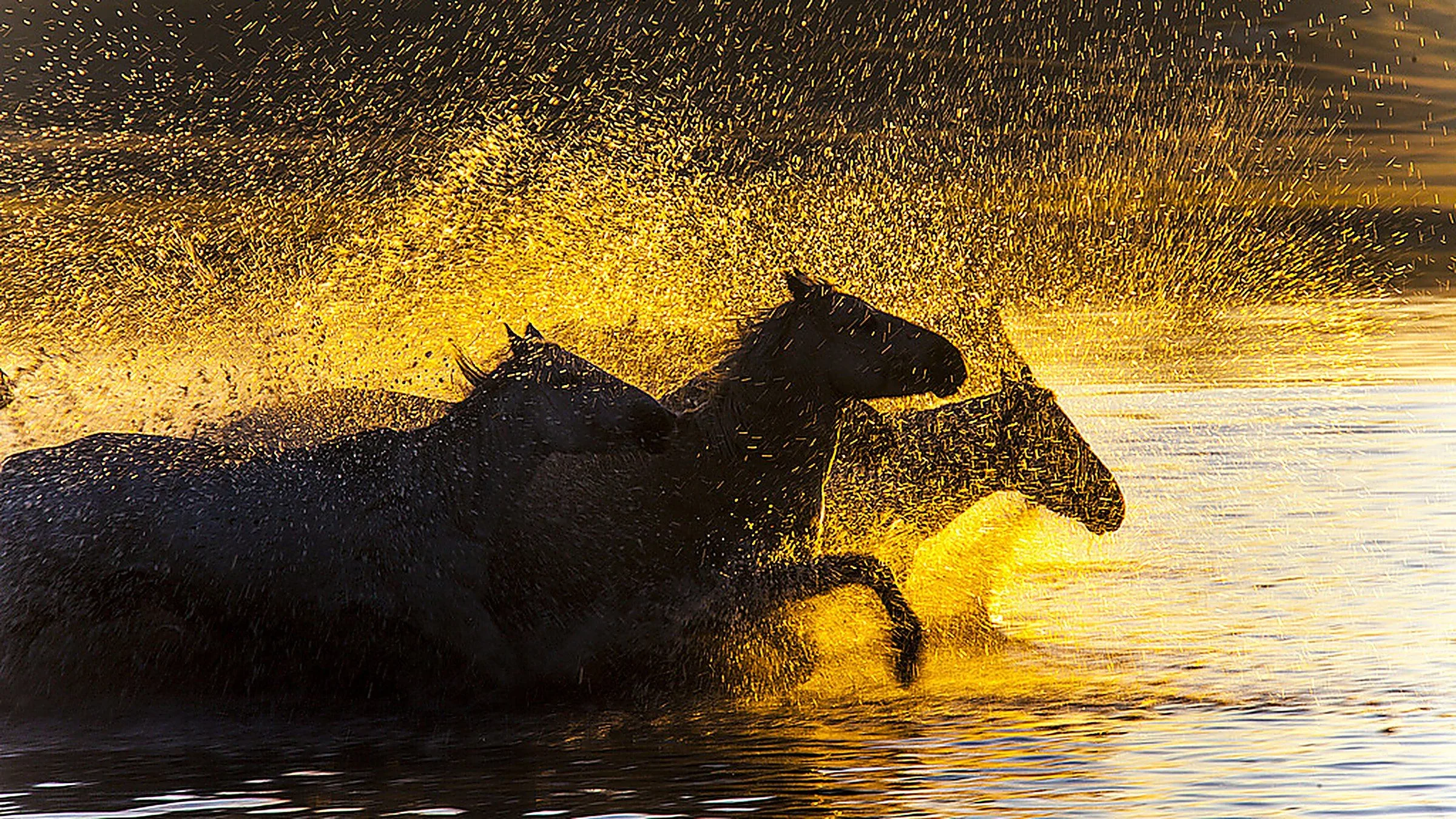
Hulunbuir Grassland Guide: China's Most Beautiful Prairie
Hulunbuir is China's largest grassland (100,000 sq km) in Inner Mongolia. Covers Ergun River, birch forest, Manzhouli, 4WD tours, yurt stays, and 4-5 day route.
Hulunbuir (呼伦贝尔, Hulunbei’er) is a prefecture-level city in northeastern Inner Mongolia, covering 263,953 sq km - larger than the United Kingdom. The name combines the Mongolian words for Hulun Lake and Buir Lake, the two large lakes at the heart of the region. The Hulunbuir grassland is the most intact temperate grassland ecosystem in the world, with 100,000 sq km of unbroken green steppe in summer and gold in autumn. For the best months to visit, late June to late August is the green season, late September to early October is peak autumn — these are the two real windows.
The grassland is bordered by Mongolia to the west, Russia to the north, and Heilongjiang province to the east. The Ergun River, which forms the border with Russia, is 1,620 km long. Manzhouli, at the western edge, is the largest land port of entry between China and Russia, and the architecture, food, and language reflect 100 years of cross-border Russian influence. Most visitors fly into Hailar, the regional capital, rent a 4WD, and drive the 1,200 km loop through the four most scenic stops: Erguna Wetland, Enhe Russian Village, Shiwei border town, and Manzhouli.
How to plan your 4-5 day trip
Day 1 - Hailar to Erguna (170 km)
Pick up the rental 4WD at Hailar Dongshan Airport. Drive 170 km north on the G301 highway, 3 hours. Stop at the Genghis Khan Horse Tourism Park (¥80) 20 km east of Hailar for the morning horse show. Lunch in Erguna town (northeastern Chinese noodle shops are common). Visit the Erguna Wetland (¥65) in the afternoon, allow 3 hours. Stay overnight in Erguna or drive 30 minutes further to Enhe.
Day 2 - Enhe to Shiwei (70 km)
Drive the unpaved road from Erguna to Enhe, 2 hours, with views of the Ergun River and Russian villages on the far bank. Lunch at a Russian log-cabin homestay in Enhe, ¥80-150 per person. Drive 1.5 hours to Shiwei in the afternoon. Stay overnight in a Russian-style wooden guesthouse, ¥200-400/night. Sunset on the Ergun River bluff.
Day 3 - Shiwei to Manzhouli via Hulun Lake (450 km)
Long driving day. Leave Shiwei at 7:00 AM, return to Erguna (2 hours), then west on the G301 to Hulun Lake (呼伦湖, 2 hours). Stop at Hulun Lake for 1 hour; this is China’s fifth largest freshwater lake, 2,339 sq km. Continue to Manzhouli (3 hours), arrive by 5:00 PM. Stay in Manzhouli 2 nights.
Day 4 - Manzhouli
Full day in Manzhouli. Morning: Matryoshka Square (¥148) and the Bear Museum (¥80). Lunch at a Russian restaurant, try borscht (¥40) and Russian dumplings (pelmeni, ¥60). Afternoon: walk the Sino-Russian trade market and the wedding photo plaza. Sunset at the border gate. Evening: the Matryoshka Square light show (included in ticket) starts at 8:30 PM and runs 40 minutes.
Day 5 - Return to Hailar and fly out
Drive 200 km from Manzhouli back to Hailar, 3 hours, all paved. Return the 4WD. Fly Hailar-Beijing in 2h 30m. If you have a buffer day, add a half day at the grassland east of Hailar (1.5 hours drive) for the most photogenic yurt camps.
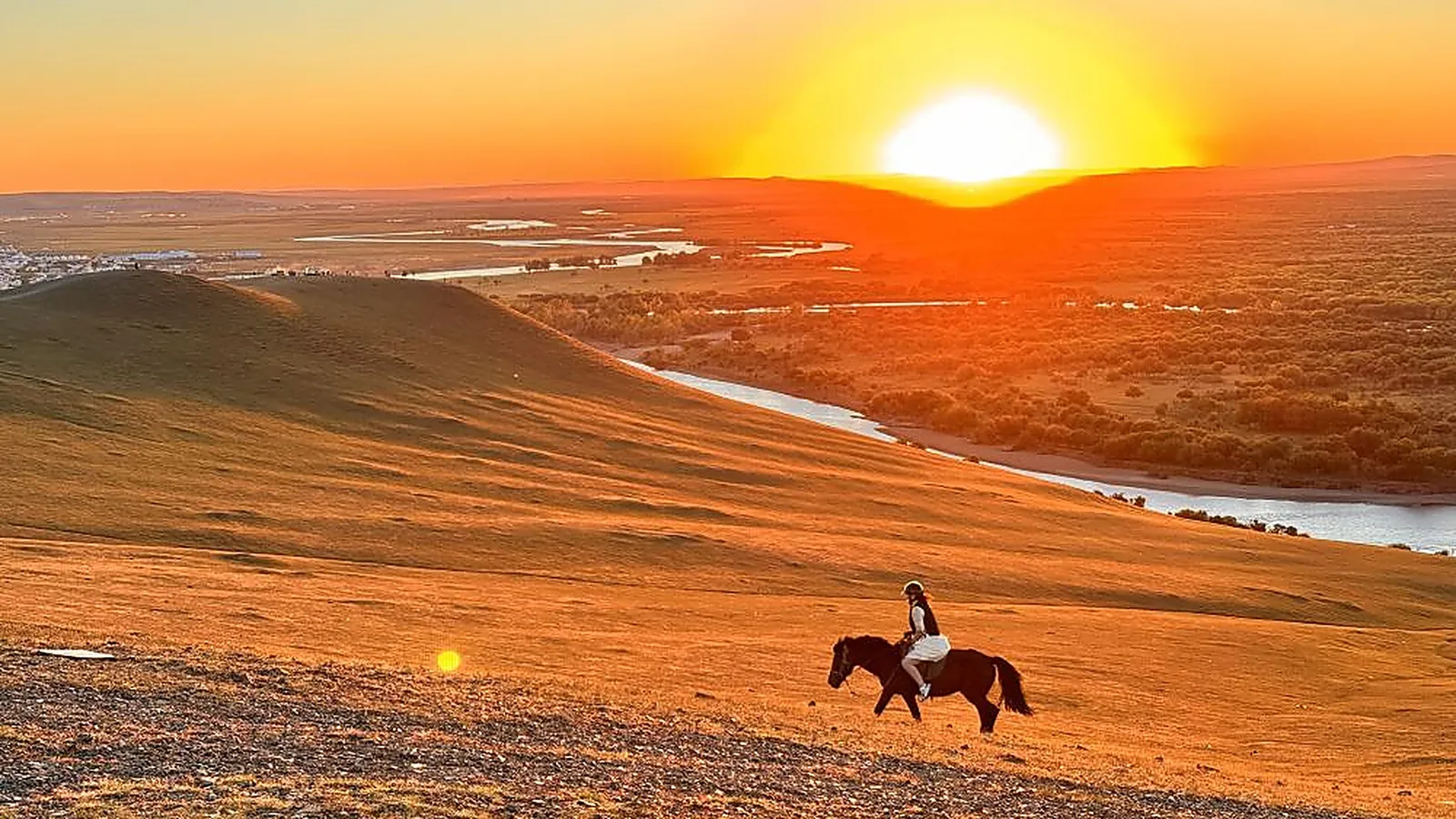
Photo: Wikimedia Commons / CC BY-SA. Source

Tickets, booking, and payment
Major sites and their 2026 entry fees:
- Erguna Wetland - ¥65, includes shuttle bus. 8:00 AM to 6:00 PM.
- Matryoshka Square (Manzhouli) - ¥148, includes the light show. 9:00 AM to 10:00 PM.
- Genghis Khan Horse Tourism Park (Hailar) - ¥80, includes the horse show. 9:00 AM to 5:30 PM.
- Hulun Lake viewpoint - ¥30, no facilities. Open 24 hours.
- Bear Museum (Manzhouli) - ¥80, 9:00 AM to 6:00 PM.
- Grassland activity zones (horse riding, wrestling shows) - ¥150-300 per person, varies.
How to book:
- At the gate - passport required, cash or Alipay/WeChat. No foreigner surcharge.
- Trip.com - English, accepts foreign Visa/Mastercard, 5% service fee. Most comprehensive booking platform for tour packages.
- Local agent in Hailar - book at any hotel front desk; the desk can arrange 4WD rental, hotels, and a Chinese-speaking driver-guide for the full loop at ¥1,500-2,500 per day for the car and guide.
Free entry: Children under 1.2m, seniors over 65 (with passport). Most grassland activity zones give 50% student discount with Chinese ID.
Getting there and around
By air: Hailar Dongshan Airport (HLD). Direct flights from Beijing (2h 30m, 4-5 daily), Hohhot (2h, 3 daily), Shanghai (4h, 2 daily), Guangzhou (5h, 1 daily). Round trip from Beijing is ¥1,800-3,500 in July-August. The airport is 8 km east of downtown Hailar. The airport rental counter opens 7:00 AM to 10:00 PM. For domestic flight booking tips, see our China domestic flights guide. Most travelers fly in from Beijing — if you have a free day before the grassland, the Beijing must-see highlights are the most logical pre-trip add-on. For context on how Hulunbuir compares with other natural wonders, see our China scenic wonders comparison.
By train: Hailar Station is on the Harbin-Manzhouli rail line, 6 hours from Harbin (¥140 second class). Most visitors fly because the train is slower and less convenient than the 4WD self-drive.
By car (overland): The G301 highway from Harbin to Manzhouli is fully paved, 900 km, 12 hours. The 4WD self-drive is the recommended approach because the inner loop (Erguna-Enhe-Shiwei) has unpaved sections best navigated with a rental.
Inside the loop: 4WD is required. Speed limit on unpaved sections is 30-40 km/h. The dirt roads flood after rain; check weather the night before. Cell phone coverage is good in towns, weak to none on the open grassland. Download offline maps before departure.
When to go and what to expect
Late June to late August (green season). Peak season. Grass is at its tallest, 30-50 cm, with wildflowers (yellow chrysanthemums, purple vetch) in July. Temperatures: 15C to 28C, with cool nights. Crowds are highest in July-August. Book hotels 2-3 weeks ahead. Avoid the week of August 8-10, when the Naadam festival packs Hailar.
Early to mid September (early autumn). Shoulder season. Grass is still green but birch leaves start to turn. Fewer crowds. Temperatures: 8C to 22C. Best for travelers who want green hills without the summer crowd.
Late September to early October (peak autumn). Most photogenic season. Birch and larch turn gold; the grassland takes on a russet hue. Temperatures: -2C to 15C, with possible early snow. Book hotels 4-6 weeks ahead. The 2-week window makes this both the most beautiful and the hardest to plan.
November to March (deep winter). Cold (-30C nights, -15C days). Snow covers the grassland; rivers freeze. Most jeep tours stop. Manzhouli Ice Festival runs late December to late February. Beautiful but limited to Manzhouli and Hailar.
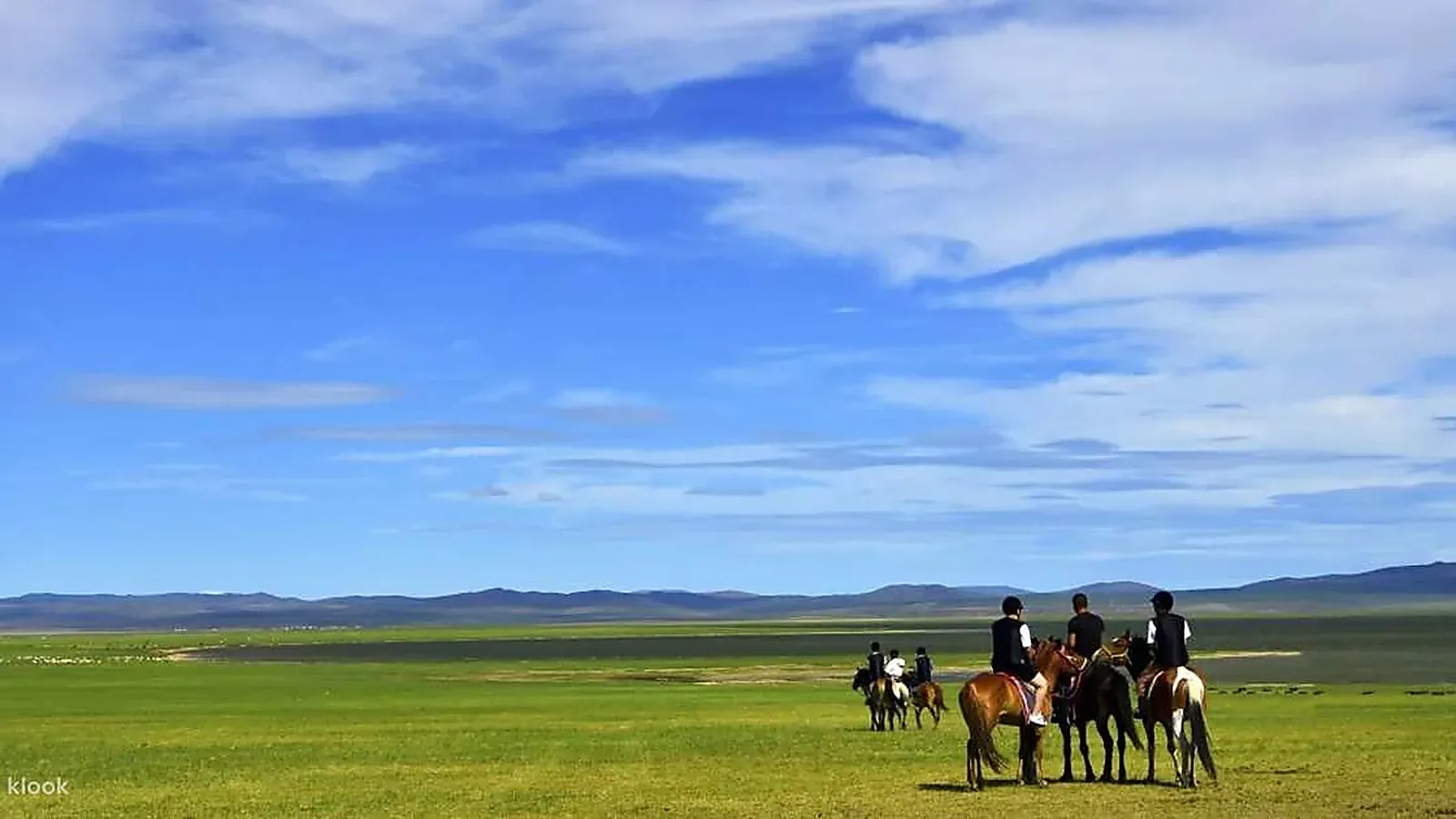
Photo: Wikimedia Commons / CC BY-SA. Source

What to bring
- 4WD rental with insurance - Sedans will get stuck on dirt roads. Book through Hailar Dongshan airport counters (eCar, China Auto Rental).
- Layered clothing - Summer days are warm (25C+) but nights are cool (10C). Autumn mornings can be -2C. A fleece and a windbreaker are essential.
- Sunglasses and sunscreen - The grassland is at 600-700m with no shade. UV is high.
- Mosquito repellent - Wetland and grassland mosquitoes are aggressive in July-August, especially near Erguna. Bring DEET-based spray.
- Cash (¥1,500-2,000) - Small yurts and herder families prefer cash. Most Hailar hotels accept Alipay. Foreign cards are not accepted outside Hailar and Manzhouli.
- Power bank - The grassland has no outlets for charging. A 20,000 mAh pack is enough for 2 phone charges.
- Offline maps - Amap or Apple Maps. Cell signal drops to 0 bars in the open grassland.
- Water bottle and snacks - There is no food on the grassland between towns. Stock up in Hailar each morning.
- Binoculars - For birds at Hulun Lake (great crested grebes, white cranes) and watching herders tend their flocks.
Hike difficulty cheat sheet
Hulunbuir is grassland terrain — mostly flat, vast, and forgiving for casual walking. The main “hikes” are actually boardwalks and short bluff climbs. The real activity is horseback riding or cycling, not serious hiking.
| Trail | Distance | Time | Elevation | Difficulty |
|---|---|---|---|---|
| Ergun Wetland boardwalk (额尔古纳湿地) | 2 km loop | 1 h | flat | Easy — wooden boardwalk, observation tower |
| Shiwei border river walk (室韦) | 3 km linear | 1-2 h | flat | Easy — dirt path along Ergun River, Russia visible across |
| Heishantou horseback grassland ride (黑山头) | 5-8 km on horseback | 2-3 h | flat | Easy (riding) — no experience needed, Mongolian guide leads |
| Moridaga Forest Park trail (莫尔道嘎) | 4 km loop | 2-3 h | +100 m | Moderate — boreal forest, some boardwalk, some dirt |
| Jinlong Mountain (金龙山) sunrise hike | 2 km round-trip | 1.5 h | +150 m | Easy-Moderate — short climb, sunrise reward |
Best for backpackers: spend your hiking time on the wetland boardwalks and the Shiwei river walk — they’re the most photogenic. The “real” Hulunbuir experience is horseback riding at Heishantou or cycling the grassland roads, not hiking. There are no strenuous trails in the region; if you want a hard hike, Hulunbuir is the wrong destination.
The 5 photo spots that matter
- Erguna Wetland viewpoint boardwalk. The 200m climb from the visitor center reaches a 720m ridge with a panoramic view of the wetland. Best at sunset when the marshes turn orange. The most-photographed spot in the entire Hulunbuir region.
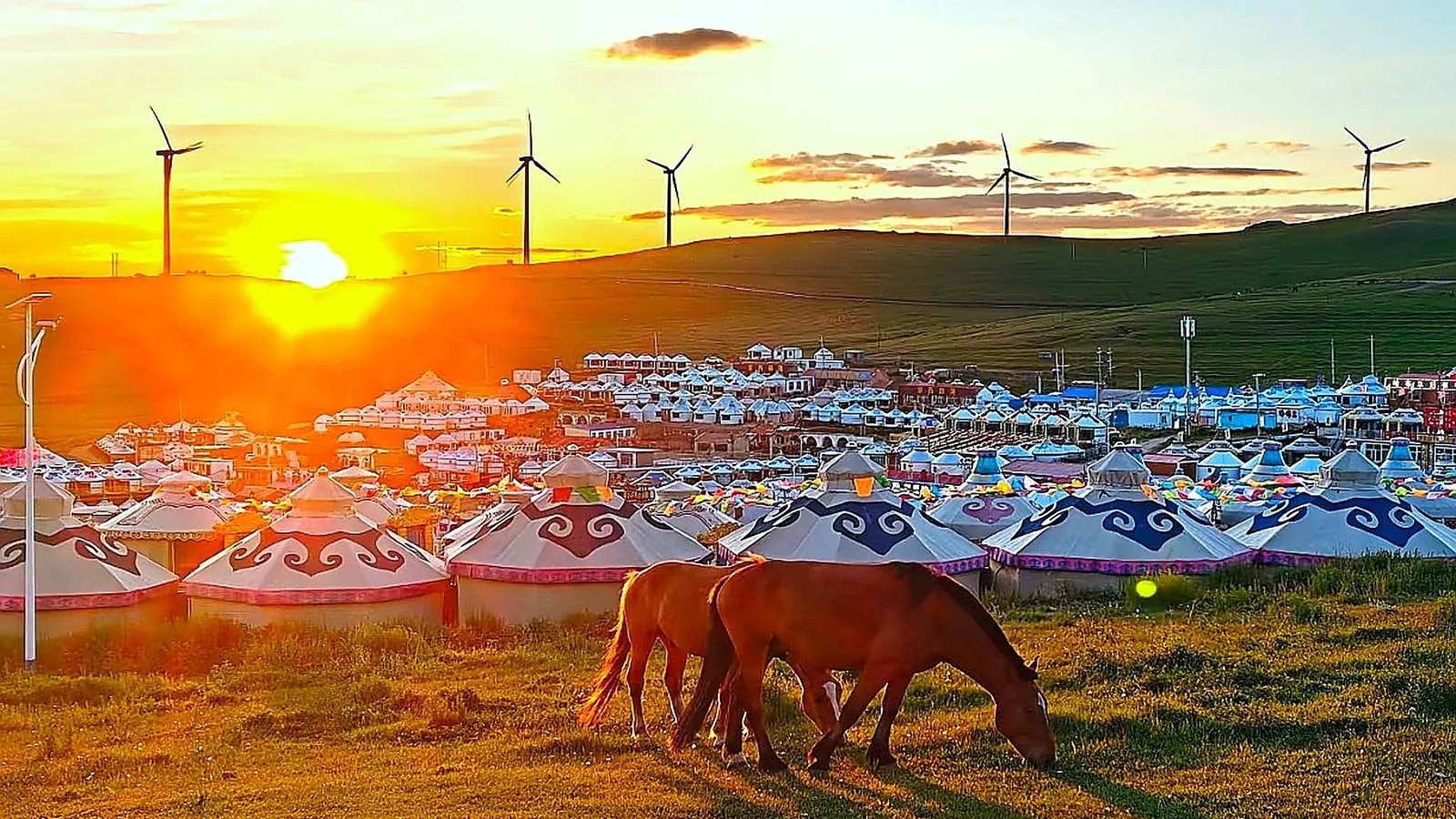
Photo: Wikimedia Commons / CC BY-SA. Source 2. Enhe Russian Village morning. The log houses with smoke from chimneys against the Ergun River valley. Best at 6:30 AM in September when the morning mist rises. Walk to the south end of the village for the unobstructed view across the river to Russia. 3. Shiwei Ergun River bluff. The river forms the border; you can see Russian villages on the far bank. Best at 7:00 AM sunrise. Bring a telephoto for the cross-border shots. No drone flights - the border is restricted airspace. 4. Hulun Lake western shore. The vast lake extends to the horizon; the surrounding grassland gives the open-steppe feel. Best 1 hour before sunset. The light is golden and the wind is usually calm. 5. Manzhouli Matryoshka Square at night. The world’s largest matryoshka statue, 30m tall, lit in changing colors. The light show at 8:30 PM is the most photogenic scene in the city. Best from the south side of the square with the bear statue in the foreground.

Common mistakes to avoid
- Driving without a spare tire and shovel. The unpaved sections of the Erguna-Enhe and Enhe-Shiwei roads have sharp rocks. A single flat tire can ruin a day. Most rental agencies include a spare; check before departure. Bring a small folding shovel for mud.
- Arriving at Manzhouli on a Sunday. The Russian trade market is closed Sundays, and the border atmosphere is much quieter. Aim for a Monday-Friday visit for the full market scene.
- Booking a “Hulunbuir 3-day tour” from Beijing. Most package tours are bus-based, spend 8+ hours per day on the road, and skip the unpaved sections. A self-drive or 4-day private tour is the only way to see the most scenic stretches.
- Drinking unboiled well water at herder yurts. The well water is usually safe after boiling but a few families have contaminated wells. Bring your own bottled water and a SteriPen for backup.
- Wearing white shoes. The grassland dust and yak droppings are not avoidable. Black or dark brown shoes are the practical choice. Yaks and sheep have a habit of approaching cameras and humans.
- Skipping the early morning grassland drive. The 6:00-8:00 AM hour has the best light, the fewest jeeps, and the herders moving their flocks. Most package tours sleep in and miss it.
- Trusting Google Maps. Google services are blocked in China. Use Amap (高德地图) for navigation. Save key Chinese names: 额尔古纳, 恩和, 室韦, 满洲里, 呼伦湖.
Where to stay
- Hailar (the gateway) - hotels in the city center. Budget: Home Inn, Hanting (¥180-280/night). Mid-range: Hailar Hotel, Beifang Hotel (¥350-550/night). All have Western-style toilets and hot water.
- Erguna town - small town, limited options. Erguna International Hotel (¥300-450/night) is the most reliable. Book 1 week ahead in autumn.
- Enhe Russian Village - log cabin homestays. Most have shared bathrooms and home-cooked Russian-style meals. ¥200-400/night, including breakfast. The Polosy log cabin is the most authentic option.
- Shiwei border town - small town with a few guesthouses. Shiwei Russian Lodge (¥200-300/night) is the main option. Basic but clean.
- Manzhouli - the largest selection. Budget: Manzhouli Friendship Hotel (¥180-300/night). Mid-range: Matryoshka Hotel, Shangri-La Manzhouli (¥400-900/night). The Shangri-La has a Russian-themed spa.
Local food and culture
Hulunbuir is at the cultural crossroads of Mongolian, Russian, and northeastern Chinese cuisines. Must-try dishes:
- Borscht (罗宋汤) - Russian-style beet soup, ¥40 at any Manzhouli restaurant. Served with sour cream.
- Pelmeni (俄罗斯水饺) - Russian dumplings, served with butter and vinegar, ¥60 per plate.
- Lamb skewers (羊肉串) - the Mongolian staple, ¥5 per skewer. Eat with beer at any evening market.
- Buuz (包子) - Mongolian steamed dumplings filled with mutton, ¥10-15 per basket of 8.
- Hand-pulled noodles (手擀面) - northeastern Chinese style, ¥20-30 per bowl.
Mongolian culture: yurt (蒙古包) living, the Naadam festival in July (wrestling, horse racing, archery), the khoomei throat singing, and the traditional long song (长调). The Genghis Khan Horse Tourism Park near Hailar has daily performances of all four. Manzhouli’s Russian influence: Orthodox churches (the Holy Protection Cathedral is a working Russian church), matryoshka dolls, samovar tea, and a small but vibrant Russian expatriate community.
Plan your trip - verified tools
These free tools are built on real, monthly-verified data and help you skip the trial-and-error phase of China trip planning:
- China 240-Hour Visa-Free Transit Checker - 57 countries, 24 provinces, 65 ports. See if you qualify for 10-day visa-free transit, which cities you can visit, and the 5-step process.
- China 6-City 5-Day Budget Calculator - Real 2026 prices for 5 days in Beijing, Shanghai, Guangzhou, Chengdu, Xi’an, or Hangzhou. Budget / mid-range / comfort tiers, broken down line by line.
Verified August 2026 by TravelHubChina Editorial. We re-check prices and policy details monthly so the data doesn’t drift.
Step by step
-
Fly Beijing Capital (PEK) to Hailar Dongshan Airport (HLD)
Direct flights from Beijing take 2h 30m and run 4-5 times daily on Air China, Hainan Airlines, and Beijing Capital Airlines. Round trip from Beijing is ¥1,800-3,500 in July-August. Hailar Dongshan is 8 km east of downtown Hailar; airport bus ¥10, taxi ¥30-40. Limited seasonal flights from Shanghai (4h) and Guangzhou (5h) exist but are unreliable.
-
Pick up a 4WD rental in Hailar
Rent at the airport or in town. Major agencies (e.gCar, China Auto Rental) have counters in Hailar Dongshan arrivals. A 4WD like a Haval H9 or Toyota Prado costs ¥600-1,000/day in summer with insurance. Bring your international driving permit, passport, and a credit card for the ¥5,000 deposit. A Chinese-speaking friend on WeChat can help if the rental contract is in Chinese only.
-
Drive Hailar to Erguna Wetland (170 km, 3 hours)
From Hailar, drive north on the G301 highway 170 km to Erguna town. The road is paved for the first 150 km. The Erguna Wetland (额尔古纳湿地) is 3 km south of town; entry ¥65, shuttle bus included. The wetland is Asia's largest, 120,000 hectares, with wooden boardwalks through marsh and birch forest. Allow 3-4 hours including the viewpoint climb.
-
Continue to Enhe Russian Ethnic Village (140 km, 3 hours)
From Erguna, drive northeast on a partially unpaved road to Enhe (恩和), a small Russian-style village with original log houses. The road follows the Ergun River with views of Russian villages on the far bank. Stay 1 night in a Russian log cabin (¥200-400/night, includes breakfast of rye bread and jam). Hike the river bluff at sunrise for the classic shot.
-
Drive to Shiwei border town (70 km, 2 hours)
From Enhe, drive north to Shiwei (室韦), a 300-person border town with a Russian Orthodox church. The road is unpaved for 30 km; the most scenic drive in the entire loop. Shiwei is a good base for a half-day horse ride along the Ergun River (¥200-300 per person, 2 hours). The Russian border is 200m across the river; do not approach the fence.
-
Loop back west to Manzhouli (450 km, 7 hours over 2 days)
From Shiwei, drive southwest back to Erguna, then west on the G301 to Manzhouli. Allow 2 days: stop at the vast Hulun Lake (呼伦湖, China's fifth largest freshwater lake) midway, ¥30 entry. Manzhouli is a Russian-influenced border city with the famous Matryoshka Square (¥148 entry, day or night), the world's largest matryoshka statue, and a working Sino-Russian trade market.
-
Return to Hailar and fly out (200 km, 3 hours)
From Manzhouli, drive 200 km back to Hailar on the G301 highway, all paved, 3 hours. Return the 4WD at the airport. Fly back to Beijing. If you have an extra day, add a half day at the Genghis Khan Horse Tourism Park (¥80 entry) 20 km east of Hailar with horse shows and archery.
-
Download offline maps and translation before arrival
Google Maps does not work in China. Use Amap (Gaode) or Apple Maps for navigation. Download Pleco dictionary for offline Chinese-English translation. The grassland has very limited English; GPS coordinates are essential. Save key Chinese names: 额尔古纳 (Erguna), 恩和 (Enhe), 室韦 (Shiwei), 满洲里 (Manzhouli), 呼伦湖 (Hulun Lake).
FAQ
-
How many days do you need in Hulunbuir?
4 full days is the minimum to see the core loop: Hailar to Erguna Wetland, Enhe Russian Village, Shiwei border town, and Manzhouli. 5 days adds a buffer day for weather (rain can flood dirt roads) and a half day at the Hulun Lake north shore. 3 days means skipping one of the four core stops. Less than 3 days, take a guided bus tour from Hailar instead of self-drive. -
Do I need a 4WD to drive in Hulunbuir?
Yes, strongly recommended. About 60% of the loop is on unpaved dirt or gravel roads, especially between Enhe and Shiwei (the most scenic section) and around the wetland boardwalks. A regular sedan will bottom out on the soft soil after rain. 4WD jeep rentals in Hailar cost ¥600-1,000 per day in summer, ¥400-700 in shoulder season. Most rentals include basic insurance but not gravel-road damage; read the contract. -
When is the best time to visit Hulunbuir grassland?
Late June to late August for the green season, when the grass is at its tallest and wildflowers bloom. Early September for the start of the autumn color change. Late September to early October for peak autumn, when birch and larch turn gold and the grassland is the most photogenic. November-April is deep winter (-30C nights, frozen rivers); beautiful but most jeep tours stop and only the Manzhouli ice festival is open. -
Are yurt stays authentic or just for tourists?
Most yurts marketed to foreigners in the central grassland are purpose-built for tourism, with brick foundations, electric heaters, and private Western-style toilets. They are not the traditional Mongolian felt yurts of the 18th century. The most authentic option is to stay with a Mongolian herder family outside Hailar; your hotel can arrange this for ¥200-400 per night including dinner and breakfast. Avoid the yurts clustered along the main road - they are busy, expensive, and the experiences are staged. -
Do I need a visa or special permit to visit the Russian border at Manzhouli?
No permit is needed to visit Manzhouli town or to photograph the border from designated viewpoints on the Chinese side. To cross into Russia you need a Russian visa, applied for at the Russian consulate in Beijing or Shanghai at least 4 weeks in advance. A same-day Manzhouli-Russian side tour is offered by some operators but the Russian visa requirement is the same as for any other trip. -
How do foreigners book Hulunbuir tours and rentals?
Book self-drive packages on Trip.com (English, accepts Visa/Mastercard, includes 4WD rental, hotels, and sometimes a Chinese-speaking driver-guide). Book guided bus tours through C-Trip or Tuniu. Independent travelers can rent a 4WD in Hailar at the airport rental counter; passport, international driving permit, and a Chinese phone number are required. Most hotels in Hailar can arrange airport pickup for ¥50.
Related guides
- Scenic & Nature
Ejina Populus Forest Guide: 21 Days of Golden China
Ejina Populus Forest in Inner Mongolia has 39,000 hectares of Populus euphratica, gold October 1-21. Covers tickets, transport, Erdaoqiao Bridge, 4-day plan.
12min read
- Scenic & Nature
Big Wild Goose Pagoda Guide: Xi'an's 1,300-Year Tang Pagoda
Big Wild Goose Pagoda (Dayan Ta) in Xi'an: 64m Tang-dynasty brick pagoda from 652 AD, UNESCO since 2014 as part of the Silk Roads network. Tickets (¥50), climb times, and the free North Square musical fountain (9 PM nightly).
8min read
- Scenic & Nature
China's Top 3 Scenic Wonders Compared: Zhangjiajie vs Huangshan vs Jiuzhaigou (2026)
Zhangjiajie (sandstone pillars), Huangshan (sea of clouds + granite peaks), Jiuzhaigou (turquoise lakes + waterfalls). Decision guide covering which fits your time, budget, fitness level, photography goals, and travel style. Prices, distances from Shanghai/Beijing, best seasons compared.
12min read
- Scenic & Nature
Daocheng Yading Scenic Guide: Three Sacred Mountains & Alpine Lakes
Daocheng Yading in Sichuan is a 4,000-6,032m reserve with three sacred peaks and Milk Lake. Covers ¥146-266 tickets, Chengdu flights, hiking, altitude prep.
12min read
- Scenic & Nature
Forbidden City Guide: Beijing Imperial Palace, Tickets & Plan
The Forbidden City in Beijing: 72 hectares, 980 buildings, 1.4 million artifacts, Ming and Qing dynasties, UNESCO since 1987. Tickets (¥60), WeChat booking.
12min read
- Scenic & Nature
Great Wall of China Guide: Mutianyu, Badaling, Jinshanling Compared
Great Wall of China: 21,196 km. Mutianyu (best first-timers), Badaling (most crowded), Jinshanling (hiking) compared. Tickets, transport, best season.
12min read