
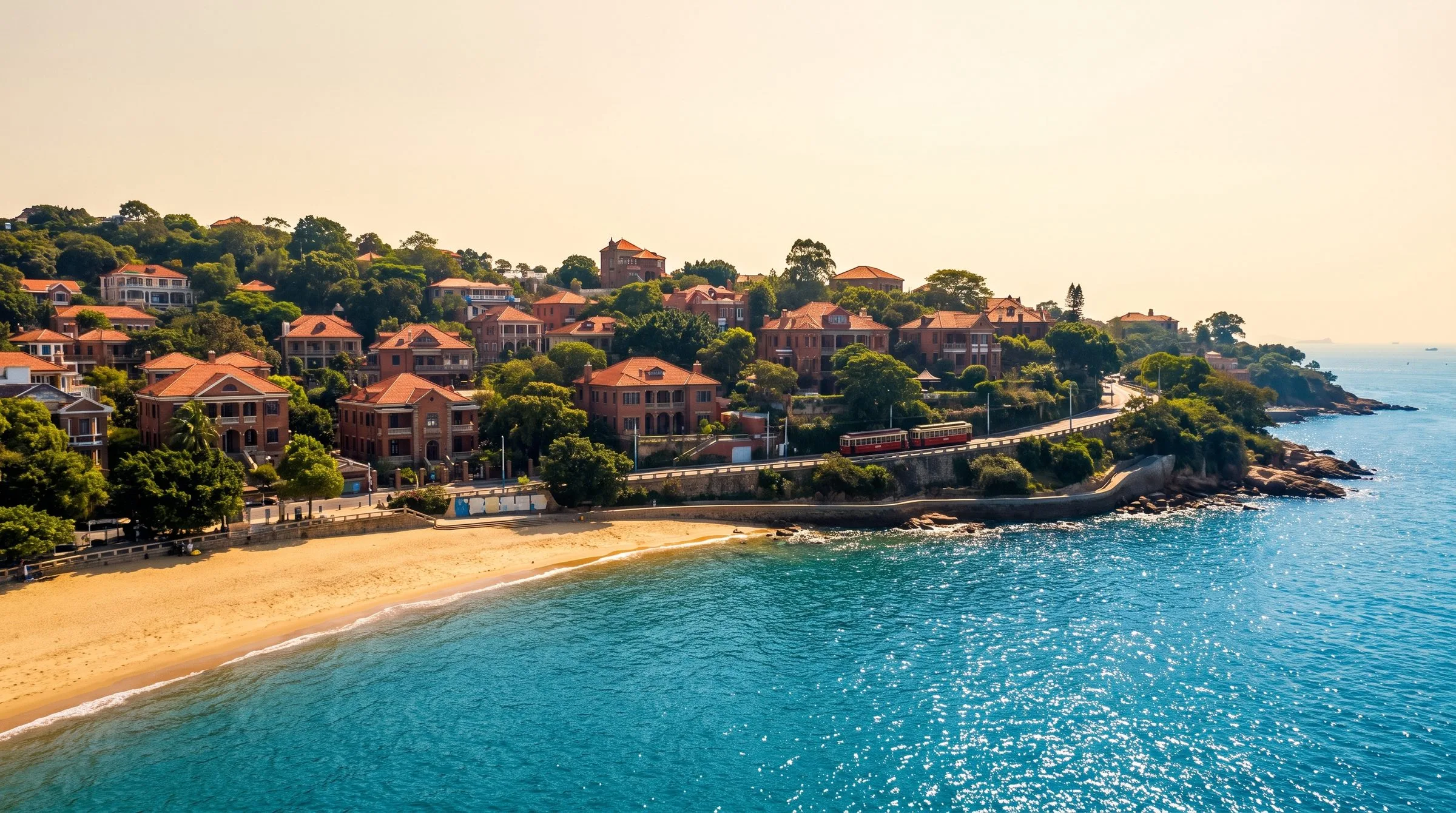
Xiamen Gulangyu Weekend Guide 2026: UNESCO Island, Fujian Food, Tulou Day Trip
Xiamen weekend guide for foreign visitors: Gulangyu UNESCO Piano Island (5-minute ferry ¥35), South Putuo Temple, Xiamen University, Zhongshan Road, and a day trip to the Hakka Tulou (round earthen buildings, UNESCO).
Xiamen rewards 2-3 days. The famous Gulangyu Island can be seen in a half-day, but the deeper Xiamen — the Fujian seafood, the coastal Xiamen University, the Hakka Tulou day trip, the slower pace of a southern Chinese coastal city — needs more time. This 2-day plan is the right amount for first-time visitors; a 3-day version adds the Tulou. If you have 5+ days, you can also add Quanzhou (1.5 hr HSR, UNESCO-listed 2022 for its Song-Yuan maritime trade) or Wuyishan (3-4 hr HSR, UNESCO-listed 1999 for the Danxia landscape).
Xiamen (厦门) was a small fishing village until 1842, when it was forced open as a treaty port by the Treaty of Nanking (the same treaty that ceded Hong Kong). Foreign consulates moved in, Gulangyu became the international settlement, and the city grew into a major port. In 1980, Xiamen was designated one of China’s first 4 Special Economic Zones (along with Shenzhen, Zhuhai, and Shantou), opening to foreign investment and trade. Today Xiamen is a wealthy, modern, tourist-friendly city of 5 million, with the best seafood in Fujian and the most beautiful university in China.
If you’re planning a Fujian or south China trip, this pairs naturally with our Suzhou travel guide, 240-hour visa-free guide, Chinese cultural etiquette, China budget 2026, and China scenic wonders comparison.
Why Xiamen Is Different
Four things make Xiamen unlike anywhere else in China:
1. Gulangyu UNESCO Piano Island. Gulangyu (鼓浪屿, “Drum Wave Island”) is a 1.88 km² island 500m offshore from central Xiamen, car-free since 2014, UNESCO-listed 2017. It’s the only UNESCO site in China listed as a historic international settlement, with 13 foreign consulates from 1902 to 1945, 30+ colonial-era buildings, and 100+ pianos — earning it the nickname “Piano Island.”
2. The Hakka Tulou (round earthen buildings). 60+ km inland from Xiamen, in the mountainous heart of Fujian, the Hakka people built 3,000+ round earthen buildings between the 12th and 20th centuries, some 4 stories tall, 60+ m in diameter, housing 200-800 people per building. 46 of them are UNESCO-listed (2008). A day trip is the highlight of any Xiamen visit.
3. Fujian seafood + Fujian cuisine. Fujian (闽) cuisine is one of China’s 8 great culinary traditions, known for light flavors, the umami of seafood, the use of red yeast rice, and the soup-based dishes. The most famous Fujian dish worldwide is Buddha Jumps Over the Wall (佛跳墙), a 30+ ingredient soup that takes 3 days to make. Xiamen specializes in the coastal Fujian style: oyster omelette, peanut soup, fish ball soup, Xiamen shacha noodles, sea worm jelly.
4. The Taiwan Strait heritage. Kinmen (金门, the ROC-controlled island) is just 10 km from Xiamen, visible from the city’s eastern shore on a clear day. Xiamen and Kinmen have had a complicated relationship for 75 years. The Hulishan Fortress on the Xiamen side still has the 1893 German Krupp cannon pointed at Kinmen.
Together, these four layers make Xiamen a city where you can see, walk, taste, and feel 200 years of Chinese coastal history compressed into a small urban footprint.
Getting to Xiamen
By Air
Xiamen Gaoqi International Airport (XMN): the main airport, on the north side of Xiamen Island, 12 km from the city centre. Direct flights from Beijing 2.5 hr, Shanghai 1.5 hr, Guangzhou 1 hr, Shenzhen 1 hr, Hong Kong 1.5 hr, Singapore 4 hr, Bangkok 4 hr. From the airport, Metro Line 1 reaches Zhongshan Road in 35 min (¥7), or DiDi/Taxi ¥50-80, 25-40 min.
By HSR
Xiamen North Railway Station (厦门北站): the HSR station, on the mainland, 30 km from the city centre. Xiamen Railway Station (厦门站): the older station, in central Xiamen. Direct HSR from Shanghai 5-6 hours (¥450 second class), Fuzhou 1.5 hours (¥85), Shenzhen 3-4 hours (¥250), Quanzhou 30 min (¥30), Wuyishan 3-4 hours (¥220).
Within Xiamen
Xiamen Metro has 3 lines + extension, clean, on-time, English everywhere. Single journey: ¥2-7. DiDi (China’s Uber) works in Xiamen, English UI, very reliable. BRT (Bus Rapid Transit): dedicated elevated bus lane, 8 lines, very fast, ¥2-5 flat fare. Ferry to Gulangyu: ¥35 round trip from Lundu Pier (轮渡码头) on the central Xiamen waterfront. Every 10 min, 7 AM-11 PM, 5-10 min crossing.
Day 1: Gulangyu UNESCO Piano Island
Theme: A car-free island, colonial architecture, 100+ pianos, sea views. Total walking: 6-8 km, mostly flat.
Morning: Ferry to Gulangyu + Piano Museum + Shuzhuang Garden (8:30 AM — 1 PM)
Step 1: Take the ferry from Lundu Pier (轮渡码头, 2 Lujiao Road, Siming District). Every 10 min, 7 AM-11 PM, ¥35 round trip. Buy on the WeChat mini-program “厦门轮渡” in advance (1-2 days for peak weekends). The ferry is from Lundu Pier on the central Xiamen waterfront, not from the First Wharf (which is for Gulangyu residents only). Foreign passports are accepted for ticket purchase.
Step 2: Walk to the Piano Museum. From Nei Dao Pier (内厝澳码头) on Gulangyu, walk 15 min to Shuzhuang Garden (菽庄花园). The Piano Museum is inside the garden complex. Gulangyu Piano Museum (鼓浪屿钢琴博物馆): opened 2000, the world’s largest collection of antique pianos, 100+ instruments from the 1800s and early 1900s. ¥30 entry, included with Shuzhuang Garden, 1 hour.
Step 3: Explore Shuzhuang Garden. Built 1933 by Lin Erjia, designed to resemble his father’s garden in Taiwan. The garden has two parts: the High Villa (mountain side) and the Beach Garden (sea side). The “piano-shape” pool in the High Villa is the highlight. ¥30 entry (combined with Piano Museum), 1-1.5 hours.
Lunch in Gulangyu (1 PM — 2 PM)
Lunch recommendations on Gulangyu:
- Lin’s Seafood (林家海鲜): Nei Dao area, the most famous Gulangyu seafood, ¥150-300 per person. Try the oyster omelette (海蛎煎), clam ginger soup, steamed grouper.
- Babycat (张三疯欧式奶茶): the famous Gulangyu tea shop, named after the original owner’s cat. The “Babycat Milk Tea” is the signature, ¥25-35.
- Ye’s Mochi (叶氏麻糍): 1957, the most famous Gulangyu street food, a hand-made mochi stall, ¥5-10 per piece.
- Chen Ji (陈记): the famous Gulangyu sausage, ¥10-20.
Afternoon: Colonial Architecture + Haoyue Garden + Sunlight Rock (2 PM — 6 PM)
Step 1: Walk the colonial architecture (free). Gulangyu has 13 former foreign consulates and 30+ colonial-era buildings, all within walking distance: Former British Consulate (16 Lujiao Road, now the Gulangyu Museum), Former Japanese Consulate (32 Lujiao Road, restored 2010, the only intact Japanese consulate in China), Former US Consulate (9 Tianwei Road, ¥20, built 1930, the most “American-style” building), Eight Trigrams Building (八卦楼, 43 Lujiao Road, ¥20, the most striking colonial building, now the Xiamen Museum), Union Church (38 Lujiao Road, free, 1863, the oldest Protestant church in Xiamen), Sea-viewing Platform (Gulangyu Road, free, the island’s most photogenic spot). 2-3 hours for the walk.
Step 2: Haoyue Garden (free). Built 1985, the giant stone statue of Zheng Chenggong (Koxinga) is 15.7m tall, the largest stone statue on Gulangyu. Koxinga was the 17th-century Ming loyalist who expelled the Dutch from Taiwan in 1662. Free entry, 30 min.
Step 3: Sunlight Rock (¥60). The highest point on Gulangyu, 92.7m above sea level. The view from the top is the iconic Gulangyu shot. The climb is 10-15 min, 300+ steps. ¥60 entry, 1-1.5 hours. Climb 4-5 PM to see the sunset.
Evening: Ferry Back to Xiamen + Zhongshan Road (6 PM — 9 PM)
Take the ferry back to central Xiamen (every 10 min until 11 PM, ¥35 return, from San Qiu Tian Pier 三丘田码头 to Lundu Pier, 5 min).
Zhongshan Road (中山路): the 1-km pedestrian shopping street in central Xiamen, built in the 1920s-30s in the Southern Fujian “Quanzhou-style” arcaded architecture (骑楼, qílóu, covered arcades on the ground floor, traditional Chinese shopfronts above). The street is one of the most photogenic in Xiamen, with the original arcades intact and lit at night. Snacks: Hou Cun Lao (厚聪井) shacha noodles, Lian Hua Wang (莲花旺) oyster omelette, Yu Xiang Yuan (渔乡源) fish ball soup. 1-2 hours.
Day 2: Xiamen Main City — South Putuo, University, Fortress, Seafood
Theme: A 1,000-year-old Buddhist temple, China’s most beautiful university, a 19th-century German cannon, fresh Fujian seafood. Total walking: 6-8 km, mostly flat.
Morning: South Putuo Temple + Xiamen University (8:30 AM — 1 PM)
South Putuo Temple (南普陀寺), 515 Siming South Road. Built in the Tang dynasty, expanded in Song and Ming dynasties, rebuilt 1924 after a fire, the current buildings are mostly 1980s-90s reconstructions. The temple is the head temple of the Southern Fujian Buddhist tradition and one of the most important Buddhist sites in China. 3 main halls (Maitreya Hall, Great Hero Hall, Great Compassion Hall) plus a 4-story Buddhist library, a large stone sutra wall, a vegetarian restaurant, and a tea house. Free entry, 8 AM-6 PM, ID required. 1-2 hours. Vegetarian lunch: ¥30-50 per person.
Xiamen University, 422 Siming South Road, immediately east of South Putuo Temple. Founded 1921 by Tan Kah Kee (陈嘉庚, 1874-1961), a Chinese Singaporean rubber magnate and philanthropist. Tan funded Xiamen University, Jimei School Village, and 100+ schools across Southeast Asia. The university is consistently rated the most beautiful university in China. Free, but reserve on WeChat mini-program 1-2 days in advance. 1.5-2 hours. Highlights: Jiageng Park honouring Tan Kah Kee, Furong Lake (the central lake, the most photographed spot), Jiageng Style buildings (mixing Minnan roof tiles with Western red brick), Furong Tunnel (1-km pedestrian tunnel, walls covered with student graffiti and art, the most popular Xiamen Instagram spot).
Lunch (1 PM — 2:30 PM)
Lunch at South Putuo Temple Vegetarian Restaurant (¥30-50 simple, ¥80-120 Buddha Jumps Over the Wall), or Hai Di Jiao near the university (¥60-100), or Zhongshan Road street food (¥30-60).
Afternoon: Hulishan Fortress + Island Ring Road (3 PM — 6 PM)
Hulishan Fortress (胡里山炮台), 2 Zengcuo’an Road, south of Xiamen University. Built 1891, a Qing-dynasty coastal fortress. The fortress has the Krupp 280mm cannon (manufactured in Germany 1893, fired 1894, one of the largest surviving coastal-defense cannons in the world). The cannon was on the original 1894 Sino-Japanese War, then in 1958 during the Second Taiwan Strait Crisis, fired shells at Kinmen. ¥30 entry, 1.5-2 hours. From the fortress, on a clear day, you can see Kinmen (the ROC-controlled island).
Xiamen Island Ring Road (环岛路): a 43-km scenic road around Xiamen Island, with dedicated bike paths, beach access, and sea views. The most photogenic section is the White City Beach (白城海滩) near Xiamen University. Alternative: Zengcuo’an (曾厝垵), a small art village in the south of Xiamen, free, 1-2 hours.
Evening: Yundang Lake + Seafood Dinner (6 PM — 9 PM)
Yundang Lake (员当湖): the most central lake in Xiamen, originally a tidal estuary, reclaimed and turned into a city lake in the 1980s-90s. The 7-km lake shore has a 5-km walking path, the White Seagull Square (白鹭洲), and the Xiamen Science and Technology Museum (free, 1.5 hr). Best at night: the lights from the surrounding skyscrapers reflect in the lake. 30-60 min walk.
Hubin Road Seafood Building (湖滨南路美食城): a multi-story seafood complex in central Xiamen, the local favourite for fresh Fujian seafood. Each floor is a different restaurant, the 5th-6th floors are the best quality. The seafood is weighed and priced live, then cooked to your order. ¥150-300 per person. Try oyster omelette, steamed grouper, salt and pepper mantis shrimp, Xiamen shacha noodles, Buddha Jumps Over the Wall (¥200-400) for the splurge.
Optional Day 3: Hakka Tulou Day Trip
If you have 3 days, the Hakka Tulou day trip is the most rewarding single day from Xiamen. The 3-hour-each-way drive is long, but the Tulou are unique to Fujian.
Option A: Day tour (recommended): Most travel agencies offer day tours to the Nanjing Tulou (Tianluokeng cluster), ¥300-500 per person including transport, guide, lunch, and entrance fees. Tour pickup is 7-8 AM at your hotel, return 6-7 PM. Tours typically include Tianluokeng cluster (4 Tulou: 1 square, 3 round, ¥90 entry) and Yuchanglou (the most tilted, ¥30). Book on Trip.com, Klook, or through your hotel.
Option B: Self-drive: 3 hours via Shenhai Expressway + Zhanglong Expressway, 180 km. ¥100-150 fuel + ¥100-200 tolls + ¥90 entry + lunch. Roads are good but winding.
Option C: Public transport: HSR from Xiamen to Nanjing Station (南靖站), 1 hour, ¥40 second class. Then DiDi to Tianluokeng, 1 hour, ¥60-100. 2 hours one way, 4 hours at Tianluokeng. 12-14 hours total.
Highlights:
- Tianluokeng Tulou Cluster (田螺坑土楼群): the most photogenic, on a hillside with 4 round + 1 square Tulou, called the “4 dishes and 1 soup” (四菜一汤). 4-5 story round earthen buildings, 1-2 m thick walls, 60-80 m in diameter. 600+ years old. ¥90 combined entry, 1-2 hours. The viewing platform 1 km uphill is the iconic shot.
- Taxia Village (塔下村): 600-year-old Hakka village, 50+ round Tulou, the Deji Hall (德远堂) is a 400-year-old ancestral hall. ¥80 entry, 1-2 hours.
- Yuchanglou (裕昌楼): the most tilted Tulou, built 1308, 5 stories, 18 m tall. The internal columns are 15-20 cm off vertical, leaning without collapsing for 700+ years. ¥30 entry, 30 min.
- Chengqi Lou (承启楼) in Yongding (5 hr from Xiamen): the “King of Tulou”, 4 stories, 400+ rooms, can house 600+ people. Built 1709, 5 generations of the same family. ¥80 entry, 1-2 hours. Yongding is 2 hours further from Xiamen than Tianluokeng.
Lunch: Tulou Hakka Lunch (土楼农家菜), traditional Hakka family lunch in a Tulou village, ¥50-100 per person. Must-try: bamboo rice (竹筒饭), salt-baked chicken (盐焗鸡), Hakka stuffed tofu (酿豆腐), Hakka preserved vegetables (梅菜扣肉).
What to bring: comfortable shoes, cash, a light jacket (the Tulou cluster is 600-800m elevation, cooler than Xiamen), camera with wide lens.
Where to Stay in Xiamen
| Neighborhood | Vibe | Hotel Range | Best For |
|---|---|---|---|
| Zhongshan Road (中山路) | Central, walkable to Lundu Pier (Gulangyu ferry) | ¥150-1,500/night | First-timers, ferry access |
| Yundang Lake (员当湖) | Modern, skyline, central | ¥200-2,000/night | Modern Xiamen, business travellers |
| Zengcuo’an (曾厝垵) | Art village, hostels, near beaches | ¥80-800/night | Budget travellers, backpackers |
| Xiamen University area | Walkable to South Putuo, university vibe | ¥150-1,000/night | Cultural focus |
| Gulangyu Island | Quiet, no cars, on the island | ¥200-2,000/night | Heritage focus, romantic |
Recommended mid-range hotels:
- Hotel Indigo Xiamen Harbour: near Yundang Lake, 5-star, ¥500-900/night, harbour views.
- Pan Pacific Xiamen: near Yundang Lake, 5-star, ¥600-1,000/night, modern.
- Millennium Harbourview Hotel Xiamen: near Lundu Pier, 4-star, ¥400-700/night, the closest hotel to the Gulangyu ferry.
- Swiss Grand Xiamen: Zhongshan Road, 4-star, ¥400-700/night, central.
- Lingshan Hotel on Gulangyu: Gulangyu, 5-star, ¥800-1,500/night, in a restored 19th-century mansion.
Booking platforms: Trip.com, Booking.com, Agoda, Fliggy.
What to Eat in Xiamen
Fujian (闽) cuisine is one of China’s 8 great culinary traditions, the most internationally known for Buddha Jumps Over the Wall (佛跳墙), a 30+ ingredient soup that takes 3 days to prepare. Xiamen specializes in the coastal Fujian style.
Must-try dishes:
- Oyster Omelette (海蛎煎, hǎilìjiān): Xiamen’s signature, fresh oysters pan-fried with sweet potato starch and egg, ¥20-40 per serving.
- Peanut Soup (花生汤, huāshēngtāng): a sweet soup of boiled peanuts, sugar, and egg, ¥10-20 per bowl.
- Fish Ball Soup (鱼丸汤, yúwántāng): fish paste formed into balls, in a clear broth, ¥20-40 per bowl.
- Xiamen Shacha Noodles (沙茶面, shāchāmiàn): thick wheat noodles in a satay-like peanut sauce, ¥20-40 per bowl.
- Sea Worm Jelly (土笋冻, tǔsǔndòng): a jelly made from sea worms, served cold with soy and mustard, ¥15-30 per serving.
- Buddha Jumps Over the Wall (佛跳墙): 30+ ingredient soup with shark fin, sea cucumber, abalone, fish maw, scallops, ginseng, mushrooms, ¥200-400 per person.
- Mochi (麻糍): the famous Gulangyu Ye’s Mochi, hand-made, ¥5-10 per piece.
Where to eat:
- Hubin Road Seafood Building (湖滨南路美食城): 5th-6th floors, the local favourite for fresh Fujian seafood, ¥150-300 per person.
- Zhongshan Road (中山路): 1 km pedestrian street with street food, ¥30-60 per person.
- Lin’s Seafood (林家海鲜): on Gulangyu, ¥150-300 per person.
- Hou Cun Lao (厚聪井): famous Xiamen shacha noodles, on Zhongshan Road.
- Yu Xiang Yuan (渔乡源): famous peanut soup, multiple branches.
Practical Xiamen Tips
Visa
- 240-hour visa-free transit for 57 countries (US, UK, Canada, AU, NZ, EU, JP, KR, SG, etc.) if transiting through Xiamen, Shanghai, Beijing, or other approved ports. Xiamen is itself a designated port of entry for 240-hour transit, unlike Nanjing.
- L-visa (tourist visa): for everyone else, apply 1-2 months ahead.
- See our 240-hour guide for the eligible list.
Money
- Currency: Chinese Yuan (CNY, ¥). 1 USD ≈ ¥7.1 (2026).
- ATMs: everywhere, BOC, ICBC, ABC dispense CNY. Most have ¥20-30 fee for foreign cards. Wise and Revolut cards usually fee-free.
- Credit cards: Visa, Mastercard, UnionPay at hotels and large restaurants. Alipay and WeChat Pay at most stores and restaurants. Cash (¥) for small vendors.
- Tipping: Not customary in China.
Language
- Mandarin is the official language. Xiamen has a local dialect (厦门话, Xiamen Hua, a Minnan/Hokkien dialect), the same family as Taiwanese.
- English in tourist areas (Gulangyu, Zhongshan Road, hotels). Less in old neighborhoods.
- Useful phrases: 你好 (nǐhǎo, hello), 谢谢 (xièxie, thank you), 卫生间在哪里 (wèishēngjiān zài nǎlǐ, where is the bathroom).
When to Visit
- Best months: October-December (autumn, 18-25°C, dry, clear) and March-May (spring, similar).
- Summer (Jun-Aug): hot (30-35°C), humid, typhoon risk July-September. The worst time to visit.
- Winter (Dec-Feb): mild (10-18°C), grey, off-season rates 30-50% lower.
- Avoid: Golden Week (early October) and Chinese New Year (late January / early February) — hotels 2-3x normal price.
Safety
Xiamen is one of the safest cities in China for tourists. Watch for pickpockets in crowded Gulangyu and on the ferries. Watch for traffic — Chinese drivers are aggressive, especially the e-scooters.
What NOT to Do in Xiamen
- Don’t take the ferry from the wrong pier — the Lundu Pier is for tourists, the First Wharf is for Gulangyu residents.
- Don’t trust the “free guide” on Gulangyu — most are commissioned tea-shop or pearl-shop touts.
- Don’t bargain aggressively in Zhongshan Road — most stores have fixed prices.
- Don’t try to drive to the Tulou on a self-drive in rainy season — the mountain roads flood, the trip becomes 5-6 hours instead of 3.
- Don’t exchange money at the airport — rates are 3-5% worse than ATMs.
Combining Xiamen with Other Cities
- Xiamen + Quanzhou: 4-5 days. 2 days Xiamen, 2-3 days Quanzhou (1.5 hr HSR, 2022 UNESCO-listed for its Song-Yuan maritime trade).
- Xiamen + Fuzhou: 4-5 days. 2 days Xiamen, 2-3 days Fuzhou (1.5 hr HSR, the Three Lanes and Seven Alleys historic district).
- Xiamen + Wuyishan: 5 days. 2 days Xiamen, 3 days Wuyishan (3-4 hr HSR, UNESCO-listed 1999 for the Danxia landscape, the Wuyi tea).
- Shanghai + Xiamen + Hong Kong: 8-10 days. 2-3 days each.
- Beijing + Xiamen + Shanghai + Suzhou: 12-14 days. The grand east-coast tour.
See our Suzhou guide, 240-hour visa-free guide, and China cultural etiquette guide for more.
Sample 2-Day Schedule (One Glance)
| Day | Focus | Key Sites | Cost Estimate |
|---|---|---|---|
| 1 | Gulangyu Island | Ferry to Gulangyu, Piano Museum, Shuzhuang Garden, colonial architecture walk, Haoyue Garden, Sunlight Rock, Zhongshan Road evening | ¥200-500 |
| 2 | Xiamen Main City | South Putuo Temple, Xiamen University, Hulishan Fortress, Zengcuo’an, Yundang Lake, seafood dinner | ¥200-400 |
2-day total:
- Budget: ¥800-1,500 (US$115-215) —hostel or budget hotel ¥150-250/night, street food, free attractions, ¥10-20 per transit.
- Mid-range: ¥1,500-3,500 (US$215-500) —3-4 star hotel ¥400-700/night, mix of restaurants, all main sites.
- Upscale: ¥5,000+ (US$710+) —5-star hotel, fine dining, private boat tour, all extras.
Add ¥300-500 for the Tulou day trip (Day 3), ¥35 per ferry ride, and ¥90 for Tianluokeng Tulou entry.
How to Make the Most of Each Day
- Start at 8 AM for the South Putuo Temple. Gulangyu is best 9 AM and 4-5 PM (golden hour).
- Pre-book the Gulangyu ferry on the WeChat mini-program (1-2 days for peak weekends).
- Pre-book Xiamen University visit on the WeChat mini-program (1-2 days in advance, English version).
- Carry small ¥ notes and coins — most vendors, taxis, and small shops don’t take credit cards.
- Pack light — central Xiamen and Gulangyu are flat, easy to walk. For the Tulou day trip, comfortable walking shoes are essential.
- Download offline maps — Xiamen is on the Great Firewall, so use Amap or Apple Maps.
- Install Alipay and link a Visa/Mastercard if you don’t have a Chinese bank account — see our Alipay guide for setup.
- Bring a refillable water bottle — Xiamen’s tap water is safe but not always tasty. Hotels and malls have filtered water dispensers.
- Save room for the seafood dinner at Hubin Road — it’s the highlight of any Xiamen visit.
Xiamen in 2 days is enough to see the island, walk the colonial architecture, taste the Fujian seafood, and feel the slower pace of a southern Chinese coastal city. The Tulou day trip is the bonus that turns the trip into a deep dive. By the end you’ll understand why the city has been rated the cleanest and most liveable in China for 20+ years.
Step by step
-
Plan your Xiamen route, confirm visa, and book flight or HSR
Plan 2 days in Xiamen (Day 1: Gulangyu Island + Zhongshan Road, Day 2: South Putuo Temple + Xiamen University + Hulishan Fortress). Day 3 (optional): Tulou day trip. Confirm visa: 57 countries qualify for 240-hour visa-free transit (Xiamen is a designated entry port). Pre-book flight to Xiamen Gaoqi (XMN) or HSR to Xiamen North Station. Pre-book Gulangyu ferry tickets on WeChat mini-program (¥35 round trip) — 1-2 day advance for peak weekends.
-
Arrive in Xiamen, take the metro or DiDi to your Zhongshan Road hotel
From Xiamen Gaoqi Airport, Metro Line 1 runs to Zhongshan Road (35 min, ¥7). From Xiamen North Railway Station, Metro Line 1 connects to the city centre (45 min, ¥6). DiDi is widely available, English UI. Pre-download offline maps — Xiamen is on the Great Firewall, so use Amap or Apple Maps. Install Alipay with Visa/Mastercard linked for tap-to-pay (most stores and restaurants accept it). Buy a Gulangyu ferry ticket online in advance (¥35 round trip).
-
Day 1 morning: Ferry to Gulangyu + Piano Museum + Shuzhuang Garden (8:30 AM — 1 PM)
Take the ferry from Lundu Pier (轮渡码头) to Gulangyu (Nei Dao Pier, 5 min, ¥35 round trip, every 10 min from 7 AM-11 PM). Walk to the Piano Museum (鼓浪屿钢琴博物馆, ¥30, 1 hr, world's largest collection of antique pianos, mostly in the Shuzhuang Garden complex). Continue to Shuzhuang Garden (菽庄花园, ¥30, 1.5 hr, seaside garden with a private beach and a 'piano-shape' pool). Lunch: Gulangyu's seafood restaurants, ¥100-200 per person. The island is car-free, only 1.88 km², walk the entire thing.
-
Day 1 afternoon: Gulangyu colonial architecture + Haoyue Garden + Sunlight Rock (1:30 PM — 5:30 PM)
Walk Gulangyu's 6 most photogenic colonial sites (all free, all within walking distance): the former British Consulate (now Gulangyu Museum), the former Japanese Consulate, the former US Consulate (now a private museum), the Eight Trigrams Building (八卦楼, Bagu Building, the most striking colonial building, ¥20), the Sea-viewing Platform, and the Union Church. Continue to Haoyue Garden (皓月园, free, 30 min) with the giant stone statue of Zheng Chenggong (Koxinga). For the view: Sunlight Rock (日光岩, ¥60, 1 hr, the highest point on the island, 92m above sea level).
-
Day 2: South Putuo Temple + Xiamen University + Hulishan Fortress (8:30 AM — 5 PM)
South Putuo Temple (南普陀寺, free, 1-2 hr): a 1,000-year-old Buddhist temple, the most important in southern Fujian. Three main halls, a large stone sutra wall, vegetarian lunch (¥30-50 per person). Next door: Xiamen University (厦门大学, free, 1-2 hr): founded by Tan Kah Kee (陈嘉庚, the rubber magnate from Singapore) in 1921, the most beautiful university in China. Allow 1-2 hours to see the lake, the traditional buildings, the Furong Tunnel. Lunch: vegetarian at South Putuo, or local seafood on Zhongshan Road. Afternoon: Hulishan Fortress (胡里山炮台, ¥30, 1.5 hr, the 1893 German Krupp cannon, sea views).
-
Day 2 evening: Zhongshan Road + Gulangyu night view (5:30 PM — 9 PM)
Zhongshan Road (中山路, free, 1-2 hr): the 1-km pedestrian shopping street in central Xiamen, the most photogenic in the city. Fujian snacks (oyster omelette 海蛎煎, peanut soup 花生汤, fish ball soup 鱼丸汤, Xiamen shacha noodles 沙茶面). Cross to the Yundang Lake area for the night skyline (free, 30 min). Optional: take the ferry back to Gulangyu at night to see the lit-up colonial buildings (¥35 round trip, 7-11 PM). Or dinner at one of the seafood restaurants on Hubin Road (湖滨南路), the local favourite for fresh seafood at a 5th-floor dining complex.
FAQ
-
Is Xiamen worth visiting?
Yes, especially for first-time visitors who want a slower, coastal China experience. Xiamen is one of China's cleanest and most relaxed cities, with the UNESCO-listed Gulangyu Island, beautiful beaches, excellent Fujian seafood, and a strong Western colonial heritage. The city is also the gateway to the Hakka Tulou (round earthen buildings, UNESCO), a 3-hour drive inland. Many visitors combine Xiamen with Quanzhou (1.5 hr away, 2022 UNESCO-listed), Wuyishan, or Fuzhou (the Fujian provincial capital, 2 hr HSR). -
How do I get to Xiamen?
Xiamen Gaoqi International Airport (XMN) has direct flights to most major Chinese cities (Beijing 2.5 hr, Shanghai 1.5 hr, Guangzhou 1 hr, Shenzhen 1 hr) and some Asian hubs (Hong Kong 1.5 hr, Singapore 4 hr, Bangkok 4 hr). HSR from Shanghai takes 5-6 hours (¥450 second class), from Fuzhou 1.5 hours (¥85). The Xiamen Metro is good for moving around the city, with 3 lines and a tram in the Gulangyu ferry area. Gulangyu is a 5-min ferry from downtown. -
Do I need a visa for Xiamen?
About 57 countries qualify for the 240-hour visa-free transit (10 days) if transiting through Xiamen, Shanghai, Beijing, or other approved cities. Most other nationalities need an L-visa. Xiamen is itself a designated port of entry for 240-hour transit, unlike Nanjing. See our 240-hour visa-free guide for the eligible list. The US, UK, Canada, Australia, NZ, EU, Japan, South Korea, Singapore are all eligible. -
What is the Hakka Tulou and is it worth a day trip?
The Hakka Tulou (土楼) are round earthen buildings built by the Hakka people in Fujian between the 12th and 20th centuries, a unique architecture found nowhere else on earth. 46 Tulou were UNESCO-listed in 2008, with clusters around Nanjing County (3 hr drive from Xiamen) and Yongding (5 hr drive). The most accessible cluster is Tianluokeng (4-story round + square Tulou, ¥90, 1-2 hr), and the most impressive is Yongding's Chengqi Lou (the 'king of Tulou', 400+ rooms, ¥80, 1-2 hr). A guided day tour from Xiamen costs ¥300-500 per person and is the easiest way to see them. -
Is Gulangyu Island really car-free?
Yes, Gulangyu is one of China's first car-free islands (since 2014) and was declared a UNESCO World Heritage site in 2017 specifically because of its preserved historical architecture and unique car-free culture. Residents use electric carts, bicycles, and walk. The island is only 1.88 km², with a 7-km coastline, and most visitors walk the entire thing in a half-day. The only vehicles on the island are small electric tour carts, bicycles, and the small emergency vehicles.
Related guides
- Itineraries
Fujian Tulou and Wuyishan Tea Trip 2026: UNESCO Hakka Round Buildings + Da Hong Pao
Fujian deep travel guide: Hakka Tulou UNESCO round earthen buildings (Yongding + Nanjing tulou clusters, ¥90-130), Wuyishan mountain tea (Da Hong Pao 大红袍 from the mother trees), 5-7 day combined itinerary from Xiamen.
- Itineraries
China Cool 2026: 8 Best Summer Escapes from the Heat (Foreigners' Guide)
China Cool is the 2026 trending travel movement — escaping the summer heat to China's mountain and forest retreats averaging 18-26°C. 8 hand-picked destinations with transport, stay, and food tips for foreign visitors.
11min read
- Itineraries
China's 15 Hidden Gem Cities: The 2026 Reverse Tourism Guide for Foreigners
Skip Beijing and Shanghai. China's 15 hidden gem cities for 2026 — verified lesser-known destinations (Wuyuan, Fenghuang, Songpan, Dali, Wuyi, Tengchong, Jianshui, etc.) with how to get there, what to do, where to stay, and food. Reverse tourism trend up 187% YoY in 2026.
14min read
- Itineraries
China Honeymoon 2026: The Ultimate Romantic Travel Guide (Itineraries, Cost, Visas)
China is the surprise 2026 honeymoon destination — cheaper than Bali/Maldives, less crowded than Paris, with hidden romantic gems. 4 ready-made itineraries (7 / 14 / 21 / 30 days) covering Yunnan, Sichuan, Jiangnan, and Tibet-Yunnan grand circuits. 2026 visa rules, costs, best seasons, and how to avoid the 5 most common honeymoon mistakes in China.
16min read
- Itineraries
2 Weeks in China: The Classic Beijing-Xi'an-Chengdu-Shanghai Route (2026)
A complete 14-day China itinerary for first-time visitors: 3 days Beijing, 2 days Xi'an, 2 days Chengdu, 4 days Shanghai, with day-by-day timing, costs, transit between cities (high-speed rail vs flight), hotel recommendations, and which days to skip if you have less time. Budget: ¥15,000-22,000 per person excluding international flights.
12min read
- Itineraries
3 Days in Chongqing: Hongya Cave Night, Hotpot, Yangtze Cable Car (2026 Itinerary)
The perfect 3-day Chongqing itinerary: Hongya Cave at night, Chongqing hotpot, Yangtze River cable car over the river, Jiefangbei, Ciqikou ancient town, and a Dazu Rock Carvings day trip. With prices, transit times, and a foreigner-friendly hotpot survival guide.
10min read