
China on a Backpacker Budget 2026: 2 Weeks Under ¥3,000 (USD 420)
A real 2-week China budget for backpackers: how to keep total spend under ¥3,000 / USD 420 per person (excluding international flights) including hostels, street food, sleeper trains, attraction tickets, and the 240-hour visa-free transit. With where to stay, how to get around, what to eat, and the booking tools that actually work for foreigners.
Two weeks in China for under ¥3,000 (USD 420) per person — excluding international flights — is not a budget fantasy. It is what an experienced backpacker actually spends if they stay in hostels, eat street food, and use overnight high-speed rail (HSR) instead of domestic flights. This guide is the exact breakdown, the booking tools that work for foreigners, and the visa-free path that saves you $140 on a tourist visa.
Sample 2-week budget breakdown (per person, 2026 prices)
Two weeks in China for under ¥3,000 (USD 420) per person — excluding international flights — is not a budget fantasy. It is what an experienced backpacker actually spends if they stay in hostels, eat street food, and use overnight high-speed rail (HSR) instead of domestic flights. This guide is the exact breakdown, the booking tools that work for foreigners, and the visa-free path that saves you $140 on a tourist visa.
Sample 2-week budget breakdown (per person, 2026 prices)
| Category | Per day | Per 14 days | Notes |
|---|---|---|---|
| Hostel dorm (¥60-120/night) | ¥90 | ¥1,260 | 8-12 bed dorm in Beijing/Xi’an/Shanghai/Chengdu |
| Food (street + cheap restaurants) | ¥50 | ¥700 | Breakfast ¥5 (street bun + soy milk), lunch ¥15-25, dinner ¥20-40 |
| Transport within city (metro + bus) | ¥10 | ¥140 | 7-day metro pass ¥70 in Beijing, ¥45 in Shanghai |
| Long-distance transport (3 HSR sleeper segments) | — | ¥600 | Beijing-Xi’an ¥300, Xi’an-Shanghai ¥300, sleeper upgrade ¥200-300 extra |
| Attraction tickets (15+ paid sites) | ¥15 | ¥210 | Forbidden City ¥60, Terracotta Army ¥120, Yu Garden ¥40, others ¥0-50 |
| Visa savings (240h transit vs L-visa) | — | -¥1,000 (savings) | US/UK/EU/AU/CA citizens get 240h visa-free if flying through to a third country |
| Total | ~¥210/day | ~¥2,910 | Within ¥3,000 target |
Add ¥1,500-2,500 (USD 210-350) for international flights from Southeast Asia, or ¥3,500-7,000 (USD 500-1,000) from US/Europe/Australia. Total 2-week trip: USD 600-1,400 all-in.
Where to stay: hostels + budget hotels
China has a strong hostel network, especially in the main tourist cities. All hostels below accept foreign passports for check-in (they handle the 24-hour police registration automatically). For solo travelers, a 6-8 bed dorm is the sweet spot for cost + social scene.
- Beijing: Beijing Downtown Hostel (¥90/night dorm, 8-bed) — central Dongcheng location, walking distance to Forbidden City + Wangfujing, has a rooftop bar. Book on Hostelworld.
- Xi’an: Xi’an Desti Youth Park Hostel (¥60/night dorm, 6-bed) — inside the ancient city wall, near the Bell Tower, with a tour desk for Terracotta Army day trips.
- Shanghai: The Phoenix Hostel Shanghai (¥120/night dorm, 8-bed) — French Concession, 5 min walk to Xintiandi, has a co-work space. Book on Hostelworld.
- Chengdu: Sima Hostel Chengdu (¥70/night dorm) — Chunxi Road, walking distance to the Panda Base shuttle, English-speaking staff.
- Budget hotel alternative: chain hotels like Jinjiang Inn (锦江之星) and Home Inn (如家) have private rooms for ¥150-220/night with en-suite bathroom, free Wi-Fi, and 24h reception. Book Jinjiang Inn on Trip.com.
Transportation: HSR + sleeper trains + buses
High-speed rail (HSR) is the backbone of cheap China travel. Second-class tickets are 60% cheaper than domestic flights, and the network covers every major city. Sleeper berths (overnight) save a night’s accommodation.
- Beijing → Xi’an: 4.5 hours HSR second-class ¥300 (USD 42), sleeper bullet train ¥500-700 (saves a hotel night)
- Xi’an → Shanghai: 6-7 hours HSR second-class ¥450 (USD 63)
- Shanghai → Chengdu: 12-15 hours HSR second-class ¥550 (USD 77), or fly for 2.5 hours at ¥600-900
- Chengdu → Beijing: same as above in reverse
Sleeper trains are the secret weapon. For routes 8+ hours, the Z-series (Z1, Z2, etc.) overnight trains have hard sleeper (¥200-350) and soft sleeper (¥350-500) berths. They save a hotel night AND let you travel while you sleep. Book 3-7 days ahead on Trip.com (which shows the HSR and sleeper timetables in English with foreign-card payment). For bus + ferry + slower train options (especially to remote places like Yangshuo, Zhangjiajie, or Yunnan), use 12Go Asia — they have English booking, foreign cards, and consolidated tickets for overland segments.
Where to eat: street food + cheap restaurants
China is one of the cheapest countries for travelers who eat like locals. Street food is ¥5-15 per item, cheap restaurants are ¥20-50 per meal, and even the most famous local spots (Yangzhou fried rice, Chongqing hotpot, Xi’an biangbiang noodles) are under ¥80 per person with drinks.
- Breakfast (¥5-10): any street vendor with a steamer basket. Baozi (包子, ¥2-3 each), jianbing (煎饼, ¥8-12, the Chinese crepe), soy milk + youtiao (豆浆油条, ¥5). Convenience stores (Family Mart, 7-Eleven) have onigiri-style rice balls for ¥6-10.
- Lunch (¥15-25): any noodle shop or rice bowl place with a queue of locals. Look for: lamian (拉面, hand-pulled noodles ¥18-25), dan dan noodles (担担面, ¥15-20), rice + 2 dishes (盖浇饭, ¥15-20). Avoid menus with pictures + English translations aimed at tourists — they are 3-5x more expensive.
- Dinner (¥20-40): local hotpot (¥60-80 for two sharing), skewer BBQ (¥30-50 per person), or a regional specialty restaurant (Yunnan crossing-bridge noodles, ¥25; Xi’an biangbiang noodles, ¥25; Chengdu chuanchuan, ¥50). For ¥80-100 per person you can eat at mid-range sit-down restaurants that would cost $30+ in the US.
- Where to find cheap food: walk 2-3 blocks from any main tourist attraction. The area immediately around the Forbidden City, Yu Garden, and the Bund is 3-5x more expensive than 500m away. Local university districts (Wudaokou in Beijing, Wujiaochang in Shanghai) have the cheapest + most authentic food.
- Paying: most street vendors and small restaurants are WeChat Pay / Alipay only. Download Alipay before you arrive, link your Visa/Mastercard (works in 2026 for foreign cards), and you’ll be set. Cash is accepted but increasingly rare.
Free + cheap attractions (the bulk of the China experience)
China’s top attractions are not expensive compared to Europe or Japan, and many of the best experiences are free. A 2-week China trip can include 15+ paid attractions for under ¥300 total.
Free attractions (¥0):
- Beijing: Tiananmen Square, Beihai Park, Jingshan Park (¥2 for the Forbidden City view), the Olympic Park + Bird’s Nest exterior, the 798 Art District
- Xi’an: the ancient city wall bike ride (¥45 bike rental, the wall itself is free), the Muslim Quarter, the Bell + Drum Tower squares
- Shanghai: the Bund (24/7 free, the night view is the best in China), Nanjing Road walk, Jing’an Temple exterior, the French Concession walk
- Chengdu: People’s Park (with the matchmaking corner), Jinli Ancient Street, Wide and Narrow Alley (宽窄巷子)
Paid but cheap (¥40-120):
- Forbidden City ¥60 (the single most important museum in China, allow 3-4 hours)
- Temple of Heaven ¥35 (where locals do tai chi at sunrise, free entry to outer park)
- Mutianyu Great Wall ¥95 + ¥120 cable car roundtrip (cheaper than Badaling)
- Terracotta Army ¥120 (Xian, 1.5 hours outside city)
- Yu Garden ¥40 (Ming Dynasty garden in Shanghai Old City)
- Panda Base ¥55 (Chengdu, go before 9 AM to see active pandas)
- West Lake free (Hangzhou, the surrounding temples are ¥10-30)
- Zhangjiajie National Forest Park ¥225 for 4 days (the Avatar mountains)
Skip: tourist-marked shows (¥200-400) that are usually 80% Chinese-language with bad subtitles. Use the saved money for one more night of good food or a sleeper train upgrade.
Visa-free path: 240-hour transit (saves $140)
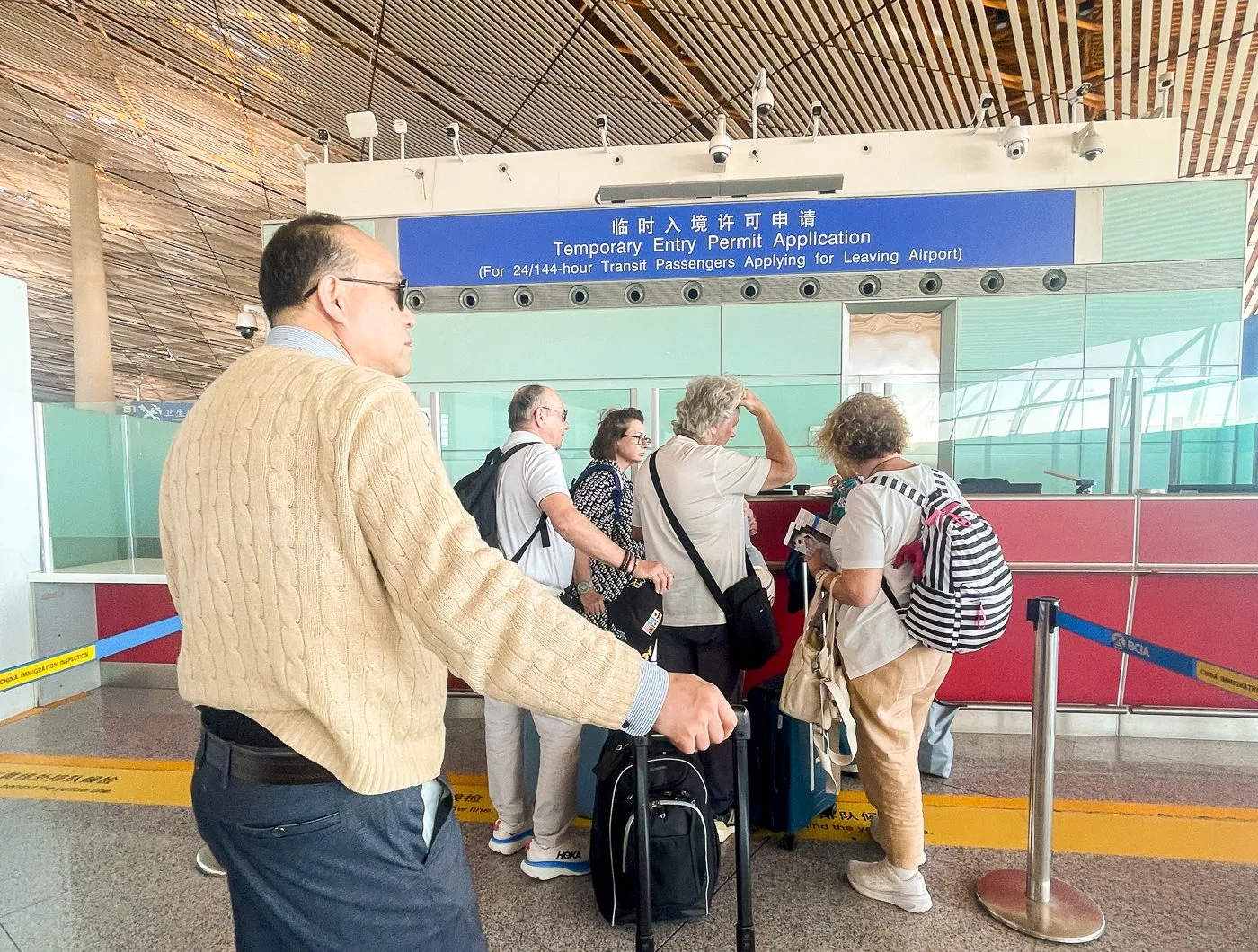
For citizens of 57 countries (US, UK, EU 27, Canada, Australia, NZ, Japan, Korea, Brazil, Argentina, etc.), the 240-hour visa-free transit is the easiest way into China and saves the $140 tourist visa fee + 4-working-day processing time. The conditions:
- You have a confirmed onward ticket to a third country (e.g., Beijing → Shanghai → Tokyo, or Shanghai → Hong Kong → home)
- You arrive at one of 65 eligible ports (all major international airports qualify)
- You stay within 24 permitted provinces (this covers all the main tourist cities)
- The 240 hours = 10 days, starting from midnight the day after arrival
For a 2-week trip, this is tight but doable: enter Beijing Day 1, exit to Tokyo from Shanghai Day 11. If you need more time, the 30-day visa-free policy covers 50 countries (overlaps with 240h list) — no transit requirement, just show up. See our full China 240-hour visa-free guide for the entry process.
Best 2-week route (the backpacker classic)
Beijing (3 nights) → Xi’an (2 nights) → Shanghai (3 nights) → Chengdu (2 nights) → Beijing fly-out (1 night). Total 11 nights, 14 days including travel days. The route forms a closed loop and uses the 240h visa-free transit (exit via Beijing to a third country like Tokyo).
- Days 1-4 Beijing: Forbidden City + Tiananmen (Day 2), Great Wall day trip to Mutianyu (Day 3), hutong walk + Temple of Heaven (Day 4)
- Day 4 night: overnight sleeper train Z19 to Xi’an (hard sleeper ¥350, saves a hotel night, arrives 7 AM Day 5)
- Days 5-6 Xi’an: Terracotta Warriors day tour (Day 5), city wall bike ride + Muslim Quarter (Day 6)
- Day 6 night: overnight HSR to Shanghai (G-series bullet train, second class ¥450, sleeper upgrade ¥700, 6-7 hours)
- Days 7-9 Shanghai: the Bund + Nanjing Road (Day 7), Yu Garden + French Concession (Day 8), Zhujiajiao water town day trip (Day 9)
- Day 9 night: overnight HSR to Chengdu (12-15 hours, second class ¥550)
- Days 10-11 Chengdu: Panda Base morning (Day 10), People’s Park + Jinli + Sichuan hotpot (Day 11)
- Day 11 evening: fly Chengdu → Beijing (2.5 hours, ¥600-900, or sleeper train 22 hours for ¥350)
- Days 12-13 Beijing: rest day + last-minute shopping + Peking duck dinner
- Day 14: fly out Beijing → Tokyo (or other third country for 240h validity)
This route hits all 4 major cities, uses 3 sleeper/HSR segments to save on hotel nights, and includes 1 domestic flight at the end for time efficiency. The 240h visa-free is satisfied because you exit to a third country (Japan) at the end.
When to go: best months + what to avoid
- April-May and September-October are the two windows. 15-25°C, low humidity, comfortable walking weather. Shoulder season = cheaper hostels and fewer crowds.
- June-August: hot (32-38°C) + humid in south, expensive (peak domestic travel). Avoid unless you have specific reasons (e.g., summer-only festival).
- November-March: cold in the north but cheap, fewer tourists. Good for budget travelers who don’t mind layers.
- AVOID: Chinese New Year (late Jan / early Feb, 7-15 days depending on year) and National Day Golden Week (Oct 1-7). Hostels triple in price, HSR tickets sell out 2 weeks ahead, attractions are at 3-5x normal crowd.
Booking tools that actually work for foreigners
The platforms below all accept foreign credit cards, have English interfaces, and are the ones Chinese domestic travelers use (not just foreigner-targeted sites with inflated prices).
- Trip.com — the single best platform for HSR, domestic flights, hostels, and attraction tickets. English interface, foreign cards, e-tickets on the phone. Use it for all HSR bookings and as a backup hostel platform.
- Hostelworld — the dominant hostel booking platform globally. For China hostels, the inventory is the same as Trip.com but the search + filter UX is much better for solo travelers looking for social dorms.
- 12Go Asia — best for overland transport to less-served destinations (Yangshuo, Zhangjiajie, Yunnan, Guilin). They consolidate bus + slow train + ferry tickets that aren’t on Trip.com, and the English booking is reliable.
China HSR + hostels + flights
Single platform for all China transport + accommodation: HSR tickets (Beijing-Xi'an, Xi'an-Shanghai, Shanghai-Chengdu), budget hostels (Beijing Downtown, Phoenix Hostel, Sima Hostel), domestic flights, and attraction tickets. English interface, foreign cards accepted, e-ticket on phone.
HSR from ¥200 · Hostels from ¥60/night · Flights from ¥400
China hostels (40+ cities)
The biggest backpacker hostel inventory in China. Best UX for solo travelers: filter by 6/8/12-bed dorm, social atmosphere rating, female-only dorm, central location. Free cancellation on most properties. The platform also has 5M+ reviews from real backpackers to avoid the bad dorms.
Hostels from ¥50/night · 14 nights ≈ ¥700-1,400
Overland transport (Yunnan, Yangshuo, Zhangjiajie)
The best platform for overland transport to less-served destinations: Yangshuo buses, Zhangjiajie minivans, Dali-Lijiang-Shangri-La route, Guilin-Longji Rice Terraces. They consolidate tickets that aren't on Trip.com. English booking + foreign card payment + 24h support if your bus is late.
Buses from ¥50 · Multi-leg routes ¥200-400
eSIM for China (4G/5G data)
Skip the airport SIM card scam. Airalo eSIM works the moment you land, has 4G/5G coverage across all major Chinese cities + most scenic areas, and you can top up from your phone without finding a store. The China-specific 5GB/15-day plan is enough for a 2-week trip if you use hotel Wi-Fi for big downloads.
5GB/15 days: USD 8.50
Plan your trip — verified tools
- China Travel Budget Calculator — interactive tool to size your budget by style (budget / mid / luxury) and trip length
- China 240-hour visa-free checker — confirm your nationality is on the 240h eligible list
- China HSR route map + class comparison — pick the right seat class for your budget
- China Alipay setup guide — link your foreign credit card to Alipay in 5 minutes
- Sick in China: Foreigners’ Hospital Network — international hospitals in every major city, just in case
China is one of the best-value travel destinations in the world for backpackers in 2026. The infrastructure is there, the hostels are clean and social, the food is world-class and cheap, and the visa-free path is the easiest it’s ever been for Western travelers. Book the flight, pack a 40L backpack, and go.
Step by step
-
Plan a 2-3 city route on HSR (Beijing -> Xi'an -> Shanghai -> Chengdu, sleeper berths for 8+ hour legs)
Plan a 2-3 city route on HSR (Beijing -> Xi'an -> Shanghai -> Chengdu, sleeper berths for 8+ hour legs)
-
Decide travel month (April-May or Sep-Oct shoulder season) + book international flights into Beijing, out of Shanghai or Chengdu
Decide travel month (April-May or Sep-Oct shoulder season) + book international flights into Beijing, out of Shanghai or Chengdu
-
Check 240-hour visa-free eligibility (US/UK/EU/AU/CA qualify with confirmed onward ticket to a 3rd country) OR apply for L-visa (USD 140)
Check 240-hour visa-free eligibility (US/UK/EU/AU/CA qualify with confirmed onward ticket to a 3rd country) OR apply for L-visa (USD 140)
-
Book 14 nights of hostels (CNY 60-120/night dorms) via Hostelworld + 3 HSR segments via Trip.com (Beijing-Xi'an CNY 300, Xi'an-Shanghai CNY 300, sleeper upgrade CNY 200-300)
Book 14 nights of hostels (CNY 60-120/night dorms) via Hostelworld + 3 HSR segments via Trip.com (Beijing-Xi'an CNY 300, Xi'an-Shanghai CNY 300, sleeper upgrade CNY 200-300)
-
Download Alipay + WeChat Pay + DiDi, link Visa/Mastercard to Alipay; budget ~CNY 2,910 (~USD 420) per person excluding international flights
Download Alipay + WeChat Pay + DiDi, link Visa/Mastercard to Alipay; budget ~CNY 2,910 (~USD 420) per person excluding international flights
FAQ
-
How much does 2 weeks in China really cost a backpacker?
About CNY 2,910 (~USD 420) per person excluding international flights: ~CNY 1,260 hostels (CNY 60-120/night dorms in Beijing, Xi'an, Shanghai, Chengdu), CNY 700 food (street + cheap restaurants), CNY 140 city transit, CNY 600 HSR (3 sleeper/HSR segments: Beijing-Xi'an CNY 300, Xi'an-Shanghai CNY 300, sleeper upgrade CNY 200-300), CNY 210 attraction tickets (Forbidden City CNY 60, Terracotta Army CNY 120, Yu Garden CNY 40, others CNY 0-50). Add CNY 3,500-7,000 (~USD 500-1,000) for round-trip international flights from US/Europe, or CNY 1,500-2,500 (~USD 210-350) from Southeast Asia. Total all-in: USD 600-1,400 for 2 weeks. -
Can I backpack China on a budget as a foreigner?
Yes. China has strong hostel networks in Beijing, Xi'an, Shanghai, and Chengdu (8-12 bed dorms at CNY 60-120/night), and the HSR + sleeper train network is fast, cheap, and foreigner-friendly. Book hostels on Hostelworld (foreign passport accepted, automatic 24h police registration) and HSR tickets on Trip.com (which accepts international cards and shows the timetable in English). Pay with Alipay/WeChat Pay after linking your Visa/Mastercard to Alipay — most vendors no longer accept cash. -
What is the cheapest way to travel between cities in China?
High-speed rail (HSR) second-class tickets, plus overnight sleeper berths for 8+ hour routes. Beijing-Xi'an is 4.5 hours at CNY 300; Xi'an-Shanghai is 6-7 hours at CNY 450; Shanghai-Chengdu is 12-15 hours at CNY 550. Sleeper berths save a hotel night — Z-series overnight trains have hard sleeper (CNY 200-350) and soft sleeper (CNY 350-500) berths. For routes over 1,500 km (Beijing-Guangzhou, Shanghai-Chengdu), a budget flight (~CNY 600-900) can be cheaper than HSR. For overland buses + ferries (Yunnan, Yangshuo, Zhangjiajie), use 12Go Asia.
Related guides
- Itineraries
China Solo Travel Guide 2026: 2-Week Backpacker Route for First-Time Visitors
A practical 2-week China solo travel guide for first-time backpackers and independent travelers. Covers a five-city route (Beijing, Pingyao, Xi'an, Chengdu, Shanghai), hostel and boutique-hotel picks, the China 240-hour visa-free transit, DiDi, HSR, sleeper trains, group tour options for harder-to-reach places, daily budgets, and a no-safety-theatre safety section.
- Tools & Resources
China Travel Budget 2026: Real Costs by Style
Actual 2026 prices for flights, hotels, food, transport, and attractions in China — broken down by budget / mid-range / luxury traveler. With $20 hotel rooms, $5 Michelin meals, and the real cost traps.
9min read
- Itineraries
China on a Budget 2026: The Backpacker & Extreme Budget Travel Guide
Travel China on a backpacker budget of $30-60/day in 2026 — hostel culture, sleeper trains (硬座/硬卧/软卧), the classic backpacker route (Shanghai-Yangshuo-Dali-Lijiang), street food deep dive, free attractions, couchsurfing, work exchange (WWOOF/Workaway), and 4 ready-made itineraries (2 weeks, 3 weeks, 1 month, 2 months). Includes 30 FAQs and 7 cheap cities ranked by daily cost.
- Tools & Resources
China Daily Budget 2026: Beijing, Shanghai + 5 More
Verified 2026 per-person daily budget for 7 China cities in 4 travel styles. Line-item breakdown and 4 city-specific cost traps to avoid.
10min read
- Tools & Resources
Trip.com for Foreigners: The Complete 2026 Guide
Complete 2026 Trip.com guide for foreign travelers: registration, payment methods, coupons, 6-tier loyalty, refunds, price-match, and 5 places where Trip.com is the wrong choice. Verified 2026-09-06.
9min read
- Tools & Resources
Cheapest Flights on Trip.com (2026): Timing + Hacks
Verified 2026 playbook for booking the cheapest flights on Trip.com — booking windows, cheapest days, Air Flexibility, Bundle-and-Save, Price Alerts, and 5 China flight tips. Verified 2026-09-06.
8min read