
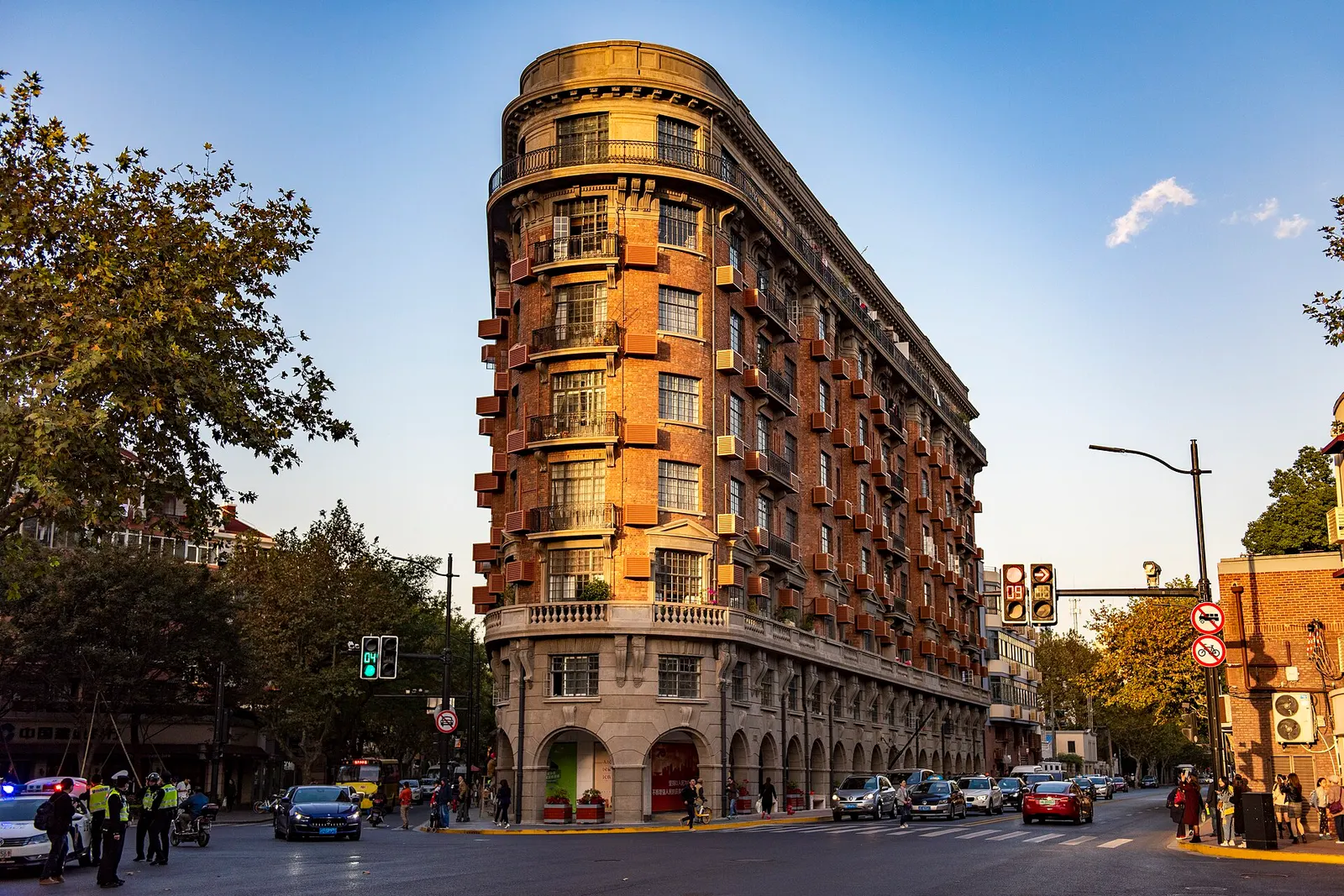
French Concession, Shanghai (法租界), the Hengfu Historical District
法租界(衡复历史文化风貌区) · Fǎ Zū Jiè (Héngfù Lìshǐ Wéngfào Qū)
Quick answer
There is no ticket to buy, no booking to make and no separate foreigner rate: the district is public street and entry to the Wukang Building is free, so there is nothing a passport or a visa changes here. Official sources publish no foreigner-specific condition for the streets. If you want the exhibition spaces inside the old villas, ask the Wukang Road Tourist Information Centre (Shanghai Old Houses Art Centre) on 021-64335000, which publishes its own hours.
Why visit
- 1 Not a scenic park but a living piece of the city — officially the Hengfu Historical and Cultural Style District (衡复历史文化风貌区), and still called 法租界 (Fǎ Zū Jiè) by the people who live here
- 2 The Wukang Building (武康大楼), built in 1924 and designed by Hudec, was Shanghai's first exterior-corridor apartment and stands at 1850 Huaihai Middle Road
- 3 64 roads inside the district are protected from ever being widened, and Xuhui District alone counts close to 520 listed excellent historic buildings and protected cultural sites
- 4 Free to walk and free to enter the Wukang Building; the Wukang Road visitor centre publishes hours for Sunday to Friday and for weekends
- 5 A half-day walk covers the Wukang Building, the villa streets, the shikumen lanes, Fuxing Park and Anfu Road
Essential tips for foreigners
- Ask for 法租界 (Fǎ Zū Jiè), and add 衡复风貌区 for the official name. The first is what people actually say; the second is what the signage and the planning documents use.
- Start at street level, not on the viewing deck. The new source point plaza (源点广场) opposite the Wukang Building gives a 720° view of it, but the building's own corner is where you understand its shape.
- Free does not mean open. The district and the Wukang Building are free, but the official material publishes no opening times for the buildings themselves — plan around the venues that do publish hours, such as the Wukang Road visitor centre on 021-64335000.
- Write the addresses in Chinese. 淮海中路 1850 号 and 武康路 393 号甲 are what the door signs say; the romanised form rarely helps a taxi driver.
- Allow half a day, not an hour. The streets are close together, but the villa fronts, the lane houses and the park each deserve unhurried time.
- Do not expect a museum circuit. The reward here is the streetscape: the walls, the gates, the plane trees and the corner buildings, photographed from the pavement.
Shanghai’s French Concession is not a scenic park, a museum or a ticketed attraction. It is the part of the city centre officially designated the Hengfu Historical and Cultural Style District (衡复历史文化风貌区), the grid of streets around Hengshan Road and Fuxing Road. People still call it 法租界 (Fǎ Zū Jiè), the French Concession, because that is what this district was for much of the last century. It is a neighbourhood you walk through, not a set piece behind a gate.
What you see is a coherent piece of early twentieth-century Shanghai: the wedge-shaped Wukang Building (武康大楼) on the sharp corner where Wukang Road meets Huaihai Middle Road; the villa streets behind it, with their garden walls and plane trees; the older shikumen (石库门) lane houses; and Fuxing Park closing the southern end.
None of it costs anything to walk. We will tell you up front what we cannot give you: the official sources publish no recommended season, no opening times for the buildings themselves and no visitor numbers, so this page does not invent them.
What is Shanghai’s French Concession?
The name comes from the concession itself. In 1849 the Shanghai daotai (道台, the provincial intendant) and the first French consul to Shanghai agreed a boundary for a French-administered district outside the old walled city. The boundary was extended several times afterwards, including a large enlargement around 1900 and a further expansion in 1914.
What is protected and walked today is the Hengfu Historical and Cultural Style District, first sketched by the city as a conservation area at the turn of the century and later formally designated as a historical style district. The scale is manageable: 4.3 square kilometres of it lie inside Xuhui District, 64 roads inside it are protected from ever being widened, and Xuhui District alone counts close to 520 listed excellent historic buildings and protected cultural sites. Most of the housing stock here is nearly a century old.
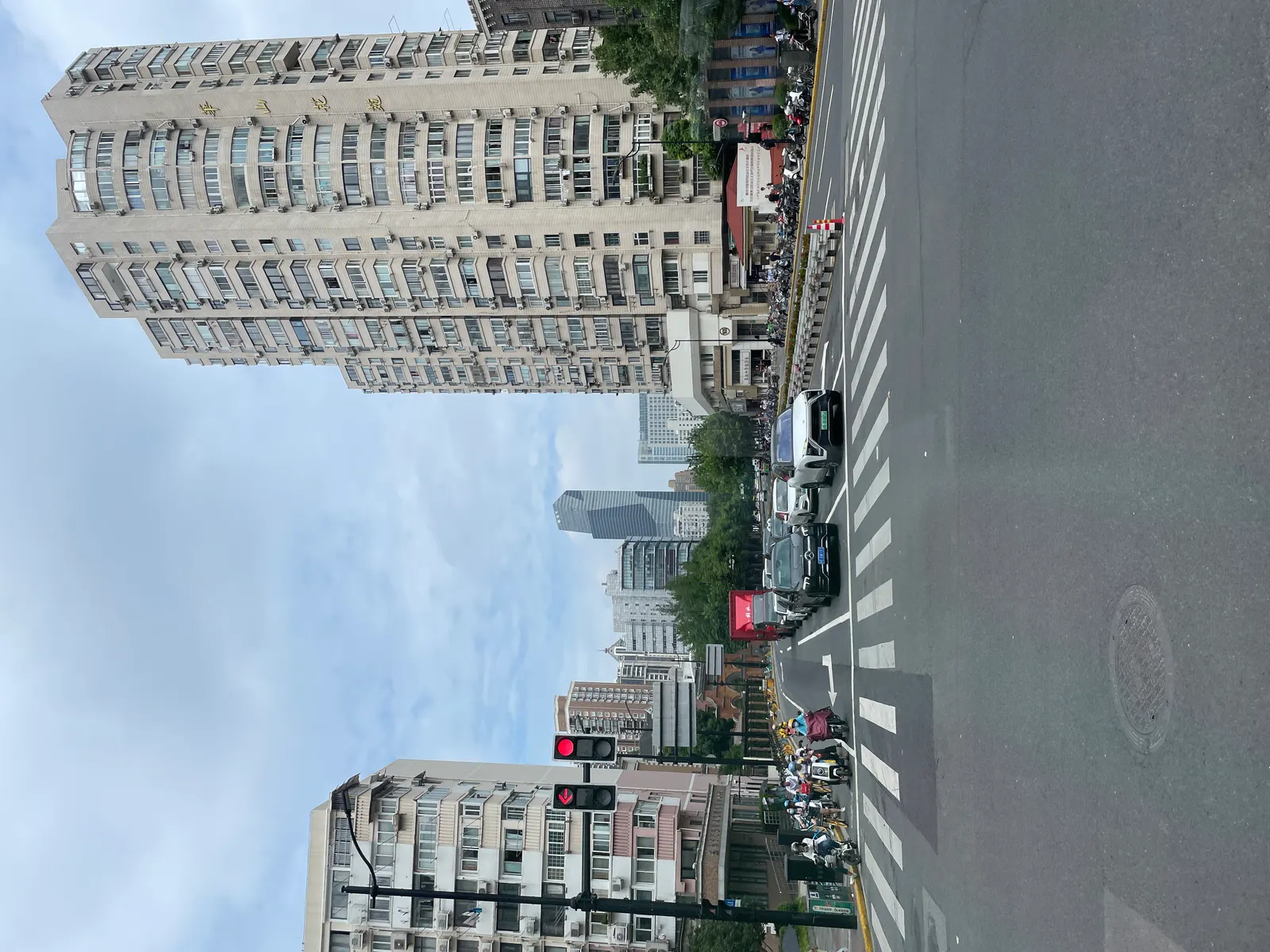
Huaihai Middle Road, the wide avenue that runs along the northern edge of the district. Photo: Wikimedia Commons / CC BY-SA 4.0 — MNXANL. Source
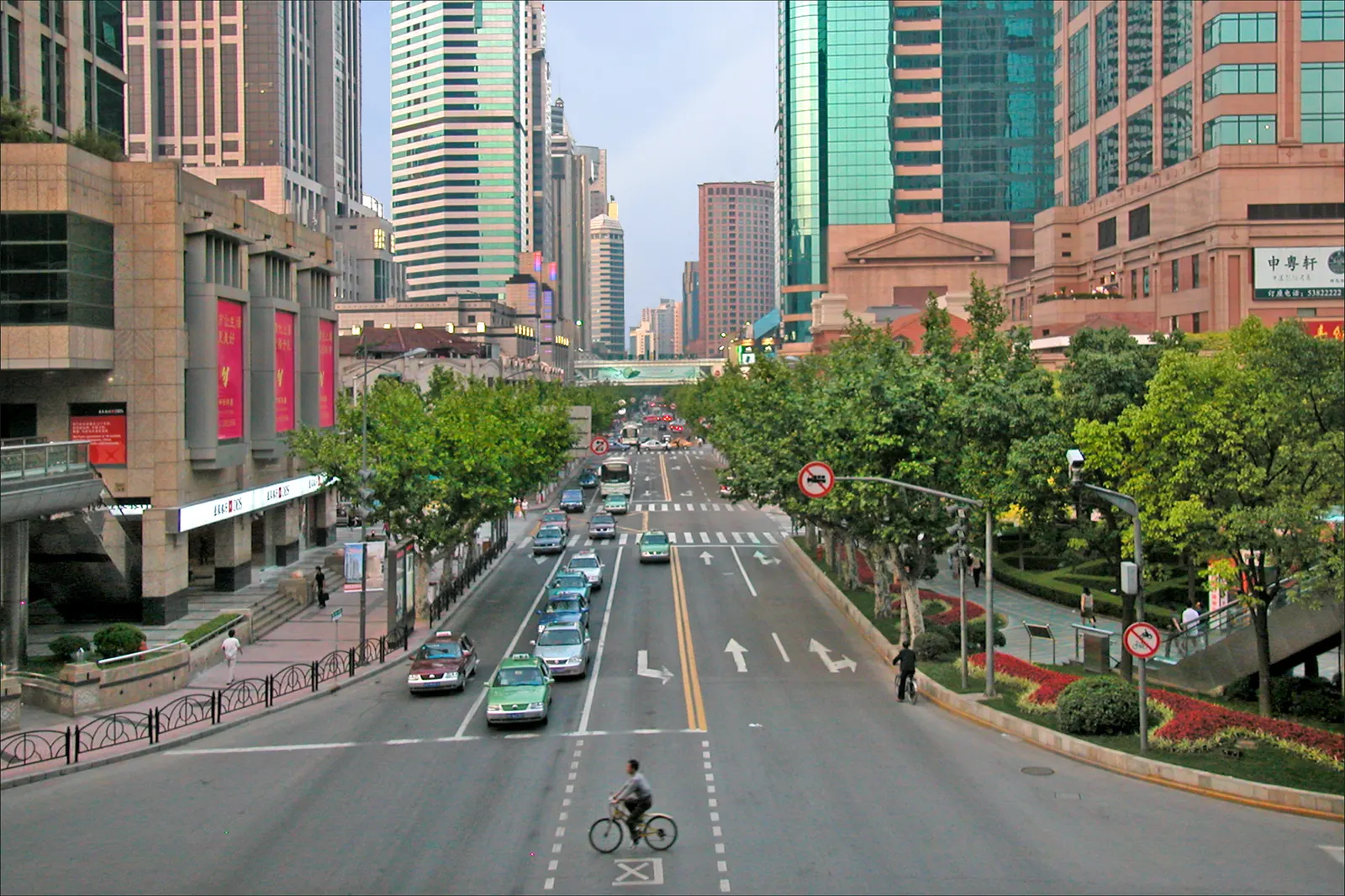
The same avenue a century ago — the plane trees were already here. Photo: Wikimedia Commons / CC BY 2.0 — Jean-Pierre Dalbéra from Paris, France. Source
Is French Concession Shanghai worth visiting?
Yes — with one condition attached: come to walk the streets, not to tick off interiors. It is small enough to do in half a day, it is free, and the buildings are individually dated and named, which is what makes it more than a generic old-Shanghai photo stop. The municipal route groups the four streets where the quarter met into a film district of 0.4 square kilometres: the films of the 1930s and 1940s — 《风云儿女》, 《一江春水向东流》, 《永不消逝的电波》 — are tied to this space, and actors including Zhao Dan and Wang Renmei lived here.
The honest caveat is that this is a streetscape, not a museum circuit. The official material publishes no admission times for the buildings themselves, so what you get is the exterior: the garden walls, the gates, the plane trees, the corner geometry. Plan it as a walk and it pays off.
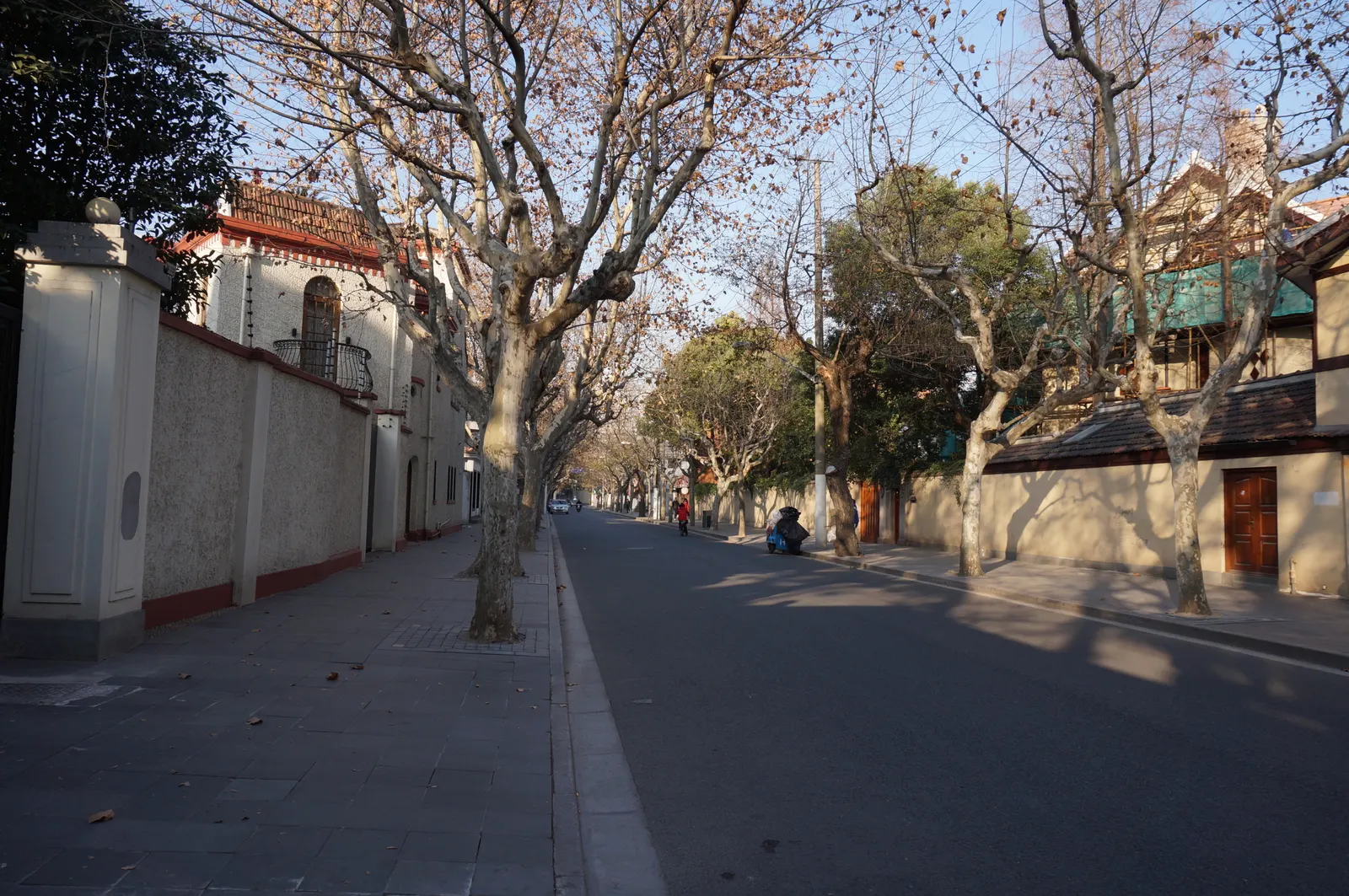
The villas along Wukang Road sit back behind their own garden walls. Photo: Wikimedia Commons / CC BY-SA 3.0 — Livelikerw. Source
What is the French concession in Shanghai called in Chinese?
法租界 — pronounced Fǎ Zū Jiè. That is the name Shanghai people still use for this group of old streets, and the one you will hear on the ground, in the two characters any local understands immediately.
The official name is different, and worth knowing: the protected area is the 衡复历史文化风貌区, the Hengfu Historical and Cultural Style District, with the Hengshan Road — Fuxing Road stretch at its centre. In practice the two names describe the same walk. Maps, taxi bookings and street signs use 衡复风貌区, 武康路, 淮海中路, 复兴西路 and 乌鲁木齐南路 — street names rather than the district name. Ask a person for directions and 法租界 is the faster word; match it to a planning document or a protected-buildings list and use 衡复风貌区. The name has nothing to do with France today: what survives is a protected neighbourhood and a name.
Where to go in French Concession Shanghai?
If you only have one walk: south from the Wukang Building along Wukang Road, then over to Fuxing West Road and Urumqi South Road, finishing at the Wuzhong Market. Almost everything worth seeing is on those streets.
| Stop | Address | What it is |
|---|---|---|
| Wukang Building (武康大楼) | 1850 Huaihai Middle Road | 1924, designed by Hudec; free to enter |
| Ba Jin’s former home (巴金故居) | 113 Wukang Road | Where Ba Jin wrote 《随想录》 |
| Midan Apartments (密丹公寓) | 115 Wukang Road | Built 1931; excellent historic building |
| Cape Town Apartments (开普敦公寓) | 240 Wukang Road | Built 1940; listed in 2015 |
| Zhou Xuan’s old home (周璇旧居) | 391 Lane 1, Wukang Road | Built 1916 |
| Film actors’ troupe (上影演员剧团) | 395 Wukang Road | Founded 1926 |
| Visitor centre (上海老房子艺术中心) | 393A Wukang Road | South block 1912, north block 1933; ask what is open |
| Rose Villas (玫瑰别墅) | 44 Lane 7, Fuxing West Road | Seven apartment buildings, 1940 |
| Ke Ling’s former residence (柯灵故居) | 147 Fuxing West Road | The writer’s house |
| Xia Yan’s former residence, Cao Ying study | 178 Urumqi South Road | Units 2 and 3 |
| Wuzhong Market (乌中市集) | 318 Urumqi Middle Road | The market |
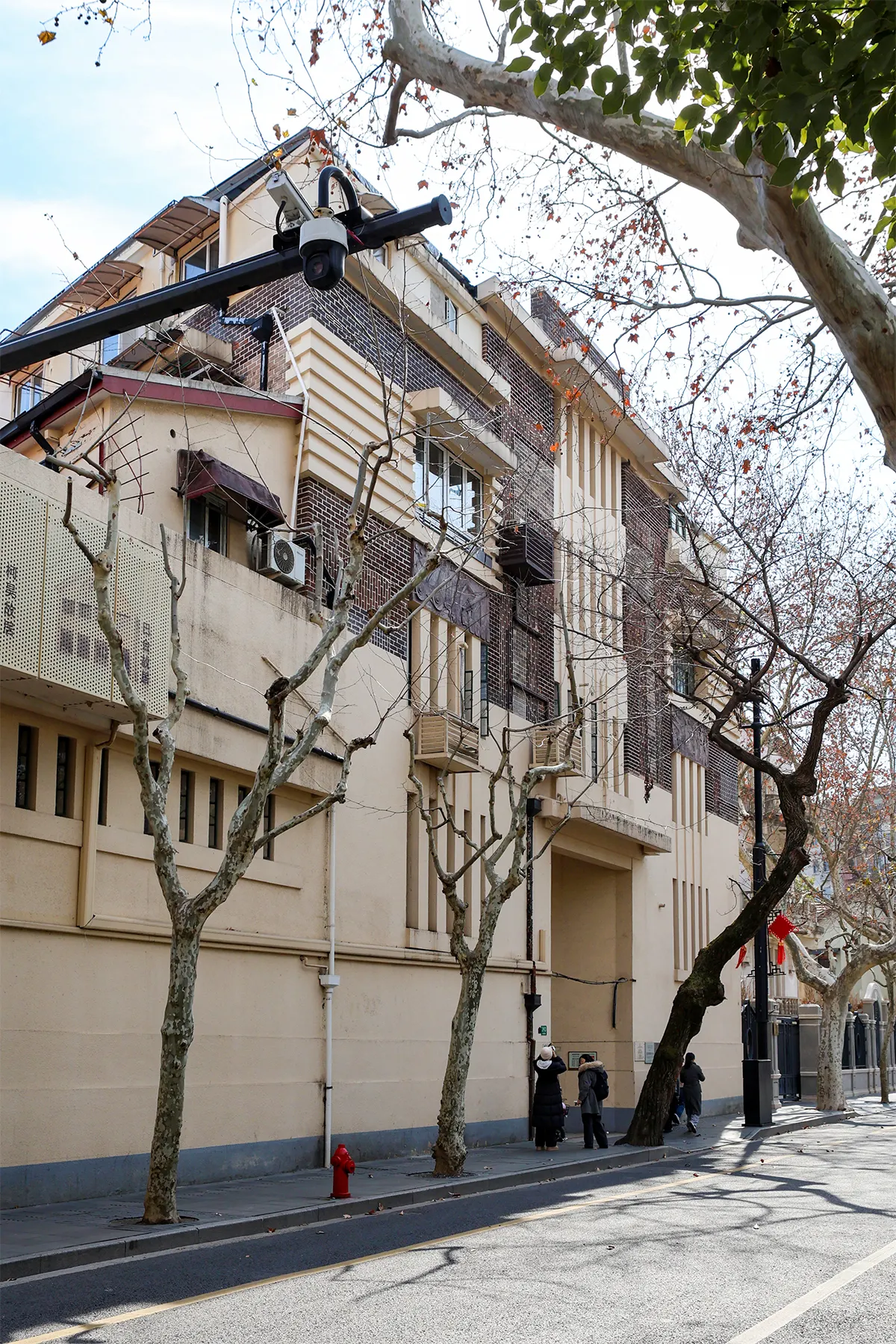
Number 393 Wukang Road, a former residence now used as a visitor centre. Photo: Wikimedia Commons / CC BY-SA 4.0 — Windmemories. Source
What to see in French Concession Shanghai?
The Wukang Building
Start here, because it is the building the district is recognised by. It was built in 1924 by the savings society 万国储蓄会 and designed by 邬达克 (Hudec), and was originally the Normandy Apartments (诺曼底公寓), also known as the East American Apartments (东美特公寓). The municipal culture and tourism bureau calls it Shanghai’s first exterior-corridor apartment (首座外廊式公寓), and in 1994 it joined the second batch of the city’s excellent historic buildings. The style is French Renaissance: render at the bottom, yellow-brown brick through the middle, render again at the top, with a triangular classical pediment above the entrance level. Entry is free.
Its shape is the point — the wedge was forced by the corner of the two roads, and the building narrows as it rises, which is why it reads like a ship’s prow. Across the street, the source point plaza (源点广场) at the Tianping Road junction adds a focus area of more than 530 square metres and a 720° view of the building, the easiest way to take in the whole geometry at once.
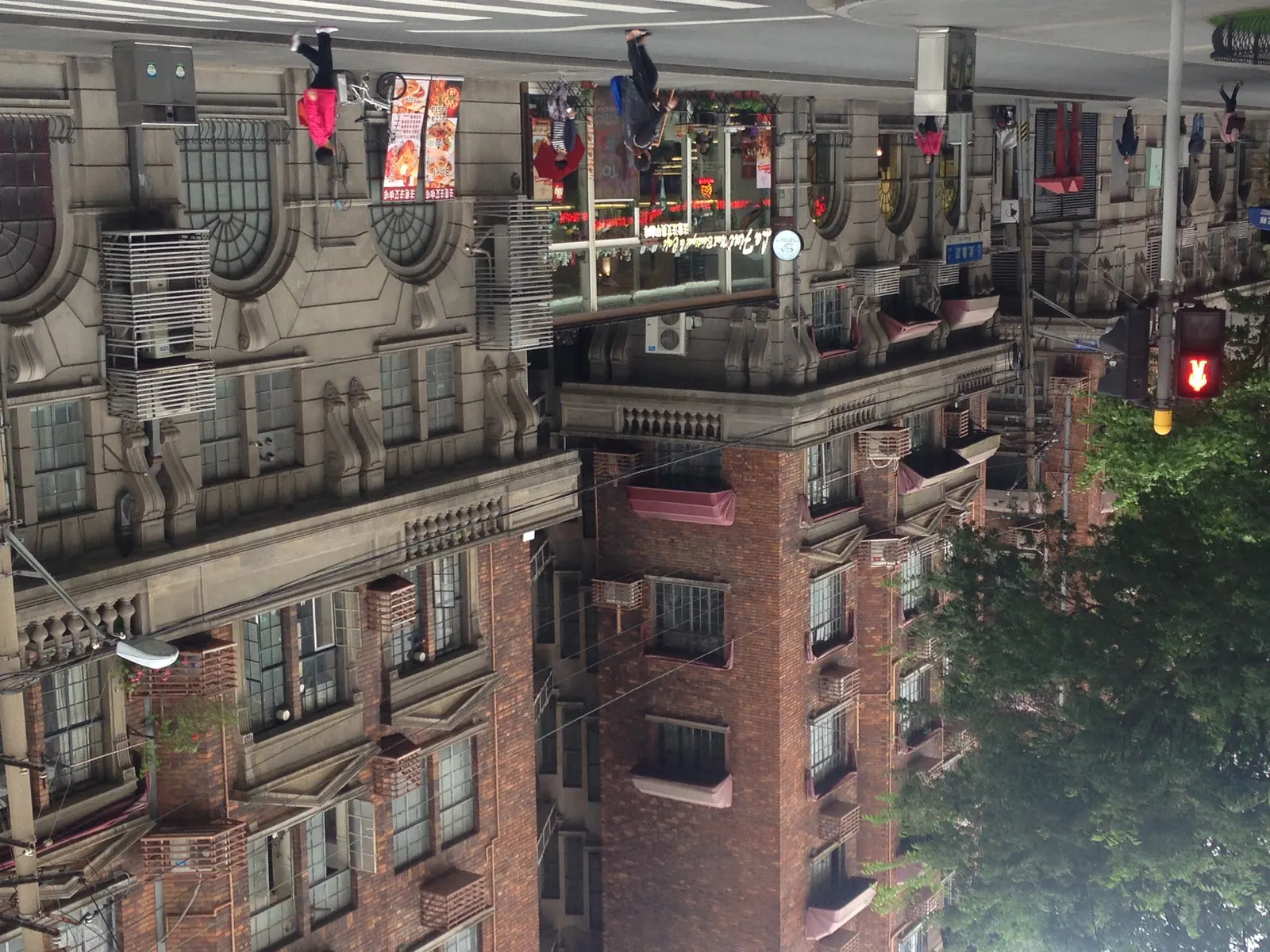
Wukang Building from street level. Photo: Wikimedia Commons / CC BY-SA 4.0 — SSYoung. Source
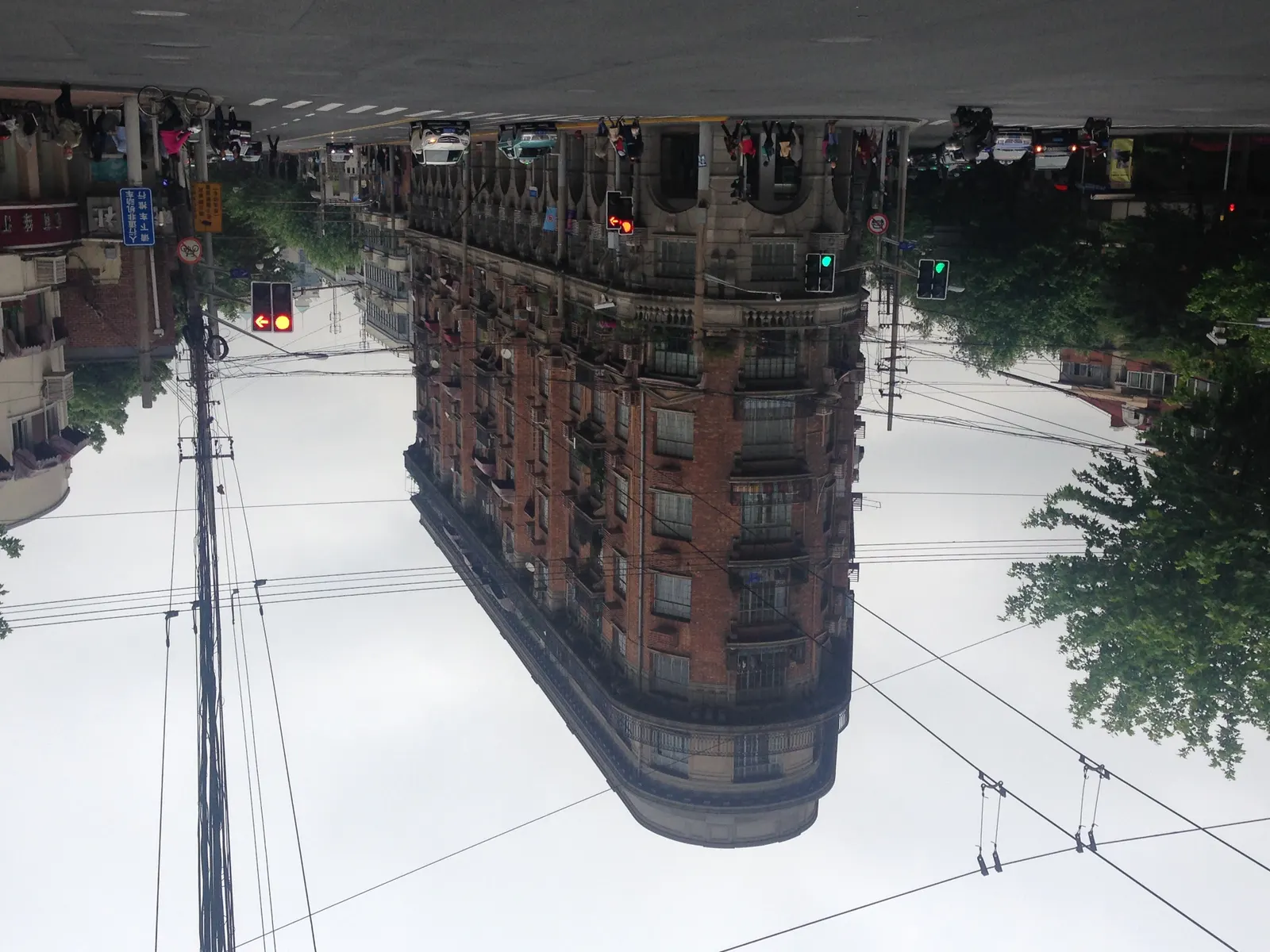
The building narrows as it rises, which is what gives it its ship-like shape. Photo: Wikimedia Commons / CC BY-SA 4.0 — SSYoung. Source
The villa streets
Wukang Road is the spine of the district, and the municipal route describes it as the street that condenses a century of modern Shanghai. The villas sit back behind their own garden walls, which gives the street its rhythm rather than a continuous frontage, and the plane trees shade the road and the facades behind it.
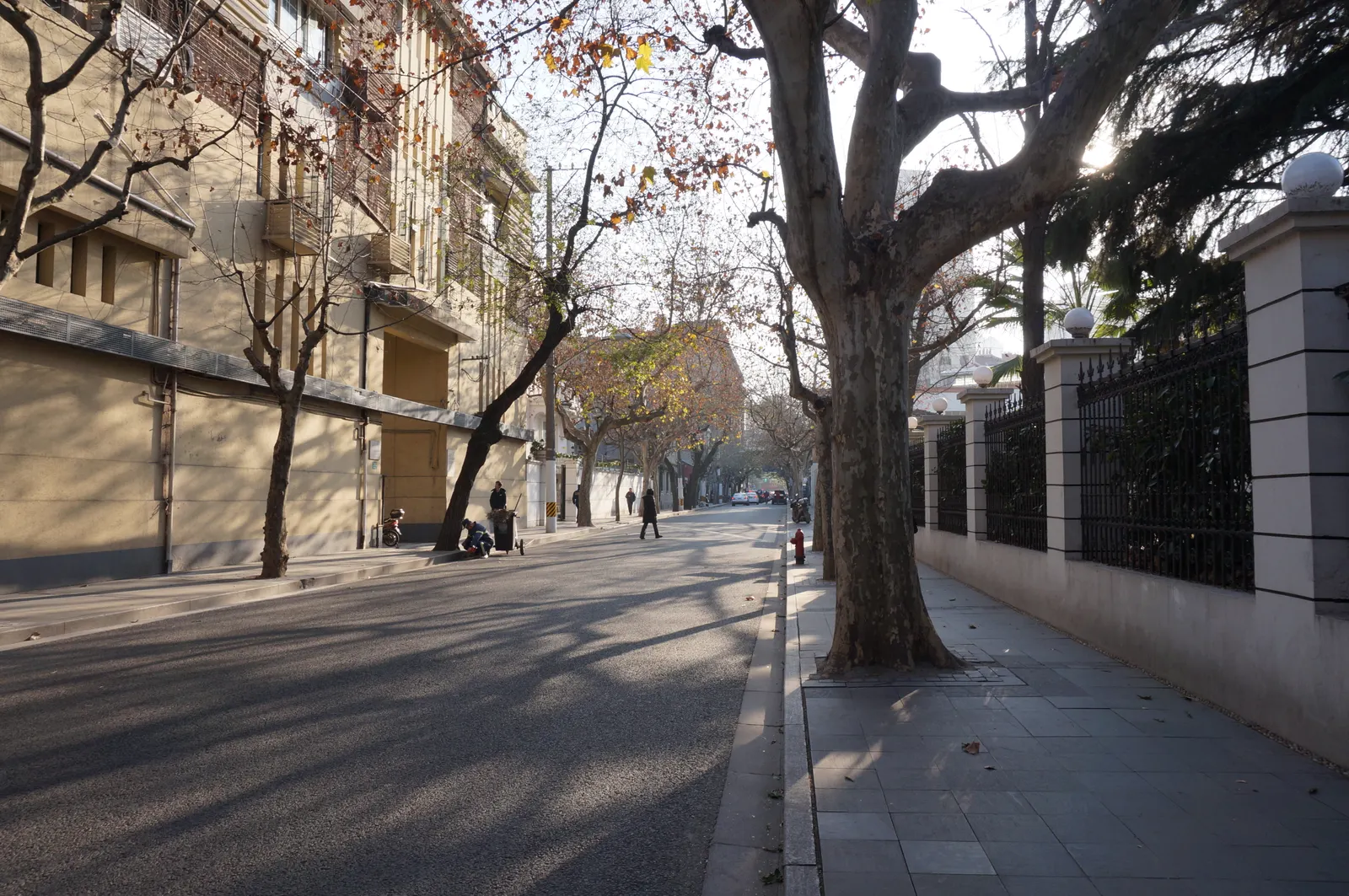
The plane trees that shade Wukang Road are the reason the district is nicknamed for them. Photo: Wikimedia Commons / CC BY-SA 3.0 — Livelikerw. Source
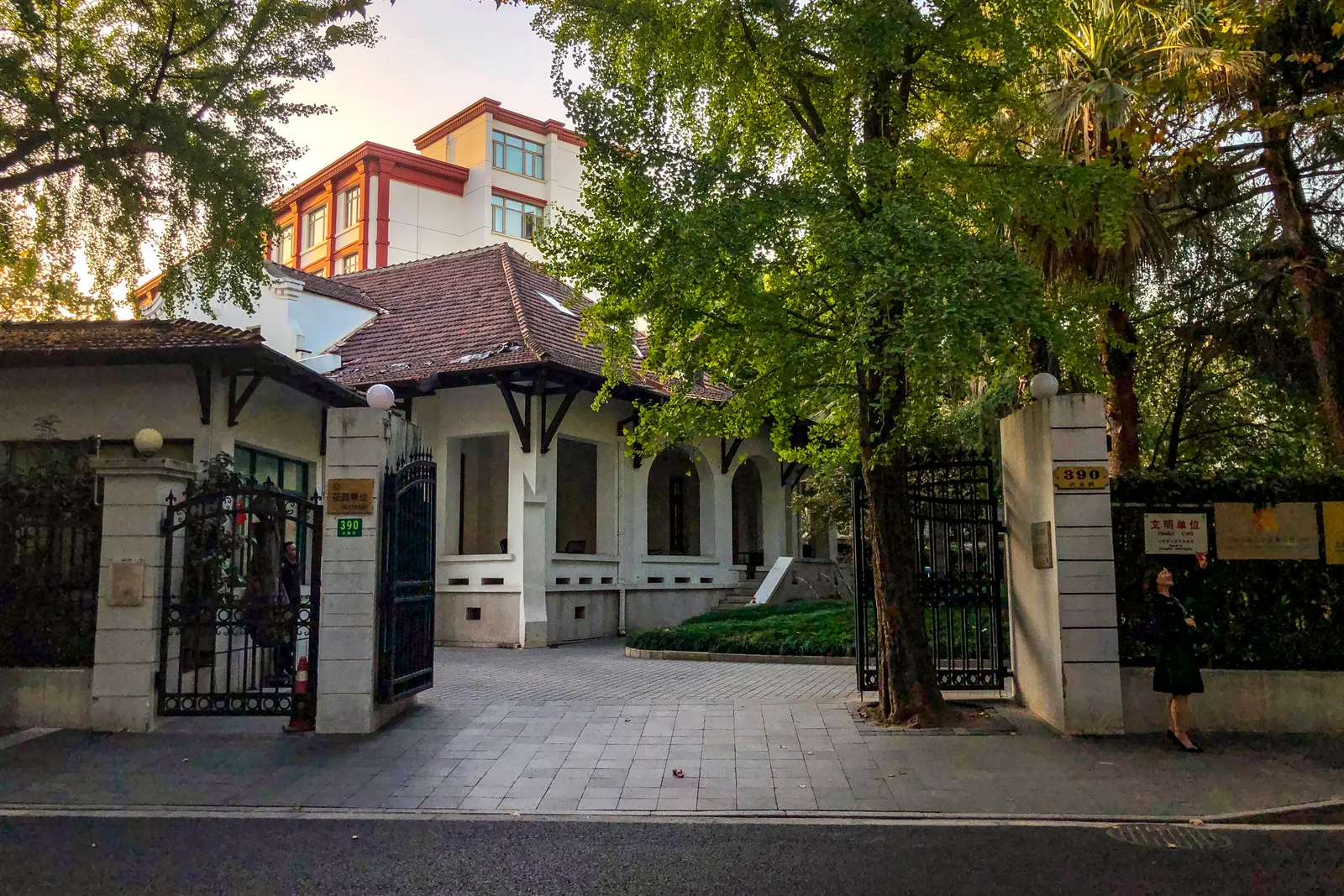
One of the villas on Wukang Road, behind its own gate. Photo: Wikimedia Commons / CC BY-SA 4.0 — N509FZ. Source
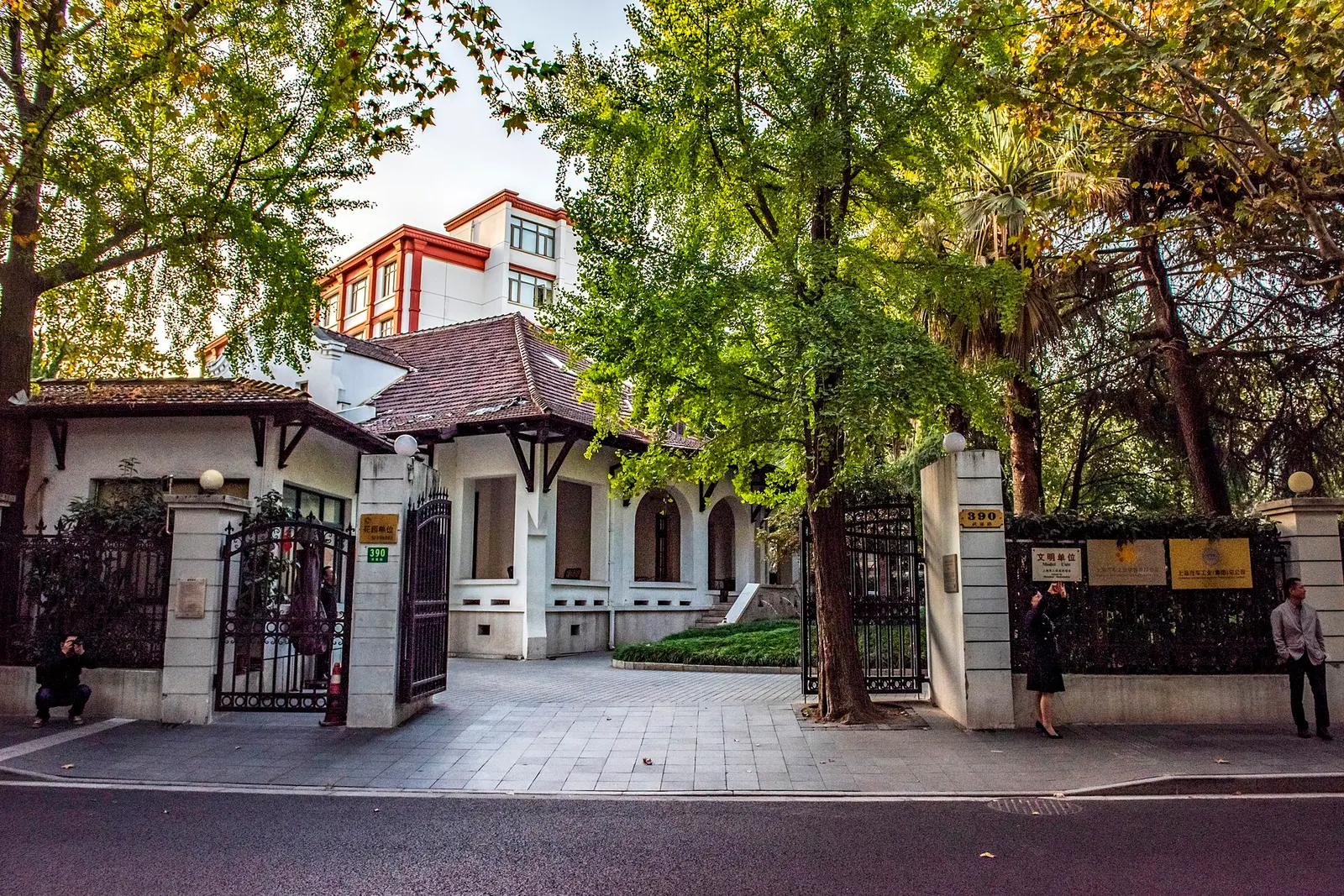
Another villa frontage on Wukang Road. Photo: Wikimedia Commons / CC BY-SA 4.0 — N509FZ. Source
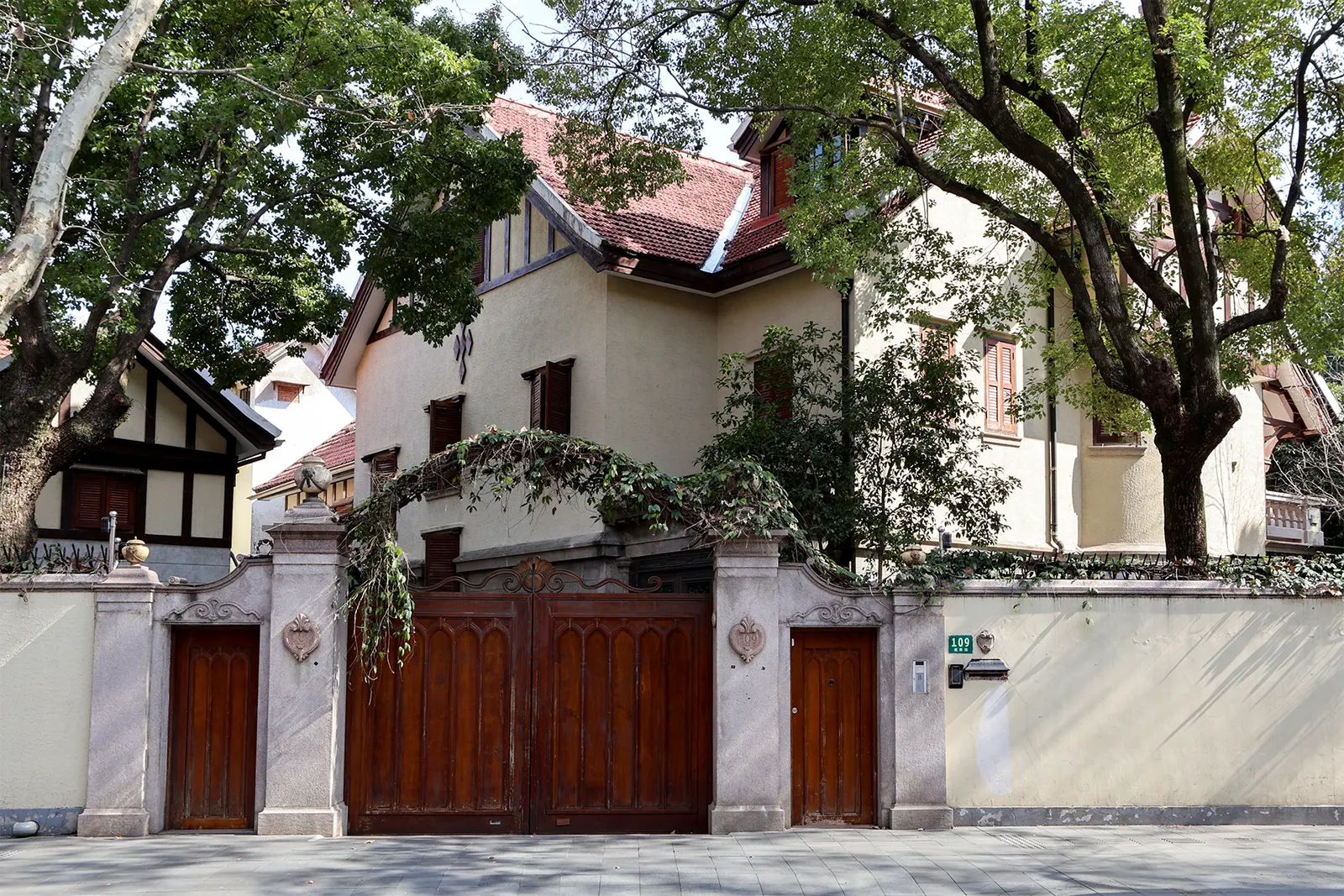
The villas on Wukang Road change little from one gate to the next. Photo: Wikimedia Commons / CC BY-SA 4.0 — Windmemories. Source
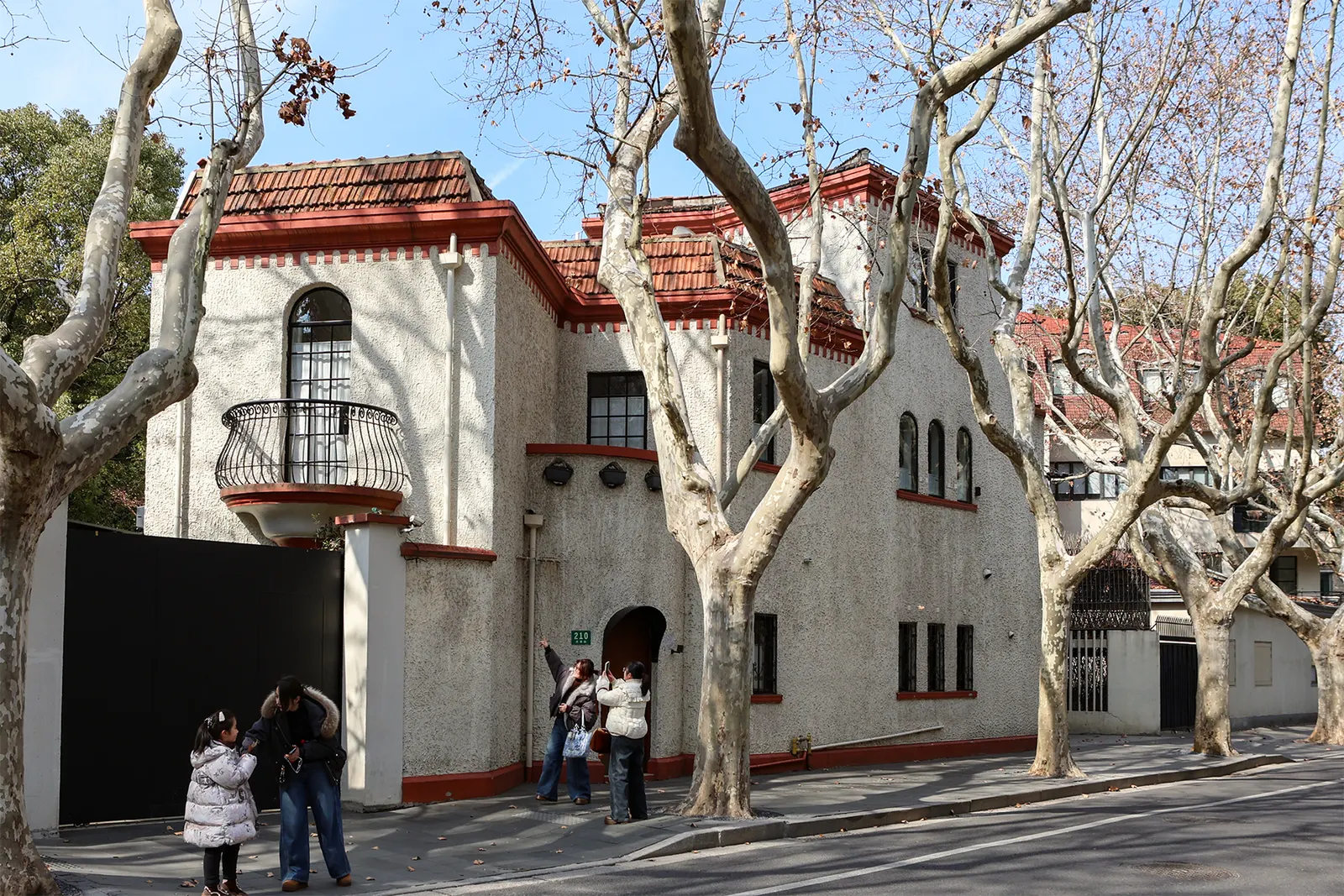
Rows of houses along Wukang Road. Photo: Wikimedia Commons / CC BY-SA 4.0 — Windmemories. Source
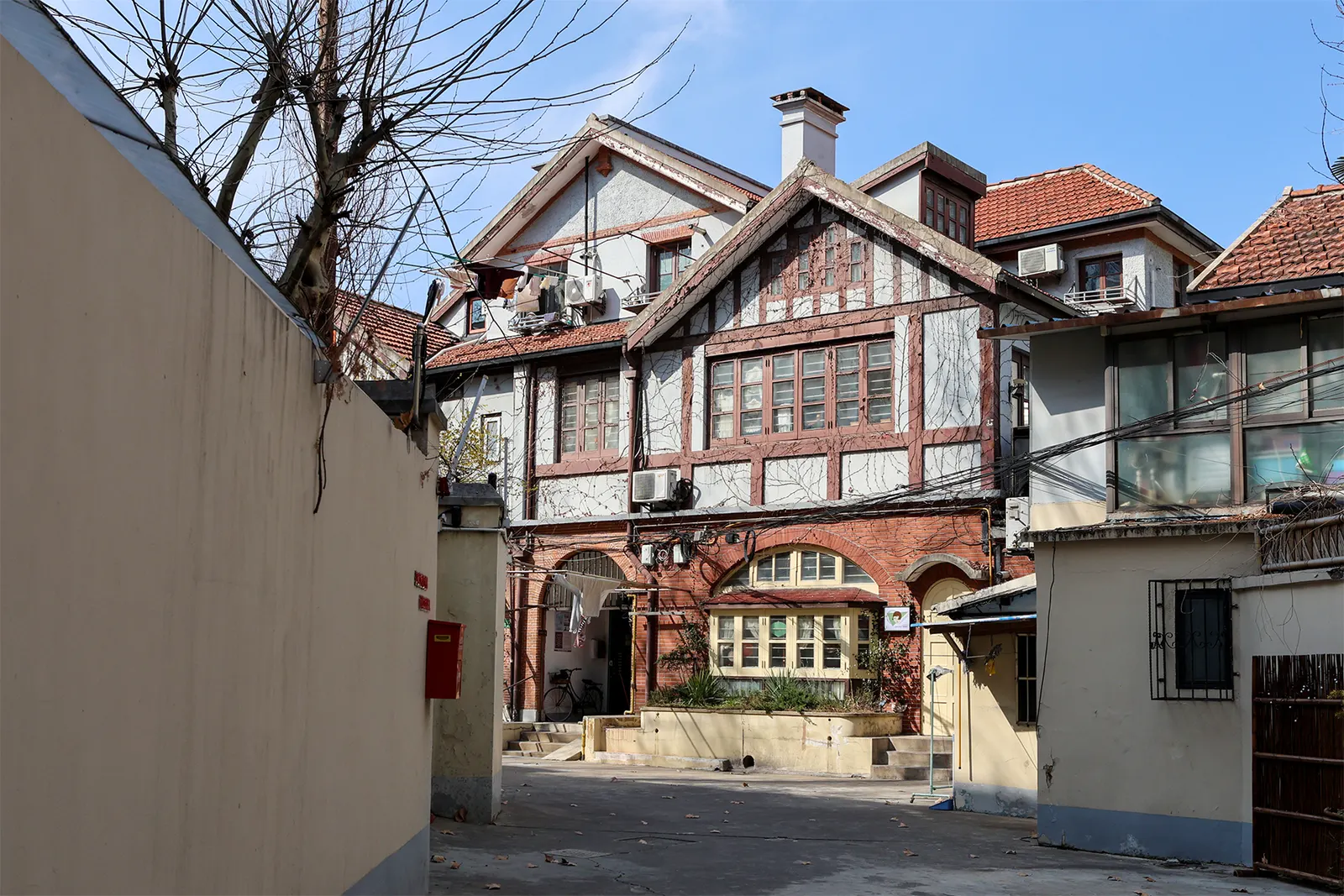
One of the old residences on the street. Photo: Wikimedia Commons / CC BY-SA 4.0 — Windmemories. Source
The lane houses
Behind and between the villa streets is the older fabric: rows of shikumen (石库门) lane houses, the grey-brick terrace houses that give the style its name. What identifies them is the stone gate — a carved lintel set into a grey brick wall — and the lanes themselves, stone-paved, narrow, walled on both sides.
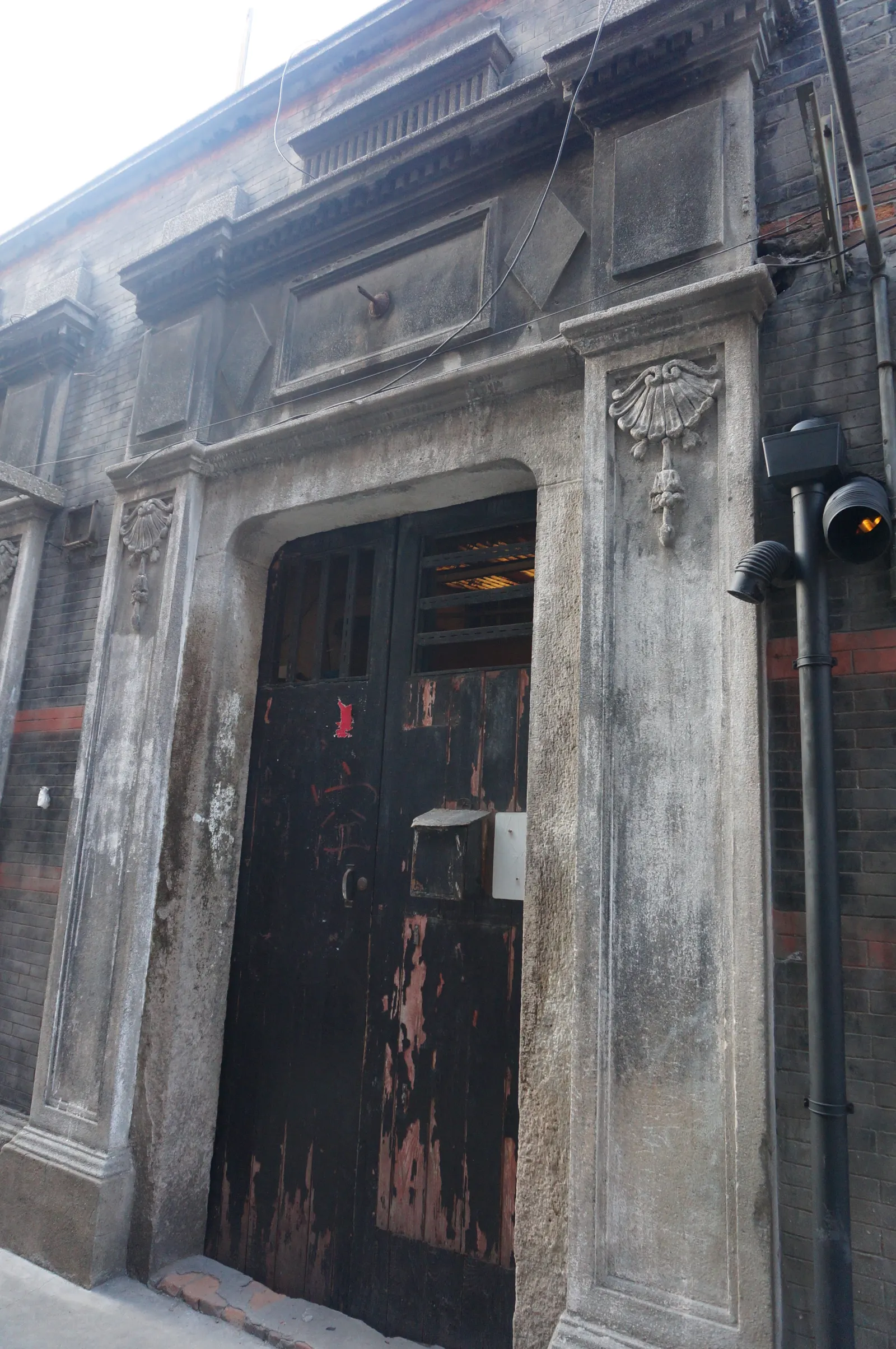
A stone gate on a shikumen lane house — the detail that names the style. Photo: Wikimedia Commons / CC BY-SA 3.0 — Livelikerw. Source
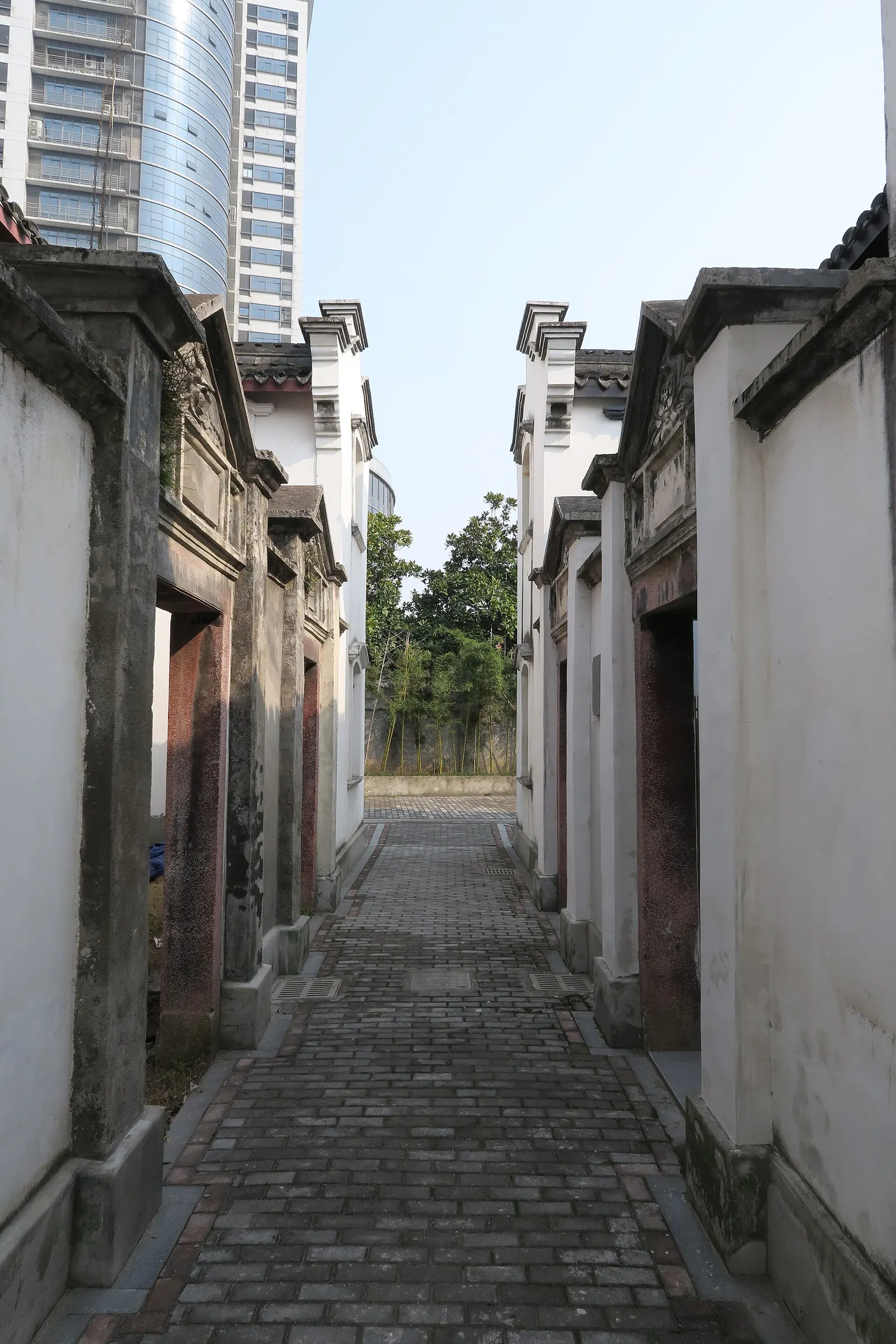
A lane between shikumen houses. Photo: Wikimedia Commons / CC BY-SA 4.0 — Siyuwj. Source
Fuxing Park
The southern end of the district opens into Fuxing Park: a path through trees and shrubs, a lake with a railing along its near edge, formal planting in beds of red and yellow, and an open lawn where the towers of the city rise behind the trees. It is the natural place to end the walk rather than a separate destination.
One thing to be straight about: the official pages we checked publish no opening hours and no charges for the park itself, so treat it as part of the walk rather than as a stop to schedule.
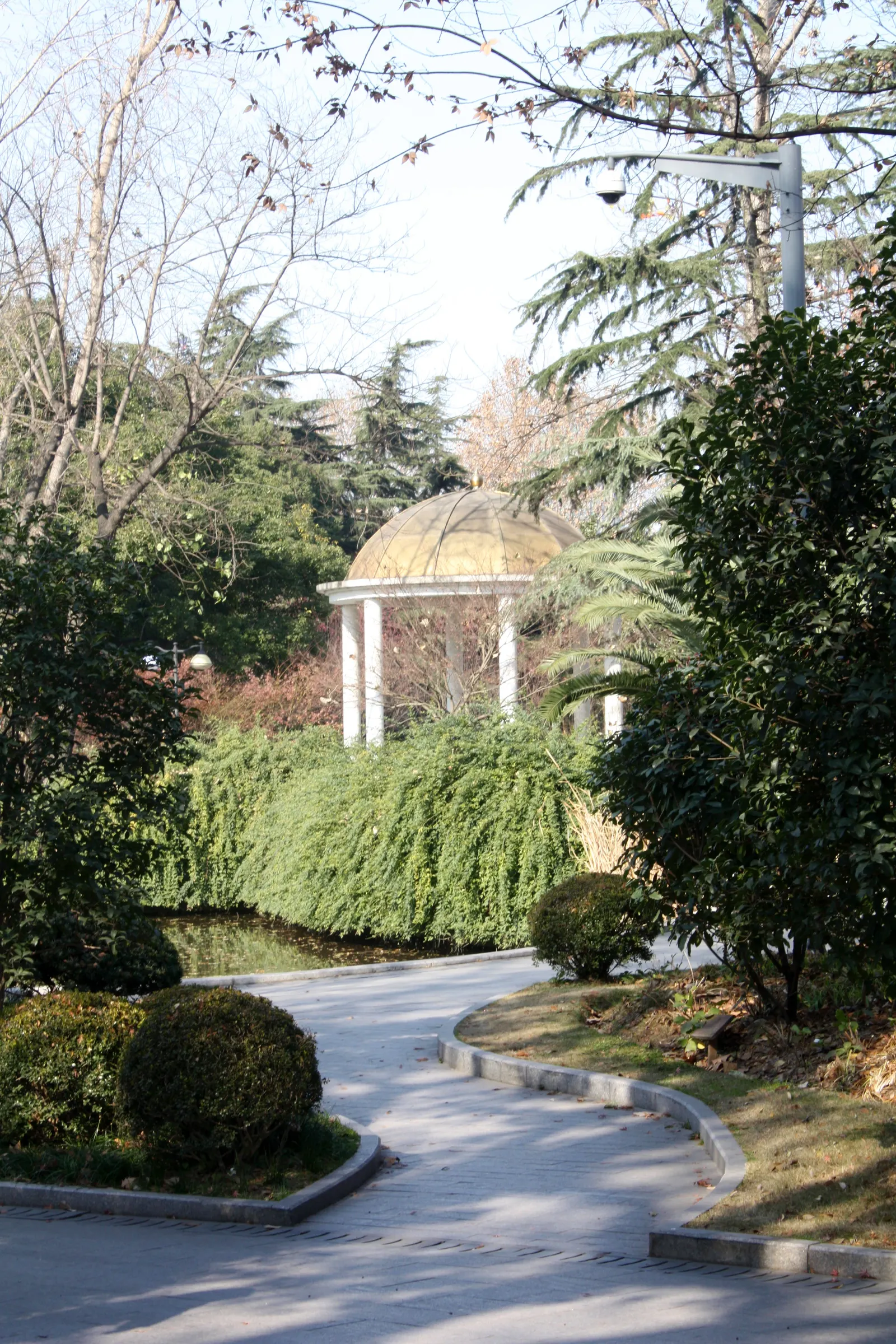
Fuxing Park, at the southern end of the district. Photo: Wikimedia Commons / CC BY-SA 3.0 — J. Patrick Fischer. Source
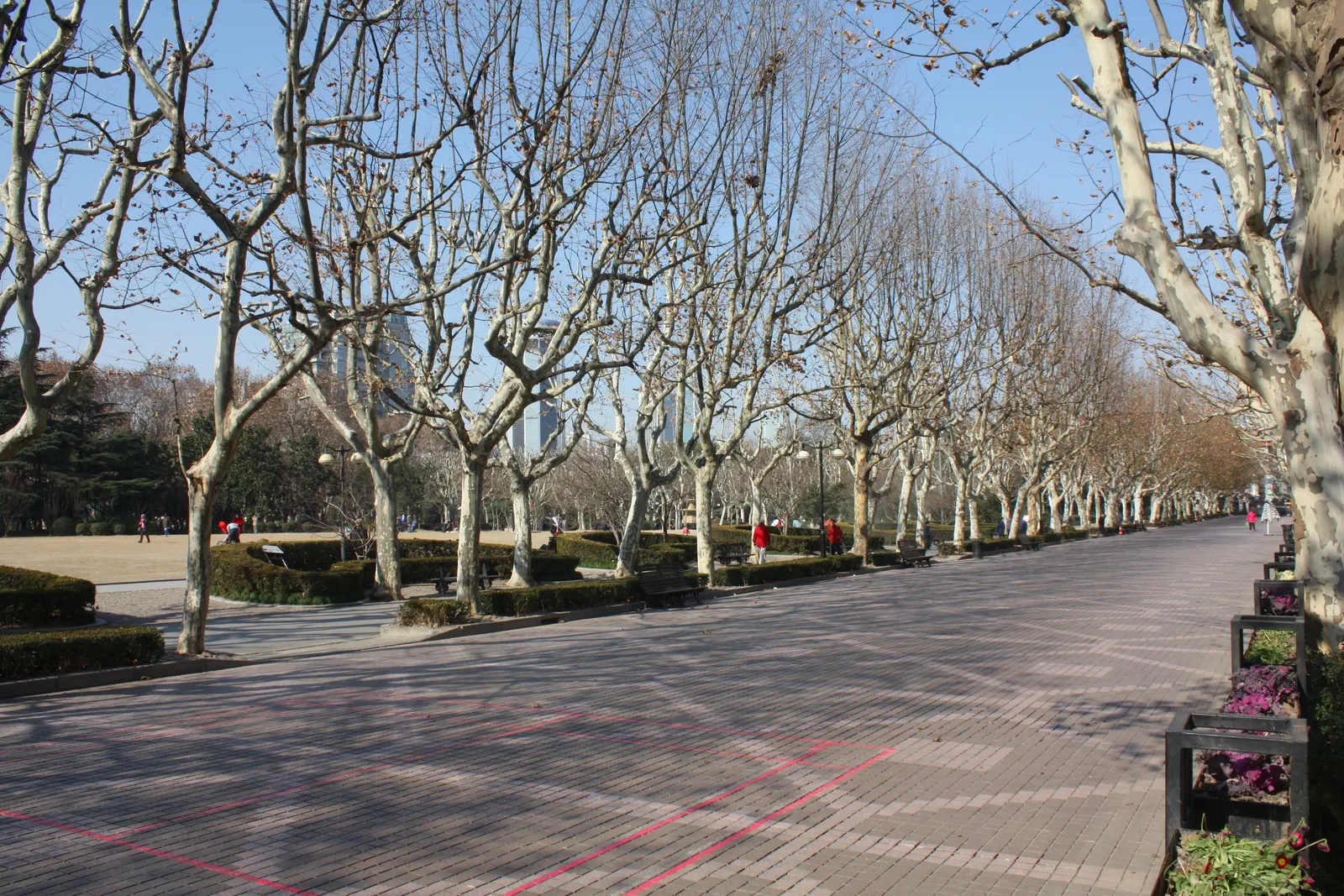
The lake inside Fuxing Park. Photo: Wikimedia Commons / CC BY-SA 3.0 — J. Patrick Fischer. Source
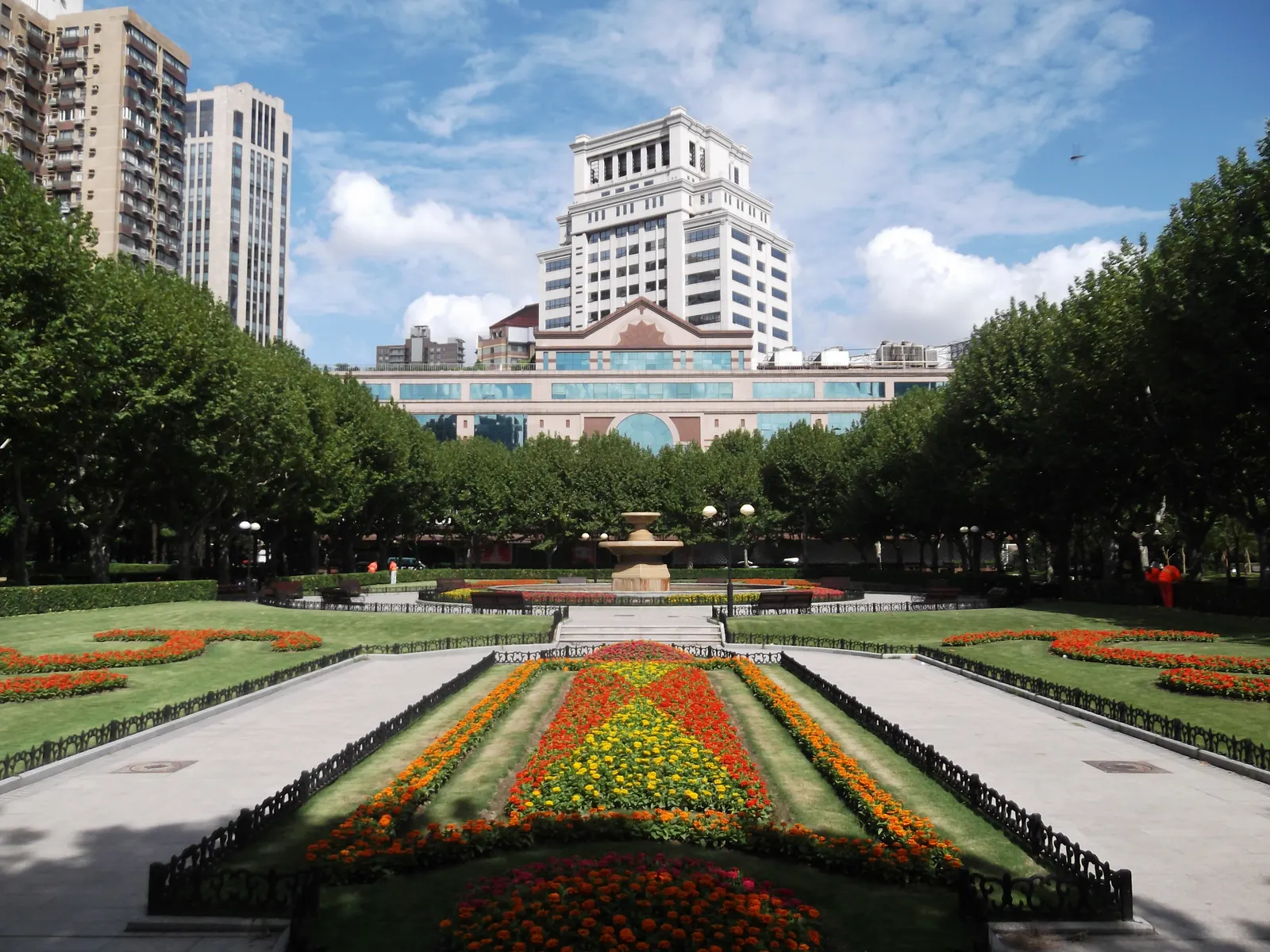
The formal planting in Fuxing Park. Photo: Wikimedia Commons / CC BY-SA 4.0 — Jpbowen. Source
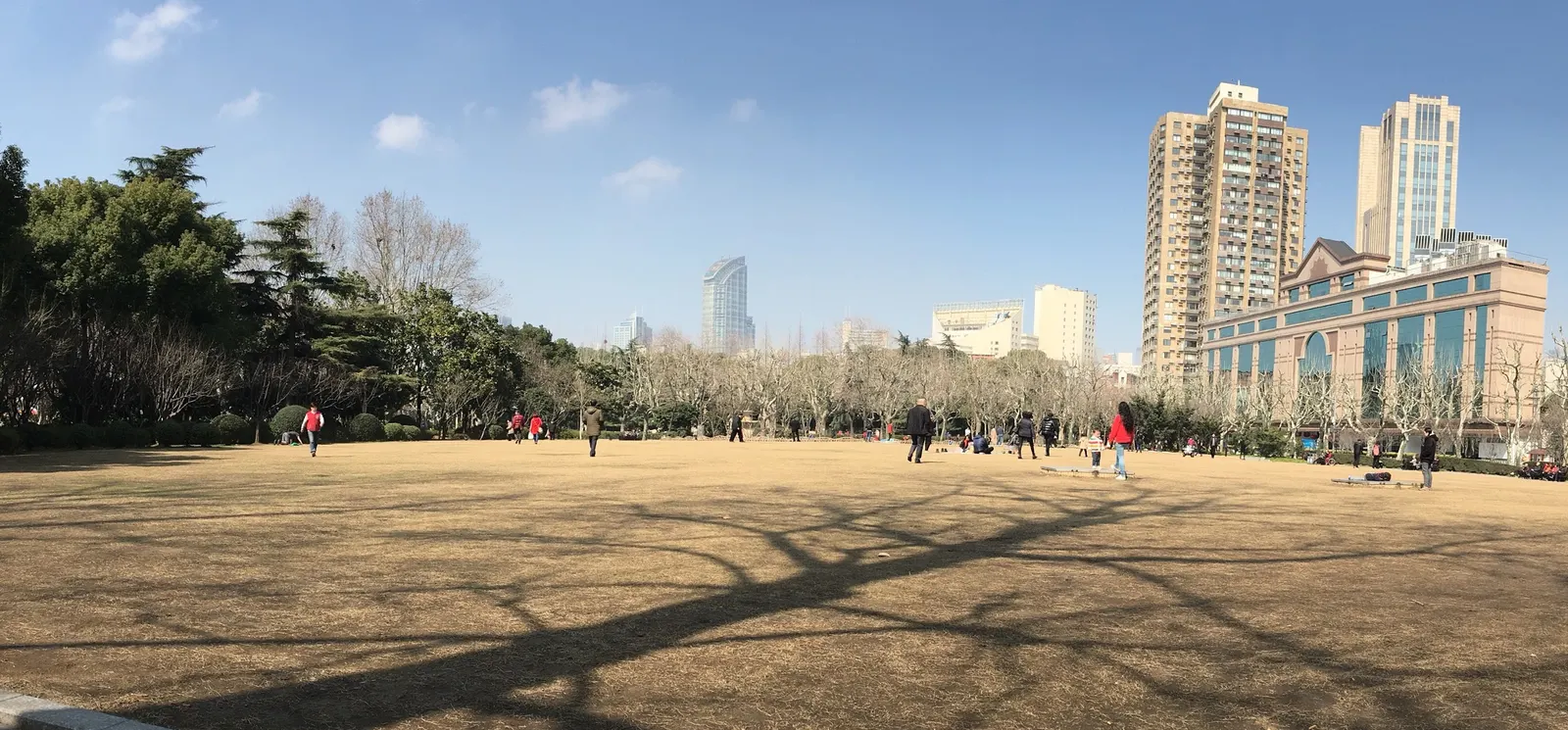
The open ground at Fuxing Park, with the towers of the city rising behind the trees. Photo: Wikimedia Commons / CC BY-SA 4.0 — Metro man 27. Source
Anfu Road
One block south of Wukang Road, Anfu Road is the same villa architecture in a quieter key, and one of the four streets the municipal route groups into the 梧桐影巷 film district. The old villas here have been taken on by small cafés, the first thing you will notice walking down it.
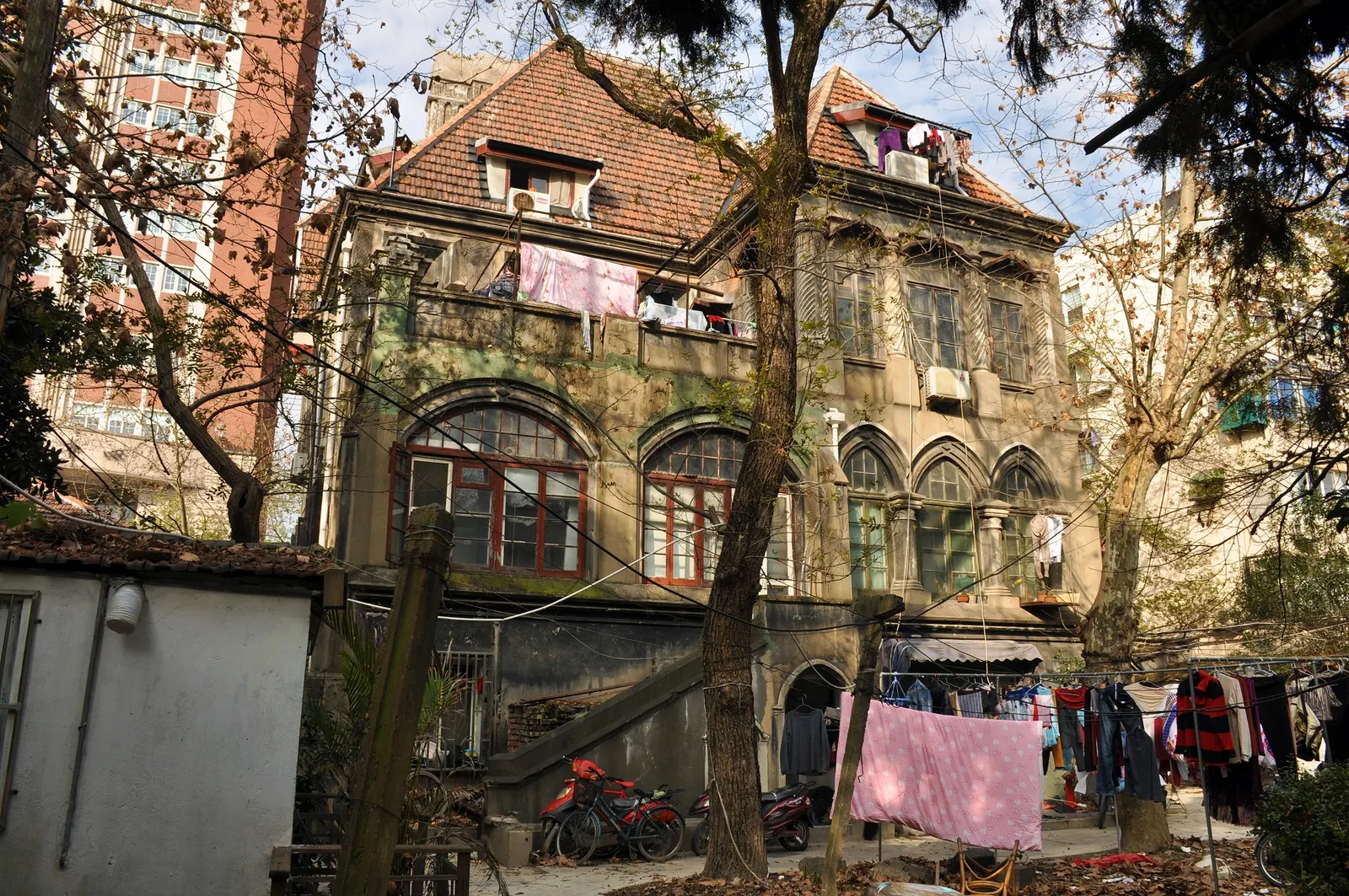
Anfu Road, one block south of Wukang Road, in the same style. Photo: Wikimedia Commons / CC BY-SA 3.0 — Fayhoo. Source
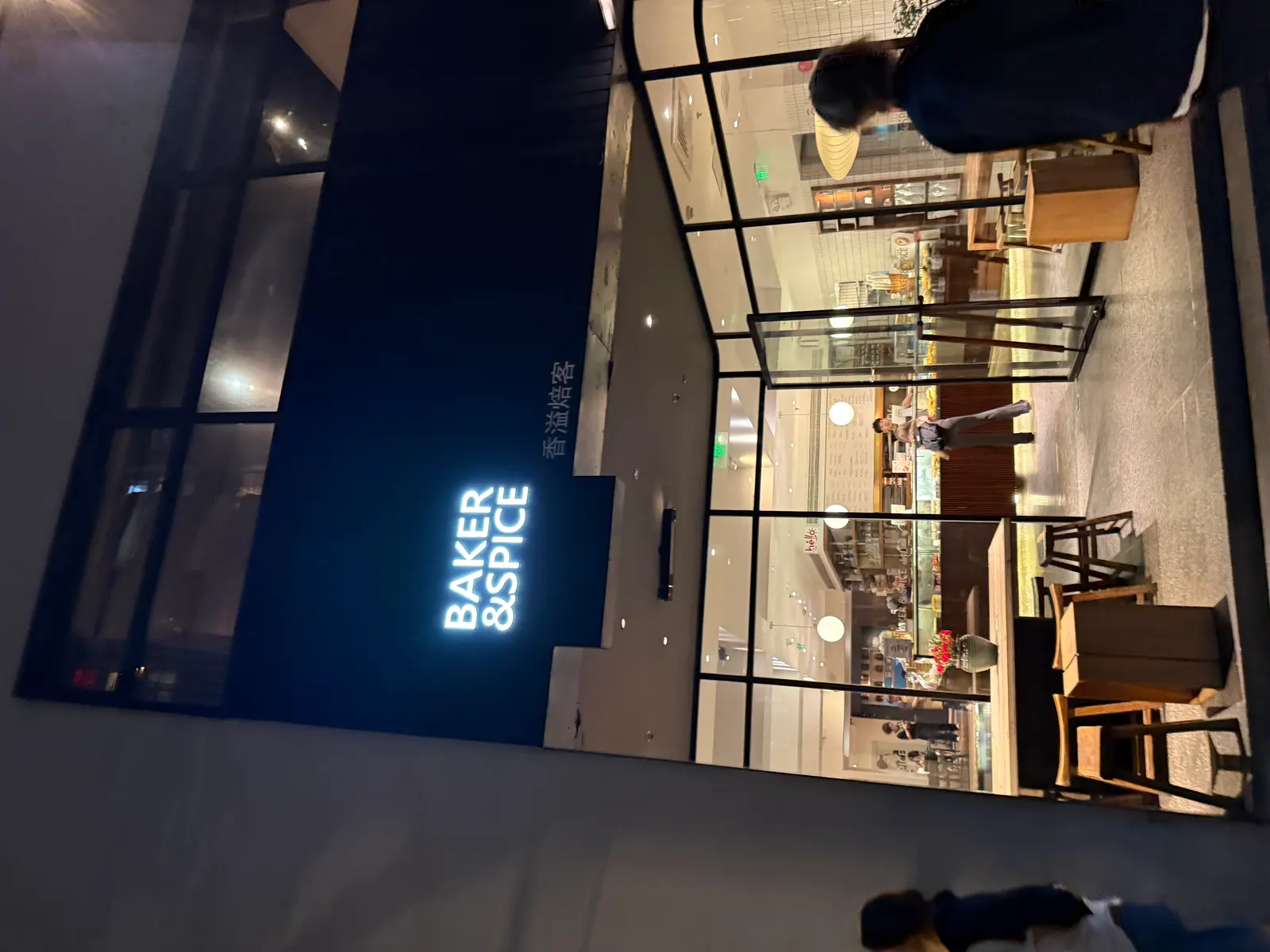
The small cafes that have moved into the old villas. Photo: Wikimedia Commons / CC0 — RunningTurtle8964. Source
Getting there and getting around
Every line and bus number below comes from the district’s own tourist material. We do not give station names: the official sources here publish lines, not stops.
| Destination | Metro lines | Bus |
|---|---|---|
| Wukang Building | 10, 11 | 830, 923, 926, 946 |
| Visitor centre, 393A Wukang Road | 10, 11 | — |
| Ke Ling’s former residence | 1, 7 | — |
| Xia Yan’s former residence | 7, 9, 10 | — |
The rest is best covered on foot: Wukang Road is the spine, with Fuxing West Road and Urumqi Middle Road crossing it and Huaihai Middle Road along the busy northern edge. Yongkang Road runs from Jiashan Road to Taiyuan Road.
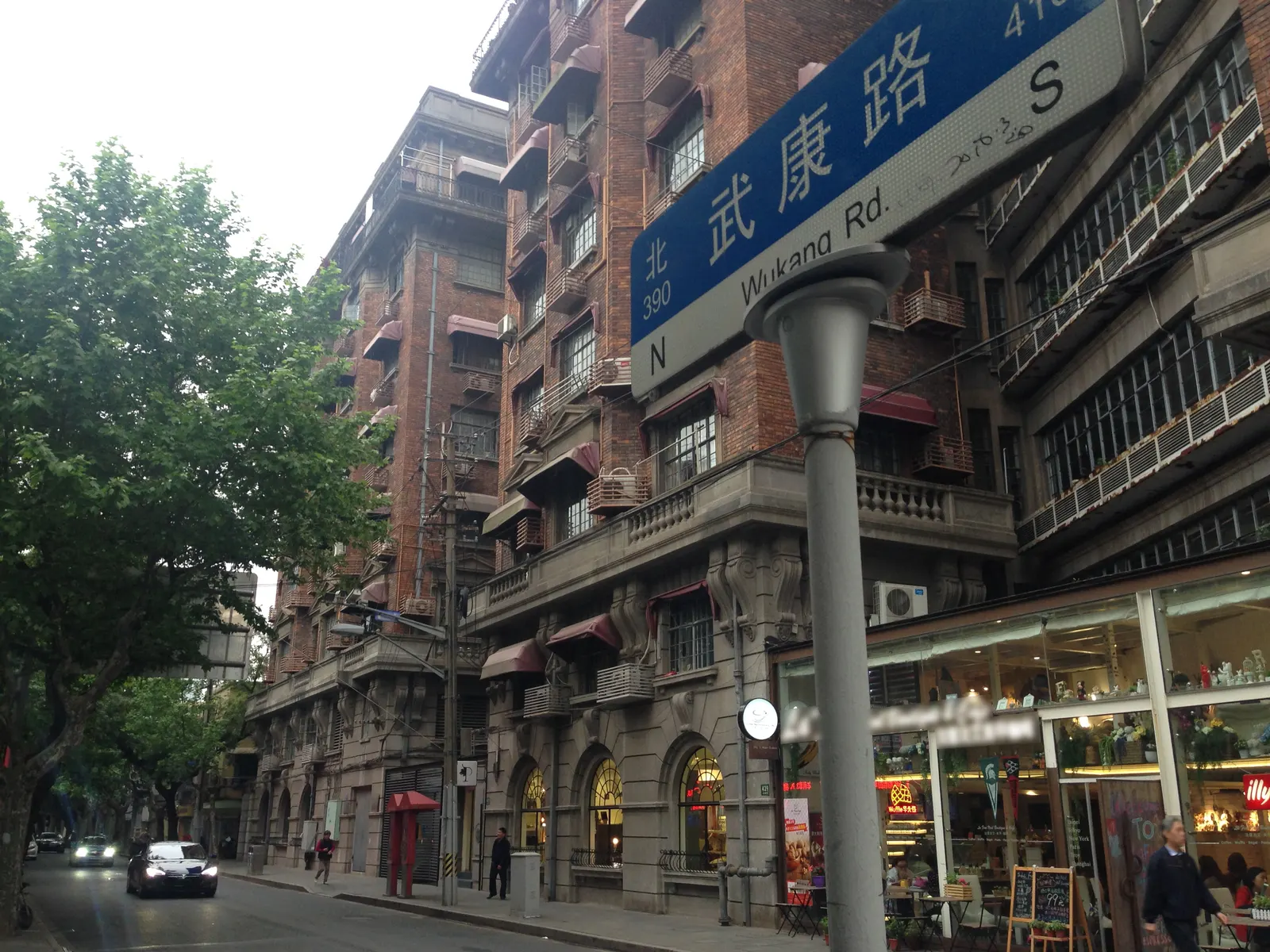
Wukang Road — the street sign that marks the start of the walk. Photo: Wikimedia Commons / CC BY-SA 4.0 — SSYoung. Source
Practical facts for foreign visitors
| Question | Answer |
|---|---|
| Do I need a ticket? | No. Public street; the Wukang Building is free to enter. |
| Do I need to book? | No booking, no gate, no queue. |
| Does a passport or visa change anything? | No foreigner rate or condition is published. |
| Where do I ask questions? | Wukang Road Tourist Information Centre, 393A Wukang Road, 021-64335000. |
| When is that centre open? | Sunday to Friday 9:00-17:00; Saturday and public holidays 9:00-20:30. |
| What is not published? | A recommended season, building hours, visitor numbers. |
One practical point for a non-Chinese speaker: write the address in characters. 淮海中路 1850 号 and 武康路 393 号甲 are what the door signs say, and they work far better in a taxi than a romanised street name.
Where this fits
The French Concession works best as the middle of a Shanghai day: half a day walking, then the Bund or the museums on Huaihai Middle Road. Our other Shanghai pages: The Bund, Shanghai Museum, Shanghai Tower, Oriental Pearl Tower, Yu Garden and Jade Buddha Temple.
With more than a day in Shanghai, the two other open districts are Xintiandi, the redeveloped shikumen quarter south-east, and, a full morning away, Zhujiajiao.
Also nearby
- Xintiandi (新天地) — the redeveloped shikumen quarter.
- The Bund (外滩) — the waterfront promenade.
- Shanghai Museum (上海博物馆) — on Huaihai Middle Road.
- Shanghai Tower (上海中心大厦) — the tallest tower in view from Fuxing Park.
- Oriental Pearl Tower (东方明珠) — the older landmark tower.
- Yu Garden (豫园) — the old garden and its market.
Best photo spots
-
The corner of Wukang Road and Huaihai Middle Road
The Wukang Building fills the sharp junction of the two roads — the view that makes the district legible in one frame.
-
The villa fronts on Wukang Road
White and cream villas with red-tiled roofs set back behind garden walls and iron gates, under the plane trees.
-
Fuxing Park, at the southern end
The lake, the formal planting and the open lawn, with the towers of the city rising behind the trees.
Frequently asked questions
What is Shanghai's French Concession?
It is the working district officially called the Hengfu Historical and Cultural Style District (衡复历史文化风貌区), around Hengshan Road and Fuxing Road in Xuhui District. Its boundary was agreed between the Shanghai daotai and the first French consul in 1849 and extended several times afterwards, including around 1900 and again in 1914. What you visit today is not a concession park but a protected city neighbourhood: 4.3 square kilometres of the district lie inside Xuhui, 64 roads inside it can never be widened, and Xuhui District counts close to 520 listed excellent historic buildings and protected sites.
Is French Concession Shanghai worth visiting?
Yes, if you want compact, free, walkable 1920s-1940s Shanghai architecture in one afternoon and are content to look at the buildings from the street rather than to go inside them. The Wukang Building (1924, designed by Hudec, free to enter), the villas of Wukang Road and Fuxing West Road, the shikumen lanes and Fuxing Park all sit within a half day's walk. The caveat is honest: the official sources publish no opening times for the buildings themselves, no recommended season and no visitor numbers, so the district is best planned as a street walk rather than a list of ticketed interiors.
What is the French concession in Shanghai called in Chinese?
法租界, pronounced Fǎ Zū Jiè. It is the name Shanghai people still use for this group of old streets, and it is what you will hear on the ground. The official name of the protected area today is 衡复历史文化风貌区 — the Hengfu Historical and Cultural Style District — and that is the form used in signage and planning documents.
Where to go in French Concession Shanghai?
Start at the Wukang Building, 1850 Huaihai Middle Road, and walk south along Wukang Road: Ba Jin's former home at 113, Midan Apartments at 115, the Cape Town Apartments at 240, Zhou Xuan's old home at 391 Lane 1 and the Wukang Road visitor centre at 393A, where the south block was built in 1912 and the north block added in 1933. Then cross to Fuxing West Road for Ke Ling's former residence at 147 and the Rose Villas at 44 Lane 7, and to Urumqi South Road 178 for the Xia Yan former residence and the Cao Ying study. The Wuzhong Market is at 318 Urumqi Middle Road.
What to see in French Concession Shanghai?
The wedge-shaped Wukang Building and its source point plaza across the road; the villa fronts of Wukang Road behind their garden walls, including the Midan and Cape Town apartment blocks; the shikumen lane houses with their carved stone gates and narrow stone-paved lanes; Fuxing Park at the southern end with its lake and formal planting; and Anfu Road one block south of Wukang Road, where the old villas hold small cafes.
Do I need to buy a ticket to walk the French Concession?
No. The district is public street with no gate and no ticket, and entry to the Wukang Building is free. The official sources publish no foreigner rate and no foreigner-specific condition, because there is nothing to charge for and nothing to check. If you want the exhibition spaces inside the old villas, ask the Wukang Road Tourist Information Centre (Shanghai Old Houses Art Centre) at 393A Wukang Road on 021-64335000; it publishes its own hours, Sunday to Friday 9:00-17:00 and Saturday and public holidays 9:00-20:30.
How long should I spend walking the French Concession?
Allow half a day for the main loop on foot. The streets are short and close together, so the Wukang Building, the villa streets of Wukang Road and Fuxing West Road, the shikumen lanes, Fuxing Park and Anfu Road all fall within a single walk. The official sources publish no recommended visiting time, so treat the half day as a practical estimate rather than a published figure; the exhibition spaces inside the old villas keep their own schedules.
Where can I get official information about the French Concession?
The Wukang Road Tourist Information Centre / Shanghai Old Houses Art Centre at 393A Wukang Road (021-64335000) is the official information point for the district, and the Shanghai municipal culture and tourism bureau publishes the district walking route and the exhibitions running in the old villas month by month. The official pages publish no recommended season, no opening times for the buildings themselves and no visitor numbers, so we do not fill those gaps in here.
Sources
- 上海市徐汇区人民政府 —「十四五」开局,历史风貌保护大文章这样「打开」(衡复风貌区 64 条永不拓宽的马路、徐汇区内近 520 处优秀历史建筑和文物保护单位、徐汇区所辖 4.3 平方公里) · Government of the PRC
- 上海市文化和旅游局 — 武康路 393 号甲 徐汇老房子艺术中心 / 武康路旅游咨询中心开放时间与电话 · Government of the PRC
- 上海市文化和旅游局 —《徐汇漫游新玩法》(武康大楼 1924 年、邬达克设计、原名诺曼底公寓、上海首座外廊式公寓、密丹公寓、开普敦公寓、玫瑰别墅、梧桐影巷电影街区) · Government of the PRC
Related guides
Attractions
Xintiandi (上海新天地), Shanghai
Attractions
Zhujiajiao Water Town (朱家角古镇), Qingpu District, Shanghai
Attractions
The Bund
Attractions
Shanghai Museum (上海博物馆), Shanghai
Attractions
Shanghai Tower (上海中心大厦), Lujiazui, Shanghai
Attractions
Oriental Pearl Tower
Attractions
Yu Garden
Attractions
Jade Buddha Temple (玉佛寺), Shanghai
Rescue card
🆘 Ask How To Get There




