Zhujiajiao Water Town (朱家角古镇), Qingpu District, Shanghai
朱家角古镇 · Zhūjiājiǎo Gǔzhèn
Quick answer
There is no separate foreigner rate and no passport or visa condition in anything the official site publishes. One set of prices applies to every visitor, and the concessions are written by category rather than by nationality: free entry on the combined ticket for children 1.3 m and under or aged 6 and under, for the families of martyrs and of serving military personnel, for fire-rescue personnel and trainees, and for holders of a guide, disability, press, retired-cadre or class A1 driving licence; half price for ages 6 to 18, for full-time students up to undergraduate level, for visitors aged 60 and over, and for the families of serving military personnel.
Why visit
- 1 A working Jiangnan water town of 3.08 square kilometres, with 9 century-old streets along the waterways and 36 old bridges, all of it free to walk into
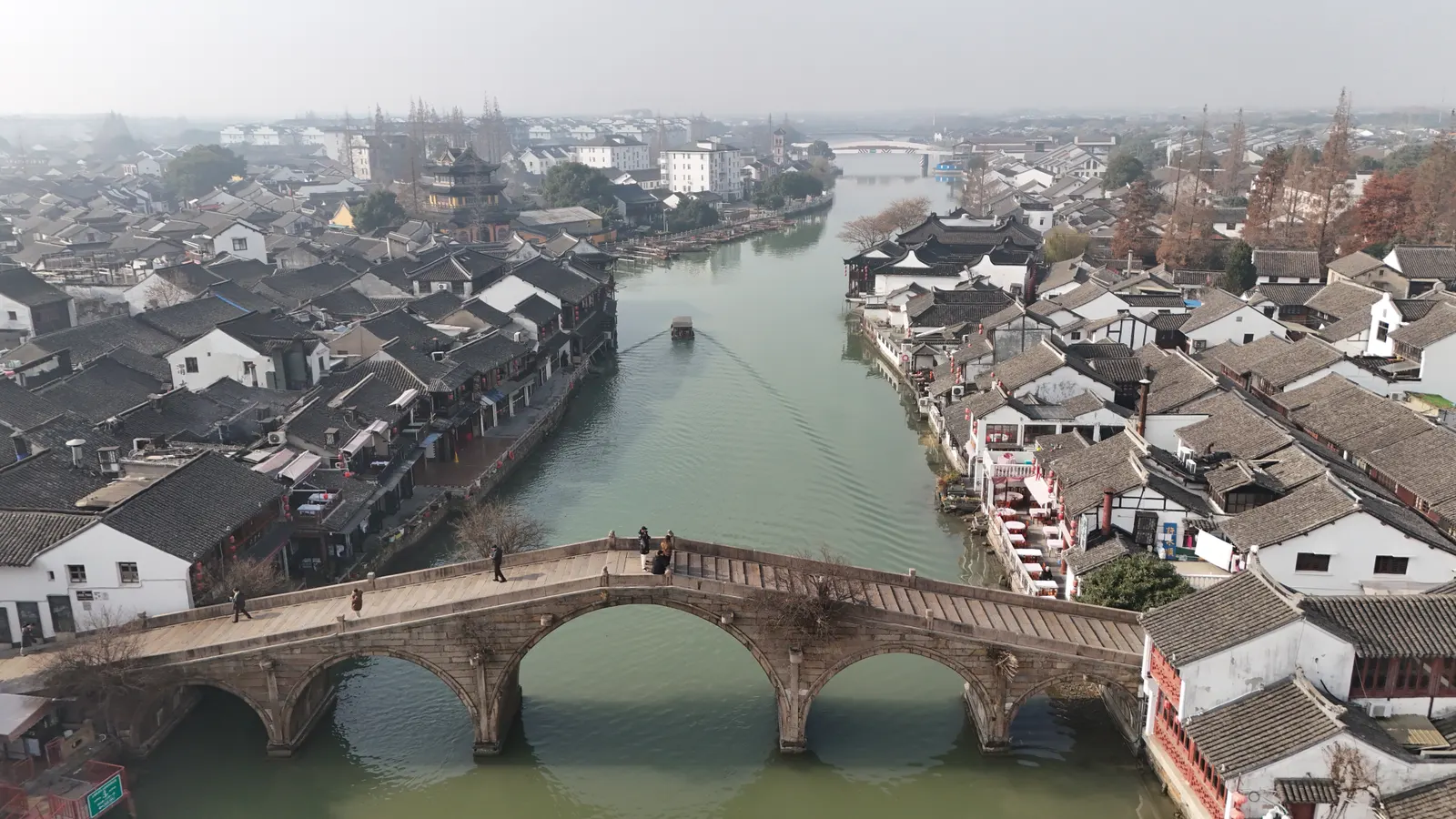
- 2 Fangsheng Bridge, which the official site calls the largest five-arched stone bridge in East China, over the Caogang River
- 3 The Daqing Post Office, which the official site calls the only preserved Qing post office site in East China
- 4 Kezhi Garden, the largest Sino-Western private manor in the Shanghai region, and Hexin Garden with its stele collection
- 5 Metro Line 17 runs from Hongqiao Railway Station to Zhujiajiao station at 6 CNY, about every 10 minutes
Essential tips for foreigners
- Entering the old town costs nothing. Only the three sites inside the scenic area are ticketed, and they share one 60 CNY combined ticket, so you can see most of the town without buying anything.
- Order the combined ticket before 08:00 on the day and collect it between 08:30 and 15:00 at the tourist centre on 555 Kezhiyuan Road. It is valid that day for a single entry only.
- The paid sites shut at 17:00. The streets stay open, but if you want the gardens and the art museum, work backwards from 17:00 rather than planning a late start.
- Take Line 17 rather than a taxi. The station is 290 m, 488 m or about 1.3 km from the old town depending on the route, so the last stretch is on foot.
- No fare is published for the hand-rowed boats. Ask at the dock; what is published is the routing, the six-person limit and the 8:30 to 17:00 ticket window.
Zhujiajiao (朱家角) is a Jiangnan water town in Zhujiajiao Town, Qingpu District, in the west of Shanghai. The official site puts the scenic area at 3.08 square kilometres, with 9 century-old streets following the waterways, thousands of Ming–Qing buildings along the water and 36 old bridges. The town took shape in the Ming and Qing periods; the official site publishes no founding year, so we quote none.
It was named one of Shanghai’s historical and cultural towns in 1991, rated a national AAAA scenic area in 2004, and included in the third batch of national historical and cultural towns in 2007.
Two things to settle first. Money: free entry to the old-town streets — no ticket, no reservation — and one combined ticket at 60 CNY per person for the three sites inside the scenic area, which open daily from 8:30 to 17:00. Time: this is a half-day trip out of the city, and the simplest way in is Metro Line 17 from Hongqiao Railway Station.
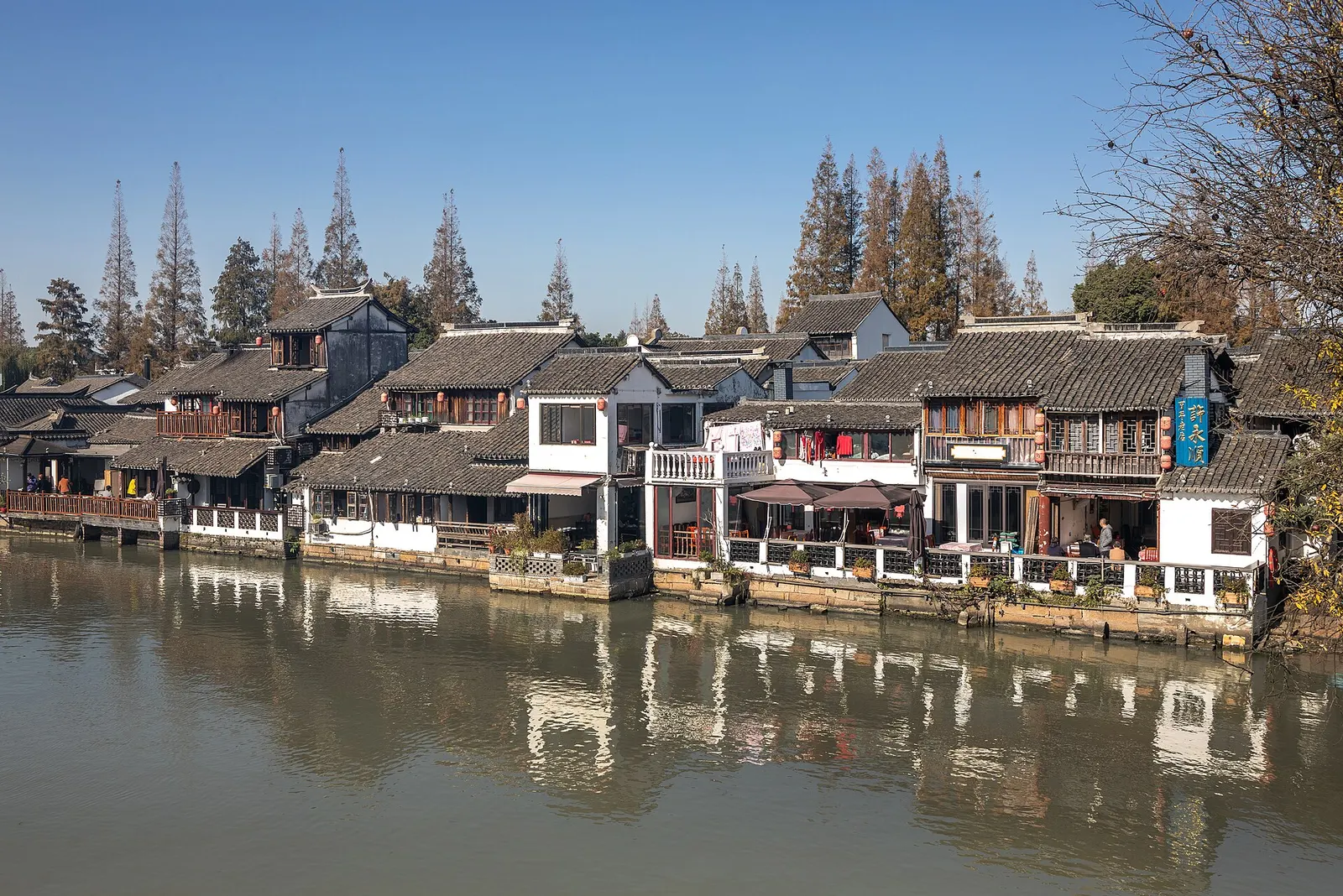
The old town stretches along the canal in a continuous run of houses. Photo: Wikimedia Commons / CC BY 4.0 — Supanut Arunoprayote. Source
Is Zhujiajiao worth visiting?
Yes — if what you want is a working Jiangnan water town rather than a staged set, and if you can give it a half day. The case rests on official numbers rather than adjectives: 3.08 square kilometres, 9 century-old streets, 36 bridges and thousands of Ming–Qing buildings, all of it free to walk into.
The honest trade-off is distance. Zhujiajiao sits at the western edge of Shanghai in Qingpu District, so even the quickest route in is a train ride plus a walk from the station to the water. Weekends and public holidays are the busiest days on the canal.
What you get for it: a five-arched stone bridge the official site calls the largest in East China, a private garden, the only preserved Qing post office site in East China, and century-old shops — two inside the paid ticket, the rest free to look at in the streets.
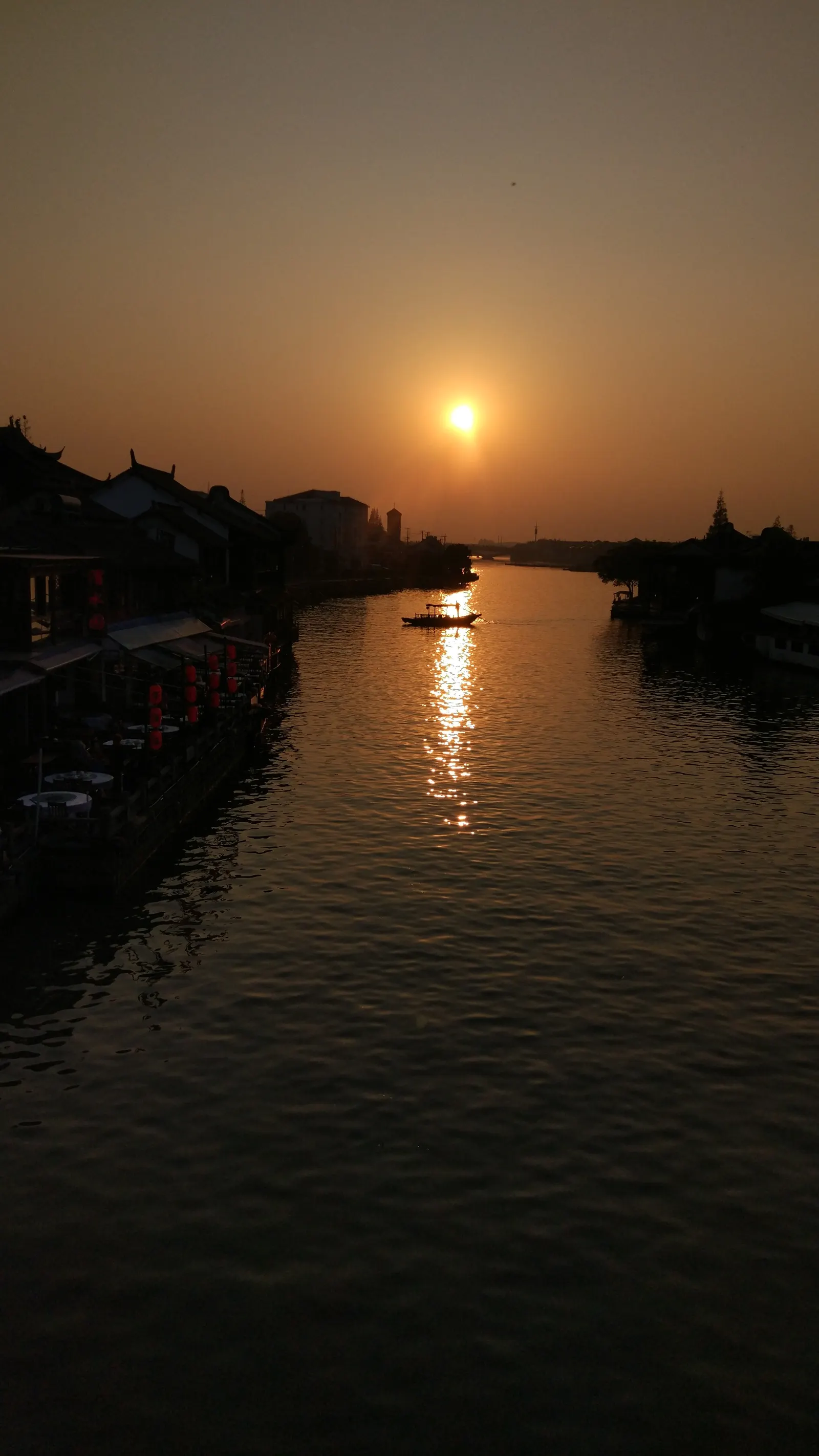
Late in the day, the light drops across the canals from the bridge. Photo: Wikimedia Commons / CC BY-SA 4.0 — Jiangshang. Source
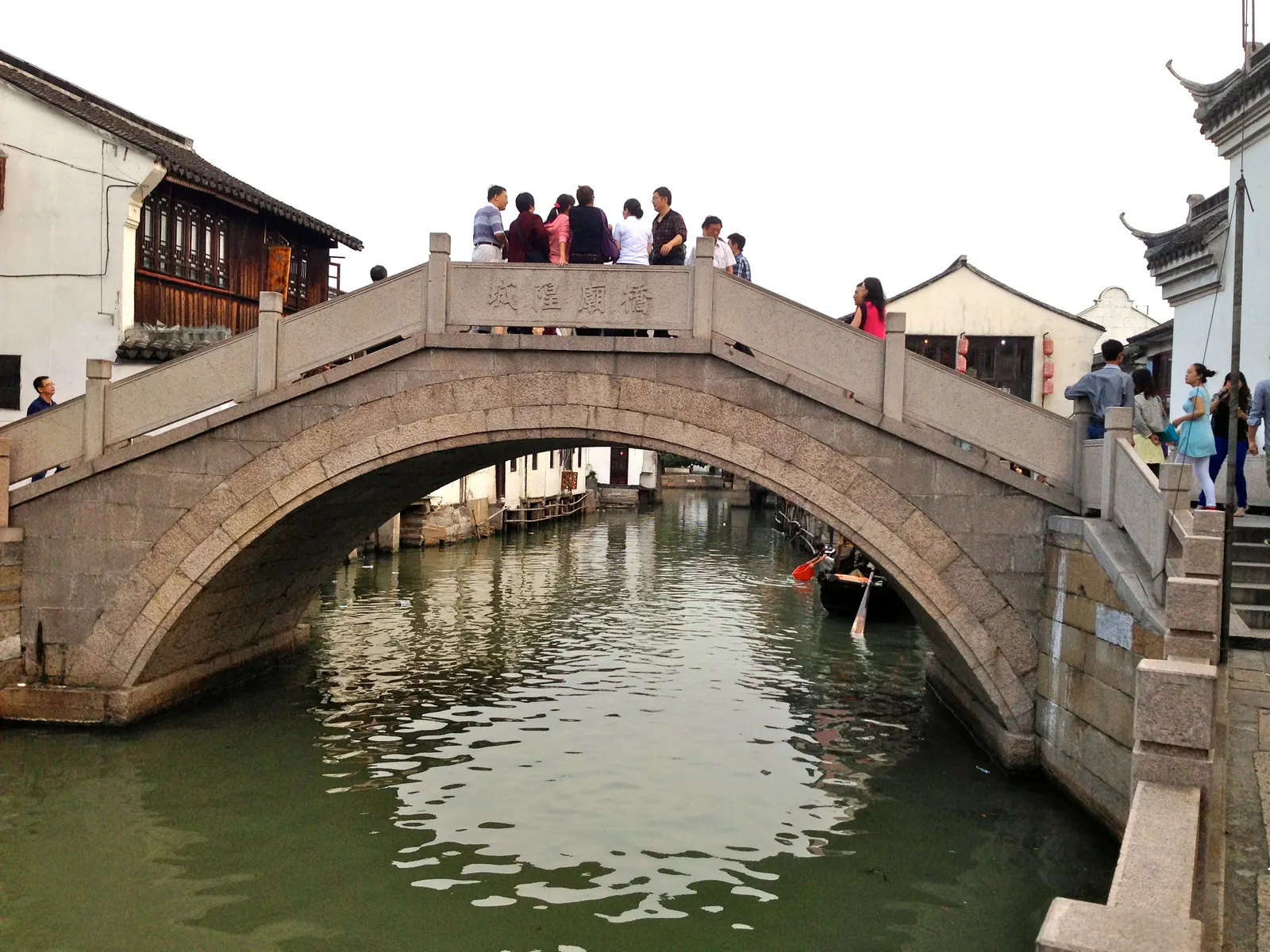
Fangsheng Bridge, the stone arch that crosses the main canal in the centre of town. Photo: Wikimedia Commons / CC BY-SA 3.0 — Dolly442. Source
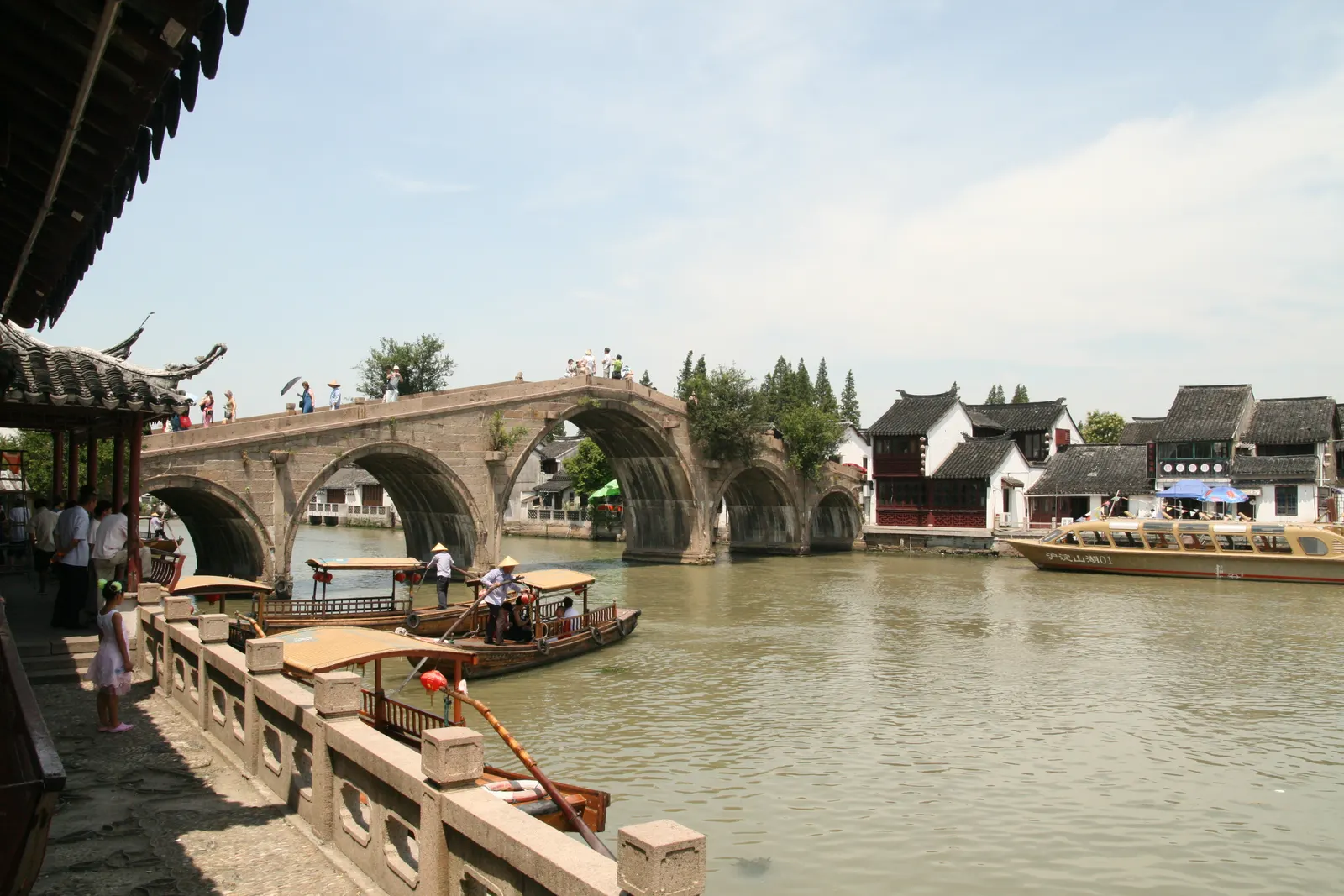
Fangsheng Bridge from the bank, the largest five-arched stone bridge in the region. Photo: Wikimedia Commons / CC BY 2.0 — Bernt Rostad. Source
How do I get to Zhujiajiao from Shanghai by train?
Metro Line 17 runs between Hongqiao Railway Station and Zhujiajiao station. The official transport page gives the fare as 6 CNY and the service as roughly one train every 10 minutes. From Hongqiao the first is at 06:00 and the last at 23:00; from Zhujiajiao the first is at 05:43 and the last at 22:33.
Exit 1 of Zhujiajiao station is where the walking starts: the official site publishes three routes from there, 290 m, 488 m and about 1.3 km, the last of them served by a shuttle.
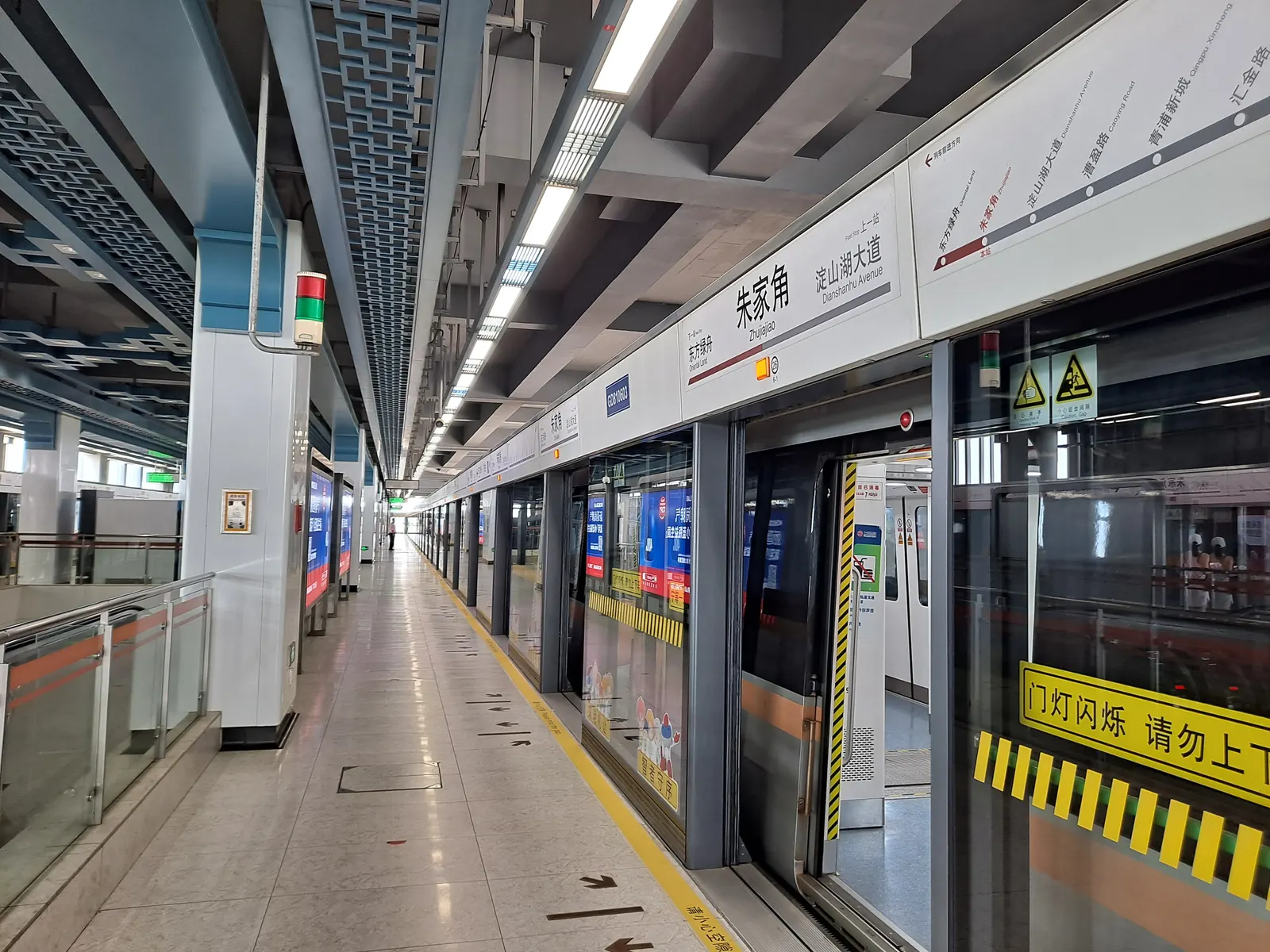
Metro Line 17 — the train that brings most visitors out from the city. Photo: Wikimedia Commons / CC BY-SA 4.0 — 钉钉. Source
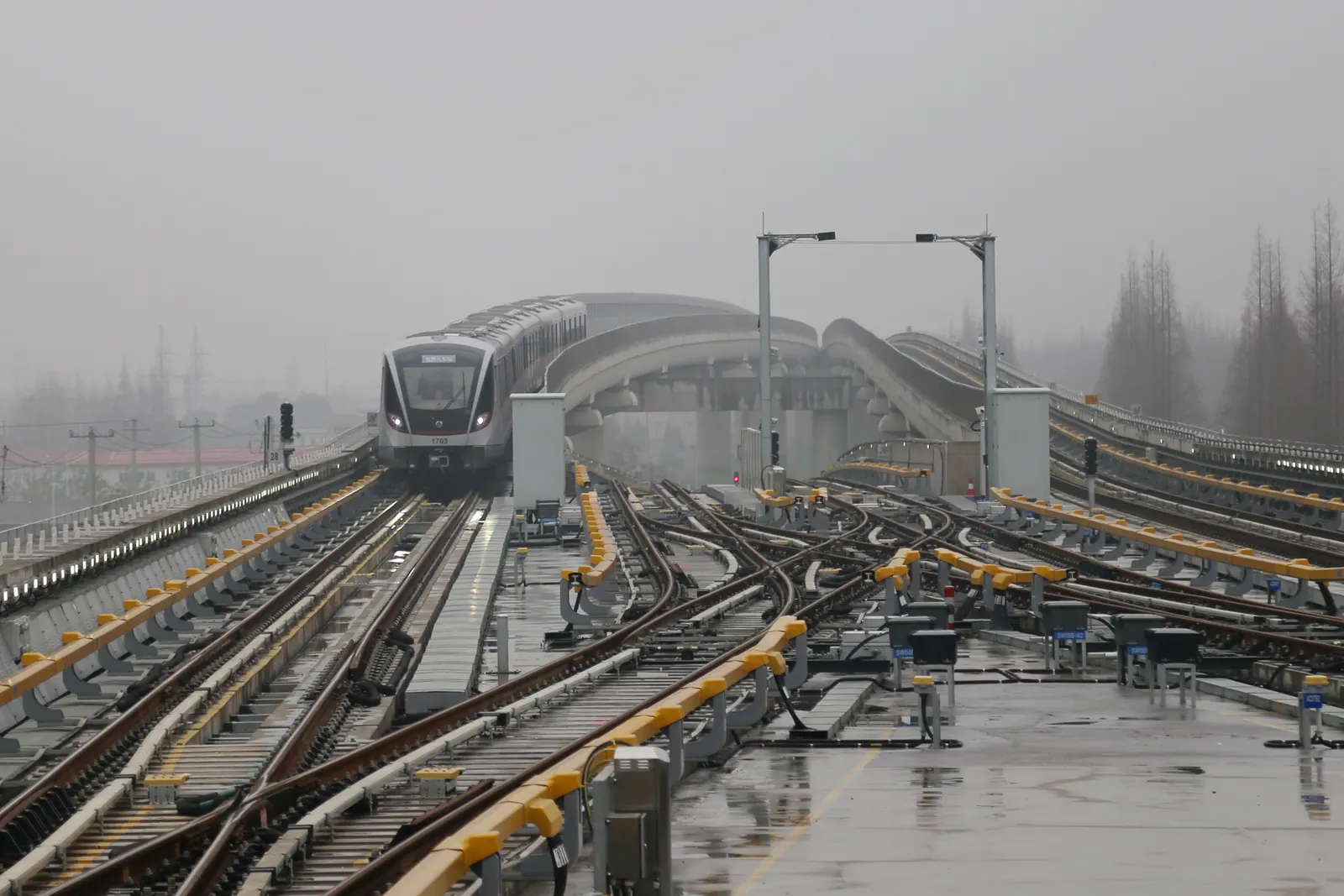
Line 17 comes above ground on the last stretch before Zhujiajiao station. Photo: Wikimedia Commons / CC BY-SA 4.0 — MasaneMiyaPA. Source
How long does it take to get to Zhujiajiao from Shanghai?
The official site publishes service intervals and first and last trains, but no journey time in minutes, so we are not inventing one. What it publishes is enough to plan a day: trains roughly every 10 minutes.
The part you control is the walk from the station and then the town itself — 3.08 square kilometres of streets. A half day is the honest unit.
How far is Zhujiajiao from Shanghai?
The official site does not publish a distance in kilometres, so this page does not quote one. What it does publish: Line 17 runs between Hongqiao Railway Station and Zhujiajiao station at 6 CNY a trip, about every 10 minutes, and the station is 290 m, 488 m or about 1.3 km from the old town. By car, the published route is the Yan’an Elevated Road, then G50 to the Zhujiajiao exit and on to Kezhiyuan Road.
How do you pronounce Zhujiajiao?
Zhūjiājiǎo — say it as written: roughly “joo-jyah-jow”. The tones are first, first, third: “joo” is level, “jyah” is level, and the last syllable drops. In English writing it is Zhujiajiao, and you will see it on maps and tickets as often as you see the characters 朱家角.
What the old town is actually made of
The official site names these places rather than describing them, so the table keeps its wording. Three sit inside the paid ticket; the rest are in the streets.
| Sight | What the official site calls it |
|---|---|
| Fangsheng Bridge (放生桥) | The largest five-arched stone bridge in East China, over the Caogang River |
| North Street (北大街) | Shanghai’s longest Ming–Qing street, and the town’s main street |
| Kezhi Garden (课植园) | The largest Sino-Western private manor in the Shanghai region |
| Daqing Post Office (大清邮局) | The only preserved Qing post office site in East China |
| Tongtianhe Pharmacy (童天和国药号) | An old pharmacy founded in the Jiaqing era of the Qing dynasty |
| Han Da Long sauce garden, Jiangnan’s first teahouse | Century-old shops still trading on the main street |
| Hexin Garden (和心园) | A private garden of about 3,000 square metres with a stele collection in its south-west corner |
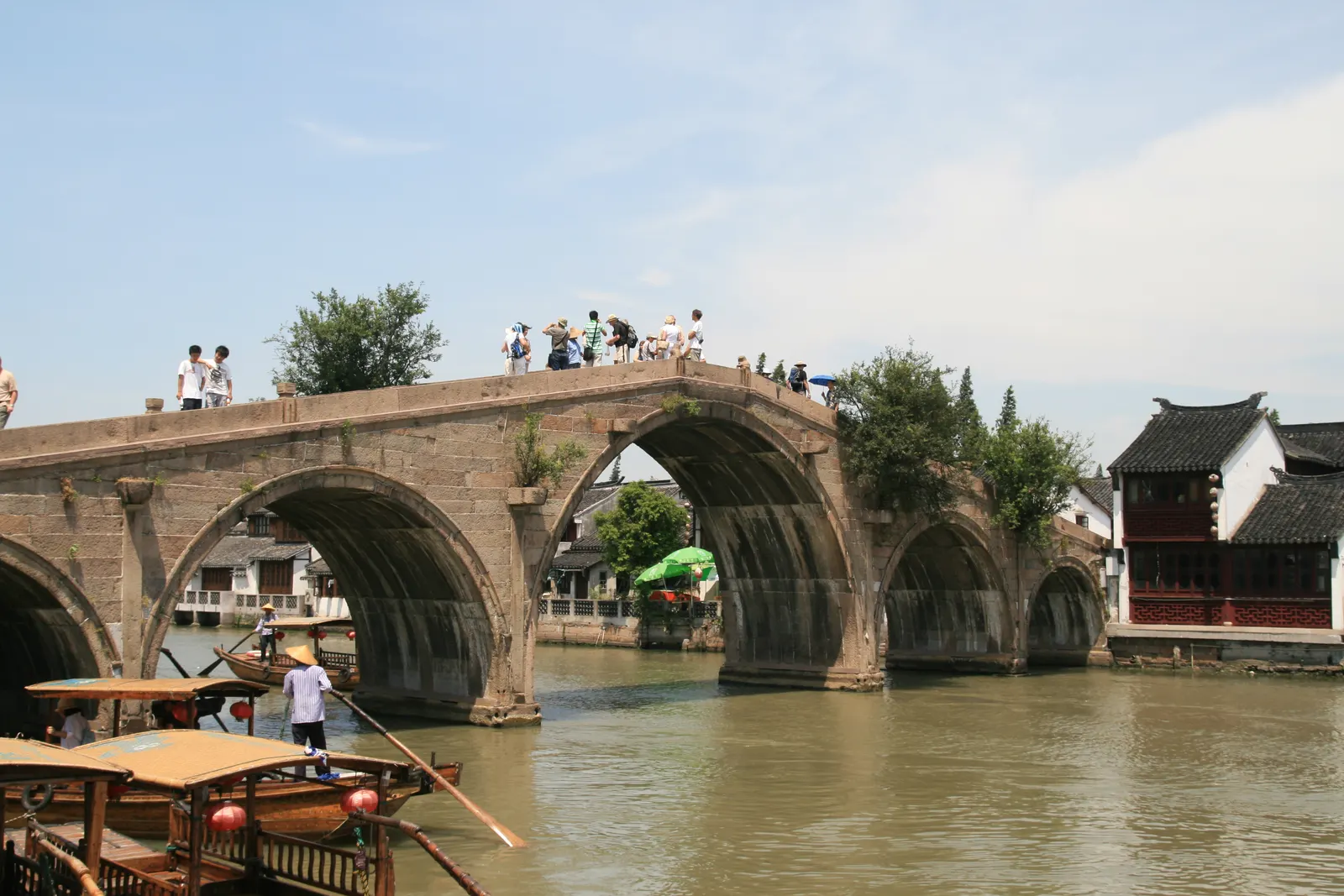
The five arches of Fangsheng Bridge, with the rowing boats tied up below. Photo: Wikimedia Commons / CC BY 2.0 — Bernt Rostad. Source
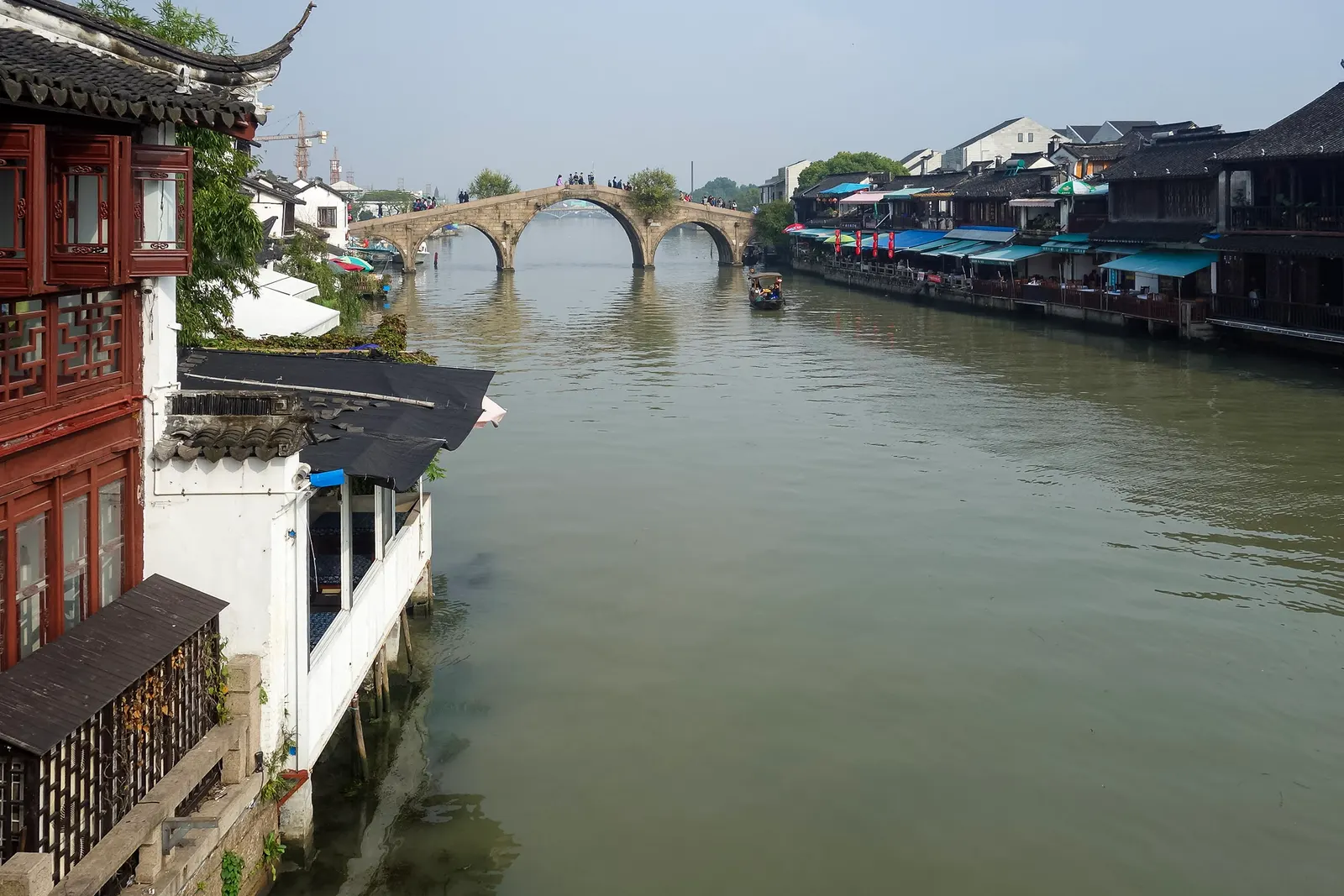
Looking along the canal towards the old town. Photo: Wikimedia Commons / CC BY-SA 4.0 — KQuhen. Source
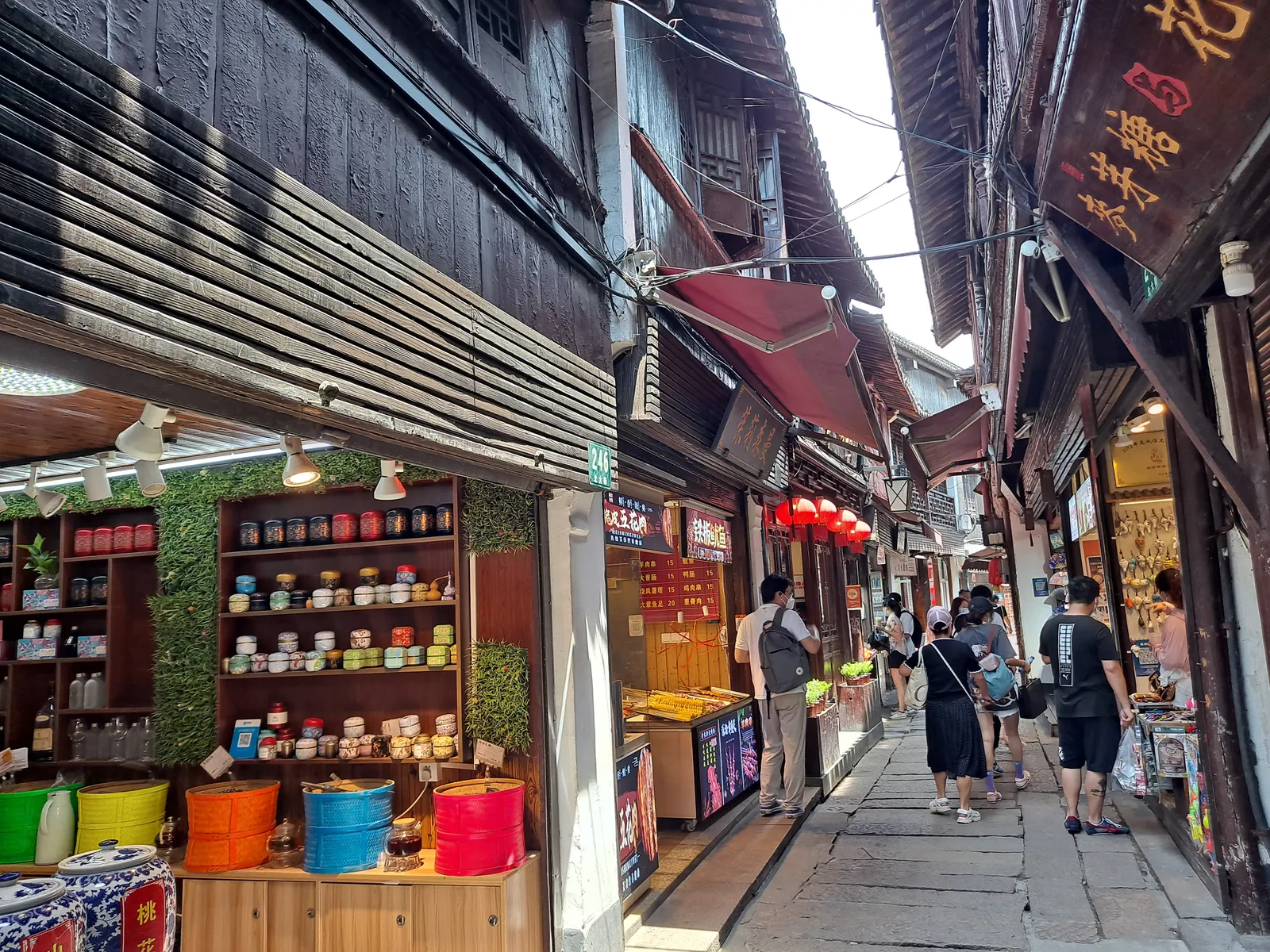
North Street — the old main lane, still lined with small shops. Photo: Wikimedia Commons / CC BY-SA 4.0 — 钉钉. Source
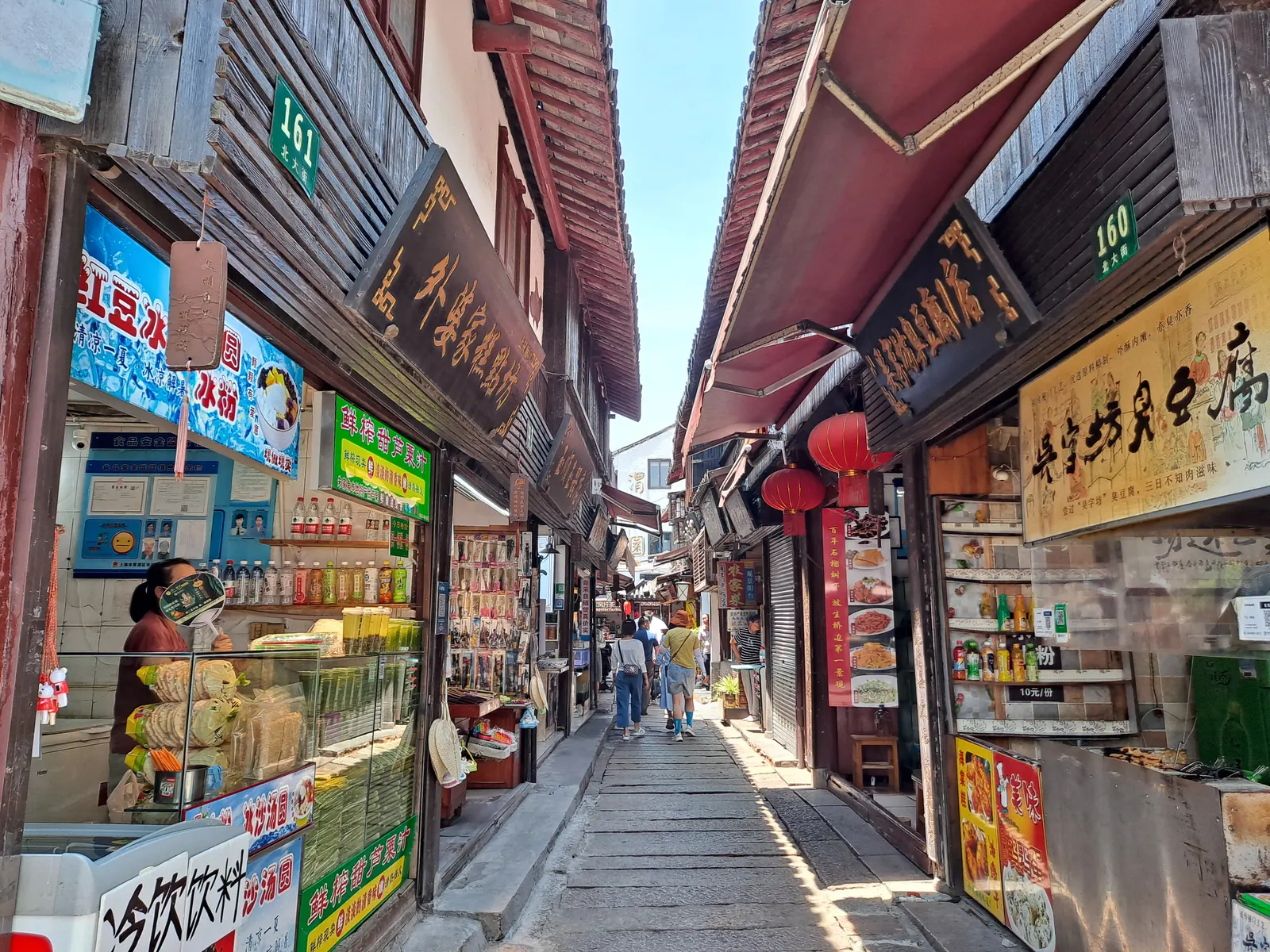
The lanes off North Street are the busiest part of the town. Photo: Wikimedia Commons / CC BY-SA 4.0 — 钉钉. Source
Kezhi Garden and the other paid sites
The combined ticket is collected in person at the Zhujiajiao Tourist Centre at 555 Kezhiyuan Road, and orders must be placed before 08:00 on the day you visit. It is valid that day only and for a single entry; the ticketing hotline is 021-59240077.
| What | Published price |
|---|---|
| Entering the old-town streets | Free, no ticket and no reservation |
| Combined ticket: Kezhi Garden, Hexin Garden, Shanghai Helong Art Museum | 60 CNY per person |
| Half price on the combined ticket | Half of 60 CNY, for ages 6 to 18, students up to undergraduate level, visitors aged 60 and over, and military families |
| Free entry on the combined ticket | Children 1.3 m and under or aged 6 and under, military and martyrs’ families, fire-rescue personnel and trainees, and holders of a guide, disability, press, retired-cadre or class A1 driving licence |
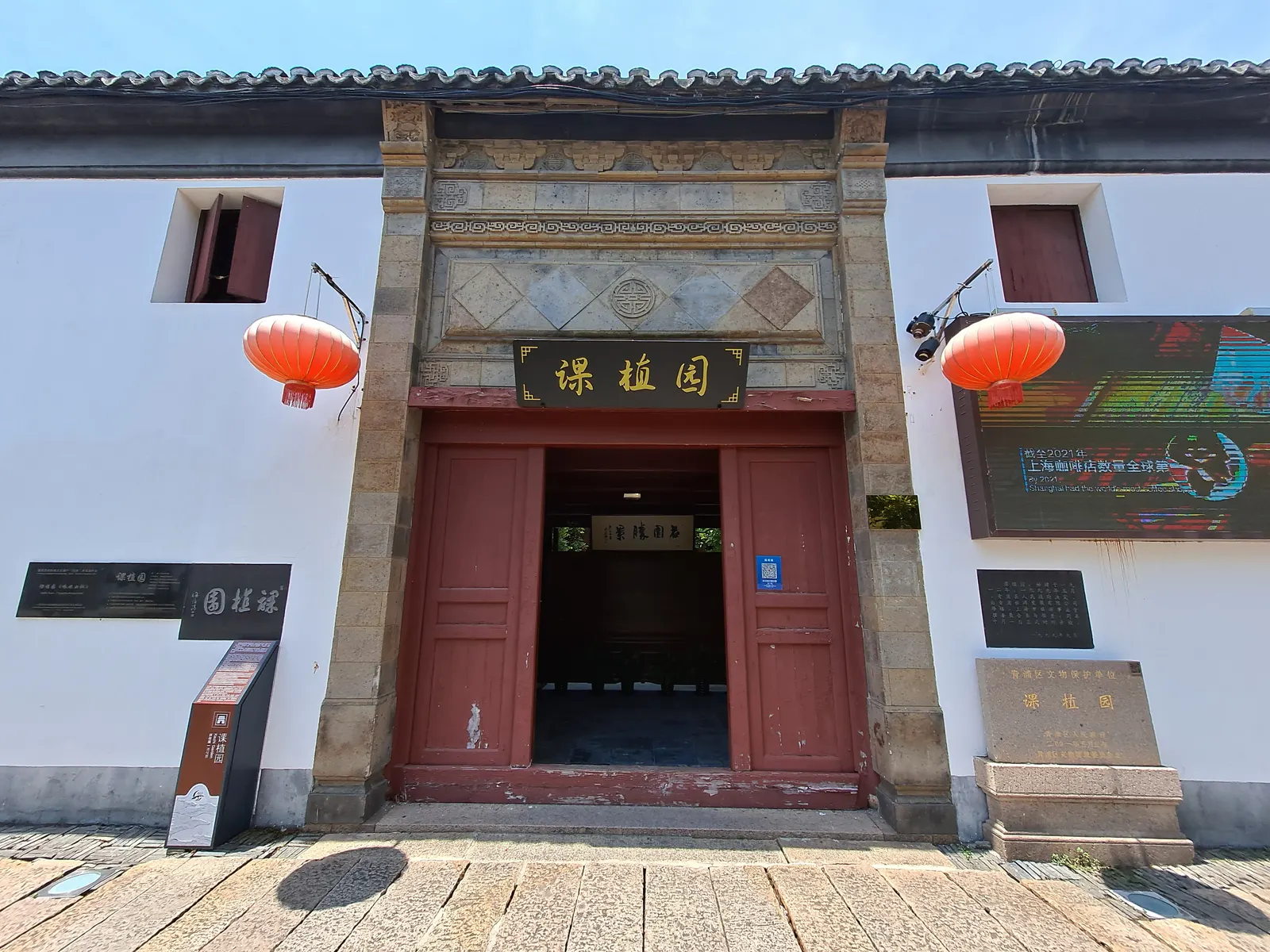
The entrance to Kezhi Garden. Photo: Wikimedia Commons / CC BY-SA 4.0 — 钉钉. Source
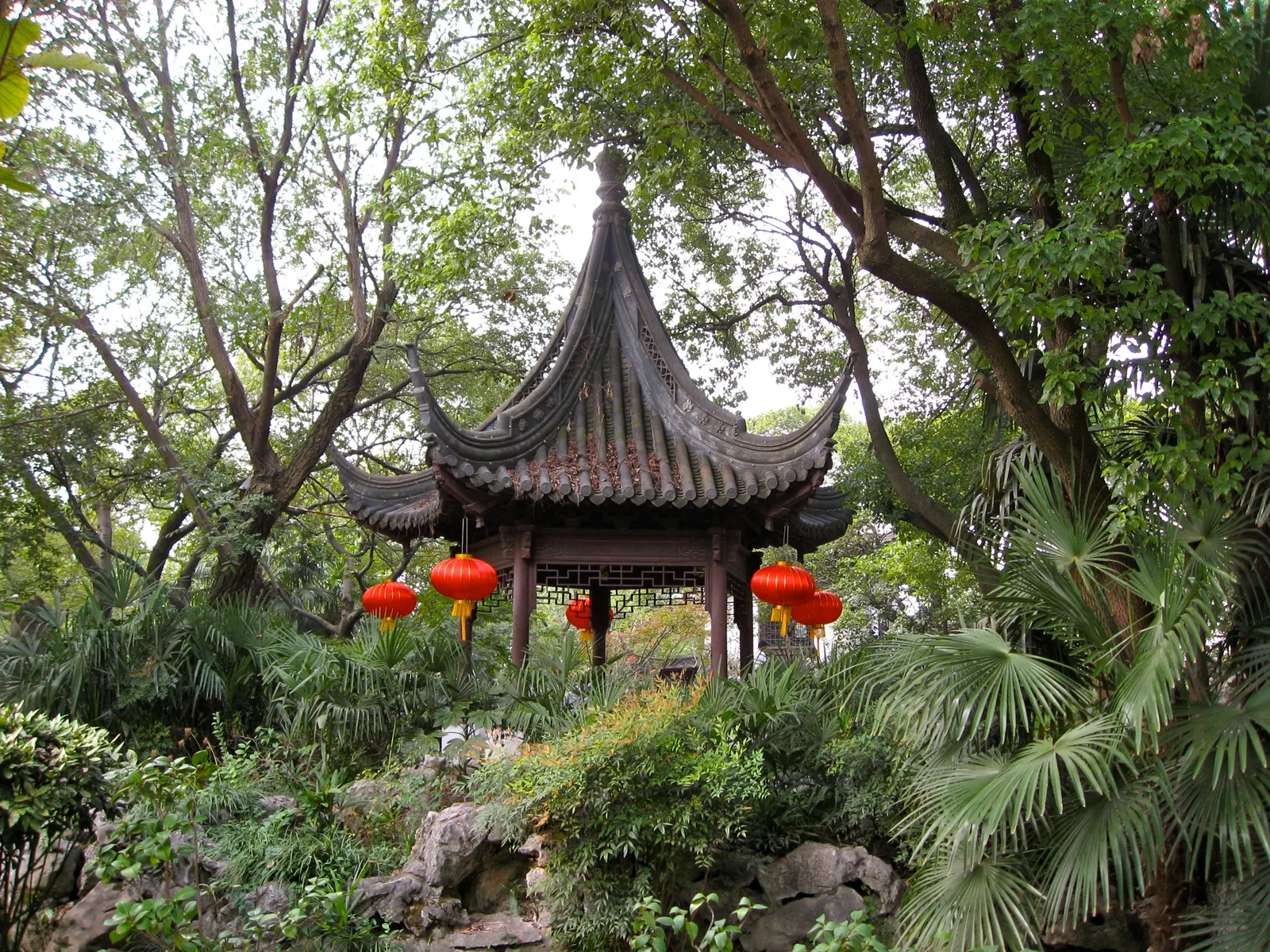
A pavilion inside Kezhi Garden, the old private garden at the edge of the water town. Photo: Wikimedia Commons / CC BY-SA 3.0 — Dolly442 at English Wikipedia. Source
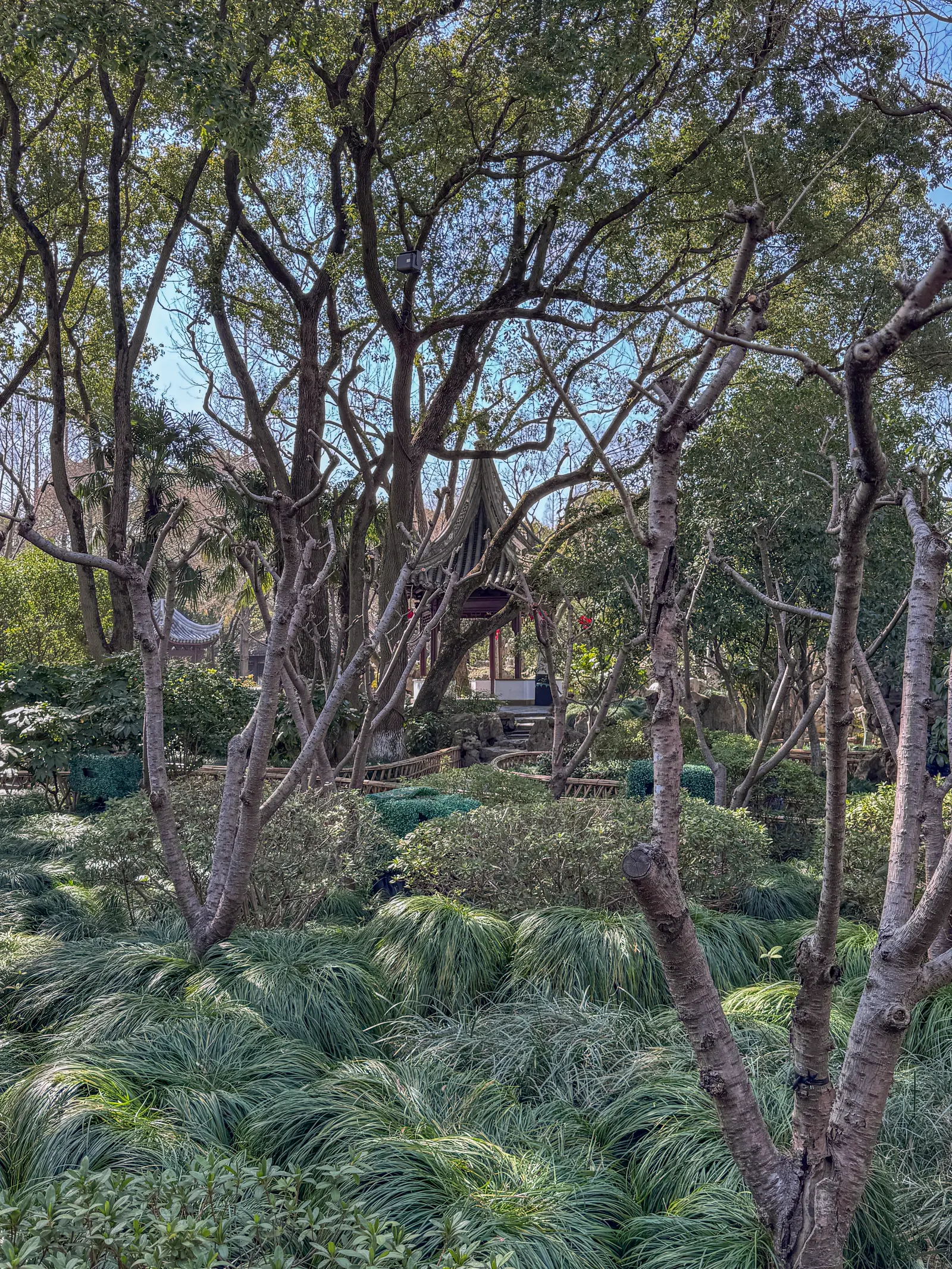
Kezhi Garden in winter, when the pavilions stand bare among the trees. Photo: Wikimedia Commons / CC BY-SA 4.0 — Marek Śliwecki. Source
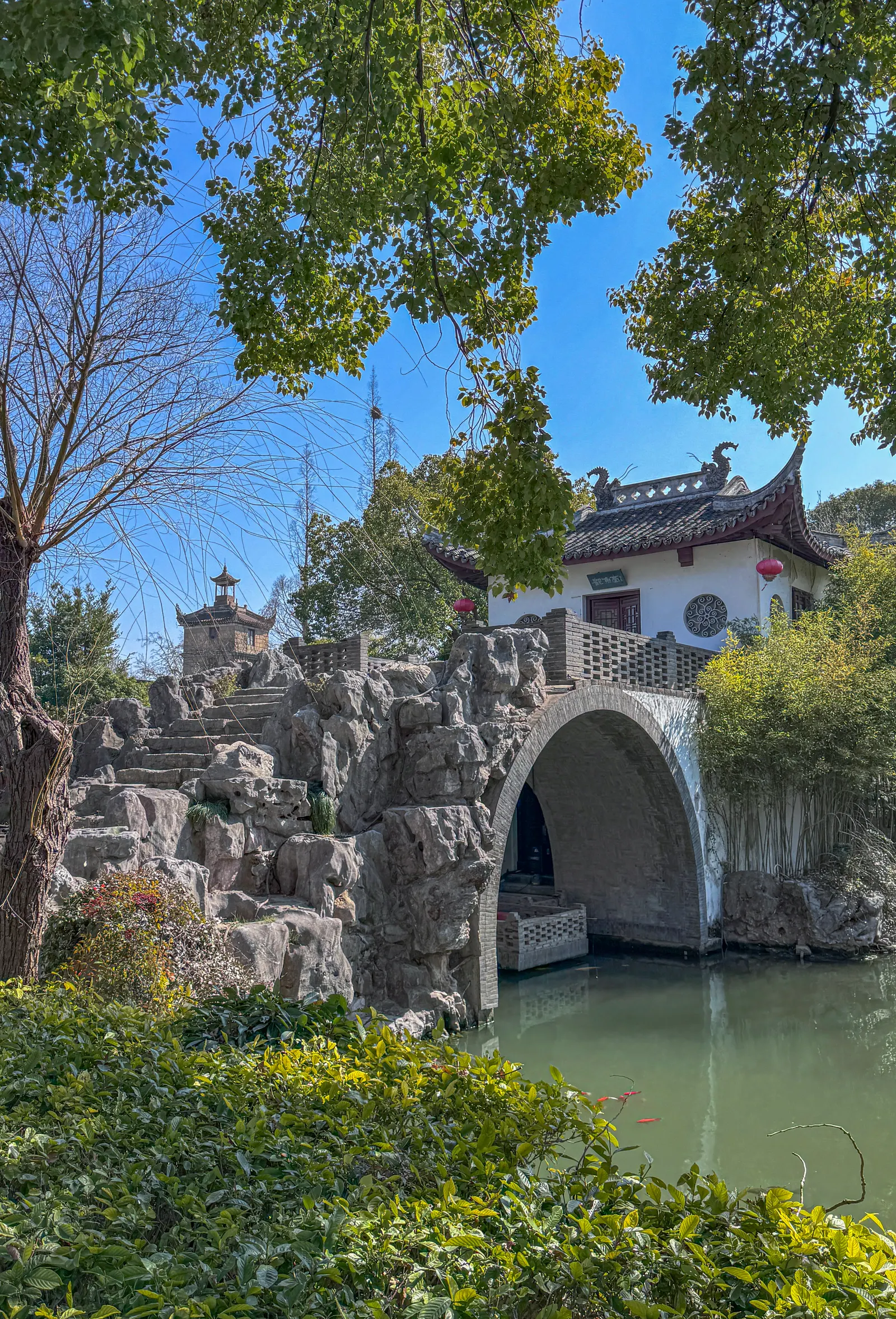
The stone bridge and pavilion inside Kezhi Garden. Photo: Wikimedia Commons / CC BY-SA 4.0 — Marek Śliwecki. Source
The old shops and the post office
North Street is the working part of the town: a narrow covered lane of small shops, with the side lanes behind it filling up with stalls in the morning. The official site lists a sauce garden and what it calls Jiangnan’s first teahouse among the century-old shops still trading here, and a Jiaqing-era pharmacy with a carved signboard over the door.
The Daqing Post Office is the one entry on the list that is a building to go into rather than a street to walk down. The official site does not publish its street address, so take the signboard and the canal in front of it as the landmark.
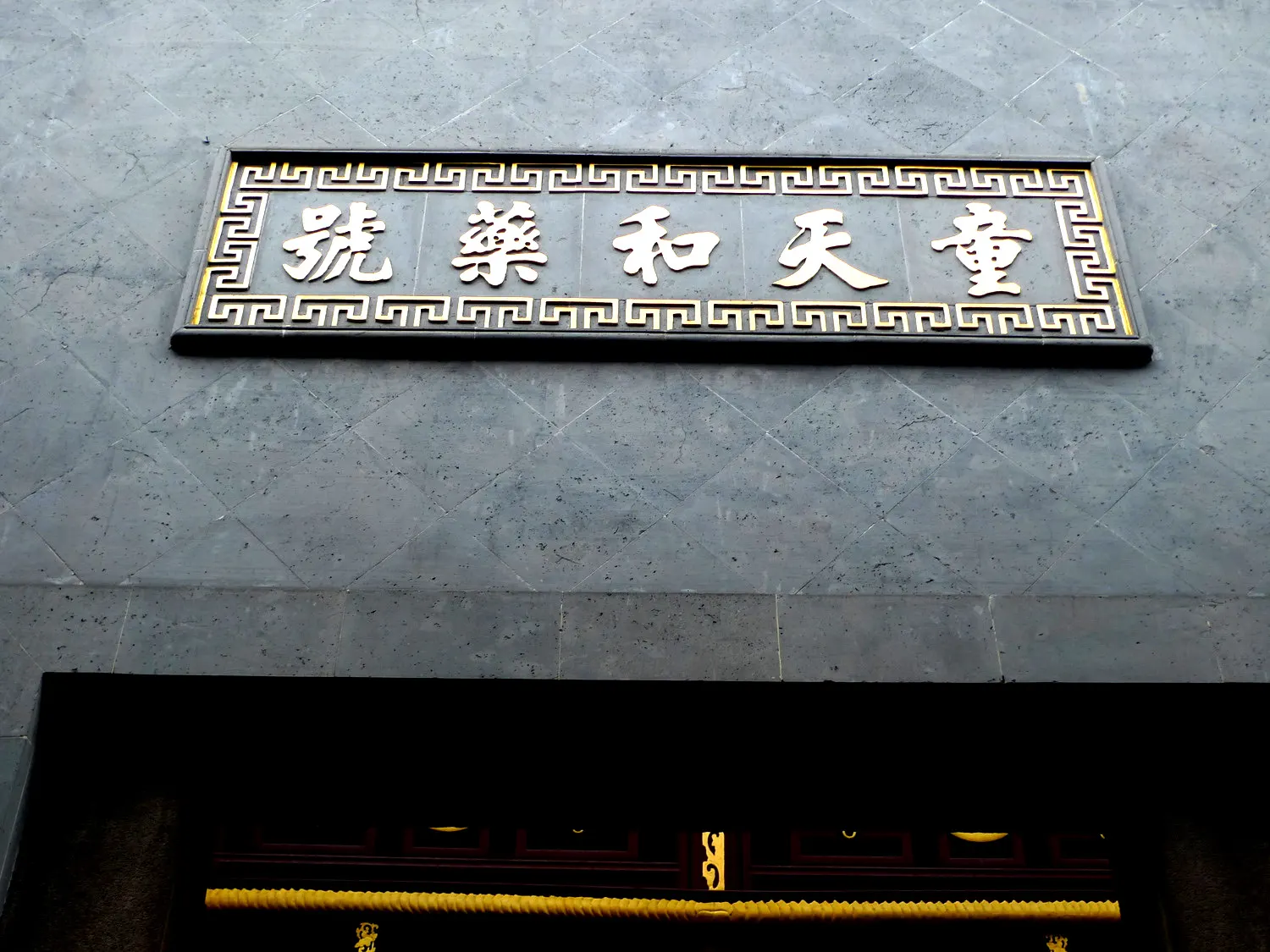
The carved signboard of an old pharmacy on the main street. Photo: Wikimedia Commons / CC BY-SA 3.0 — Gisling. Source
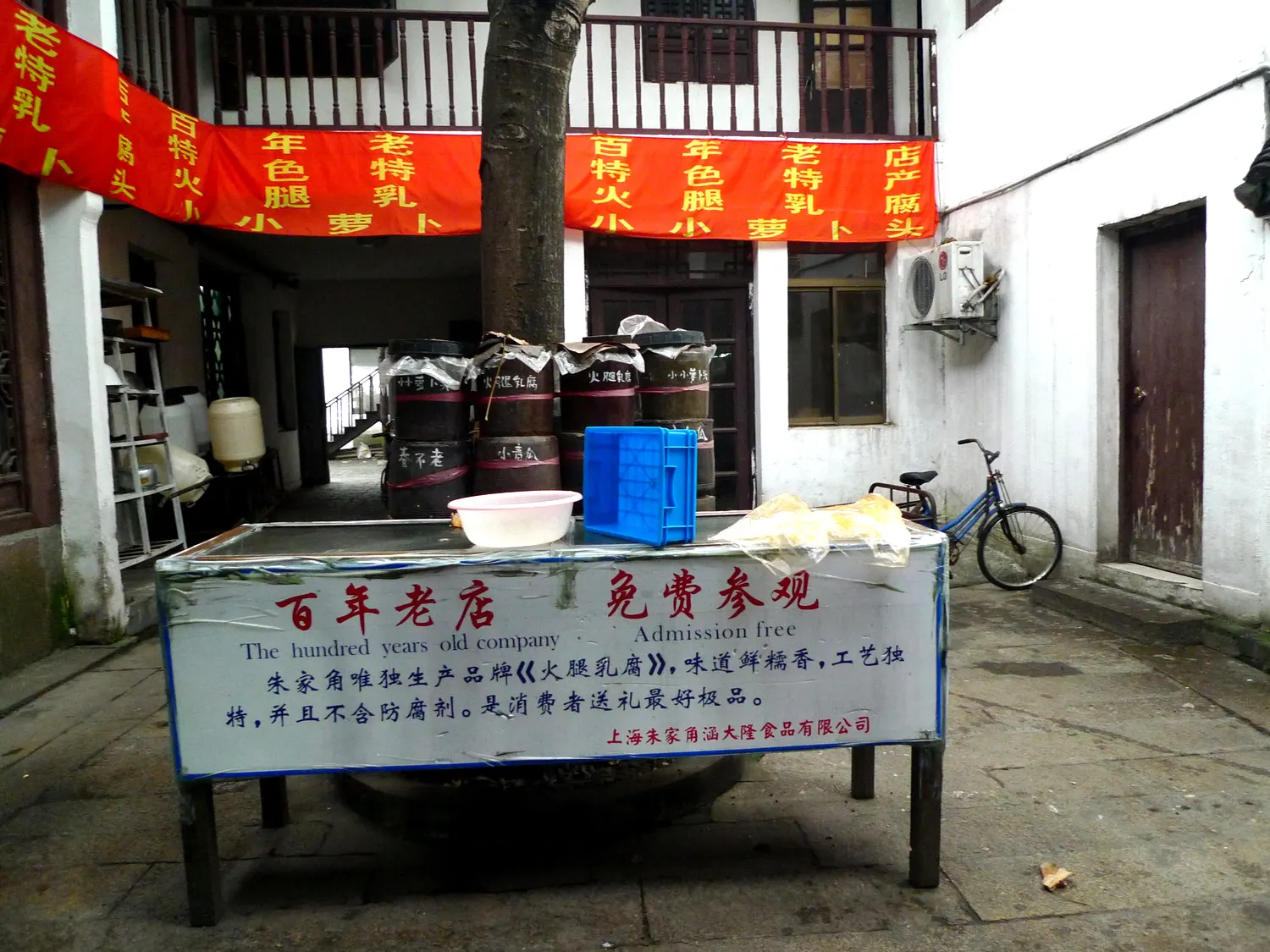
One of the old shops on the main street, still trading as it always has. Photo: Wikimedia Commons / CC BY-SA 3.0 — Gisling. Source
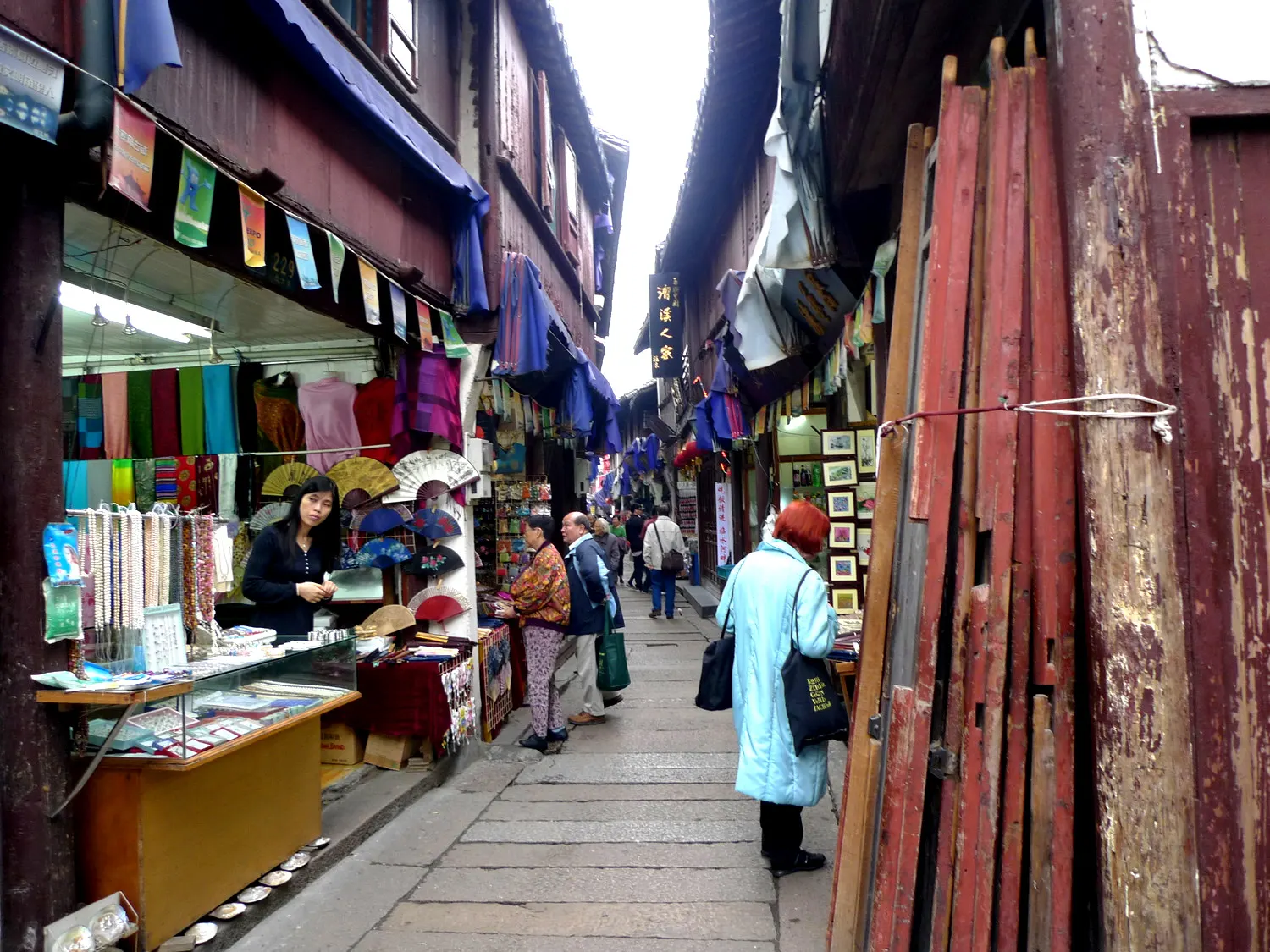
The small lanes behind the main street, where the stalls still set up in the morning. Photo: Wikimedia Commons / CC BY-SA 3.0 — Gisling. Source
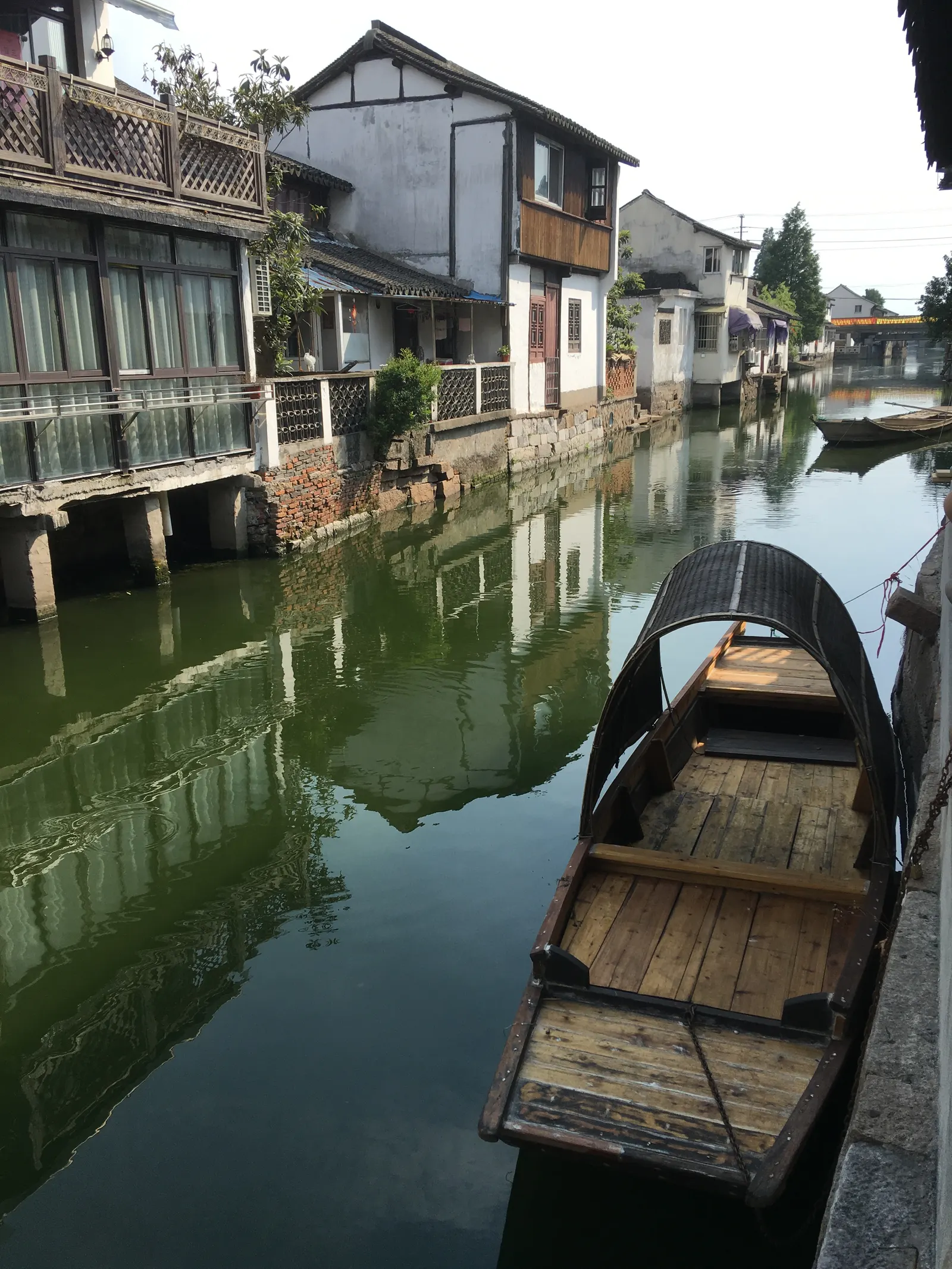
A boat at the canal by the old Qing Dynasty post office. Photo: Wikimedia Commons / CC BY-SA 4.0 — Bjoertvedt. Source
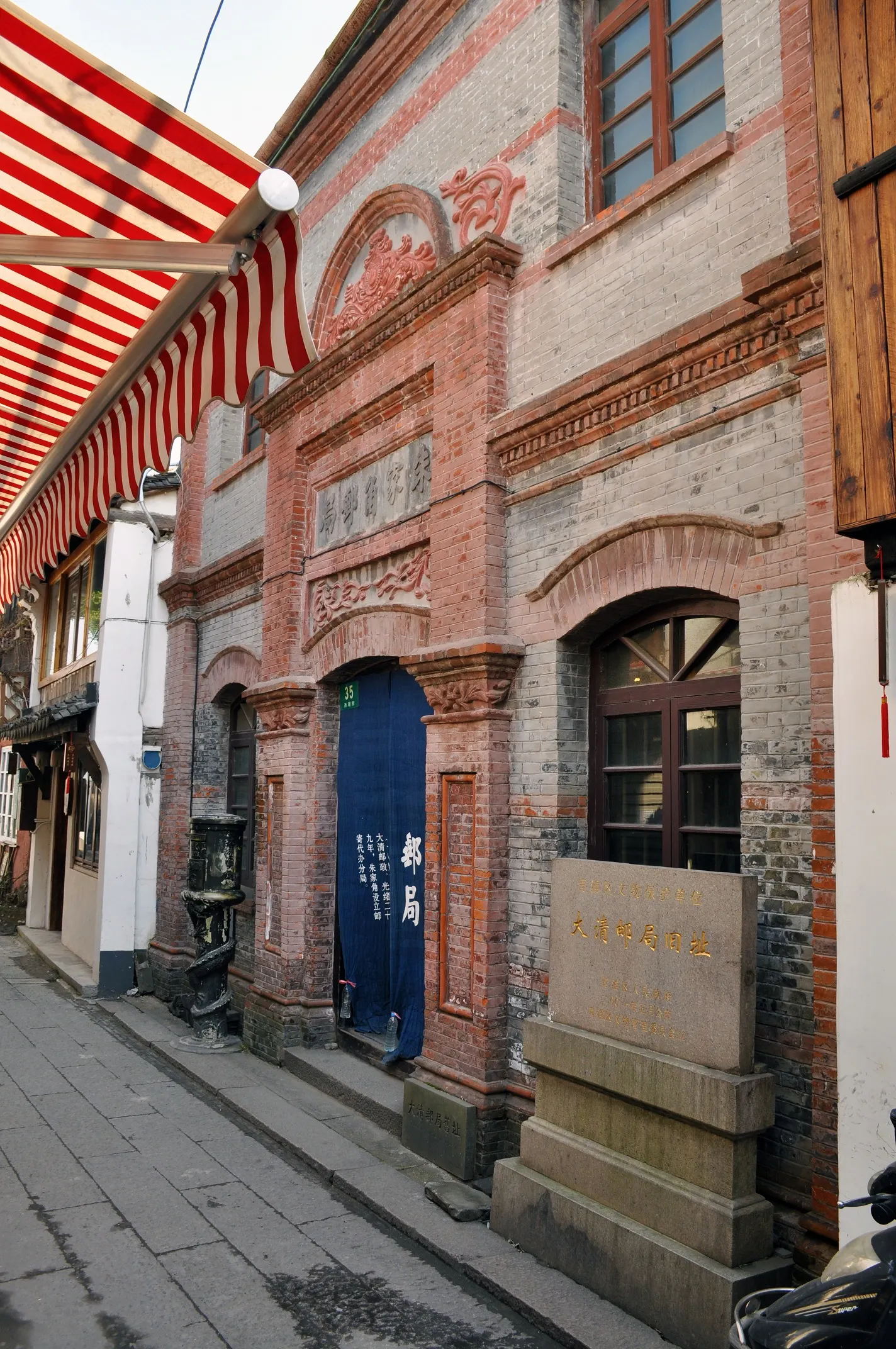
The old Qing Dynasty post office stands on a lane like this one. Photo: Wikimedia Commons / CC BY-SA 3.0 — Fayhoo. Source
Boats on the canals
The hand-rowed boats work the canals you walk beside. Information published through the municipal culture and tourism bureau describes boats leaving from three docks — the City God Temple, Kezhi Garden and North Street — running one way only through the Jingtinggang and Caogang waterways. Each boat carries at most six people; tickets are sold from 8:30 to 17:00.
No fare is published, so ask at the dock. To look rather than ride, the northern canal is where most of the covered boats are tied up.
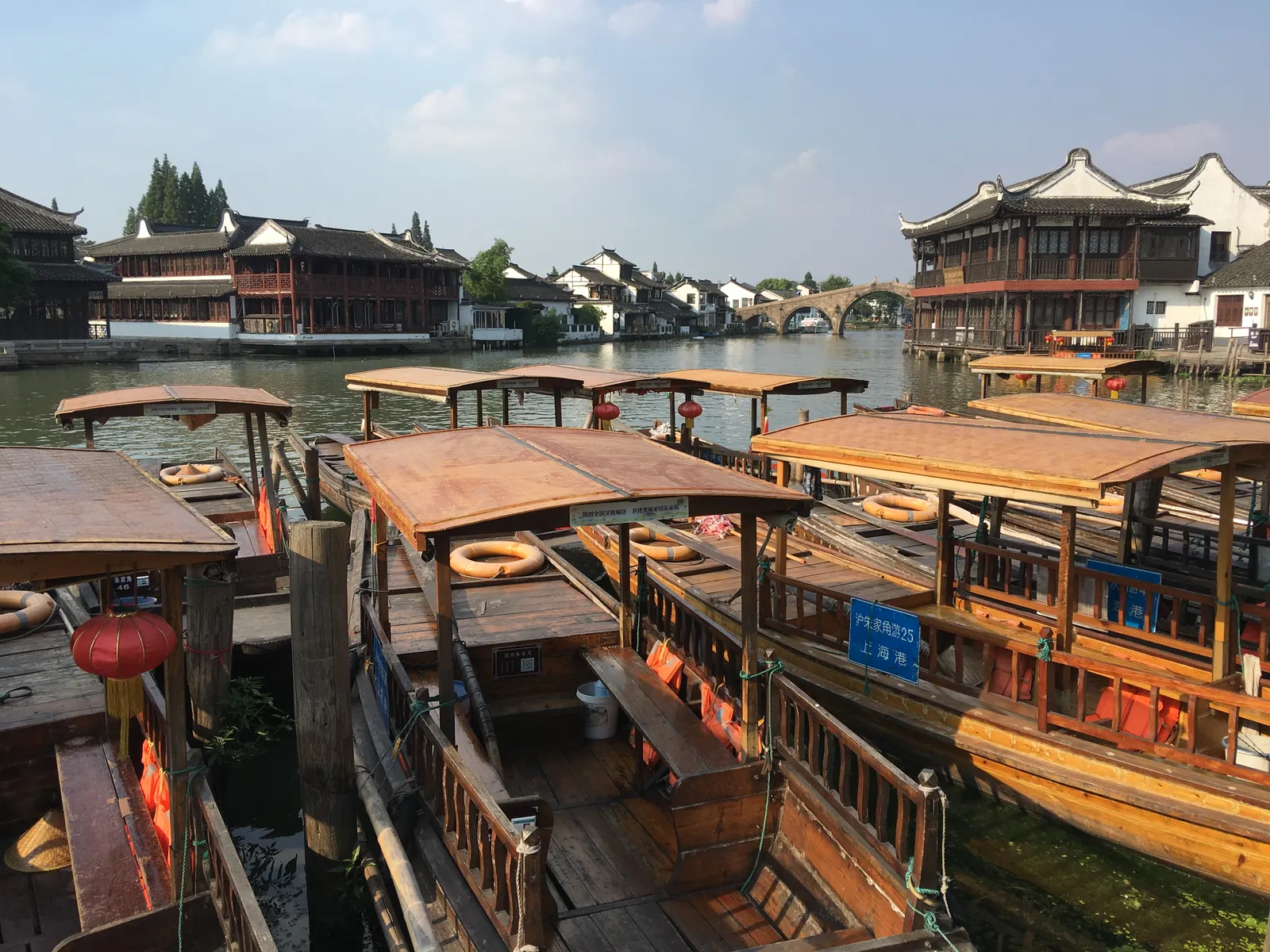
The covered rowing boats that work the canals of the old town. Photo: Wikimedia Commons / CC BY-SA 4.0 — Bjoertvedt. Source
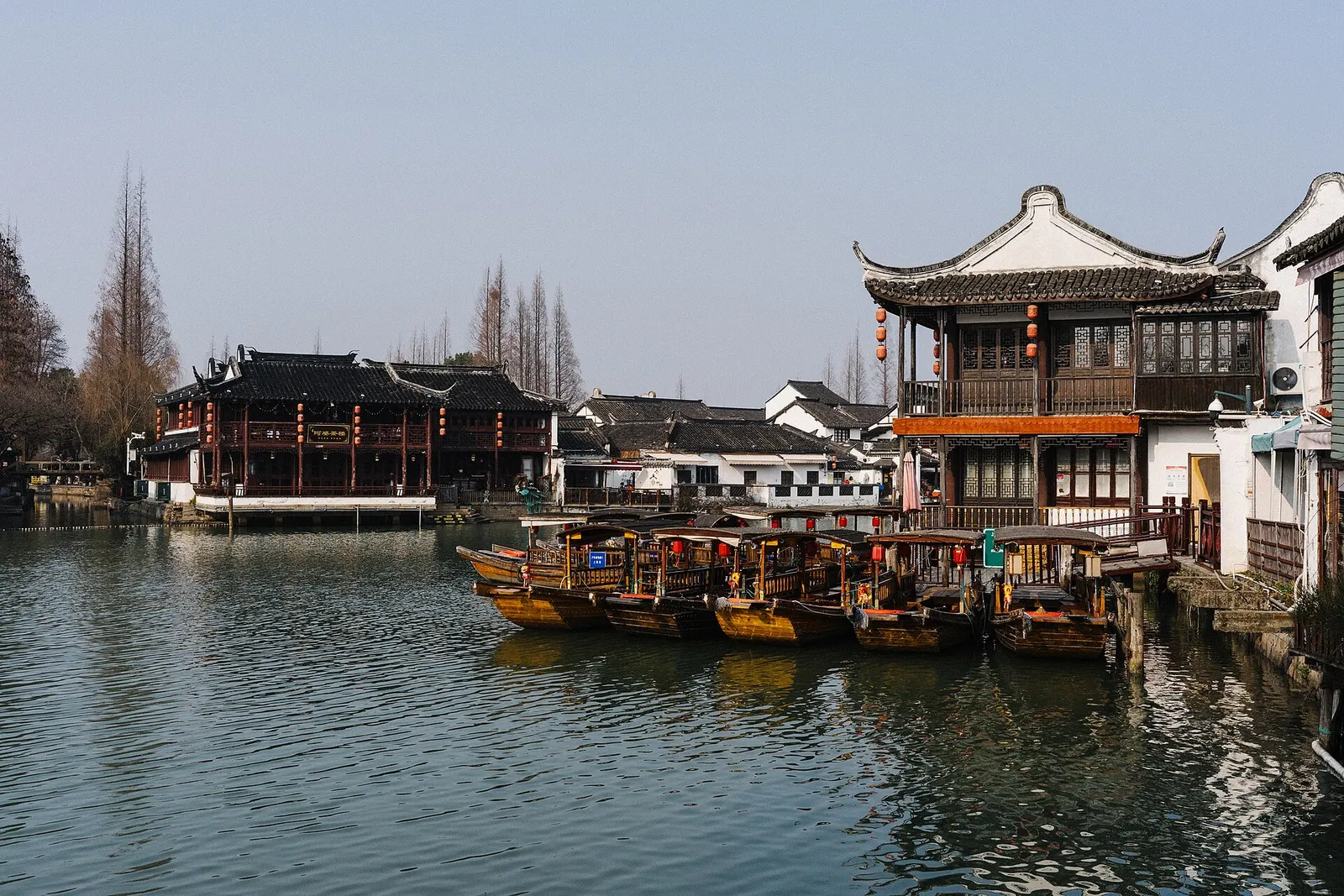
A pavilion on the water, with the rowing boats below it. Photo: Wikimedia Commons / CC BY-SA 4.0 — Lloyd Tudor. Source
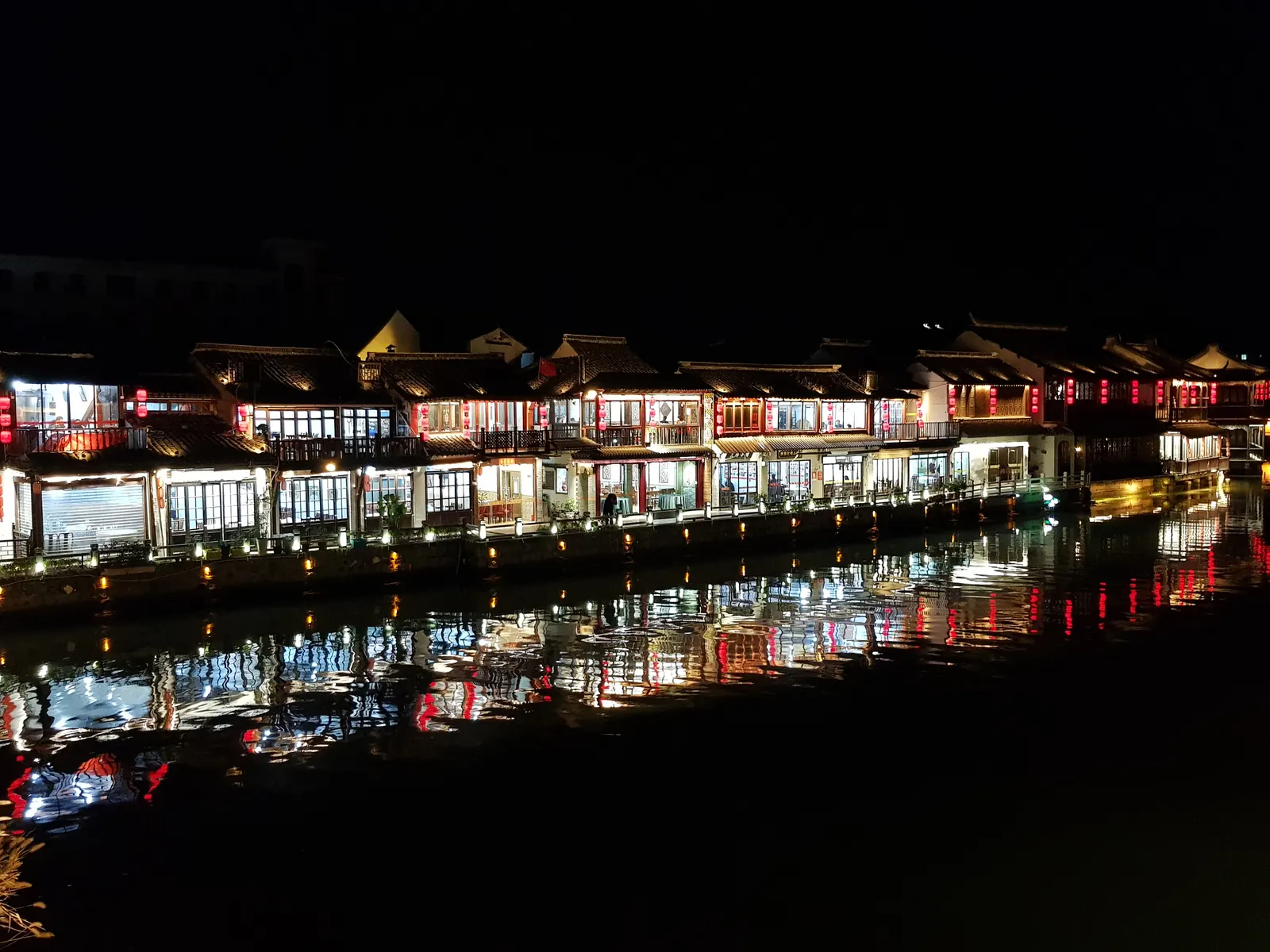
The old town after dark, when the lanterns along the canal are lit. Photo: Wikimedia Commons / CC BY-SA 4.0 — Woong Deewaa. Source
Getting there and getting around
| Option | What the official transport page publishes |
|---|---|
| Metro Line 17 | Hongqiao Railway Station to Zhujiajiao station, about every 10 minutes, 6 CNY; first 06:00, last 23:00 from Hongqiao, first 05:43, last 22:33 from Zhujiajiao |
| Bus 1510 | Zhuxi Road at Huhingping Highway to the visitor centre at Zhuhu Road at Kezhiyuan Road; every 15-20 minutes from 06:02 to 11:12, every 25-30 minutes to 21:02 |
| Expressway coach | People’s Square to the Zhujiajiao coach station, about every 60 minutes; People’s Square first 06:00, last 23:00, Zhujiajiao first 05:10, last 21:00 |
| On foot from the station | Three published routes from Exit 1: 290 m, 488 m and about 1.3 km |
| By car | Yan’an Elevated Road, then G50 to the Zhujiajiao exit, Zhuxi Road and Kezhiyuan Road |
| From Hangzhou or Nanjing | Huhang expressway or Huning expressway to G1501, then G50 |
Two addresses: the tourist centre and ticket collection point at 555 Kezhiyuan Road, and the tourism consultation station at 172 Xinfeng Road. Information 021-59240077, complaints 021-59245559, rescue 021-59242774.
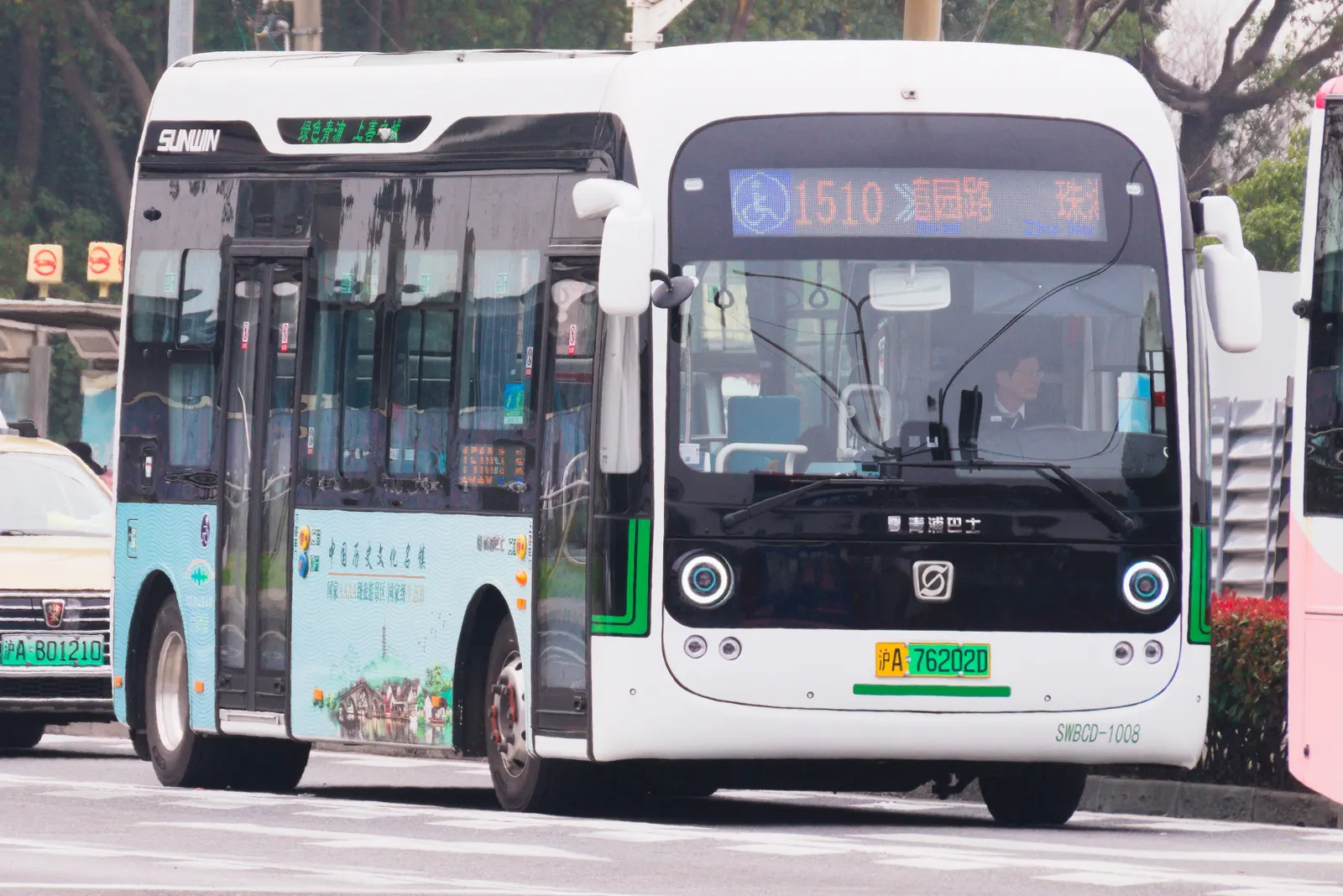
Bus 1510 is the dedicated shuttle between the metro station and the visitor centre. Photo: Wikimedia Commons / CC BY 4.0 — 4084470 0.smil. Source
Tickets, booking and what foreigners need to know
There is no separate foreigner rate and no passport or visa condition in anything the official site publishes. One set of prices applies to every visitor, and the concessions are written by category rather than by nationality — the same list applies whether you show a Chinese ID card or a passport, and the tourist centre processes them in person with the relevant document.
Booking is needed only for the combined ticket: order before 08:00 on the day, collect between 08:30 and 15:00 at 555 Kezhiyuan Road, valid that day for one entry only. The old town itself needs nothing.
Two practicalities: the old town is a walk, not a drive — the streets are narrow and stone-paved, and the sensible loop is North Street, the canal, Fangsheng Bridge and back — and the window to plan against is 8:30 to 17:00 for the paid sites, while the streets stay open all day.
Where this fits
Zhujiajiao is a day trip out of Shanghai rather than a stop inside it, so it belongs with the central sights you would do on a different day. The riverside run is the natural pairing: the Bund, Shanghai Tower, the Oriental Pearl Tower and the Shanghai Museum.
If you would rather see the other half of the old city, the Jade Buddha Temple and Yu Garden are the two Shanghai classics, and the two neighbourhood guides cover the French Concession and Xintiandi. The Shanghai city page pulls the set together.
Also nearby
- The Bund (外滩) — the riverside skyline, on the way back from the metro.
- Shanghai Tower (上海中心大厦) — the other end of the same walk.
- Jade Buddha Temple (玉佛寺) — an older city stop.
- Yu Garden (上海豫园) — classical gardens in the old city.
- French Concession (法租界) — the other side of the old town.
- Xintiandi (上海新天地) — the redeveloped shikumen quarter.
Best photo spots
-
Fangsheng Bridge, over the Caogang River
The five-arched stone bridge the official site calls the largest in East China, and the place to stand when the light drops across the water.
-
North Street
The covered main street, narrow and lined with small shops, with the side lanes behind it filling up with stalls in the morning.
-
The canal outside Kezhi Garden
The water in front of the garden, with the covered rowing boats tied up along the bank and the pavilions behind them.
Frequently asked questions
Is Zhujiajiao worth visiting?
Yes, if you want a working Jiangnan water town rather than a staged set, and if you can give it a half day. The official site puts the scenic area at 3.08 square kilometres with 9 century-old streets, 36 old bridges and thousands of Ming-Qing buildings, all free to walk into. The trade-off is distance: it sits in Qingpu District at the western edge of Shanghai, so even the quickest route in is a train ride plus a walk from the station.
How do I get to Zhujiajiao from Shanghai by train?
Metro Line 17, from Hongqiao Railway Station to Zhujiajiao station. The official transport guide gives the fare as 6 CNY and the service as roughly one train every 10 minutes, with the first train from Hongqiao at 06:00 and the last at 23:00. Exit 1 of Zhujiajiao station is the start of the walk: the official site publishes three routes from there, 290 m, 488 m and about 1.3 km, the last served by a shuttle.
How long does it take to get to Zhujiajiao from Shanghai?
The official site publishes service intervals and first and last trains, but no journey time in minutes, so this page does not quote one. What it does publish is enough to plan: trains roughly every 10 minutes, a first train from Hongqiao at 06:00 and a last at 23:00, and from Zhujiajiao a first at 05:43 and a last at 22:33. The part you control is the walk from the station and the size of the town itself.
How far is Zhujiajiao from Shanghai?
The official site does not publish a distance in kilometres, so this page does not quote one either. What is published: Line 17 runs between Hongqiao Railway Station and Zhujiajiao station at 6 CNY a trip about every 10 minutes; the station is 290 m, 488 m or about 1.3 km from the old town depending on the route; bus route 1510 runs between Zhuxi Road at Huhingping Highway and the visitor centre every 15 to 20 minutes from 06:02 to 11:12 and every 25 to 30 minutes from 11:12 to 21:02.
How do you pronounce Zhujiajiao?
Zhūjiājiǎo, roughly 'joo-jyah-jow'. The tones are first, first and third: 'joo' is level, 'jyah' is level, and the last syllable drops. In English writing it is Zhujiajiao, and you will see it written that way on maps and tickets as often as you see the characters 朱家角.
How much does it cost to visit Zhujiajiao?
Free entry to the old-town streets, with no ticket and no reservation. The three sites inside the scenic area - Kezhi Garden, Hexin Garden and the Shanghai Helong Art Museum - share one combined ticket at 60 CNY per person, half price for ages 6 to 18, students up to undergraduate level, visitors aged 60 and over and the families of serving military personnel, and free entry for children 1.3 m and under or aged 6 and under, military and fire-rescue categories, and holders of a guide, disability, press, retired-cadre or class A1 driving licence.
What are the opening hours at Zhujiajiao?
The three paid sites open daily from 8:30 to 17:00. The old-town streets are open all day and free to enter. Combined tickets can be collected between 08:30 and 15:00 at the tourist centre on 555 Kezhiyuan Road, and orders must be placed before 08:00 on the day you visit.
Can Zhujiajiao be visited in one day from Shanghai?
Yes, and it needs to be a half day rather than a quick stop. The town is 3.08 square kilometres with 9 century-old streets, the train runs about every 10 minutes from Hongqiao Railway Station, and the last train back from Zhujiajiao leaves at 22:33. Plan the day backwards from the 17:00 closing time of the paid sites, and treat the streets outside them as the part you can take at any hour.
Sources
Related guides
Attractions
The Bund
Attractions
Shanghai Tower (上海中心大厦), Lujiazui, Shanghai
Attractions
Oriental Pearl Tower
Attractions
Shanghai Museum (上海博物馆), Shanghai
Attractions
Yu Garden
Attractions
Jade Buddha Temple (玉佛寺), Shanghai
Attractions
French Concession, Shanghai (法租界), the Hengfu Historical District
Attractions
Xintiandi (上海新天地), Shanghai
Rescue card
🆘 Ask How To Get There
Rescue card
🆘 Ask Metro Line And Exit
Rescue card
🆘 Ask Taxi Fare And Time