
Stone Forest
石林 · Shílín
Quick answer
Foreign passport required at entry. Tickets are sold by visitor category — full-time students, ages 60-69, ages 70+, children under 1.2 m, serving military and disabled visitors — so carry photo ID as well as your passport; the category is checked, not just the price.
Why visit
- 1 Limestone pinnacles over 270 million years old — this landscape was a shallow sea floor during the Permian period
- 2 UNESCO World Natural Heritage since 2007, as part of the South China Karst (Naigu Stone Forest and Suogeyi Village), and a national 5A-rated scenic area
- 3 The Greater and Lesser Stone Forest are the famous postcard landscape; Naigu, 9 km to the northeast, is the quieter UNESCO component and the emptier one
- 4 One ¥130 ticket covers the Greater Stone Forest, Lesser Stone Forest, Bushuishan, Wanning Lingzhi and the Karst Museum, and allows re-entry within 3 days
- 5 Buy the ¥25 electric shuttle: the visitor centre sits about 3 km from the Greater Stone Forest, and the karst is the reason you came
Essential tips for foreigners
- Buy the ¥25 electric shuttle ticket. The visitor centre is roughly 3 km from the Greater Stone Forest. The shuttle is what makes the difference between a 30-minute walk in and a proper visit.
- Arrive at opening time (07:30). The first couple of hours are empty, the light is low and raking across the pinnacles, and the tour coach groups have not arrived yet.
- Trust 07:30–18:00 with last entry 17:30 — that is what the park posts. Several third-party listings still show an older 08:00–17:30 schedule.
- Wear shoes with grip. Paths between the pinnacles are paved but frequently wet, and the June–August showers leave them slick.
- Your ticket is valid for re-entry within 3 days and covers all five included areas, so splitting the visit across two mornings is a legitimate way to avoid the crowds.
- Half price is ¥65, not less — it applies to full-time students and ages 60–69. Free entry for ages 70+, children under 1.2 m, serving military and disabled visitors. All of these are ID-checked at the gate.
Suggested route
- 07:30 20 min Arrive at the visitor centre as it opens, buy the ¥130 ticket and the ¥25 electric shuttle
- 08:00 1.5 hours Ride the shuttle out to the Greater Stone Forest and start walking the main karst while it is empty
- 09:30 1 hour Continue into the Lesser Stone Forest, which is tighter and more maze-like than the Greater
- 10:45 45 min Karst Museum for the geological explanation — how a Permian sea floor became stone pillars
- 11:45 1 hour Lunch inside the scenic area, then walk out to Wanning Lingzhi and Bushuishan
- 13:00 1.5 hours Optional drive to Naigu Stone Forest, 9 km northeast — the quieter, emptier UNESCO component
- 15:00 1.5 hours Return to the entrance and head back to Kunming
A 270-million-year-old forest made of limestone
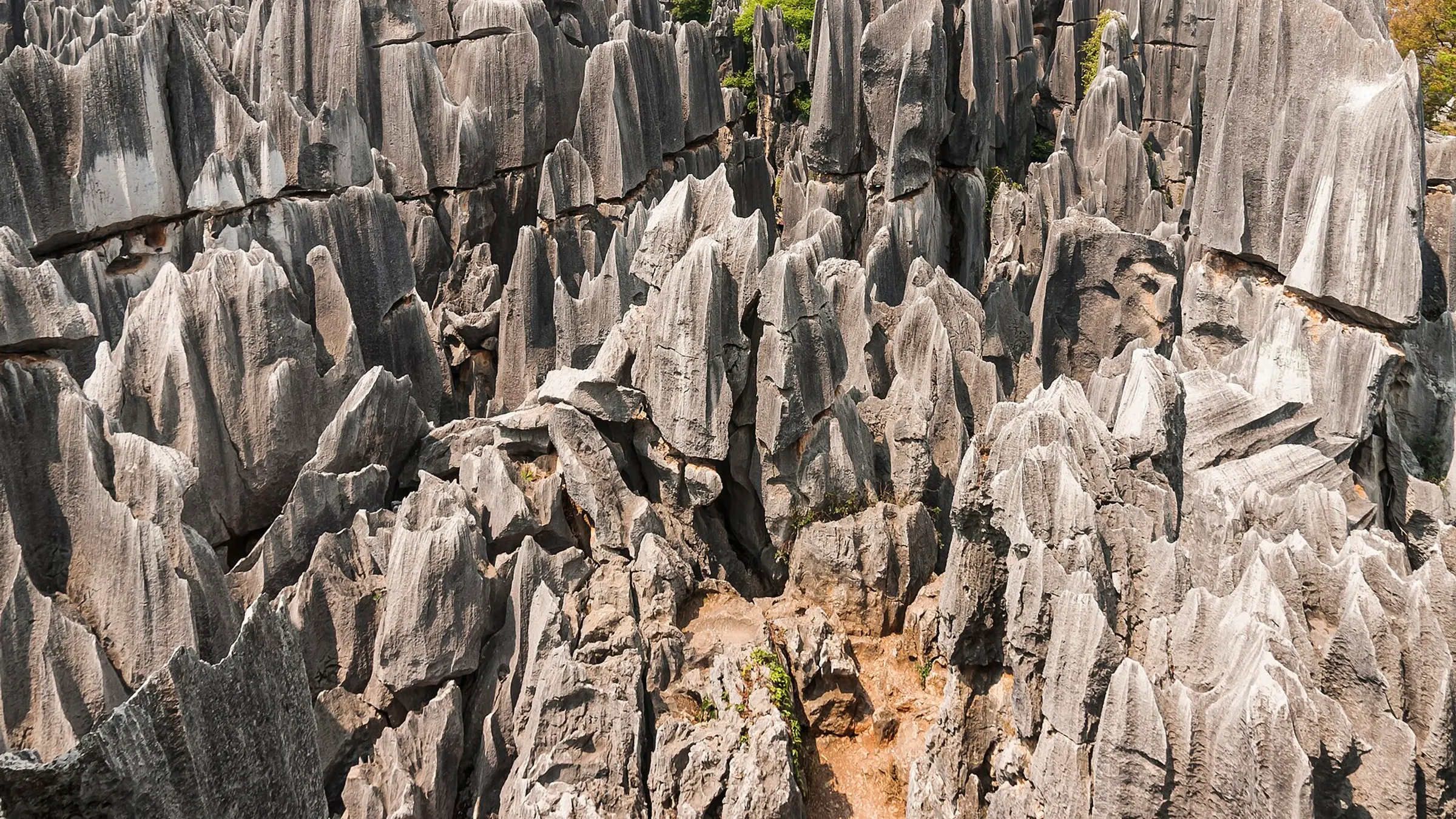
The Stone Forest is roughly 500 square kilometres of limestone formations in Shilin Yi Autonomous County, about 90 km east of Kunming — a landscape of stone pinnacles so dense and so vertical that the ground between them reads as forest floor. The pillars look like petrified trees or oversized stalagmites, and that resemblance is the whole appeal: you walk into what reads as a woodland and it is all rock.
Photo: Wikimedia Commons / CC BY-SA 3.0 (CEphoto, Uwe Aranas).
The formations are thought to be over 270 million years old. Two parts of the wider site — Naigu Stone Forest and Suogeyi Village — have been UNESCO World Natural Heritage since 2007, as components of the South China Karst, a serial property running across Guizhou, Guangxi, Yunnan and Chongqing. The scenic area is also rated 5A, China’s top national classification, and is a member of the Global Network of National Geoparks.
What “Stone Forest” actually covers
The name gets used loosely, and it helps to know that there are two nested things here. The Stone Forest formations themselves span about 500 km². Inside them sits the Shilin National Scenic Area, a ticketed zone of about 400 km² divided into seven scenic areas — and those seven areas are what your ticket and the shuttle network actually serve.
They are the Greater and Lesser Stone Forests, also known collectively as the Lizijing Stone Forest; Naigu Stone Forest; Zhiyun Cave; Long Lake; Moon Lake; Dadieshui Waterfall; and Qifeng Cave.
Almost every visitor sees two of them. The seven-area figure is not marketing filler — it is the reason “4-5 hours” is the realistic number rather than an optimistic one.
Which areas you should actually see
The Greater Stone Forest is the famous one: the largest, densest field of pinnacles, and the landscape in every photograph you have seen of this place. It is where you want to spend the bulk of your time.
The Lesser Stone Forest sits close by and is tighter and more maze-like — lower formations, narrower passages, fewer people. It takes less time and ages you differently.
Naigu Stone Forest is 9 km to the northeast and is the quieter half of the UNESCO inscription. It was carved into dolomite and dolomitic limestone rather than the purer limestone of the main forest, and it is markedly less crowded. If your ticket is still valid for re-entry, this is the best use of a second morning.
The remaining four — two caves, two lakes and a waterfall — are pleasant and cheap to add, but they are not why people come.
The geology, briefly
The area was a shallow sea about 270 million years ago, during the Permian period. Sandstone accumulated in the basin, limestone was laid down over it, and the whole package was later uplifted. Once the rock was exposed, wind and running water did the rest.
The Greater and Lesser Stone Forests are developed in the near-pure limestone of the Permian Maokou Formation; Naigu, in the dolomite of the Qixia Formation. Both are Lower Permian and together they aggregate around 505 m thick. The strata dip gently westward, only two to six degrees, and the conjugate shear joints running through them — the NE-SW and NE-SE sets — are what water used as its passageways. The orientation and depth of those fractures is the reason the karst topography has the shape it does.
If you visit only one interpretive stop, make it the Karst Museum. It is included in the ticket, and it converts the landscape from a curiosity into a legible process.
Ashima and the Sani people
The Sani are the branch of the Yi people whose homeland this is, and the Stone Forest sits at the centre of their story. According to the legend, the forest is the birthplace of Ashima — a beautiful Sani girl who fell in love, was forbidden to marry the man she chose, and turned into a stone in the forest that still bears her name. Visitors are shown the stone called Ashima; treat the framing as legend, which is how the local community presents it, rather than as something to argue about.
Each year on the 24th day of the sixth lunar month, Yi people across the region celebrate the Torch Festival, with folk dances and wrestling competitions. It is a genuine cultural event rather than a staged performance for visitors, and if your dates are flexible it is worth finding out what is happening locally that week.
Tickets: what ¥130 buys, and who pays less
The ¥130 ticket covers the Greater Stone Forest, the Lesser Stone Forest, Bushuishan, Wanning Lingzhi and the Karst Museum. It is valid for re-entry within 3 days, which makes the two-morning approach genuinely practical rather than a loophole.
Half price is ¥65, for full-time students and visitors aged 60 to 69. Entry is free for ages 70 and over, children under 1.2 m, serving military personnel and disabled visitors. These categories are checked with ID at the gate, so the passport that got you into the country also gets you the right ticket.
The ¥25 electric shuttle is separate and worth buying. The visitor centre is about 3 km from the Greater Stone Forest, which is a walk or a shuttle ride depending on how much energy you want to spend before you have even started.
Getting there from Kunming
By high-speed rail, then bus. Take the high-speed train from Kunming South to Shilin West — 18 to 25 minutes, roughly ¥18 in second class — then bus 99 on to the gate. This is the fastest option and the one to use if you are on a tight schedule.
By tourist coach. Coaches run from Kunming East Bus Station and take about 1.5 hours. Slower, but it drops you at the site with no transfer to think about.
By self-drive. The Kunshi Expressway (Kunming–Shilin) takes roughly 90 minutes. Convenient if you have a group, since the scenic area has areas spread far enough apart that a car genuinely helps.
Whichever way you come, the practical point is the same: buy the shuttle ticket when you buy the entry ticket, not after you have walked the first kilometre.
When to go, and what to wear
March to October is the window. March and April bring azaleas flowering in the gaps between the pinnacles, which is the most beautiful time to be here and also the busiest. September and October give you the clearest air and the best photography, because after the rainy season the visibility across the karst is at its best.
The rainy season is June to August. Showers are usually short rather than all-day, but the paths between the pinnacles become genuinely slick, and it is not the time to be wearing sandals.
Whatever the season, the gate opening time is 07:30 and last entry is 17:30, with the park itself open until 18:00. Be inside the karst by 09:30 if you want the place to yourself.
Final tip
The most common mistake is arriving at midday from Kunming. You get there around noon, walk in under flat overhead light, share the paths with the coach groups that arrived before you, and leave having photographed grey silhouettes. Start at 07:30 instead — the same ticket, the same paths, a third of the people, and light that actually shows the rock.
Best photo spots
-
Greater Stone Forest · 07:30-09:30 (low raking light, no crowds)
The classic view: a field of sharp limestone pinnacles rising from a flat floor. Early light gives you side-light and long shadows between the pillars; by midday the same view flattens out.
-
Lesser Stone Forest · Late morning
Tighter, lower and more maze-like than the Greater, so it rewards a slower lens. Good spot for detail shots where the pinnacles fill the frame instead of the landscape.
-
Naigu Stone Forest · Midday
Developed in dolomite rather than the purer limestone of the main forest, and far less visited. Worth the drive if you have the ticket valid for re-entry and want the landscape without the coach groups.
Frequently asked questions
How long do you need at the Stone Forest?
Four to five hours for the main karst areas. That covers the Greater Stone Forest properly, the Lesser Stone Forest, and time in the Karst Museum. Add 40-50 minutes if you also want to drive out to Naigu Stone Forest, which sits 9 km to the northeast and is the quieter half of the UNESCO inscription. Most visitors who allow three hours see the Greater Stone Forest only, and it is a bigger place than it looks.
How much is the Stone Forest ticket and what does it include?
¥130, and it covers the Greater Stone Forest, Lesser Stone Forest, Bushuishan, Wanning Lingzhi and the Karst Museum. The ticket is valid for re-entry within 3 days, so you can come back the next morning without paying twice. The ¥25 electric shuttle inside the park is a separate purchase.
Do I need to book the Stone Forest in advance?
No advance booking is needed. Buy the ticket at the gate when you arrive. Do bring your passport and a second piece of ID if you are claiming half price or free entry, because those categories are checked rather than taken on trust.
Can I get into the Stone Forest with a foreign passport?
Yes. The Stone Forest is a national 5A scenic area that sells tickets by visitor category, and a foreign passport is the document that establishes your identity and age category. Carry it with you, along with anything that backs a student or disability discount.
Is the Stone Forest better than the karst around Guilin?
They are different landscapes rather than a ranking. The Stone Forest is a concentrated field of sharp limestone pinnacles you walk through at close range, and it is a compact half-day trip from Kunming. The Guilin karst is the towering rivers-and-hills scenery most people picture, spread over a much larger area. If you have a full day in Kunming, the Stone Forest is the obvious excursion; if you are routing through Guangxi, do not detour.
What is the best time of day to visit the Stone Forest?
Morning, and as early as you can manage. The gate opens at 07:30, the pinnacles throw long shadows in the first hours, and the crowds build up through the late morning. Aim to be inside the karst before 09:30 if you want any quiet and any good light.
Is the Stone Forest suitable for children or seniors?
Yes for both, with the usual caveat that it is a walking site. The main karst areas are paved and manageable, and four to five hours is a long morning for small children. Wheelchair users and anyone with limited mobility should plan around the fact that the visitor centre is about 3 km from the main entrance and the electric shuttle is the practical way in.
What is the Stone Forest's connection to UNESCO?
Two parts of the site — Naigu Stone Forest and Suogeyi Village — were inscribed in 2007 as part of the South China Karst, a serial World Natural Heritage property running across Guizhou, Guangxi, Yunnan and Chongqing. The famous Greater Stone Forest that most photographs show is inside the same scenic area but is not itself the inscribed component. It is also a member of the Global Network of National Geoparks.
Sources
- Stone Forest — Wikipedia (Shilin, 500 km² of limestone formations, seven scenic areas, Permian geology, Ashima legend, UNESCO since 2007)
- South China Karst — UNESCO World Heritage Centre listing (serial natural site across Guizhou, Guangxi, Yunnan and Chongqing)
- Stone Forest — Wikidata Q2735583 (coordinates 24.8178 / 103.325, Global Geopark Network membership)