
China on a Backpacker Budget 2026: The Complete Guide
Backpack China on $30-60 a day in 2026, or ¥2,910 for two weeks itemized. Sleeper trains, the 4-week route, hostels, street food, free sights and the 240-hour visa-free path.
60-second summary: Is China a good backpacking destination?
Yes — China is one of the best-value backpacker destinations in the world, comparable to India and Vietnam, much cheaper than Japan/Korea. A realistic $30-60/day budget covers most backpackers: $8-17/night hostels, $8-14/day street food, $0-7/day free attractions, $3-6/day local transport, $20-40/trip sleeper trains. The classic 4-week route: Beijing → Xi’an → Chengdu → Lijiang → Dali → Kunming → Guilin/Yangshuo → Hangzhou → Shanghai. The cheapest cities (Kunming, Dali, Lijiang, Yangshuo, Guilin) come in under $35/day. The most expensive (Shanghai, Beijing) still under $60/day. The unique China experience: the Great Wall, Terracotta Warriors, Forbidden City, Panda Base, the karst mountains of Guilin, the Naxi old town of Lijiang, the Erhai Lake of Dali, the West Lake of Hangzhou. The honest assessment: China is harder than SE Asia (Great Firewall, language barrier, more conservative) but the rewards (history, culture, food, infrastructure) are significant. This 7,500-word guide covers everything for the budget backpacker: realistic daily costs, the classic route, hostels, sleeper trains, street food, free attractions, couchsurfing/WWOOF, and 30 FAQs from experienced China backpackers.
1. The reality of the daily budget
The day-to-day budget for a China backpacker in 2026 is one of the most attractive in the world. Three tiers:
$30-40/day (shoestring): dorm beds, street food only, free attractions, sleeper trains, no alcohol. Doable with discipline, more comfortable in Yunnan than in Shanghai. Breakdown: accommodation $8-12, food $8-12, transport $4-7, attractions $0-3, misc $3. Total ~$30.
$40-60/day (comfortable backpacker): dorm beds + occasional private room, mix of street food and local restaurants, mix of free and paid attractions, HSR + occasional flights, more flexibility. Breakdown: accommodation $12-20, food $12-18, transport $6-12, attractions $3-8, misc $3-5. Total ~$45.
$60-100/day (mid-range): mostly private rooms, mix of street food and mid-range restaurants, all major attractions, HSR + occasional flights, more comfort. Breakdown: accommodation $25-50, food $20-30, transport $10-20, attractions $5-15, misc $5-10. Total ~$80.
The $30-60/day tier covers 80% of backpackers. The $60-100/day tier is for those who want more comfort or are doing shorter trips. Above $100/day, you’re in mid-range territory, not backpacker.
Itemized for a 4-week trip (mid-range backpacker, $60/day):
- International flights: $600-1,200
- China visa (if needed): $0-130
- Travel insurance: $40-80/month
- Accommodation (mix of dorm + private): $20/night × 28 = $560
- Food: $15/day × 28 = $420
- HSR + sleeper trains: $300-500
- Local transport: $5/day × 28 = $140
- Attractions: $5-10/day × 14 days = $70-140
- eSIM: $20-40
- Souvenirs: $50-150
- Total: $2,500-3,500 for a 4-week China backpacking trip
The 2-week version, itemized in CNY
Two weeks is the shortest trip that justifies the flight. At 2026 prices, a disciplined backpacker does it for about ¥2,910 (~$420) per person, excluding international flights:
| Category | Per day | Per 14 days | What it buys |
|---|---|---|---|
| Hostel dorm (¥60-120/night) | ¥90 | ¥1,260 | 8-12 bed dorm in Beijing / Xi’an / Shanghai / Chengdu |
| Food (street + cheap restaurants) | ¥50 | ¥700 | Breakfast ¥5, lunch ¥15-25, dinner ¥20-40 |
| Transport within city (metro + bus) | ¥10 | ¥140 | 7-day metro pass ¥70 in Beijing, ¥45 in Shanghai |
| Long-distance (3 HSR/sleeper segments) | — | ¥600 | Beijing-Xi’an ¥300, Xi’an-Shanghai ¥300, sleeper upgrade ¥200-300 |
| Attraction tickets | ¥15 | ¥210 | Forbidden City ¥60, Terracotta Army ¥120, Yu Garden ¥40, the rest ¥0-50 |
| Total | ~¥210/day | ~¥2,910 | Inside the ¥3,000 target |
Add ¥1,500-2,500 ($210-350) for flights from Southeast Asia, or ¥3,500-7,000
($500-1,000) from the US, Europe or Australia. All-in for two weeks: $600-1,400.
The honest assessment: a 4-week China backpacking trip is one of the best values in international travel right now. The same 4 weeks in Japan would cost $4,000-6,000, in Western Europe $4,000-7,000, in the US $3,000-5,000. China is the top value among major destinations.
2. The 4-week classic backpacker route
The classic China backpacker route has been refined over decades. It’s the most efficient way to see the iconic experiences while keeping the budget reasonable.
Week 1: North (Beijing + Xi’an)
- Beijing (3-4 nights): Forbidden City, Tiananmen Square, Temple of Heaven, Wangfujing, hutong walking, Peking duck dinner. Day trip: Great Wall at Mutianyu (most accessible, best cable car + viewing platform). Day trip: Summer Palace or Ming Tombs. Sleeper train to Xi’an.
- Xi’an (2-3 nights): Terracotta Warriors (1h bus each way, ¥150), City Wall cycling (¥54 bike rental for 14km ride), Muslim Quarter (best street food in China), Big Wild Goose Pagoda. Sleeper train to Chengdu.
Week 2: West (Chengdu + Lijiang)
- Chengdu (2-3 nights): Panda Base (early morning, 7-10am is best), Sichuan museum, Jinli Ancient Street, People’s Park teahouse, Sichuan hotpot. Fly or HSR to Lijiang (1h flight, 8h HSR).
- Lijiang (2-3 nights): Naxi Old Town (UNESCO), Black Dragon Pool, Jade Dragon Snow Mountain (cable car ¥180-220), Lashi Lake. Bus to Dali (3-4h, ¥80).
Week 3: Yunnan (Dali + Kunming)
- Dali (2-3 nights): Erhai Lake cycling, Cangshan Mountain, Dali Old Town, Xizhou village (Bai culture), Zhoucheng (tie-dye village). Bus or train to Kunming (5-6h, ¥140).
- Kunming (1-2 nights): Stone Forest day trip (¥175 with transport, 90min), Green Lake Park, Old Street. Fly to Guilin (1.5h, ¥300-500) or train (15-20h sleeper, ¥200-300).
Week 4: South and East (Guilin/Yangshuo + Hangzhou + Shanghai)
- Guilin/Yangshuo (3-4 nights): Li River cruise (Guilin to Yangshuo, 4-5h, ¥215-450), karst landscape, cooking class, West Street, Moon Hill, Yangshuo countryside cycling. Fly or HSR to Hangzhou.
- Hangzhou (2 nights): West Lake walking (15km loop, 3-4 hours), Lingyin Temple, Hefang Ancient Street, Longjing Tea Plantation, sunset at Leifeng Pagoda. HSR to Shanghai (1h, ¥73).
- Shanghai (3 nights): The Bund (evening), French Concession walking, Yu Garden, Nanjing Road, Shanghai Tower (¥180), Shanghai Museum (free), Zhujiajiao Water Town day trip (1h by metro).
Total: 4 weeks, 9-10 cities, $2,500-3,500. This is the classic route. The ‘right’ length for first-time China backpackers.
Variations:
- Add Hainan: Sanya (3 nights, beach, tropical, $40-60/day)
- Add Inner Mongolia: Hohhot + grasslands (3-4 nights, yurt stay, $40-60/day)
- Add Tibet: Lhasa (5-7 nights, requires permit, $50-70/day)
- Add the Silk Road: Xi’an → Dunhuang → Urumqi (1-2 weeks, $50-70/day)
- Add Guizhou: Kaili + Miao villages (3-4 nights, $30-50/day)
- Skip the east: focus on Yunnan/Sichuan for 4 weeks, deeper cultural experience
The ‘right’ route depends on your interests. The classic route above covers the iconic experiences for first-time China backpackers. The variations are for second-timers or those with specific interests (mountains, beaches, culture, etc.).
Two weeks instead of four: the compressed loop
If you only have 14 days, the loop becomes Beijing (3 nights) → Xi’an (2) → Shanghai (3) → Chengdu (2) → fly out of Beijing: 11 nights, 14 days including the travel days. It closes on itself, which is what makes the 240-hour visa-free transit work — you exit to a third country or region (Tokyo, Seoul, Hong Kong SAR).
- Days 1-4, Beijing: Forbidden City + Tiananmen (day 2), Mutianyu Great Wall (day 3), hutong walk + Temple of Heaven (day 4)
- Night of day 4: sleeper Z-train to Xi’an, hard sleeper ¥350, arrives 07:00 — one hotel night saved
- Days 5-6, Xi’an: Terracotta Warriors (day 5), city wall bike ride + Muslim Quarter (day 6)
- Night of day 6: HSR to Shanghai, second class ¥450, 6-7 hours (sleeper upgrade ¥700)
- Days 7-9, Shanghai: the Bund + Nanjing Road (day 7), Yu Garden + French Concession (day 8), Zhujiajiao water town (day 9)
- Night of day 9: HSR to Chengdu, ¥550, 12-15 hours
- Days 10-11, Chengdu: Panda Base before 09:00 (day 10), People’s Park + Jinli + hotpot (day 11)
- Evening of day 11: fly Chengdu → Beijing, 2.5 hours, ¥600-900 (or a 22-hour sleeper for ¥350 if you have the time and the spine)
- Days 12-13, Beijing: rest day, shopping, Peking duck
- Day 14: fly out to a third country
Two weeks means four cities, three overnight legs and no slack for a cancelled train. If your dates are fixed and the budget is not, four weeks is the better trip — the 4-week route above costs only about 25% more per day because the fixed costs (flight, visa, insurance) get spread over twice the days.
3. The sleeper train experience
The sleeper train is the iconic China budget travel experience. It’s not the most comfortable way to travel, but it’s the most memorable and one of the cheapest.
The classes:
- 硬座 (hard seat): cheapest, no bed, upright seats for 10+ hours. Not recommended for trips over 6 hours. ¥80-200 ($11-28).
- 软座 (soft seat): softer, more legroom, more expensive. ¥150-300 ($20-40).
- 硬卧 (hard sleeper): 6 bunks per compartment (3 tiers: lower, middle, upper). The cheapest bed option. Most common choice for backpackers. ¥150-300 ($20-40) for 8-15 hour trips.
- 软卧 (soft sleeper): 4 bunks per compartment (2 tiers). More comfortable, more private, more expensive. ¥250-500 ($35-70).
The experience:
- Book via Trip.com (English, accepts foreign cards) for 10-30 RMB booking fee, or 12306 (free, Chinese-only with VPN).
- Most popular routes: Beijing-Xi’an (overnight, 11h), Xi’an-Chengdu (overnight, 16h), Shanghai-Chengdu (overnight, 24h, soft sleeper recommended), Beijing-Guilin (overnight, 21h), Kunming-Lijiang (overnight, 9h).
- The train becomes a social space — the bunk compartments become impromptu social clubs. Bring snacks, drinks, cards, books, and a willingness to chat.
- The dining car serves basic Chinese food (¥30-50/meal). Or bring your own.
- The toilets are basic. Bring hand sanitizer and toilet paper.
- Bring a power bank (no outlets in older trains, limited in newer ones).
- Bring a sleep mask and earplugs (the trains are noisy, lights stay on).
- The ‘lower bunk’ (下铺) is more expensive but easier to access. The ‘upper bunk’ (上铺) is cheaper but requires climbing.
Tips:
- Book 1-2 weeks ahead for popular routes, 1-3 days for less popular.
- Hard sleeper for 6-12 hour trips is the sweet spot.
- Soft sleeper for 15+ hour trips is worth the upgrade.
- Combine the sleeper train with a ‘night saved’ — you don’t pay for accommodation that night, you wake up in a new city.
- The ‘standing’ ticket (无座) is sometimes the only option for very popular routes, especially during Chinese New Year and Golden Week. Avoid if possible.
The sleeper train is part of the China experience. Embrace it. You’ll have stories for years.
HSR segment prices (2026, second class):
| Segment | Time | Second class | Notes |
|---|---|---|---|
| Beijing → Xi’an | 4.5 h | ¥300 (~$42) | Sleeper bullet ¥500-700 saves a hotel night |
| Xi’an → Shanghai | 6-7 h | ¥450 (~$63) | |
| Shanghai → Chengdu | 12-15 h | ¥550 (~$77) | 2.5 h flight costs ¥600-900 instead |
| Beijing → Guangzhou | 8 h | ¥862 | Over 1,500 km: a ¥600-900 flight usually wins |
The rule of thumb: HSR under 6 hours, sleeper train for 8-15 hours, flight above 1,500 km. Second class is 60% cheaper than flying the same route, and the network reaches every major city.
4. Street food: the best in the world
Chinese street food is the best value food in the world. The variety, quality, and price are unmatched. A backpacker can eat 3 meals a day for $5-10 and have some of the best food of their life.
The rules:
- Eat at busy stalls: high turnover = fresh food.
- Look for stalls with lines of locals: the ‘排队’ (line) is a great signal.
- Avoid raw seafood, unpeeled fruit, and ice in drinks: stick to cooked food, fruit you peel yourself, and bottled water.
- Don’t drink tap water: use bottled water (¥2-3) or filtered.
- Bargain at markets: street food is usually fixed price, but market snacks and souvenirs can be bargained.
- Try everything once: the worst Chinese food is still pretty good.
Top picks by region (see FAQ for full list):
- Xi’an: rou jia mo, liang pi, biangbiang noodles, Muslim Quarter street food
- Chengdu: dan dan noodles, hotpot, chuan chuan skewers, Jinli street food
- Shanghai: xiao long bao, sheng jian, scallion oil noodles
- Beijing: zha jiang mian, jian bing, lü zhu
- Yunnan: guo qiao mi xian, xian hua bing, kao ru shan, mushroom hotpot
- Guangzhou: dim sum (¥30-80, the best value), clay pot rice
- Yangshuo: luo si fen (smelly but iconic), beer fish
Cost by meal — this is where the daily ¥50 figure comes from:
- Breakfast (¥5-10): any vendor with a steamer basket. Baozi (包子, ¥2-3 each), jianbing (煎饼, the Chinese crepe, ¥8-12), soy milk + youtiao (豆浆油条, ¥5). Convenience stores (Family Mart, 7-Eleven) sell onigiri-style rice balls for ¥6-10.
- Lunch (¥15-25): any noodle shop with a queue of locals. Lamian (拉面, hand-pulled noodles, ¥18-25), dan dan noodles (担担面, ¥15-20), rice + two dishes (盖浇饭, ¥15-20). Menus with photos and English translations are priced 3-5x higher.
- Dinner (¥20-40): hotpot ¥60-80 for two sharing, skewer BBQ ¥30-50 per person, or a regional specialty — Yunnan crossing-bridge noodles ¥25, Xi’an biangbiang noodles ¥25, Chengdu chuanchuan ¥50.
- Fine dining: ¥150+ per person, which still buys food that costs $30+ in the US.
Where: walk 2-3 blocks away from any headline attraction. The ring immediately around the Forbidden City, Yu Garden and the Bund is 3-5x the price 500 m away. University districts (Wudaokou in Beijing, Wujiaochang in Shanghai) are the cheapest and most authentic.
Paying: most street vendors and small restaurants are WeChat Pay / Alipay only. Set up Alipay before you land and link your Visa/Mastercard. Cash is accepted but rare.
The backpacker standard is street breakfast (¥10), local restaurant lunch (¥30), street or local dinner (¥30): ¥70-100/day ($10-14/day).
The honest assessment: Chinese street food is one of the great travel experiences in the world. The variety is unmatched, the price is unbeatable, and the quality is consistently high. For backpackers who want to eat well on a budget, China is the best destination.
5. Hostel culture in China
Chinese hostels are the social infrastructure for backpackers. They range from $6-30/night for dorm beds, and the best ones are clean, social, and well-run.
The culture:
- Most Chinese hostels have a common area (kitchen, lounge, rooftop) where travelers gather.
- The staff often speak some English, especially in tourist areas.
- Many hostels organize free or cheap events: walking tours, group dinners, day trips, language exchanges.
- The typical backpacker age: 20s-30s, Western (Europe, Australia, US), some Asian (Korea, Japan, Singapore).
- The vibe: more independent than the classic ‘banana pancake trail’ (SE Asia), more international than the standard hotel (East Asia), more social than the average hotel.
Top hostels by city (see FAQ for full list):
- Beijing: Beijing Downtown Backpackers, 365 Inn, Peking Yard Hostel ($15-20/night)
- Shanghai: The Phoenix Hostel, YHA, KoKo ($20-30/night)
- Xi’an: Xi’an Desti Youth Park, Han Tang Inn, Lichee ($12-20/night)
- Chengdu: Chengdu Mix, Bottom of the Hill ($15-20/night)
- Yangshuo: Sudder Street, Mocha Hotel, Giggling Tree ($10-15/night)
- Yunnan (Kunming, Dali, Lijiang): many hostels at $8-15/night
When a dorm stops being worth it: Chinese chain hotels are the underrated middle tier. Jinjiang Inn (锦江之星) and Home Inn (如家) run private rooms at ¥150-220/night with an en-suite bathroom, reliable Wi-Fi, 24-hour reception and, critically, they accept foreign passports and handle the police registration themselves — the thing that makes budget hotels risky for foreigners in smaller cities. At ¥180 a double is ¥90 each for two people, which is dorm money for a private room. Book them on Trip.com with a foreign card.
Named hostels with 2026 dorm prices, if you want to book directly:
- Beijing: Beijing Downtown Hostel, ¥90/night 8-bed — Dongcheng, walk to the Forbidden City
- Xi’an: Xi’an Desti Youth Park Hostel, ¥60/night 6-bed — inside the city wall, Terracotta day trips from the desk
- Shanghai: The Phoenix Hostel, ¥120/night 8-bed — French Concession, co-work space
- Chengdu: Sima Hostel, ¥70/night — Chunxi Road, walks to the Panda Base shuttle
Tips:
- Book via Hostelworld or Booking.com (English, reviews, payment in advance).
- Avoid the cheapest options (under $8/night) — quality varies.
- Mid-range hostels ($12-20/night) are usually clean, social, and a great value.
- Read recent reviews — Chinese hostels change ownership frequently.
- The ‘private room’ in a Chinese hostel is often a small double room, $25-40/night.
- Most hostels have free WiFi (variable quality), free luggage storage, and a 24-hour front desk.
- The dorm bed is usually a bunk bed with a thin mattress, a pillow, and a thin blanket.
- Showers are usually shared, often with hot water (variable pressure).
The honest assessment: Chinese hostels are not as ‘developed’ as European hostels (less common kitchens, more basic dorms), but they serve the backpacker community well. The social experience is good in tourist hubs (Yangshuo, Dali, Beijing), less so in business cities (Shanghai, Shenzhen).
6. Free and cheap attractions
China has hundreds of free or very cheap attractions. The Bund, West Lake, French Concession, and Tiananmen Square alone are worth the trip. You can spend days in any major Chinese city and not pay a single attraction fee.
Top 15 free attractions (see FAQ for full list):
- The Bund, Shanghai (free)
- Tiananmen Square, Beijing (free)
- Beijing’s hutongs (free)
- Shanghai’s French Concession (free)
- West Lake, Hangzhou (free)
- Xi’an City Wall cycling (¥54 for bike)
- Jingshan Park, Beijing (¥2)
- Yu Garden bazaar, Shanghai (free)
- People’s Park, Shanghai (free)
- Houhai Lake, Beijing (free)
- Pingyao Ancient City walls, Shanxi (free)
- Lijiang Old Town, Yunnan (free)
- Muslim Quarter, Xi’an (free for walking, cheap food)
- Pearl Market, Beijing (free for window shopping)
- Local city parks in any city (free)
Cheap paid attractions:
- Great Wall (Mutianyu, Badaling, Jinshanling): ¥40-65 entrance + ¥120 cable car at Mutianyu
- Forbidden City, Beijing: ¥60 ($8.50)
- Temple of Heaven, Beijing: ¥35 (the outer park is free — locals do tai chi there at sunrise)
- Terracotta Warriors, Xi’an: ¥120 ($17)
- Panda Base, Chengdu: ¥55 ($8) — go before 09:00 or you get sleeping pandas
- Shanghai Tower: ¥180 ($25)
- West Lake boat ride, Hangzhou: ¥70 ($10)
- Li River cruise, Guilin/Yangshuo: ¥215-450 ($30-65)
- Zhangjiajie National Forest Park: ¥225 for a 4-day pass (the “Avatar” mountains)
- Stone Forest, Kunming: ¥130 ($18)
Worth skipping: the tourist-marked song-and-dance shows at ¥200-400. They are 80% Mandarin with poor subtitles, and the money buys two more nights of good food or a sleeper upgrade.
The honest assessment: China’s free attractions are world-class. The Bund, West Lake, French Concession, and Tiananmen Square alone justify the trip. The paid attractions are reasonable. For the budget backpacker, the combination of free + cheap attractions + street food + hostel = an excellent trip.
7. Couchsurfing, Workaway, and rural homestays
Beyond hostels, there are several other accommodation options for budget backpackers.
Couchsurfing (CS): works in China but with mixed quality. Active in Shanghai, Beijing, Chengdu, Kunming, Dali, Yangshuo, Guilin. The best hosts are young Chinese who want to practice English, expats who have been in China for years, or former backpackers who settled. Use the CS app, read reviews, check references, use the verification system. (See FAQ for details.)
Workaway: more active than Couchsurfing in China. Opportunities include: teaching English at rural schools, farm work, homestay work (cooking, cleaning, gardening), NGO work, yoga retreat assistance, hostel work in exchange for accommodation. Cost: $50/year membership. Best regions: Yunnan, Sichuan, Guizhou, Guangxi, Anhui (tea), Inner Mongolia. (See FAQ for details.)
WWOOF China (wwoofchina.org): limited. Some organic farms in Yunnan, Sichuan, Guizhou, Inner Mongolia. The work is 4-6 hours/day, 5-6 days/week, in exchange for room and board. Less developed than WWOOF in Europe/NZ.
Rural homestays in ethnic minority villages: some of the most rewarding China experiences. Yunnan (Naxi, Bai, Tibetan), Guizhou (Miao, Dong), Guangxi (Zhuang), Inner Mongolia (Mongolian yurt), Xinjiang (Uyghur). Book via Airbnb, Booking.com, or local tourism office. ¥100-300/night ($14-42) including meals. (See FAQ for details.)
Temple stays: in some Buddhist and Taoist temples, you can stay for free (or a small donation) in exchange for following the temple routine (early morning chanting, vegetarian meals, simple accommodation). Less common than in Thailand or Japan, but possible. Ask locally.
The honest assessment: for backpackers who want to go beyond hostels, China has more options than expected. The Couchsurfing community is smaller than in Europe, the WWOOF community is less developed, but the homestay and Workaway opportunities are real. For the most authentic China experience, spend at least 1-2 weeks in a rural homestay.
8. Apps and tools
The app stack for China is heavier than for most countries (you need Chinese apps + VPN for Western apps), but once set up, getting around is very smooth.
Critical apps (must have):
- VPN: Astrill, ExpressVPN, LetsVPN. Install before flying.
- Alipay: for payments, transport, food, hotels.
- WeChat Pay: backup for Alipay, for messaging.
- Trip.com: flights, HSR, hotels, attractions, English, accepts foreign cards.
- Pleco: Chinese dictionary, offline, OCR for menus.
- DiDi: Chinese Uber, English UI, accepts foreign cards.
- Airalo / Holafly eSIM: for data, install before flying.
Recommended apps (very useful):
- Hostelworld: hostel booking, English UI, 100+ hostels in China.
- Booking.com: hotels + hostels, English UI, more options than Hostelworld.
- Baidu Maps / Amap: Chinese maps, more accurate than Google in China.
- Maps.me: offline maps based on OpenStreetMap.
- Google Translate: with VPN, good for text and photo translation.
- Baidu Translate: no VPN needed, good for Chinese.
- Meituan / Ele.me: food delivery, restaurant reviews.
Optional apps (for specific situations):
- Couchsurfing: for CS hosting.
- Workaway: for work exchange.
- WWOOF China: for organic farm stays.
- Tinder / Bumble / Tantan: for dating (use carefully).
- WeChat: for messaging Chinese friends, joining groups.
Setup time: 30-45 minutes. Critical: install the VPN and eSIM BEFORE flying. Once you land, you can’t download the VPN from the Chinese app store.
9. Pre-trip checklist (8-4-2-1 weeks)
8 weeks before:
- Choose your route (classic 4-week, or one of the variations).
- Book visa (if needed, 4-7 days processing).
- Book international flights.
- Buy travel insurance (SafetyWing, World Nomads, Allianz).
- Start learning basic Mandarin (Du Chinese, HelloChinese).
4 weeks before:
- Book first 3-5 nights of accommodation (Hostelworld, Booking.com).
- Buy and install VPN (Astrill, ExpressVPN, LetsVPN).
- Buy and install eSIM (Airalo, Holafly).
- Download critical apps (Alipay, WeChat, Pleco, DiDi, Trip.com, Maps.me).
- Get a bank card with no foreign transaction fee.
- Get $200-500 USD cash as backup.
2 weeks before:
- Verify all bookings.
- Book HSR or sleeper train tickets for the first 2-3 legs of the route (via Trip.com or 12306).
- Print or save accessibility documentation in English and Chinese.
- Refill all medications (carry 2x supply, in original pharmacy-labeled bottles).
- Verify passport (6+ months validity, 2+ blank pages).
- Check travel advisories for China.
1 week before:
- Final app test (make sure VPN, eSIM, Alipay, WeChat all work).
- Pack: passport, visa, bank cards, $200-500 USD cash, power adapter, small backpack, reusable water bottle, microfiber towel, quick-dry clothes, universal bathroom kit, universal power adapter.
- Notify home bank of travel dates.
- Set up out-of-office email.
Day 1 in China:
- Arrive, get to your hostel, set up Alipay/WeChat Pay at a café, walk the area, get oriented.
10. The 240-hour visa-free path (saves $140)
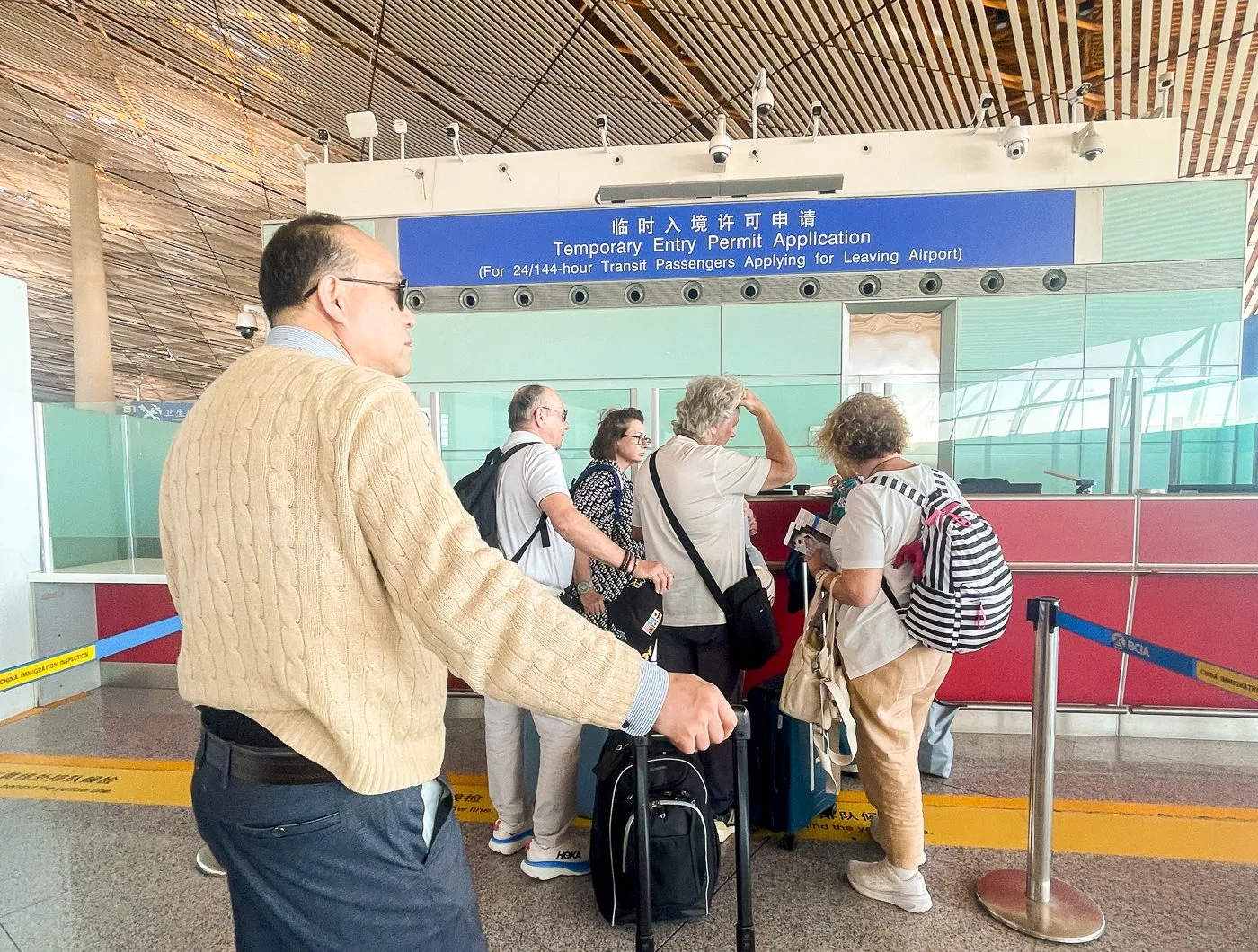
For citizens of 57 countries — the US, UK, all of the EU, Canada, Australia, New Zealand, Japan, South Korea, Brazil, Argentina and more — the 240-hour (10-day) visa-free transit is the cheapest way into China. It skips the tourist visa entirely: ¥1,000 (~$140) in fees plus four working days of processing.
Four conditions, all of which a normal backpacking loop satisfies:
- A confirmed onward ticket to a third country or region. Beijing → Shanghai → Tokyo works. Beijing → Shanghai → back home to Germany does not — the exit must leave China for somewhere other than where you came from. Hong Kong SAR, Macao SAR and Taiwan region count as “third regions” for this purpose.
- You arrive at one of 65 eligible ports — every major international airport qualifies.
- You stay inside the 24 permitted provinces (all the main tourist cities above are inside).
- The 240 hours start at midnight on the day after arrival, so a day-1 morning landing gives you nearly eleven usable days.
For the classic 4-week route this is too short. For the 2-week loop it fits exactly: enter Beijing on day 1, exit from Shanghai to Tokyo on day 11. If you need longer, the 30-day visa-free policy covers 50 countries with no transit requirement at all — you just show up.
⚠️ Verify your own nationality against the current list before booking, and keep a printed copy of the onward ticket. Airline check-in staff are the ones who enforce this, not Chinese immigration. Full process: China 240-hour visa-free guide.
11. When to go: month by month
- April-May and September-October are the two windows. 15-25°C, low humidity, walkable. Shoulder season also means cheaper dorms and shorter queues.
- June-August: 32-38°C and humid in the south, and prices peak with domestic summer travel. Only worth it for a specific reason (a summer-only festival, or the grasslands).
- November-March: cold in the north, but cheap and empty. Fine for budget travelers who pack layers, and the only window for Harbin’s Ice Festival (late December to February).
- Avoid, if you have a choice: Chinese New Year (late January to mid-February, 7-15 days depending on the year) and National Day Golden Week (1-7 October). Dorm prices triple, HSR tickets sell out two weeks ahead, and headline attractions run at 3-5x normal crowds.
Ready-made tools (book this trip)
All 4 tools below can be pre-booked or set up before your flight.
China eSIM for backpackers
Get data on landing for navigation, translation, and app access. 1-3 GB plans from $5, 5-30 day options, China Mobile network. Critical for the data-heavy first days of orientation in China.
5 GB / 30 days: $16 · 10 GB / 30 days: $28
Unlimited data eSIM
Best for backpackers who use maps, translation, and apps intensively. Unlimited data plans for $45-60/30 days. Critical for Couchsurfing, Workaway, or volunteer stays that require heavy data use.
Unlimited / 30 days: $57
HSR + hostels + sleeper trains
China's biggest OTA, English interface, foreign cards accepted. Book HSR tickets, hostels, sleeper trains, attraction tickets in one cart. The most reliable way for English-speaking backpackers to book Chinese transport. Often 10-30% cheaper than booking separately.
HSR from $15 · Hostels from $8/night
Travel insurance for backpackers
$40-60/month, covers 180+ countries including China, emergency medical, evacuation, trip interruption. Critical for backpackers who do adventure activities (hiking, rock climbing, etc.). Cancel anytime.
$56/month · Cancel anytime
Related guides
For more on budget China travel, see our dedicated articles:
Companion guides:
- China Travel Guide 2026 (Complete A-Z)
- China Travel Budget 2026
- How Much Does a Trip to China Cost?
- Hostels in China Guide
Cities on the backpacker route:
- Beijing Travel Guide
- First Time in Xi’an Guide
- Chengdu Travel Guide
- Chengdu Panda Base Guide
- Shanghai Travel Guide
- Hangzhou West Lake Complete Guide
- Guilin Li River Cruise Guide
- Lijiang Old Town
Practical:
Step by step
-
Step 1: Plan your route and book the visa (4-8 weeks before trip)
Choose your route based on time and interests. (1) 2-week route: Beijing (3 nights) + Xi'an (2 nights) + Shanghai (3 nights) + Hangzhou (2 nights) = 10 nights + travel days. (2) 3-week route: add Chengdu (2 nights) + Lijiang (2 nights) for variety. (3) 4-week classic backpacker route: the full route above (Beijing → Xi'an → Chengdu → Lijiang → Dali → Kunming → Guilin/Yangshuo → Hangzhou → Shanghai). (4) 6+ week extended route: add Inner Mongolia, Tibet, Hainan, or the Silk Road. Book the visa 4-8 weeks ahead: (a) 30-day visa-free for 50+ countries (no action needed if eligible). (b) L-visa for US and other nationalities that are not visa-free ($185 for US citizens, about 4 working days; Canada has been visa-free for 30 days since 17 February 2026). (c) Multiple-entry L-visa for longer Asia trips. Book international flights 4-8 weeks ahead. Best value: budget airlines from Europe (€300-500), connecting flights from US ($600-900), or one-stop via Tokyo/Seoul/Hong Kong. Download apps BEFORE flying: VPN, Alipay, WeChat, Pleco, Maps.me, Airalo/Holafly, Trip.com, Hostelworld.
-
Step 2: Set up your digital and physical toolkit (1-2 weeks before)
Digital setup (1-2 days): (1) VPN: Astrill (China-optimized), ExpressVPN, or LetsVPN — check each provider's official pricing page. Install on phone + laptop. (2) eSIM: Airalo ($16-30 for 30 days) or Holafly ($45-60 for 30 days unlimited). Buy and install before flying. (3) Alipay: register with foreign phone, add Visa/MC under Me → Bank Cards. (4) WeChat: register, add Visa/MC under Me → Services → Wallet. (5) Pleco: free Chinese dictionary, install offline. (6) Trip.com: create account, link foreign card. (7) Hostelworld / Booking.com: create accounts. Physical preparation: (1) Passport with 6+ months validity. (2) Visa (if needed). (3) Travel insurance ($40-60/month for SafetyWing, $50-100 for World Nomads). (4) Prescriptions in English (translated to Chinese if possible). (5) Bank cards: no-FX-fee Visa/MC, $200-500 USD cash as backup. (6) Power adapter (China uses Type A/C/I, 220V/50Hz). (7) Small backpack (30-50L) + day pack. (8) Reusable water bottle, microfiber towel, quick-dry clothes. (9) Universal bathroom kit (Chinese budget hotels don't always provide toiletries). (10) Photos for visas (some require paper photos).
-
Step 3: First 7 days in China (orientation + first city)
Most backpackers arrive in Beijing or Shanghai. Day 1: Land, get to your hostel, set up Alipay/WeChat Pay at a café, walk the area. Day 2-3: Major attractions. Beijing: Forbidden City, Tiananmen Square, Wangfujing pedestrian street. Shanghai: The Bund, Nanjing Road, Yu Garden, French Concession. Day 4: Day trip. Beijing: Great Wall (Mutianyu or Badaling). Shanghai: Zhujiajiao Water Town (1h by metro). Day 5: Free day. Wander the hutongs (Beijing) or French Concession (Shanghai). Use this day to book your HSR ticket to the next city via Trip.com. Day 6: Travel to next city. Beijing-Xi'an by HSR 4.5h, ¥553 ($75) second class. Xi'an: City Wall, Muslim Quarter, Terracotta Warriors. Day 7: Day trip to Terracotta Warriors (1h by bus from Xi'an). Evening: sleeper train to next city (Lanzhou, Chengdu, etc.) or continue by HSR. The first 7 days set the rhythm. Don't try to do too much. Save energy for the bigger cities later in the route.
-
Step 4: The classic 4-week route (weeks 2-4)
The classic China backpacker route. (1) Week 2 in Xi'an + Chengdu + Lijiang: 2-3 nights Xi'an, sleeper train (12-15h) to Chengdu, 2-3 nights Chengdu (panda base, Sichuan food, Jinli), fly or HSR to Lijiang (1h flight, 8h HSR). (2) Week 3 in Yunnan (Lijiang + Dali + Kunming): 2-3 nights Lijiang (Naxi old town, Jade Dragon Snow Mountain), bus to Dali (3-4h, ¥80), 2-3 nights Dali (Erhai Lake, Cangshan Mountain, Dali Old Town), bus or train to Kunming (5-6h, ¥140), 1-2 nights Kunming (Stone Forest day trip). (3) Week 4 in Guilin/Yangshuo + Hangzhou + Shanghai: sleeper train (15-20h) or fly to Guilin, 1-2 nights Guilin, bus to Yangshuo (1.5h, ¥30), 2-3 nights Yangshuo (Li River cruise, karst mountains, cooking class), fly or HSR to Hangzhou (2-3h, ¥300-500), 2 nights Hangzhou (West Lake, Lingyin Temple), HSR to Shanghai (1h, ¥73), 3 nights Shanghai (Bund, French Concession, Shanghai Tower, Yu Garden, Nanjing Road). The 4-week route is the most common backpacker experience. Variations: (a) Add Inner Mongolia, Tibet, or Hainan for 5-6 weeks. (b) Skip the east, focus on Yunnan for 4 weeks. (c) Add the Silk Road (Dunhuang, Urumqi) for 5-6 weeks. The 4-week route is the 'right' amount for most backpackers.
-
Step 5: Plan your exit and visa (ongoing)
Plan the visa carefully. (1) 30-day visa-free is a hard 30 days. It is counted from 00:00 the day after you land. It is NOT routinely extendable — the official guidance is that if you need to stay beyond 30 days you should have held the right visa in advance, and only genuine, documented reasons (illness, force majeure) justify applying to the local PSB exit-entry office for a stay permit. Ordinary tourism will not be granted one, so do not build a 60-day trip on that assumption. (2) Border runs: to get a fresh 30 days, leave mainland China and re-enter — Hong Kong, Macau, Japan or Korea, 1-3 days. Each entry grants its own allowance. (3) Long-stay visa: if you want 90+ days, apply for an L-visa at the Chinese consulate before you fly. (4) Tax residency: 183+ days in China makes you a Chinese tax resident — plan income structure if you approach that. (5) Exit checklist: (a) withdraw the housing fund if eligible, (b) refund social security if eligible, (c) get a tax clearance certificate, (d) close or keep your Chinese bank account, (e) cancel your residence permit stamp, (f) settle outstanding bills. (6) The honest assessment: for stays over about a month, sort the visa before you book, not at the border.
FAQ
-
Is China cheap for backpackers in 2026?
Yes — China is one of the cheapest countries to backpack in the world, especially for Western visitors. A realistic daily budget: $30-40/day = shoestring, $40-60/day = comfortable backpacker, $60-100/day = mid-range. The same budgets in other popular destinations: Thailand ($40-70), Vietnam ($30-50), India ($25-45), Japan ($80-150), South Korea ($80-130), Western Europe ($100-150), USA ($100-200). China is comparable to India and Vietnam, slightly more expensive than the cheapest SE Asia, but much cheaper than Japan/Korea/Europe. The reasons China is cheap: (1) World-class infrastructure at low cost — HSR, metro, hostels, food. (2) Strong government investment in tourism, including visa-free entry for 50+ countries. (3) Massive domestic market that keeps prices low for services. (4) Currency exchange rates favor USD/EUR/GBP. The catch: the Great Firewall (need VPN for Google), the language barrier outside major cities, and the visa limitations (30-day visa-free is short for a real backpacking trip) make China harder than SE Asia. For experienced backpackers, China is a top-3 value destination. For first-time backpackers, SE Asia is easier but China offers a more 'exotic' experience at a similar price. -
How much does a 2-week China trip cost as a backpacker?
Realistic 2-week China backpacker budget (mid-2026, USD): Shoestring ($30/day, dorm beds, street food only, free attractions): $420 + international flights $600-1,200 + China visa $0-130 (depending on nationality) + travel insurance $40-80 = $1,200-1,700. Comfortable backpacker ($50/day, hostel dorm + occasional private room, mix of street food and local restaurants, paid attractions): $700 + flights $600-1,200 + visa $0-130 + insurance $40-80 = $1,500-2,100. Mid-range backpacker ($80/day, mostly private rooms, mix of street food and restaurants, all major attractions): $1,120 + flights $600-1,200 + visa $0-130 + insurance $40-80 = $1,900-2,500. Itemized costs for 2 weeks: International flights $600-1,200 (from US), $400-700 (from EU), $500-900 (from Australia/NZ). Within China: hostels $8-17/night × 13 = $104-221. Food $10-20/day × 14 = $140-280. HSR between cities $30-100/trip × 4 = $120-400. Local transport $5-10/day × 14 = $70-140. Attractions $5-20/day × 8 days = $40-160. eSIM $20-40. Souvenirs $50-200. The honest assessment: 2 weeks in China is short for the travel time — you'll spend 2-3 days just getting oriented, see 3-4 cities, and feel rushed. 3-4 weeks is the backpacker sweet spot. But for a quick taste, 2 weeks works. -
What is the cheapest way to travel between cities in China?
Six options, ranked by cost: (1) Sleeper trains (硬卧/软卧) — the classic Chinese budget travel experience. Hard sleeper (硬卧) ¥150-300 ($20-40) for 8-15 hour trips between major cities. Soft sleeper (软卧) ¥250-500 ($35-70), more comfortable. Hard seat (硬座) ¥80-200 ($11-28), the cheapest but very basic (no bed, upright seats for 10+ hours). Book via 12306 (Chinese Railway website, English version with VPN) or Trip.com. (2) Regular trains (普快/快速) — slower than HSR but cheaper. ¥50-150 for short trips. (3) Sleeper buses — common for routes not served by trains, especially southwest China (Yunnan, Guizhou). ¥100-250 ($14-35) for 8-12 hour trips. Less comfortable than trains. (4) HSR (高铁/动车) — fast and comfortable, ¥150-500 for 2-8 hour trips. The HSR is not the cheapest but is excellent value. (5) BlaBlaCar rideshare — limited in China, mostly on long routes between major cities. ¥50-150. (6) Flights — for long distances (Shanghai-Chengdu, Beijing-Guangzhou), domestic flights can be cheaper than HSR. ¥300-700 ($40-100). The best budget travel: sleeper trains for 6-15 hour trips, HSR for shorter trips, flights for very long distances. The sleeper train is the iconic Chinese budget experience — not the most comfortable, but very cheap and you save a night's accommodation. -
What are the best hostels in China for backpackers?
Top hostels by city. Beijing: (1) Beijing Downtown Backpackers (北京国际青年旅舍) — courtyard, central, social, $15-20/night dorm. (2) 365 Inn — near Forbidden City, $15-20/night. (3) Peking Yard Hostel — hutong location, charming, $15-20/night. Shanghai: (1) The Phoenix Hostel — French Concession, social, $20-30/night. (2) Shanghai YHA (上海青年旅舍) — central, clean, $20-30/night. (3) KoKo International Youth Hostel — modern, social. Xi'an: (1) Xi'an Desti Youth Park Hostel — near the City Wall, social, $15-20/night. (2) Han Tang Inn Youth Hostel — central, $15-20/night. (3) Lichee Youth Hostel — near Muslim Quarter, $12-18/night. Chengdu: (1) Chengdu Mix Hostel — social, central, $15-20/night. (2) Sichuan Bottom of the Hill Hostel — near the panda base, $12-18/night. Yangshuo: (1) Yangshuo Sudder Street Guesthouse — central, social, $10-15/night. (2) Mocha Hotel — slightly more upscale, $15-25/night. (3) Giggling Tree — nature setting, $12-18/night. Kunming, Dali, Lijiang have many hostels at $8-15/night. The honest assessment: Chinese hostels vary in quality. The Hostelworld and Booking.com reviews are the most reliable indicator. Avoid the cheapest options (under $8/night) — they often have thin walls, dirty bathrooms, and inconsistent hot water. Mid-range hostels ($12-20/night) are usually clean, social, and a great value. -
What is the best backpacker route in China?
The classic 3-4 week China backpacker route: Week 1: Beijing (3 nights, Forbidden City, Great Wall at Mutianyu or Jiankou) → Xi'an (2 nights, Terracotta Warriors, City Wall, Muslim Quarter, sleeper train to...). Week 2: ...Chengdu (2 nights, panda base, Sichuan food) → overnight sleeper to Lijiang (2 nights, Naxi old town, Jade Dragon Snow Mountain) → Dali (2-3 nights, Cangshan Mountain, Erhai Lake, Dali Old Town). Week 3: Kunming (1-2 nights, Stone Forest day trip) → sleeper train to... Week 4: ...Guilin/Yangshuo (3-4 nights, Li River cruise, karst mountains, cooking class) → Hangzhou (2 nights, West Lake, Lingyin Temple) → Shanghai (3 nights, Bund, French Concession, Shanghai Tower). Total: 3-4 weeks, 9-10 cities, $1,200-2,500. Variations: (1) Add Hainan: extend with Sanya (3 nights, beach) — adds tropical relaxation. (2) Add Tibet: Lhasa (5-7 nights) requires a special permit but is the ultimate backpacking experience. (3) Add Inner Mongolia: Hohhot and the grasslands (3 nights) — different culture. (4) Skip the east: focus on southwest (Yunnan, Sichuan, Guizhou) for a deeper cultural experience. (5) Add the Silk Road: Xi'an → Dunhuang → Urumqi (1-2 weeks) — for the more adventurous. The 'right' route depends on your interests. The classic route above covers the iconic experiences for first-time China backpackers. -
How do I book sleeper trains in China?
The sleeper train is the iconic Chinese budget travel experience. Booking: (1) Trip.com (English): the easiest option for foreigners. Search route, select train, choose sleeper class, pay with foreign card. ¥10-30 booking fee but worth it for the convenience. (2) 12306 (Chinese Railway official): free, but requires Chinese phone number, VPN for English version, and Chinese ID/passport details. The 12306 English version is incomplete — many sleeper trains don't show up. (3) At the station: walk in, go to the ticket window, show your passport. Mandarin required or use a translation app. Cash or Alipay/WeChat Pay accepted. (4) Through a hostel/hotel: many hostels and hotels will book train tickets for a small fee. (5) Through a travel agency: in major cities, especially for popular routes. Sleeper train classes: 硬座 (hard seat) — cheapest, no bed, upright seats for 10+ hours. Not recommended for trips over 6 hours. 软座 (soft seat) — softer, more expensive. 硬卧 (hard sleeper) — 6 bunks per compartment (3 tiers), cheapest bed option. 软卧 (soft sleeper) — 4 bunks per compartment (2 tiers), more comfortable. For 8-15 hour trips, the hard sleeper is the standard budget experience. For 15+ hour trips, the soft sleeper is worth the upgrade. Tips: book 1-2 weeks ahead for popular routes, 1-3 days ahead is usually fine for less popular routes. The 'lower bunk' (下铺) is more expensive but easier to access. Bring your own food and water. Toilets are basic. The sleeper train is part of the China experience — embrace it. -
What is Couchsurfing like in China?
Couchsurfing (CS) works in China but with some caveats. (1) Active hosts: Shanghai, Beijing, Chengdu, Kunming, Dali, Yangshuo, Guilin have the most active CS hosts. (2) Quality of hosts: mixed. The best CS hosts are young Chinese who want to practice English with foreigners, expats who have been in China for years, and former backpackers who settled in China. (3) Safety: Couchsurfing is generally safe in China, especially for experienced travelers. Read reviews, check references, use the verification system, and trust your instincts. (4) Cultural exchange: the best part of Couchsurfing in China is the cultural exchange — Chinese hosts love to show foreigners their city, share meals, practice English, and learn about other cultures. (5) The visa question: technically, CS hosts who let you stay for free are providing 'accommodation', which is allowed on tourist visas. Most CS experiences don't trigger any visa issues. (6) Free alternatives: BeWelcome (similar to CS, smaller in China), Trustroots (more for hitchhikers), and WarmShowers (for cyclists). (7) The realistic assessment: Couchsurfing in China is less developed than in Europe or SE Asia. The host quality is mixed. Most backpackers use hostels as their primary accommodation and CS as an occasional supplement. (8) Safety tip: don't accept CS requests from people without verified profiles, without multiple positive reviews, or who want to host women only. (9) Best cities for CS: Shanghai, Beijing, Chengdu, Kunming, Dali, Yangshuo, Lijiang, Guilin. (10) Combine with a hostel: stay in hostels for the social atmosphere and to meet other travelers, supplement with 1-2 CS stays per city for the cultural exchange. -
What is the WWOOF/Workaway/volunteer situation in China?
WWOOF (World Wide Opportunities on Organic Farms) and Workaway (work exchange) work in China with some considerations. (1) WWOOF China: limited. Some organic farms in Yunnan, Sichuan, Guizhou, and Inner Mongolia participate. The work is typically 4-6 hours/day, 5-6 days/week, in exchange for room and board. ¥1,000-3,000/month value. (2) Workaway: more active in China than WWOOF. Opportunities include: (a) Teaching English at rural schools or homestays. (b) Farm work (rice, tea, fruit). (c) Homestay work (cooking, cleaning, gardening). (d) NGO work (conservation, education). (e) Yoga retreat assistance. (f) Backpacker hostel work (in exchange for accommodation and sometimes food). (3) Visa considerations: technically, WWOOF and Workaway are 'volunteer' work, not 'employment'. The Chinese government may consider this a gray area, especially if you're doing 'work' in exchange for accommodation. For stays under 30 days, the visa-free entry is fine. For longer stays, the F-visa or L-visa with extension may be needed. (4) Best platforms: (a) Workaway.info — the main platform, $50/year membership, 50+ active hosts in China. (b) WWOOF China (wwoofchina.org) — limited but growing. (c) HelpX — similar to Workaway, smaller in China. (d) Worldpackers — focused on hostels, more in SE Asia than China. (5) Best regions for WWOOF/Workaway: Yunnan, Sichuan, Guizhou, Guangxi, Anhui (rural tea regions), Inner Mongolia. (6) The realistic assessment: WWOOF and Workaway in China are less developed than in Europe or NZ/Australia. The host quality is mixed. The experiences can be very rewarding — you live with a local family, learn about rural Chinese life, and save on accommodation. For backpackers with more time, WWOOF/Workaway can be a 2-4 week experience in a rural area as a break from city-hopping. -
What is the best street food in China for backpackers on a budget?
China is a street food paradise — the variety, quality, and price are unmatched. Top picks by region: (1) Xi'an: 肉夹馍 (rou jia mo, Chinese hamburger) ¥8-15, 凉皮 (liang pi, cold noodles) ¥8-12, 羊肉泡馍 (yang rou pao mo, lamb soup with bread) ¥25-40, biangbiang noodles ¥12-18. The Muslim Quarter is the best street food area in China. (2) Chengdu/Sichuan: 担担面 (dan dan mian, dan dan noodles) ¥12-20, 龙抄手 (long chao shou, wontons) ¥10-15, 三大炮 (san da pao, glutinous rice balls) ¥5-10, street hotpot ¥20-40, 串串 (chuan chuan, skewers) ¥1-3/skewer. The Jinli and Jianshe Road areas are street food heaven. (3) Yangshuo/Guilin: 米粉 (mi fen, rice noodles) ¥10-15, 啤酒鱼 (pi jiu yu, beer fish) ¥30-50, 螺蛳粉 (luo si fen, snail noodles) ¥10-15 (smelly but iconic). (4) Yunnan (Kunming, Dali, Lijiang): 过桥米线 (guo qiao mi xian, crossing-the-bridge noodles) ¥20-30, 鲜花饼 (xian hua bing, flower cake) ¥3-8, 鸡豆凉粉 (ji dou liang fen, chickpea jelly) ¥5-10, 烤乳扇 (kao ru shan, grilled milk fan) ¥5-10. (5) Shanghai: 小笼包 (xiao long bao, soup dumplings) ¥20-40 for 8, 生煎 (sheng jian, pan-fried dumplings) ¥8-15 for 4, 大闸蟹 (da zha xie, hairy crab, October-December) ¥30-100. (6) Beijing: 炸酱面 (zha jiang mian, zhajiang noodles) ¥15-25, 卤煮 (lu zhu, braised offal) ¥20-30, 爆肚 (bao du, quick-fried tripe) ¥25-40, 豆汁 (dou zhi, fermented mung bean milk, acquired taste) ¥5-10. (7) Guangzhou/Cantonese: 早茶 (zao cha, dim sum) ¥30-80, 煲仔饭 (bao zai fan, clay pot rice) ¥20-30, 艇仔粥 (ting zai zhou, sampan porridge) ¥15-25. The general rules: eat at busy stalls (high turnover = fresh), look for stalls with a '排队' (line) of locals, avoid raw seafood or unpeeled fruit from street vendors, and don't drink tap water. The honest assessment: Chinese street food is the best value food in the world. You can eat 3 meals a day for $5-10 and have some of the best food of your life. -
What are the cheapest cities in China for backpackers?
Ranked cheapest first (all budgets are USD/day mid-range backpacker): (1) Kunming (昆明) — $25-35/day. Spring city, gateway to Yunnan, lots of free parks, cheap food, hostels $6-12/night, gateway to Stone Forest and Yuanyang Rice Terraces. (2) Dali (大理) — $25-35/day. Yunnan mountain town, slow pace, backpacker haven, hostels $7-12/night, Erhai Lake, Cangshan Mountain. (3) Lijiang (丽江) — $30-40/day. UNESCO old town, Naxi culture, hostels $8-15/night, more touristy than Dali. (4) Yangshuo (阳朔) — $30-40/day. Karst mountains, Li River, hostels $8-15/night, the classic backpacker hub. (5) Guilin (桂林) — $30-40/day. Similar to Yangshuo, slightly cheaper, less backpacker-focused. (6) Chongqing (重庆) — $30-40/day. Spicy food, mountain city, hostels $8-15/night, lots of free attractions. (7) Wuhan (武汉) — $30-40/day. Central China, spicy food, hostels $8-12/night, Yellow Crane Tower. (8) Chengdu (成都) — $35-45/day. Pandas, Sichuan food, hostels $10-18/night, more mid-range than budget. (9) Xi'an (西安) — $35-45/day. Terracotta Warriors, City Wall, hostels $10-15/night. (10) Beijing (北京) — $40-60/day. Forbidden City, Great Wall, hostels $12-20/night, the most expensive major city. (11) Shanghai (上海) — $50-70/day. Bund, French Concession, hostels $15-25/night, the most expensive major city. (12) Hong Kong (香港) — $60-90/day. Most expensive. The west and south are cheaper than the east. The 'best value' for backpackers: Yunnan (Kunming-Dali-Lijiang) and Guangxi (Guilin-Yangshuo). -
How much does the Great Wall cost?
The Great Wall is free to access, but you pay for transport and amenities. The 4 most popular sections: (1) Mutianyu — entrance fee ¥45 ($6), round-trip cable car + shuttle bus from central Beijing ¥180-220 ($25-30) for the full package. The most accessible. Total: ~¥230-280 ($30-40). (2) Badaling — entrance fee ¥40 ($5.50), round-trip cable car ¥120 ($17), shuttle bus from Deshengmen ¥20 ($3) one way. The most crowded. Total: ~¥230 ($32). (3) Jinshanling — entrance fee ¥65 ($9), most hikers do the Jinshanling-Simatai 5-hour hike, shuttle bus from Beijing ¥80 ($11) one way. Total: ~¥230 ($32). (4) Gubeikou — entrance fee free (or ¥20-40 depending on which section), wild wall, requires more hiking. The cheapest option but least accessible. (5) Jiankou (wild wall) — free, the most photogenic section but requires serious hiking. Only recommended for experienced hikers with proper gear. (6) Huanghuacheng (Yellow Flower City) — entrance fee ¥45, less visited, includes a lake section. (7) Jiankou to Mutianyu hike — the classic 3-hour hike from the wild Jiankou section to the restored Mutianyu section. Free for the hiking, plus the Mutianyu cable car down. Total: ~¥150 ($20). The most backpacker-recommended: Jinshanling-Simatai hike for the most authentic experience, or Mutianyu for the easiest. The Great Wall is one of the most affordable major attractions in the world — significantly cheaper than equivalent experiences in Europe or Japan. -
What are the best free attractions in China?
China has hundreds of free or very cheap attractions. Top 15: (1) The Bund, Shanghai (外滩) — free, iconic waterfront, 1.5km. (2) Tiananmen Square, Beijing (天安门) — free, symbolic heart of China. (3) Beijing's hutongs (胡同) — free, walk Nanluoguxiang, Yandai Xiejie, Wudaoying. (4) Shanghai's French Concession — free, tree-lined streets, art deco villas. (5) West Lake, Hangzhou (西湖) — free, 15km of walking path around the lake. (6) Xi'an City Wall cycling — ¥54 ($7.50) for bike rental, 14km ride on the ancient wall. (7) Jingshan Park, Beijing (景山公园) — ¥2 ($0.30) entry, panoramic view of the Forbidden City. (8) Yu Garden bazaar, Shanghai (豫园) — free for the bazaar, ¥40 for the garden. (9) People's Park, Shanghai (人民公园) — free, morning tai chi, calligraphy, blind dating corner. (10) Houhai Lake, Beijing (后海) — free, lakeside walking, hutong exploration. (11) Pingyao Ancient City walls, Shanxi — free, walk the walls. (12) Lijiang Old Town, Yunnan — free for the old town, ¥80 for the Black Dragon Pool. (13) Muslim Quarter, Xi'an — free for walking, cheap food. (14) Pearl Market, Beijing — free for window shopping, haggling fun. (15) Local city parks in any city — most Chinese cities have beautiful parks free to enter. The honest assessment: China's free attractions are world-class. The Bund, West Lake, French Concession, and Tiananmen Square alone are worth the trip. You can spend days in any major Chinese city and not pay a single attraction fee, just enjoying the public spaces, parks, and street life. -
Is it safe to backpack in China?
Yes — China is one of the safest countries in the world for backpackers. (1) Violent crime against foreigners is extremely rare. (2) Petty theft is low compared to other destinations. (3) The Great Firewall is the biggest 'safety' concern — Google/Slack/GitHub/most Western SaaS are blocked. (4) Scams: the main ones are (a) The tea ceremony scam (Beijing, Shanghai, Xi'an) — young women invite you to a 'traditional tea house' for $100+ bills. (b) The art student scam (similar pattern). (c) Taxi meter manipulation — use DiDi instead. (d) 'Overpriced tickets' for attractions. (e) Currency exchange scams at street money changers. (5) Traffic safety — the main day-to-day risk. Look both ways even on one-way streets. Don't trust e-bikes to stop. (6) Tap water — don't drink from the tap. Bottled water ¥2-3. (7) Air quality — Beijing/Hengshui/Xi'an have PM2.5 issues Dec-Feb. (8) Police: 110 (police), 120 (ambulance), 119 (fire). Tourist police in major cities have English-speaking staff. (9) The 'political' concern: avoid political discussions, don't take photos of police stations or military installations, don't photograph protests (very rare for tourists to encounter), don't discuss Tibet, Xinjiang, or Taiwan in sensitive contexts. (10) Solo female travelers: very safe. The 'no' means no is universal. Use the same common sense as in any country. The honest assessment: China is safer for backpackers than most Western countries, less safe than Japan/Singapore, comparable to South Korea, much safer than India. The biggest 'risk' is the social invisibility — being in a country where you don't speak the language and don't understand the culture can be lonely, but it's not dangerous. -
What is the visa situation for backpackers in China?
Three main paths: (1) 30-day visa-free entry for 50 countries — the easiest. Just show your passport. Note it is not routinely extendable: ordinary tourism does not qualify for an extension, so plan to leave by day 30. (2) 240-hour (10-day) visa-free transit — for 57 nationalities with a confirmed onward ticket to a third country, at 65 designated ports. Cannot be extended. (3) L-visa (tourist) — for longer stays (60-90 days). Fees are reciprocal per nationality: USD $185 for US citizens, GBP £151 UK, CAD $150 Canada, roughly EUR €75 for most EU, about USD $30-60 single entry for most others. (4) L-visa multi-entry — 1-10 year validity. The honest assessment for backpackers: if you want 60+ days, get the L-visa upfront or plan repeat entries. The 30-day visa-free list is broad: most EU states, the UK, Canada, Australia, NZ, South Korea, Japan, Brazil, Argentina, and more. NOT included: US, India, most of Africa, most of the Middle East. Malaysian and Thai nationals are not on the unilateral list either — they hold separate bilateral mutual visa-exemption agreements. For US/Canadian citizens the L-visa is the standard route. The 'transit' option: book a cheap onward flight to Japan/Korea within 240 hours, enter on the 240-hour transit permission, and use a separate entry later for another 30 days — but each entry needs its own qualifying basis, and the transit permission itself cannot be extended. -
What are the best apps for backpackers in China?
Top apps: (1) Trip.com (English) — flights, HSR, hotels, attractions, in English, accepts foreign cards. The most important app for getting around China. (2) 12306 (with VPN) — Chinese Railway official, free, but Chinese-only UI. Use for sleeper train bookings. (3) Hostelworld — hostel booking, English UI, 100+ hostels in China. (4) Booking.com — hotels + hostels, English UI, more options than Hostelworld. (5) Pleco — Chinese dictionary, works offline, OCR for menus, free with paid add-ons. The most important translation app. (6) Google Translate — with VPN, good for text and photo translation. (7) Baidu Translate — no VPN needed, good for Chinese. (8) Maps.me — offline maps based on OpenStreetMap. (9) Baidu Maps / Amap — Chinese maps, more accurate than Google in China. (10) DiDi — Chinese Uber, English UI, accepts foreign cards. (11) Alipay + WeChat Pay — for payments, transportation, food, hotels. (12) Meituan / Ele.me — food delivery, restaurant reviews. (13) Airalo or Holafly — eSIM for data, install before flying. (14) VPN — Astrill, ExpressVPN, LetsVPN. Install before flying. (15) HelloChinese / Du Chinese — Chinese learning apps. (16) WeChat — for messaging Chinese friends, joining groups. (17) Couchsurfing — for CS hosting. (18) Workaway / WWOOF — for work exchange. The honest assessment: the app stack for China is heavier than for most countries (you need Chinese apps + VPN for Western apps), but once you have it set up, getting around is very smooth. Setup time: 30-45 minutes. Critical: install the VPN and eSIM BEFORE flying. -
What is the best way to meet other travelers in China?
Six reliable ways: (1) Hostels — the classic. Stay in dorm rooms (4-8 bed), use the common areas, join the hostel's organized events (free walking tours, group dinners, day trips). Most social hostels in China: Beijing Downtown Backpackers, The Phoenix Hostel (Shanghai), Xi'an Desti Youth Park, Chengdu Mix, Yangshuo Sudder Street. (2) Couchsurfing events — CS groups in major cities organize weekly meetups. Check the CS app. (3) Group tours and activities — book a day tour or cooking class through your hostel or GetYourGuide. (4) Train journeys — sleeper trains are social spaces. The bunk compartments become impromptu social clubs. (5) Apps — Tinder, Bumble, Tantan (Chinese), Aloha (Chinese Bumble). Use carefully, but they work. (6) Walking tours — most major Chinese cities have free walking tours (mostly led by expats, ¥50-100 tip expected). The classic 'banana pancake trail' social experience (named after the breakfast served at hostels in SE Asia) doesn't exist in China in the same way, but the hostel culture is similar. The best cities for meeting other travelers: Yangshuo (backpacker hub), Dali (slow pace, traveler community), Lijiang (similar), Beijing (international mix), Shanghai (international, but more transient). The realistic assessment: meeting other travelers in China is easier than in Japan or Korea (more hostels, more Western tourists), but harder than in SE Asia (fewer backpackers, more independent travelers). The hostel is still the #1 way. -
Is it possible to backpack China for $30/day?
Yes, but tight. The $30/day breakdown: (1) Accommodation — hostel dorm bed ¥60-80 ($8-12), averaging $10/night = $10. (2) Food — street food + canteen meals only, ¥60-80 ($8-12), averaging $10/day. (3) Transport — local transport (metro + bus + occasional cheap long-distance bus), ¥30-50 ($4-7), averaging $5/day. (4) Attractions — free attractions only or ¥50-100 ($7-14) on days you visit paid attractions, averaging $3/day. (5) Misc — water, snacks, laundry, ¥30-50 ($4-7), averaging $3/day. (6) Total daily — ~$31. The $30/day tier is doable with: (a) Staying in dorm rooms. (b) Eating mostly street food and canteen meals. (c) Free attractions mostly, paid ones 1-2 per week. (d) Using sleeper trains for long distances. (e) Not drinking alcohol. (f) Not buying souvenirs. (g) Bargaining hard at markets. The realistic assessment: $30/day is achievable but tight. $40-50/day is the 'comfortable backpacker' tier with more flexibility. $60-80/day is mid-range. The cheapest days: hiking in rural Yunnan, temple stays, work exchange. The most expensive days: paid attractions in Beijing ($20-40 for Forbidden City + Great Wall + museums), HSR tickets, hostels in Shanghai during peak season. The $30/day tier is more achievable in Yunnan (Dali, Lijiang) than in Shanghai or Beijing. For real shoestring travel: combine $30/day in cheap cities with $50-60/day in expensive cities, average $40/day over a month. -
How do I handle the language barrier as a backpacker in China?
The language barrier is the #1 challenge of backpacking China. (1) Learn 20 critical Mandarin phrases before you fly: 你好 (hello), 谢谢 (thank you), 多少钱 (how much), 太贵了 (too expensive), 买单 (the bill), 不要辣 (not spicy), 我要去X (I want to go to X), X在哪里 (where is X), 洗手间 (bathroom), 左/右/前/后 (left/right/forward/back), 1-10 numbers, 我不会中文 (I don't speak Chinese), 请帮帮我 (please help me), 谢谢 (thank you again), 救命 (help), 紧急 (emergency), 医院 (hospital), 谢谢 (thank you again), 警察 (police), 谢谢 (one more time, just to be safe). (2) Use translation apps: Pleco (offline dictionary, OCR for menus), Google Translate (with VPN, photo translation), Baidu Translate (no VPN needed). (3) Print a card with key phrases in both English and Chinese, hand to taxi drivers and hotel staff. (4) Use Maps.me or Baidu Maps for navigation. (5) Hire a Chinese-speaking guide for the first 1-2 days in each major city (¥300-500/day). (6) Stay in hostels — the staff often speak some English. (7) Use translation apps at restaurants — Pleco's camera mode translates menus in real-time. (8) Join group tours — the guide handles the language. (9) Be patient and friendly — most Chinese people, especially younger ones, will try to help you even with limited English. (10) Use WeChat's voice translation in real conversations. The realistic assessment: the language barrier is the #1 reason Western backpackers find China harder than SE Asia. It takes 2-4 weeks of immersion to start feeling comfortable. The 20 phrases + Pleco + patience will get you through 80% of situations. The 20% where it doesn't work: bargaining at markets without a Chinese friend, dealing with transportation disruptions, getting medical care. For those: have a translator app, a translation card, and the hotel phone number. -
What is the best time of year to backpack China on a budget?
April-May and September-October are the best budget backpacker windows. (1) April-May: spring, pleasant 15-25°C, manageable humidity, before the May Day rush, cherry blossoms in some regions. (2) September-October: autumn, clear skies, comfortable 15-25°C, before the National Day Golden Week. (3) November: still good in southern China, getting cold in the north, low season, lower prices. The WORST times for backpackers: (1) Chinese New Year (Feb 17, 2026, plus 7-day holiday) — biggest travel rush of the year, prices triple, tickets sold out weeks in advance, the country is in holiday mode. Avoid. (2) National Day Golden Week (Oct 1-7) — similar problem, every Chinese person on vacation. Avoid. (3) May Day (May 1-5) — 5-day holiday, similar to Golden Week. Avoid. (4) Mid-Autumn Festival (varies, 3-day weekend) — busy but manageable. (5) Summer (July-August) — hot (35°C+ in Beijing, 38°C in Xi'an), humid, and crowded with domestic tourists. Better in northern China (Inner Mongolia, Tibet) for cooler weather. (6) Winter (Dec-Feb) — cold in north (-10°C in Beijing, 0°C in Shanghai), but warm in south (15°C in Guangzhou, 22°C in Hong Kong). Lower prices in winter for the cold-tolerant. The cheapest times: November (excluding Nov 11 Singles Day, which is a big shopping holiday but doesn't affect travel much), late February (after Chinese New Year rush but before Spring), early December (after Golden Week, before winter holidays). The best combination: arrive in April, stay 2-3 months, leave in June (before summer heat). Or arrive in September, stay 2-3 months, leave in November (before winter). -
What are the most common scams to avoid in China as a backpacker?
Top 10 scams to avoid: (1) The tea ceremony scam (Beijing, Shanghai, Xi'an) — young attractive Chinese women approach you in tourist areas, invite you to a 'traditional tea house' for 'cultural exchange', order expensive tea, you get a $100-300 bill. The most common scam. Solution: don't go anywhere with strangers who approach you in tourist areas. (2) The art student scam (Beijing hutongs, Shanghai) — similar pattern, invitations to 'student art exhibitions' with aggressive sales tactics. (3) Taxi meter manipulation — driver takes a longer route, claims the meter was at $X when you got in, demands payment. Solution: always use DiDi, never hail unmarked taxis. (4) 'Free tour' scams — offers of free guided tours that end at a high-pressure tea shop or art gallery. Solution: ignore 'free tour' offers. (5) Overpriced attraction tickets — fake 'discounted' tickets sold by touts outside attractions, often invalid or marked-up 50-100%. Solution: buy tickets online via Trip.com or at the official ticket window. (6) Currency exchange scams — short-changing at street money changers. Solution: use bank ATMs with your no-FX-fee card. (7) The 'helpful stranger' scam — someone offers to help you buy a ticket or find a restaurant, then leads you to a tourist trap with high prices. Solution: politely decline. (8) 'Friendship' photo scams — people (especially young women) ask to take a photo with you, then demand money. Solution: politely decline. (9) The 'broken meter' or 'out of change' scam — taxi driver claims the meter is broken or they have no change for a small bill, demands more money. Solution: use DiDi. (10) Counterfeit goods at markets — fake brand-name items, especially in Beijing's Silk Market and Shanghai's AP Plaza. Solution: don't buy 'brand' items at markets, or accept that they're fake. The honest assessment: China has more scams than Japan or Singapore, fewer than India, similar to SE Asia. The 'teapot scam' (tea ceremony) is the most common and the most expensive. Awareness + DiDi + Trip.com = 95% safe. -
What is the backpacker community like in China?
Different from the classic 'banana pancake trail' of SE Asia. (1) Smaller community: China has fewer 'long-term' backpackers than SE Asia. The typical traveler is 1-2 weeks (Chinese New Year holiday, summer holiday) or 2-4 weeks (Western backpacker on a multi-country Asia trip). (2) More diverse: the China backpacker community includes Western tourists (mostly European, Australian, American, with some Canadian), Asian backpackers (Korean, Japanese, Singaporean, Malaysian), and a smaller number of long-term travelers (digital nomads, expats, world travelers). (3) More independent: the China traveler is more likely to be traveling solo or with a partner, less likely to be in the classic 'gap year' crowd. (4) The hostels are still social: Chinese hostels have common areas, organize events, and are the #1 way to meet other travelers. (5) The classic 'trail': the China backpacker trail is: Beijing → Xi'an → Chengdu → Lijiang → Dali → Kunming → Yangshuo/Guilin → Shanghai. Variations exist. (6) The 'Yunnan slow trail': the most established backpacker scene is in Yunnan (Dali, Lijiang, Shangri-La), which has a Western-oriented backpacker vibe similar to Chiang Mai. (7) The 'Guilin/Yangshuo adventure hub': karst mountains, rock climbing, kayaking, caving. (8) The 'Silk Road trail': Xi'an → Dunhuang → Urumqi. Less backpacker traffic, more adventurous. (9) The honest assessment: the China backpacker community is smaller and less 'developed' than the SE Asia one, but it's growing. The hostels are the #1 social infrastructure. For the classic gap-year experience, China is more challenging than SE Asia, but the rewards (history, culture, food, infrastructure) are significant. For most backpackers, China is a 2-4 week stop on a longer Asia trip, not a 6-month stay. -
What about rural homestays and ethnic minority villages in China?
Some of the most rewarding China experiences. (1) Yunnan (Dali, Lijiang, Shangri-La) — Naxi, Bai, Yi, Tibetan villages. (a) Naxi culture in Lijiang old town. (b) Bai culture in Xizhou village near Dali. (c) Tibetan villages in Shangri-La. (2) Guizhou — Miao and Dong ethnic minority villages. (a) Xijiang Qianhu Miao Village (largest Miao village in China). (b) Zhaoxing Dong Village. (c) Many smaller villages accessible by local bus. (3) Guangxi — Zhuang ethnic villages around Guilin/Yangshuo. (4) Sichuan — Tibetan villages in western Sichuan (Kangding, Litang, Danba). Requires more travel. (5) Inner Mongolia — Mongolian yurt stays on the grasslands. Hohhot, Xilinhaote. (6) Xinjiang — Uyghur villages in Kashgar, Turpan. (7) Hainan — Li and Miao ethnic minority villages. (8) How to visit: (a) Book a homestay through Airbnb, Booking.com, or the local tourism office. (b) Use Workaway/WWOOF for a longer stay. (c) Hire a local guide for cultural context. (d) Use a tour operator specializing in minority villages (China Cultural Tours, WildChina). (9) Cost: homestays ¥100-300/night ($14-42) including meals. Day tours ¥200-500 ($28-70). (10) Cultural sensitivity: respect local customs, ask before photographing people, learn a few words in the local language, don't bargain aggressively. (11) The honest assessment: rural homestays in ethnic minority villages are some of the most authentic cultural experiences in China. The infrastructure varies (some villages have WiFi and hot water, others don't). The food is local and fresh. The hospitality is genuine. For backpackers who want to go beyond the cities, this is the way. -
What is hitchhiking like in China?
Hitchhiking in China is possible but different from Europe. (1) It's not a backpacker tradition: unlike Europe (where hitchhiking is common), China doesn't have a strong hitchhiking culture among locals. Most Chinese travelers use trains, buses, or cars. (2) Truck drivers: long-distance truck drivers (货车司机) sometimes pick up backpackers, especially in western China (Yunnan, Sichuan, Tibet, Xinjiang). Offer to help with navigation, share food, or pay for gas. (3) Car drivers: occasional. Less common than in Europe. (4) Safety: hitchhiking in China is generally safe, but use common sense — don't accept rides from obviously drunk drivers, don't get in unmarked vehicles. (5) Cost: most Chinese drivers don't expect payment, but offer to pay for gas (¥50-100). (6) Apps: there are some Chinese rideshare apps that allow for longer-distance ride-sharing, but they're less developed than BlaBlaCar. (7) The realistic assessment: hitchhiking in China is not the backpacker institution it is in Europe or Central America. If you want to do it for the experience, it works in western China (more friendly drivers, more road-trip culture) but is less reliable in eastern China. Most backpackers use the HSR + sleeper train + bus combination, which is cheap and reliable. (8) The 'thumb' in China: extending the thumb is the international hitchhiking signal but not widely understood. A written sign with your destination in Chinese is more effective. Use a translation app to write the destination. The 'polite Chinese wave' (hand flat, palm down, fingers waving toward yourself) is the 'come here' gesture in China, not 'goodbye'. (9) Cycling alternative: cycling is a popular Chinese tourist activity. Many hostels rent bikes for ¥30-50/day, and long-distance cycling routes are well-documented. (10) Bottom line: hitchhiking works but is not the default. Most backpackers use the excellent public transport network, which is cheap, fast, and reliable. -
What is the best transport pass or discount for backpackers in China?
No universal transport pass like Japan's JR Pass, but several options: (1) China Railway Pass — China has launched a multi-day HSR pass in 2024-2025 for foreign tourists. The pass covers 7, 10, or 15 days of unlimited HSR travel within a 30-day window. Cost: 7-day pass ¥1,500-2,500 ($210-350) for second class, depending on the routes covered. This is the closest equivalent to Japan's JR Pass. Check the official 12306 English site for the latest. (2) Trip.com HSR deals — Trip.com often has package deals for HSR + hotel + attractions, can save 10-20% vs separate bookings. (3) Student/youth discounts — limited. Some student IDs (ISIC) get 10-20% off attractions and some transport. (4) Senior discounts — Chinese seniors (60+) get HSR discounts, but this doesn't apply to foreigners. (5) Off-peak HSR — HSR tickets are slightly cheaper (5-10%) for off-peak times. (6) Sleeper trains — the best value for long distances. Hard sleeper ¥150-300, soft sleeper ¥250-500. (7) Discount flight aggregators — Trip.com, Qunar (Chinese Kayak), Ctrip. (8) Hotel + transport packages — sometimes 15-30% off. (9) The honest assessment: China's HSR pass is a recent addition and not as developed as Japan's JR Pass. For most backpackers doing the classic route, individual HSR tickets booked via Trip.com are the best value. The sleeper train is the iconic 'cheap transport' experience. The 240-hour visa-free transit + 30-day visa-free entry is the 'cheapest visa' experience. -
What are the most common mistakes backpackers make in China?
Top 12 mistakes to avoid: (1) Arriving without a VPN installed — you cannot download one inside China. (2) Not setting up Alipay/WeChat Pay before flying — needed for transport, food, hotels. (3) Not bringing an eSIM or buying one at the airport — data is essential. (4) Booking too tight an itinerary — China travel takes longer than expected (trains, immigration, getting lost). (5) Only visiting the east coast — missing the cheaper and more diverse southwest (Yunnan, Guizhou, Guangxi). (6) Not learning basic Mandarin — even 20 phrases makes a huge difference. (7) Not bargaining at markets — you should, but politely. (8) Trusting unmarked taxis — use DiDi. (9) Drinking tap water — use bottled. (10) Trying to do too much in 2 weeks — China is huge, 2 weeks covers 3-4 cities max. (11) Not having backup cash — ¥500-1,000 in small bills for emergencies. (12) Not respecting local customs — remove shoes indoors, don't point at people with one finger, avoid public displays of affection, don't discuss politics. (13) Falling for the tea ceremony scam — say no to 'cultural exchange' invitations from strangers. (14) Underestimating the language barrier — it's harder than SE Asia. (15) Not having the visa situation sorted — make sure you have the right visa for your nationality. The honest assessment: most backpacker mistakes in China are 'first-time in Asia' mistakes. Once you've backpacked in SE Asia or India, the patterns are similar but the specific issues (VPN, Alipay, tea scam) are China-specific.
Related guides
- Itineraries
China Honeymoon 2026: 8 Best Destinations & Costs
China honeymoon 2026: 8 best destinations, real costs by tier ($1,800-$8,000), 240-hour visa-free transit for 57 countries, and 10-day sample itineraries.
9min read
- Itineraries
China Group Tours 2026: Is It Worth It?
China group tours cost $2,000-5,000 for 10-14 days. The top 6 operators, honest pros and cons, the shopping-stop trap, and when to go independent.
10min read
- Itineraries
China Vacation Packages 2026: Costs & Best Operators
What China tours cost in 2026: $1,500-2,500 budget, $3,000-5,000 mid-range, $6,000-15,000 luxury. The 8 operators to know and the shopping trap.
11min read
- Itineraries
15 Hidden Gem Cities in China: 2026 Reverse Tourism
Skip Beijing and Shanghai. 15 verified lesser-known Chinese cities for 2026, plus the best 2-city combinations for a 5-7 day trip.
14min read
- Itineraries
China Honeymoon Itinerary: 10 Romantic Days (2026)
A 10-day route works well: Beijing, Xi'an, Guilin/Yangshuo and Shanghai, pairing culture and scenery with luxury hotels.
13min read
- Itineraries
First Time in China 2026 Guide
First-time China 2026: visa-free entry, Alipay + WeChat Pay setup, the apps to install at home, common scams, and 30-50% savings. Verified 2026.
14min read