
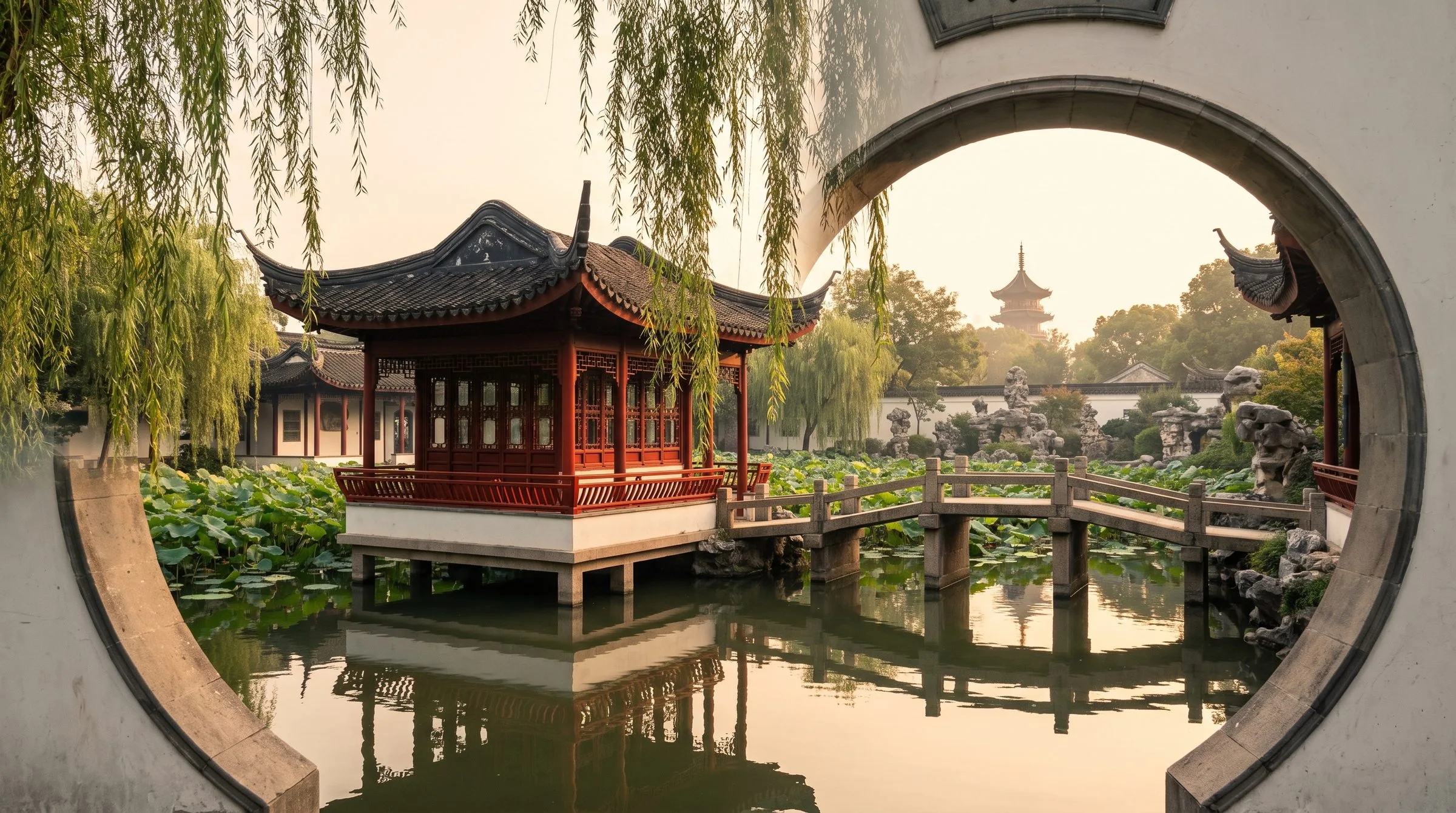
Suzhou China Travel Guide 2026: Classical Gardens, Canals, Day Trips from Shanghai
Suzhou travel guide for foreign visitors: 9 UNESCO classical gardens (Humble Administrator's Garden ¥70, Lion Grove ¥40), canal boat rides, silk museum, day trip from Shanghai (25 min HSR), Tongli and Zhouzhuang water town options.
Suzhou rewards slow time. The famous classical gardens can be ticked off in a Shanghai day trip, but to actually feel the city —the Ming dynasty canals, the silk heritage, the soft Kunqu opera drifting from teahouses, the modern skyline next to ancient waterways —you need 2 days. This plan is built around the 2-day shape, but it’s flexible: a 1-day version for Shanghai day-trippers and a 3-day version adding a second water town are at the end.
Suzhou has been continuously inhabited for 2,500 years (since 514 BC), was a capital of the ancient Wu kingdom, and is the southern terminus of the Grand Canal of China (the world’s longest canal at 1,776 km, Beijing-Hangzhou). The 9 UNESCO-listed classical gardens are Ming and Qing dynasty private estates of wealthy scholars, each one a masterclass in landscape design — borrowing scenery, framing views, and balancing water, rock, plant, and architecture into miniature ecosystems. The city is often called the Venice of the East, and with 35+ km of preserved Ming-Qing dynasty canals, the comparison is fair.
If you’re planning a Shanghai + Suzhou trip, this pairs naturally with our Shanghai Disney guide, 240-hour visa-free guide, Chinese cultural etiquette, China budget 2026, and Muslim travel halal guide if relevant.
Why Suzhou Is Different
Four things make Suzhou unlike anywhere else in China:
1. The classical gardens. Nine of them are UNESCO-listed (2000, extended 2018). Unlike Japanese garden design (minimal, suggestive) or British garden design (natural, English landscape style), Suzhou gardens are layered narrative landscapes: you walk a path that reveals and conceals views in turn, you lean on a balustrade and see a “framed painting” of a distant rock through a moon gate, you sit in a pavilion and hear water that you can’t see. Each garden is a 3D poem, designed to be read while walking.
The 9 UNESCO gardens are: Humble Administrator’s Garden, Lingering Garden, Master of Nets Garden, Mountain Villa with Embracing Beauty, the Garden of the Master of the Nets, the Couple’s Retreat Garden, the Garden of Cultivation, the Retreat Garden, and the I-Am-in-the-Reflections Garden. The first 4 are the most visited.
2. The Grand Canal terminus. Suzhou is the southern end of the Grand Canal of Beijing-Hangzhou, 1,776 km long, the world’s longest artificial waterway. It was built in sections starting 486 BC, completed 1327 (Yuan dynasty), used for shipping grain, silk, and porcelain for 600 years. UNESCO-listed 2014. The Grand Canal in Suzhou still has 35+ km of working waterway, mostly in the historic centre, with a few sections you can boat.
3. Silk heritage. Suzhou has been China’s silk capital for 1,000+ years. The Silk Museum has the world’s largest collection of silk artefacts from the Han to the Qing dynasties. The First Silk Factory (still operating) lets you watch silkworm-to-fabric in real time. The “Suzhou silk” label on a scarf or comforter is a real quality marker.
4. The Kunqu opera and Pingtan music. Suzhou is the birthplace of Kunqu (昆曲, one of the oldest Chinese opera forms, 600 years old, UNESCO-listed 2001 as part of the Masterpieces of the Oral and Intangible Heritage of Humanity). The “Pavilion of the Drunken Maiden” from Kunqu is a UNESCO-listed intangible cultural heritage piece. Pingtan (评弹, “ping + tan” = story + sing) is the Suzhou-born storytelling form, sung in soft Suzhou dialect with pipa and erhu accompaniment, traditionally performed in teahouses.
Together, these four layers make Suzhou a city where you can see, hear, taste, and walk the deeper past — not just photograph it.
Getting to Suzhou
From Shanghai (Most Common, Recommended)
Shanghai Hongqiao Railway Station → Suzhou Railway Station (or Suzhou North):
- Time: 25 minutes (Suzhou Station) to 35 minutes (Suzhou North)
- Price: ¥40-50 second class, ¥75-90 first class
- Frequency: every 5-10 min, 6 AM-10 PM
- Booking: Trip.com, 12306.cn (official Chinese rail, requires passport + verification), or station ticket machine. Book 1-2 days ahead for first class, walk-up is fine for second.
Shanghai Pudong Airport (PVG) → Suzhou: less convenient, requires 1 train + 1 metro, 1.5-2 hours. Hongqiao is much better.
Shanghai Hongqiao Airport (SHA) → Suzhou: 25-30 km, 30-40 min by taxi (¥150-200) or via metro + HSR.
Driving: 100 km, 1.5 hours via G2 Beijing-Shanghai Expressway or G42 Shanghai-Chengdu. Parking in Suzhou is ¥10-30 per day in tourist areas.
From Beijing
Beijing South → Suzhou North: HSR, 4.5 hours, ¥430 second class, 8-12 direct trains per day. Or fly to Shanghai Hongqiao then 25 min HSR.
From Hangzhou
Hangzhou East → Suzhou: HSR, 1.5 hours, ¥110 second class, every 30 min. Or via Shanghai.
From Nanjing
Nanjing South → Suzhou: HSR, 1 hour, ¥135 second class, every 15 min.
Within Suzhou
Suzhou Metro is clean, on-time, English everywhere. 4 lines + extension. Sufficient for the historic centre, Suzhou Industrial Park (east, near Jinji Lake), and the train stations.
- Line 1: north-south, connects Suzhou North Station to Guanqian Street and the historic centre.
- Line 2: east-west, connects Suzhou Railway Station to the Industrial Park.
- Line 3: north-west to south-east.
- Line 4: connects Suzhou Railway Station to the Industrial Park and Tongli direction (Tongli water town).
Single journey: ¥2-7. Day pass: ¥15. Octopus equivalent is the Suzhou Tong Card (苏州通卡) which works for metro, bus, taxi, and some stores. Buy at metro stations for ¥20 (¥18 stored value + ¥2 deposit). iPhone users: NFC pay also works on Suzhou Metro via UnionPay or Alipay.
DiDi (China’s Uber): works in Suzhou, English UI, very reliable. From Suzhou Railway Station to Humble Administrator’s Garden: ¥15-20, 10 min.
Buses: dense network, ¥2 flat fare, but slower than metro for tourists.
Taxis: ¥10 flag fall + ¥2.5 per km. Most drivers speak Mandarin (not Cantonese, since Suzhou is in the Wu dialect region). For non-Mandarin speakers, DiDi is easier.
Walking: The historic centre is highly walkable. The Pingjiang Road historic district is entirely pedestrian and most gardens cluster in a 2-km radius.
The 9 UNESCO Classical Gardens
The Classical Gardens of Suzhou were added to the UNESCO World Heritage List in 2000 and extended in 2018 to include 4 more. All 9 are private Ming and Qing dynasty estates, each one a complete work of art.
| Garden | Name (Chinese) | Year | Size | Ticket | Time | Vibe |
|---|---|---|---|---|---|---|
| Humble Administrator’s | 拙政园 | 1513 (Ming) | 5.2 ha | ¥70 | 3 h | The most famous, most crowded, most representative |
| Lingering | 留园 | 1593 (Ming) | 2.3 ha | ¥55 | 2 h | The rockery and corridor |
| Master of Nets | 网师园 | 1140 (Song, rebuilt 1780) | 0.5 ha | ¥30-¥100 | 1.5 h | The smallest, the most intimate, evening Pingtan |
| Mountain Villa with Embracing Beauty | 环秀山庄 | 1587 (Ming) | 0.2 ha | ¥20 | 1 h | The cliff-and-cave rockery |
| Garden of the Master of the Nets | 网师园 (same as Master of Nets) | 1140 | 0.5 ha | ¥30-¥100 | 1.5 h | — |
| Couple’s Retreat Garden | 耦园 | 1874 (Qing) | 0.8 ha | ¥25 | 1.5 h | The romantic one, on a canal |
| Garden of Cultivation | 艺圃 | 1541 (Ming) | 0.3 ha | ¥20 | 1 h | The local one, no tourists |
| Retreat and Reflection Garden | 退思园 | 1885-1887 (Qing) | 0.6 ha | ¥50 | 1.5 h | In Tongli water town |
| I-Am-in-the-Reflections Garden | 怡园 | 1874 (Qing) | 0.6 ha | ¥15 | 1 h | Built later, eclectic style |
You can visit all 9 in 3-4 days if you’re a garden obsessive. Most visitors see 2-3 in a 2-day trip.
Day 1: Historic Centre — Gardens, Museum, Pingjiang Road, Pingtan
Theme: The best of Suzhou in 1 day. Total walking: 8-10 km, mostly flat.
Morning: Humble Administrator’s Garden + Lion Grove (8 AM — 12:30 PM)
Start at Humble Administrator’s Garden (拙政园), 178 Dongbei Street. Arrive 7:30-8 AM at opening. The crowds thin after 4 PM, but the morning is when the light is best and the gardeners are working.
- Ticket: ¥70. Pre-book on Trip.com to skip the line.
- Duration: 3 hours, including the central garden’s lotus pond, the eastern orchid-and-bamboo grove, and the western rockery pavilions.
- What to see: The 28m-wide central pool with the “Hall of the Distant View” (远香堂) is the iconic shot. The “Frost-Free Pavilion” (梧竹幽居) is the smallest but most photographed. The “Listening to Rain” pavilion (听雨轩) is where the rain hitting the banana leaves becomes music.
- History: Built 1513 by a scholar who failed the imperial exam and retired to Suzhou. Owned by 20+ families over 500 years, expanded in waves, restored to Ming and Qing designs.
Walk 5 minutes east to Lion Grove Garden (狮子林), 23 Yuanlin Road.
- Ticket: ¥40. Combined ticket with Humble Administrator’s Garden sometimes available.
- Duration: 1 hour.
- What to see: The rockery maze is the highlight — 500+ lion-shaped limestone rocks stacked into 9 artificial peaks with tunnels, caves, and bridges. The Chinese saying “山穷水复疑无路,柳暗花明又一村” (mountain exhausted, water end, looks like no way through; willows dark, flowers bright, another village) was written about this exact feeling.
- Bonus: The garden is wheelchair-accessible (rare for a classical Chinese garden).
Late Morning: Suzhou Museum (10:30 AM — 12:30 PM)
Walk 5 minutes back to Suzhou Museum, 204 Dongbei Street (next to the Humble Administrator’s Garden).
- Ticket: Free, but reserve on the museum’s WeChat mini-program or Trip.com.
- Duration: 2 hours.
- Why it’s special: Designed by I.M. Pei (贝聿铭, 1917-2019), the Chinese-American architect who also did the Louvre Pyramid, the Bank of China Tower in Hong Kong, and the Rock and Roll Hall of Fame. Suzhou Museum was his last major work, opened 2006, when he was 89. He called it “a small thank-you to my hometown” (his family was a Suzhou gentry clan).
- Architecture: White-washed walls, grey-tiled roofs, modern concrete beams — the building itself is the exhibit. The “water feature” out back is the entire southern wall made of cut stone reflecting in a rectangular pool, with a single tree as the focal point. Pei’s design philosophy: “Less is more.”
- Collection: 15,000+ items, mostly from Suzhou’s history — Ming and Qing furniture, calligraphy, ancient jade, ceremonial objects. The 3-story central atrium is a single light shaft with bamboo and water.
Lunch: Deyueju on Guanqian Street (12:30 PM — 1:30 PM)
Walk 10 minutes west to Guanqian Street (观前街), Suzhou’s main historic commercial street, 1,500 years of continuous commerce.
Lunch recommendation: Deyueju (得月楼), 43 Taijian Lane, off Guanqian Street. Founded 1541 (Ming dynasty), the most famous Suzhou restaurant, the setting for the Su opera classic “The Reincarnation of the Red Chamber” (the dream banquet scene). Try:
- Songshu Mandarin Fish (松鼠桂鱼): the signature, deep-fried sweet-and-sour Mandarin fish scored to look like a pine cone. ¥80-120.
- Dongpo Pork (东坡肉): braised pork belly, Hangzhou/Suzhou style. ¥60-80.
- Biluochun tea (碧螺春): from nearby Dongting Mountain, China’s top 10 teas, brewed in glass to show the spiral leaves. ¥40-60 per pot.
- Braised bamboo shoots with salted pork (腌笃鲜): spring only.
¥150-250 per person. Book ahead on weekends.
Afternoon: Pingjiang Road + Suzhou Silk Museum (2 PM — 5:30 PM)
Walk 10 minutes to Pingjiang Road (平江路), 1.6 km of restored Ming-Qing dynasty streetscape along a 800-year-old canal. The street is pedestrian-only, lined with teahouses, craft shops (Suzhou embroidery, silk scarves, sandalwood fans), and small museums.
- Best stops:
- Suzhou Couple’s Retreat Garden (耦园): 20 min walk east, ¥25, the romantic canal-side garden.
- Suzhou Pingtan Museum (中国苏州评弹博物馆): free, 1 hour, the city’s small but well-curated museum of Pingtan opera.
- Kunqu Opera Museum (中国昆曲博物馆): free, 1 hour, the small museum dedicated to Kunqu, opposite the Pingtan Museum.
- Couple’s Retreat Garden (耦园): 25 min walk east, ¥25, on a small canal, the most romantic of the small gardens.
- Boat ride: Hand-poled boats run from several points along the canal, ¥150 per boat (1-6 people, 30 min), great for photographing the bridges and houseboats.
Optional: Suzhou Silk Museum (苏州丝绸博物馆), 2001 Renmin Road, free, 1.5 hours. The world’s largest collection of silk artefacts from Neolithic to modern. The live silkworm display (spring only, March-May) and the working looms are the highlights.
Late Afternoon: Master of the Nets Garden Evening (7:30 PM — 9:30 PM)
Master of the Nets Garden (网师园), 11 Kuojiatou Lane, off Caihou Street.
- Daytime ticket: ¥30, 7:30 AM-5 PM.
- Evening ticket: ¥100, 7:30 PM-9:30 PM, INCLUDES a Pingtan performance in one of the garden’s pavilions.
- Why evening: The garden is the smallest UNESCO Suzhou garden (0.5 ha) but the most atmospheric. The Pingtan performers sit in a moonlit pavilion, singing and playing the pipa and erhu — the music drifts over the central pond. The garden is capped at 50-80 visitors per evening, so it’s not crowded. Reserve on Trip.com (limited).
- Photography: Tripods are restricted; flash discouraged. The garden is dimly lit by lanterns and the moon.
Alternative to Master of the Nets evening: If the Pingtan doesn’t appeal or is sold out, do the Guanqian Street night market (free, 6 PM-10 PM) for street food and souvenirs. Or take a Grand Canal boat ride (¥120 per person, 40 min, 7 PM-9 PM, from the canal dock near Xuanmen Bridge).
Day 2: Tongli Water Town Day Trip
Theme: A 1,000-year-old water town, 30 km from Suzhou. Total walking: 6-8 km, mostly flat.
Morning: Travel to Tongli + Tuisi Garden (9 AM — 12 PM)
From Suzhou Railway Station, take bus 4, 39, or 301 to Tongli (同里), 1 hour, ¥8. First bus 6:30 AM, last return bus 6:30 PM (later ones exist but become sparse).
Or take the Tongli Special Line from Suzhou South Bus Station (¥10, 1 hour).
Or take a DiDi: 40-50 min, ¥100-150. The fastest if you’re a group of 3-4.
Tongli (同里): One of the six ancient water towns south of the Yangtze River (江南六大古镇, sometimes called the “Six Water Towns of Jiangnan”). The six are: Tongli, Zhouzhuang, Luzhi, Xitang, Wuzhen, Nanxun. Tongli is the most accessible from Suzhou and the most architecturally authentic.
- Combined ticket: ¥100, includes 8-9 historic sites within the town. The 24-hour ticket is good for 2 entries.
- Tuisi Garden (退思园): UNESCO-listed 2000, the most important site in Tongli. Built 1885-1887 by a Qing dynasty official who “retired in disgrace” (退思 = “retreat and reflect”). The garden is laid out in 3 sections (residential, central, garden) with the central pool and the “Pavilion of Fragrant Snow and Moon” as the highlight. 1.5-2 hours. ¥50 alone, included in combined ticket.
- Three Bridges (三桥): 3 ancient stone bridges within 50m of each other — Tai’an, Changqing, Jiji. The saying is that walking all three in one go brings good luck. Local weddings traditionally pass all three.
- Luang Sheng Mansion (柳亚子故居): the former home of Luang Sheng, a 20th-century revolutionary poet, now a small museum. Free with combined ticket.
- Pearl Pagoda (珍珠塔): a 70m-tall pagoda on the south end of town, climb for the view (¥20 alone, included in combined).
Lunch in Tongli (12:30 PM — 1:30 PM)
Lunch recommendation:
- Mafu noodles (马夫面): a Tongli specialty, wheat noodles with a rich pork and vegetable broth, the name means “cart-driver’s noodles” because cart drivers used to eat them on the road. ¥30-50 per bowl.
- Braised pork knuckle (扎肉): a Tongli specialty, slow-braised with soy and sugar, falls off the bone. ¥30-50 per serving.
- Lake crabs (大闸蟹): in season October-December, from nearby Yangcheng Lake, ¥80-150 each (carnival, not a meal).
¥80-150 per person at any of the canal-side restaurants on Mingqing Street (明清街), the main pedestrian strip.
Afternoon: Canal Boat Ride + Sihai Spring (2 PM — 5 PM)
Canal boat ride: ¥150 per boat, 30 min, 1-6 people. Boats depart from the Zhongshi Bridge (中石桥) dock, every 15-20 min. The boat is hand-poled (no motor), so it’s quiet and the gondolier (usually a local in a straw hat) will sometimes sing. The boat weaves through the central Tongli canal, under 15+ ancient bridges, past old houseboats and water-side homes. Highly recommended.
Sihai Spring (四面环水): After the boat ride, walk to the south end of Tongli where the canals branch into a cross pattern — the Sihai Spring pavilion is the icon of Tongli, sitting in the middle of the cross of canals. Free.
Optional: Lu Xun ancestor’s home (鲁迅祖居): Tongli was the hometown of the Lu clan (Lu Xun’s family). The ancestral home is a small museum, ¥10. For literature fans only.
Late Afternoon: Return to Suzhou or Continue to Zhouzhuang (5 PM — 6:30 PM)
Take the return bus to Suzhou Railway Station (1 hour, ¥8). Total Tongli day: 8-9 hours including travel.
Alternative: Day 2 as Tongli + Zhouzhuang double day:
- Tongli in the morning, lunch in Tongli, then bus from Tongli to Zhouzhuang (30 min, ¥15), spend the afternoon in Zhouzhuang, return to Suzhou from Zhouzhuang in the evening.
- Zhouzhuang is more touristy and more commercial than Tongli (it’s the most famous of the six water towns and was one of the first to be developed). Tickets: ¥130 combined. Boat ride: ¥150 per boat. The Double Bridge (双桥) is the iconic shot.
- The combined day is doable but rushed (10-11 hours including travel).
Where to Stay in Suzhou
| Neighborhood | Vibe | Hotel Range | Best For |
|---|---|---|---|
| Guanqian Street / Pingjiang Road | Historic centre, walking distance to gardens, cobblestone streets | ¥150-2,000/night | First-timers, garden-focused visitors |
| Suzhou Industrial Park (Jinji Lake area) | Modern, skyline, malls, Ferris wheel | ¥200-3,000/night | Modern Suzhou, business travellers, families with cars |
| Lion Hill / Shantang Street | Old town south, Shantang Street pedestrian, near Tiger Hill | ¥150-1,500/night | Budget-conscious, evening atmosphere |
| Suzhou Railway Station area | Convenient for transit, less charming | ¥120-500/night | Short stays, transit-only |
Recommended mid-range hotels:
- Hotel Indigo Suzhou Grand Canal (洲际英迪格酒店): Industrial Park, 5-star, ¥600-900/night, modern with Suzhou design touches.
- Pan Pacific Suzhou (苏州泛太平洋酒店): Industrial Park, 5-star, ¥700-1,200/night, lake views.
- Crowne Plaza Suzhou (苏州皇冠假日酒店): Industrial Park, 4-star, ¥400-700/night, near Jinji Lake.
- Scholar’s Garden Hotel (书香世家·平江府): Pingjiang Road, 4-star, ¥400-700/night, in a restored Ming courtyard.
- Tonino Lamborghini Hotel Suzhou (托尼洛·兰博基尼书苑酒店): Guanqian Street, 5-star, ¥800-1,500/night, contemporary luxury.
Booking platforms: Trip.com, Booking.com, Agoda, Fliggy (Alibaba’s travel platform). For Tongli, the Tongli Lake View Hotel (同里湖大饭店) is the 5-star right next to the entrance, ¥600-900/night.
What to Eat in Suzhou
Suzhou cuisine (苏菜, also called Suxiu) is one of China’s 8 great culinary traditions. It emphasizes fresh ingredients, light seasoning, and the “sweet aftertaste” (甜中带鲜) that distinguishes it from Shanghai, Hangzhou, and Nanjing cuisines.
Must-try dishes:
- Songshu Mandarin Fish (松鼠桂鱼): deep-fried, scored, sweet-and-sour, the visual signature. The fish is meant to look like a pine cone, and the sauce is meant to sound like a squirrel’s tail thumping when poured.
- Biluochun green tea (碧螺春): from Dongting Mountain near Suzhou, China’s top 10 teas, harvested March-May only.
- Yangcheng Lake hairy crab (阳澄湖大闸蟹): in season October-December, ¥80-150 each, the most famous Chinese crab.
- Suzhou noodles (阳春面): plain wheat noodles in a simple broth, the “yangchun” (early spring) name comes from the cheap price — 2 fen in the 1950s.
- Boat noodles (船面): boat-shaped pastries filled with sweet bean paste, ¥5-10 each.
- Yaba Shengjian (哑巴生煎): 1932, the city’s most famous pan-fried soup dumplings, ¥20 for 4. Branches on Guanqian Street.
- Tongli Mafu noodles (马夫面): see Day 2 above.
- Osmanthus cake (桂花糕): the city’s signature sweet, soft glutinous rice cake with osmanthus flowers.
- Qingtuanzi (青团子): green rice balls with sweet bean paste, only available spring (Qingming festival season).
Where to eat:
- Deyueju (得月楼): the Songshu Mandarin Fish institution, 1541, see Day 1 lunch above.
- Songhelou (松鹤楼): 1737, the other Suzhou institution, on Guanqian Street, ¥100-200 per person.
- Cai’s Mansion (蔡记): small local chain, good Yangcheng crabs in season, ¥150-300 per person.
- Pin Zhen Guan (品真观): local snacks, ¥30-60 per person, multiple branches.
- Yaba Shengjian (哑巴生煎): see above, must-visit.
- Sipinju (苏品记): modern Suxiu, Pingjiang Road, ¥100-200 per person.
Practical Suzhou Tips
Visa
- 240-hour visa-free transit for 57 countries (US, UK, Canada, AU, NZ, EU, JP, KR, SG, etc.) if transiting through Shanghai, Beijing, or other approved cities. See our 240-hour guide for the eligible list.
- L-visa (tourist visa): for everyone else, apply 1-2 months ahead.
- Hong Kong / Macau: separate from mainland China, so a HK visa does not let you enter mainland China. Most Westerners enter the mainland from HK on a transit visa.
Money
- Currency: Chinese Yuan (CNY, ¥). 1 USD ≈ ¥7.1 (2026). 1 EUR ≈ ¥7.7.
- ATMs: everywhere, Bank of China (BOC), ICBC, ABC dispense CNY. Most have a ¥20-30 fee for foreign cards. Wise and Revolut cards usually fee-free.
- Credit cards: Visa, Mastercard, UnionPay at hotels and large restaurants. Alipay and WeChat Pay at most stores and restaurants, but cash (¥) for small vendors.
- Tipping: Not customary in China. 10% sometimes added at upscale restaurants.
Language
- Mandarin is the official language. Suzhou has its own dialect (苏州话, Suzhounese, a Wu dialect like Shanghainese), unintelligible to Mandarin speakers, used by older residents. Most young people speak Mandarin.
- English in tourist areas (gardens, museums, restaurants with English menus, hotels). Less in old neighborhoods.
- Useful phrases: 你好 (nǐhǎo, hello), 谢谢 (xièxie, thank you), 多少钱 (duōshǎo qián, how much), 卫生间在哪里 (wèishēngjiān zài nǎlǐ, where is the bathroom).
When to Visit
- Best months: March-May (spring, 12-22°C, gardens in bloom, Biluochun tea harvest) and September-November (autumn, 15-25°C, clear skies, Yangcheng crab season, Mid-Autumn Festival).
- Summer (Jun-Aug): hot (30-35°C), humid, lotus bloom in the Humble Administrator’s Garden (mid-June to mid-August is the peak). Book hotels 1-2 months ahead.
- Winter (Dec-Feb): cold (0-8°C), grey, but the gardens are quieter and the off-season rates are 30-50% lower.
- Avoid: Golden Week (early October, Chinese National Day) and Chinese New Year (late January / early February) — hotels are 2-3x normal price and crowded.
Safety
Suzhou is one of the safest cities in China for tourists. Violent crime against visitors is essentially zero.
- Watch for pickpockets in crowded garden areas and on busy metro lines.
- Watch for traffic — Chinese drivers are aggressive, especially the e-scooters (they often run red lights).
Day Trip from Shanghai (1-Day Version)
If you only have 1 day from Shanghai:
- 7 AM: HSR Shanghai Hongqiao → Suzhou (25 min, ¥40-50)
- 8:30 AM: Metro to Humble Administrator’s Garden, arrive 8:45 AM at opening
- 9 AM — 12 PM: Humble Administrator’s Garden + Lion Grove Garden
- 12 PM — 1 PM: Lunch at Deyueju or Songhelou on Guanqian Street
- 1:30 PM — 3 PM: Suzhou Museum (skip the line by reserving on Trip.com)
- 3 PM — 4:30 PM: Pingjiang Road walk + optional 30-min canal boat ride
- 4:30 PM — 5 PM: Optional visit to Suzhou Silk Museum (15 min from Pingjiang Road)
- 5:30 PM — 6 PM: Walk back to Suzhou Railway Station or take DiDi (¥15)
- 6 PM — 6:30 PM: HSR back to Shanghai
- Total: ~12 hours, very doable but tiring.
Combining Suzhou with Other Cities
- Shanghai + Suzhou: 4-5 days. 2-3 days Shanghai, 2 days Suzhou. Easy 25 min HSR between.
- Suzhou + Hangzhou: 4 days. 2 days each. The two cities are 1.5 hr HSR apart (¥110 second class).
- Suzhou + Nanjing: 4 days. 1 hr HSR. Often combined with a 2-3 day Nanjing trip.
- Shanghai + Suzhou + Tongli + Zhouzhuang: 4-5 days. Suzhou 2 days + Tongli 1 day + Zhouzhuang 1 day.
- Beijing + Shanghai + Suzhou + Hangzhou: 10-14 days. The classic China grand tour.
See our Shanghai Disney guide, 240-hour visa-free guide, and China cultural etiquette guide for more.
Sample 2-Day Schedule (One Glance)
| Day | Focus | Key Sites | Cost Estimate |
|---|---|---|---|
| 1 | Historic Centre | Humble Administrator’s, Lion Grove, Suzhou Museum, Pingjiang Road, Master of the Nets evening | ¥300-700 |
| 2 | Tongli Water Town | Tuisi Garden, Three Bridges, canal boat, Luang Sheng Mansion, Pearl Pagoda | ¥300-600 |
2-day total:
- Budget: ¥1,200-2,400 (US$170-340) —hostel or budget hotel ¥150-250/night, street food, free gardens, ¥10-20 per transit.
- Mid-range: ¥2,400-5,000 (US$340-700) —3-4 star hotel ¥400-700/night, mix of restaurants, all main gardens, Tongli day trip.
- Upscale: ¥8,000+ (US$1,130+) —5-star hotel, fine dining, private boat rides, guided tours.
Add ¥200-400 for round-trip HSR from Shanghai, ¥150-300 for a canal boat ride in Suzhou, and ¥150 per boat for Tongli boat.
How to Make the Most of Each Day
- Start at 8 AM for the gardens — they open 7:30-8 AM, and the morning is when the gardens are quietest, the light is best, and the gardeners are working.
- Pre-book tickets for Humble Administrator’s Garden and Master of the Nets evening on Trip.com (skip the line, limited evening visitors).
- Carry small ¥ notes and coins — most vendors, taxis, and small shops don’t take credit cards.
- Pack light — Suzhou historic centre is cobblestone in places, no cars, easy to walk.
- Download offline maps — Suzhou is on the Great Firewall, so Google Maps doesn’t work without VPN. Use Amap or Apple Maps (which uses Amap data in China).
- Install Alipay and link a Visa/Mastercard if you don’t have a Chinese bank account — see our Alipay guide for setup.
- Tip in cash at upscale restaurants (10% if not auto-added).
- Save room for Yaba Shengjian and the Biluochun tea — these are the two “only in Suzhou” experiences.
Suzhou in 2 days is enough to see the gardens, walk the canals, taste the cuisine, and take a water town day trip. By the end you’ll understand why the city has been inspiring Chinese poets and painters for 1,000 years.
Step by step
-
Plan your Suzhou route, confirm visa, and pre-book HSR from Shanghai
Plan 2 days in Suzhou (Day 1: historic centre gardens + Pingjiang Road + Suzhou Museum; Day 2: Tongli water town OR Zhouzhuang). Confirm visa: 57 countries qualify for 240-hour visa-free transit; others need an L-visa. Pre-book HSR Shanghai Hongqiao → Suzhou on Trip.com or 12306 (¥40-50 second class, 25 min, every 5-10 min). Pre-book Humble Administrator's Garden tickets on Trip.com to skip the line (¥70 vs ¥70 walk-up, but skips the cash queue).
-
Take HSR from Shanghai Hongqiao to Suzhou, transfer to metro to the historic centre
Shanghai Hongqiao Station is the closest to Suzhou (Suzhou Station and Suzhou North are also served but Hongqiao-Suzhou is fastest). 25 min HSR, ¥40-50 second class, ¥75-90 first class. Trains every 5-10 min, 6 AM-10 PM. From Suzhou Railway Station, Metro Line 4 to Beisita Pagoda Station (¥3, 15 min), then 5 min walk to the Humble Administrator's Garden. DiDi is widely available in Suzhou if metro is too crowded.
-
Day 1 morning: Humble Administrator's Garden + Lion Grove Garden (8:30 AM — 12:30 PM)
Humble Administrator's Garden (拙政园, 178 Dongbei Street): arrive 8 AM (opens 7:30 AM in summer, 7:45 in winter), ¥70, 3 hours. The largest classical garden in Suzhou, 5.2 hectares, 700 years of layered history, UNESCO-listed. Walk in order: Eastern Garden (orchids + bamboo), Central Garden (the lotus pond and main hall), Western Garden (pavilions + rockeries). After 11 AM, walk 5 min east to Lion Grove Garden (狮子林, ¥40, 1 hour): the rockery maze is the highlight, kids love it, 500+ lion-shaped rocks.
-
Day 1 afternoon: Suzhou Museum + Pingjiang Road + Pingtan tea (1:30 PM — 6 PM)
Suzhou Museum (204 Dongbei Street, free, I.M. Pei design 2006, 2 hours): combine with the Humble Administrator's Garden visit. The building itself is the highlight — Pei's last work, a meditation on white, grey, and water. Then walk 10 min to Pingjiang Road (平江路), a 1.6-km canal-side street with teahouses, craft shops, and Kunqu opera. Lunch: Songshu Mandarin Fish at Deyueju (得月楼) on Guanqian Street. Optional: Suzhou Silk Museum (free, 2001 Renmin Road, 1.5 hours) for the world's largest silk collection.
-
Day 1 evening: Master of Nets Garden evening ticket + Pingtan performance (7 PM — 9 PM)
Master of Nets Garden (网师园, ¥100 evening ticket, 11 Kuojiatou Lane): the only Suzhou garden offering evening visits (7:30 PM-9:30 PM). The evening ticket includes a Pingtan performance (Suzhou-style storytelling with pipa and erhu) in the garden's pavilions —magical in low light. Allow 1.5-2 hours. Reserve on Trip.com (limited to 50 visitors per evening). Alternative: the Guanqian Street night market (free, 6 PM-10 PM) for street food and souvenirs.
-
Day 2: Tongli water town day trip (9 AM — 5 PM)
From Suzhou Railway Station, take bus 4, 39, or 301 to Tongli (1 hour, ¥8). Or taxi (¥100-150, 40 min). Tongli water town (同里, ¥100 combined ticket) is one of the six ancient water towns south of the Yangtze, 1,000+ years old, with 15 km of canals. Highlights: Tuisi Garden (UNESCO, ¥45, 1 hour), the Three Bridges (walk the three-arched bridge layout), boat ride (¥150 per boat, 30 min, 6 people max), Luang Sheng Mansion and Pearl Pagoda. Lunch: local specialty, the 'Mafu noodles' (马夫面). Return to Suzhou by 6 PM.
FAQ
-
Is Suzhou worth visiting as a day trip from Shanghai?
Yes, Suzhou is one of the easiest and most rewarding day trips from Shanghai —just 25 minutes by HSR. A one-day plan covers 2-3 gardens (Humble Administrator's Garden + Lion Grove or Lingering Garden), Pingjiang Road, the Suzhou Museum, and the Silk Museum. But 2 days is better because Tongli water town deserves a full day and the gardens reward slower time. Combine with a 2-3 day Shanghai trip for a 4-5 day Yangtze Delta itinerary. -
Which Suzhou garden is the best for first-time visitors?
The Humble Administrator's Garden (拙政园) is the largest, most famous, and most representative — 5.2 hectares, UNESCO-listed, the only Suzhou garden to be added to the tentative list of China's top national gardens. It's also the most crowded, so arrive 8 AM at opening. For a quieter alternative, the Master of Nets Garden (网师园) is smaller but more intimate, and its evening tickets (¥100 including a Pingtan performance) are the most atmospheric way to experience a classical garden. -
Do I need a Chinese visa for Suzhou?
About 57 countries qualify for the 240-hour visa-free transit (10 days) if you're transiting through Shanghai or another major city. Most other nationalities need an L-visa (tourist visa). Apply 1-2 months ahead through a Chinese consulate. Note that Hong Kong and Macau are separate immigration zones, so a Hong Kong visa does not let you enter mainland China. See our 240-hour visa-free guide for the eligible countries list. -
How much does a Suzhou trip cost per day?
Budget: US$50-80 per day (hostel or budget hotel ¥150-250/night, street food, free gardens, ¥10 public transport). Mid-range: US$80-150 per day (3-4 star hotel ¥400-700/night, mix of restaurants, all main gardens, Tongli day trip). Upscale: US$200+ per day (5-star hotel, fine dining, private boat rides, curated tours). HSR from Shanghai adds ¥40-50 one-way, ¥80-100 round trip. -
Is Suzhou a good destination for kids and families?
Yes, very family-friendly. The gardens have koi ponds, pavilions, and walkways that work for all ages. Tongli water town has boat rides kids love. The Suzhou Silk Museum has live silkworm displays. Lingering Garden has wheelchair-accessible paths. The only caveat: 3+ hours walking a day is required, so for very young kids (under 5) consider a half-day plan and skip the third garden. Suzhou is much more relaxed than Shanghai for families with strollers.
Related guides
- Culture & Practical
Solo Female Travel in China 2026: The Honest Safety Guide Foreigners Don't Get
China is statistically one of the safer large countries for solo female travelers, but the safety profile is different from Western countries. What works in Tokyo or Paris may not work in Beijing. The 2026 honest guide: 8 specific safety scenarios (DiDi at night, hostel vs hotel, walking alone, foreigner-targeted scams, hostel harassment, menstruation access, dating safety, embassy backup), ranked by frequency and risk. Includes the 5 phrases every solo female traveler should learn, and the 2 scenarios where you should NOT go alone.
5min read
- Culture & Practical
Is It Safe to Travel to China in 2026? The Complete Foreigner's Safety Guide
Comprehensive 2026 safety guide for China travel: crime statistics, region-specific risks, scams targeting foreigners, US State Department advisory, LGBTQ+ safety, female solo travel, health and medical care, embassy registration, and 5-step arrival safety checklist. Plus: is it safe to travel to China right now in 2026 (yes, with normal precautions).
12min read
- Culture & Practical
Chinamaxxing 2026: 12 Chinese Lifestyle Experiences Every Foreigner Should Try
Chinamaxxing is the 2026 trend of foreign visitors going deep into Chinese daily life — hot water, ba duan jin qigong, hanfu, mahjong, tea ceremony, foot baths, and more. 12 hands-on experiences with where to try each one, what to expect, and how to book.
9min read
- Culture & Practical
Nanjing China Travel Guide 2026: Six Dynasties Capital, Massacre Memorial, Purple Mountain
Nanjing travel guide for foreign visitors: 2,600-year history, Six Dynasties and Ming capital, Sun Yat-sen Mausoleum, Nanjing Massacre Memorial Hall (free, deeply moving), Confucius Temple, Ming city wall, and how Nanjing compares to Beijing's Forbidden City.
- Culture & Practical
LGBTQ+ Travel in China 2026: Safety, Apps, Cities & Practical Guide
Practical LGBTQ+ travel guide for China in 2026 — legal status (homosexuality is legal, no same-sex marriage), social attitudes by city, dating apps (Blued, Tantan, Aloha), the 3 most LGBTQ+-friendly cities (Shanghai, Beijing, Chengdu), nightlife, healthcare, family considerations, and 5 ready-made LGBTQ+-friendly city profiles. Updated 2026-08-21 with current legal status and city-by-city social attitudes.
- Culture & Practical
Beijing Hutongs: A Complete Guide to the City's Ancient Alleyways (History, Map, How to Visit)
Complete guide to Beijing's hutongs: the 700-year history from Yuan dynasty to today, why hutongs are disappearing, the 6 best hutong areas to visit as a foreigner, how to navigate them on foot or by rickshaw, the etiquette rules, and how to experience the real local hutong life (not the tourist-trap version).
8min read