
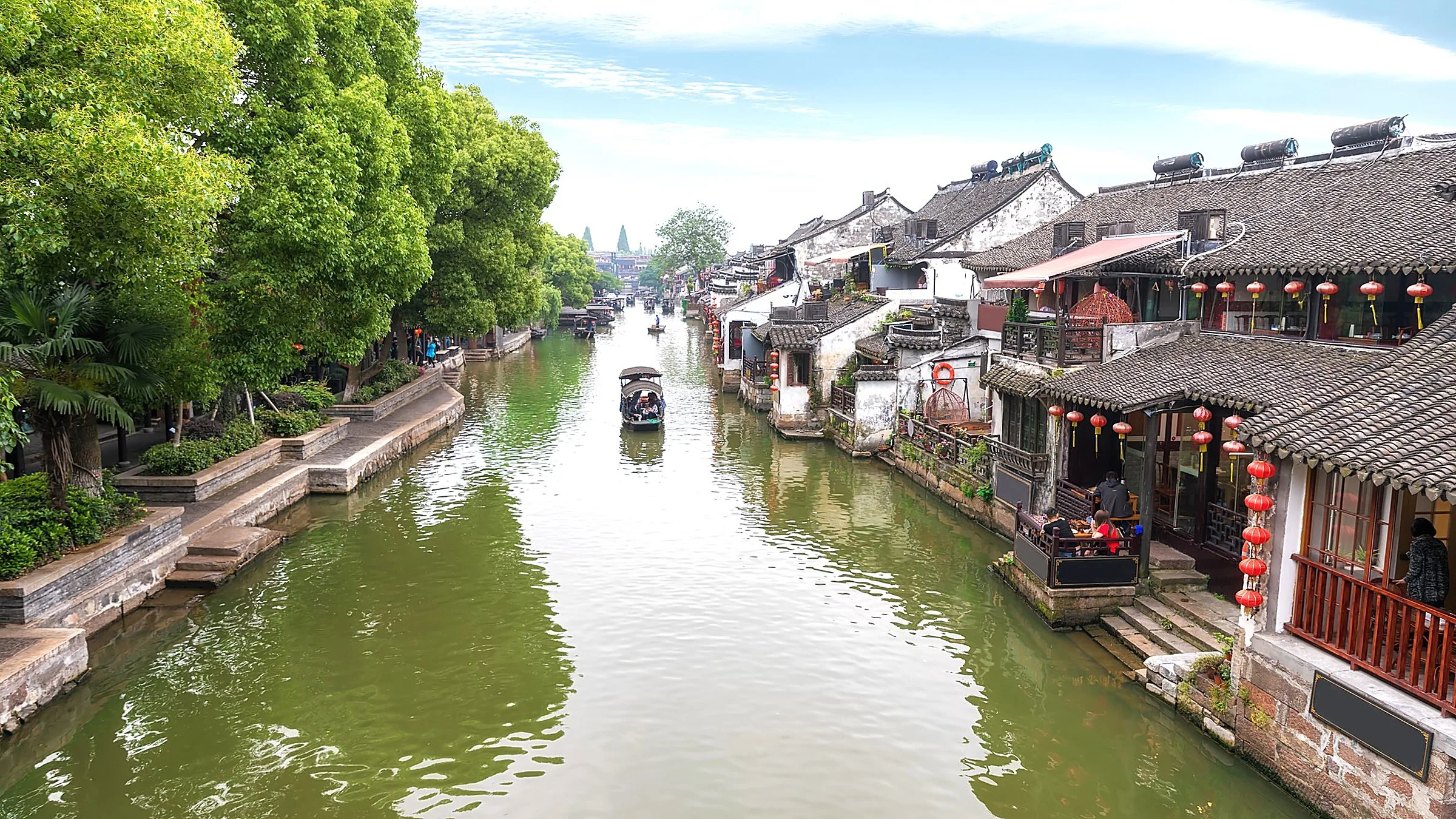
Pingjiang Road
平江路 · Píngjiāng Lù
Quick answer
No entry restrictions — Pingjiang Road is a public street. The individual museums (Pingjiang History Museum, Kunqu Opera Museum) require passport for entry. The boat ride companies accept cash, Alipay, or WeChat Pay; some accept Trip.com booking.
Why visit
- 1 A 1.6-km canal-side street in Suzhou's old town, with 168 stone bridges crossing the Pingjiang Canal. The best-preserved section of the 1,000-year-old Suzhou canal grid, the UNESCO-listed 'Grand Canal' system.
- 2 The 1,600-year-old canal (built 514 AD by the King of Wu) — the same waterway that made Suzhou the 'Venice of the East.' Walk the stone bridges, watch the small boats pass under, and listen to the rowers' songs.
- 3 30+ teahouses, bookshops, and Suzhou-style snack stalls along the street. Try the osmanthus-flavored sweet soup (桂花糖芋苗), the Suzhou-style mooncakes (苏式月饼), and the sugar-roasted chestnuts (糖炒栗子).
- 4 The Pingjiang History Museum (平江历史馆) — a small free museum at the southern end of the street, showing the history of the canal grid and the old town. 30-min visit.
- 5 The Kunqu Opera Museum (昆曲博物馆) — a small free museum showing the 600-year-old Kunqu opera tradition. Kunqu is the ancestor of all Chinese opera forms and UNESCO-listed as Intangible Cultural Heritage.
Essential tips for foreigners
- Walk from north to south — the northern end (Beisita Pagoda metro) is the most authentic, with the 1,600-year-old canal, the 168 stone bridges, and the small Suzhou-style houses. The southern end is more touristic, with the main museums and the boat ride pier.
- Try the osmanthus-flavored sweet soup (桂花糖芋苗) — the signature Suzhou street food. The osmanthus (桂花) fragrance is the scent of Suzhou in autumn. Sold at multiple stalls along the street for ¥15-25.
- Take a boat ride — the 30-45 min boat ride on the Pingjiang Canal is the best way to see the old town from the water. ¥80-150/boat, fits 4-6 people. The boatman sings traditional Suzhou songs (¥20 tip expected).
- Visit in the evening (after 19:00) — the lanterns light up, the teahouses fill with locals, and the night scene is the most atmospheric. The street is busiest 19:00-22:00 but the energy is worth it.
- Combine with the Humble Administrator's Garden (5 min walk west) — the garden is the historical anchor, the street is the cultural experience. The 2-hour garden visit + 2-hour street walk + Suzhou-style meal is the most complete Suzhou day.
Suggested route
- 14:00 20 min Arrive at Beisita Pagoda Metro Station, Exit 3. Walk 8 min north to the northern end of Pingjiang Road. The 1,600-year-old canal and the 168 stone bridges are the focus.
- 14:20 1 hour Start at the **northern end** of Pingjiang Road. Walk south along the canal-side street. The whitewashed Suzhou-style houses, the small bridges, and the willow trees are the highlights. Allow 1 hour for the northern half.
- 15:20 1 hour Mid-street: stop for **osmanthus-flavored sweet soup** (桂花糖芋苗, ¥15-25) and a Suzhou-style mooncake (苏式月饼, ¥10) at one of the canal-side teahouses. The 1-hour teahouse rest is the most-Suzhou experience.
- 16:20 30 min Continue south. Stop at the **Kunqu Opera Museum** (昆曲博物馆) — small free museum showing the 600-year-old Kunqu opera tradition. Allow 30 min.
- 16:50 Optional 30-45 min Reach the **southern end** of Pingjiang Road. Optional: take a **boat ride** on the Pingjiang Canal (¥80-150/boat, 30-45 min) to the Humble Administrator's Garden. The boat ride departs from this pier.
- 17:35 30 min Visit the **Pingjiang History Museum** (平江历史馆) — small free museum at the southern end. Allow 30 min.
- 18:05 1.5 hours Dinner at one of the **canal-side restaurants** — Song He Lou (松鹤楼, 1757, the most famous Suzhou restaurant, ¥100-200/person) or De Yue Lou (得月楼, 1564, the most famous Suzhou banquet restaurant, ¥150-300/person). Or try the street food at the night market stalls (¥30-80/person).
- 19:35 1 hour Walk the **evening street scene** — the lanterns light up, the teahouses fill with locals, and the night scene is the most atmospheric. Allow 1 hour.
- 20:35 20 min Didi back to your hotel or to the metro. The Beisita Pagoda Station on Line 4 is 8 min walk north. The Xiangmen Station on Line 1 is 10 min walk south.
The most atmospheric walk in Suzhou
Pingjiang Road (平江路, Píngjiāng Lù) is a 1.6-km canal-side street in Suzhou’s old town, with 168 stone bridges crossing the 1,600-year-old Pingjiang Canal. The street is the best-preserved section of the 1,000-year-old Suzhou canal grid (UNESCO-listed as part of the Grand Canal) and the most atmospheric walk in the old town.
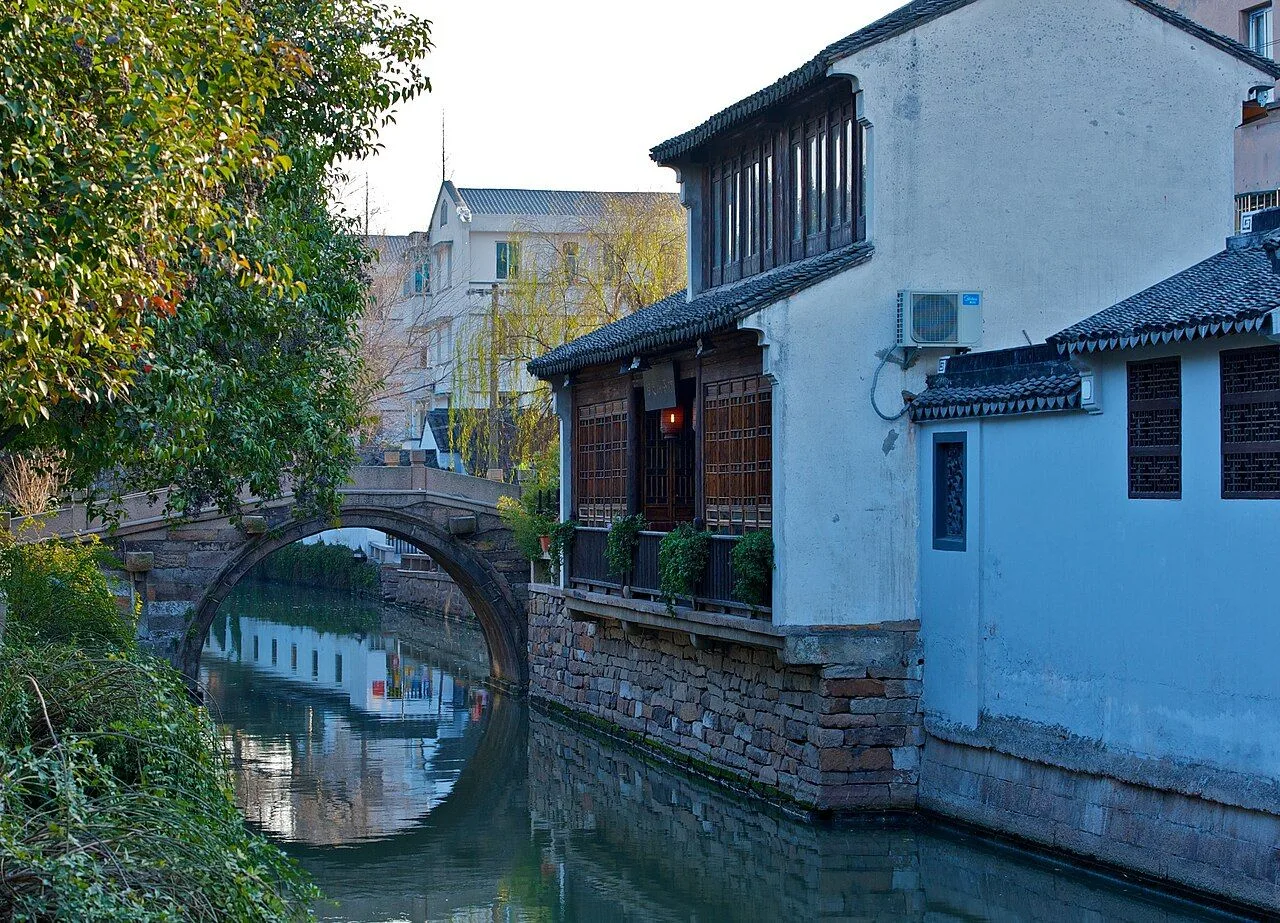
Photo: Wikimedia Commons / CC BY-SA. Source

The street is lined with 30+ teahouses, bookshops, and Suzhou-style snack stalls. The most-photographed scene is the 1,600-year-old canal with the stone bridges, the small boats passing under, and the whitewashed Suzhou-style houses with willow trees along the banks. The night scene (after 19:00) is the most atmospheric — the lanterns light up, the teahouses fill with locals, and the canal reflects the red lanterns.
For most foreign visitors, Pingjiang Road is the most-Suzhou experience — different from the imperial grandeur of Beijing or the modern megacity of Shanghai. The street is the cultural anchor of a full-day Suzhou visit: combine with the Humble Administrator’s Garden (5 min walk west) and the Suzhou Museum (10 min walk north) for the most complete Suzhou day.
What to actually see
The street is a 1.5-2 hour walk, or half a day if you include a boat ride, a teahouse visit, and a Suzhou-style meal. The key stops:
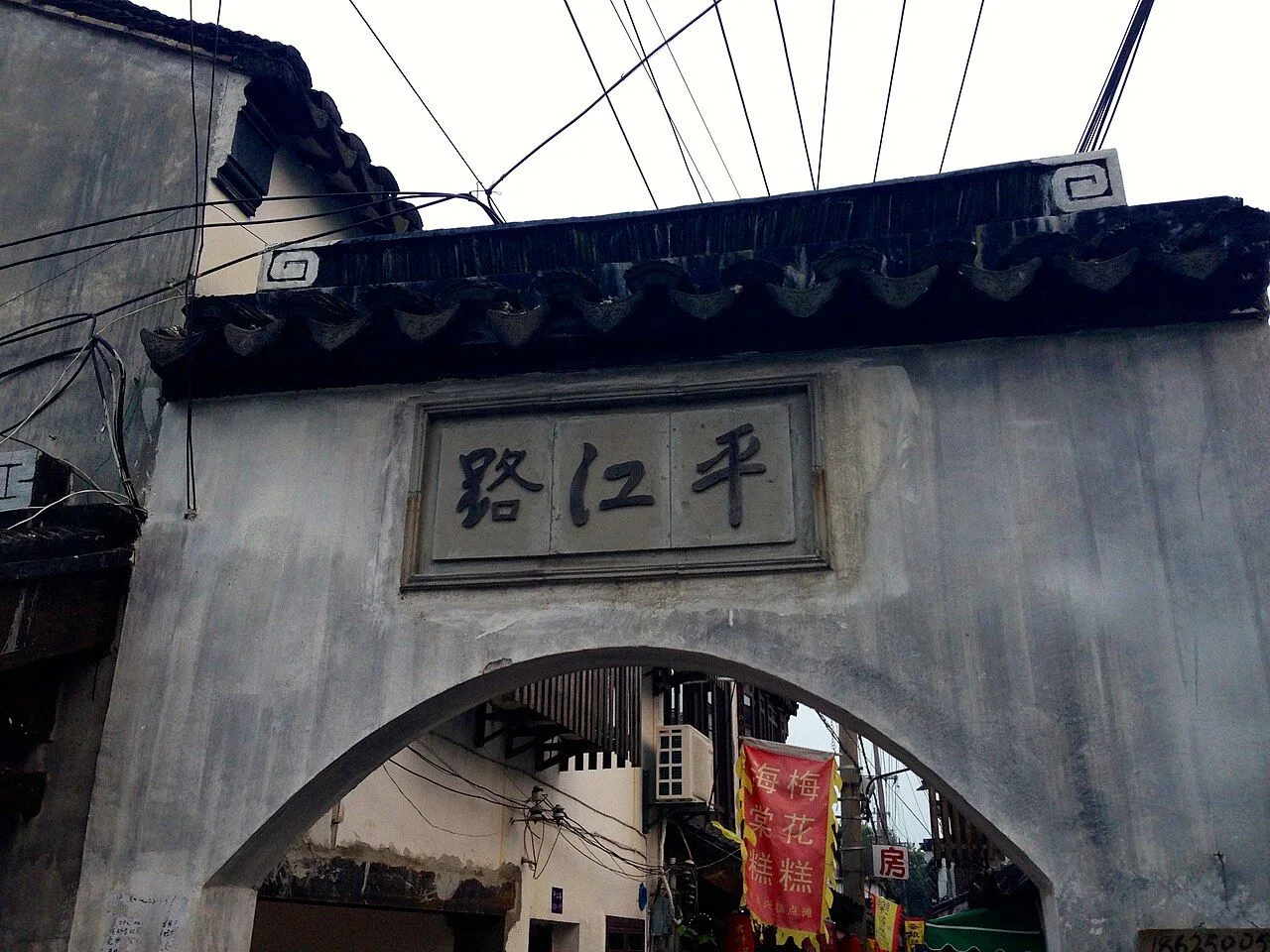
Photo: Wikimedia Commons / CC BY-SA. Source

Northern end (Beisita Pagoda metro) — the most authentic section, with the 1,600-year-old canal, the 168 stone bridges, and the small Suzhou-style houses.
Mid-street — the 30+ teahouses, bookshops, and Suzhou-style snack stalls. The osmanthus-flavored sweet soup and the Suzhou-style mooncakes are the signature street food.
Kunqu Opera Museum — a small free museum showing the 600-year-old Kunqu opera tradition. Kunqu is the ancestor of all Chinese opera forms and UNESCO-listed as Intangible Cultural Heritage.
Southern end (boat pier) — the boat ride departs from this pier. The 30-45 min boat ride on the Pingjiang Canal (¥80-150/boat) is the best way to see the old town from the water.
Pingjiang History Museum — a small free museum showing the history of the canal grid and the old town.
When to go
Best: March-May and September-November. Spring cherry blossoms; autumn osmanthus fragrance. The evening (after 19:00) is the most atmospheric.
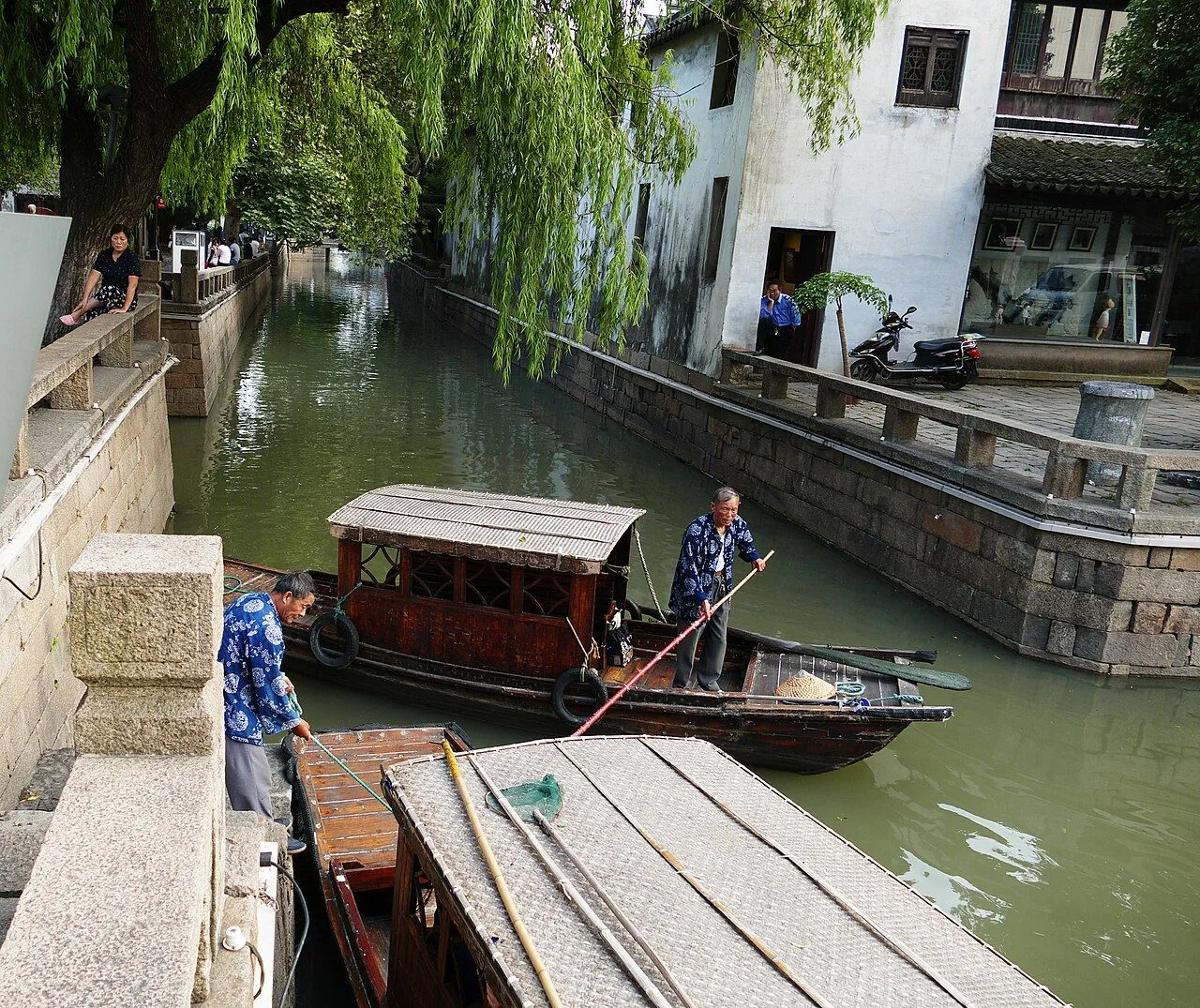
Photo: Wikimedia Commons / CC BY-SA. Source

Acceptable: All year. The street is mostly outdoor, but the canal-side teahouses are climate-controlled. The night scene is popular in all seasons.
Avoid: June. Plum-rain season (long drizzle), the stone pavement is slippery.
Time of day: evening (after 19:00) is the most atmospheric. Late afternoon (14:00-17:00) for the boat ride and the museums.
How to get there
The metro is the easiest. Beisita Pagoda Station on Line 4, Exit 3. The northern end of Pingjiang Road is 8 min walk from the metro. Alternative: Xiangmen Station on Line 1, Exit 4. The southern end of Pingjiang Road is 10 min walk from this metro.
From Suzhou Railway Station (high-speed from Shanghai), take the metro Line 2 to Beisita Pagoda (transfer at Shantangjie). 20 minutes, ¥4.
From Shanghai Hongqiao, take the high-speed rail to Suzhou Railway Station. 25 minutes, ¥40 second class. Trains run every 5-15 minutes.
What to pair it with
Pingjiang Road is in the old town (Gusu district). Pair your visit with:
- Humble Administrator’s Garden (5 min walk west) — the largest classical garden in Suzhou, ¥70
- Suzhou Museum (10 min walk north) — I.M. Pei’s 2006 masterpiece, free
- Lion Grove Garden (10 min walk south) — famous for the rockeries, ¥40
- Shantang Street (15 min Didi) — the 1,000-year-old canal street with teahouses
- Tongli Water Town (30 min by bus) — the 1,000-year-old water town, ¥100
Best photo spots
-
Northern end of Pingjiang Road (Beisita Pagoda end) · Morning (08:00-10:00) for the soft light on the canal and the bridges
The northern end of the street is the most authentic — the 1,600-year-old canal, the 168 stone bridges, and the small whitewashed houses. Use a 24mm wide-angle at f/8 to capture the depth of the street and the reflections in the canal.
-
Mid-street canal-side teahouse · Late afternoon (16:00-17:30) for the golden hour on the water
The mid-street teahouses have outdoor seating with views of the canal. The reflections of the bridges and the willow trees in the water are the photo. Use a 24-70mm at f/4 to capture the depth of the canal.
-
Southern end boat pier · Late afternoon (16:00-17:30) for the golden hour on the boats
The boat pier at the southern end is where the boat rides depart. The wooden boats, the boatmen in straw hats, and the canal reflections are the photo. Use a 35mm prime at f/2.8 for the boats and the reflections.
-
Cherry blossom season (March-April) · Midday (12:00-14:00) for the overhead light through the blossoms
The cherry blossoms along the canal in spring make the 1,600-year-old street the most photogenic in Suzhou. Use a 35mm prime at f/2.8 for the bokeh of the blossoms and the canal.
-
Evening lanterns (after 19:00) · Blue hour (sunset +30 min)
The lanterns light up the street in the evening. The red lanterns, the stone bridges, and the canal reflections are the photo. Use a 24mm wide-angle at f/4 to capture the street and the lanterns.
Where to eat nearby
-
Song He Lou (松鹤楼) — mid-street on Pingjiang Road
Suzhou-style restaurant since 1757. Famous for sweet and sour Mandarin fish (松鼠桂鱼, ¥80-120), Suzhou noodles (苏式汤面, ¥20-30), and osmanthus-flavored desserts. The most famous Suzhou restaurant. · ¥100-200/person · On Pingjiang Road, mid-street
-
De Yue Lou (得月楼) — 5 min walk from Pingjiang Road
Suzhou-style banquet restaurant since 1564. Famous for sweet and sour Mandarin fish, braised pork belly, and Suzhou-style dim sum. The most famous Suzhou banquet restaurant. · ¥150-300/person · 5 min walk from Pingjiang Road, in the old town
-
Pingjiang Road snack stalls (平江路小吃)
Suzhou-style street food. Osmanthus-flavored sweet soup (桂花糖芋苗, ¥15-25), Suzhou-style mooncakes (苏式月饼, ¥10), sugar-roasted chestnuts (糖炒栗子, ¥20), sweet rice dumplings (桂花酒酿圆子, ¥15). Cheap, authentic, family-friendly. · ¥10-50/person · Along Pingjiang Road
-
Pingjiang History Museum teahouse
Mid-tier Suzhou tea house. Biluochun green tea (碧螺春, ¥30-50/cup), Suzhou-style dim sum (¥20-40/portion). The terrace overlooks the canal. · ¥50-100/person · At the southern end of Pingjiang Road, inside the Pingjiang History Museum
Frequently asked questions
Is Pingjiang Road worth visiting?
Yes, especially for the canal-side walk, the teahouses, and the Suzhou-style snacks. The 1.6-km street is the best-preserved section of the 1,000-year-old Suzhou canal grid and the most atmospheric walk in the old town. Free. 1.5-2 hours is enough.
How much does Pingjiang Road cost?
Free to walk. The boat ride (¥80-150/boat, 4-6 people) is the most popular paid activity. The Kunqu Opera performance is ¥80-200. Suzhou-style meals are ¥60-200/person. Total visit cost: ¥30-150/person for a typical afternoon + evening.
What is the best time to visit Pingjiang Road?
**Evening (after 19:00)** is the most atmospheric — the lanterns light up, the teahouses fill with locals, and the night scene is the most photogenic. **Spring (March-May)** for the cherry blossoms along the canal. **Autumn (September-November)** for the osmanthus fragrance. Avoid June (plum-rain season).
How do I get to Pingjiang Road from central Suzhou?
Metro Line 4 to Beisita Pagoda Station, Exit 3. The northern end of Pingjiang Road is 8 min walk from the metro. From Suzhou Railway Station is 10 min by Didi (¥20-30). From Shanghai Hongqiao is 1.5 hours (¥40 second class high-speed rail + 10 min metro).
What is the boat ride on Pingjiang Road?
The 30-45 min boat ride on the Pingjiang Canal is the best way to see the old town from the water. ¥80-150/boat, fits 4-6 people. The boatman rows the wooden boat under the stone bridges, past the whitewashed houses, and along the 1,000-year-old canal. Most boatmen sing traditional Suzhou songs (¥20 tip expected). The boat ride departs from the southern end of Pingjiang Road (near the Kunqu Opera Museum) and goes to the Humble Administrator's Garden.
Is Pingjiang Road stroller-friendly?
Yes — the street is flat stone, no vehicles, stroller-accessible. The 168 stone bridges have steps (one or two each) but the street itself is stroller-friendly. The boat ride is stroller-friendly with assistance.
What are the best Suzhou-style snacks on Pingjiang Road?
**Osmanthus-flavored sweet soup** (桂花糖芋苗, ¥15-25): the signature Suzhou street food, made with taro and osmanthus syrup. **Suzhou-style mooncakes** (苏式月饼, ¥10): flaky pastry with sweet or savory filling, distinct from the Cantonese mooncake. **Sugar-roasted chestnuts** (糖炒栗子, ¥20): a winter specialty, sold from November to March. **Sweet rice dumplings** (桂花酒酿圆子, ¥15): glutinous rice balls in sweet fermented rice soup. All sold at multiple stalls along the street.
What is the difference between Pingjiang Road and Shantang Street?
**Pingjiang Road** is the 1.6-km canal-side street in the eastern old town, with 168 stone bridges, teahouses, and Suzhou-style snacks. **Shantang Street** is the 1-km canal-side street in the western old town, with the silk shops, the old town market, and the entrance to Tiger Hill. Both are UNESCO-listed sections of the Grand Canal. Most visitors do both — Pingjiang Road in the afternoon, Shantang Street in the morning before Tiger Hill.