
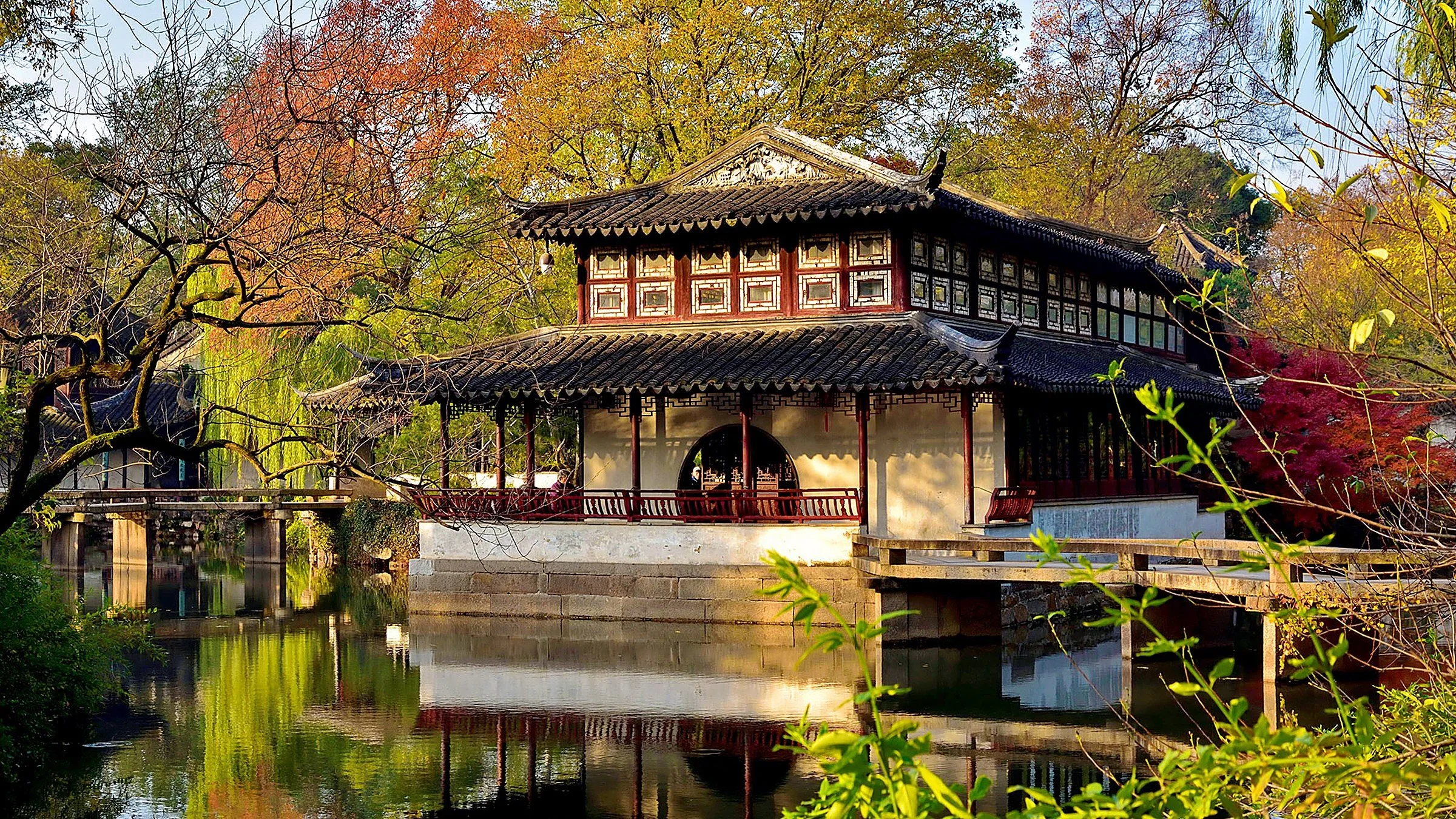
Humble Administrator's Garden
拙政园 · Zhuō Zhèng Yuán
Quick answer
Passport required at the gate (UNESCO World Heritage Site regulations). Tickets sold at the gate in cash, Alipay, or WeChat Pay. The English audio guide (¥20) covers all 21 window frames and the 12 main pavilions. English signage is good — every pavilion has a bilingual placard.
Why visit
- 1 UNESCO World Heritage Site (1997) — the largest classical garden in Suzhou, built 1509-1525 by a retired Ming-dynasty official. 5.2 hectares of ponds, pavilions, bridges, and bamboo groves.
- 2 The 21 distinctively-shaped window frames — each pavilion has a different shape (round, hexagonal, plum-blossom, fan, vase). The window frames were designed to 'frame' the view beyond — a key principle of Chinese garden design.
- 3 The central pond with the Fragrant Snow (远香荷香) and Floating Fragrance pavilions — the most-photographed scene in any Suzhou garden. The lotus blooms in June are spectacular.
- 4 The 12 main pavilions, each named with a poetic title and designed for a specific activity (reading, drinking tea, playing chess, viewing the moon). The garden encodes a Confucian-influenced landscape philosophy of 'within the four waters, return to the garden.'
- 5 The plum blossom (Feb-Mar), wisteria (Apr-May), lotus (Jun-Aug), osmanthus (Sep-Oct), and maple (Nov) seasons — the garden transforms 5 times a year. The most photogenic season is the osmanthus (Sep-Oct) when the entire garden smells sweet.
Essential tips for foreigners
- Arrive at 07:30-08:30 (when the gate opens) — the locals do tai chi in the morning, the light is best for photography (low side-light on the white walls), and the garden is empty. By 10:00 the tour groups arrive and the central pond is crowded.
- Buy the audio guide (¥20, English) — it covers all 21 window frames and the 12 main pavilions. The 90-minute narration is detailed and the only way to understand the symbolism.
- Walk counter-clockwise around the central pond — the classic route follows the eastern shore (entrance), the southern shore (pavilions), the western shore (the 21 windows), and the northern shore (the old house museum). Allow 1.5 hours at a comfortable pace.
- Visit in the osmanthus season (Sep-Oct) — the garden smells sweet for 2-3 weeks in late September. Combine with the autumn maples for the most photogenic visit of the year.
- Don't skip the old house museum in the north — the 200-year-old wooden residential building is the original scholar's retreat, with period furniture and a quiet teahouse. Most tour groups skip it.
Suggested route
- 07:30 20 min Arrive at Beisita Pagoda Metro Station, Exit 3. Walk 8 min north to the garden entrance. Buy the ¥70 ticket (Apr-Oct) or ¥30 ticket (Nov-Mar) at the gate. Pick up the audio guide (¥20) inside.
- 07:50 30 min Enter the garden. The morning light is best — the white walls glow in the low sun. Start with the **eastern shore** of the central pond. The locals are doing tai chi on the lawns; walk quietly and don't block the paths.
- 08:20 30 min Cross to the **southern shore** to see the Fragrant Snow and Floating Fragrance pavilions. The lotus blooms in June are spectacular; the maple leaves turn red in November.
- 08:50 45 min Walk the **western shore** — the 21 distinctively-shaped window frames. Each frames a unique view. The audio guide explains the symbolism. Allow 45 min for all 21.
- 09:35 20 min Walk the **northern shore** — the old house museum with period furniture. Most tour groups skip this. Allow 20 min.
- 09:55 1.5 hours Exit through the north gate. Cross the canal to the **Suzhou Museum** (I.M. Pei, 2006, free). The water reflection of the white walls is the most-photographed spot. Allow 1.5 hours.
- 11:25 1 hour Lunch at the museum café or one of the Suzhou-style restaurants on **Pingjiang Road** (5 min walk east). Try the osmanthus-flavored sweet soup (桂花糖芋苗) and the Suzhou noodles (苏式汤面).
- 12:25 1.5 hours Walk **Pingjiang Road** — the 1.6-km canal-side street in the old town. The stone bridges, the teahouses, and the Suzhou-style snack stalls are the highlights. Allow 1.5 hours.
- 13:55 Optional 2-3 hours Optional: walk 10 min to **Lion Grove Garden** (¥40, smaller than Humble Administrator's but famous for the rockeries). Or Didi to **Tiger Hill** (¥60, the 1,000-year-old leaning pagoda).
The largest classical garden in Suzhou
Humble Administrator’s Garden (拙政园, Zhuō Zhèng Yuán) is the largest and most-visited of the 9 UNESCO classical gardens in Suzhou. Built 1509-1525 by a retired Ming-dynasty official, the 5.2-hectare garden encodes a Confucian-influenced landscape philosophy of “within the four waters, return to the garden” — a personal retreat where the scholar-official could contemplate, write poetry, and entertain friends away from the imperial court.
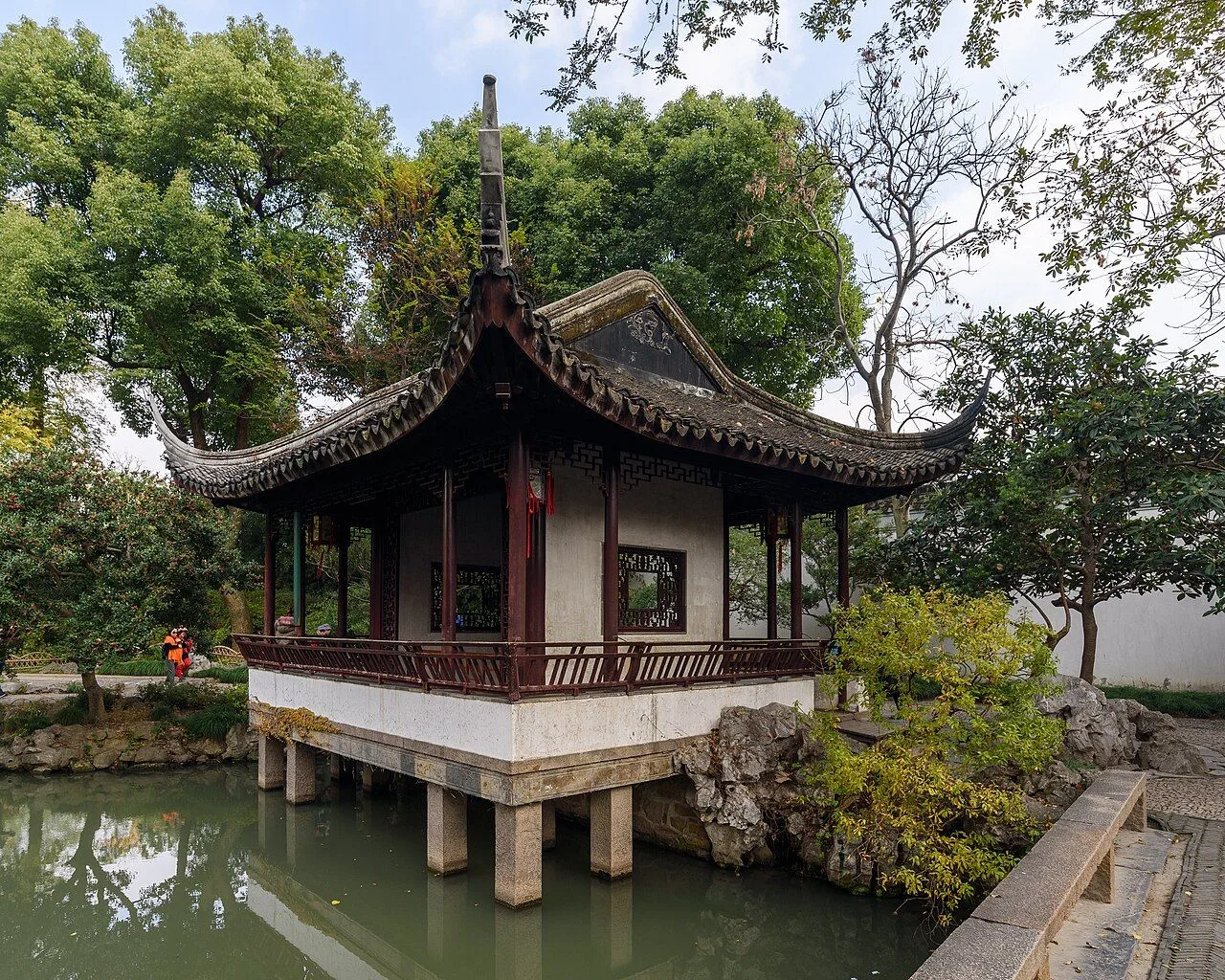
Photo: Wikimedia Commons / CC BY-SA. Source

The garden is organized around a central pond, with the Fragrant Snow (远香荷香) and Floating Fragrance pavilions on the southern shore, the 21 distinctively-shaped window frames on the western shore, and the old house museum in the north. The lotus blooms in June, the maples turn red in November, and the osmanthus smells sweet in September-October.
For most foreign visitors, the Humble Administrator’s Garden is the most-photographed and best-preserved classical Chinese garden. The garden is the centerpiece of a full-day Suzhou visit: combine with the Suzhou Museum (I.M. Pei, 2006, 5 min walk north) and Pingjiang Road (1.6-km canal-side street, 5 min walk east) for the most complete Suzhou experience.
What to actually see
The garden is a 2-3 hour visit, or 1.5 hours for the highlights. The key stops, in walking order:
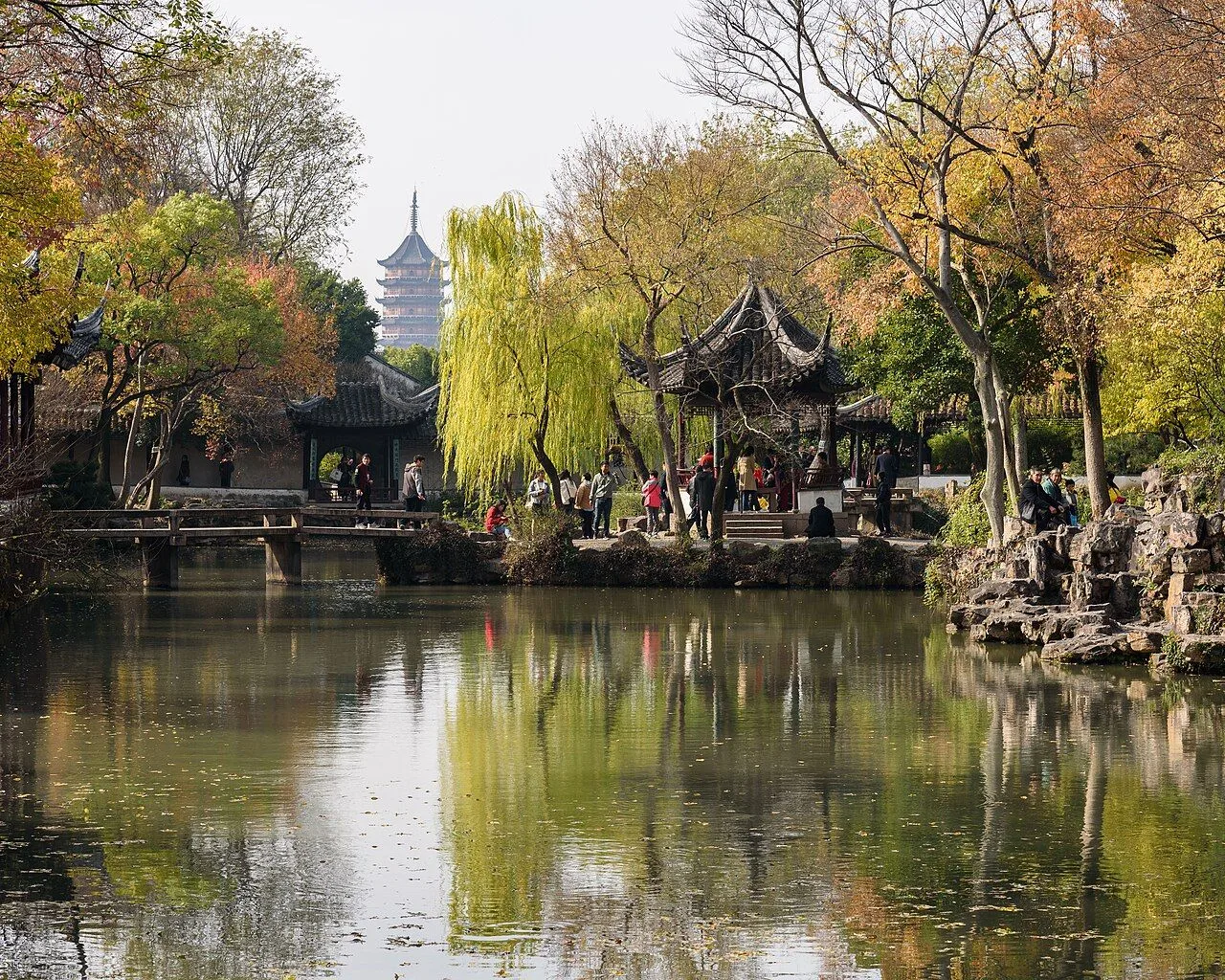
Photo: Wikimedia Commons / CC BY-SA. Source

Eastern shore — the entrance section, with the bonsai garden and the 500-year-old wisteria trellis. The locals do tai chi here in the morning.
Southern shore — the Fragrant Snow (远香荷香) and Floating Fragrance pavilions, the most-photographed scene. The lotus blooms in June; the maples turn red in November.
Western shore — the 21 distinctively-shaped window frames. Each frames a unique view of the garden beyond. The audio guide explains the symbolism.
Northern shore — the old house museum, a 200-year-old wooden residential building with period furniture. Most tour groups skip this.
Bamboo grove (eastern section) — the 5-10m bamboo stems create a vertical rhythm; the dappled light through the leaves is the photo.
When to go
Best: March-May and September-November. Spring blossoms (plum, peony, wisteria) and autumn osmanthus fragrance. The osmanthus (Sep-Oct) is the most photogenic and fragrant season.
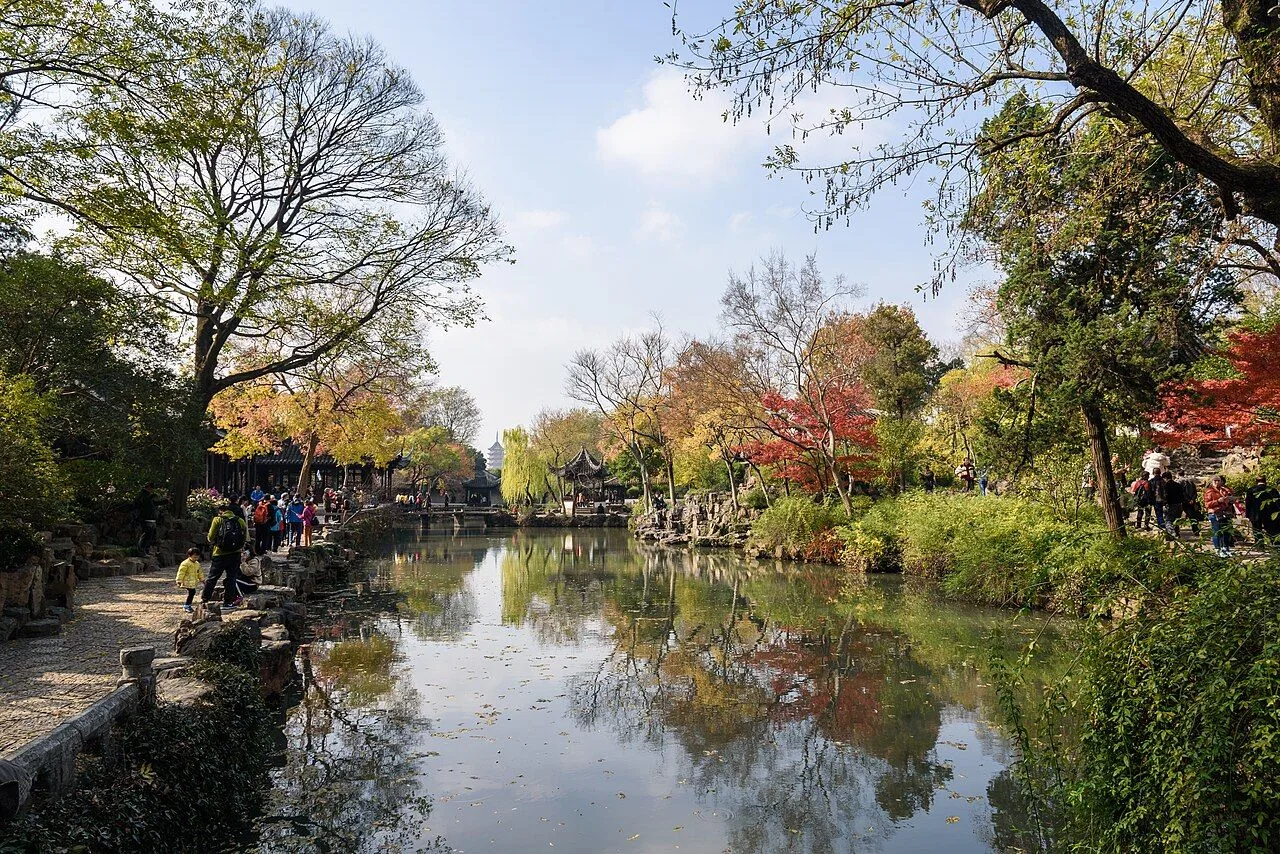
Photo: Wikimedia Commons / CC BY-SA. Source

Acceptable: June, December-February. June has the plum-rain season (long drizzle) but also the lotus blooms. December-February is quiet but the garden is dormant.
Avoid: July-August. Hot and humid. The garden has minimal shade.
Time of day: arrive at 07:30-08:30 (when the gate opens) for the morning light and the empty paths. By 10:00 the tour groups arrive and the central pond is crowded.
How to get there
The metro is the easiest. Beisita Pagoda Station on Line 4, Exit 3. The garden is 8 min walk from the metro. Alternative: Suzhou Railway Station on Line 2 and Line 4, Exit 1, then 10 min walk.
From Shanghai Hongqiao (high-speed from Beijing, Hangzhou, Nanjing), take the high-speed rail to Suzhou Railway Station. 25 minutes, ¥40 second class. Trains run every 5-15 minutes.
From Shanghai Hongqiao, Didi is 1.5 hours, ¥250-350.
What to pair it with
The Humble Administrator’s Garden is in the old town (Gusu district). Pair your visit with:
- Suzhou Museum (5 min walk north) — I.M. Pei’s 2006 masterpiece, free
- Lion Grove Garden (500m south) — famous for the rockeries, ¥40
- Pingjiang Road (5 min walk east) — the 1.6-km canal-side street
- Tiger Hill (10 min Didi) — the 1,000-year-old leaning pagoda, ¥60
- Tongli Water Town (30 min by bus) — the 1,000-year-old water town, ¥100
Best photo spots
-
Fragrant Snow pavilion (远香荷香) on the southern shore of the central pond · Morning (08:00-10:00) for the side-light, June for the lotus blooms, November for the maples
The most-photographed scene in any Suzhou garden. The pavilion with the dark tile roof and white walls, reflected in the pond, framed by lotus or maples. Use a 24-70mm at f/8 to capture the full composition.
-
Western shore — the 21 window frames · Any time (the window frames are the focus)
Each window frame is a different shape and frames a unique view. The most-photographed is the round window framing the distant pagoda. Use a 50mm prime at f/2.8 to capture the bokeh of the foreground flowers and the framed view beyond.
-
Stone bridge over the central pond · Late afternoon (16:00-17:30) for the golden hour
The stone bridges are designed to reflect in the water — the reflection completes the composition, a key principle of Chinese garden design. Use a 24mm wide-angle at f/8 to capture the full bridge and its reflection.
-
Old house museum in the north · Midday (11:00-13:00) for the interior light
The 200-year-old wooden residential building with period furniture. The interior is dim, the wooden beams are weathered, the windows frame the garden beyond. Use a 35mm prime at f/2 for the interior detail.
-
Bamboo grove in the eastern section · Any time (the bamboo is the focus)
The bamboo grove in the eastern section of the garden. The 5-10m bamboo stems create a vertical rhythm; the dappled light through the leaves is the photo. Use a 35mm prime at f/2 for the bokeh.
Where to eat nearby
-
Suzhou Museum Café (苏州博物馆咖啡厅)
Mid-tier Western-Cantonese. Coffee ¥30-50, light meals ¥60-120. The most convenient option after the garden. The terrace overlooks the museum's water reflection. · ¥60-120/person · 5 min walk from the garden, inside the Suzhou Museum
-
Song He Lou (松鹤楼) — Pingjiang Road
Suzhou-style restaurant since 1757. Famous for sweet and sour Mandarin fish (松鼠桂鱼), Suzhou noodles (苏式汤面), and osmanthus-flavored desserts. The most famous Suzhou restaurant. · ¥100-200/person · 5 min walk from the garden, on Pingjiang Road
-
Pingjiang Road snack stalls (平江路小吃)
Suzhou-style street food. Osmanthus-flavored sweet soup (桂花糖芋苗, ¥15), Suzhou-style mooncakes (苏式月饼, ¥10), sugar-roasted chestnuts (糖炒栗子, ¥20), sweet rice dumplings (桂花酒酿圆子, ¥15). Cheap, authentic, family-friendly. · ¥10-50/person · 5 min walk from the garden, on Pingjiang Road
-
De Yue Lou (得月楼) — 10 min Didi from the garden
Suzhou-style banquet restaurant since 1564. Famous for sweet and sour Mandarin fish, braised pork belly, and Suzhou-style dim sum. The most famous Suzhou banquet restaurant. · ¥150-300/person · 10 min Didi from the garden
Frequently asked questions
How much does the Humble Administrator's Garden cost in 2026?
**Standard entry**: ¥70 (Apr-Oct peak season), ¥30 (Nov-Mar off-peak). **Audio guide**: ¥20 extra (English, Mandarin, Japanese, Korean). **Teahouse service**: ¥30-80/person for tea + snacks. **Boat ride**: ¥30 (summer only). **Children under 1.2 m** free; **1.2-1.5 m** half price; **Senior 60+** with Chinese ID ¥35.
What is the best time to visit the Humble Administrator's Garden?
**March-May** for plum blossoms, peonies, and wisteria. **September-November** for osmanthus fragrance and autumn maples — the most photogenic and fragrant season. **Avoid June** (plum-rain season — long drizzle, slippery paths, fewer flowers). **December-February** is quiet but the garden is dormant. Arrive at 07:30-08:30 to beat the crowds.
How long does the Humble Administrator's Garden take?
2-3 hours for the full garden. 1.5 hours for the central pond, the 21 window frames, and the Fragrant Snow pavilion. Half a day if you want to sit in the teahouse and contemplate, or combine with the Suzhou Museum (5 min walk north).
Is the Humble Administrator's Garden worth it?
Yes, for first-time visitors. The 21 window frames, the central pond, and the 12 main pavilions are the most-photographed and best-preserved classical garden in China. The garden encodes a Confucian-influenced landscape philosophy that's unique to Suzhou. Skip if you've been to similar classical gardens (Yu Garden in Shanghai, Beihai Park in Beijing) — Suzhou has 9 UNESCO gardens, but the Humble Administrator's is the largest and most visited.
Can I buy tickets at the door?
Yes, on weekdays. On weekends and Chinese national holidays (May 1-3, Oct 1-7, Spring Festival), the entry queue is 15-30 min. Book via Trip.com (¥60) for skip-the-line and a small discount.
What is the difference between the Humble Administrator's Garden and other Suzhou gardens?
The Humble Administrator's Garden is the **largest** (5.2 hectares) and **most visited** of the 9 UNESCO classical gardens in Suzhou. Other notable gardens: **Lion Grove Garden** (500m south, famous for the rockeries), **Master of the Nets Garden** (1 km west, the smallest and most intimate, evening shows), **Humble Administrator's Garden** (the largest), **Lingering Garden** (5 km west, the second-largest, with the famous 500m corridor). Most visitors do Humble Administrator's + Lion Grove + Suzhou Museum in one day.
Is the Humble Administrator's Garden wheelchair-accessible?
Partially. The main paths are flat stone, accessible. The garden has 8 small bridges with single-step access — some are accessible, some are not. The central pond and the 21 window frames are reachable. The 12 pavilions have one-step entrances (manageable with assistance). Strollers are fine throughout.
What is the symbolism of the 21 window frames?
Each window frame has a different shape (round, hexagonal, plum-blossom, fan, vase, gourd, etc.) and frames a different view of the garden beyond. The window frame is a key principle of Chinese garden design — 'the view through the window is a painting.' Walking the western shore of the central pond, you see 21 different 'paintings,' each a unique composition. The most-photographed is the round window framing the distant pagoda.