
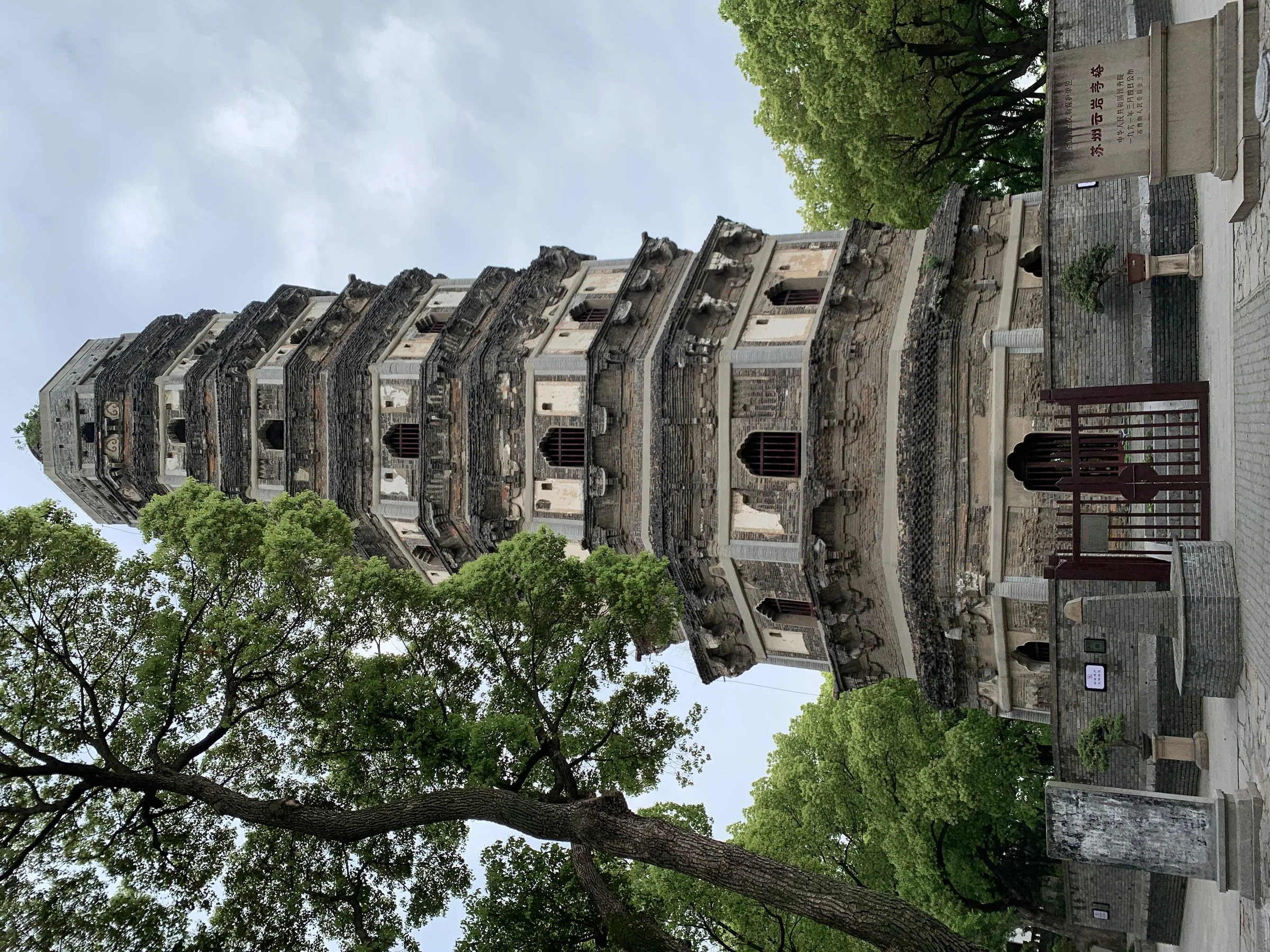
Tiger Hill
虎丘 · Hǔ Qiū
Quick answer
Passport required at the gate. Tickets sold at the gate in cash, Alipay, or WeChat Pay. The English audio guide (¥20) covers the leaning pagoda, the Sword Pool, and the 10 main historical sites. English signage is good — every major site has a bilingual placard.
Why visit
- 1 The 1,000-year-old leaning pagoda (Yunyan Temple, 云岩寺塔) — a 47m, 7-story brick pagoda tipped 2.34° from vertical, the same lean as the Leaning Tower of Pisa but built 200 years earlier (961 AD). UNESCO World Heritage tentative list.
- 2 The Sword Pool (剑池) — a rectangular pond at the foot of the hill, named for the legend that the founder of Suzhou (He Lu, 阖闾) was buried here with 3,000 swords as burial goods. The water is still mysteriously clear after 2,500 years.
- 3 The bonsai garden (万景山庄) — over 600 potted bonsai trees, some over 500 years old. The collection is one of the largest in the Yangtze Delta region.
- 4 The Yunyan Temple complex (云岩寺) — a Tang-dynasty Buddhist temple at the top of the hill, with the leaning pagoda as its centerpiece. The temple has been rebuilt 7 times; the current buildings are Ming-Qing dynasty.
- 5 The 36m hill itself — the eastern slope is the gentler walking route, the western slope is steeper and has the most historical sites. Allow 2 hours for the full hill.
Essential tips for foreigners
- Arrive at 07:30-08:30 (when the gate opens) — the locals exercise on the hill in the morning, the light is best for photography (low side-light on the pagoda), and the path is empty. By 10:00 the tour groups arrive.
- Walk the eastern slope up, the western slope down — the eastern route is gentler, the western route has the most historical sites. This is the classic loop recommended by the local guides.
- Don't skip the Sword Pool — the legend (3,000 swords buried with the king) is the most famous Suzhou legend. The water is mysteriously clear because it's fed by an underground spring. Allow 20 min.
- Visit in the cherry blossom season (Mar-Apr) — the cherry trees at the top of the hill bloom in late March. The combination of the leaning pagoda and the cherry blossoms is the most-photographed scene of the Suzhou spring.
- Combine with Shantang Street (5 min walk from Tiger Hill) — the 1,000-year-old canal street is the most famous old street in Suzhou, with teahouses, silk shops, and Suzhou-style snacks.
Suggested route
- 07:30 20 min Arrive at Shantang Street Metro Station, Exit 1. Walk 5 min south to the Tiger Hill entrance. Buy the ¥60 ticket (Apr-Oct) or ¥40 ticket (Nov-Mar) at the gate. Pick up the audio guide (¥20) inside.
- 07:50 30 min Enter the hill. Walk the **eastern slope up** — the gentler route. The path passes the bonsai garden (万景山庄, 600+ potted bonsai, 500 years old) on the right. Allow 30 min for the climb.
- 08:20 30 min Reach the top. Visit the **Yunyan Temple** (云岩寺) and the **leaning pagoda** (云岩寺塔) — the 47m, 7-story brick pagoda tipped 2.34° from vertical. Allow 30 min.
- 08:50 30 min Walk the **western slope down** — the steeper route. The path passes the **Sword Pool** (剑池) — the rectangular pond named for the 3,000-sword burial legend. Allow 30 min.
- 09:20 1.5 hours Exit through the south gate. Walk 5 min to **Shantang Street** (山塘街) — the 1,000-year-old canal street. The teahouses, the silk shops, and the Suzhou-style snacks are the highlights. Allow 1.5 hours.
- 10:50 2-3 hours Didi to the **Humble Administrator's Garden** (10 min, ¥20-30) for the afternoon visit. The garden is best in the late afternoon when the tour groups have left. Allow 2-3 hours.
- 13:20 1 hour Lunch at the garden or at **Pingjiang Road** (5 min walk east) — try the Suzhou-style noodles (苏式汤面) and the osmanthus-flavored sweet soup (桂花糖芋苗). Allow 1 hour.
- 14:20 Optional 1.5 hours Optional: Didi to the **Suzhou Museum** (I.M. Pei, 2006, free) for the late-afternoon visit. The water reflection of the white walls is best at golden hour (16:00-17:00). Allow 1.5 hours.
The 1,000-year-old leaning pagoda
Tiger Hill (虎丘, Hǔ Qiū) is a 36m hill on the western edge of Suzhou’s old town, with a 1,000-year-old leaning pagoda (Yunyan Temple) at its top, the legendary Sword Pool at its foot, and a 600-piece bonsai garden at its base. The hill has been a pilgrimage site for 2,500 years and is on UNESCO’s World Heritage tentative list.
The leaning pagoda is the centerpiece. Built 961 AD, the 47m, 7-story brick pagoda is tipped 2.34° from vertical — the same lean as the Leaning Tower of Pisa but built 200 years earlier. The lean is due to the soft soil and the weight of the upper stories; engineers have monitored it for 1,000 years and it increases about 2mm per year.
For most foreign visitors, Tiger Hill is one of two top Suzhou attractions (the other is the Humble Administrator’s Garden). The leaning pagoda, the Sword Pool, and the Yunyan Temple are the most-photographed. The hill is best in the early morning (07:30-08:30) when the locals exercise and the light is best.
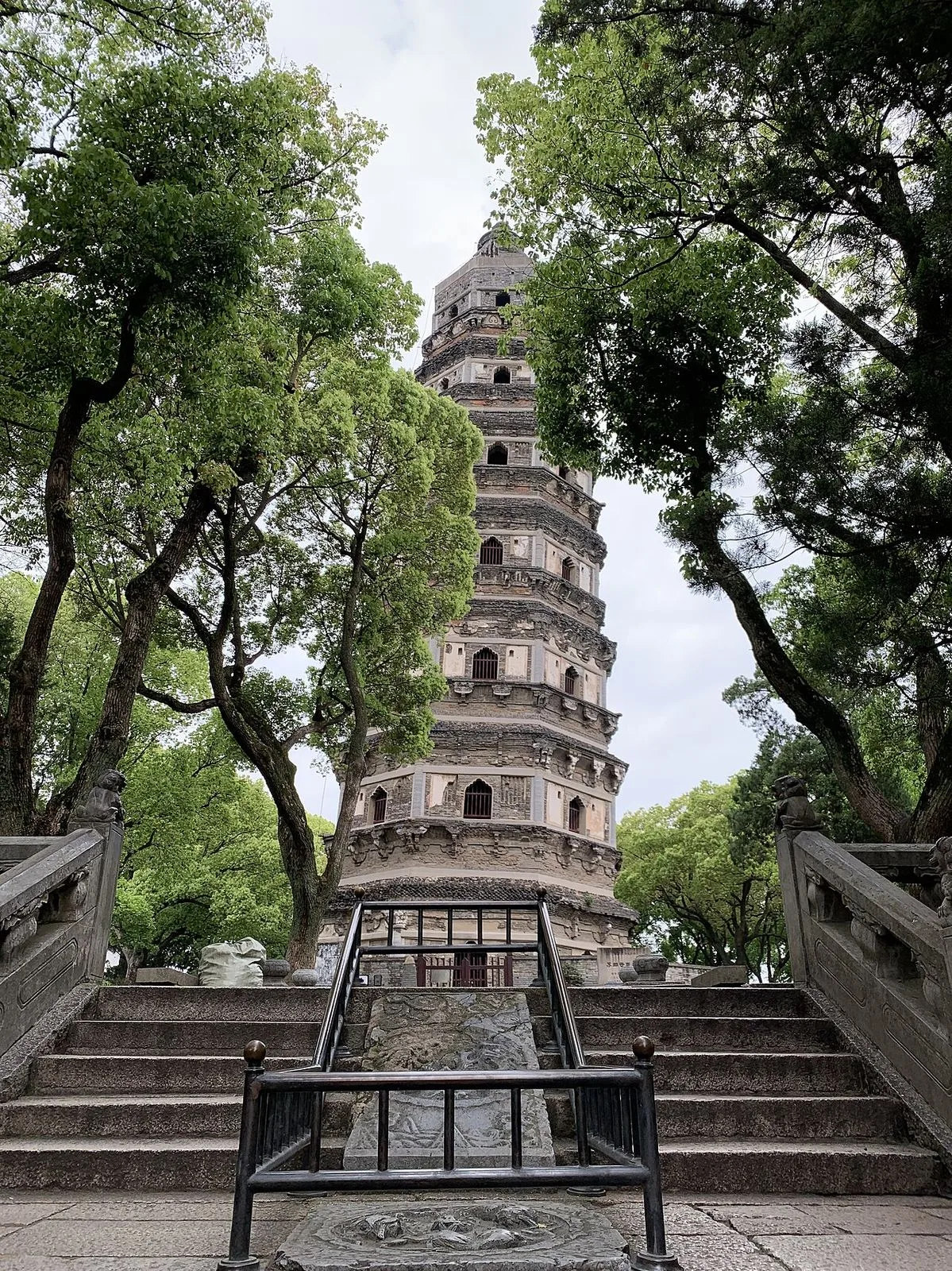
Photo: Wikimedia Commons / CC BY-SA. Source
_-_img_04.webp)
What to actually see
The hill is a 2-3 hour visit, or 1.5 hours for the highlights. The key stops, in walking order:
Eastern slope up — the gentler route. The path passes the bonsai garden (万景山庄) with 600+ potted bonsai, some over 500 years old. The collection is one of the largest in the Yangtze Delta region.
Yunyan Temple and the leaning pagoda (top) — the 47m, 7-story brick pagoda tipped 2.34° from vertical. The temple has been rebuilt 7 times; the current buildings are Ming-Qing dynasty.
Western slope down — the steeper route. The path passes the Sword Pool (剑池), the rectangular pond named for the 3,000-sword burial legend of He Lu, the founder of the ancient State of Wu.
Bonsai garden (base of the hill) — 600+ potted bonsai trees. The morning light is best for photography.
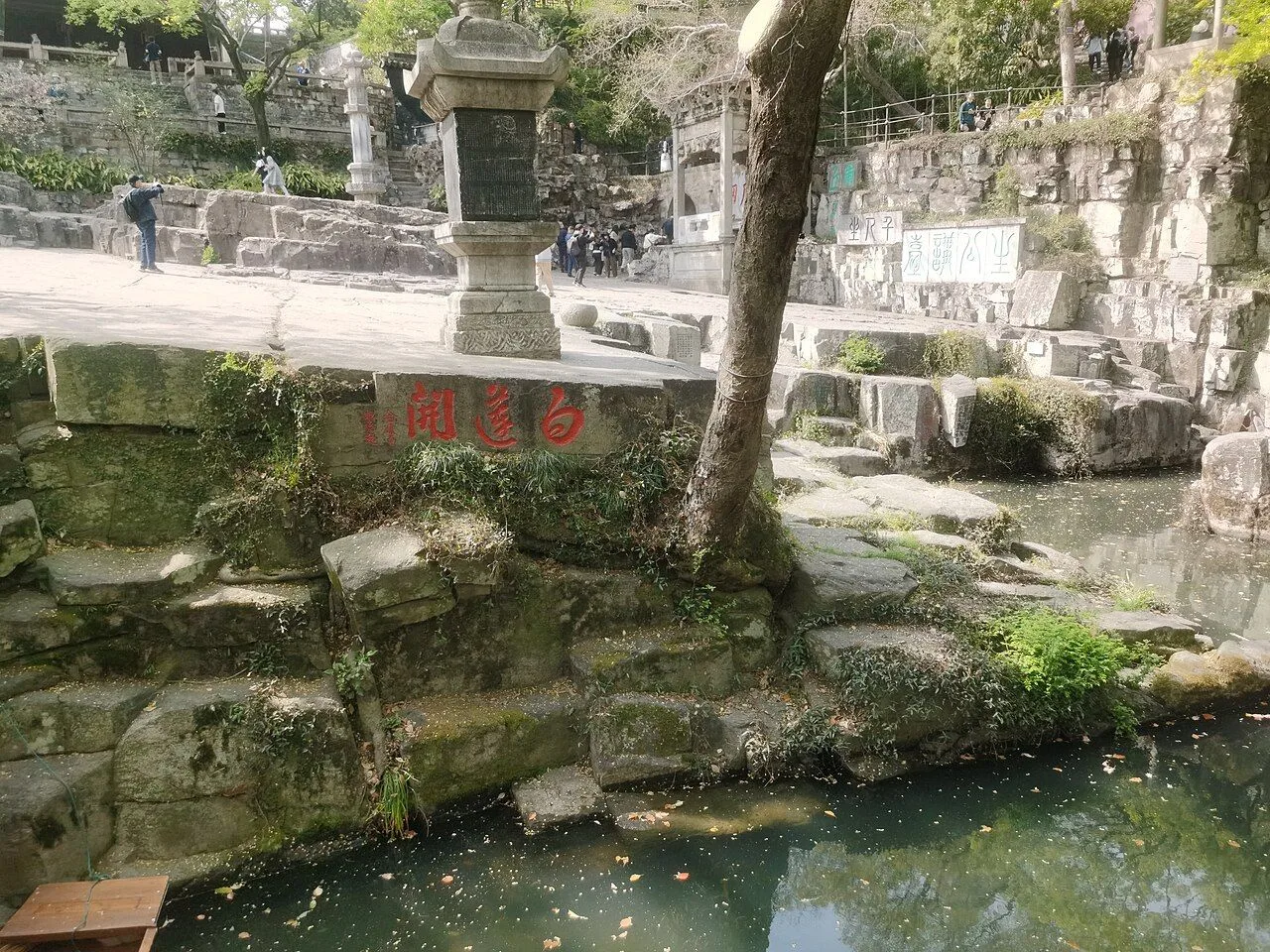
Photo: Wikimedia Commons / CC BY-SA. Source

When to go
Best: March-May and September-November. Spring cherry blossoms and peonies; autumn osmanthus fragrance and maples.
Acceptable: June, December-February. June has the plum-rain season. December-February is quiet but the hill is dormant.
Avoid: July-August. Hot and humid. The hill has minimal shade.
Time of day: arrive at 07:30-08:30 (when the gate opens) for the morning light and the empty paths. By 10:00 the tour groups arrive.
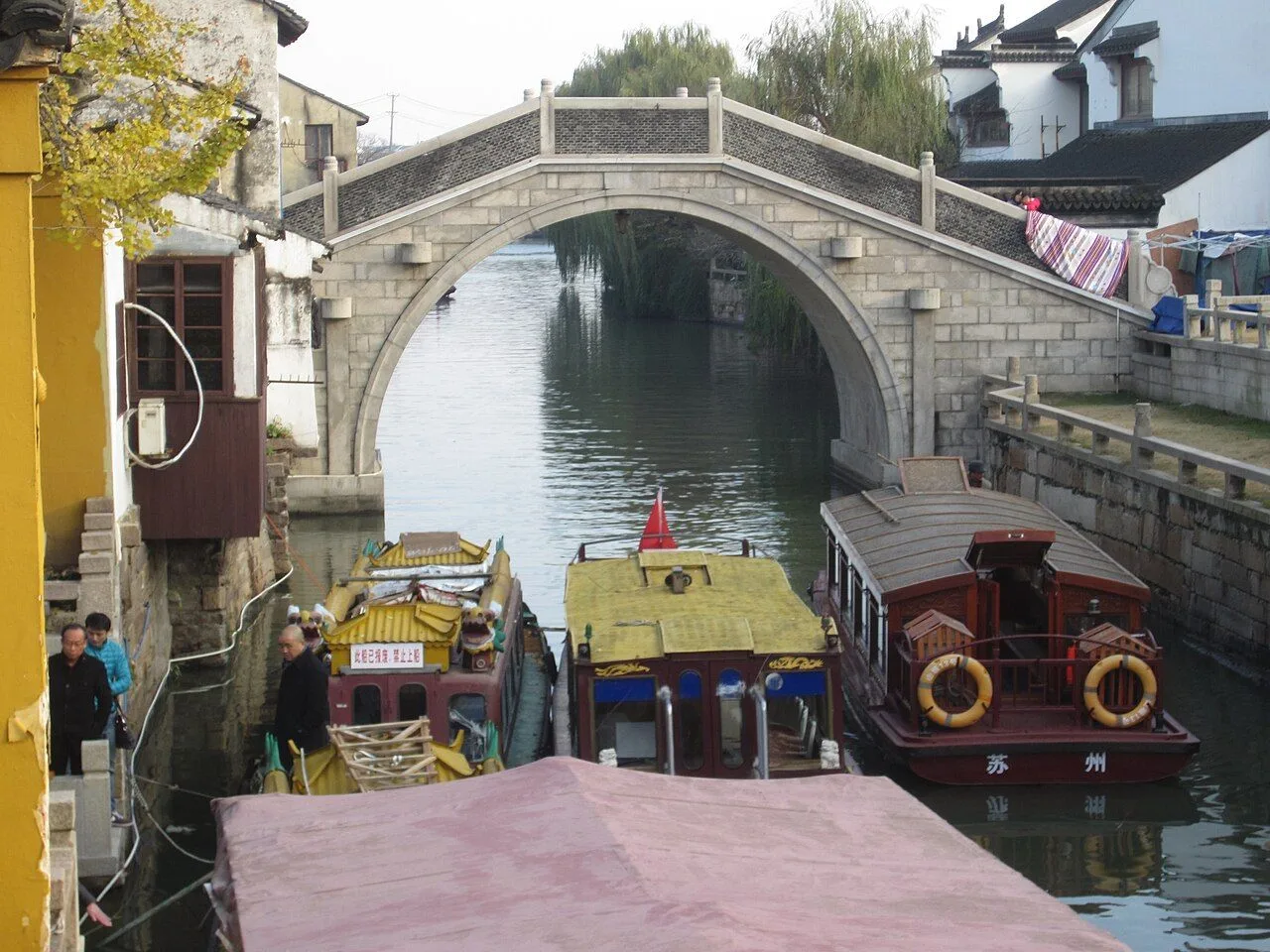
Photo: Wikimedia Commons / CC BY-SA. Source

How to get there
The metro is the easiest. Shantang Street Station on Line 2, Exit 1. Tiger Hill is 5 min walk from the metro.
From Suzhou Railway Station (high-speed from Shanghai), take the metro Line 2 to Shantang Street. 10 minutes, ¥3.
From Shanghai Hongqiao, take the high-speed rail to Suzhou Railway Station. 25 minutes, ¥40 second class. Trains run every 5-15 minutes.
What to pair it with
Tiger Hill is on the western edge of the old town. Pair your visit with:
- Humble Administrator’s Garden (10 min Didi) — the largest classical garden in Suzhou, ¥70
- Suzhou Museum (15 min Didi) — I.M. Pei’s 2006 masterpiece, free
- Shantang Street (5 min walk south) — the 1,000-year-old canal street with teahouses
- Pingjiang Road (15 min Didi) — the 1.6-km canal-side street in the old town
- Tongli Water Town (30 min by bus) — the 1,000-year-old water town, ¥100
Best photo spots
-
Yunyan Temple pagoda (top of the hill) · Late afternoon (16:00-17:30) for the golden hour on the brick
The 1,000-year-old leaning pagoda, tipped 2.34° from vertical. The 7-story brick structure is most photogenic in the late afternoon when the sun lights up the weathered brick. Use a 24-70mm at f/8 to capture the full pagoda and the autumn maples in the foreground.
-
Sword Pool (foot of the hill, western side) · Any time (the water is the focus)
The rectangular pond at the foot of the hill, named for the 3,000-sword burial legend. The water is mysteriously clear because it's fed by an underground spring. The reflections of the trees and the rocks on the pool are the photo. Use a 24mm wide-angle at f/8 to capture the full pool and the rock walls.
-
Bonsai garden (万景山庄, base of the hill) · Morning (08:00-10:00) for the soft light on the bonsai
The 600+ potted bonsai trees, some over 500 years old. The collection is one of the largest in the Yangtze Delta region. Use a 50mm prime at f/2.8 to capture the detail of individual bonsai.
-
Eastern slope path · Morning (08:00-10:00) for the dappled light through the bamboo
The eastern slope path passes through bamboo groves and past stone inscriptions. The dappled light through the bamboo is the photo. Use a 35mm prime at f/2 for the bokeh.
-
Shantang Street canal (south of Tiger Hill) · Late afternoon (16:00-17:30) for the golden hour on the canal
The 1,000-year-old canal street with stone bridges, whitewashed houses, and arched bridges. The reflections in the canal are the photo. Use a 24-70mm at f/8 to capture the full street and the bridges.
Where to eat nearby
-
Tiger Hill Teahouse (虎丘茶室)
Suzhou-style tea house. Biluochun green tea (碧螺春, ¥30-50/cup), Suzhou-style dim sum (¥20-40/portion), and traditional snacks. The terrace overlooks the leaning pagoda. · ¥50-100/person · Inside Tiger Hill, near the Yunyan Temple
-
Shantang Street restaurants
Suzhou-style street food. Sweet and sour Mandarin fish (松鼠桂鱼, ¥80-120), Suzhou noodles (苏式汤面, ¥20-30), and Suzhou-style dim sum. Multiple restaurants along the 1-km canal street. · ¥30-100/person · 5 min walk from Tiger Hill, along Shantang Street
-
Song He Lou (松鹤楼) — 15 min Didi from Tiger Hill
Suzhou-style restaurant since 1757. Famous for sweet and sour Mandarin fish, Suzhou noodles, and osmanthus-flavored desserts. The most famous Suzhou restaurant. · ¥100-200/person · 15 min Didi from Tiger Hill, on Pingjiang Road
-
De Yue Lou (得月楼) — 10 min Didi from Tiger Hill
Suzhou-style banquet restaurant since 1564. Famous for sweet and sour Mandarin fish, braised pork belly, and Suzhou-style dim sum. The most famous Suzhou banquet restaurant. · ¥150-300/person · 10 min Didi from Tiger Hill, in the old town
Frequently asked questions
How much does Tiger Hill cost in 2026?
**Standard entry**: ¥60 (Apr-Oct peak season), ¥40 (Nov-Mar off-peak). **Audio guide**: ¥20 extra (English, Mandarin, Japanese, Korean). **Boat ride on the inner canal**: ¥30 (summer only). **Teahouse service**: ¥30-80/person. **Children under 1.2 m** free; **1.2-1.5 m** half price; **Senior 60+** with Chinese ID ¥30.
What is the best time to visit Tiger Hill?
**March-May** for cherry blossoms and peonies. **September-November** for osmanthus fragrance and autumn maples. **Avoid June** (plum-rain season). **Arrive at 07:30-08:30** (when the gate opens) for the morning light and the empty paths. By 10:00 the tour groups arrive.
How long does Tiger Hill take?
2-3 hours for the full hill. 1.5 hours for the leaning pagoda, the Sword Pool, and the bonsai garden. Half a day if you want to walk the entire hill, visit the Yunyan Temple, and sit in the teahouse.
Is the leaning pagoda of Tiger Hill actually leaning?
Yes, the Yunyan Temple pagoda is tipped 2.34° from vertical, the same lean as the Leaning Tower of Pisa but built 200 years earlier (961 AD). The lean is due to the soft soil and the weight of the upper stories. Engineers have monitored the lean for 1,000 years; it increases about 2mm per year. The pagoda is on UNESCO's World Heritage tentative list.
What is the legend of the Sword Pool?
The legend says that He Lu (阖闾), the founder of the ancient State of Wu and the king who made Suzhou his capital, was buried at the foot of Tiger Hill in 496 BC with 3,000 swords as burial goods. The Sword Pool is the rectangular pond at the foot of the hill, named for this legend. The water is still mysteriously clear after 2,500 years because it's fed by an underground spring. No one has ever found the swords — the pool has been dredged multiple times without success.
Is Tiger Hill wheelchair-accessible?
No — the hill has 100+ stone steps and the paths are uneven. The leaning pagoda, the Sword Pool, and the Yunyan Temple all require climbing. Strollers are OK with assistance but the path is steep in places. The bonsai garden at the base of the hill is accessible.
What's the difference between Tiger Hill and the Humble Administrator's Garden?
**Tiger Hill** is a 36m hill on the western edge of the old town, with the leaning pagoda, the Sword Pool, and the Yunyan Temple. The hill is the highlight. **Humble Administrator's Garden** is a 5.2-hectare classical garden in the eastern old town, with the central pond, the 21 window frames, and the 12 pavilions. The garden is the highlight. Both are top Suzhou attractions. Most visitors do the Humble Administrator's Garden in the morning and Tiger Hill in the afternoon (the leaning pagoda is best at golden hour).
Can I buy tickets at the door?
Yes, on weekdays. On weekends and Chinese national holidays, the entry queue is 10-20 min. Book via Trip.com (¥50) for skip-the-line and a small discount.