
Suzhou Museum
苏州博物馆 · Sūzhōu Bówùguǎn
Quick answer
Passport required at the gate (the museum scans the passport for the WeChat mini-program reservation). Free entry with reservation. The English audio guide (¥20) covers all 5 main exhibition halls. English signage is excellent — every exhibit has a bilingual English placard.
Why visit
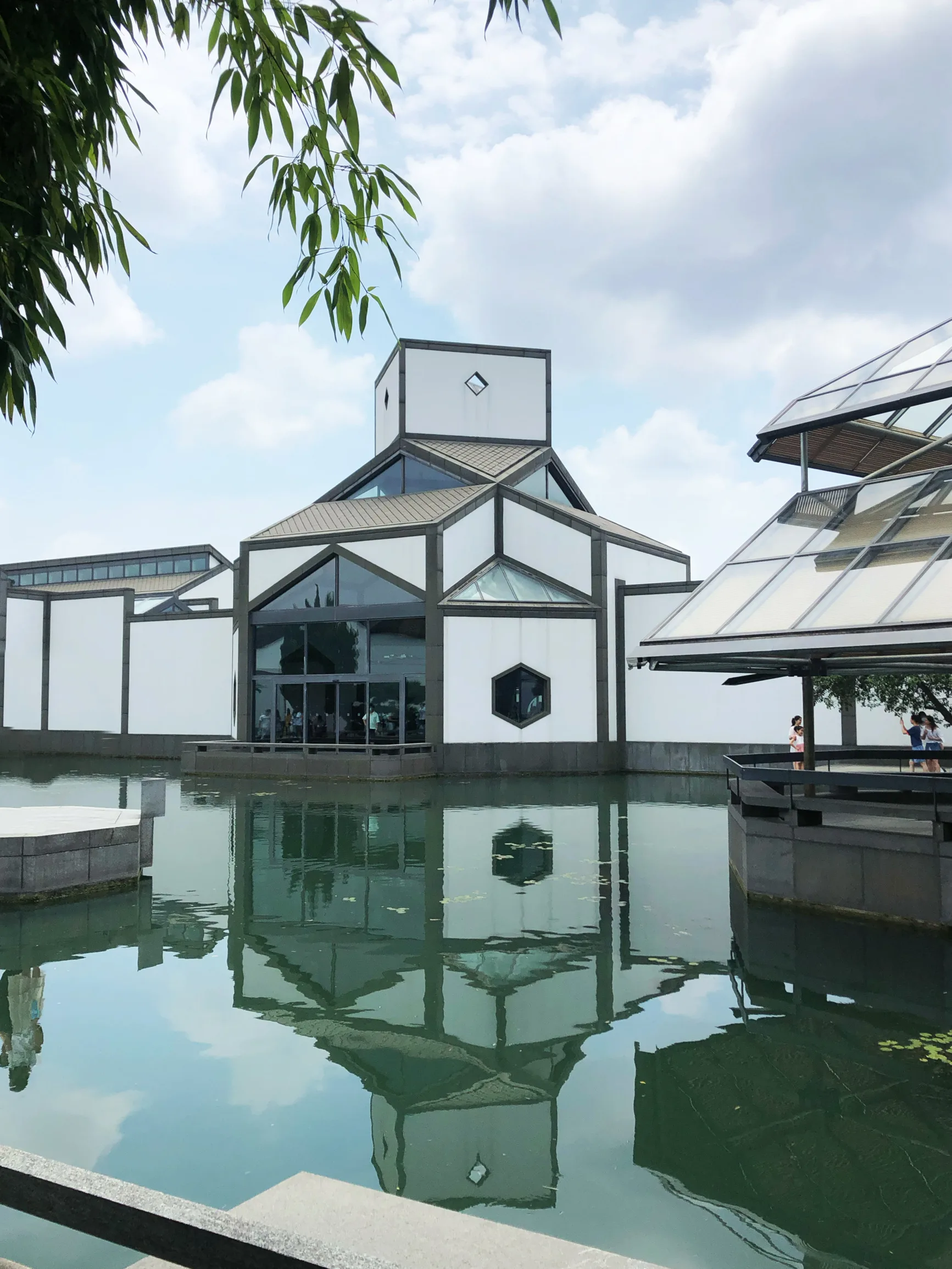
- 1 I.M. Pei's last major work (2006) — the master architect (Louvre Pyramid, Bank of China Tower Hong Kong, Rock and Roll Hall of Fame) returned to his family's hometown to design the museum. The modernist building fuses Chinese garden design with minimalist architecture.
- 2 The central courtyard with the rock garden and the water reflection — the most-photographed spot in Suzhou. The rectangular pool, the white walls, the dark tile roofs, and the rock garden compose a 'painting' that fuses I.M. Pei's signature geometric precision with the Chinese landscape philosophy of 'borrowed scenery' (借景).
- 3 The 5 main exhibition halls — showing the 5,000-year history of Suzhou, from the Neolithic to the modern era. Highlights: the Song-dynasty celadon ceramics, the Ming-dynasty silk textiles, the Qing-dynasty scholar's desk, the Republican-era wedding sedan chair, and the contemporary Suzhou embroidery collection.
- 4 The contemporary art wing (open until 20:00 Fri-Sat) — rotating exhibitions of contemporary Chinese art, often by Suzhou-born artists. The I.M. Pei architecture tour (free, reservation required for groups) explains the design principles.
- 5 The tea house (茶室) in the southeast corner — a small traditional tea house with a terrace overlooking the central courtyard. ¥30-80/person for tea + snacks. The most peaceful spot in the museum.
Essential tips for foreigners
- Reserve 7 days in advance via the WeChat mini-program (苏博预约) — the main hall fills 1-2 days ahead for weekends and Chinese national holidays. Reservations open at 00:00 China time (midnight). The osmanthus season (Sep-Oct) is the most popular — book immediately when reservations open.
- Visit in the late afternoon (15:00-17:00) — the late afternoon light on the white walls and the water reflection is the most photogenic. The tour groups have left by 16:00 and the central courtyard is quiet.
- Walk the central courtyard before entering the exhibition halls — the rock garden and the water reflection are the most-photographed scenes. Take 15 min just for the courtyard. The composition fuses I.M. Pei's geometric precision with the Chinese landscape philosophy.
- Skip the audio guide if you're short on time — the English signage is excellent. The audio guide is detailed but the museum is small enough to read every placard in 90 min.
- Combine with the Humble Administrator's Garden (5 min walk south) — the museum is the modern anchor, the garden is the historical anchor. The 1.5-hour museum + 2-hour garden + 1-hour Pingjiang Road = the most complete Suzhou day.
Suggested route
- 14:30 20 min Arrive at Beisita Pagoda Metro Station, Exit 3. Walk 8 min north to the museum. Show your WeChat mini-program reservation at the gate. Pick up the audio guide (¥20) inside.
- 14:50 15 min Walk the **central courtyard** first — the rock garden and the water reflection. The late afternoon light is starting to come in. Take 15 min just for the courtyard. The composition fuses I.M. Pei's geometric precision with the Chinese landscape philosophy.
- 15:05 1 hour Enter the **main hall** — the 5 exhibition halls showing the 5,000-year history of Suzhou. Highlights: the Song-dynasty celadon ceramics, the Ming-dynasty silk textiles, the Qing-dynasty scholar's desk. Allow 1 hour for the main hall.
- 16:05 30 min Visit the **contemporary art wing** (open until 20:00 Fri-Sat) — rotating exhibitions of contemporary Chinese art. Allow 30 min.
- 16:35 30 min Tea house break at the **tea house in the southeast corner** (¥30-80/person). The terrace overlooks the central courtyard. The most peaceful spot in the museum. Allow 30 min.
- 17:05 2-3 hours Exit through the south gate. Walk 5 min south to the **Humble Administrator's Garden** (¥70). The late afternoon light is best for the 21 window frames and the central pond. Allow 2-3 hours.
- 19:35 1.5-2 hours Walk 5 min east to **Pingjiang Road** — the 1.6-km canal-side street. The evening scene (after 19:00) is the most atmospheric. Allow 1.5-2 hours.
- 21:00 1.5 hours Dinner at one of the canal-side restaurants — Song He Lou (松鹤楼, 1757) or De Yue Lou (得月楼, 1564). Or try the street food at the night market stalls. Allow 1.5 hours.
I.M. Pei’s modernist masterpiece in his hometown
Suzhou Museum (苏州博物馆) is the 2006 modernist building designed by I.M. Pei (贝聿铭) in his family’s hometown of Suzhou. The master architect (Louvre Pyramid, Bank of China Tower Hong Kong, Rock and Roll Hall of Fame Cleveland) returned to Suzhou to design his last major public work, fusing modernist minimalism with Chinese garden design.
The building is organized around a central courtyard with a rectangular pool, white walls, dark tile roofs, and a rock garden designed by I.M. Pei himself. The 5 main exhibition halls show the 5,000-year history of Suzhou. The contemporary art wing hosts rotating exhibitions. The tea house in the southeast corner overlooks the central courtyard.
For most foreign visitors, the Suzhou Museum is the most-photographed spot in the city — the central courtyard with the water reflection is the classic Suzhou shot. The museum is the modern anchor of a full-day Suzhou visit: combine with the Humble Administrator’s Garden (5 min walk south) and Pingjiang Road (10 min walk east).
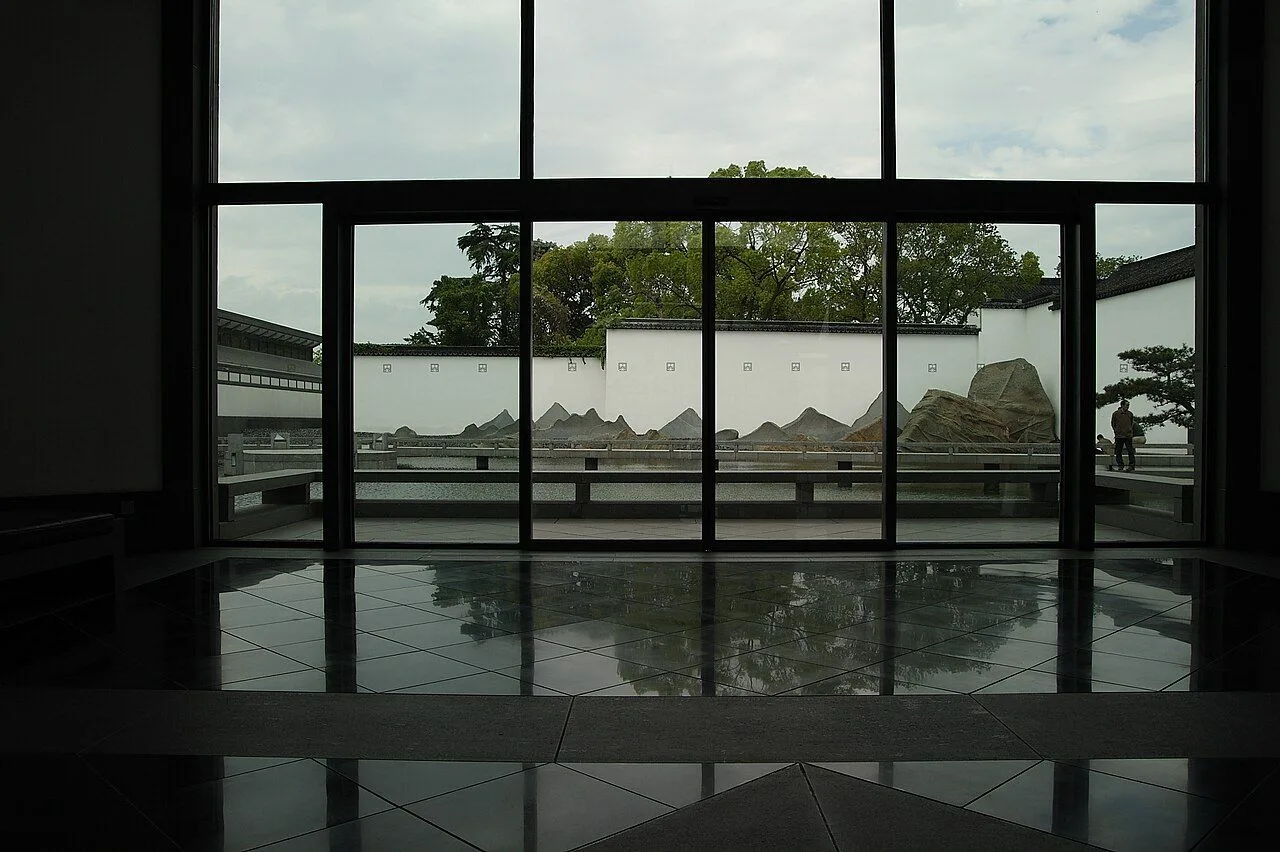
Photo: Wikimedia Commons / CC BY-SA. Source

What to actually see
The museum is a 1.5-2 hour visit, or half a day if you include the tea house and the I.M. Pei architecture tour. The key stops:
Central courtyard — the heart of the museum. The rectangular pool, the white walls, the dark tile roofs, and the rock garden compose a “painting” that fuses I.M. Pei’s geometric precision with the Chinese landscape philosophy of “borrowed scenery” (借景). The most-photographed spot in Suzhou.
5 main exhibition halls — the 5,000-year history of Suzhou. Highlights: the Song-dynasty celadon ceramics, the Ming-dynasty silk textiles, the Qing-dynasty scholar’s desk, the Republican-era wedding sedan chair, and the contemporary Suzhou embroidery collection.
Contemporary art wing (open until 20:00 Fri-Sat) — rotating exhibitions of contemporary Chinese art, often by Suzhou-born artists.
Tea house (southeast corner) — a small traditional tea house with a terrace overlooking the central courtyard. ¥30-80/person.
I.M. Pei architecture tour (free, reservation required for groups of 5+) — explains the design principles, including the “borrowed scenery” concept and the geometric precision of the building.
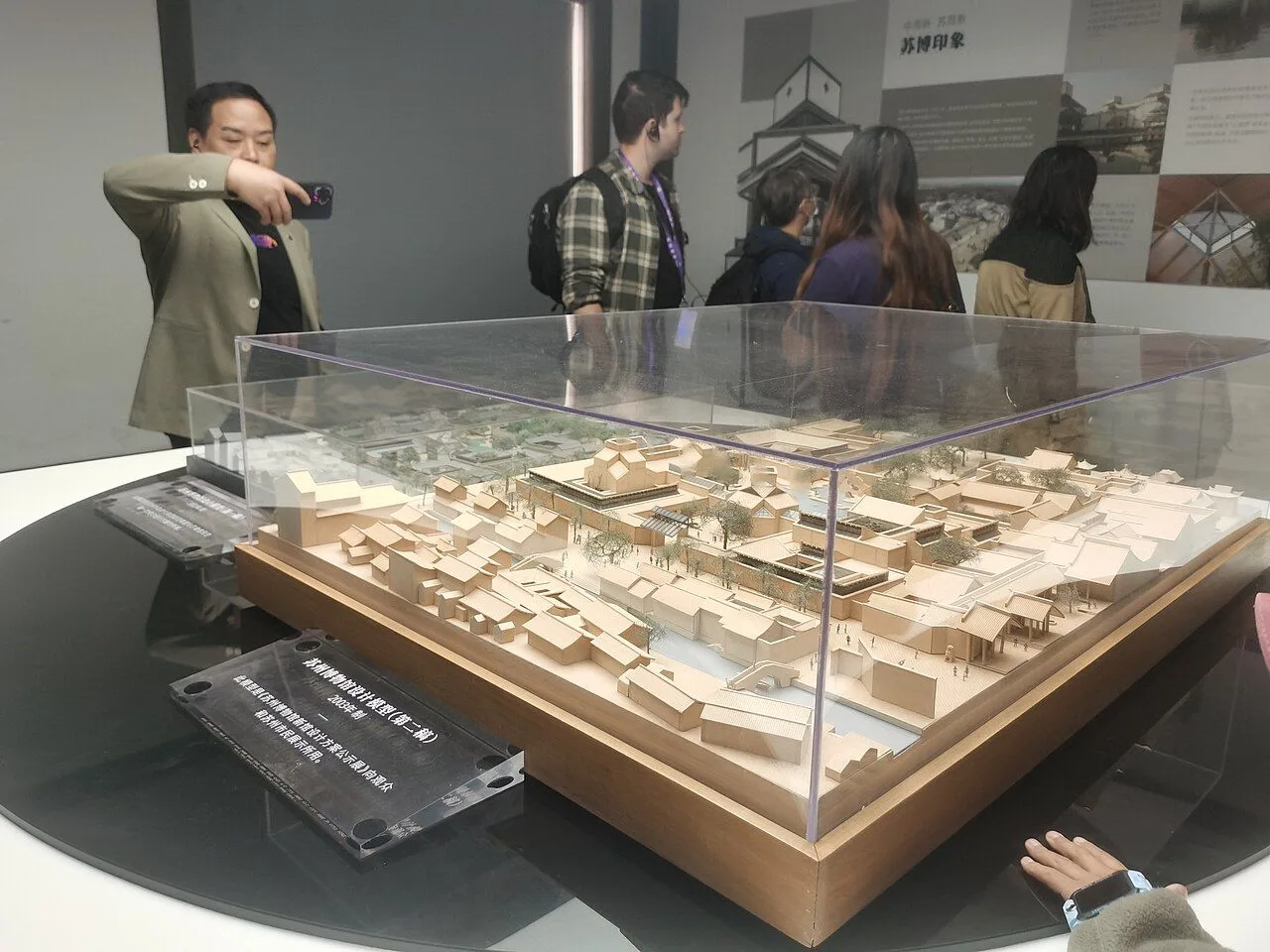
Photo: Wikimedia Commons / CC BY-SA. Source

When to go
Best: late afternoon (15:00-17:00). The late afternoon light on the white walls and the water reflection is the most photogenic. The osmanthus season (Sep-Oct) is the most popular.
Avoid: Mondays (the museum is closed). Avoid Chinese New Year (the museum closes 2-3 days).
Time of day: late afternoon (15:00-17:00). By 16:00 the tour groups have left and the central courtyard is quiet.
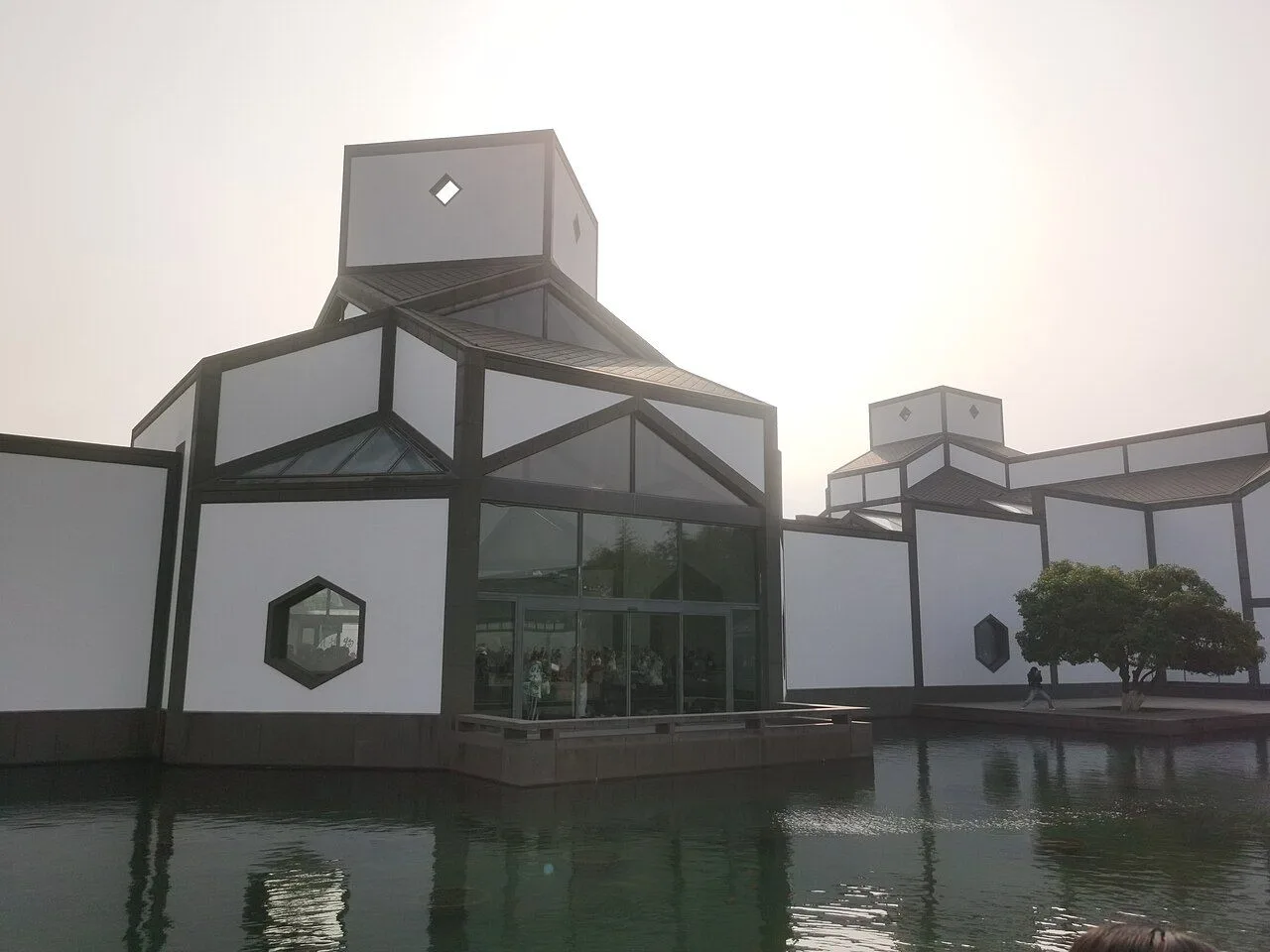
Photo: Wikimedia Commons / CC BY-SA. Source

How to get there
The metro is the easiest. Beisita Pagoda Station on Line 4, Exit 3. The museum is 8 min walk from the metro.
From Suzhou Railway Station (high-speed from Shanghai), take the metro Line 2 to Beisita Pagoda (transfer at Shantangjie). 20 minutes, ¥4.
From Shanghai Hongqiao, take the high-speed rail to Suzhou Railway Station. 25 minutes, ¥40 second class. Trains run every 5-15 minutes.
What to pair it with
The Suzhou Museum is in the old town (Gusu district), 5 min walk north of the Humble Administrator’s Garden. Pair your visit with:
- Humble Administrator’s Garden (5 min walk south) — the largest classical garden in Suzhou, ¥70
- Pingjiang Road (10 min walk east) — the 1.6-km canal-side street
- Lion Grove Garden (10 min walk south) — famous for the rockeries, ¥40
- Tiger Hill (10 min Didi) — the 1,000-year-old leaning pagoda, ¥60
- Tongli Water Town (30 min by bus) — the 1,000-year-old water town, ¥100
Best photo spots
-
Central courtyard (the rock garden and the water reflection) · Late afternoon (15:00-17:00) for the golden hour on the white walls and the water reflection
The most-photographed spot in Suzhou. The rectangular pool, the white walls, the dark tile roofs, and the rock garden compose a 'painting' that fuses I.M. Pei's geometric precision with the Chinese landscape philosophy. Use a 24mm wide-angle at f/8 to capture the full composition.
-
Stone bridge over the central pool (main hall entrance) · Late afternoon (16:00-17:00) for the warm light on the stone bridge
The stone bridge at the entrance to the main hall, reflected in the central pool. Use a 24-70mm at f/8 to capture the full bridge and its reflection.
-
Contemporary art wing interior (Friday-Saturday evening, until 20:00) · Evening (19:00-20:00) for the warm interior lighting
The contemporary art wing has dramatic interior lighting. The high ceilings and the white walls are the photo. Use a 35mm prime at f/2 for the interior detail.
-
Tea house terrace (southeast corner) · Afternoon (14:00-16:00) for the overhead light on the courtyard
The tea house terrace overlooks the central courtyard. The view of the rock garden and the water reflection is the photo. Use a 50mm prime at f/2.8 for the depth of the courtyard.
-
Main hall exterior (white wall + dark tile roof) · Blue hour (sunset +30 min)
The exterior of the main hall is I.M. Pei's signature composition — white walls, dark tile roofs, geometric lines. Use a 24-70mm at f/4 to capture the full facade.
Where to eat nearby
-
Suzhou Museum Tea House (苏州博物馆茶室)
Mid-tier Suzhou tea house. Biluochun green tea (碧螺春, ¥30-50/cup), Suzhou-style dim sum (¥20-40/portion), and traditional snacks. The terrace overlooks the central courtyard. · ¥50-100/person · Inside the Suzhou Museum, southeast corner
-
Song He Lou (松鹤楼) — 10 min walk from the museum
Suzhou-style restaurant since 1757. Famous for sweet and sour Mandarin fish (松鼠桂鱼, ¥80-120), Suzhou noodles (苏式汤面, ¥20-30), and osmanthus-flavored desserts. The most famous Suzhou restaurant. · ¥100-200/person · 10 min walk from the museum, on Pingjiang Road
-
De Yue Lou (得月楼) — 10 min walk from the museum
Suzhou-style banquet restaurant since 1564. Famous for sweet and sour Mandarin fish, braised pork belly, and Suzhou-style dim sum. The most famous Suzhou banquet restaurant. · ¥150-300/person · 10 min walk from the museum, in the old town
-
Pingjiang Road snack stalls (平江路小吃)
Suzhou-style street food. Osmanthus-flavored sweet soup (桂花糖芋苗, ¥15-25), Suzhou-style mooncakes (苏式月饼, ¥10), sugar-roasted chestnuts (糖炒栗子, ¥20), sweet rice dumplings (桂花酒酿圆子, ¥15). Cheap, authentic, family-friendly. · ¥10-50/person · 10 min walk from the museum, on Pingjiang Road
Frequently asked questions
How much does the Suzhou Museum cost?
**Free entry**. The WeChat mini-program reservation (苏博预约) is required for the main hall — open 7 days in advance at midnight, often fills 1-2 days ahead for weekends and holidays. **Audio guide**: ¥20 extra (English, Mandarin, Japanese, Korean). **Tea house**: ¥30-80/person. **Children under 12** free with adult; **Senior 60+** with Chinese ID free. **The contemporary art wing and the tea house are walk-in, no reservation needed.**
What is the best time to visit the Suzhou Museum?
**Late afternoon (15:00-17:00)** is the most photogenic — the late afternoon light on the white walls and the water reflection is the most-photographed scene. **Osmanthus season (Sep-Oct)** is the most popular — the entire central courtyard smells sweet. **Avoid Mondays** (the museum is closed). **Avoid Chinese New Year** (the museum closes 2-3 days).
How long does the Suzhou Museum take?
1.5-2 hours for the main hall. 1 hour for the contemporary art wing. Half a day if you include the tea house and the I.M. Pei architecture tour. Most visitors spend 2 hours.
Is the Suzhou Museum worth it?
Yes, especially for architecture enthusiasts. I.M. Pei's last major work is a masterclass in fusing modernist minimalism with Chinese garden design. The central courtyard is the most-photographed spot in Suzhou. The 5 main exhibition halls are well-curated. Skip if you've been to other I.M. Pei buildings (Louvre Pyramid, Bank of China Tower Hong Kong) — the museum is most rewarding for architecture enthusiasts.
Do I need to reserve the Suzhou Museum in advance?
**Yes, for the main hall** — the WeChat mini-program reservation (苏博预约) is required. Reservations open 7 days in advance at 00:00 China time (midnight). The main hall fills 1-2 days ahead for weekends, Chinese national holidays, and the osmanthus season (Sep-Oct). Foreign passports are accepted in the mini-program but you may need a Chinese phone number to receive the SMS code — use your hotel's number. **The contemporary art wing and the tea house are walk-in, no reservation needed.**
What is the difference between the Suzhou Museum and the Humble Administrator's Garden?
The **Suzhou Museum** is a 2006 modernist building by I.M. Pei, showing the 5,000-year history of Suzhou. The **Humble Administrator's Garden** is a Ming-dynasty classical garden (1509-1525), a UNESCO World Heritage Site. The two are 5 min walk apart and complement each other. Most visitors do the museum (1.5-2 hours) + the garden (2-3 hours) as a half-day combo.
Is the Suzhou Museum wheelchair-accessible?
Yes — the museum is fully accessible. The main hall is on a single level, the central courtyard is flat stone, the contemporary art wing has elevator access. The tea house has ramp access. Strollers are fine throughout.
What is the central courtyard of the Suzhou Museum?
The central courtyard is the heart of the museum. The rectangular pool, the white walls, the dark tile roofs, and the rock garden compose a 'painting' that fuses I.M. Pei's signature geometric precision with the Chinese landscape philosophy of 'borrowed scenery' (借景). The rock garden was designed by I.M. Pei himself — the rocks are from Lake Tai (太湖) and the garden transforms 5 times a year (plum blossoms Feb-Mar, wisteria Apr-May, lotus Jun-Aug, osmanthus Sep-Oct, maple Nov). The most-photographed spot in Suzhou.