
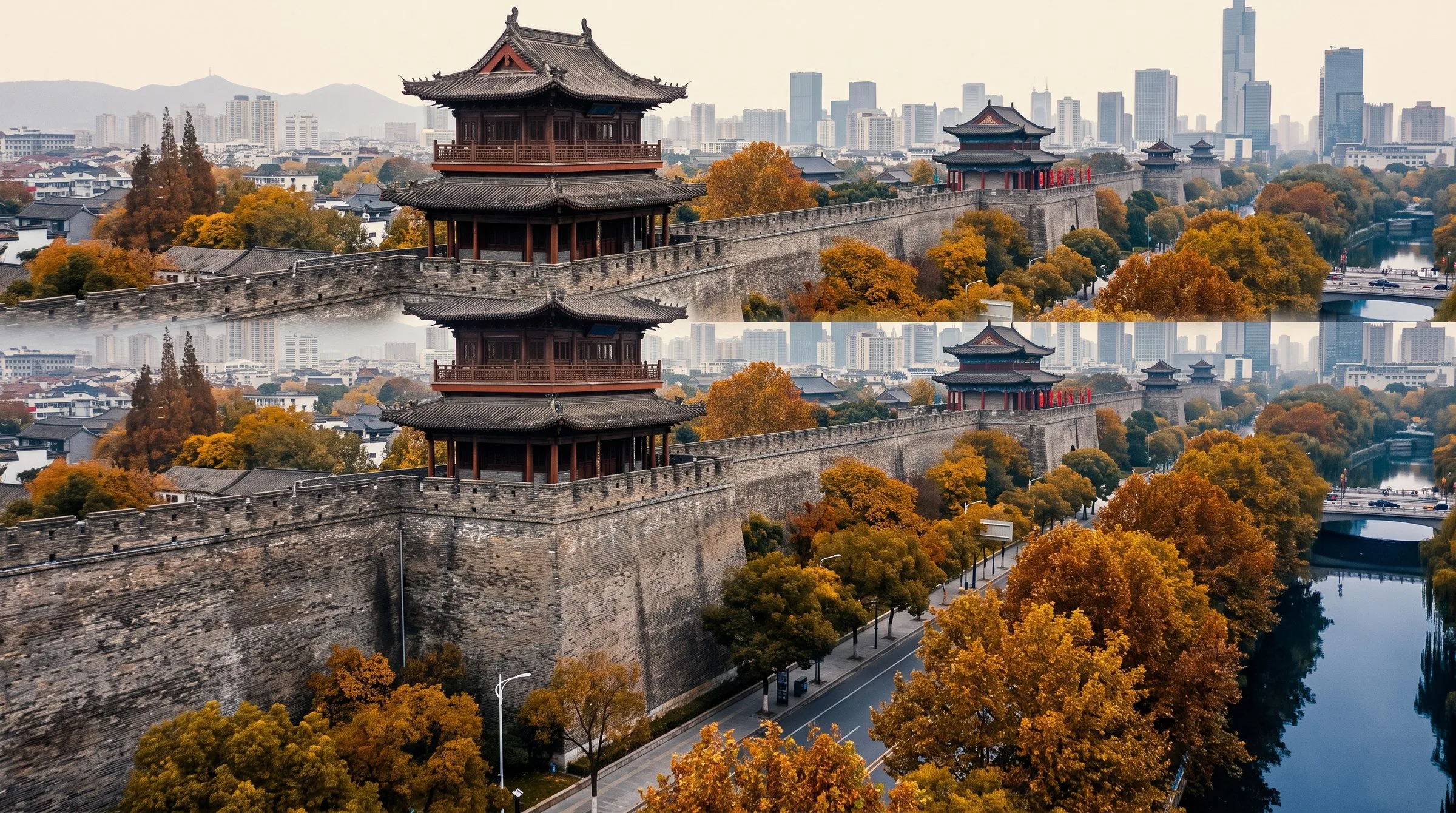
Nanjing China Travel Guide 2026: Six Dynasties Capital, Massacre Memorial, Purple Mountain
Nanjing travel guide for foreign visitors: 2,600-year history, Six Dynasties and Ming capital, Sun Yat-sen Mausoleum, Nanjing Massacre Memorial Hall (free, deeply moving), Confucius Temple, Ming city wall, and how Nanjing compares to Beijing's Forbidden City.
Nanjing is the China most tourists miss. Beijing has the imperial drama, Shanghai has the modern energy, Xi’an has the ancient warriors — but Nanjing has 2,600 years of layered history, including the most important 20th-century memorial in modern China, and somehow stays under the radar. The city was the capital of 10+ dynasties and regimes (more than any other Chinese city), including the early Ming (1368-1421, before Beijing), the Taiping Heavenly Kingdom (1851-1864), the Republic of China (1927-1949, including the Nanjing Decade), and a major city in Mao-era China. It’s the only Chinese city that was the capital, then a regional city, then the capital again, then a regional city, then the capital again, multiple times.
This 2-day plan is the right amount of time: 1 day for the historic sites (Purple Mountain, Ming Xiaoling, Confucius Temple) and 1 day for the modern China sites (Nanjing Massacre Memorial, Nanjing Museum, Presidential Palace). If you have 3 days, the bonus day adds a deeper Purple Mountain exploration and the Yangtze River Bridge.
If you’re planning a Yangtze Delta trip, this pairs naturally with our Suzhou travel guide, 240-hour visa-free guide, Chinese cultural etiquette, China budget 2026, and China scenic wonders comparison.
Why Nanjing Is Different
Four things make Nanjing unlike anywhere else in China:
1. The layered history. Nanjing has been continuously inhabited for 2,600 years (since 495 BC), was a capital under 10+ different regimes, and has been a major city continuously. Walk the Ming City Wall (built 1366) and look west: that’s the location of the imperial capital of the Six Dynasties (220-589 AD). Look east: the Yangtze River. Look south: the Purple Mountain, where the founders of 5+ dynasties are buried. The city’s motto is “六朝古都” (Capital of Six Dynasties), but in fact it’s been the capital of many more.
2. The Nanjing Massacre Memorial. This is the single most important historical site in modern China. The 1937-1938 massacre, where 300,000+ Chinese civilians and disarmed soldiers were killed by the Imperial Japanese Army in 6 weeks, is a defining event in modern Chinese identity. The Memorial Hall, opened 1985 and expanded 2015, is solemn, evidence-based, and deeply affecting. Every Chinese schoolchild visits. The English signage is excellent, and the experience is essential for understanding modern China.
3. The early Ming capital. Before Beijing became the Ming capital in 1421, Nanjing was the Ming capital for 53 years (1368-1421). Zhu Yuanzhang, the Hongwu Emperor and founder of the Ming, built his tomb (Ming Xiaoling) and his city wall (the world’s longest) here. The Ming City Wall (33.4 km, still walkable) and the Ming Xiaoling Mausoleum (UNESCO-listed) are the two biggest Ming-dynasty sites outside Beijing.
4. The geographic position. Nanjing sits at the meeting point of the Yangtze River and the Huai River plain, the historical boundary between northern and southern China. The Yangtze River Bridge (1968, the first Chinese-designed road-rail bridge over the Yangtze) is the symbol of modern Nanjing. The city is also the cultural centre of the Jiangnan region (south of the Yangtze), and its cuisine is part of the same Jiangsu family as Suzhou, Wuxi, and Hangzhou.
Together, these four layers make Nanjing a city where you can see, walk, and feel 2,600 years of Chinese history compressed into a small urban footprint.
Getting to Nanjing
From Shanghai (Most Common)
Shanghai Hongqiao → Nanjing South:
- Time: 1.5 hours
- Price: ¥140 second class, ¥220 first class, ¥420 business class
- Frequency: every 15 min, 6 AM-10 PM
- Booking: Trip.com, 12306.cn, or station ticket machine. Book 1-2 days ahead for first class.
Shanghai Hongqiao → Nanjing Station (older line, longer): 2 hours, ¥95 second class, slower.
From Pudong Airport (PVG): not recommended, 2-3 hours with transfers.
From Suzhou (Very Common)
Suzhou → Nanjing South: 1 hour, ¥135 second class, every 15 min.
From Hangzhou
Hangzhou East → Nanjing South: 1.5 hours, ¥165 second class, every 30 min.
From Beijing
Beijing South → Nanjing South: HSR, 4 hours, ¥445 second class, 6-8 direct trains per day. Or fly to Nanjing (NKG, 2 hours direct, ¥800-1,500).
Within Nanjing
Nanjing Metro is one of China’s best, with 11 lines + extensions, clean, on-time, English everywhere.
- Line 1: north-south, connects Nanjing South Railway Station to Xinjiekou (commercial centre) and Nanjing Railway Station.
- Line 2: east-west, with direct access to the Sun Yat-sen Mausoleum (Muxuyuan Station).
- Line 3: connects to the Nanjing Massacre Memorial (Yunjin Lu Station, 5 min walk).
- Line 10: connects to Confucius Temple (Fuzimiao Station).
Single journey: ¥2-7. Day pass: ¥15. Octopus equivalent is the Jinling Tong (金陵通) card, works for metro, bus, ferry, and some stores. Buy at metro stations for ¥20 (¥18 stored value + ¥2 deposit). iPhone users: NFC pay also works on Nanjing Metro via Alipay.
DiDi (China’s Uber): works in Nanjing, English UI, very reliable. From Nanjing South to Xinjiekou: ¥30-40, 20 min.
Buses: dense network, ¥2 flat fare.
Taxis: ¥11 flag fall + ¥2.5 per km. Most drivers speak Mandarin.
Walking: The central area (Xinjiekou, Confucius Temple, Presidential Palace) is walkable. Purple Mountain is connected by 5 km of city blocks from Xinjiekou.
Day 1: Purple Mountain + Ming Dynasty Sites
Theme: 2,600 years of imperial and Republican history. Total walking: 8-10 km, includes 392 steps.
Morning: Sun Yat-sen Mausoleum (7:30 AM — 11 AM)
Start at Sun Yat-sen Mausoleum (中山陵), the most important Republican-era site in China.
- History: Sun Yat-sen (1866-1925), known in China as Sun Zhongshan (孙中山), was the founder of the Republic of China (1912) and the leader of the 1911 Xinhai Revolution that ended 2,000+ years of imperial rule. He never held the presidency (he was elected in 1912 but stepped aside for Yuan Shikai within months), but he is honored as the “Father of the Nation” in both mainland China and Taiwan.
- Architecture: Built 1926-1929 by the Kuomintang (KMT) government in Nanjing, designed by Lü Yanzhi. The mausoleum is built into the south slope of Purple Mountain (Zijin Shan, 448m), ascending 392 marble steps in 8 terraces to a white marble sacrificial hall. The shape is a clock visible from above — a “warning bell” for the nation.
- Visit: 2-3 hours. Open 8:30 AM (Tue-Sun, closed Monday for maintenance). Free entry, ID required.
- Time tip: Arrive 8 AM at opening. By 10 AM, the steps are 30 min queues. Take the steps slow — they’re steeper than they look.
- Photography: The blue-tiled marble steps ascending through the forest of Chinese pine are the iconic Nanjing shot.
Getting there: Metro Line 2 to Muxuyuan Station (苜蓿园站), then 5 min walk to the entrance. Or take the sightseeing bus from the parking lot (¥10, 5 min).
Late Morning: Ming Xiaoling Mausoleum (11 AM — 1 PM)
Walk 10 min from Sun Yat-sen to Ming Xiaoling Mausoleum (明孝陵), the tomb of Zhu Yuanzhang (1328-1398), the Hongwu Emperor and founder of the Ming dynasty.
- History: Zhu Yuanzhang was a peasant-born rebel who founded the Ming in 1368, the first Han Chinese dynasty after the Mongol Yuan. He chose Nanjing as his capital and built his tomb on the south slope of Purple Mountain, 1381-1405. The tomb is UNESCO-listed (2003) as part of the “Imperial Tombs of the Ming and Qing Dynasties.”
- Architecture: The Sacred Way (神道), 1.2 km long, lined with 12 pairs of stone animals and 4 pairs of stone officials, is the most photographed part. The animals are 600 years old, weathered but still impressive. The main hall and tomb mound are at the end.
- Ticket: ¥70. Allow 2-3 hours.
- Bonus: The Linggu Temple (灵谷寺) is 10 min walk away, in the same Purple Mountain scenic area (combined ticket with Ming Xiaoling sometimes available). The Beamless Hall (无梁殿) at Linggu is a 600-year-old brick-and-stone vault without any wooden beams, a Ming engineering marvel.
Lunch in the City Centre (1:30 PM — 2:30 PM)
Take Metro Line 2 to Xinjiekou (新街口), Nanjing’s main commercial centre. Lunch recommendation:
- Jiangsu Cuisine (苏菜 / Huaiyang): try De Yue Lou (得月楼), a Huaiyang cuisine institution. Order the Salted Duck (盐水鸭), Nanjing’s signature dish. ¥100-200 per person.
- Duck Blood Soup (鸭血粉丝汤): a Nanjing street food classic, ¥15-30 per bowl, sold at hundreds of stalls. Try the Zhangyun Duck Blood Soup (张云鸭血粉丝汤) chain.
- Pan-Fried Buns (生煎包): Shanghai-style, ¥20-30 for 4.
- Soup Dumplings (小笼包): Nanjing’s are slightly larger and sweeter than Shanghai’s, ¥30-50 for a steamer.
- Mutton Noodles (羊肉面): a winter specialty, ¥30-50.
Afternoon: Ming City Wall (2:30 PM — 5 PM)
Take DiDi or Metro Line 1 to Zhonghua Gate (中华门), the world’s largest city gate and the most impressive section of the Ming City Wall.
- Ming City Wall history: Built 1366-1386 under Zhu Yuanzhang’s orders, the longest city wall in the world at 33.4 km, with 13 gates, 20,000+ soldiers to defend, and 200,000+ civilian workers. It’s the only Chinese city wall that is still fully walkable (Beijing’s wall is mostly demolished, Xi’an’s is intact but you can only walk short sections).
- Zhonghua Gate (中华门): 1366-1386, 4 nested gates and 27 hidden soldier chambers — designed so that if attackers breached the outer gate, the inner gates could be closed and the trapped soldiers inside could be fired upon from the chambers. The chambers held up to 3,000 soldiers in winter, 1,000 in summer.
- Walking the wall: From Zhonghua Gate, you can walk the wall east toward Qingliang Gate (清凉门) (4 km, 1.5-2 hours, ¥50 combined ticket). The walk is wide, well-maintained, with views over Nanjing’s south side and the Purple Mountain.
- Alternative: The Xuanwu Lake (玄武湖) section (north side, ¥30) is more popular and easier. The lake (5 km around) has 5 islands, several pavilions, and the wall section connects the city to the lake.
Evening: Confucius Temple + Qinhuai River (6 PM — 9 PM)
Take Metro Line 3 to Fuzimiao (夫子庙) Station, Confucius Temple.
- Confucius Temple (夫子庙): built 1034 (Song dynasty), dedicated to Confucius. The original complex was destroyed multiple times in wars; the current complex is a 1980s-90s reconstruction in Ming-dynasty style. The free area is the commercial pedestrian street with shops, snack stalls, and the riverfront. The paid area (¥30-60) is the Temple of Confucius proper and the Jiangnan Examination Hall.
- Jiangnan Examination Hall (江南贡院): 1168, the largest imperial exam hall in China, with 20,000+ exam cells (1 m² each, 3 days per exam). The hall was used for 800+ years, and the most famous examinee was Zheng Chenggong (郑成功, Koxinga), the 17th-century hero who expelled the Dutch from Taiwan. ¥30 entry, English signage, 1-1.5 hours.
- Qinhuai River (秦淮河): the “mother river” of Nanjing, the line between north and south, between imperial and merchant, between Confucian and commercial. The 1-km riverfront is lit with red lanterns at night, and the painted pleasure boats (画舫) ply the river. ¥80 per person, 30 min, with a recorded narration of the river’s history. The most photogenic Nanjing scene.
- Food in the Confucius Temple area:
- Duck Blood Soup (鸭血粉丝汤) — must-try
- Osmanthus Cake (桂花糕)
- Sweet Tofu Pudding (赤豆元宵)
- Jinling Roast Duck (金陵烤鸭) — different from Beijing roast duck, sweet and crispy
Note: The Confucius Temple area is the most touristy in Nanjing, with prices 30-50% above normal. The food is decent but the experience is the river, not the dining. For better food, eat at the Xinjiekou area or in a side street off the main pedestrian.
Day 2: Nanjing Massacre Memorial + Modern China
Theme: The most important site in modern China + the alternative narrative. Total walking: 6-8 km, much of it slow and reflective.
Morning: Nanjing Massacre Memorial Hall (9 AM — 12 PM)
The Nanjing Massacre Memorial Hall (侵华日军南京大屠杀遇难同胞纪念馆) is the most important site in modern China, opened 1985 and expanded 2015. Address: 418 Jiangwangmiao Street, Yunjin Lu Station, Metro Line 3.
- History: Between December 13, 1937 and January 1938, the Imperial Japanese Army captured Nanjing and killed 300,000+ Chinese civilians and disarmed soldiers over 6 weeks. The massacre included mass executions, rape, looting, and burning. The incident is known in China as 南京大屠杀 (Nanjing Datusha) and in Japan as 南京事件 (Nankin Jiken). It’s the most controversial event in Sino-Japanese relations and a defining event in modern Chinese national identity.
- Site: Built on the site of a mass grave. The 2015 expansion by architect He Jingtang (who also designed the China Pavilion at Shanghai Expo 2010) added a 1-km exhibition path and a Peace Park. The architectural design is stark, white-and-grey, and the visitor path is solemn.
- Exhibits:
- Main Hall: a marble chamber with 3 levels of excavation showing the bones of identified victims. Documented with photos, names, and burial details.
- Exhibition Hall 1 (Pre-war Nanjing): life in 1930s Nanjing, before the war.
- Exhibition Hall 2 (The Massacre): 6 weeks of atrocities, documented with survivor testimonies, Japanese soldier photographs (many taken by Japanese soldiers themselves, found in archives), and a wall listing 100+ of the most notorious Japanese war criminals.
- Exhibition Hall 3 (Post-war Trials): the Nanjing War Crimes Tribunal (1947), the 25 Japanese officers executed.
- The 30,000-name Wall: a long wall inscribed with the names of identified victims. New names are still being added as research continues.
- The 12-Second Waterfall: a clock that drops a drop of water every 12 seconds, representing the 30 victims who died every 12 seconds during the worst 6 weeks of the massacre.
- The Peace Park (2015): a hill, a giant sculpture, and a wall inscribed with messages of peace from around the world.
- Visit time: 2.5-3 hours minimum. Closed Mondays.
- Audio guide: Free English audio guide at the entrance. Strongly recommended.
- Photography: Permitted in most of the museum (no flash). The main hall with the bones is the only section where photography is restricted.
Visitor note: This is not a feel-good museum. The experience is intentionally difficult. Most Chinese visitors come out in silence. Allow yourself 3-4 hours total and don’t plan a heavy activity afterward.
Lunch (12:30 PM — 1:30 PM)
After the memorial, take Metro Line 3 back to the city centre. Eat at Lian Yuming (莲于明) or a small Nanjing Huaiyang restaurant near the Presidential Palace. Try:
- Salted Duck (盐水鸭): Nanjing’s signature, brined and cold-served.
- Osmanthus Rice Cake (桂花糖芋苗)
- Pan-fried Buns (生煎包)
- Duck Blood and Vermicelli Soup (鸭血粉丝汤): a Nanjing classic, ¥15-30 per bowl.
- Lion’s Head Meatball (狮子头): a Yangzhou specialty also popular in Nanjing.
Afternoon Option A: Nanjing Museum (1:30 PM — 5:30 PM)
Nanjing Museum (南京博物院), 321 Zhongshan East Road, free (ID required, no reservation needed for individuals, can be busy on weekends).
- One of China’s 3 best museums (along with the National Museum in Beijing and the Shanghai Museum). 400,000+ artefacts covering 5,000+ years of Chinese history.
- Special sections:
- History Hall (2nd floor): Neolithic, bronze, jade, ceramics, calligraphy, paintings.
- Special Exhibition Hall (1st floor): rotating high-quality exhibitions.
- Republic of China Hall (unique to Nanjing): the 1912-1949 era, when Nanjing was the ROC capital. Period furnishings, clothing, photos, the Sun Yat-sen memorial, the Chiang Kai-shek office. The most distinctive section.
- Digital Hall (3rd floor): 3D printing, interactive exhibits, kid-friendly.
- Intangible Cultural Heritage Hall (negative 1st floor): live demonstrations of Nanjing Yuhua tea, Jinling gold foil, Qinhuai lanterns, Nanjing paper-cutting.
- Visit time: 3-4 hours. Free audio guide in English. Closed Mondays.
Afternoon Option B: Presidential Palace (1:30 PM — 5 PM)
Presidential Palace (总统府), 292 Changjiang Road, ¥35 (¥40 with English guide).
- One of China’s most important modern sites — the seat of the ROC government 1927-1949 and the Taiping Heavenly Kingdom’s Heavenly Palace 1853-1864.
- Layout:
- Zhongshan Gate: the original Ming-dynasty gate.
- Taiping Heavenly Kingdom Hall (1853-1864): the rebel government’s palace, partially restored.
- ROC Presidential Office (1927-1949): the main building, the Sun Yat-sen office, the Chiang Kai-shek office (he was president here 1928-1949), the meeting halls.
- Garden: classical Chinese garden, the original 600-year-old Ming-era part still visible.
- Sun Yat-sen Memorial: an adjacent building with photographs of the Xinhai Revolution and Sun’s life.
- Visit time: 2-3 hours.
- Note: This is the place where Chiang Kai-shek fled to Taiwan in April 1949, ending 22 years of ROC rule in Nanjing. The site is the alternate narrative to the Communist victory — a useful complement to the Nanjing Massacre Memorial.
Evening: Xuanwu Lake + Dinner (5:30 PM — 8 PM)
Xuanwu Lake (玄武湖), the 5 km² royal lake of the Six Dynasties, sits just outside the Ming City Wall’s north gate.
- Walk or bike around the lake (5 km, 1-2 hours), free. The lake has 5 islands connected by bridges and causeways, with pavilions, lotus gardens, and views of the Purple Mountain and the modern Nanjing skyline.
- Best time: late afternoon, golden hour light on the lake.
- Adjacent: The Jiangsu Provincial Art Museum (江苏美术馆), free, 1 hour, is on the south side of the lake.
Dinner recommendation:
- Ma Xiang Xing (马祥兴): 1840, the most famous Nanjing restaurant, known for its Mutton Soup (羊肉汤) and Mafu Steak (马夫牛排). ¥150-250 per person, on Yunnan North Road.
- Yin Ma (银马): modern Huaiyang cuisine, ¥200-400 per person, on Zhongshan Road.
- Nanjing Impressions (南京大牌档): the most popular chain for Nanjing classics, ¥80-150 per person, multiple branches (the one at Confucius Temple is touristy but the one at Xinjiekou is local).
Optional Day 3: Deeper Nanjing
If you have a 3rd day, choose 2-3 from below:
- Linggu Temple + Beamless Hall (灵谷寺, ¥35): 10 min from Ming Xiaoling, the Beamless Hall (无梁殿) is a 600-year-old brick-and-stone vault, no wooden beams, 32m wide, 11m tall. One of China’s most important Ming engineering achievements.
- Purple Mountain Observatory (紫金山天文台, ¥20): 1934, China’s first modern astronomical observatory, on the summit of Purple Mountain, 1-hour hike from the cable car (¥35) or 30 min from the bus.
- Nanjing Yangtze River Bridge (南京长江大桥): 1968, the first Chinese-designed road-rail bridge over the Yangtze River. 4.5 km long, 100+ m tall. Free to walk on the upper pedestrian deck. Best at sunset, views of the Yangtze. Take Metro Line 1 to the bridge.
- Xuanwu Lake: see Day 2 evening above.
- Nanjing 1912 Block (南京1912街区): a pedestrian street of restored 1910s-1920s buildings with bars, restaurants, and boutiques, near the Presidential Palace. Evening vibe.
- Deji Plaza (德基广场): a luxury mall in Xinjiekou, the most expensive mall in the world by sales per square meter. Top floors have art exhibitions, the 7th floor is a public art gallery with rotating modern art shows, free.
Where to Stay in Nanjing
| Neighborhood | Vibe | Hotel Range | Best For |
|---|---|---|---|
| Xinjiekou (新街口) | Commercial centre, central, walkable to Confucius Temple | ¥150-2,000/night | First-timers, business travellers |
| Confucius Temple (Fuzimiao) | Historic, riverfront, walking distance to attractions | ¥150-1,500/night | Heritage-focused visitors |
| Sun Yat-sen Mausoleum / Purple Mountain | Quiet, scenic, but remote | ¥200-2,500/night | Nature lovers, photographers |
| Nanjing South Railway Station area | Convenient for transit, less charming | ¥100-400/night | Short stays, transit-only |
| Lukou International Airport | Only for flight transfers | ¥150-500/night | Layovers |
Recommended mid-range hotels:
- Jinling Hotel (金陵饭店): 1983, the original Chinese luxury hotel, Xinjiekou, 5-star, ¥500-900/night, the rotunda lobby is the architectural highlight.
- Sofitel Nanjing Galaxy (南京索菲特银河大酒店): Xinjiekou, 5-star, ¥600-1,000/night.
- Shangri-La Hotel Nanjing (南京香格里拉大酒店): Xinjiekou, 5-star, ¥700-1,200/night.
- Grand Yuantong Hotel (远东大饭店): Confucius Temple, 4-star, ¥300-500/night, walkable to the river.
- Nanjing Time Youth Hostel (南京时光青年旅舍): Confucius Temple, budget, ¥60-120/night/bed.
Booking platforms: Trip.com, Booking.com, Agoda, Fliggy.
What to Eat in Nanjing
Nanjing cuisine is part of the Huaiyang (淮扬) tradition, one of China’s 4 great culinary traditions. It emphasizes knife skills, the natural flavor of ingredients, and the “sweet aftertaste” that distinguishes Jiangnan cuisine. Nanjing is known for river fish, duck, and snacks.
Must-try dishes:
- Salted Duck (盐水鸭): Nanjing’s signature, brined in a salt and Sichuan pepper brine, cold-served, slightly chewy. Available everywhere, ¥30-50 per serving. Try Han Zheng (韩复兴) brand.
- Duck Blood and Vermicelli Soup (鸭血粉丝汤): a Nanjing street food classic, vermicelli in a rich duck broth with duck blood, duck gizzard, and tofu, ¥15-30 per bowl.
- Pan-Fried Buns (生煎包): Shanghai-style, pan-fried pork buns with crispy bottom, ¥20-30 for 4.
- Soup Dumplings (小笼包): Nanjing’s are slightly larger and sweeter than Shanghai’s, ¥30-50 for a steamer.
- Mutton Noodles (羊肉面): a winter specialty, Yangzhou style, ¥30-50.
- Osmanthus Cake (桂花糕): a Nanjing sweet, soft rice cake with osmanthus flowers, ¥5-10 per piece.
- Nanjing Lion’s Head Meatball (金陵狮子头): a Yangzhou-style giant pork meatball, braised, ¥30-50.
- Mafu Beef (马夫牛排): a Nanjing specialty, beef stewed in soy and star anise, ¥50-80.
- Xuanwu Lake Lotus Root (玄武湖莲藕): stuffed lotus root, sweet, a summer specialty.
Where to eat:
- Nanjing Impressions (南京大牌档): the most popular chain for Nanjing classics, multiple branches, ¥80-150 per person, expect a 30-60 min wait on weekends.
- Ma Xiang Xing (马祥兴): 1840, the most famous Nanjing restaurant, on Yunnan North Road, see Day 2 above.
- Lian Yuming Restaurant (莲于明): refined Huaiyang, near the Presidential Palace, ¥200-400 per person.
- Han Zheng Salted Duck (韩复兴): the most famous salted duck brand, multiple branches.
- Jinling Hotel Jin Restaurant (金陵饭店梅苑): refined Huaiyang, in the 1983 Jinling Hotel, ¥300-500 per person, the gold-standard Nanjing dining experience.
- Zhangyun Duck Blood Soup (张云鸭血粉丝汤): small chain for the duck blood soup, multiple branches.
Practical Nanjing Tips
Visa
- 240-hour visa-free transit for 57 countries (US, UK, Canada, AU, NZ, EU, JP, KR, SG, etc.) if transiting through Shanghai, Beijing, or other approved ports. Nanjing is not itself a port of entry, so you must enter through Shanghai or another approved city.
- L-visa (tourist visa): for everyone else, apply 1-2 months ahead.
- See our 240-hour guide for details.
Money
- Currency: Chinese Yuan (CNY, ¥). 1 USD ≈ ¥7.1 (2026).
- ATMs: everywhere, BOC, ICBC, ABC dispense CNY. Most have ¥20-30 fee for foreign cards. Wise and Revolut cards usually fee-free.
- Credit cards: Visa, Mastercard, UnionPay at hotels and large restaurants. Alipay and WeChat Pay at most stores and restaurants. Cash (¥) for small vendors.
- Tipping: Not customary in China. 10% sometimes added at upscale restaurants.
Language
- Mandarin is the official language. Nanjing has a local dialect (南京话, Nanjinghua), but Mandarin is universal in tourist areas.
- English in tourist areas (museums, hotels, restaurants with English menus). Less in old neighborhoods.
- Useful phrases: 你好 (nǐhǎo, hello), 谢谢 (xièxie, thank you), 卫生间在哪里 (wèishēngjiān zài nǎlǐ, where is the bathroom), 这个多少钱 (zhège duōshǎo qián, how much is this).
When to Visit
- Best months: March-May (spring, 12-22°C, plum blossoms on Purple Mountain) and September-November (autumn, 15-25°C, maple leaves on Purple Mountain, Mid-Autumn Festival).
- Summer (Jun-Aug): hot (30-35°C), humid, but the plum and lotus are in bloom. Book hotels 1-2 months ahead.
- Winter (Dec-Feb): cold (0-8°C), grey, but the off-season rates are 30-50% lower. The plum blossom season starts in late February.
- Avoid: Golden Week (early October) and Chinese New Year (late January / early February) — hotels 2-3x normal price and crowded.
- December 13: the Nanjing Massacre Memorial Day. The memorial hall is closed to the public on this day except for official ceremonies. A memorial ceremony is held, the entire city rings sirens at 10:01 AM, and a moment of silence is observed. Very moving, but the museum is not open to general visitors.
Safety
Nanjing is one of the safest cities in China for tourists. Violent crime against visitors is essentially zero.
- Watch for pickpockets in crowded metro lines and the Confucius Temple area.
- Watch for traffic — Chinese drivers are aggressive, especially the e-scooters.
Combining Nanjing with Other Cities
- Shanghai + Suzhou + Nanjing: 5-7 days. 2 days Shanghai, 2 days Suzhou, 2-3 days Nanjing. Easy HSR between.
- Nanjing + Wuxi: 4 days. Wuxi is 30 min HSR from Nanjing, the Lihu Lake + Yuantouzhu scenic area is beautiful.
- Nanjing + Yangzhou: 3-4 days. Yangzhou is 1 hr HSR, the Slender West Lake and Huaiyang cuisine are highlights.
- Beijing + Nanjing + Shanghai: 8-10 days. 3-4 days Beijing, 2-3 days Nanjing, 3 days Shanghai. The grand central-east tour.
- Nanjing + Hangzhou: 4 days. 1.5 hr HSR, often combined with a Suzhou stop in the middle.
See our Suzhou guide, 240-hour visa-free guide, and China cultural etiquette guide for more.
Sample 2-Day Schedule (One Glance)
| Day | Focus | Key Sites | Cost Estimate |
|---|---|---|---|
| 1 | Purple Mountain + Ming | Sun Yat-sen Mausoleum, Ming Xiaoling, Ming City Wall, Confucius Temple evening | ¥150-300 |
| 2 | Massacre Memorial + Modern | Nanjing Massacre Memorial, Nanjing Museum OR Presidential Palace, Xuanwu Lake | ¥80-200 |
2-day total:
- Budget: ¥600-1,200 (US$85-170) —hostel or budget hotel ¥150-250/night, street food, free museums, ¥10-20 per transit.
- Mid-range: ¥1,200-2,500 (US$170-355) —3-4 star hotel ¥400-700/night, mix of restaurants, all main sites.
- Upscale: ¥4,000+ (US$565+) —5-star hotel, fine dining, private guides, all extras.
Add ¥140-280 for round-trip HSR from Shanghai, ¥70-100 for the Ming Xiaoling entry, and ¥30-60 for the Jiangnan Examination Hall.
How to Make the Most of Each Day
- Start at 7:30-8 AM for the Sun Yat-sen Mausoleum (it opens 8:30 AM, arrive 8 AM). The Nanjing Massacre Memorial opens 8:30 AM (Tue-Sun), arrive 8:30-9 AM to avoid the morning school-trip crowds.
- Pre-book the Presidential Palace and the Nanjing Yangtze River Bridge if going.
- Carry small ¥ notes and coins — most vendors, taxis, and small shops don’t take credit cards.
- Pack light — Nanjing is flat in the city centre but Purple Mountain has 392 steps.
- Download offline maps — Nanjing is on the Great Firewall, so use Amap or Apple Maps.
- Install Alipay and link a Visa/Mastercard if you don’t have a Chinese bank account — see our Alipay guide for setup.
- Bring a refillable water bottle — Nanjing’s tap water is safe but not always tasty. Hotels and malls have filtered water dispensers.
- Save energy for the Nanjing Massacre Memorial — it’s a 3-hour emotionally heavy experience. Don’t pair it with another intense site on the same day.
Nanjing in 2 days gives you the full picture: 2,600 years of imperial history, 600 years of Ming architecture, 100 years of Republican history, and the most important memorial in modern China. By the end you’ll understand why the city’s motto is “Capital of Six Dynasties” and why the 1937-1938 massacre is still a defining event in Chinese identity.
Step by step
-
Plan your Nanjing route, confirm visa, and book HSR from Shanghai or Suzhou
Plan 2-3 days. Day 1: Purple Mountain (Sun Yat-sen Mausoleum + Ming Xiaoling) + Confucius Temple night. Day 2: Nanjing Massacre Memorial + Nanjing Museum OR Presidential Palace. Day 3 (optional): Linggu Temple, Xuanwu Lake, Nanjing Yangtze River Bridge. Confirm visa — 57 countries qualify for 240-hour visa-free transit; others need an L-visa. Book HSR Shanghai Hongqiao → Nanjing South on Trip.com (¥140 second class, 1.5 hr, every 15 min). Pre-book Nanjing Massacre Memorial for 9 AM (free) and Sun Yat-sen Mausoleum for 7:30 AM (free).
-
Take HSR to Nanjing South, transfer to metro Line 1+2+3 to the city centre
Nanjing South is the main HSR station (Beijing-Shanghai HSR). Nanjing Station handles the older slower trains. From Nanjing South, Metro Line 1 runs north-south to Xinjiekou (the main commercial centre, 30 min, ¥4). Line 3 runs east-west, with direct access to the Nanjing Massacre Memorial. Line 2 runs to Sun Yat-sen Mausoleum. DiDi is widely available, English UI, ¥15-30 most trips. Pre-download offline maps: Nanjing is on the Great Firewall, so use Amap or Apple Maps.
-
Day 1 morning: Sun Yat-sen Mausoleum + Ming Xiaoling Mausoleum (7:30 AM — 1 PM)
Sun Yat-sen Mausoleum (中山陵, free, 2-3 hr): on the south slope of Purple Mountain (Zijin Shan), the tomb of Sun Yat-sen (1866-1925), the founder of the Republic of China (ROC). Take Metro Line 2 to Muxuyuan Station, then 5 min walk. Open 8:30 AM (Tue-Sun, closed Mon). 392 marble steps ascend through a forest to a white marble sacrificial hall. Arrive 8 AM to beat crowds. Walk 10 min to Ming Xiaoling Mausoleum (明孝陵, ¥70, 2-3 hr): the tomb of Zhu Yuanzhang, the Hongwu Emperor, founder of the Ming dynasty, built 1381-1405. UNESCO-listed. The 600-year-old Sacred Way has 12 pairs of stone animals.
-
Day 1 afternoon: Ming City Wall + Linggu Temple OR Nanjing Museum (2 PM — 5:30 PM)
Ming City Wall (¥50, 1-2 hr): the longest city wall in the world, 33.4 km, built 1366-1386, still walkable. Best section: Zhonghua Gate (中华门) — the world's largest city gate, a multi-tiered fortress with 4 nested gates and 27 hidden soldier chambers (¥50 combined). Or walk the Xuanwu Lake section (¥30, 2 km) for the lake + wall combo. Alternative: Nanjing Museum (南京博物院, free, 3-4 hr): one of China's 3 top museums, 400,000+ artefacts, the Republic of China Hall is unique. Or Linggu Temple (灵谷寺, ¥35, 1.5 hr): Buddhist temple inside Purple Mountain, the Beamless Hall is a Ming wooden marvel.
-
Day 1 evening: Confucius Temple + Qinhuai River night scene (6 PM — 9 PM)
Confucius Temple (夫子庙, free entry to the commercial area, ¥30-60 for the Jiangnan Examination Hall): on the Qinhuai River, the most photogenic Nanjing scene. The Temple of Confucius was built 1034 (Song dynasty). The Jiangnan Examination Hall (江南贡院) is the largest imperial exam hall in China — 20,000+ exam cells, you can walk through. Evening: walk the riverfront, ride the painted pleasure boats (¥80, 30 min), the bridges are lit with red lanterns, the night market has been here since the Ming dynasty. Try Nanjing's signature dish, duck blood soup, at one of the riverside stalls.
-
Day 2: Nanjing Massacre Memorial Hall (9 AM — 12 PM) + Presidential Palace OR Xuanwu Lake (1 PM — 5 PM)
Nanjing Massacre Memorial Hall (侵华日军南京大屠杀遇难同胞纪念馆, free, 3 hr): 418 Jiangwangmiao Street, the most important site in modern China, opened 1985. The site of the 1937-1938 massacre where 300,000+ Chinese civilians and disarmed soldiers were killed by the Imperial Japanese Army over 6 weeks. The 2015 expansion added a 1-km exhibition path. English audio guide available. Closed Mon. Afternoon: Presidential Palace (总统府, ¥35, 2-3 hr): the ROC government seat 1927-1949, includes the Sun Yat-sen office, the Chiang Kai-shek office, the garden. Or Xuanwu Lake (玄武湖, free, 1-2 hr): the royal lake of 6 dynasties, 5 km around, easy walking.
FAQ
-
Is Nanjing worth visiting instead of Beijing?
Nanjing complements Beijing more than it replaces it. Beijing has the Forbidden City, Great Wall, and Temple of Heaven — the imperial capital's greatest hits. Nanjing has the early Ming capital, the 1937 Massacre Memorial (essential for any China trip), Sun Yat-sen Mausoleum, and a more relaxed pace. Most first-time visitors do both — 3 days Beijing, 2-3 days Nanjing. Nanjing is also a 1.5-hour HSR from Shanghai and 1 hour from Suzhou, so it pairs naturally with a Yangtze Delta trip. -
How much time do I need in Nanjing?
2 full days covers the essentials: Day 1 —Sun Yat-sen Mausoleum + Ming Xiaoling + Ming City Wall + Confucius Temple night. Day 2 —Nanjing Massacre Memorial (3 hours minimum) + Nanjing Museum (4 hours) or Presidential Palace. 3 days lets you add the Linggu Temple + Purple Mountain Observatory + Xuanwu Lake + Nanjing Yangtze River Bridge. A single day is doable but rushed. -
Is the Nanjing Massacre Memorial Hall appropriate for families with kids?
Yes, but with caveats. The memorial is essential to understanding modern China — it's where hundreds of thousands of Chinese civilians and disarmed soldiers were killed by the Imperial Japanese Army in December 1937-January 1938. The exhibits are historical and educational, not gratuitous. The new section added in 2015 specifically shows personal artifacts, family photos, and survivor testimonies. Children 10+ can handle the experience, often better than adults. Under 10s can stay in the lobby; the central area with the bones of identified victims is intense. -
Do I need a Chinese visa for Nanjing?
Same as Suzhou: 57 countries qualify for 240-hour visa-free transit (10 days) if transiting through Shanghai, Beijing, or other approved cities. Most other nationalities need an L-visa. Nanjing is not itself a designated port of entry for 240-hour transit, so you must enter through Shanghai or another approved port. See our 240-hour visa-free guide for the full list. -
What's the best way to combine Nanjing with Suzhou or Shanghai?
From Shanghai: 1.5-hour HSR to Nanjing (¥140 second class), 4 trains per hour. From Suzhou: 1 hour HSR (¥135 second class), 4 trains per hour. Suggested: 5 days in Yangtze Delta —2 days Nanjing, 2 days Suzhou, 1 day Shanghai. Or 7 days —2 days Nanjing, 2 days Suzhou, 1 day Tongli water town, 2 days Shanghai. Nanjing is also 1.5 hours from Hangzhou and 1.5 hours from Wuxi.
Related guides
- Culture & Practical
Solo Female Travel in China 2026: The Honest Safety Guide Foreigners Don't Get
China is statistically one of the safer large countries for solo female travelers, but the safety profile is different from Western countries. What works in Tokyo or Paris may not work in Beijing. The 2026 honest guide: 8 specific safety scenarios (DiDi at night, hostel vs hotel, walking alone, foreigner-targeted scams, hostel harassment, menstruation access, dating safety, embassy backup), ranked by frequency and risk. Includes the 5 phrases every solo female traveler should learn, and the 2 scenarios where you should NOT go alone.
5min read
- Culture & Practical
Is It Safe to Travel to China in 2026? The Complete Foreigner's Safety Guide
Comprehensive 2026 safety guide for China travel: crime statistics, region-specific risks, scams targeting foreigners, US State Department advisory, LGBTQ+ safety, female solo travel, health and medical care, embassy registration, and 5-step arrival safety checklist. Plus: is it safe to travel to China right now in 2026 (yes, with normal precautions).
12min read
- Culture & Practical
Chinamaxxing 2026: 12 Chinese Lifestyle Experiences Every Foreigner Should Try
Chinamaxxing is the 2026 trend of foreign visitors going deep into Chinese daily life — hot water, ba duan jin qigong, hanfu, mahjong, tea ceremony, foot baths, and more. 12 hands-on experiences with where to try each one, what to expect, and how to book.
9min read
- Culture & Practical
Beijing Hutongs: A Complete Guide to the City's Ancient Alleyways (History, Map, How to Visit)
Complete guide to Beijing's hutongs: the 700-year history from Yuan dynasty to today, why hutongs are disappearing, the 6 best hutong areas to visit as a foreigner, how to navigate them on foot or by rickshaw, the etiquette rules, and how to experience the real local hutong life (not the tourist-trap version).
8min read
- Culture & Practical
Lingyin Temple + Feilai Peak: The Complete Guide (2026)
Lingyin Temple (灵隐寺) is the largest Buddhist temple in Hangzhou, founded 326 AD, with the Feilai Peak grottoes containing 1,000+ stone Buddhas. Tickets, transport, what to see, and how to combine with Flying Peak and Yongfu Temple.
8min read
- Culture & Practical
China Historic Capitals 2026: Beijing vs Nanjing vs Luoyang vs Xi'an vs Hangzhou
Comparison of China's 5 great historic capitals: Beijing (Ming/Qing), Nanjing (Six Dynasties, early Ming), Luoyang (Eastern Han, Northern Wei), Xi'an (Tang), Hangzhou (Southern Song). What to see, which to pick, how to combine.