Huangshan Hot Springs
黄山温泉 · Huángshān Wēnquán
Quick answer
Carry your passport and expect to use it at the ticket desk for your category. The single practical thing worth researching before you go is the bathing policy rather than the visa: Chinese public bathhouses commonly operate on a house rule about tattoos, and some also restrict or separate foreign swimwear, because bathing suits that cover the body are unusual there. Neither rule is universal and we cannot state this venue's policy from a source, so check it before you get changed rather than after.
Why visit
- 1 Thermal water at roughly 42 degrees that holds that temperature all year, so the springs work in deep winter as well as summer
- 2 High carbonate content, and locally claimed to help with skin, joint and nerve complaints
- 3 Not one spring but a cluster, most of them at the foot of the Purple Cloud Peak
- 4 A shuttle ride from Tangkou, the town at the foot of the mountain, running roughly every twenty minutes alongside the two southern cable car stations
- 5 A day-use resort rather than a scheduled attraction, so it works as the thing you do either side of a mountain day
- 6 The scenic area also carries carved cliff inscriptions and a statue of Xu Xiake, the Ming travel diarist
Essential tips for foreigners
- Treat this as a soak at 42 degrees, not a swim. The water is hot enough that a session is a short, repeated soak with breaks rather than time in the water, and the pools are built for that rhythm.
- Confirm the price on arrival. The figures we hold for entry disagree with each other and we could not verify either, so do not budget from this page alone.
- Check the bathing policy before you get changed. Tattoo rules and restrictions on covering swimwear are common in Chinese bathhouses; neither is universal and we cannot state this venue's rule, so ask.
- Position it either side of the mountain day, not during it. It is above Tangkou, below the climb, and the shuttles that serve it also serve the cable car stations.
- The springs are usable in winter. Unlike the summit, the water does not cool down, which makes them the standard answer to a freezing night on the mountain.
Suggested route
- Day before, 15:00 15 min Ask at your Tangkou or hotel desk what the day price for the hot springs is and what the house rules are, since neither is reliably published
- Day of, 16:00 1 hour Soak after coming down, while you are still sore from the mountain rather than before it
- 16:15 45 min Work up to a longer session in the main pool, soaking in short bursts with breaks between
- 17:00 15 min Drink a lot of water before and after; the pools are hot and the mountain is dry
- Day of, alternative 1 hour Or come up before the climb instead, if you are climbing first thing and want the muscles loose
What 42 degrees actually means
The number that defines this place is the temperature. The water at the Huangshan hot springs holds at about 42 degrees Celsius, and it holds it all year, in August and in January alike. It is also high in carbonates.
That combination sets the expectations. This is not a pool you swim lengths in. At 42 degrees, time in the water is done in short soaks with breaks between them, and the good pools are built around that rhythm - you get in, you stay in long enough to feel it, you get out, you sit under a fan or in a rest area, you go back in. Facilities designed this way usually have a clock and sometimes an attendant who will tell you when to stop.
The local claim about the water helping with skin, joint and nerve complaints is long-standing, and it is the reason Chinese visitors come here as much as foreign ones. We are describing the local claim rather than asserting a medical effect.
There is more than one spring. Most of the hot springs around this mountain sit at the foot of the Purple Cloud Peak, which is what makes this cluster a distinct place rather than scattered roadside water.
It works in winter, which is the interesting part
Almost everything on Huangshan is seasonal in a way that shapes when you go. The summit freezes, the trails close, the sunrise needs a hotel booking made weeks ahead, and in winter a lot of the mountain simply stops being practical.
The springs do not. The water holds 42 degrees through the coldest weeks, which makes them the standard answer to a freezing night on the mountain and the reason the complex stays open rather than shutting for the season.
That inverts the usual seasonal logic. If you are here on a winter schedule, the springs are one of the parts of the trip that is reliable, and they are a genuinely good answer to a day of ice on the summit paths.
Where it sits and how you get there
The springs are above Tangkou, the town at the foot of the mountain, and a shuttle service runs from the town down to the hot spring area roughly every twenty minutes. The useful detail is that the same shuttle network connects to both of the southern cable car stations, the one serving the western steps and the one serving Cloud Valley.
So the springs fit naturally into a mountain day rather than competing with it. The sensible sequence is either to soak after you have come down, while you are sore, or before you go up, if you are climbing early and want your muscles loose. What does not work is trying to treat it as a fixed attraction slotted into the middle of a cable car and walking itinerary.
The price is the one thing you should not take from a page like this
We are flagging this rather than hiding it. Our seed data carries ¥198 for entry. An existing page on this site states ¥238 for the same springs in its body text. We could not verify either figure against a source we are willing to put our name to, and the two figures are close enough that one of them is probably simply out of date.
So: treat ¥198 as the number to plan around, and confirm it at the gate on the day. Budget separately for pool use and for any private room, which are normally charged on top of entry rather than included.
We would rather hand you an unconfirmed number that we have flagged than a confident one that is wrong, because a wrong price here costs you money at a ticket window where you have no leverage.
How a day here actually works
The unfamiliarity here is cultural rather than logistical, and it is worth describing the rhythm so it is not a surprise on arrival.
A Chinese hot spring resort runs as a day-use facility rather than a timed attraction. You arrive, pay, get changed, and spend two to three hours in and out of the water. The unit of the experience is not time in the pool. At 42 degrees it is a cycle: soak until you have had enough, get out, rest somewhere cool, come back. The best pools are designed around that cycle and are usually tiered by temperature so that you can move between them, and it is normal and expected to spend as long sitting outside the water as in it.
Facilities at resorts of this kind commonly include a range of pools at different temperatures, rest areas, and private rooms you can book by the hour. Private rooms are the normal choice for a group or for anyone who does not want to be in a mixed pool, and they are charged separately from entry - which is the second reason the ticket figure matters less than the room figure.
Two practical consequences follow from all of this. First, you do not need to allocate a whole day; two hours done properly is a complete experience. Second, you are going to want somewhere to sit between soaks, so look at the rest facilities before you pay rather than after.
Why the water is where it is
The springs are at the foot of the mountain rather than on it, and that is not an accident of where the visitor centre ended up. They emerge in the valley below the Purple Cloud Peak, in the same corridor the southern cable cars climb out of, which puts them on the approach rather than at the destination.
The practical consequence is that they sit with the transport you already need rather than somewhere extra. The shuttles from Tangkou that serve the cable car stations serve the hot spring area as well, so a single transfer infrastructure covers both the mountain and the soak, and you are not making a third journey.
The water itself is carbonate-rich, which is the property the local health claims are attached to, and it arrives at its temperature regardless of season. Those two facts - constant temperature and carbonate content - are the whole of what can be said about the water with confidence, and they are enough to explain both how it is used and why people come.
What foreigners should check before they get changed
Nothing about reaching the springs is difficult for a foreigner. It is a public facility at the foot of a mountain, reachable by shuttle, and passport-carrying visitors are an ordinary part of the clientele.
The thing worth researching in advance is not the visa or the ticket, it is the bathing policy. Chinese public bathhouses commonly operate a house rule about tattoos, and many also have expectations or restrictions about covering swimwear, because bathing costumes that cover the body are unfamiliar there.
Neither rule is universal, and we cannot state this specific venue’s policy from a source, so we are not going to guess at it. What we will say is that it costs you nothing to ask at the desk or at your hotel beforehand, and considerably more to find out after you have paid and changed.
One thing to be clear about in the photographs
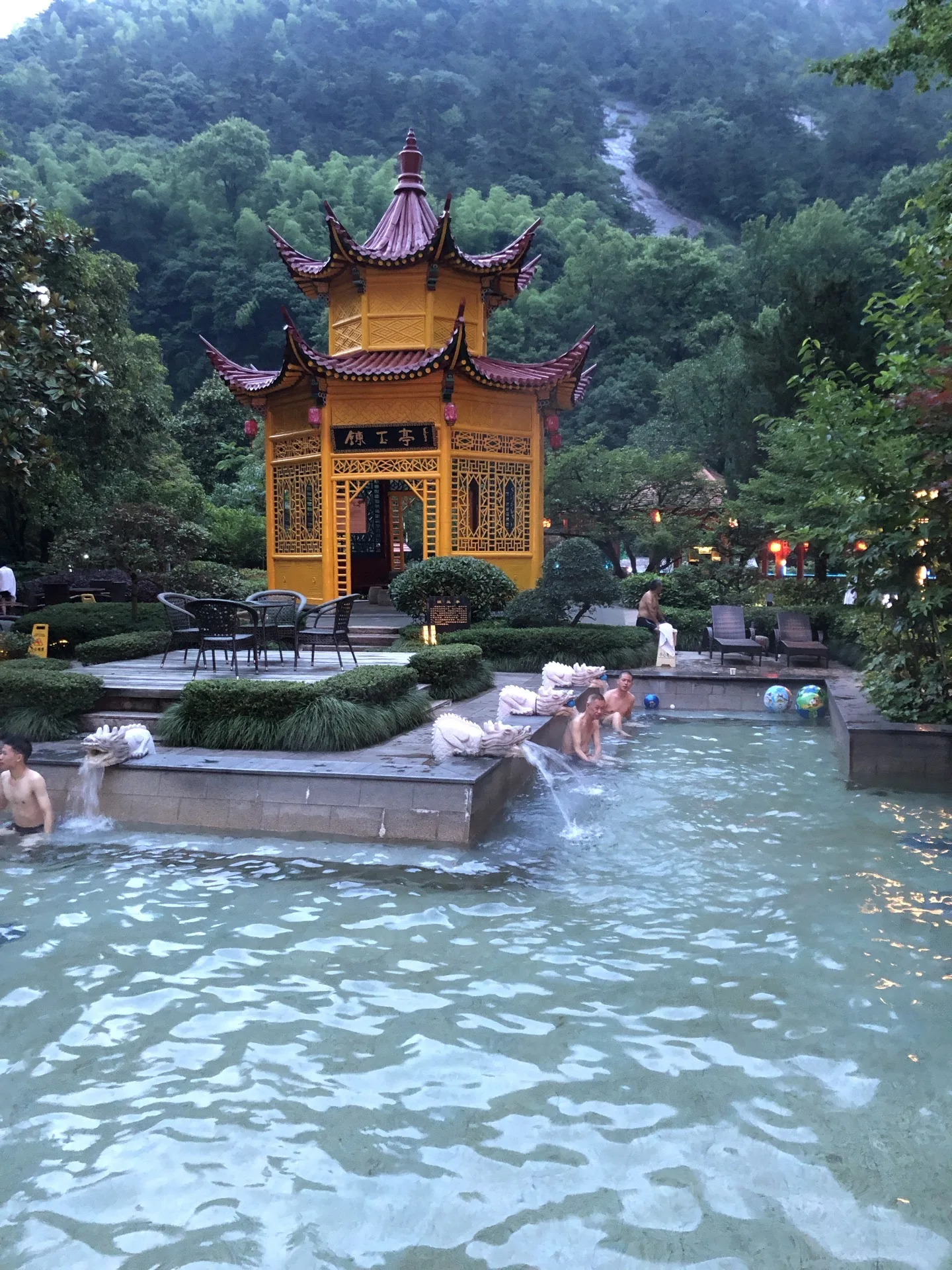
The image used on this page shows the grounds of the hot spring area rather than the thermal pools themselves. It was checked before publication precisely because the filename in the repository claims to show hot springs and in fact shows a pavilion and a decorative pool in a garden.
We are saying so here rather than quietly using it, because a photograph labelled as a hot spring that turns out to be a garden pavilion is exactly the kind of small untruth that makes the rest of a page untrustworthy. Commons does not have a photograph of the Huangshan bathing pools either. What the scenic area does have, and what is genuinely worth a few minutes, are the carved cliff inscriptions and the statue of Xu Xiake, the Ming travel diarist whose written account is the most famous record of Chinese inland travel. His presence here is a useful reminder that these springs were on a road between provinces long before there was a cable car.
Best photo spots
-
The landscaped grounds of the hot spring scenic area · Late afternoon, when the light drops into the valley
The grounds are worth a look in their own right, with Huizhou-style pavilions and stonework set against the forested slope behind. Bear in mind these are the buildings, not the pools.
-
The cliff inscriptions in the scenic area · Whenever the light is raking across the stone
Carved inscriptions cut into the rock face within the scenic area, one of the things actually worth seeing here if you have half an hour before or after your soak.
-
The Xu Xiake statue · Daytime
A statue of Xu Xiake, the Ming-dynasty travel diarist whose account of his journeys is the most famous record of Chinese inland travel. Its presence in a hot spring area is a reminder that these springs were on a route long before the cable cars were.
Frequently asked questions
How hot are the Huangshan hot springs?
About 42 degrees Celsius, and that is the point - they hold that temperature all year. It is a hot soak rather than a swimming pool, and the local claim is that the carbonate-rich water helps with skin, joint and nerve complaints. That claim is local tradition rather than something we could verify as a medical effect.
How much do the Huangshan hot springs cost?
We are not going to give you a confident number, because the figures we hold disagree: our seed data says ¥198 and an existing page in our own site says ¥238, and we could not verify either. Confirm the price at the gate on the day you go. Budget separately for pool use or a private room, which are charged on top of entry.
How do I get to the Huangshan hot springs?
They are above Tangkou, the town at the foot of the mountain, and a shuttle service runs roughly every twenty minutes from Tangkou town to the hot spring area, stopping at the same points as the two southern cable car stations. That makes it straightforward to combine with a cable car.
Are the Huangshan hot springs open in winter?
Yes, and this is the unusual thing about them. The water holds its temperature all year, so the springs are genuinely usable in deep winter even when the summit above is covered in snow and ice. That is why they are the standard way to finish a cold mountain day.
Do I need to book the Huangshan hot springs?
It is a day-use resort rather than a timed attraction, so booking is not the pattern. What you do want to confirm on arrival is the current price and the pool and room charges, which are separate from entry.
Can I use the pool and the mountain ticket together?
They are separate purchases at separate places. The hot springs sit below the mountain at Tangkou, and the mountain entrance and any cable car are bought independently. A sensible day is the climb, then or before the soak, rather than trying to hold both at once.
Sources
- Huangshan — English Wikipedia (multiple hot springs, most of them at the foot of the Purple Cloud Peak, water holding at 42 degrees C all year with a high concentration of carbonates, and the local claim that the waters help with skin, joint and nerve complaints) · Wikipedia
- Huangshan — Wikivoyage (the hot springs named as one of the famous attractions of the mountain and located above Tangkou, the shuttle service running every twenty minutes from Tangkou town to the Hot Springs Area alongside the two southern cable cars, and the positions of Tangkou and the Yuping cable car) · Wikivoyage
- Huangshan Hot Springs on OpenStreetMap (node 3630426138 tagged natural=hot_spring at 30.1030497 / 118.1687846 on the Z104 near Xiaoyao Ting, Huangshan District, and the neighbouring viewpoint node 800570288 at 30.1010006 / 118.1703471) · openstreetmap.org
- 黄山温泉 — Wikidata Q12095344 (the item exists and is typed as a hot spring in China, but carries no coordinate statement, which is why no coordinates are published on this page) · Wikidata
- Cliff inscriptions of Wenquan scenic area, Huangshan — Wikimedia Commons (CC BY-SA 4.0, Siyuwj), evidence that the hot spring scenic area itself contains carved cliff inscriptions as well as a Xu Xiake statue · Wikimedia Commons