
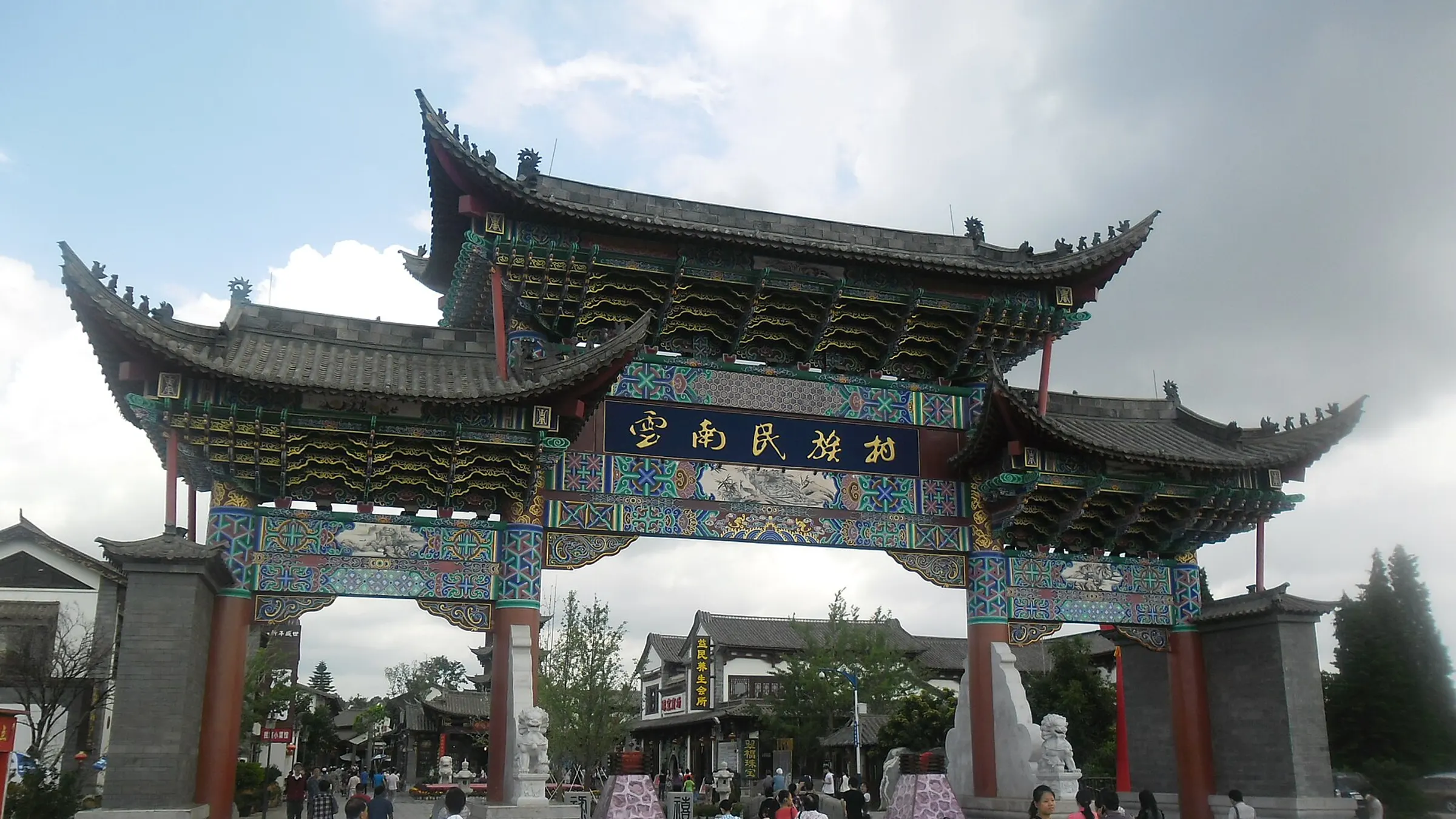
Yunnan Nationalities Village
云南民族村 · Yúnnán Mínzúcūn
Quick answer
One admission price covers every visitor — CNY 90 for the daytime session — and none of the sources we checked lists a separate foreigner ticket or a passport-only counter. The only published exemption is free entry for children 1.2 m or shorter. There is no evidence here of a foreign-passport discount, and equally no evidence of one being required: the gate arranges appear to be ordinary mixed queues. We could not verify which payment methods the gate and the separate ride counters accept, so carry cash alongside your payment app.
Why visit
- 1 A curated 85-hectare theme park presenting 26 of Yunnan's ethnic groups in one walk — the fastest possible overview of the province's building traditions, and plainly not a substitute for the real villages
- 2 Two ticketed sessions: CNY 90 for the daytime (09:00-18:00) and a much cheaper CNY 50 night ticket (17:30-21:30), with the park open 09:00-21:30 and free for children 1.2 m or shorter
- 3 Chinese Wikipedia records 12 village compounds built and opened, plus a Mosuo Home (摩梭之家) — fewer physical villages than the headline 26, and worth knowing before you arrive
- 4 The Bai, Yi and Dai compounds are the substantial ones: 1:4-scale reproductions of Dali's Three Pagodas, a Yi totem column with the Eight Trigrams, and stilted Dai houses around a Burmese-style temple
- 5 Free short performances around the villages through the day, plus an evening show (The Call of the Plateau) at CNY 150 standard or CNY 260 VIP — all separate from admission
- 6 About 8-10 km out on Dianchi Road, so plan it as a half-day rather than a quick detour from the old city
Essential tips for foreigners
- Know what it is before you go. This is a curated park, not a settlement. The 26 ethnic groups are represented through built architectural reproductions, guides and scheduled performances. If you want to see how these communities actually live, this orients you and then you go to the real villages.
- The 26 is a headline, not a building count. English Wikipedia lists 26 groups represented; Chinese Wikipedia records 12 village compounds built and opened plus the Mosuo Home. Both are correct and they count different things — but nobody should expect 26 full villages.
- The night ticket is less than half the price. CNY 50 for 17:30-21:30 against CNY 90 for the daytime session, and the park runs to 21:30. On a tight budget, the evening is where the value is.
- Admission does not include the rides or the show. The site is large. Battery cars, the mini-train, the boat and the evening show are each priced separately, so budget beyond the ticket if you want to cover ground.
- Do not build a tight itinerary around the performance times. The published schedule is explicitly stated to be subject to weather and other factors.
- Give the driver 云南民族村 or 滇池路1310号. Pinyin-only addresses are a reliable way to end up somewhere else; the entrance archway makes arrival easy to confirm.
Suggested route
- 09:00 20 min Arrive through the entrance archway and pay the CNY 90 daytime ticket. Note the gate plaque and the white elephant statues on the lawn near the entrance
- 09:20 30 min Dai Village, the first compound through the gate — stilted bamboo houses on 1.8 hectares surrounded by water on three sides, with a Burmese-style temple at the far end
- 09:50 40 min Solar Calendar Square and Yi Village west of Harmony Square, for the totem column, the tiger rockery and the distilleries
- 10:30 40 min Bai Village, the largest compound — the 1:4 Three Pagodas of Dali, the butterfly specimens, and San Dao Cha if you are thirsty
- 11:10 40 min Walk on to the smaller compounds — Miao, Mosuo, Yao, Naxi — or take a battery car if your legs have had enough. This is where the site gets big
- 11:50 30 min Tea Culture View Garden, then head back toward the entrance. Daytime admission runs to 18:00 and the park to 21:30, so there is no rush
- 12:20 — Exit, or stay on: the elephant show and the free Colorful Clouds performances run through the afternoon, and The Call of the Plateau plays at 13:20-14:10 for CNY 150 standard or CNY 260 VIP
A park of Yunnan in miniature, not the villages themselves
The Yunnan Nationalities Village (云南民族村) is the most misread attraction in Kunming, and the misreading is forgivable: the name says “village”, the sign at the gate is carved in Chinese, and half the travel writing about it describes it as the place to go to see Yunnan’s ethnic minorities. It is in fact a curated park on the shore of Lake Dian that presents selected material from 26 of the province’s ethnic groups in one walkable site. It is a good, well-run and genuinely useful overview. It is also a summary — and a summary is not the thing.
That distinction is worth making before anything else, because it decides how you spend the two or three hours you have here. You are not visiting the Bai, Dai, Yi, Naxi, Hani or Mosuo communities. You are visiting carefully built architectural reproductions of representative dwellings, set in landscaped grounds, staffed by guides dressed in ethnic costume, and scheduled around visitor flow. If you have come to Yunnan to understand how these communities actually live, this is orientation material at best. If you have two spare hours in Kunming, want to see several of the province’s building traditions in one place, and have no realistic chance of travelling to any of the actual villages, it is very difficult to beat.
What the park actually is
English Wikipedia describes it in one sentence that settles the categorisation: “an ethnographic village and theme park that displays the various folklore, culture, and architecture of 26 ethnic groups in Yunnan Province.” The park’s own stated purpose is to present the ethnic diversity, cultural variety and heritage of Yunnan. Both descriptions are consistent, and both are more accurate than “a village”.
It sits in the southwest suburbs of Kunming, right on the shore of Lake Dian (滇池), backing onto the Western Hill Forest Park. Chinese Wikipedia puts it 8 km from the city centre; TravelChinaGuide says 10 km from downtown. Either way, plan it as a half-day rather than a quick detour from the old city.
Size figures vary slightly between sources — English Wikipedia gives 89 hectares, TravelChinaGuide 84 hectares, and both include 31 hectares of water. Call it roughly 85 to 89 hectares, a third of it water. It is classified as a 4A-level tourist attraction, the second tier of China’s national scenic-site grading.
Photo: Wikimedia Commons / CC BY-SA 4.0 (董辰兴)
Twenty-six groups, twelve built villages
The two headline numbers on this site are easy to conflate, so it is worth separating them.
English Wikipedia lists the 26 ethnic groups represented: Dai, Bai, Yi, Naxi, Wa, Bulang, Jinuo, Lahu, Tibetan, Jingpo, Hani, De Ang, Zhuang, Hmong, Shui, Nu, Mongol, Buyi, Dulong, Lisu, Pumi, Manchu, Hui, Yao and Achang.
Chinese Wikipedia, describing what has actually been built and opened, records 12 village compounds — Bai, Dai, Yi, Wa, Naxi, Tibetan, Lahu, Jinuo, Bulang, De Ang, Hani and Jingpo — plus one Mosuo Home (摩梭之家).
These are not in conflict; they count different things. Twenty-six groups are represented across the site as a whole, while 12 full village compounds have been constructed as walk-through spaces. The honest summary is that you should not arrive expecting 26 self-contained villages. Half the groups are represented by smaller exhibits, displays and performance rather than a full architectural compound you can walk into, and the Mosuo compound is a distinct addition rather than one of the twelve.
That gap is the single most useful thing to know before you buy a ticket, and almost no short guide tells you.
Hours and what a ticket actually buys
The park operates 09:00 to 21:30, split into two separately ticketed sessions:
- Daytime: CNY 90, 09:00–18:00, last entry 16:30.
- Night: CNY 50, 17:30–21:30, last entry 20:30.
Children 1.2 metres or shorter are free. The park also opens at night whenever one of the minorities’ festivals is running, and the night ticket is the cheaper of the two.
The night ticket deserves attention in its own right. At less than 60% of the daytime price, and with the park open until 21:30 and free short performances running into the early evening, it is by some distance the better-value visit for anyone watching budget. What you trade away is daylight, and with it most of the photography.
Crucially, admission is not an all-inclusive ticket. These are all charged separately:
- The Call of the Plateau, the evening show on Dianchi Stage — CNY 150 standard, CNY 260 VIP.
- Battery cars — CNY 300 for a 7-seat car over two hours, CNY 500 for a 13-seat car over two hours.
- Sightseeing mini-train — CNY 30 per person. Sightseeing boat — CNY 20 per person.
- Electro car — CNY 80 per hour. Balance bike — CNY 80 per hour.
- Quadricycle, 2 or 4 seats — CNY 100 per vehicle for three hours.
On a site this size, those rides are the difference between seeing the park and crossing it. If you intend to cover ground rather than visit two or three compounds, price them into your budget.
The three villages that carry the visit
Dai Village is the first thing you see through the gate, and for good reason. It occupies 1.8 hectares and is surrounded by water on three sides, with bamboo houses built on stilts under the shade of trees and flowers. A path paved with red sandstone leads to a Burmese-style temple whose white tower and pavilions are the compound’s focal point. The Dai are associated with singing and dancing — the peacock dance, and music on cucurbit flutes — and that is what the staging here plays on.
Yi Village lies west of Harmony Square and covers more than 3.4 hectares. Because the Yi are said to hold the tiger in respect, the compound includes a tiger rockery and a wall engraved with three tigers. The centrepiece is the Solar Calendar Square, with a giant totem column carved with the sun, fire, tigers and the Eight Trigrams, ringed by ten black and white stone spheres and twelve zodiac carvings. There are also distilleries, bullrings, and a seesaw-like village game called Mo Qiu.
Bai Village is the largest compound in the park. Its traditional dwellings combine Han architectural strengths with Bai forms, and the three white towers are built at 1:4 scale to reproduce the Three Pagodas of Dali — a deliberate, unmistakable borrowing from the most photographed Buddhist site in Yunnan. There are butterfly specimens on display, and a tea tradition called San Dao Cha, three cups of tea: bitter, sweet, then a blend, mapping onto the Bai idea that hardship comes first and a better life after.
Beyond those three, Miao, Mosuo, Yao, Naxi, Wa, Hani, Lahu and Achang compounds are open, and there is a Tea Culture View Garden for the region’s tea rather than its buildings. Chinese Wikipedia also notes that guides dressed in ethnic costume explain the customs of the various groups, alongside staged scenes of weddings and festival days.
Shows, and why not to plan around them
Free short performances called Colorful Clouds run at various village locations through the day. The published schedule runs Achang Court at 09:30 and 11:30 and again at 16:10; Daogan Square at 10:10 and 11:20 and 17:00; Wa and Bai Village at 10:30, around midday, and again at 17:00; Yi at 10:40 and 13:20 and 16:10; Hani, Dai, Lahu and Muosuo through late morning and the mid-afternoon.
Alongside these there is an elephant show with separate riding and photography sessions, water screen films, and ethnic cabarets. The evening show, The Call of the Plateau, plays on Dianchi Stage.
One caveat matters more than the times themselves: TravelChinaGuide states explicitly that the schedule is subject to change due to weather and other factors. Treat it as a menu rather than an itinerary, and do not build a tight connection around a 20-minute slot.
Festivals, if you can time the trip to one
The park stages minority festivals so that visitors can see festival behaviour compressed into a short window. If your dates happen to line up, this is the park at its most alive:
- The Dai Water-Splashing Festival (泼水节), 13–16 April.
- The Bai March Fair (三月街).
- The Yi Torch Festival (火把节), on the 24th day of the sixth lunar month.
- The Jingpo Munao Zongge (目瑙纵歌).
- The Jinuo New Rice Festival (新米节), from the end of July into early August.
- The Lisu Knife Pole Festival (刀杆节).
Note what this list reveals about the park’s design. These are staged versions of festivals whose real observances are tied to specific villages and dates spread across the province — which is another way of saying that the park’s job is to give you the shape of the thing in miniature. That is a fine thing for a park to do. It is just not the same as being there.
Getting there
The address is 1310 Dianchi Road (滇池路1310号), on the lake shore in the southwest suburbs.
TravelChinaGuide lists bus lines 24, 44, 73, 94, 171, A1, K31 and Tourist Line 1 to the Yunnan Minzucun stop; English Wikipedia lists 44, 73 and A1. Kunming bus routes do get renumbered, so confirm at the stop rather than trusting a list — and note that with a long wait, a bus is a poor trade for a short ride.
A taxi or Didi is the realistic choice for most visitors. Give the driver 云南民族村, or the address as 滇池路1310号; translating the pinyin on the spot is a reliable way to end up somewhere else. Arrival is easy to confirm, because the entrance archway (牌坊) carries the park’s name and is visible from the road.
When to go, and the honest verdict
It operates year-round, but it is an open-air site on a lake shore with village compounds built largely without weather protection. It is at its best in dry, settled weather. During Kunming’s wet season the open-air architecture and the lake-front paths are the weak point, and the daytime programme holds up better than the evening shows. If you have one fixed day in the city, pick the driest forecast day rather than optimising for a particular month.
Two to three hours is the right target for the daytime session. The site is large and the compounds are strung along the shore, so cover the Bai, Yi and Dai compounds properly and treat the rest as optional, or pay for a battery car and see more.
The honest summary is this. The Yunnan Nationalities Village is a competent, well-run, genuinely educational park that answers a question most visitors to Kunming cannot easily answer for themselves — what do the building traditions of two dozen of Yunnan minorities actually look like? For that, and for two or three hours that also put you on the shore of Lake Dian, it earns its ticket. It is a curated presentation of the villages rather than the villages, and the value of seeing one real Bai or Hani or Mosuo village is not close to what this park can give you. Go with that expectation and you will have a good afternoon. Expect the villages and you will be disappointed by a well-run park that was never trying to be one.
Best photo spots
-
The entrance archway on Dianchi Road · Morning, before tour groups arrive
The park's main gate, with the five-character name 云南民族村 on the plaque and a flying golden phoenix logo below it. The easiest shot to confirm to a driver that you have arrived at the right place.
-
The white elephant statues on the lawn near the gate · Any time in daylight
A group of white elephant statues stands on the grass by the entrance. They are there because welcoming distinguished guests with elephants is the custom here, which makes them a good conversation piece as much as a photo.
-
Solar Calendar Square, Yi Village · Late afternoon, when the light rakes across the totem column
The giant totem column carved with the sun, fire, tigers and the Eight Trigrams, ringed by ten black and white stone spheres and twelve zodiac carvings. The strongest single piece of symbolic design in the park.
-
The Bai Village white towers · Morning or late afternoon
Three white towers built at 1:4 scale to reproduce the Three Pagodas of Dali. Photographed straight on, they read as the Dali landmark they are imitating.
Frequently asked questions
What is the Yunnan Nationalities Village?
A curated ethnographic theme park in the southwest suburbs of Kunming, on the shore of Lake Dian, that presents the folklore, culture and architecture of 26 of Yunnan's ethnic groups. It is classified as a 4A-level tourist attraction. It is a good overview — and a summary, not a substitute for visiting the real villages.
Is it worth visiting?
Yes, for what it actually is: the fastest way to see several of Yunnan's distinct building traditions in a single two-to-three-hour visit, with staged performances and a lake setting. It is not a substitute for the real villages, and if your interest is in how these communities live rather than how they have looked, you will find it thin.
How much does it cost?
CNY 90 for the daytime session (09:00-18:00, last entry 16:30). A separate night session (17:30-21:30, last entry 20:30) costs CNY 50. Children 1.2 m or shorter are free. The evening show and the in-park vehicle, boat and train rides are all priced separately from admission.
What are the opening hours?
The park runs 09:00-21:30. Ticketed sessions are daytime 09:00-18:00 with last entry at 16:30, and night 17:30-21:30 with last entry at 20:30. The park also opens at night whenever a minority festival is running, when the night ticket is comparatively cheaper. Published show times are stated to change with weather and other factors.
How many ethnic groups are there?
Twenty-six are represented, according to English Wikipedia, which lists them: Dai, Bai, Yi, Naxi, Wa, Bulang, Jinuo, Lahu, Tibetan, Jingpo, Hani, De Ang, Zhuang, Hmong, Shui, Nu, Mongol, Buyi, Dulong, Lisu, Pumi, Manchu, Hui, Yao and Achang. However, Chinese Wikipedia records that 12 village compounds have actually been built and opened, plus a Mosuo Home (摩梭之家). The two figures count different things.
How long should I spend there?
Two to three hours for the daytime session. The park covers roughly 85-89 hectares including about 31 hectares of water, and the built villages are spread out along the shore, so the paid battery cars and the mini-train exist for a reason. Stay into the evening only if you want the cheaper night ticket and the shows.
How do I get there from Kunming?
It is at 1310 Dianchi Road (滇池路1310号), about 8-10 km from the city centre. TravelChinaGuide lists bus lines 24, 44, 73, 94, 171, A1, K31 and Tourist Line 1 to the Yunnan Minzucun stop; English Wikipedia lists 44, 73 and A1. A taxi or Didi with the Chinese name is simpler and, given the distance, what most visitors should do. Kunming bus routes do change, so confirm before relying on a specific line.
Do foreign visitors need to book in advance?
Nothing we checked describes an advance booking system. Admission is bought at the gate, split into daytime and night sessions. Bring cash as well as a payment app, since we could not verify which methods the gate and the separate ride counters accept, and there is no indication of a foreigner discount — one published price covers everyone.
What can I see inside?
The Bai, Yi and Dai compounds are the substantial ones. Bai has three white towers built at 1:4 scale reproducing the Three Pagodas of Dali, butterfly specimens, and the three-cups-of-tea tradition. Yi has a tiger rockery and a Solar Calendar Square totem column carved with the sun, fire, tigers and the Eight Trigrams. Dai has stilted bamboo houses on 1.8 hectares surrounded by water. Miao, Mosuo, Yao, Naxi, Wa, Hani and Lahu compounds are also open, along with a tea culture garden.
What are the shows?
Short free performances titled Colorful Clouds run at various village locations through the day — published slots include Achang Court, Daogan Square, Wa, Bai, Yi, Hani, Dai, Lahu and Muosuo, mostly in the morning, around midday and again in the late afternoon. Separately there is an elephant show, water screen films, ethnic cabarets, and the evening show The Call of the Plateau on Dianchi Stage, at CNY 150 for a standard ticket and CNY 260 for VIP.
Sources
- Yunnan Ethnic Village — English Wikipedia (theme-park description, 26 ethnic groups and full list, 89 hectares including 31 of water, 4A rating, location next to Dianchi, address, bus lines, festival dates)
- 云南民族村 — Chinese Wikipedia (on the shore of Dianchi 8 km from the city centre, 1300 mu, the 12 village compounds actually built plus the Mosuo Home, guides in ethnic dress explaining customs, festival list)
- Yunnan Nationalities Village — TravelChinaGuide (daytime CNY 90 / night CNY 50 tickets, daytime 09:00-18:00 last entry 16:30 and night 17:30-21:30 last entry 20:30, park hours 09:00-21:30, free under 1.2 m, gate plaque and white elephants, Dai/Yi/Bai village detail, Colorful Clouds timetable, The Call of the Plateau prices, in-park transport prices, bus lines, last updated 7 Aug 2026)
- Wikidata Q9384908 — Yunnan Ethnic Village (English label, Commons category, Google Knowledge Graph identifier)
- File:云南民族村-入口牌坊.jpg — Wikimedia Commons (hero image: the entrance archway, photographed by 董辰兴, CC BY-SA 4.0, depicts Q9384908)