
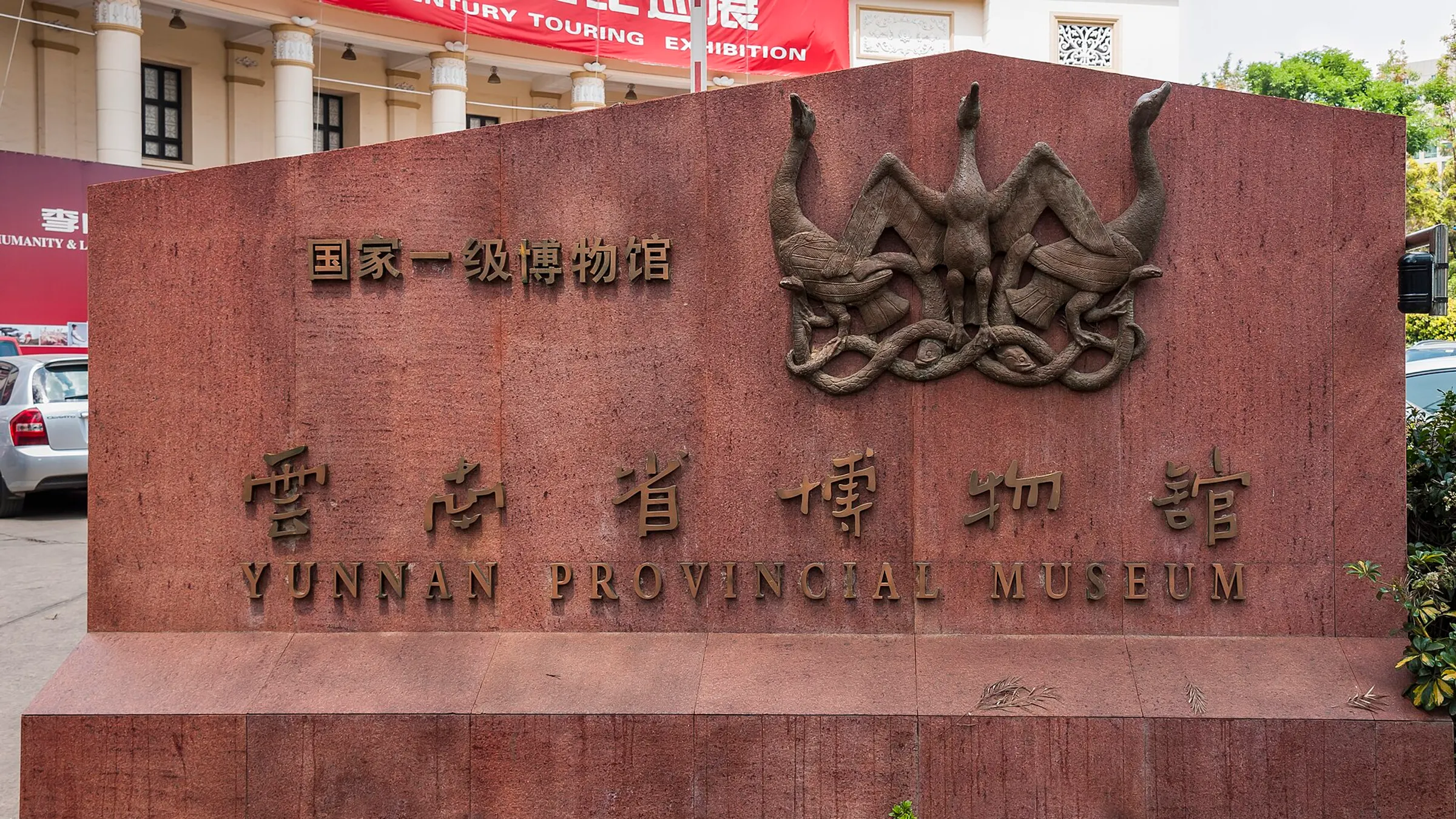
Yunnan Provincial Museum
云南省博物馆 · Yúnnán Shěng Bówùguǎn
Quick answer
Foreign passport holders pay nothing and need nothing beyond the passport they travel on. Visitors exchange a valid ID document for an admission ticket at the entrance desk and clear security screening, exactly as at any Chinese public building. Permanent exhibition labels are in Chinese.
Why visit
- 1 Free admission — a passport is the only thing you need, and this is a national first-grade museum (国家一级博物馆), the highest grade China assigns
- 2 **Closed Mondays**, open roughly 09:00-17:00 Tuesday to Sunday. The one scheduling fact that decides whether you see anything
- 3 Over 230,000 items in the collection, with more than 10,000 objects on display across six permanent galleries and four special exhibitions
- 4 The centre of gravity is the Dian kingdom bronze material (古滇青铜文明) from the tomb excavations at Jinning — the context that makes the rest of Yunnan make sense
- 5 Best wet-weather option in Kunming: entirely indoors, free, and two hours well spent
- 6 The current building opened on 18 May 2015, designed after the traditional Yunnan courtyard house 「一颗印」 and the weathered karst of the Stone Forest
Essential tips for foreigners
- Never plan a Monday. Chinese state museums close on Mondays as standard, and this one is no exception — if your Kunming itinerary starts on a Monday, move this to a later day before you book anything else around it.
- Bring the passport you travel on. Visitors exchange a valid ID document for an admission ticket at the desk and then clear security screening.
- Go straight to 《文明之光——青铜时代的云南》 (Light of Civilisation — Bronze Age Yunnan). It is the gallery that makes the rest of the province legible, and it is where the objects are worth the trip on their own.
- Budget two hours, not four. Six permanent galleries plus rotating special exhibitions invite a full day; the material that matters is concentrated, and two focused hours beat a rushed four.
- Keep it as your wet-weather swap. Kunming's rain season runs roughly May to October, when the Stone Forest and Western Hills are unreliable and this free indoor museum is not.
- Show the driver 云南省博物馆 or 广福路. Translation apps stumble on the pinyin; the stone monument at the gate carries both 云南省博物馆 and YUNNAN PROVINCIAL MUSEUM, so it is easy to confirm you are in the right place.
Suggested route
- 09:00 15 min Arrive at the entrance on Guangfu Road. Passport at the desk for an admission ticket, then security screening. Budget 15 minutes for the queue at peak times
- 09:15 45 min Go first to 《文明之光——青铜时代的云南》 — the Bronze Age Yunnan gallery. The Ox and Tiger Bronze Table and the cowrie containers are here
- 10:00 20 min Move on to 《南中称雄》 covering the Eastern Han to Wei-Jin period, where the Dian material gives way to early imperial administration
- 10:20 30 min 《妙香佛国》 for the Tang and Song period, then 《开疆戍边》 for Yuan, Ming and Qing — the Buddhist and imperial chapters
- 10:50 20 min 《风云百年》 for the modern period, to close the chronological sweep. Keep an eye on the clock: the galleries close at 17:00
- 11:10 30 min If time allows, walk whichever of the four special exhibitions is running — these rotate and are the reason to come back twice
- 11:40 10 min Exit. The entrance monument outside is the natural photo stop before getting a Didi back toward the old city
Free, closed Mondays, and two hours well spent
The Yunnan Provincial Museum is the single most useful indoor stop in Kunming, and it is free. Admission costs nothing for anyone, foreign passport holders included. It is also a national first-grade museum (国家一级博物馆) — the highest grade China assigns, and the grade carved on the stone monument at the entrance. The collection runs to more than 230,000 items, of which over 10,000 are on display at any time across six permanent galleries and four special exhibitions.
What earns it a place on a Kunming itinerary, rather than being indoor filler, is the Bronze Age material. The centre of gravity of the collection is bronze and lacquer from the Dian kingdoms (滇王国), excavated from the tomb complexes at Jinning on the southern rim of Lake Dian. If you go to the Stone Forest or Dali and want to understand why the province looks the way it does, this is where the ground is laid.
The museum traces its origin to 1951, when the Yunnan provincial government approved a preparatory committee that August; it was formally established in the spring of 1959. It has run more than a hundred archaeological excavations and surveys across the province, including the large-scale digs at the Shizhaishan (石寨山) and Lijia Shan (李家山) tomb complexes that produced the Dian bronzes.
Photo: Wikimedia Commons / CC BY-SA 3.0 (CEphoto, Uwe Aranas)
Before you go: hours, entry, and the Monday trap
Opening hours are approximately 09:00-17:00, Tuesday to Sunday. Closed Mondays.
The Monday closure is not a quirk of this museum — it is the standard for Chinese state museums, and it is the single fact most likely to derail a foreign visitor’s plans. Itineraries tend to start on a Monday, because that is when a trip begins, and then the museum that was meant to anchor Tuesday’s context is the one thing you cannot see. Sort the week out before booking anything around it.
Public holidays are the exception: the museum normally opens on statutory holidays, and instead closes for special circumstances. If you are travelling over Golden Week or the Spring Festival, confirm closer to the date rather than assuming either way.
Entry itself is the easy part. Walk in, hand your passport — or any valid ID document — to the desk, receive an admission ticket, and pass security screening. There is no booking, no payment, and no mini-program to set up beforehand. Bring the physical document: this is the kind of check that does not accept a photo of a passport on a phone.
The six permanent galleries
The permanent exhibition is a chronological walk through the province, and the gallery titles are given here in Chinese because that is how they are labelled in the building.
The six permanent galleries run from prehistoric Yunnan through to the modern century, with four special exhibitions alongside them rotating their contents.
They move in order: 《远古云南》 on the prehistoric period, then 《文明之光——青铜时代的云南》 for the Bronze Age, 《南中称雄》 for the Eastern Han through Wei-Jin, 《妙香佛国》 for the Tang and Song, 《开疆戍边》 for the Yuan, Ming and Qing, and 《风云百年》 for the modern era. Read them in sequence and the province assembles itself as a single story; arrive at the Bronze Age gallery cold and it is just a room of unfamiliar metalwork.
Start in the Bronze Age gallery
This is the reason to come. The Dian kingdoms flourished around Lake Dian in the first millennium BC, and the bronzes recovered from the Jinning tomb complexes are among the most distinctive finds in Chinese archaeology — a bronze tradition that does not simply follow the Central Plains models of the Zhou.
Four objects to look for:
The Ox and Tiger Bronze Table (牛虎铜案) is the museum’s signature treasure from the Warring States period — a ritual table cast in one piece, with an ox and a tiger in the round on top. It is the single most recognisable object in the collection.
The gilt-bronze cowrie container with four oxen and a mounted rider (西汉四牛鎏金骑士铜贮贝器) is a Han-period piece built around a practical object: cowrie shells were money in this part of China, and containers like this stored them. The sculptural group on the lid turns storage into theatre.
The cowrie container with a sacrifice scene (杀人祭柱场面贮贝器) carries a narrative cast around its lid that records a ritual killing in a form that shocks first-time viewers and then explains the society behind it. It is one of the most discussed objects excavated at Shizhaishan.
The tiger-devouring-ox pillow (虎噬牛铜枕, Warring States) is a small bronze object with an unusually violent composition — a tiger mid-leap over a fallen ox — that was a bolster, not a weapon.
What else is worth your time
Beyond the bronzes, the Tang and Song gallery 《妙香佛国》 holds the Buddhist material of the period, including the silver-gilt, gold-inlaid Garuda bird (大理国银鎏金镶珠金翅鸟) from the Dali Kingdom — a piece of Nanzhao and Dali court metalwork that connects the museum to the temples most visitors come to Yunnan for.
The collection also holds a group of paintings and calligraphy that belonged to Gao Yunhuai, a former Nationalist military officer; the works were confiscated during the Cultural Revolution in 1966 and later returned to the open market. It is a small corner of the museum, and it is the most direct reminder that the institution’s own history, like the province’s, is not tidy.
The four special exhibitions rotate, which is the honest reason to consider a second visit if you are in Kunming for a week rather than a day.
The building: 一颗印 and the Stone Forest
The museum moved to its current building on 18 May 2015, replacing the Soviet-style building on Wuyi Road that had housed it since the 1960s and which is itself a listed provincial heritage structure.
The new building draws on two very specific Yunnan references. Its plan takes the form of the traditional Yunnan courtyard house known as a 「一颗印」 — the “single seal” layout, a square plan enclosed within a square, named for the resemblance of its roofline to a seal impression. The exterior takes its weathered, pitted profile from the karst formations of the Stone Forest, the same limestone formations that draw most visitors to the region in the first place. Inside it has three storeys, roughly 61,800 square metres of floor area, and about 16,500 square metres of exhibition space.
It is worth a look even if the galleries do not hold you — the building is doing something specific about place rather than being a generic box.
Getting there
The museum is at No. 6393 Guangfu Road (广福路6393号) in Guandu District, on the left bank of the Baoxiang River (宝象河), in the new building.
The reliable approach is a Didi or taxi. Give the driver 云南省博物馆, or the address as 广福路6393号 — translating the pinyin on the spot is a reliable way to end up somewhere else. Arrival is easy to confirm: the stone monument outside the gate carries both 云南省博物馆 and YUNNAN PROVINCIAL MUSEUM, carved with the 国家一级博物馆 designation beneath.
Two hours, and the rain plan
Kunming’s rain season runs roughly May to October, and it is the reason this museum earns its slot. The Stone Forest, the Western Hills and the temples around the lake all degrade in wet weather; the provincial museum does not, because it is indoors, free, and open six days a week.
Two hours is the right target. Go to the Bronze Age gallery first while you still have attention, work forward through the chronology, and stop at 17:00 rather than trying to see all six permanent galleries plus four special exhibitions. The museum is not going anywhere, and it takes an annual pass-holder to get real value out of the back half.
Final tip
Put the museum on the same day as something you need context for, not as a rainy-day afterthought. Seen on the morning after a Stone Forest day trip, the Bronze Age gallery explains what you were standing in front of the day before — the provincial archaeology that produces the bronzes, the bronzes that explain the objects, and the objects that make the province legible. Seen on a wet Tuesday afternoon, it is still a good free museum. Seen in sequence, it is the reason the rest of the trip makes sense.
Best photo spots
-
Entrance monument on Guangfu Road · Morning, before the midday crowds
The stone monument at the gate carries 云南省博物馆 and YUNNAN PROVINCIAL MUSEUM, plus the 国家一级博物馆 grade designation. It is the quickest way for an arriving driver to confirm the right destination.
-
Ox and Tiger Bronze Table (牛虎铜案) in the Bronze Age gallery · Any time — it is a display case, lit for viewing rather than for photography
The museum's signature object from the Warring States period. Shoot the case rather than the room: the object carries the detail, and the surrounding gallery is busy with school groups in the middle of the day.
Frequently asked questions
Is the Yunnan Provincial Museum free?
Yes. Admission is free for all visitors, foreign passport holders included, and there is no separate foreigner ticket price. You exchange a valid ID document for an admission ticket at the entrance desk and clear security screening.
Is the Yunnan Provincial Museum open on Mondays?
No — it closes on Mondays, as Chinese state museums standardly do. It opens Tuesday to Sunday. Public holidays are the exception, when it normally opens, and it may also close for special circumstances, so confirm before a holiday trip.
What are the opening hours of the Yunnan Provincial Museum?
Approximately 09:00-17:00, Tuesday to Sunday. No separate last-entry time is published, so arrive with an hour to spare rather than planning to walk in at 16:30.
How long does it take to visit the Yunnan Provincial Museum?
Two hours is a good target. That is enough for the Dian kingdom bronze gallery and a walk through the chronological permanent exhibitions without dragging a Kunming day around it. Families and keen museum-goers will happily take three.
What are the must-see exhibits at the Yunnan Provincial Museum?
The Bronze Age Yunnan gallery (《文明之光——青铜时代的云南》). Look for the Ox and Tiger Bronze Table (牛虎铜案), the museum's signature treasure from the Warring States period, the gilt-bronze cowrie container with four oxen and a mounted rider from the Western Han (西汉四牛鎏金骑士铜贮贝器), and the tiger-devouring-ox pillow (虎噬牛铜枕). The cowrie containers are the clearest introduction to how the Dian kingdoms stored and used shell money.
Do I need to book in advance, and will they accept a foreign passport?
Neither. It is a walk-in free museum: bring your passport, hand it over at the entrance desk in exchange for an admission ticket, and pass security screening. No booking, no payment, no mini-program.
Is it worth visiting if I am only in Kunming for one day?
Yes, and it is the best rain-proof option in the city. It is free, indoors, two hours, and it carries the Bronze Age material excavated at Jinning on the southern shore of Lake Dian — the background that explains why the rest of Yunnan looks the way it does. On a wet day it beats a damp Stone Forest.
Is the museum in central Kunming, and how do I get there?
It is on Guangfu Road (广福路6393号) in Guandu District, in the new building that has housed the museum since May 2015, beside the Baoxiang River. The practical approach is a Didi or taxi with the Chinese name 云南省博物馆 — confirm arrival at the stone monument outside the gate.
Sources
- Yunnan Provincial Museum — English Wikipedia (founding, old and new buildings, Jinning tomb collection)
- 云南省博物馆 — Chinese Wikipedia (address, opening hours and closure days, free entry, collection totals, permanent gallery list, key objects)
- Wikidata Q2114114 — Yunnan Provincial Museum (coordinates, 1951 inception, Commons category)