
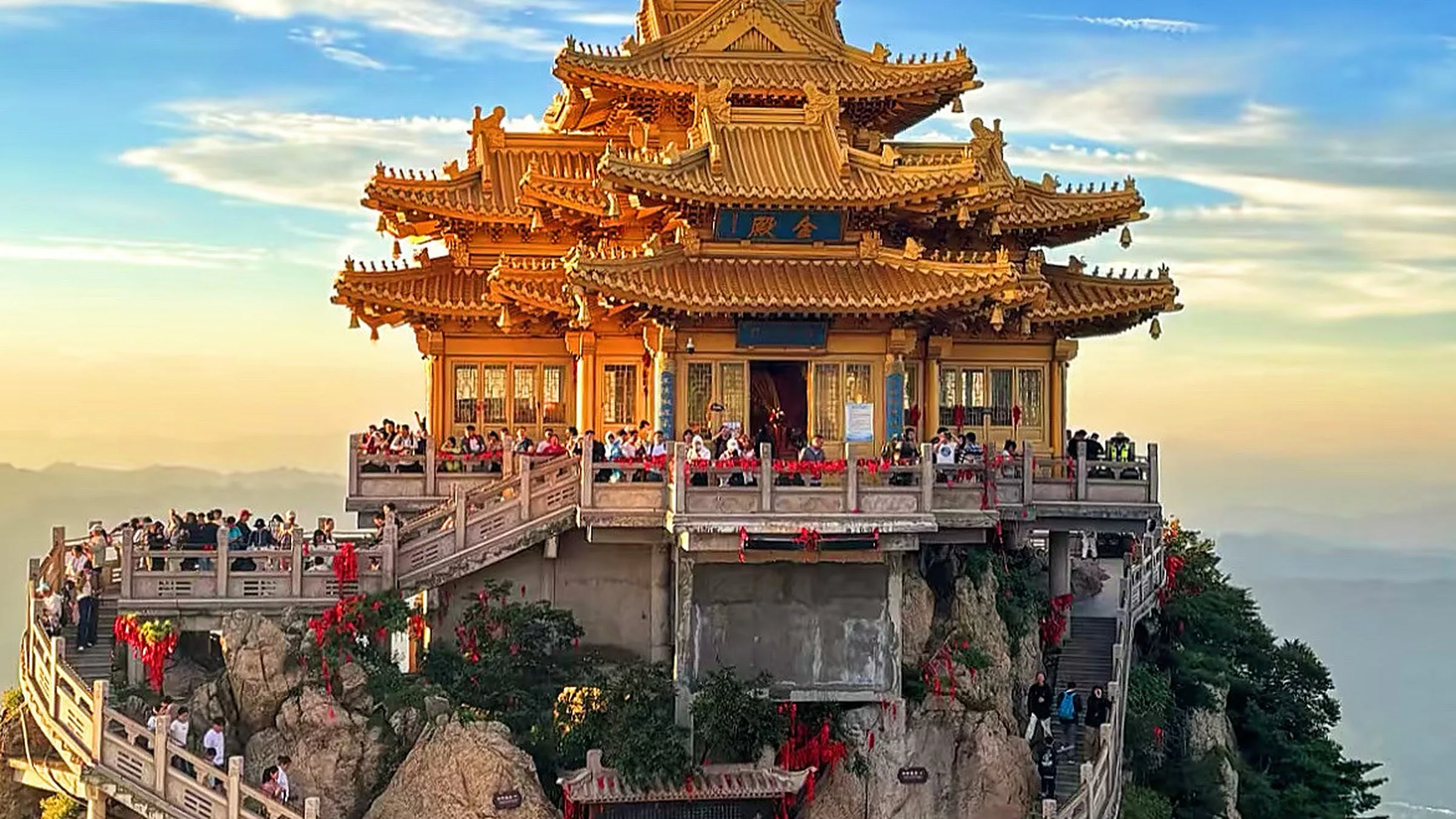
Laojun Mountain
老君山 · Lǎojūn Shān
Quick answer
Foreign passport required at entry. Tickets sold at the gate in cash, Alipay, or WeChat Pay. No advance booking required. The mountain is a state-managed 5A scenic area.
Why visit
- 1 Golden Summit (金顶道观群) — a Taoist temple complex of 5 golden-roofed halls perched on a 2,217m rocky outcrop
- 2 Named after Laozi (老子), the founder of Taoism, who is said to have cultivated here in the 6th century BC
- 3 Ten-Mile Painting Screen (十里画屏) — a 5-km ridge walk with views of stone peaks that inspired Song-dynasty landscape painters
- 4 One of the few Chinese mountains where you can see snow-capped peaks within a half-day of Luoyang city
- 5 Glass skywalk (玻璃栈道) — a 30-m glass-bottomed cantilevered walkway on the south side of the summit, 2,100 m above sea level
- 6 Winter snow scenery on the golden roofs is the most-photographed scene in all of Luoyang
Essential tips for foreigners
- Take both cable cars (¥80 + ¥80) — the walking path from the base to the Golden Summit is 12 km and 4-5 hours of vertical climb. The cable cars are the only practical option for most visitors.
- Visit in winter (December-February) for the most-photographed scene: the golden-summit Taoist temples covered in snow. Spring and autumn are also good; summer brings thunderstorms and the cable cars shut down in storms.
- Start at 07:00-08:00 to be on the summit by 10:00 — the best light for photography of the Golden Summit is mid-morning. Most tour groups arrive at 11:00 and the place becomes shoulder-to-shoulder.
- Bring a warm jacket even in spring and autumn — the summit is 1,500m higher than Luoyang city (2,217m vs 700m), and temperatures are 8-12°C cooler. Winter temperatures can be -15°C with wind chill.
- Don't skip the Ten-Mile Painting Screen (十里画屏) between the two cable cars — it's the most scenic walking section, with stone peaks and views of the surrounding Funiu Mountains. Allow 1.5-2 hours for the full 5-km ridge walk.
- Avoid weekends and Chinese National holidays (Oct 1-7, May 1-3, Spring Festival). The site receives 30,000+ visitors per day during peak weekends; on a normal weekday, 2,000-3,000. The Golden Summit is much smaller than the crowds suggest.
Suggested route
- 06:00 3.5 hours Early Didi from Luoyang city to Laojun Mountain Scenic Area (3.5 hours, ¥500-700). Or HSR from Luoyang Longmen Station to Luanchuan Station (45 min, ¥45-65) and Didi from Luanchuan to the mountain (40 km, 1 hour, ¥120-180).
- 09:30 30 min Arrive at the visitor center, buy ticket (¥100) and first cable car (Zhongtianmen, ¥80). Take the cable car up.
- 10:00 1.5-2 hours Walk the Ten-Mile Painting Screen (十里画屏) — a 5-km ridge walk with views of stone peaks. Allow 1.5-2 hours at a moderate pace.
- 11:30 15 min Take the second cable car (Yunjing Cableway, ¥80) up to the Golden Summit
- 11:45 1.5 hours Explore the Golden Summit complex: 5 Taoist temples, the glass skywalk, the panoramic viewing platforms. Allow 1-2 hours.
- 13:15 45 min Lunch at the on-site restaurant (basic Chinese food, ¥50-80/person) or bring your own snacks
- 14:00 1 hour Optional: walk the less-crowded south-side paths for different Golden Summit views
- 15:00 1.5 hours Take Yunjing Cableway down (¥80), then walk the shorter return path to Zhongtianmen
- 16:30 2.5 hours (Didi) or 1.5 hours (HSR + Didi) Take Zhongtianmen cable car down, then return transfer to Luoyang city
The mountain of the founder of Taoism
Laojun Mountain is the most sacred Taoist mountain in central China, named after Laozi (老子, “Old Master”), the 6th-century BC philosopher who founded Taoism and is traditionally credited with writing the Tao Te Ching. According to legend, Laozi traveled to this mountain in his old age to cultivate the Way (道, Dao), and the mountain has been a Taoist pilgrimage site ever since.
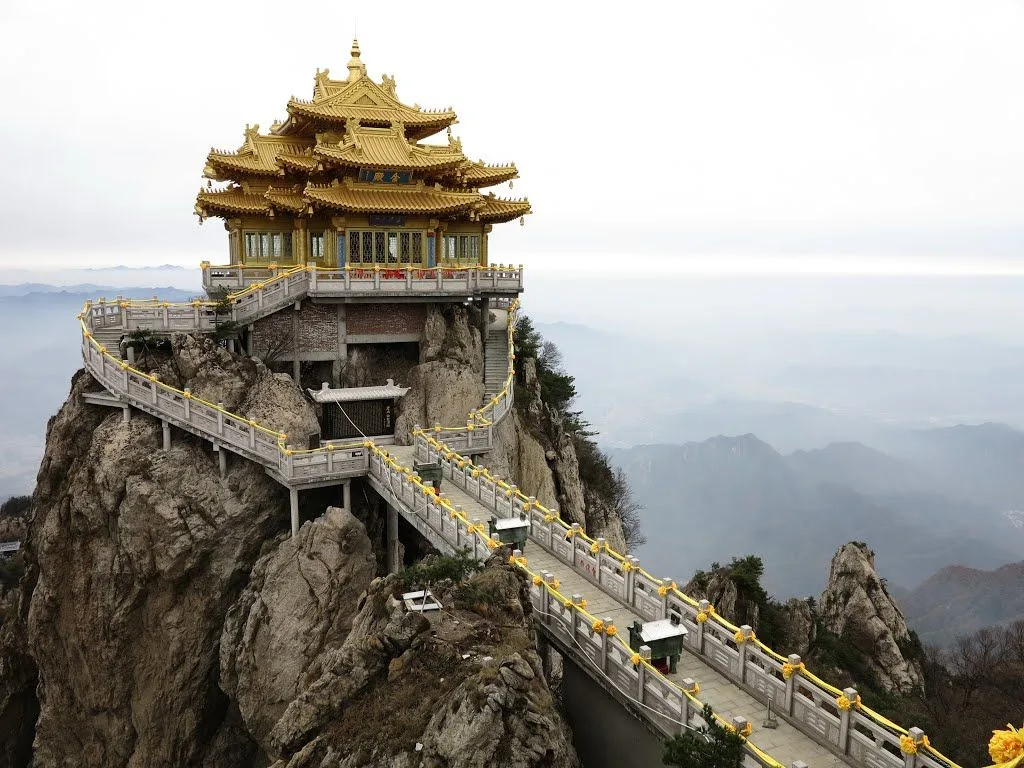
Photo: Wikimedia Commons / CC BY-SA. Source

The 2,217-meter peak is the highest in the Funiu Mountain range that runs along the Henan-Shaanxi border. The summit is dominated by the Golden Summit (金顶道观群) — a cluster of 5 Taoist temples with golden glazed-tile roofs, built in 1994-2014 to replace earlier temples destroyed in the Cultural Revolution. The temples are perched on a narrow rocky outcrop with sheer cliffs on three sides, giving the entire complex the appearance of floating in the clouds. The most-photographed scene: the Golden Summit covered in snow, the golden roofs contrasting against the white landscape.
Laojun Mountain is in Luanchuan County, 150 km south of Luoyang city. The full-day round trip from Luoyang takes 10-12 hours including the 3.5-hour drive each way. Most foreign visitors do it as a 1-day side trip from Luoyang with an early 6:00 AM start.
The Taoist mountain experience
Laojun Mountain is the most accessible major Taoist mountain in China. The cable car infrastructure (two cable cars, total 20 minutes of riding) brings visitors to within 15 minutes of the Golden Summit on foot. The mountain is therefore accessible to non-hikers, families with children over 6, and senior visitors — unlike Wudangshan or other Taoist mountains that require multi-day climbing.
The day at Laojun Mountain follows a standard pattern:
- Cable car up (Zhongtianmen): 20 min, 800m vertical gain
- Ten-Mile Painting Screen walk (十里画屏): 5-km ridge walk between the two cable cars, the most scenic section. Allow 1.5-2 hours.
- Second cable car up (Yunjing Cableway): 15 min, 500m vertical gain to the Golden Summit
- Golden Summit exploration: 5 Taoist temples, the glass skywalk, panoramic views. Allow 1-2 hours.
- Return: reverse the route
The total visit is 6-8 hours from the visitor center to the visitor center.
A brief history
6th century BC: Laozi, the founder of Taoism, is said to have cultivated on this mountain. The mountain becomes a sacred Taoist site.
Tang dynasty (618-907 AD): The mountain is named Laojunshan (老君山, “Old Lord Mountain”) in honor of Laozi. The first Taoist temples are built at the summit. Emperor Xuanzong of Tang builds a Taoist temple complex on the summit during a 725 AD imperial visit.
Song dynasty (960-1279 AD): The mountain becomes one of the most important Taoist pilgrimage sites in China. The original “Ten-Mile Painting Screen” walking path is built by the monks and pilgrims of this period — the path follows the same route used today.
Ming-Qing dynasties (1368-1912 AD): The Taoist temple complex on the summit reaches its largest extent, with 16 temples housing 200+ Taoist priests. The mountain becomes a destination for both religious pilgrimage and Song-dynasty landscape painting inspiration.
1966-1976 (Cultural Revolution): The Taoist temple complex is destroyed. The Taoist priests are dispersed. The mountain becomes a state forest farm.
1994-2014: The current Golden Summit complex is rebuilt as a 5-temple cluster with golden glazed-tile roofs. The cable car infrastructure is installed. The mountain reopens as a 5A scenic area (China’s highest tourist classification).
What to actually see
Three things stand out. The Golden Summit (金顶道观群): the showpiece — 5 Taoist temples with golden glazed-tile roofs on a 2,217m rocky outcrop. The temples are dedicated to Laozi, the Three Pure Ones, and the Jade Emperor. Active working Taoist temples with resident priests. The Ten-Mile Painting Screen (十里画屏): the 5-km ridge walk between the two cable cars. Stone peaks, cliff faces, distant mountain ranges — the inspiration for Song-dynasty landscape painters. The glass skywalk (玻璃栈道): a 30-m cantilevered glass-bottomed walkway on the south face of the summit at 2,100m. Dramatic view straight down.
The Taoist temple complex (金顶道观群)
The 5 temples at the Golden Summit are:
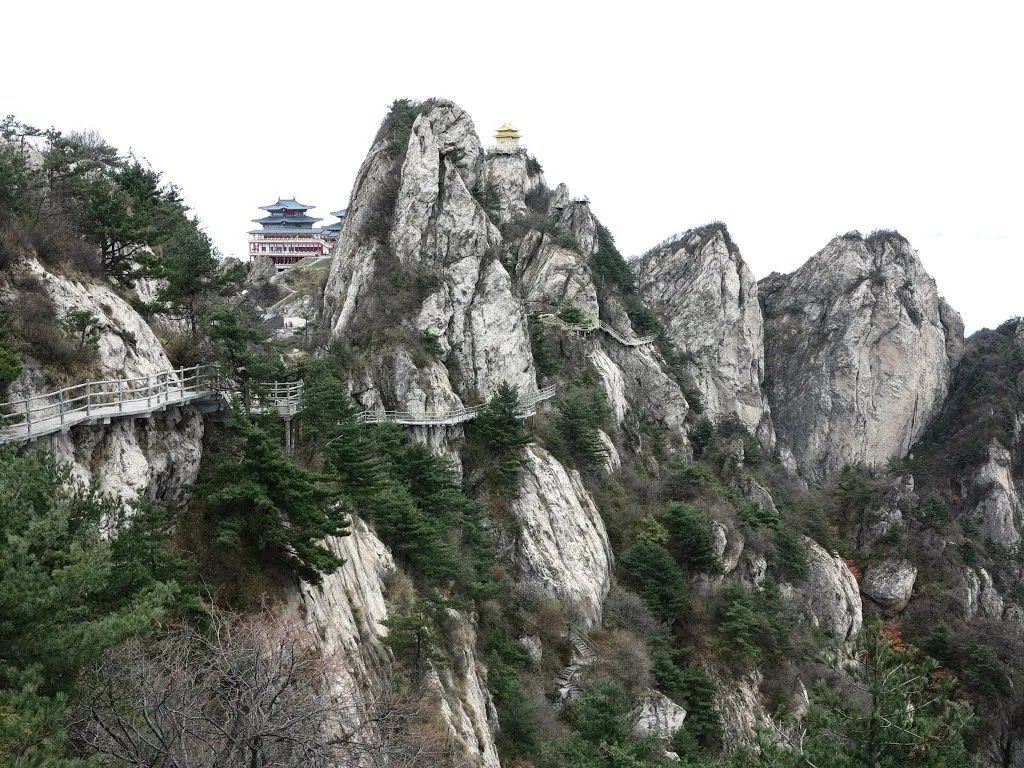
Photo: Wikimedia Commons / CC BY-SA. Source

- Laozi Temple (老君殿): the main hall, dedicated to Laozi himself. A 3-meter bronze statue of Laozi sits on the central altar. Active chanting by Taoist priests daily at 06:00 and 18:00.
- Three Pure Ones Hall (三清殿): dedicated to the Three Pure Ones, the highest deities in the Taoist pantheon (Yuanshi Tianzun, Lingbao Tianzun, Daode Tianzun). The hall has a large jade-carved statue group from Burma.
- Yuxu Temple (玉虚殿): dedicated to the Jade Emperor (Yuhuang Dadi), the ruler of heaven. A 4-meter gold-leaf statue dominates the altar.
- Doumu Temple (斗姆殿): dedicated to the Mother of the Big Dipper, a female Taoist deity associated with the stars.
- Wenchang Temple (文昌殿): dedicated to Wenchang Dijun, the Taoist deity of literature and examinations. Popular with students taking the college entrance exam.
The temples are all active working temples. Visitors are welcome to observe but should follow standard Chinese temple etiquette: hats off inside, no pointing at statues, no flash photography during chanting, modest dress.
The Ten-Mile Painting Screen (十里画屏)
The 5-km ridge walk between the two cable cars is the most scenic section of the mountain. The path follows a series of stone peaks that rise 50-200 m above the surrounding valleys, with views in every direction of the Funiu Mountain range.
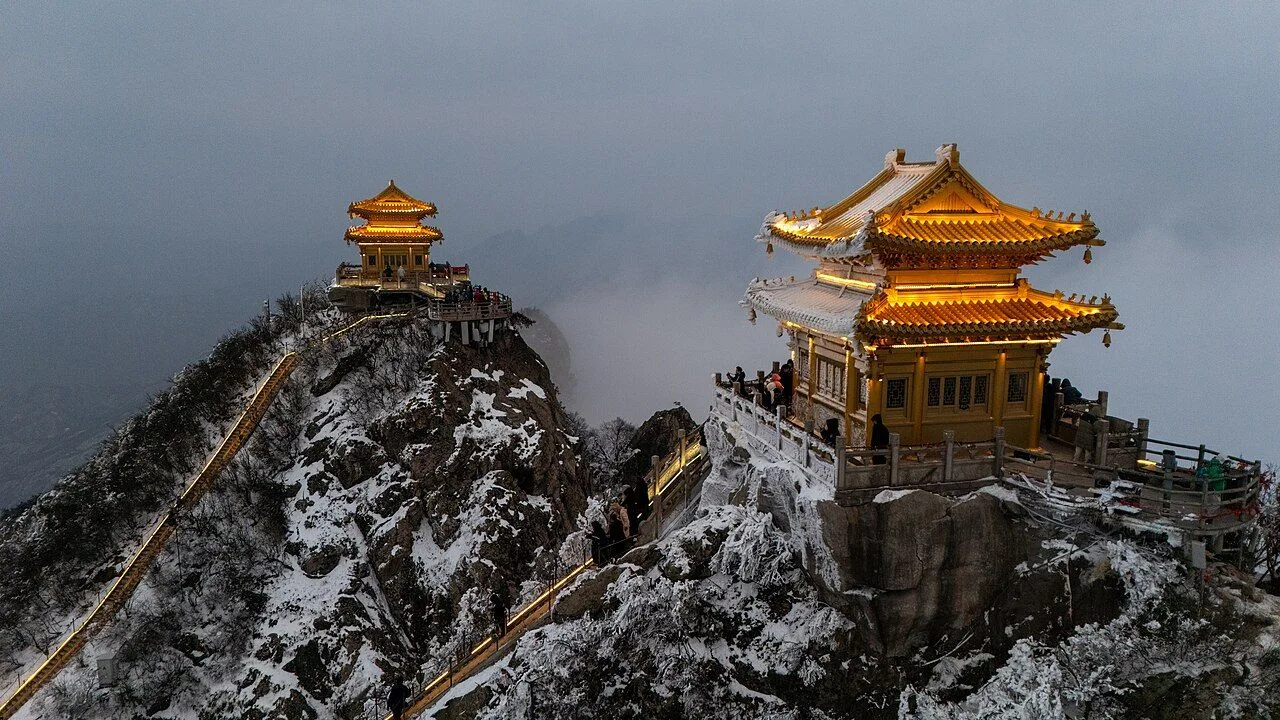
Photo: Wikimedia Commons / CC BY-SA. Source
.jpg)
The walk is moderate difficulty — 5 km with ~200m of elevation gain/loss, mostly on stone steps and well-maintained wooden boardwalks. Allow 1.5-2 hours at a comfortable pace. The walk is exposed — bring sun protection in summer, warm layers in winter.
Highlights along the way:
- Lovers’ Bridge (情人桥): a small wooden bridge over a chasm. The most-photographed spot on the ridge.
- Glass viewing platforms: 2 small 1-2m square glass panels set into the cliff edge, with views straight down.
- Pine peaks: distinctive rock formations with twisted pines growing from the cracks, similar to Huangshan but smaller scale.
- Sea of clouds (云海): in autumn and after rain, the valleys below fill with a rolling sea of clouds. The most spectacular sight at Laojun.
Getting to Laojun Mountain
Laojun Mountain is in Luanchuan County, 150 km south of Luoyang city center. The transfer is the main challenge — there is no direct public transport to the mountain.
Option 1: Didi directly (3.5 hours each way). Most foreign visitors take this option. ¥500-700 one-way. Round trip with 4 hours waiting: ¥1,500-2,000. The driver will wait at the mountain for a few hours. Best for groups of 2-4 people.
Option 2: HSR + Didi (1.5 hours each way). HSR from Luoyang Longmen Station to Luanchuan Station (45 min, ¥45-65), then Didi from Luanchuan Station to the mountain (40 km, 1 hour, ¥120-180). Total per person: ¥165-245 one-way. Cheaper than Didi for solo travelers.
Option 3: Self-drive (2.5 hours each way). Via Luoyang-Luanchuan Expressway (S88). Large parking lot at the visitor center ¥20/day. Best for groups with a car.
There is no public bus to the mountain. The closest city is Luanchuan, 40 km from the mountain. HSR to Luanchuan + taxi is the cheapest option for solo travelers.
When to visit
- Winter (December-February): Best for the snow-covered golden-summit scenery. The single most-photographed scene in all of Luoyang. Cold (-10 to -15°C on the summit), but clear skies are common. January-February is the peak season for the snow scenery. Book hotels in Luoyang in advance.
- Spring (March-May): Mild weather (5-15°C on the summit), wildflowers on the ridge, fewer crowds than autumn. April-May is the Luoyang Peony Festival — combine for a full cultural day.
- Summer (June-August): Hot at the base (30-35°C) but only 15-20°C on the summit. Frequent afternoon thunderstorms — the cable cars shut down in storms. Bring rain gear.
- Autumn (September-November): Best for the sea of clouds (云海). Clear skies, mild weather, autumn colors. The second most popular season after winter. Avoid Chinese National Day (Oct 1-7) — the mountain is overwhelmed by domestic tour groups.
Practicalities for foreign visitors
- Payment: Gate accepts Alipay (with international Visa/Mastercard linked) and WeChat Pay. Both cable cars accept the same. The on-site restaurants accept cash and Alipay/WeChat Pay.
- Dress code: Warm layers year-round (the summit is 1,500m higher than Luoyang city). Modest dress for the Taoist temples (no shorts, cover shoulders). The path can be icy in winter — bring hiking shoes with good grip.
- Photography: Allowed throughout. The Golden Summit complex has multiple viewing platforms for the most-photographed scenes. The glass skywalk is a popular photo spot.
- Restrooms: Available at the visitor center, both cable car stations, and the Golden Summit. Western-style toilets. Bring your own tissue paper.
- Language: English signage is limited — most signs are in Chinese only. The cable car staff and restaurant staff speak basic Chinese only. The mountain is much more foreigner-friendly with a Chinese-speaking companion.
- Cable car safety: Both cable cars are modern and well-maintained. They shut down in high winds (>50 km/h) and during lightning storms. Wait times are minimal on weekdays, can be 30-60 min on weekends.
What to do nearby
- Longmen Grottoes (龙门石窟): 150 km north, the UNESCO World Heritage Buddhist cave complex. Combine with Laojun for a 2-day Luoyang Buddhist/Taoist cultural day.
- White Horse Temple (白马寺): 150 km north, China’s first Buddhist temple. Combine with Laojun for a Buddhist/Taoist paired visit.
- Luoyang Museum (洛阳博物馆): 150 km north, 40,000+ artifacts spanning 5,000 years. Pair with Longmen for a full day.
- Old Town Luoyang (老城十字街): 150 km north, the traditional old-city cross-street with night market and food stalls.
- Baiyun Mountain (白云山): a different mountain, 80 km south of Laojun. The highest peak in the Funiu range at 2,216m, with a permanent ski resort. Combine with Laojun for a 2-day mountain trip.
Final tip
The biggest mistake first-timers make: not taking both cable cars. The walking path from the base to the Golden Summit is 12 km and 4-5 hours of vertical climb — most visitors underestimate this and run out of energy before reaching the Golden Summit. Take both cable cars (¥80 + ¥80) and walk only the 5-km Ten-Mile Painting Screen ridge between them. The full experience — cable car + ridge walk + cable car + Golden Summit — fits comfortably into a 6-8 hour day. The other common mistake: visiting in summer for the wildflowers, but the cable cars shut down in summer thunderstorms and the sea of clouds is rare. December-February is the gold standard for the snow scenery; September-November is the second-best.
Best photo spots
-
Golden Summit main viewing platform (金顶道观群观景台) · 10:00-11:00 (morning side-light) and 15:00-16:00 (afternoon side-light)
The most-photographed spot. The 5 golden-roofed Taoist temples on the 2,217m rocky outcrop with the surrounding stone peaks and (in winter) snow. Best framed from the south side for the full 5-temple panorama.
-
Ten-Mile Painting Screen (十里画屏) ridge · 10:00-11:00 (morning, soft side-light on the stone peaks)
The 5-km ridge walk between the two cable cars. Each section has a different view — stone peaks, cliff faces, distant mountain ranges. In winter, the rime ice on the pines is the most-photographed detail.
-
Glass skywalk (玻璃栈道) · 11:00-14:00 (midday, best light through the glass)
The 30-m cantilevered glass walkway on the south face. The view straight down 2,100m is dramatic. Walk it from east to west for the best photos. Best with a wide-angle lens.
-
Zhongtianmen platform (中天门) — between the two cable cars · 10:00-12:00
The mid-mountain platform where the second cable car starts. The view of the Golden Summit in the distance, with the Funiu Mountain range behind, is the classic 'approaching the mountain' photo.
Where to eat nearby
-
On-site restaurants at the Golden Summit
Basic Chinese fast food — noodles, dumplings, rice dishes, instant noodles. Expensive and not great quality. · ¥50-100/person · Multiple small restaurants near the Golden Summit cable car station
-
Luanchuan County restaurants (at the mountain base)
Henan local cuisine — Luoyang Water Banquet (洛阳水席), beef soup (牛肉汤), Henan noodles (烩面) · ¥40-80/person · Luanchuan County town, 40 km / 1 hour from the mountain
-
Bring your own snacks
Recommended for serious hikers or anyone wanting quality food · ¥20-40/person (snacks from Luoyang) · Buy in Luoyang city before transfer
-
Luanchuan acorn jelly (橡子凉粉)
Local specialty — a translucent jelly made from acorn starch, served cold with chili, vinegar, and garlic. ¥5-10/bowl. Available at roadside vendors in Luanchuan. · ¥5-15/person · Luanchuan County town
Frequently asked questions
How long does it take to visit Laojun Mountain?
Full day (6-8 hours) including: HSR/Luoyang to mountain transfer (3.5 hours one way by car, 1 hour by HSR+transfer); cable car up (20 min); Ten-Mile Painting Screen walk (1.5-2 hours); Golden Summit exploration (1-2 hours); cable car down (20 min). Most foreign visitors do Laojun as a 1-day side trip from Luoyang city, with an early 6:00 AM start and 8:00 PM return.
How much does Laojun Mountain cost?
Gate entry: ¥100. Two cable cars: ¥80 + ¥80 = ¥160. Total: ¥260 per person. Add round-trip transport from Luoyang (HSR+taxi ¥100-200 per person, or Didi ¥500-700 one-way). Budget ¥400-500 per person for the full day including transport, food on the mountain, and tips.
Is Laojun Mountain kid-friendly?
For older children (6+) who can handle the cable car transfers and the moderate walking on the Ten-Mile Painting Screen ridge, yes. The Golden Summit has steep metal stairs and the glass skywalk — not recommended for children under 8 or anyone with a fear of heights. Strollers are not practical (the cable car stations and summit paths are mostly stairs). For families, consider skipping the Ten-Mile Painting Screen and taking both cable cars directly to the Golden Summit area.
What is the Golden Summit (金顶道观群)?
The Golden Summit is the 2,217m peak of Laojun Mountain, with a cluster of 5 Taoist temples built in the Ming-Qing style with golden glazed-tile roofs. The temples are dedicated to Laozi (the founder of Taoism), the Three Pure Ones (the highest Taoist deities), and the Jade Emperor. The temples are all active — Taoist priests perform daily chanting rituals. The Golden Summit complex was built in 1994-2014 to replace earlier temples destroyed in the Cultural Revolution.
Can I take the glass skywalk if I'm afraid of heights?
The glass skywalk (玻璃栈道) is a 30-meter glass-bottomed walkway cantilevered off the south face of the summit at 2,100m. It is 1.5 m wide, holds 20-30 people at a time, and the glass is 6 cm thick. The walk takes 5 minutes. If you have a serious fear of heights, you can skip it and still enjoy the rest of the summit. The rest of the Golden Summit complex is on flat paths with railings.
How does Laojun Mountain compare to other sacred mountains in China?
China has 5 Buddhist sacred mountains and 4 Taoist sacred mountains. Laojun is not officially one of the 4 Taoist sacred mountains (those are Wudangshan, Longhushan, Qiyunshan, and Maoshan), but it is the most famous Taoist mountain associated with the founder Laozi himself. The scale is much smaller than the great mountains — Laojun is a single day trip from Luoyang, while Wudangshan or Emeishan are 2-3 day excursions. The cable car infrastructure makes it accessible to non-hikers.
Is there a glass-bottomed section on the way up?
Yes — the Ten-Mile Painting Screen (十里画屏) has 2 small glass viewing platforms (not the main skywalk on the summit). They are 1-2 m square glass panels set into the cliff edge, with a view straight down. They are much less dramatic than the main skywalk but offer a taste for those with mild fear of heights.
What should I wear to Laojun Mountain?
Year-round: comfortable hiking shoes (the cable car stations and the ridge walk have stairs and uneven stone paths). Warm jacket — even in summer the summit is 20°C cooler than Luoyang city. Winter (December-February): down jacket, gloves, hat, wind-resistant outer layer. The summit is exposed to wind and temperatures can be -15°C with wind chill. Bring snacks and water — the on-site restaurants are basic and expensive.
Is Laojun Mountain worth the 3.5-hour drive from Luoyang?
Yes for the dedicated traveler who wants a Taoist sacred mountain experience. The drive is long but scenic (the Funiu Mountains). The Golden Summit is one of the most dramatic Taoist temple complexes in China, especially in snow. If you only have 1-2 days in Luoyang, prioritize the Longmen Grottoes and White Horse Temple — they are in the city and require no long transfer. Laojun is for travelers with 3+ days in Luoyang who want a full-day mountain experience.