People's Park and Heming Teahouse, Chengdu
人民公园 · Rénmín Gōngyuán
Quick answer
The park is a city park in the middle of Chengdu and passport-carrying visitors are an ordinary part of who uses it. There is no foreigner ticket tier, no advance booking and, as far as our sources describe, no passport check at the gate - though we should be honest that the north gate in our photograph does have turnstiles and a guard booth, and we could not establish from any source what, if anything, is checked there. Your passport matters for the things around the park, not the park itself: rail tickets, and hotels. One thing genuinely worth knowing is that Chengdu's teahouse culture is local and social rather than tourist-facing, so nobody will find it strange or unwelcoming if a foreigner sits down, but nobody is going to explain anything to you either. The tea is served in a gaiwan - a lidded bowl with no handle, an ancient Chinese vessel form - and the session is the point, not the tea.
Why visit
- 1 This is what makes it Chengdu's oldest park: built in 1911 out of the Qing garrison quarter, it was the first public park in the city and, by the Chinese account, the first in Sichuan
- 2 Heming Teahouse (鹤鸣茶社) has been in the park since 1923 and has been a protected historic building since 2013 - the single most famous teahouse in the city
- 3 The tea is a gaiwan: a bowl-shaped vessel with a lid and no handle, an ancient Chinese vessel form. You lift the lid to drink and put it back down
- 4 The Railway Protection Movement Monument (辛亥秋保路死事纪念碑) is a Major Historical and Cultural Site of China, with its four faces inscribed in four different calligraphic scripts
- 5 112,639 square metres - about 169 mu - and the largest green area in downtown Chengdu, with an artificial lake, gardens and mature trees
- 6 It is a working local park, not a tourist set piece. TravelChinaGuide describes it as where the elderly play tai chi and square-dance in the morning
- 7 Metro Line 2 has a station named People's Park, so this is the easiest stop in central Chengdu to reach from a hotel
- 8 The whole afternoon is the unit of the experience here - the teahouse, not the park
Essential tips for foreigners
- Go for the teahouse, not the park. The park is the largest green space downtown but it is ordinary parkland; the thing you cannot get anywhere else in China is an afternoon in a Chengdu park teahouse. Heming Teahouse is at No. 12 Shaocheng Road, inside the gates.
- Do not budget for the tea until you know the price. We could not verify what a pot currently costs at Heming or at any other teahouse in the park, and tea is the entire cost of this visit. Ask the price before you order, in the teahouse, where it is displayed.
- The unit of time here is an afternoon, not an hour. You are expected to sit. TravelChinaGuide describes the session as bamboo chair, fragrant tea, a face-changing or kung-fu tea performance and ear cleaning - that is a half-day with nothing else scheduled.
- Mornings and evenings are different parks. The tai chi, square dancing and card-playing crowds are a daytime phenomenon; the teahouses run through the afternoon and into the evening. Pick which one you want before you go.
- We could not verify the park's opening hours and we are not going to guess. The gate has turnstiles and a guard booth, so it is controlled at some point in the day, but we could not establish a schedule. If the teahouse is your destination, confirm before crossing the city.
- Combine it with Wide and Narrow Alleys. They are a short walk apart and the metro puts both on the network - Line 2 for this park, Line 4 for the alleys.
Suggested route
- 09:00 15 min Arrive on Metro Line 2 at People's Park Station and walk in past the north gate on Citang Street
- 09:15 45 min If you want the morning park, walk the loop past the exercise groups before the teahouses fill
- 10:00 30 min Stop at the Railway Protection Movement Monument in the north-west of the park - it is a protected Major Historical and Cultural Site, with four scripts carved on its four faces
- 10:30 20 min Make your way to Heming Teahouse at No. 12 Shaocheng Road and ask for the price of a pot before you order
- 10:50 3 hours Sit down on a bamboo chair with a gaiwan of tea and let the afternoon happen - this is the part of the visit that cannot be shortened
- 14:00 20 min Walk out and cross to Wide and Narrow Alleys, which are close enough to make an obvious second stop
This is a teahouse that happens to be in a park
Almost every account of Chengdu’s People’s Park leads with the park, and the park is genuinely worth a look. But it is a city park of 112,639 square metres in Qingyang District, and a city park is a city park. The thing that makes this one worth crossing the city for is the tea.
Chengdu is described by Wikivoyage as a city with “many parks, teahouses, and green spaces throughout” - and this park is where that culture is at its most concentrated and most traditional. TravelChinaGuide, describing an ordinary local day in the city, sends you here for a walk and then sends you to a teahouse: “Sitting on a bamboo chair, you savor the fragrant tea while watching a Sichuan Opera Face-changing or Kung-fu Tea performance, and enjoy relaxing ear cleaning, spending your cozy afternoon.”
That sentence is the best short description of this place we have found, and it is worth reading twice. Note what it is actually selling: not tea, not a park, but time spent sitting still while other people do things around you. That is the experience.
What the park actually is
It was built in 1911, and that date is not a marketing figure - it is the founding of Chengdu’s public park system. The Chinese Wikipedia account states it plainly: this was the first park in Sichuan’s history.
The land has an older story. The area was the Shaocheng - literally “small city” - which in 1721, in the sixtieth year of the Kangxi Emperor, the Sichuan governor built inside the walls of Chengdu as the garrison city (满城, also called 少城) where Manchu and Mongol people were stationed for the Eight Banners. It stayed a garrison quarter for close to two centuries. Then in 1911, the garrison commander 玉昆 - who the English account identifies as the last Qing general in Chengdu - proposed converting part of it into a park in order to resolve a dispute among the garrison’s brothers. The account describes the work as flattening hutongs, paddy fields, wasteland, stables and granaries, and taking down a particular courtyard on Citang Street.
The English account adds the political backdrop: the Railway Protection Movement erupted in Sichuan in the same year, 1911, and led to the Xinhai Revolution that ended the dynasty. The park was expanded for the first time in 1914, the same year the government built the Monument to the Martyrs of the Railway Protection Movement inside it. In 1924 Lu Zuofu, appointed education minister of Sichuan, added museums, a library, a zoo and sports facilities - and, according to the Chinese account, many teahouses were built in the park at that time, among them the one still famous today.
The park was bombed during the Second Sino-Japanese War, on 27 September 1940 and again on 27 July 1941, and many facilities were destroyed; the Railway Protection Monument survived. It was renamed People’s Park in 1950 and reopened after refurbishment in October 1952.
Heming Teahouse, and what a gaiwan actually is
The teahouse to go to is Heming Teahouse (鹤鸣茶社), at No. 12 Shaocheng Road, inside the park.
It was built in 1923 by the businessman identified in the Chinese source as 大鵬熊氏, which is to say it predates the Republic of China by a couple of years and is genuinely a century-old institution rather than a themed reconstruction. On 8 October 2013 the Chengdu municipal government listed it in the first batch of protected historic buildings for the city. The English Wikipedia article calls it a local landmark; the Chinese article calls it 至今仍闻名, still famous.
The tea is served in a gaiwan (盖碗). The Chinese Wikipedia description of the vessel is worth reading because it is counterintuitive to a Western reader: it is a bowl-shaped vessel with a lid and deliberately no handle, described as an ancient vessel form, generally used to steep drinks. You steep in it, lift the lid to drink, and replace the lid. There is no handle because the lid is the handle, and the whole point is that the vessel stays still and hot while you do not.
One clarification, because it is a common mix-up: this is ordinary Chinese tea drunk in an unusual cup. It is not 八宝茶, the sweet herbal eight-treasure tea, which is a different drink and not what park teahouses serve.
What you cannot get from us is the price. We could not verify what a pot currently costs at Heming, or anywhere else in the park, from a source we are willing to put our name to - and tea is the entire cost of this visit. Ask when you arrive. The teahouse will have it posted.
The morning crowd and the afternoon crowd
These are two different parks and it is worth choosing.
In the morning it is a local exercise park. TravelChinaGuide describes exactly this when it lays out an ordinary Chengdu day: a city walk to the People’s Park “and join the elderly playing Tai Chi and enjoying square dancing”. The Chinese article is blunter about the park’s role as a political and civic venue in its earlier decades, when it was the main gathering place for progressive groups in the city.
Through the afternoon the teahouses take over, and that is when the park is really being used as the social infrastructure it was always meant to be. Nobody is going to sit you down and explain anything. That is the point - the tea is local and ordinary, and your presence is unremarkable, which is precisely why it is worth going.
If you want photographs, morning gives you the calm, lower light over the lake and the stone bridges; afternoon gives you the density of people sitting still under the bamboo, which is the harder and better shot.
The monument is the one thing that is genuinely old in the park
If you only walk to one piece of history here, make it the Monument to the Martyrs of the Railway Protection Movement (辛亥秋保路死事纪念碑), in the north-west of the park.
Built in 1913-14, it is designated a Major Historical and Cultural Site of China - the highest category of Chinese heritage protection for a site of this kind. The Chinese account describes the stele as square-diamond in shape with its four faces bearing inscriptions in four different calligraphic scripts - seal, clerical, regular and cursive - carved by four named calligraphers: 赵熙, 颜楷, 吴伯绂 and 张夔阶.
It also has the best story of survival in the park. It was standing here in 1940 and 1941 when the park was bombed twice and much of what was in it was destroyed.
Outside the east gate there is also a monument to Sichuan Army soldiers killed in the war against Japan, according to the Chinese account.
Getting there, and the hours we cannot give you
Metro Line 2 to People’s Park Station (人民公园站) is the answer. The station is named after the park, and both the English and Chinese Wikipedia articles record it, along with buses 5, 13 and 37 - the Chinese article puts the total at around eleven routes. It is one of the easiest stops in central Chengdu to reach from a hotel, and Wide and Narrow Alleys is a short walk away.
Now the thing we have to be honest about.
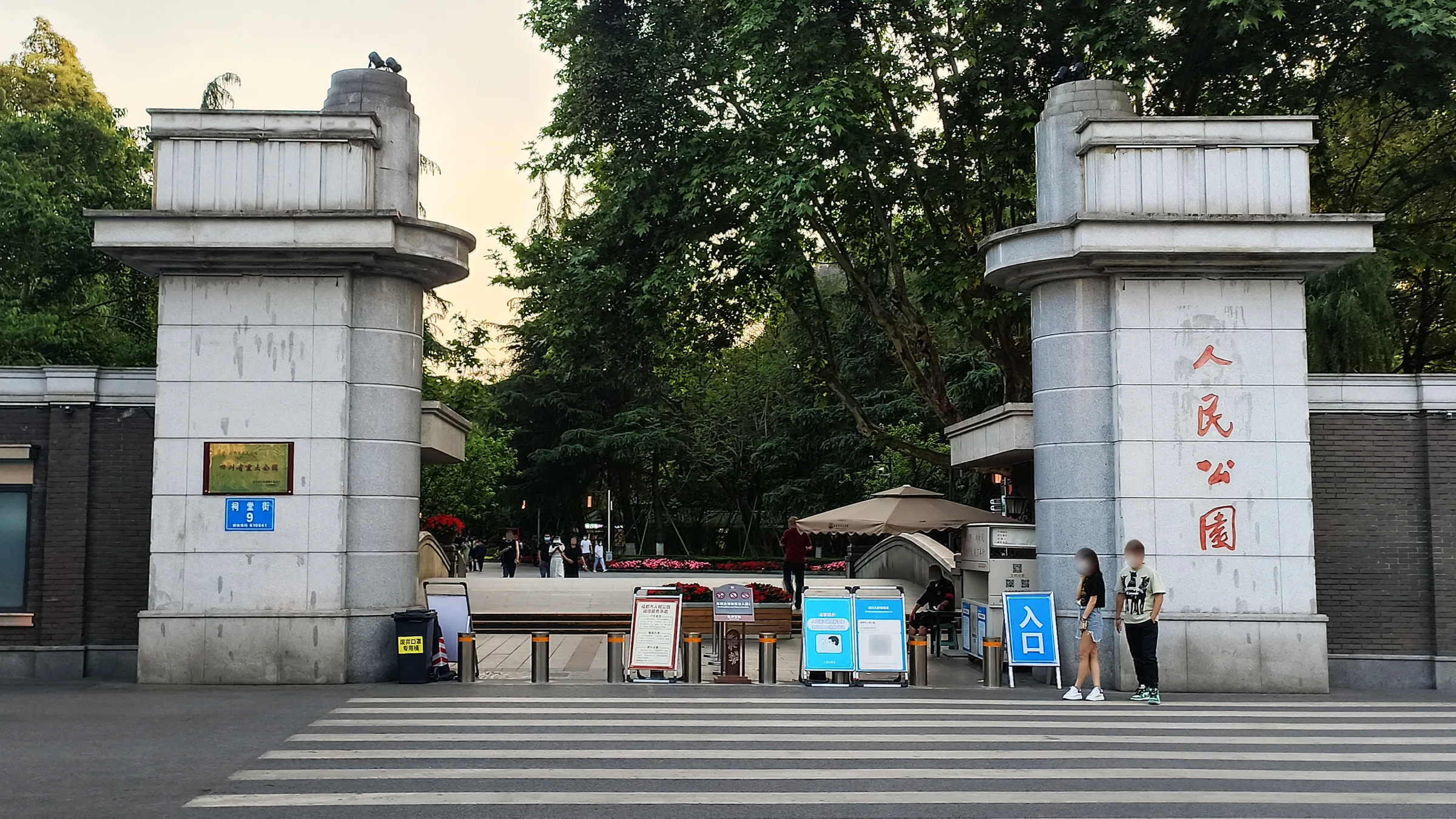
We could not verify the park’s opening hours. Our photograph shows a gatehouse, a row of turnstiles, a guard booth and a blue entrance sign, which tells us the park is controlled at its entrances at least at some point in the day. It does not tell us when those gates are staffed, when the park closes, or whether there is a closing time at all. We found no source that publishes any of it, and we are not going to fill the gap with a plausible-sounding figure.
We could not verify the teahouse hours either, and those are the hours that actually matter, because the teahouse is the reason to come.
What we can offer instead is the shape of the day, which is consistent across our sources: the exercise crowds are a morning phenomenon, the teahouses carry the afternoon and evening, and Chengdu residents treat the whole thing as something to sit in rather than walk through. Plan the shape, and confirm the specific hours with your hotel or the teahouse before you cross the city.
One note on the photograph, and why this one is safe to publish
We opened and looked at the image on this page before writing its description, because in this repository a filename has twice described a completely different place.
This one is unusually well-evidenced, and it is worth saying why. The photograph shows the north gate, and the right-hand pillar has the characters 人民公園 carved down it in large red lettering. The subject is therefore confirmed by the thing in the frame itself, not by the filename, not by the category and not by our own assumption. The blue street plate on the left pillar gives the address as Citang Street, No. 9.
The file itself is from Wikimedia Commons, published by its own author under a CC BY-SA 4.0 licence, filed under Commons’ Category:People’s Park (Chengdu), and carrying GPS coordinates of 30.660265 / 104.056389 - which fall inside the park and are consistent with the coordinate this site publishes.
What the description on this page says is what is in the frame: the gate, the carved characters, the entrance sign, the turnstiles, the guard booth, and the trees and flower beds beyond.
Best photo spots
-
Heming Teahouse (鹤鸣茶社), No. 12 Shaocheng Road · Late afternoon, when the raking light comes across the tea tables
The reason to come. Outdoor bamboo chairs in rows, tea served in handleless lidded bowls, and a clientele that is local rather than staged. Built in 1923 and a protected historic building since 2013, so the room itself is part of the attraction. Shoot wide rather than close - the subject is the density of people sitting still, not any one cup.
-
The Railway Protection Movement Monument (辛亥秋保路死事纪念碑), north-west of the park · Daytime, when the stone is legible
A square-diamond stone stele whose four faces carry inscriptions in four different calligraphic scripts - seal, clerical, regular and cursive - carved by four named calligraphers. It is a Major Historical and Cultural Site of China and it is one of the few things in the park that is a monument rather than a garden. The exercise crowds around it are part of the scene.
-
The north gate on Citang Street (祠堂街) · Late afternoon
The entrance this page's photograph was taken from. The characters 人民公園 are carved in red down the right-hand pillar, there is a brass plaque on the left, and the street plate gives the address as Citang Street No. 9. A good establishing frame if you want the park identified in a way that does not depend on a caption.
-
The lake and its stone bridges · Early morning or late afternoon
The park's artificial lake is the landscape element that actually photographs, particularly when the arched stone bridges are in frame. Mornings are quieter and the light is lower; the park is at its most ordinary and peaceful then.
Where to eat nearby
-
Heming Teahouse (鹤鸣茶社) — No. 12 Shaocheng Road
Chengdu park teahouse: gaiwan tea — ordinary Chinese tea in a bowl-shaped vessel with a lid and deliberately no handle — drunk sitting on low bamboo chairs, with tea-house snacks, and optional Sichuan opera face-changing or kung-fu tea performance and ear cleaning at the table. · ⚠ UNVERIFIED — ASK AT THE VENUE, AS THIS PAGE SAYS ELSEWHERE. We could not confirm a current price from a source we are willing to cite. The third-party listings we retrieved contradict each other, running from about ¥16 per person on Ctrip and ¥15-30 per cup of gaiwan tea on Baidu Wenku up to ¥48 or more per seat where a performance is included, and one guide quotes ¥3 for dawn tea. Treat the price posted at the entrance as the real one, because tea is the entire cost of this visit. · Inside the park. Baidu Baike places Heming at No. 12 Shaocheng Road (少城路12号) in Qingyang District, within People's Park, and the Chinese Wikipedia entry for the teahouse gives the same address. Walk in from any gate.
-
Zhong Shui Jiao, People's Park main branch (钟水饺·人民公园总店)
Sichuan red-oil dumplings (钟水饺), served in a sweet chilli oil, alongside the Chengdu snack classics on the same menu — wonton soup, dan dan noodles, egg cakes and ye'er ba. · About ¥20/person. The Ctrip listing's review data gives 人均消费 20元, and a Ctrip visitor records spending under ¥30 on a half-price snack voucher that covered more than ten items. Amap files the branch as a local-specialty restaurant (特色/地方风味餐厅). · Inside the park too, in the Ziwei Pavilion at No. 12 Shaocheng Road (少城路12号人民公园内紫薇阁) — the same address as the teahouse above. Four separate listings (Qunar, Amap, 360 Map, Meipian) give that address, and one of them notes it sits right beside the famous teahouse.
Frequently asked questions
What is People's Park in Chengdu and why go?
It is a 112,639-square-metre city park in Qingyang District, near Tianfu Square, made out of part of the Qing garrison quarter and opened as a park in 1911 - the first public park in Chengdu. The reason to go is the teahouses rather than the landscaping: this is the city's teahouse heart, and the park's best-known teahouse, Heming Teahouse, has been there since 1923.
Is People's Park in Chengdu free to enter?
We publish it as free because it is a city park with no admission control described in any source we could reach - our photograph shows a gatehouse and turnstiles but no ticket booth. We should be straight about the limit: we could not retrieve a source stating an admission price, so this is inferred from the absence of a priced entry rather than read off a published tariff. Entry is not the thing to budget for. The tea is.
How much does tea cost at Heming Teahouse?
We do not know, and we are not going to invent a figure. We could not verify the current price of a pot at Heming Teahouse or at any other teahouse in the park from a source we are willing to cite, and tea is the entire cost of this visit. Ask the price when you sit down - it is posted in the teahouse - and treat whatever you are quoted as the real budget line.
What is gaiwan tea and what do I do with the bowl?
A gaiwan is a bowl-shaped vessel with a lid and deliberately no handle - an ancient Chinese vessel form. You steep the tea in it, lift the lid to drink, and put the lid back. It is served with you sitting on a low bamboo chair rather than at a table, which is the whole visual signature of a Chengdu teahouse. Chengdu park tea is ordinary Chinese tea drunk in this way; it is not the sweet herbal eight-treasure tea, which is a different drink entirely.
How do I get to People's Park in Chengdu?
Metro Line 2 to People's Park Station (人民公园站), which is named after the park - both the English and Chinese Wikipedia articles record it, along with buses 5, 13 and 37. It is one of the easiest stops in central Chengdu to reach, and it puts you within a short walk of Wide and Narrow Alleys.
What is the Railway Protection Movement Monument?
The Monument to the Martyrs of the Railway Protection Movement (辛亥秋保路死事纪念碑), built in the park in 1913-14 after the 1911 movement that helped trigger the Xinhai Revolution. It is designated a Major Historical and Cultural Site of China. The Chinese account describes the stele as square-diamond in shape with its four faces inscribed in four different calligraphic scripts, carved by four named calligraphers. It survived the wartime bombing of the park in 1940 and 1941, unlike much else here.
Is People's Park worth it if I only have an hour?
Yes, but point it. The park is large and ordinary in its landscaping; an hour is enough for the teahouse and the monument, which are the two things actually worth your time. What is not worth doing is trying to walk all of it. If you have more time, the afternoon in a teahouse is the version most Chengdu residents would recommend.
What does the park look like at different times of day?
In the morning it belongs to the people who use it for exercise - TravelChinaGuide specifically describes walking there to join the elderly playing tai chi and square dancing. Through the afternoon the teahouses are the centre of gravity. We could not verify gate hours, so if you want the morning version, arrive early rather than assuming the gates are staffed from dawn.
Sources
- People's Park (Chengdu) — English Wikipedia (an urban public park in central Chengdu, built in 1911 as Shaocheng Park and the city's first public park; its location on Shaocheng Road near Tianfu Square and its area of 112,639 square metres as the largest green area downtown; the artificial lake, gardens, the Railway Protection Movement Monument as a Major Historical and Cultural Site of China, and the century-old Heming Teahouse as a local landmark; the origin of the site as the Qing garrison for Manchu and Mongol Eight Banners soldiers and Yu Kun's 1911 conversion of part of it; the 1913-14 monument, the 1914 enlargement, Lu Zuofu's 1920s museums, library and zoo, the wartime bombing of 27 September 1940 and 27 July 1941, the 1950 renaming and the October 1952 reopening; and the transport, being People's Park station on Line 2 plus buses 5, 13 and 37). Confirmed on retrieval to be the CHENGDU park, not another city's namesake. · Wikipedia
- 人民公园 (成都) — Chinese Wikipedia (the park's location in Qingyang District near Tianfu Square and its 112,639 square metres, about 169 mu; the Railway Protection Monument in the north-west and the Sichuan Army anti-Japanese war memorial outside the east gate; the 1721 Kangxi-60 building of the Manchu garrison city 满城 / 少城 by the governor 策楞布 and the 1911 conversion by 玉昆 which made it the first park in Sichuan history; the 1914 first enlargement and the four-script inscription on the monument by 赵熙, 颜楷, 吴伯绂 and 张夔阶; Lu Zuofu's 1924 improvements and the many teahouses built in the park including the still-famous 鹤鸣茶社; the 2001-2003 enlargement by 155 mu and the sumo that appeared in the park from 2005; and the transport, Line 2 People's Park Station with buses 5, 13, 37 and about eleven more routes). · Wikipedia
- 鹤鸣茶社 — Chinese Wikipedia (Heming Teahouse stands inside People's Park at No. 12 Shaocheng Road in Qingyang District, Chengdu; it was built in 1923 by the businessman 大鵬熊氏; and on 8 October 2013 the Chengdu municipal government listed it in the first batch of Chengdu protected historic buildings, 成都市历史建筑保护名录). · Wikipedia
- Chengdu — Wikivoyage (Chengdu described as known for its emphasis on culture and relaxation, with many parks, teahouses and green spaces throughout the city; and the climate as foggy most of the year, hot and humid in summer, mild but damp in winter, with spring and autumn the most comfortable seasons for sightseeing.) · Wikivoyage
- Chengdu City Guide — TravelChinaGuide (the description of how a local spends the day: a city walk to People's Park to join the elderly playing tai chi and square dancing, and then the teahouse, sitting on a bamboo chair drinking fragrant tea while watching a Sichuan Opera face-changing or kung-fu tea performance, with ear cleaning, spending a whole afternoon.) · TravelChinaGuide
- 八宝茶 — Chinese Wikipedia, reached via the redirect from 盖碗茶 (used here only for the vessel, not for the drink: it records that the gaiwan is a bowl-shaped vessel with a lid and deliberately no handle, 三层台, an ancient vessel form, and is generally used to steep drinks. Eight-treasure tea itself is a different, sweet herbal drink and is NOT what is served in Chengdu park teahouses - we are not claiming that it is.) · Wikipedia
- People's Park (Q16927648) — Wikidata (the item's English description 'urban public park in Chengdu, Sichuan, China', its English alias 'Shaocheng Park', its inception date of 1911, its coordinate statement 30.65945 / 104.05541, its official website cdpeoplespark.cn, and its image statement pointing at the north gate photograph used as this page's hero). Used to confirm the subject is Chengdu's park and not another city's namesake. · Wikidata
- File:成都人民公园北大门.jpg — Wikimedia Commons (CC BY-SA 4.0, Kcx36, own work, 2022-05-02; filed under Category:People's Park (Chengdu); description 成都人民公园北大门; GPS 30.660265 / 104.056389). Source of this page's hero image. · Wikimedia Commons