
Wide and Narrow Alleys (Kuanzhai Xiangzi)
宽窄巷子 · Kuānzhǎi Xiàngzi
Quick answer
There is no passport check, no foreigner ticket tier and no booking, because there is no gate. You walk in from the street. Your passport matters here only for the things that surround it - buying rail and air tickets, and checking into a hotel. The one practical note worth making is about English signage: we could not retrieve a source describing how much English the alleys carry, so we are not going to claim there is plenty. Assume you will be navigating by Chinese characters and carry a translation app. 宽巷子 (Wide), 窄巷子 (Narrow) and 井巷子 (Well) are the three words worth knowing, and a taxi driver will understand 宽窄巷子 without trouble. Public Wi-Fi is free here - Wikivoyage specifically records free government Wi-Fi at Kuanzhaixiangzi.
Why visit
- 1 Three parallel lanes, not one: Wide Alley (宽巷子), Narrow Alley (窄巷子) and Well Alley (井巷子), with the residential courtyards between them - 45 of them by TravelChinaGuide's count
- 2 The whole thing is a restoration, not a survivor. 900-plus households were relocated and 50-plus courtyards and 30,000-plus square metres of buildings were rebuilt, and it reopened on 14 June 2008
- 3 The ground under it was Eight Banners garrison housing. The lanes were originally three separate hutongs - 兴仁, 太平 and 如意 - and were renamed after the 1911 Revolution
- 4 Each alley was given a different character on purpose: Wide for teahouses and the old life, Narrow for courtyard culture, Well for pubs, nightclubs and weddings
- 5 Wide Alley carries an Experiencing House of Old Chengdu Life built as a kitchen, study, living room and bedroom showing an ordinary family's world between 1912 and 1949
- 6 It is on the metro: Line 4 has a station named after the alleys and you walk southeast into the block from it
- 7 Free government Wi-Fi is available on site, which is unusual enough to be worth knowing before you buy a roaming data pack
Essential tips for foreigners
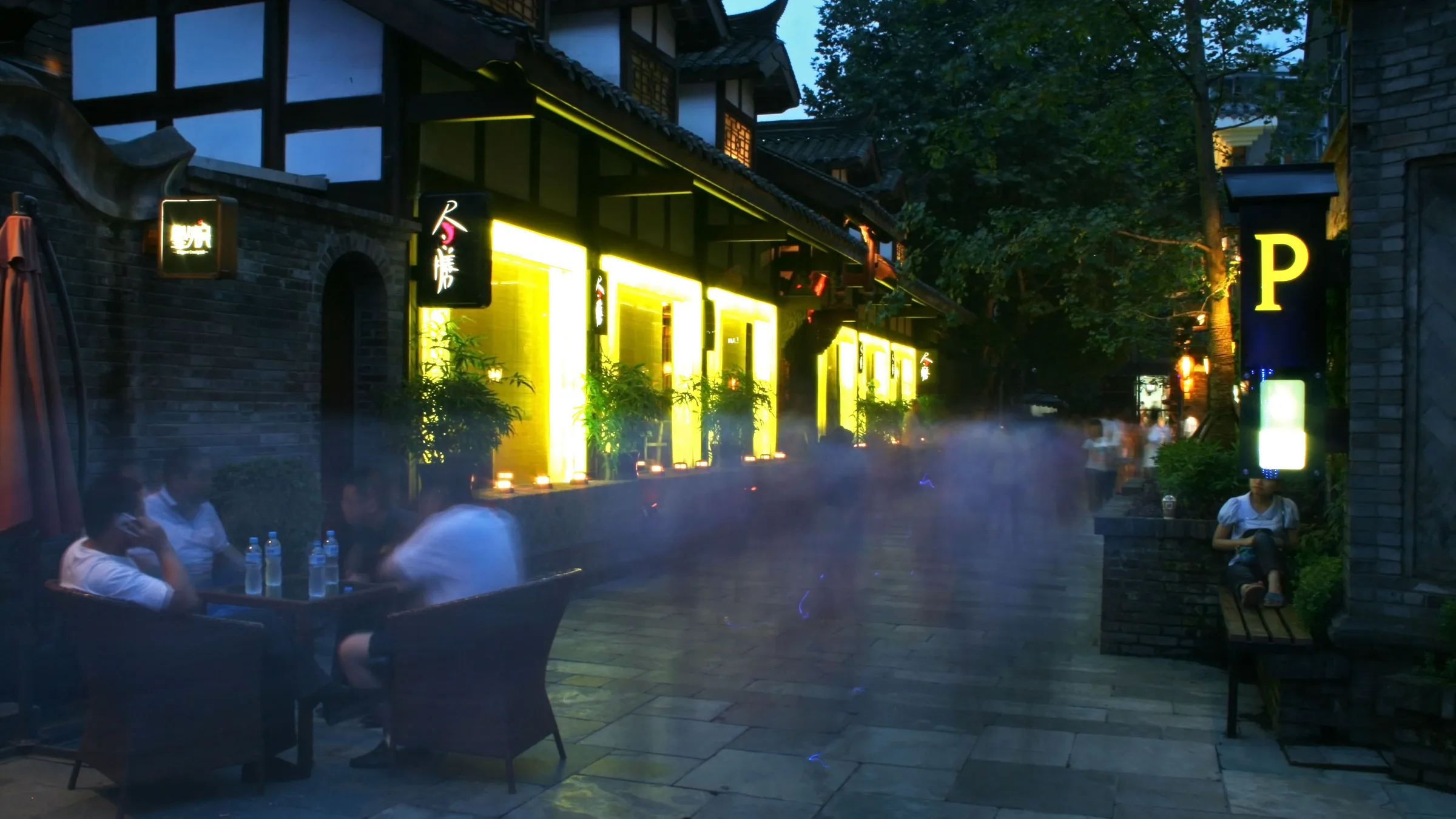
- Go in the evening, not at midday. The lanes are lit shopfront to shopfront after dark, the teahouses fill with people, and Well Alley turns into a nightlife strip. This is also the honest reason the hero photo on this page looks the way it does.
- This is a dining and nightlife block, not an untouched old town. TravelChinaGuide and Wikivoyage both describe the tea houses and restaurants here as expensive for Chengdu. Set your budget accordingly before you sit down, because the tea houses in particular are the reason people come.
- There is no ticket and no gate, so there is also no official opening hour. We could not verify a published schedule and we are not going to invent one. The hours that matter are the trading hours of whichever teahouse or restaurant you actually plan to use.
- Learn three characters before you go. 宽巷子, 窄巷子 and 井巷子 are the three lanes, and 宽窄巷子 is what you show a taxi driver. That is the entire navigation problem, and it is a small one.
- Do not expect signage you can read. We could not find a source describing how much English is on the shopfronts here. Assume none and bring a translation app.
- The Hi Panda scenic shuttle bus runs from here, with the alleys as one of its main hubs, but its WeChat miniapp does not accept foreign phone numbers - pay the driver in cash.
Suggested route
- 17:00 20 min Arrive on Metro Line 4 as the shopfronts light up, and start at the north end of Wide Alley
- 17:20 30 min Walk Wide Alley south, looking at the courtyard doorways - the Experiencing House of Old Chengdu Life is on this lane
- 17:50 30 min Cross to Narrow Alley for the bamboo-and-vine stretch and the quieter, slower feel
- 18:20 40 min Move to Well Alley for the pubs, dessert shops and the former villa now used as a wedding venue
- 19:00 90 min Stop for tea or a meal - budget more than you would in the city, and confirm the venue's hours before you rely on them
- 20:30 20 min Walk out toward People's Park, which is close enough to extend the evening if you want a park instead of a bar
What this actually is, before you go looking for it
The most common misunderstanding about 宽窄巷子 is that it is an old town that survived. It did not survive anything. It is a reconstruction, done deliberately and at scale, and it is better to arrive with that expectation than to feel short-changed when you realise the courtyards were rebuilt in the last two decades.
What it is, underneath the reconstruction, is real and worth the trip. The ground it occupies was Eight Banners garrison housing during the Qing dynasty. That whole quarter was known collectively as 宽窄胡同, and the three lanes that survive as the attraction were once three separate hutongs with entirely different names: 宽巷子 was 兴仁胡同, 窄巷子 was 太平胡同, and 井巷子 was 如意胡同. They were renamed to the names you see on the signs after the 1911 Xinhai Revolution, which is why the modern name and the old names do not match up in any tourist account you will read.
So the honest framing is: early-twentieth-century garrison-quarter architecture, in its original street pattern, rebuilt with modern fabric and repurposed as a dining and nightlife district. It is one of the best-preserved patterns of old Chengdu you can walk through, and it is emphatically not a quiet residential neighbourhood.
Three lanes, three characters
What makes the block worth walking rather than photographing from the end of the street is that each alley was given a different brief during the restoration, and you can feel the difference within about thirty metres of turning onto each one.
Wide Alley (宽巷子) is the one that sells the old Chengdu. TravelChinaGuide describes it as the alley that exhibits the leisurely life of local people, with the natives, the old inns and the old teahouses as its characteristic elements. It also carries the Experiencing House of Old Chengdu Life, which is furnished as a kitchen, study, living room and bedroom and exists to show the daily life of an ordinary family between 1912 and 1949. That exhibit is the single most clarifying thing in the block if you actually stop in it.
Narrow Alley (窄巷子) is the slow one. TravelChinaGuide describes it as the typical slow life of Chengdu residents and the courtyard culture of the city, decorated after restoration with bamboo, vines and traditional wall lamps. The interest here is in the doorways and the enclosed courtyards rather than in any view.
Well Alley (井巷子) is the modern side - the most open, most varied and most dynamic part of the area. It carries pubs, nightclubs, dessert shops, a wedding site and retail. The building that anchors it is a western-style villa that was originally a private residence and later a church.
If you only have time for one, take Wide Alley for the sense of what the place is arguing about, and come back to Well Alley at night if you want the version with the lights on.
The restoration, and why the date matters
The alleys reopened to the public on 14 June 2008. Both the Chinese Wikipedia article and TravelChinaGuide agree on that date, so it is safe to plan around.
Before that, the scale of the change is worth knowing. More than 900 resident households were relocated. Over 50 courtyards and more than 30,000 square metres of ground-floor buildings were repaired and converted, and 11,000-plus square metres of underground parking was added underneath. TravelChinaGuide counts 45 courtyards along the lanes.
There is one genuine disagreement between our sources, and we would rather flag it than smooth it over. TravelChinaGuide dates the start of the restoration programme to 2003. The Chinese Wikipedia article dates the start of the redevelopment to 2007. Both agree on the 14 June 2008 reopening, so the useful figure for a traveller is the opening date; the start date is a planning detail, and the discrepancy most likely reflects earlier preparatory work versus the main construction phase. We have published neither as a fact.
For context on how the Chinese authorities themselves rated the result: the block was named among the recipients of a 2008 national award for completed creative-industry projects, and a 2009 award as a Chinese characteristic commercial pedestrian street.
Getting there, and what it costs to enter
Entry is free, because there is no gate.
We want to be careful about exactly how confident we are in that. We could not retrieve a citable source that states an admission price for the alleys. What we have instead is that every source we did read - the Chinese Wikipedia article, TravelChinaGuide and Wikivoyage - describes 宽窄巷子 as public streets opened to the public, with shops and businesses operating in them and no admission control of any kind described anywhere. That is strong enough to plan on and weak enough that we are flagging rather than asserting it.
What you will spend money on is everything inside the block. Teahouses, restaurants, cafes, bars and performances are all priced separately, and both TravelChinaGuide and Wikivoyage independently describe the tea houses and restaurants here as expensive by Chengdu standards. That is worth knowing before you sit down rather than discovering it afterwards.
On getting there: Metro Line 4 has a station named Wide and Narrow Alley Station (宽窄巷子站), and TravelChinaGuide’s instruction is to get off there and walk southeast into the scenic area. Wikivoyage lists the same station. The alternative it also gives is Line 2 to People’s Park Station, Exit D1, then along Changshun Upper Road - which is useful because it puts you within easy walking distance of People’s Park if you want to extend the evening. Buses 51, 62, 70, 93, 163 and 340 serve a stop of the same name.
The Hi Panda scenic shuttle bus uses the alleys as one of its main hubs and lists them among its destinations. One catch if you plan to use it: its WeChat mini-program does not accept foreign phone numbers, so pay the driver in cash.
On hours, we are deliberately saying nothing
There is no published opening or closing time for the alleys that we could find, so this page does not give you one.
That is a real gap rather than an evasion, and here is why we think it is a smaller gap than it sounds. These are streets, not a building. There is no ticket hall, no turnstile and no staff to arrive at. The alleys do not open; the businesses inside them open, each on its own schedule, and those schedules are not published in any source we could reach.
What we can tell you from the sources we do hold: the streets are busy and lit in the evening, and Well Alley specifically runs into nightlife. That is a description of when people are there, not a published trading schedule. If you are going to a specific teahouse or restaurant, check that venue’s hours directly - and expect them to run later than an ordinary shop, not earlier.
What you will and will not get
The lanes are genuinely good for strolling, eating and tea. Both TravelChinaGuide and Wikivoyage describe them as a place for tea houses, restaurants and local snacks, and Wikivoyage puts it plainly as a good place to relax.
They are not a preserved historic quarter in the sense most visitors picture. The buildings are early-twentieth-century in form and recent in fabric. There is no Qing-dynasty original left standing that our sources describe. If your interest is genuinely old architecture, Chengdu has better candidates and you should spend the day on them instead.
They are also not free to enjoy in the sense that matters to your wallet. Everything with a roof over it charges.
And on language - we could not retrieve a source describing how much English signage the alleys carry, so we are not going to claim there is plenty of it. Assume you will be reading Chinese characters, bring a translation app, and learn exactly three characters before you arrive: 宽巷子, 窄巷子 and 井巷子. Public Wi-Fi is free on site, which is genuinely useful to know before you buy a data pack.
One note on the photograph
The image at the top of this page is an evening shot, and it was checked visually before this page was published rather than after.
It is a photograph of Narrow Lane - the middle one of the three - on Wikimedia Commons, filed by its photographer under Commons’ own Category:Wide and Narrow Alleys, which is why we are confident it is the right place rather than a namesake lane somewhere else in Chengdu. What is actually in the frame is grey-brick courtyard architecture with tiled eaves, warm lit shopfronts, bamboo along the frontages, and people seated at low tables outdoors.
We are saying plainly that this is the lit, commercial, evening face of the block. If you are picturing an empty historic lane in daylight, this is not it, and the midday version of the same street looks considerably quieter and greener.
Best photo spots
-
Wide Alley (宽巷子), looking south in the late afternoon · Late afternoon into dusk, roughly 17:00-19:00
The best-lit and most-photographed lane, and the one with the teahouse frontages. The light comes down the length of the alley rather than across it, which is why evening is worth waiting for. Expect shop signage and lanterns rather than empty architecture - this is a working commercial street.
-
The courtyard thresholds along Narrow Alley (窄巷子) · Any time, but avoid hard midday sun
Narrow Alley is the one decorated with bamboo, vines and traditional wall lamps, and its interest is in the doorways and enclosed courtyards rather than in a vista. Soft overcast light suits it; the lane is narrow enough that the buildings shade each other for much of the day.
-
Well Alley (井巷子) in the evening · After dark
The most modern and most animated of the three, with pubs, nightclubs and dessert shops, and the former villa at the centre of the lane. It is the one to shoot if you want the nightlife face of the block, and the one to walk if you want it loud.
-
The Experiencing House of Old Chengdu Life on Wide Alley · Daytime, before the evening crowd
A furnished recreation of an ordinary family's home - kitchen, study, living room and bedroom - as it was between 1912 and 1949. It is the single clearest thing in the block that explains what the restoration was trying to present, and it is easy to walk straight past.
Where to eat nearby
-
Xiang Ji Chu 1999, Wide Alley branch (香积厨1999·宽巷子店) — No. 18 Wide Alley
Sichuan fine dining in a restored courtyard. Baidu Baike records it as a 川菜 (Sichuan) restaurant founded in 1999 that also folds in Anhui (徽菜) and Hangzhou (杭帮菜) cooking, with courtyard and private-room seating, late-night service, and gaiwan tea in the courtyard. It was founded by the poet Li Yawei, per Trip.com. · ⚠ THE FIGURES DISAGREE WIDELY, AND THE REASON IS WHETHER YOU ARE BUYING TEA OR DINNER. A 2024-25 Chengdu restaurant roundup on Sina puts it at ¥100-150 per person for a meal; a Ctrip visitor records 人均消费 48元 for tea seating, and a Tuniu dinner review records roughly ¥60 a head. Ctrip reviewers also quote tea-seat charges of ¥48, ¥58 and ¥68 across the alleys generally. Ask what you are being charged for before you sit down. · No. 18 Wide Alley (宽巷子18号), Qingyang District — inside the block, on the lane whose teahouses the restoration was built around. Baidu Baike describes it as adjacent to the Wide and Narrow Alleys historic district (毗邻宽窄巷子历史文化街区).
-
Shu Cha, Wide and Narrow Alleys branch (数茶·宽窄巷子景区店) — No. 46 Wide Alley
⚠ WE COULD NOT VERIFY WHAT IT SERVES. 360 Map files this business under its catering category and nothing more; we could not retrieve a menu or description of it, so we are not going to characterise the tea or the food beyond that it is a licensed food-and-drink address on Wide Alley. · ⚠ NO FIGURE PUBLISHED. 360 Map's live page for this listing shows 人均 (average spend), opening hours and telephone all as 暂无 — not available. Search-engine listings circulating for this address quote a per-person figure, but the live page does not carry one, so we are not publishing a number. · No. 46 Wide Alley (宽巷子46号), Qingyang District. 360 Map gives the coordinate 104.052115 / 30.664818, about 460 m from this page's published coordinate for the block, and the street address is on Wide Alley itself.
Frequently asked questions
What are the Wide and Narrow Alleys in Chengdu?
Three parallel lanes in central Chengdu - Wide Alley (宽巷子), Narrow Alley (窄巷子) and Well Alley (井巷子) - together with the residential courtyards between them. They are a restored Qing-dynasty quarter in Qingyang District, reopened to the public on 14 June 2008. Think of them as a compact dining, tea and nightlife block built out of 19th-century courtyard architecture, not as an archaeological site.
How much does it cost to visit the Wide and Narrow Alleys?
Entry is 0 because there is no ticket gate - these are public streets. We should be straight about the limit of that claim: we could not retrieve a citable source stating an admission price, and we are relying on the fact that every source we did read describes them as streets opened to the public. Budget separately for tea, food, coffee, beer and any performance, which are all charged by the venues themselves, and expect the tea houses and restaurants to be on the expensive side for Chengdu.
Do I need to book the Wide and Narrow Alleys?
No. There is nothing to book, because there is no gate, no timed entry and no ticket. You walk in from the street. Booking only becomes relevant for things nearby - the Scenic Shuttle Bus, or rail tickets if you are leaving Chengdu the same day.
How do I get to the Wide and Narrow Alleys?
Take Metro Line 4 to Wide and Narrow Alley Station (宽窄巷子站) and walk southeast into the block - this is the route TravelChinaGuide gives. Buses 51, 62, 70, 93, 163 and 340 also serve a stop called Kuanzhai Xiangzi. A taxi is simplest: show the driver 宽窄巷子.
What are the Wide and Narrow Alleys actually like to walk through?
Long, narrow, stone-paved lanes of grey-brick courtyard buildings with tiled eaves, now lined with restaurants, teahouses, bars and souvenir shops. Each alley was given a deliberate character during the restoration: Wide Alley carries the teahouses and the nostalgic old-Chengdu exhibits, Narrow Alley is the courtyard-culture lane decorated with bamboo, vines and traditional wall lamps, and Well Alley is the modern, loudest part with pubs, nightclubs, dessert shops and a wedding venue built around a former villa that was once a private residence and later a church.
Is the Wide and Narrow Alleys free and open all day?
Entry is free, but we could not verify a published opening or closing time and we are not going to quote one we cannot source. There is no gate to open. What does have hours is everything inside the alleys, and those are set venue by venue - teahouses and bars in particular run later than ordinary shops. If a specific venue is the reason for your visit, check its hours directly.
Are the Wide and Narrow Alleys genuinely old?
Genuinely old in origin, entirely rebuilt in execution. The ground was Eight Banners garrison housing, and the three lanes were once three separate hutongs named 兴仁, 太平 and 如意, renamed to their current names after the 1911 Revolution. The restoration relocated over 900 households and rebuilt 50-plus courtyards. So the architecture you are walking through is early-20th-century in form and recent in fabric.
What is the difference between Wide Alley, Narrow Alley and Well Alley?
Mostly atmosphere, and the difference is deliberate. Wide Alley (宽巷子) is the one that sells the old Chengdu - teahouses, old lodges, and the Experiencing House of Old Chengdu Life, which is furnished as a kitchen, study, living room and bedroom from the Republic of China period. Narrow Alley (窄巷子) is the slow, courtyard-culture one, planted with bamboo and vines and hung with traditional wall lamps. Well Alley (井巷子) is the newest and loudest, with pubs, nightclubs, dessert shops and a wedding site.
Sources
- Wide and Narrow Alleys — English Wikipedia. NOTE: accessed and confirmed on 2026-10-16 to be a NON-EXISTENT article (Wikipedia returned 'there is currently no text in this article' / a create-page screen). Listed here only because its absence is a finding: there is no English Wikipedia article for this site, so none of the facts below rest on one. · Wikipedia
- 宽窄巷子 — Chinese Wikipedia (the three parallel alleys Wide/Narrow/Well and the residential courtyards between them; the area as Eight Banners quarters in the Qing dynasty under the old collective name 宽窄胡同, with 宽巷子 formerly 兴仁胡同, 窄巷子 formerly 太平胡同 and 井巷子 formerly 如意胡同, all renamed after the 1911 Xinhai Revolution; the relocation of 900-plus existing households and restoration of 50-plus courtyards and 30,000-plus square metres of ground-floor buildings with 11,000-plus square metres of underground parking; formal reopening on 14 June 2008; the 2008 and 2009 national awards) · Wikipedia
- Wide and Narrow Alley (Kuanzhai Xiangzi) — TravelChinaGuide (three parallel alleys plus 45 courtyards; the area as Qing-dynasty Mancheng / Shaocheng City where the court quartered troops; the restoration programme and the 14 June 2008 opening; the location in today's Qingyang District east of Tongren Road and west of Changshun Street; the per-alley character of Wide, Narrow and Well Alley; Metro Line 4 to Wide and Narrow Alley Station walking southeast, or Metro Line 2 to People's Park Station Exit D1 and along Changshun Upper Road; buses 51, 62, 70, 93, 163 and 340) · TravelChinaGuide
- Chengdu — Wikivoyage (Kuanzhaixiangzi listed under Central Chengdu with the Metro Line 4 Kuanzhaixiangzi Alley Station, its tea houses, restaurants and snacks described as numerous and on the expensive side, the streets described as late-Qing in style but rebuilt, and free government Wi-Fi recorded on site; the Hi Panda scenic shuttle bus serving Kuanzhaixiangzi with its main hub at the alleys, fares from ¥2, and the note that the HiPanda WeChat miniapp does not accept foreign phone numbers so payment is in cash to the driver; Chengdu's climate as foggy most of the year, hot and humid in summer, mild but damp in winter, spring and autumn the most comfortable for sightseeing) · Wikivoyage
- Kuanzhai Xiangzi (Q10951691) — Wikidata (the item's English description is 'street in Chengdu, China', its English label is Kuanzhai Xiangzi with 'Wide and Narrow Alleys' as an alias, its coordinate statement is 30.66734 / 104.04918, and its image statement points at the Commons category Category:Wide and Narrow Alleys). Used here to confirm the subject is the Chengdu lane complex and to source the coordinate. · Wikidata
- File:Narrow Lane of Chengdu.jpg — Wikimedia Commons (CC BY-SA 3.0, AlexHe34, own work, photographed 2010-08-16; filed under Category:Wide and Narrow Alleys; self-described as a picture of Narrow Lane of Chengdu in the evening). Source of this page's hero image. · Wikimedia Commons

