
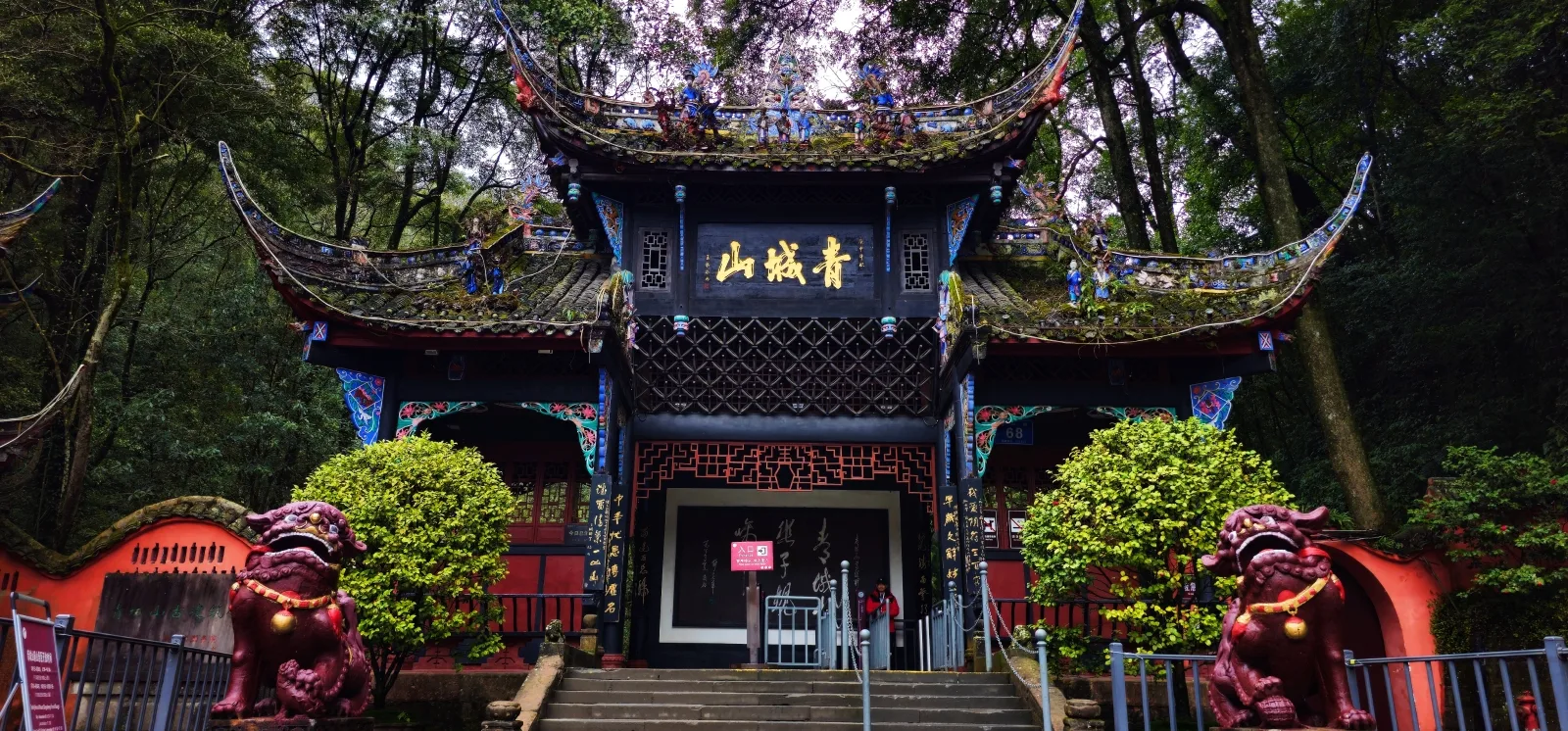
Mount Qingcheng
青城山 · Qīngchéng Shān
Quick answer
Tickets are real-name and timed: book a slot before you travel, choose a passport number as your document, and scan the same passport at the gate. The official booking system sells foreign-visitor tickets under a separate non-mainland document type at the same ¥80. There is a dedicated foreign-visitor service line, 028-96099, and a general tourist line on 028-96526. English signage runs along the main route and at the major temples; the smaller shrines and the inscriptions are Chinese-only, and a translation app earns its keep here more than at any Beijing sight.
Why visit
- 1 Walk a mountain that has been a Taoist centre for 1,800 years — Zhang Daoling is said to have founded the Way of Heaven here in the 2nd century, which makes Qingcheng one of the birthplaces of organised Taoism rather than merely a pretty hill
- 2 Take the cableway up and walk down. The ascent is 90 minutes of stone steps through humid forest; the descent on foot is where the temples, the springs and the quiet actually are
- 3 Reach Laojun Pavilion on the summit ridge for the view over the Chengdu plain — on a clear day the contrast between the green mountain and the grey basin below is the whole point of the climb
- 4 Do it as a day trip with Dujiangyan's 2,200-year-old irrigation works, which share a ticket system, a rail line and a UNESCO listing with the mountain
Essential tips for foreigners
- Book a timed slot before you go. Entry is split into two-hour windows and sold 15 days ahead through the official WeChat accounts. On May Day, National Day or a summer weekend, turning up without a slot can mean being turned away — this is not a walk-up mountain any more.
- Enter at the Front Mountain main gate at 建福宫广场 — it is the only entrance. The old Feixian Temple entrance (飞仙观) is closed. Taxi drivers and maps may still show it, and there is nothing more dispiriting than being dropped at a locked gate with 20 minutes of wasted fare.
- Budget the time honestly: 5.5 to 7 hours. The park's own estimate. Qingcheng is not a viewpoint you dash up — it is a ridge walk with temples strung along it. Arriving after 14:00 means you are descending in the dark on wet stone.
- Take the cableway up, not down. The cableway runs from Yuecheng Lake to Siwang Temple and stops at 17:30 (peak) / 17:00 (winter). Going up saves the least interesting hour; coming down on foot gives you the temples, and your knees will forgive you.
- Pack for rain, not for a view. Qingcheng sits in the wettest part of the Chengdu basin. The trail drains badly and the stone steps are slick. Grippy shoes matter more here than at any other mountain in this guide.
- The ticket does not include transport inside the park. Shuttle bus, lake ferry and cableway are charged separately — about ¥35 on top of the ¥80 if you take all three. Budget ¥115 for the comfortable version and stop being annoyed at the ticket window.
Suggested route
- 08:00 1 hour 30 min Metro Line 2 to Xipu, intercity train to Qingchengshan station (about 30 min). Shuttle bus to the Front Mountain gate at 建福宫广场 — the only entrance
- 09:30 20 min Enter and walk the short stretch to Jianfu Palace. Ten minutes here, because almost everyone skips it and it is a working temple with the mountain's best surviving wooden structure
- 09:50 50 min Follow the main trail up through the forest to Yuecheng Lake. The path is stone steps and it is humid; this is the section that makes people reconsider
- 10:40 15 min Cross Yuecheng Lake by ferry (¥5, two minutes) — the alternative is a 20-minute walk around, and the ferry is worth the ¥5 for the view back up the gorge
- 11:00 10 min Cableway from the lake to Siwang Temple (¥35 one way). Skip it and you add 60-90 minutes of steep stone steps with nothing much to see
- 11:15 1 hour 30 min Upper temples: Shangqing Palace, then the final push to Laojun Pavilion on the ridge. This is the summit and the view over the Chengdu plain
- 12:45 45 min Lunch at one of the temple tea houses — simple noodle and tofu dishes, ¥20-40. The vegetarian kitchens here are part of the experience, not a compromise
- 13:30 2 hours 30 min Walk down rather than riding. The descent passes Tianshi Dong and the springs, and it is the half of the mountain the cableway skips entirely
- 16:00 1 hour 30 min Out of the gate, shuttle to Qingchengshan station, train back to Xipu. If you have energy left, Dujiangyan's irrigation works are 20 minutes away and open until 18:00 in peak season
Mount Qingcheng (青城山) is a forested ridge 60 km north-west of Chengdu, and it carries a claim that most scenic mountains cannot make: this is where organised Taoism began. Zhang Daoling, the 2nd-century founder of the Way of Heaven, is said to have cultivated and taught on these slopes, and the Rock of the Heavenly Master — Tianshi Dong — is still on the walking route. The mountain has been a working pilgrimage site ever since, which is why its temples feel like shrines rather than exhibits.
The name means “Green City”, from the way the ridges fold around each other so completely that the forest closes like a wall. It shares a UNESCO World Heritage listing with Dujiangyan’s irrigation works 10 km away, and the two are usually visited together — same rail line, same ticket platform, same day.
What surprises visitors is the scale of the commitment. This is not a viewpoint. The park’s own estimate for the Front Mountain circuit is five and a half to seven hours, and it is honest.
How long does it take to climb Mount Qingcheng?
Five and a half to seven hours for the standard Front Mountain circuit — that is the park’s own estimate, and it is honest. With the cableway up and the walk down it is four to five hours; cableway both ways, skipping the upper ridge, and it is three to four. The ascent and the descent are each about as long as the other, which is the part visitors get wrong: this is a ridge with temples strung along it, not one summit to reach.
The way to see the time is in segments. The section the cableway removes is 60-90 minutes of steep, humid forest steps with no view, and the section it leaves you is Tianshi Dong, the springs and the smaller shrines — the walk down is the better half of the mountain. Yuecheng Lake takes 15 minutes to cross by ferry at ¥5, against a 20-minute walk around it. The deadline matters more than the estimate: the mountain closes at 17:30 in peak season and 17:00 in winter, and ticket sales stop an hour earlier, so a 5.5-7 hour circuit means starting at 08:00-09:00, not at noon.
Is Mount Qingcheng worth visiting?
Worth it — but for the temples, not for a viewpoint. Qingcheng is one of the birthplaces of organised Taoism: Zhang Daoling, the 2nd-century founder of the Way of Heaven, is said to have cultivated and taught on these slopes, and Tianshi Dong, the Rock of the Heavenly Master, is still on the walking route. The temples are working shrines rather than museum exhibits, and the mountain has been a pilgrimage site continuously for about 1,800 years. That is the difference between this mountain and a viewpoint with a pagoda on top of it.
The practical version of the same answer is that this is a walking day, not a sightseeing stop. The ¥80 Front Mountain ticket covers the trails and the temples; the cableway is ¥35 one way or ¥60 return, the Yuecheng Lake ferry is ¥5, and lunch at a temple tea house on the upper ridge is ¥20-40 per person — about ¥115 for the comfortable version of the day. What you are paying for is a day of walking through the wettest, greenest corner of the Chengdu basin, and the vegetarian kitchens at the end of it are part of the experience rather than a compromise.
How do I get to Qingcheng Mountain from Chengdu?
The rail route is the answer, and it is about 30 minutes longer than you expect: Metro Line 2 to Xipu (犀浦), then the intercity train to Qingchengshan station — 28-30 minutes, about ¥10 in second class, with frequent departures. From the station a shuttle bus reaches the Front Mountain gate in about 10 minutes for ¥20 one way or ¥35 return, and walking from the station to the gate would waste an hour of leg energy you want for the climb.
The alternatives are all slower and cost more: a taxi from central Chengdu is ¥150-200 and 70-90 minutes, while from Dujiangyan city it is ¥40-60 and 20 minutes. Driving takes 70-90 minutes on the Chengdu-Guanxian expressway and there is a large car park at the Comprehensive Parking Area (综合停车场), with a ¥10 half-route shuttle for the last stretch — but weekend and holiday traffic into Dujiangyan is genuinely bad after 09:00, so leave at 07:00 or take the train. One detail to know before you set out: there is only one entrance, the main gate at 建福宫广场. The old Feixian Temple entrance is closed, and being dropped at a locked gate costs you 20 minutes and a fare.
Can I visit Mount Qingcheng and Dujiangyan in one day?
Yes, and it is the standard pairing — they share a UNESCO listing, a rail line and a ticket platform, and the irrigation works are only 20 minutes away. But it works in one specific shape: Dujiangyan’s irrigation works first, in the morning, for 3-4 hours, then Qingcheng’s Front Mountain from midday, and only if you take the cableway up.
The arithmetic is what decides it. Dujiangyan needs 3-4 hours and the works stay open until 18:00 in peak season, so they have to go first; Qingcheng needs 4-5 hours with the cableway, and the mountain closes at 17:30 in peak season and 17:00 in winter, with ticket sales stopping an hour before that. In summer that is a full 7-9 hour day with no slack. In winter it does not fit at all, and trying to do Qingcheng properly in the afternoon means finishing on wet stone steps after dark with the cableway already shut.
The honest answer for anyone who wants both done properly is two days, and the second day has a bonus: the Back Mountain (后山) is a separate ¥20 ticket with its own entrance — a wilder, steeper hike with waterfalls and almost no Taoist architecture — and it is the obvious answer for anyone who has had enough of temples.
What you pay, and what is not included
| Item | Price | Notes |
|---|---|---|
| Front Mountain ticket (前山) | ¥80 | Trails and temples. Students/children ¥40 |
| Back Mountain ticket (后山) | ¥20 | Separate entrance, different hike |
| Shuttle, rail station to gate | ¥20 one way / ¥35 return | 10 minutes |
| Shuttle, car park to gate (half route) | ¥10 | — |
| Yuecheng Lake ferry | ¥5 one way | 2 minutes; saves a 20-min walk |
| Cableway | ¥35 one way / ¥60 return | Lake to Siwang Temple |
| Cableway, child 1.2-1.5m | ¥20 one way / ¥30 return | Under 1.2m free |
The ¥80 is the mountain. Everything that moves you up it costs extra, and the extras are not optional in any practical sense — the cableway saves 60-90 minutes of steep stone steps, and the shuttle from the station saves an hour of road walking. Budget ¥115 for the sensible version.
Free entry: under 6 or under 1.3m, and anyone 65 or over. Visitors aged 60-64 go free on ordinary days and pay half on statutory holidays. Transport is never free.
Hours, and why 14:00 is too late
| Season | Mountain | Ticket sales stop | Cableway |
|---|---|---|---|
| Peak, 1 Apr - 31 Oct | 08:00-17:30 | 17:00 | 08:00-17:30 |
| Off-peak, 1 Nov - 31 Mar | 08:30-17:00 | 16:30 | 09:00-17:00 |
The ticket window closes an hour before the mountain does, and the cableway closes with it. With a 5.5-7 hour circuit, arriving at 14:00 means the maths does not work: you will be on wet stone steps after dark, with the cableway shut.
The park caps daily numbers at roughly 22,000 and suspends entry near 19,800. On Qingming, May Day, National Day and summer weekends that ceiling is reached, and entry without a pre-booked slot is not guaranteed.
Booking, and the one detail foreign visitors get wrong
Entry is real-name and time-slotted: two-hour windows from 08:00 to 17:00, released 15 days ahead through the official WeChat accounts 青城山都江堰 or 悦游都江堰, and also through Ctrip and Meituan.
The detail that costs people their morning: the booking system has a separate ticket type for non-mainland documents. Choose it, book against your passport number, and carry that passport. If you buy the default option the gate scanner will not match, and the queue behind you will not be sympathetic.
There is a foreign-visitor service line on 028-96099 and a general tourist line on 028-96526 — worth saving before you go, because English is thin at the ticket windows.
Check Qingcheng Mountain tour availabilityEnter at the only entrance
The Front Mountain has one gate: the main gate at 建福宫广场. The old Feixian Temple entrance (飞仙观) is closed, and some maps and drivers still list it. Being dropped at a locked gate costs you 20 minutes and a fare.
Metro Line 2 to Xipu, then the intercity train to Qingchengshan station — 28-30 minutes, about ¥10 — then the shuttle to the gate. That is the whole route, and it is faster than driving once weekend traffic into Dujiangyan builds after 09:00.
Up by cableway, down on foot
The single best decision on this mountain is direction. Ride up, walk down.
The cableway climbs from Yuecheng Lake to Siwang Temple and removes the least rewarding hour of the ascent — steep, humid, forest with no view. The descent on foot is the opposite: Tianshi Dong, the springs, the smaller shrines, and the stone flights under moss that are the images people come for.
Along the ridge, Shangqing Palace and then Laojun Pavilion at the top give you the view east over the Chengdu plain — the reason the mountain’s position matters, since on a clear day you can see exactly how abruptly the green hills stop and the grey basin begins.
Weather, which is the real variable
Qingcheng sits in the wettest part of the Chengdu basin. The trails drain badly, the stone is slick, and the mountain is often in cloud when the city is dry below.
That is not a reason to skip it — the mist is half the atmosphere, and the forest is genuinely lush because of the rain — but it is a reason to bring grippy shoes and a shell rather than planning a photography day around a view. October to December and March to May give the best odds of seeing the plain.
Doing it with Dujiangyan
The irrigation works at Dujiangyan, 2,200 years old and still functioning, are 20 minutes away and share the same UNESCO listing. The standard day is Dujiangyan in the morning and Qingcheng from midday with the cableway up — workable, but tight.
Doing both properly takes two days, and the second day also lets you take the Back Mountain if the temples have left you wanting something wilder.
Our 3-day Chengdu itinerary builds the Qingcheng-Dujiangyan day in as the second day, after the pandas, which is the right order — the panda base needs an early start and Qingcheng does not. For the rail booking itself, the 12306 guide for foreigners covers the passport-verification step that trips people up at Xipu.
Find hotels in ChengduAlso nearby
- Chengdu Research Base of Giant Panda Breeding — the reason most people come to Chengdu; go at opening, not at ten.
- Du Fu Thatched Cottage (杜甫草堂) — the Tang poet’s Chengdu residence, and the calmest hour in the city.
- Wuhou Shrine (武侯祠) — Three Kingdoms history next door to Jinli, and worth an hour even for non-enthusiasts.
Best photo spots
-
Laojun Pavilion on the summit ridge, looking east over the Chengdu plain · Late morning, before the basin haze thickens; clearest October to December
The payoff shot: green ridges in front, the grey plain behind, and on a good day the far hills. The pavilion itself is a heavy Qing-style structure and works as a foreground frame. Bring a longer lens — the plain is further away than it looks.
-
Yuecheng Lake, from the ferry crossing · Any time; the light is soft under the canopy
A small emerald lake in a gorge, with the cableway crossing above. Two minutes of ferry, and the only water-level view on the mountain. Shoot wide; the enclosure is the point.
-
The stone stair flights between Jianfu Palace and Yuecheng Lake · Early morning, 08:00-09:30, before the tour groups
Moss-covered steps disappearing into forest — the image people actually want from Qingcheng. It needs the empty version, which means being on the trail before 09:30. Overcast weather is better than sun here; direct light blows out the moss.
-
Tianshi Dong (Rock of the Heavenly Master) · Mid-afternoon on the descent, when the light comes across the cliff face
The most historically loaded spot on the mountain and, because it is on the walking route rather than the cableway route, frequently empty. The cave shrine is small and dark; expose for the interior and let the forest go bright.
Where to eat nearby
-
Temple tea houses on the upper ridge
Simple Taoist vegetarian — noodles, tofu, mountain vegetables, tea · ¥20-40 per person · Along the summit ridge and at Shangqing Palace
-
Qingchengshan Town, at the foot of the mountain
Sichuan farmhouse cooking; the local speciality is 白果炖鸡, chicken stewed with ginkgo nuts · ¥50-120 per person · 5-10 min from the Front Mountain gate
-
Dujiangyan old town
Sichuan, with the river-fish and cold-noodle dishes the town is known for · ¥40-100 per person · 20 min by car or one stop on the intercity line
Frequently asked questions
How much does it cost to visit Mount Qingcheng?
¥80 for the Front Mountain (前山), the Taoist side — students and children ¥40. That covers the trails and temples only. The shuttle bus is ¥20 one way or ¥35 return from Qingchengshan rail station, the Yuecheng Lake ferry is ¥5 one way, and the cableway is ¥35 one way or ¥60 return. Doing the full comfortable route costs about ¥115 in total. The Back Mountain (后山) is a separate ¥20 ticket with a different entrance and a different, more strenuous hike.
What are the opening hours of Mount Qingcheng?
Peak season (1 April to 31 October): 08:00-17:30, with ticket sales stopping at 17:00. Winter (1 November to 31 March): 08:30-17:00, sales stopping at 16:30. The cableway closes earlier than the trails — 17:30 in peak season, 17:00 in winter — so if you plan to ride it, your real deadline is an hour earlier than the gate's.
How do I get to Mount Qingcheng from Chengdu?
Metro Line 2 to Xipu station, then the intercity train from Xipu to Qingchengshan station — about 28-30 minutes and roughly ¥10 in second class, with frequent departures. From Qingchengshan station, the shuttle bus reaches the Front Mountain gate in 10 minutes (¥20 one way, ¥35 return). By road it is 70-90 minutes from central Chengdu, but the Dujiangyan approach jams badly after 09:00 at weekends.
Front Mountain or Back Mountain — which should I choose?
Front Mountain for a first visit. It is the Taoist side, with the temples, the cableway, the lake ferry and the heritage listing — the mountain people mean when they say Qingcheng. The Back Mountain (后山) is a wilder, steeper, cheaper (¥20) hike with waterfalls and far fewer people, and almost no Taoist architecture. If you have one day, Front Mountain; if you are hiking for hiking's sake and have already seen the temples, Back Mountain.
Do I need to book Mount Qingcheng in advance?
Yes, in practice. Entry is real-name and split into two-hour windows, sold up to 15 days ahead through the official WeChat accounts 青城山都江堰 or 悦游都江堰, and also through Ctrip and Meituan. Foreign visitors book under the non-mainland document type and scan the passport at the gate. On public holidays the daily cap is around 22,000 with entry suspended near 19,800 — without a slot you may not get in.
How long does it take to climb Mount Qingcheng?
Five and a half to seven hours for the standard Front Mountain circuit, which is the park's own estimate. With the cableway up and a walk down, four to five hours. Cableway both ways and only the summit ridge, three to four hours. The mistake visitors make is treating it as a two-hour viewpoint — it is a long ridge with temples spread along it, and the descent is as long as the climb.
What is the religious significance of Mount Qingcheng?
It is one of the birthplaces of organised Taoism. Zhang Daoling, the 2nd-century founder of the Way of Heaven (天师道), is said to have cultivated and taught on this mountain, and Tianshi Dong — the Rock of the Heavenly Master — marks the spot. The mountain's name means 'Green City', from the way the forested ridges close around each other like walls. It has been a pilgrimage site continuously since, which is why the temples are working shrines rather than exhibits.
Can I visit Mount Qingcheng and Dujiangyan in one day?
Yes, and it is the standard pairing — they share a UNESCO listing, a rail line and a ticket platform. The usual shape is Dujiangyan's irrigation works in the morning (3-4 hours) and Qingcheng's Front Mountain from midday, which works only if you take the cableway up. Trying to do Qingcheng properly and Dujiangyan on the same day in winter, with a 17:00 close, is not realistic. Two days is the honest answer if you want both done well.

